


Introduction
How do men interact with women in legislatures, and, conversely, how do women interact with men? Do men and women change their speaking behavior depending on whom they address? These questions are critical if we want to deepen our understanding of whether, when, and how the authority of female ministers and Members of Parliament (MPs) is eroded in parliaments. Gendered parliamentary speech is implicated in the construction and maintenance of gender-based hierarchy in parliaments where women are marginalized (Holmes Reference Holmes1995; Kathlene Reference Kathlene1994).
A substantial body of evidence points to gender-based differences in the legislators’ speaking behavior manifested in the volume (that is, participation rates and length), content, style, and vocal pitch (Bäck et al. Reference Bäck, Debus and Müller2014; Bird Reference Bird2005; Dancey Reference Pearson and Dancey2011a, 253–54; De Vet and Devroe Reference De Vet and Devroe2023; Jacob Reference Jacob2014; Osborn and Mendez Reference Osborn and Mendez2010; Pearson and Dancey Reference Pearson and Dancey2011). Scholars have examined conditions that amplify or mitigate these differences. These conditions range from MPs’ characteristics, such as race (Boyd et al. Reference Boyd, Collins and Ringhand2025; Hawkesworth Reference Hawkesworth2003), seniority (Dodeigne et al. Reference Dodeigne, Erzeel and Randour2025), status (Brescoll Reference Brescoll2011), and issue commitments (Dietrich et al. Reference Dietrich, Hayes and O’Brien2019), to contextual factors, including the proportion of female MPs and ministers in parliaments and parliamentary committees (Bäck and Debus Reference Bäck and Debus2019; Ban et al. Reference Ban, Grimmer, Kaslovsky and West2022; Hargrave and Blumenau Reference Hargrave and Blumenau2022), electoral cycles (Poljak Reference Poljak2022), and inter- and within-party dynamics (De Vet and Devroe Reference De Vet and Devroe2023). However, beyond interruptions (Ban et al. Reference Ban, Grimmer, Kaslovsky and West2022; Boyd et al. Reference Boyd, Collins and Ringhand2025; Mattei Reference Mattei1998; Miller and Sutherland Reference Miller and Sutherland2023; Och Reference Och2020), these analyses of gender-differentiated speech have neglected a defining feature of speech itself: its interactive nature.
We examine parliamentary questions: a mechanism used by parliaments for government oversight through eliciting ministers’ answers (Norton Reference Norton, Franklin and Norton1993; Wiberg Reference Wiberg1994). Alongside their primary purpose of holding government to account, parliamentary questions are also used to showcase government policy, score points by exposing government’s incompetence or cultivate connections with voters, and enhance personal reputation and publicity (Kukec Reference Kukec2024; Rozenberg and Martin Reference Rozenberg and Martin2011, 30–31; Wiberg Reference Wiberg1994). In other words, many questions have utility that extends beyond parliament (Norton Reference Norton, Franklin and Norton1993, 176). Their utility is motivated by assertion of power across partisan, ideological, and gender lines and is displayed in question-based interactions (Ilie Reference Ilie2022, 17).
Parliamentary questions are inherently interactive. The question form is a linguistic information-seeking device that always involves an interaction between an asker and an answerer. We analyze interactions involving female and male MPs and ministers in parliamentary question-and-answer sessions, applying feminist conversation analysis. Conversation analysis theorizes communication as a form of social interaction. It conceives of speech as an act of interactional production (Psathas Reference Psathas1995, 67) and directs attention to the systematic examination of speakers’ micro-level interactions, their patterns, and their effects (Heritage and Clayman Reference Heritage and Clayman2011). Interactions can be asymmetric, with some speakers dominating others (Gnisci and Bakeman Reference Gnisci and Bakeman2007). If interactional asymmetry falls along gender lines, it can reveal a dimension of women’s marginalization that was previously overlooked.
We leverage feminist conversation analysis to ‘examine feminist concerns’ (Tennent and Weatherall Reference Tennent, Weatherall, Angouri and Baxter2021, 260), such as feminist institutionalists’ interest in removing barriers to women’s equal participation in parliaments (Acker Reference Acker1990; Krook and Mackay Reference Krook and Mackay2010). Expanding the focus of feminist institutionalist analysis, which has largely been preoccupied with the gendering of institutions through formal and informal rules and procedures (Annesley et al. Reference Annesley, Beckwith and Franceschet2019), we present a discourse-centered account of men’s domination in parliamentary interactions during question time. Consistent with feminist institutionalism (Mackay et al. Reference Mackay, Kenny and Chappell2010, 574), we adopt a feminist standpoint that takes ‘women’s experience as fundamental to knowledge of political relations between women and men’ (Ramazanoglu and Holland Reference Ramazanoglu and Holland2002, 3). As a social category, gender provides ‘a fundamental guide to how [people] are perceived, how their behaviour is interpreted and how they are responded to in every interaction’ (Aries Reference Aries1996, 163–88; Weatherall Reference Weatherall2000, 287). Above all, the gender of the communication partner affects speaking behavior (Hancock and Rubin Reference Hancock and Rubin2015, 50). In line with a feminist conversation-analytic perspective, we contend that female and male MPs will interact differently with female and male ministers, and, conversely, female and male ministers will interact differently with female and male MPs.
To test our argument, we analyze oral parliamentary question-and-answer sequences in the Croatian Parliament, which can be considered a critical case for our empirical analysis. The Croatian Parliament is a type of ‘talking parliament’, where MPs can ask follow-up questions after receiving an answer to their original question, as is the case in the United Kingdom, Canada, Germany, South Africa, Israel, and other countries. Our empirical analysis relies on two new datasets. The first consists of the texts and attributes of all oral parliamentary questions and answers from 2004 to 2020 (7,709 records in total). The second collates the characteristics of 641 MPs and 113 government ministers. Applying statistical modeling and computer-assisted text analysis to question-and-answer sequences, we identify new gendered patterns at the micro-level of parliamentary exchanges between women and men.
We demonstrate that women’s authority in parliaments is undermined through non-cooperation in interactions. Men’s withholding speaking behavior, which manifests as their use of ‘minimal speech’ or shorter interactions with women than men, is a manifestation of male power, salient to interactions (Coates Reference Coates2004; Fishman Reference Fishman1978; Spender Reference Spender1980; Tannen Reference Tannen1993b). Our results show that men address fewer and shorter questions to female ministers than to male ministers, and have shorter interactions with women than with men. Additionally, we find that female MPs adopt male MPs’ pattern of speaking behavior, directing shorter questions to female ministers than to male ministers. Finally, despite receiving shorter questions from both male and female MPs, female ministers respond with longer answers than their male counterparts do. These findings hold across a range of robustness checks and cannot be explained by differences in MPs’ and ministers’ characteristics (such as seniority, experience, their ministerial portfolios, etc.), the topics and policy issues addressed in the questions, feminization of politics (for example, female party leadership, women’s share in the parliament, party or parliamentary group, women’s leadership of ministries, etc.), partisanship, or party ideology.
Our study advances the scholarship on government oversight, which has thus far been limited to identifying patterns in the number of questions asked by women MPs compared to men (Akirav Reference Akirav2020; Jacob Reference Jacob2014; Melhuish and Yong Reference Melhuish and Yong2025; Pearson and Dancey Reference Pearson and Dancey2011a), or the number of questions women ministers receive compared to men (Kroeber et al. Reference Kroeber, Stephan, Dingler and Montero2026). This literature has largely overlooked the interactional dynamics of parliamentary questioning: who asks whom, who responds to whom, and in what manner. We reveal the gender-based interactional asymmetry evidenced in men’s domination in parliamentary question-and-answer exchanges and contribute to a new frontier in research that centers language in explanations of gender and politics (Feldman and Gill Reference Feldman and Gill2019; Pérez and Tavits Reference Pérez and Tavits2019). We study language ‘as a reflection of values and gendered assumptions’ of ministers and MPs about men’s rightful dominance in parliaments (Mattei Reference Mattei1998, 459) that manifest in mixed- and same-sex interactions. Gendered dynamics of parliamentary life may not always take the form of ‘the extremely overt and rigid gender hierarchies’ (Cameron Reference Cameron2005, 490). Subtler gender-based differences may persist. Our results highlight the need to pay attention to the interactive nature of speech, which can show how gendering of parliamentary speaking behavior, and, by extension, of parliaments, occurs at the micro-level of interactions.
Women’s Marginalization in Legislatures: Speaking Behavior and Interactional Asymmetry
Scholars of feminist institutionalism argue that, alongside informal and formal rules and norms, communication and language are also implicated in men’s exercise of control in legislatures (Acker Reference Acker1990; Mackay et al. Reference Mackay, Kenny and Chappell2010, 579–83). They build on the seminal work of Lakoff (Reference Lakoff2004), who argued that language is used to subordinate women. Gender-based inequalities in speaking behavior amplify other forms of women’s marginalization in parliaments, such as their numerical underrepresentation and gender bias that sustain parliaments as masculine institutions (Akirav Reference Akirav2020; Lovenduski Reference Lovenduski1997). ‘Masculine’ denotes men’s advantage and underpins the notion of masculinity as an ideology that ‘assume[s] the properness of men’s advantages and the universal agreement that their view should be shared’ (Duerst-Lahti Reference Duerst-Lahti2002, 374).
Participation in parliamentary speech provides an opportunity for women to increase their visibility, assert their authority, and challenge gendered status hierarchies. However, women’s proportional underrepresentation in parliamentary speech, such as floor speeches, parliamentary questions, and committee contributions, measured by the rate and length of their speeches, indicates women’s continued invisibility in parliaments (Karpowitz et al. Reference Karpowitz, Mendelberg and Shaker2012; Kathlene Reference Kathlene1994; Pearson and Dancey Reference Pearson and Dancey2011a). These gender-differentiated patterns of speaking behavior have been observed without scrutinizing systematically whether men interact differently with women than with men and whether women interact differently with women than with men (for example, Eggers and Spirling Reference Eggers and Spirling2014; Kukec Reference Kukec2024; Proksch and Slapin Reference Proksch and Slapin2011). The existing research thereby overlooks the interactional nature of speech.
In conversation analysis, speech is approached as a type of social action, and interaction as a foundational building block of communication (Goodwin and Heritage Reference Goodwin and Heritage1990). Scholars of conversation analysis further argue that institutions, such as parliaments, are ‘produced, maintained, and transformed through participants’ routine interactions’ (Drew and Heritage Reference Drew and Heritage1992; Kasper and Wagner Reference Kasper and Wagner2014, 191). However, patterns of interaction and their implications remain among the least understood aspects of legislative speaking behavior, with the notable exception of interruptions. Even the literature on interruptions in parliaments, with interruptions being a specific and readily observable form of interaction, has focused primarily on the targets of interruption, who are most often women (Erikson and Josefsson Reference Erikson and Josefsson2019; Miller and Sutherland Reference Miller and Sutherland2023). In contrast, evidence on women as interrupters is limited, either owing to inconclusive findings or a lack of data (Miller and Sutherland Reference Miller and Sutherland2023, 6; Och Reference Och2020, 399; Boyd et al. Reference Boyd, Collins and Ringhand2025, 6, fn. 9).
Our examination of interactional patterns in a national parliament builds on linguistic and discourse-analytic insights into gendered interactions in both private and public settings, including politics (Aries Reference Aries1996; Bogoch Reference Bogoch1997; Feldman and Gill Reference Feldman and Gill2019; Tannen Reference Tannen1993a; Shaw Reference Shaw2000; West Reference West1984). As Walsh (Reference Walsh2001, 2) observes, the private–public dichotomy often ‘mask[s] the many parallels between the two spheres in terms of gender asymmetry’. While interactions are shaped by the context of communication, ‘gendered language transpires only when gender is salient’ (Palomares Reference Palomares2004), as is the case under the conditions of male dominance in parliaments. Consequently, insights from informal and professional domains inform our inquiry into how ‘the masculine voice of authority’ is asserted in parliamentary interactions (Shaw Reference Shaw2020, 8). Drawing on feminist conversation analysis, we argue that women’s authority in parliaments is undermined by interactional asymmetries in exchanges between men and women.
Interactional Asymmetry and the Volume of Questions
Women’s relative invisibility in national parliaments is evident in the fewer oral parliamentary questions they ask compared with men (Jacob Reference Jacob2014; Melhuish and Yong Reference Melhuish and Yong2025; Pearson and Dancey Reference Pearson and Dancey2011a).Footnote 1 If, as we argue, the gendering of parliaments results, at least partially, from interactional asymmetry, then whether a woman asks a parliamentary question will depend on the gender of her target: male or female minister. Consistent with this perspective, the literature on small, mixed-sex group interactions shows that men receive and initiate more interactions than women (Aries Reference Aries1976, 9–10).Footnote 2 Such asymmetries are likely to be amplified in the masculine institutions of parliaments, where domination of speech delivers political capital, such as stature and agenda-setting (Ilie Reference Ilie2010; Wiberg Reference Wiberg1994). Accordingly, in line with existing research from cognate fields, we expect that women MPs will ask fewer parliamentary questions than male MPs; however, once the gender of the interactants is taken into account, this expectation requires qualification.
Female MPs are routinely subjected to aggressive treatment by male colleagues, which happens often without sanction (Erikson and Josefsson Reference Erikson and Josefsson2019; Shaw Reference Shaw2000). This can deter women from addressing questions to men (Rudman et al. Reference Rudman, Moss-Racusin, Phelan and Nauts2012). However, some parliamentary questions are agreed informally within the ruling party or coalition to showcase government policy (Kukec Reference Kukec2024; Otjes and Louwerse Reference Otjes and Louwerse2018). Female MPs may not hold back from posing such ‘showcase’ questions to co-partisan male ministers, especially as this may also enhance an MP’s profile and her relationship with the voters (Martin Reference Martin2011; Saalfeld Reference Saalfeld2011). Consequently, when deciding whom to question, female MPs weigh these oversight and electoral pay-offs against the risks associated with mixed-sex communication noted above. Legislative activity tends to be driven more by partisanship than by in-group solidarity among women (Lawless Reference Lawless2015), and partisanship can divide women even on women’s issues, such as abortion (Dittmar et al. Reference Dittmar, Sanbonmatsu and Carroll2018, 97–118; Shogan Reference Shogan2001). Furthermore, women’s speaking style in same-sex interactions is less adversarial and more civil than in mixed-sex exchanges, including in parliaments (Coates Reference Coates2004, 125–44; Carli Reference Carli1989; Poljak Reference Poljak2022, 575), which could make women MPs more likely to direct questions to women ministers rather than to men. At the same time, work on within-group dynamics in male-dominated institutions identifies a countervailing dynamic. The ‘tug-of-war’ concept indicates some women’s response to identity threat by distancing themselves from other women or withholding support, while a ‘queen bee’ response specifies the effect of women’s status: senior women dissociate themselves from junior women (Derks et al. Reference Derks, van Laar and Ellemers2016; Williams and Dempsey Reference Williams and Dempsey2014). To test these mechanisms that foreground the deterrent effect on women of mixed-sex communication, we propose the following hyp: female MPs, compared with male MPs, will address more questions to female ministers.
Like female MPs, women in the executive are treated differently from their male counterparts (Waddle et al. Reference Waddle, Bull and Böhnke2019, 74). Extensive evidence shows that women in politics are generally stereotyped as less competent than men, regardless of their power and status (Dingler and Kroeber Reference Dingler and Kroeber2023). Following this logic, male MPs may put women ministers under heightened scrutiny, by directing more questions at female ministers than their male counterparts. However, empirical findings testing this logic are mixed: men question women ministers more than men ministers in some countries, for example, in Germany and Denmark, but not in others, such as Belgium (Kroeber et al. Reference Kroeber, Stephan, Dingler and Montero2026). Consequently, we advance an alternative explanation. Gender bias in interaction can also manifest as neglect; women ministers may receive only few or no questions, which can signal a denial of their competence or serve as a mechanism for silencing them by limiting their opportunities to demonstrate competence (Linell et al. Reference Linell, Gustavsson and Juvonen1988, 435–36). Accordingly, we expect that female ministers will receive fewer questions from male MPs than male ministers.
VISIBILITY HYPOTHESIS H1a: Female MPs will ask fewer parliamentary questions than male MPs.
INTERACTION HYPOTHESIS H1b: Female MPs, in comparison to male MPs, will address more questions to female ministers.
INTERACTION HYPOTHESIS H1c: Female ministers, in comparison to male ministers, will receive fewer questions from male MPs.
Interactional Asymmetry and the Length of Questions
Conventionally, scholars of legislatures equate men’s domination and authority with the greater length of their speeches (Bäck and Debus Reference Bäck and Debus2019; Ban et al. Reference Ban, Grimmer, Kaslovsky and West2022; Kathlene Reference Kathlene1994). They thus overlook that a shorter length of a man’s speech in interaction with a woman can also indicate control (Fishman Reference Fishman1978, 402). Linguists have observed men’s domination of women by taciturnity, when men talk less than women in domestic conversational exchanges or even use silence to ‘exercise power over women’ (Tannen Reference Tannen1993b, 177). Similarly, the greater length of talk signals deference for the interlocutor in workplace settings. In courts, lawyers tend to speak longer when addressing male clients compared to female clients, which indicates that men are considered more worthy of engaging than women and more deserving of fuller explanations than women (Bogoch Reference Bogoch1997, 686). In a similar vein, the greater length of a parliamentary question can indicate validation of the authority of the minister to whom the question is addressed.
At the same time, parliamentary questions embody a power hierarchy between the MPs and ministers, which calls for consideration of the intersection of gender and status (Holmes Reference Holmes1995; Walsh Reference Walsh2001). For example, gender, rather than status, more strongly predicts who dominates talk in mixed-sex interactions in occupational settings (Brescoll Reference Brescoll2011; Woods Reference Woods, Coates and Cameron1989). Deference that women show to higher-status men but not to higher-status women reflects women’s tendency to converge to ‘the male linguistic standards’ in high gender-salient hierarchical and masculine settings (Palomares Reference Palomares2004, 564). In contexts where ‘someone’s authority is considered normal’, as is the case with mainstream conceptions of men’s authority in parliaments, all parties to an interaction, including women, may be complicit in its maintenance (Swann Reference Swann, Coates and Cameron1989, 128; Ridgeway Reference Ridgeway2001, 650).
Echoing existing research on men’s domination of parliamentary speech, we expect male MPs’ questions to be longer than those of female MPs. However, once we account for the gender of both the asker and the answerer, the question length, as an indicator of deference to authority, may vary. Specifically, we anticipate that female ministers will receive shorter questions than male ministers from both male MPs and female MPs, reflecting women’s orientation towards dominant masculine communication norms. This expectation is also consistent with work on ‘tug-of-war’ dynamics, which suggests that in male-typed institutions some women distance themselves from other women or face within-group competition, potentially further depressing female–female question length (Williams and Dempsey Reference Williams and Dempsey2014).
VISIBILITY HYPOTHESIS H2a: Male MPs’ questions will be longer than female MPs’ questions.
INTERACTION HYPOTHESIS H2b: Male MPs’ questions addressed to female ministers will be shorter than their questions addressed to male ministers.
INTERACTION HYPOTHESIS H2c: Female MPs’ questions addressed to female ministers will be shorter than their questions addressed to male ministers.
Interactional Asymmetry and the Length of Answers
Like parliamentary questions, parliamentary answers can be used to display power, and, therefore, may be gendered in the context of mixed-sex interaction (Meyerhoff in Holmes Reference Holmes1995, 35–37). They put a spotlight on female ministers’ performance and on the manner in which MPs engage with them (Meyerhoff in Holmes Reference Holmes1995, 35–37). Answering behavior therefore offers another perspective on the interactional dynamics between ministers and MPs, as illustrated by the variation in answering styles of the UK’s female and male prime ministers (Bull and Strawson Reference Bull and Strawson2020).
Parliaments are ‘performance-oriented institutional environments’ (Ilie Reference Ilie, Dirven, Frank and Ilie2001, 235) and pose significant challenges to female politicians. In parliaments, men routinely undermine women as ‘knowers’, displaying distrust in their competence in different ways (Brescoll Reference Brescoll2011; Dingler and Kroeber Reference Dingler and Kroeber2023; Montanaro Reference Montanaro2025). Because of being stereotyped in this way, women may feel pressure to work even harder to demonstrate their competence. For example, in the legal profession, women judges, who are in the minority, write longer and more substantiated opinions than male judges (Moyer et al. Reference Moyer, Szmer, Haire and Christensen2021). In legislatures, women respond to their marginalization by increasing their participation in speech (Pearson and Dancey Reference Pearson and Dancey2011b). Furthermore, for female ministers, higher status can attenuate the fear-of-backlash effect that otherwise reduces women’s volubility in mixed-sex interactions. Because answers can be used by high-status female ministers to enhance their visibility and assert authority, especially when interacting with lower-status male ‘deniers’ of their competence, we expect a pattern of heightened engagement from female ministers: their answers will be longer when responding to male MPs than to female MPs. At the same time, the ‘tug-of-war’ and ‘queen bee’ arguments suggest that in some male-typed contexts senior women may distance themselves from other women, potentially dampening female–female engagement (Derks et al. Reference Derks, van Laar and Ellemers2016; Williams and Dempsey Reference Williams and Dempsey2014). Accordingly, we expect female ministers to give longer answers when responding to male MPs than to female MPs.
Male ministers’ speaking behavior towards both men and women will also be governed by considerations of their claim to authority. Men’s claims to superior competence in parliaments can manifest as validating men with attention while discrediting women with inattention. As Coates (Reference Coates2004, 120–22) argues, men use ‘non-cooperation’ to achieve ‘conversational dominance’ over women in mixed-sex talk by being less responsive to what women say than women are to men. Similarly, in parliaments, women experience less engagement than men, especially when speaking on ‘female topics’ (Ash et al. Reference Ash, Krümmel and Slapin2024). Because disengagement and the ‘minimal response’ as forms of disregard for the interlocutor signal assertion of dominance (Fishman Reference Fishman1978, 402), male ministers’ answers will be shorter when responding to female MPs than to male MPs.
VISIBILITY HYPOTHESIS H3a: Female ministers’ answers to questions will be longer than male ministers’ answers.
INTERACTION HYPOTHESIS H3b: Female ministers will give longer answers to questions asked by male MPs than to questions asked by female MPs.
INTERACTION HYPOTHESIS H3c: Male ministers will give longer answers to questions asked by male MPs than to questions asked by female MPs.
Interactional Asymmetry and the Length of Interactions
In addition to gender-based differences in the length of talk within a single speaking turn, speakers’ willingness to pursue additional turns in an exchange may also be gendered. Commitment to the back-and-forth of a communicative exchange is another indicator of power. For example, men and women differ by the effort they invest to keep the conversations going. Evidence from informal mixed-sex interactions shows that women more often use affiliative and facilitative speech functions, such as agreeing, showing support, and building on topics under discussion, towards both men and women (James and Drakich Reference James, Drakich and Tannen1993, 298–99), which helps prolong conversations. These differences align with women’s preferences for an interaction partner. Women tend to prefer to take part in all-female group discussions (Aries Reference Aries1976), likely because women need to work less hard to engage women than to engage men in interaction (Fishman Reference Fishman1978, 404). Also, in mixed-sex parliamentary settings, men and women prefer to connect with colleagues of the same gender (Jäckle and Metz Reference Jäckle and Metz2019; Metz and Jäckle Reference Metz and Jäckle2016). While this is our primary logic, the literature on ‘tug-of-war’ dynamics cautions that, in some masculine environments, women may react to women competitors by disassociating themselves from them, potentially shortening female–female exchanges (Williams and Dempsey Reference Williams and Dempsey2014). Taken together, these preferences and dynamics may influence the length of interactions. With this in mind, we formulate our last hyp.
INTERACTION HYPOTHESIS H4: Same-sex interactions will be longer than mixed-sex interactions.
The Case of the Croatian Parliament: Generalizability
We study questions and answers in the Croatian Parliament as a typical case of a parliament (Toshkov Reference Toshkov2016, 29), where women face multiple forms of marginalization, including underrepresentation, adversarial discourse, and cultural patriarchy. Although Croatia has a quota system allocating 40 per cent of seats to women (Šinko Reference Šinko2016, 6–7), female MPs and ministers have typically constituted less than one quarter of the chamber and government. Over 2007–20,Footnote 3 Croatia’s share of women MPs rose from 20.9 to 31.1 per cent, with a mid-decade trough around 18–21 per cent (2016–19), while the EU average increased from 23.0 to 32.7 per cent (Eurostat 2025). Croatia thus broadly tracks the EU pattern, slightly below the average for much of the period and converging by 2020, which supports its use as a typical case of women’s underrepresentation.
Societal patriarchal mores about women’s role in society and sexist portrayals of female politicians in the media prevail in Croatia (Dobrotić et al. Reference Dobrotić, Matković and Zrinščak2013; Irvine and Sutlović Reference Irvine, Sutlović, Hassenstab and Ramet2015, 74), as in other contexts, as illustrated by ‘Blair’s babes’ tropes in the UK (Baxter Reference Baxter2018; Mavin et al. Reference Mavin, Bryans and Cunningham2010). Additionally, women in Croatia are sidelined by being placed low on the electoral lists (Šinko Reference Šinko2016, 6–7). At the same time, men are favored as committee chairs and ministers, including in Croatia’s representation in the European Union (EU). Men’s numerical dominance is accompanied with aggressive communication directed at women, and men’s sexist treatment of women is normalized, as in other legislatures worldwide (Bull and Wells Reference Bull and Wells2012; Erikson and Josefsson Reference Erikson and Josefsson2019; Haq Reference Haq2000; Waddle et al. Reference Waddle, Bull and Böhnke2019, 138; Wodak Reference Wodak, Meyerhoff and Holmes2003, 692). Our claim to generalizability rests on the Croatian Parliament as a typical case of women’s marginalization in a democratic state (George and Bennett Reference George and Bennett2005, 32). Furthermore, as an East European case that has received limited scholarly attention, Croatia provides transferable insights that can refine the study of parliamentary interactions in more commonly examined cases in the Global North (Akirav Reference Akirav2020; Bird Reference Bird2005; Ilie Reference Ilie2010; Kathlene Reference Kathlene1994; Rasch Reference Rasch2011), with further implications for legislatures in the Global South. Particularly, the findings have wider implications for parliaments where questions have a similarly interactive format, such as in the United Kingdom, Canada, Germany, Israel, South Africa, and others.
Parliamentary questions often involve ‘political theater’ and attract significant media attention across national contexts (Norton Reference Norton, Franklin and Norton1993). In Croatia, they are broadcast on public television and their clips are widely viewed on other platforms (Al Jazeera Balkans 2023); ministers’ answers are also scrutinized in the press, as in the coverage of an evasive response to questions about a high-profile case of gender-based violence in Croatia (Hedl Reference Hedl2025). Wiberg (Reference Wiberg and Döring1995, 181) points out that ‘questioning is signalling’ to actors both inside and outside parliament. The Croatian case therefore helps assess whether and how parliamentary questions and answers, as opportunities for MPs and ministers to build visibility and authority, are gendered.
Parliamentary Questions in Croatia: Rules and Procedures
Different rules and procedures governing parliamentary questions in different contexts can create incentives and opportunities for MPs to ask questions. In the Croatian Parliament, each parliamentary session begins with the ‘Current Affairs Morning’, during which MPs address questions to ministers. The selection of questions is guided by codified rules of parliamentary procedure (Croatian Parliament 2018). MPs post their oral questions in the Parliamentary Secretariat’s box before the parliamentary session (Croatian Parliament 2018, Article 133). The questions are publicly drawn by the Speaker, who selects forty questions per sitting. Different parliamentary clubs (broadly equivalent to a parliamentary group, which in Croatia may include members of the same party, party coalitions, or independent MPs) are given the opportunity to ask questions at every session, while MPs unaffiliated with any club, such as independents and ethnic minority MPs, can ask questions at every other session (Croatian Parliament 2018, Article 134). Each MP may ask only one question and may follow up the minister’s answer with additional questions.Footnote 4 Parliamentary clubs designate the MPs who ask questions, with allocations proportional to club size. There is no single mechanism for selecting askers; clubs may prioritize seniority, topic expertise, or simple political expediency. These rules centralize access to questioning and should inform how we generalize from the Croatian case. This institutional design contrasts with systems in which any MP may take the floor without restrictions from parliamentary parties, bringing into focus the question whether party co-ordination produces gendered patterns in parliamentary questioning. While further work is needed given the variety of questioning formats across political systems (Wiberg Reference Wiberg1994, 184), existing research finds no gender gap in question asking under party-coordinated versus open-access rules. For instance, evidence from Norway – comparing Question Time (relatively open) with Question Hour (restricted) in this parliament – reports no effect of MP gender on opposition MPs’ oral question counts (Rasch Reference Rasch2011, 388–89).
Data
Our empirical analysis draws on two original datasets. The first contains the full texts and attributes of all oral parliamentary questions and answers from 2004 to 2020. The second compiles detailed biographical and political characteristics of 641 MPs and 113 government ministers. To examine how parliamentary interactions are gendered, while controlling for a wide range of factors including those specific to Croatian parliamentary procedures, we constructed four interrelated working datasets: (1) interaction sequence dataset, which captures the full structure of each parliamentary exchange, including the initial question, ministerial answer, and any follow-up questions across five parliamentary terms (2004–20), (2) a dataset of the first questions in all oral parliamentary question-and-answer sequences, (3) a dataset of the first answers in the same sequences, and (4) a dyadic dataset of MP–minister pairs in each term. During these five parliamentary terms, there were 2,630 sequences of questions and answers.Footnote 5
The first-question and first-answer datasets allow us to examine the length of questions and answers by MPs and ministers, respectively. The dyadic dataset, based on information about all MPs and ministers, enables us to analyze the number and likelihood of questions asked in each MP–minister pair and how these are impacted by a range of characteristics of MPs, ministers, and questions commonly used in legislative studies (Akirav Reference Akirav2020; Bäck and Debus Reference Bäck and Debus2019; Jacob Reference Jacob2014; Rasch Reference Rasch2011). These characteristics include gender, age, education, parliamentary experience,Footnote 6 party ideology, the share of women in a parliamentary party, whether the party is led by a woman, and the number of committee memberships and chair positions held by MPs and ministers (used as proxies for experience and initiative-taking). In addition, we use data on MPs’ ethnicity (majority versus minority),Footnote 7 club membership, whether the MP belongs to the same party as the minister, and whether the MP belongs to the governing coalition. We include the last variable since the MP may not be from the same party as the minister but may still be a member of a governing party.
For the dyadic dataset, we also construct a ‘domain overlap’ measure capturing whether an MP’s committee membership(s) and the minister’s portfolio fall within the same policy domain. Furthermore, for the question and answer datasets, because the topic of a question may influence its length, the minister’s answer, or who poses it, we classify question and answer topics as ‘feminine’ or ‘masculine’ (Bird Reference Bird2005; Jacob Reference Jacob2014). Based on MPs’ committee memberships and the topics of their questions, we also indicate whether a question falls within an MP’s area of specialization. We call this variable ‘Within’. To account for the possibility that some ministers receive more questions simply because their portfolios, such as foreign affairs, economy, or defense, are considered more prestigious, we also include a variable that measures the level of prestige of each portfolio in both datasets. To control for other possible portfolio-specific effects on MPs’ questioning behavior, we also include portfolio fixed effects (Kaltenegger and Ennser-Jedenastik Reference Kaltenegger and Ennser-Jedenastik2022; Kroeber and Hüffelmann Reference Kroeber and Hüffelmann2022; Otjes and Louwerse Reference Otjes and Louwerse2018). In addition, we include cabinet-history indicators capturing whether the portfolio was led by a woman in the previous term and whether the current minister held the same portfolio in the previous term.
Descriptive Statistics
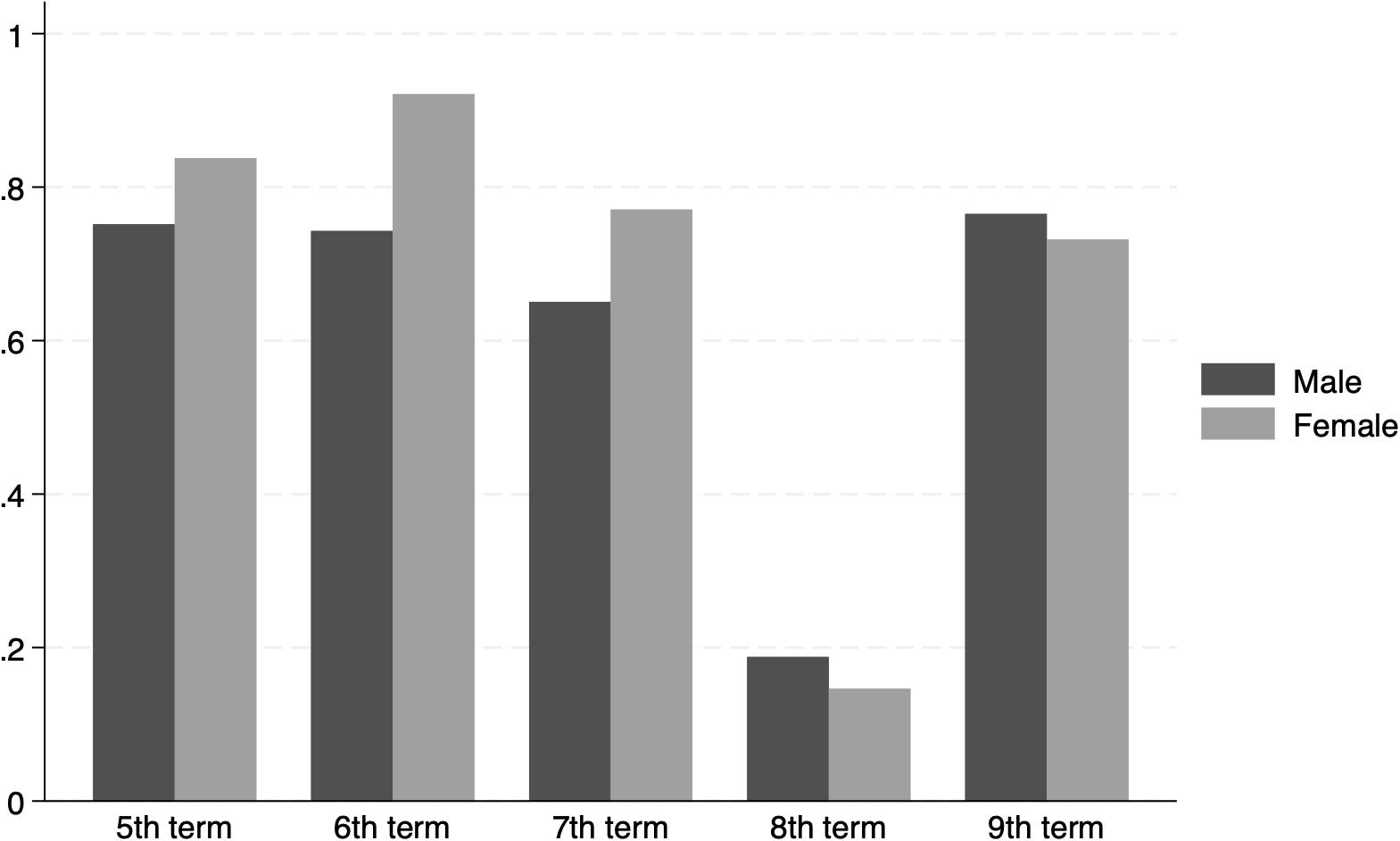
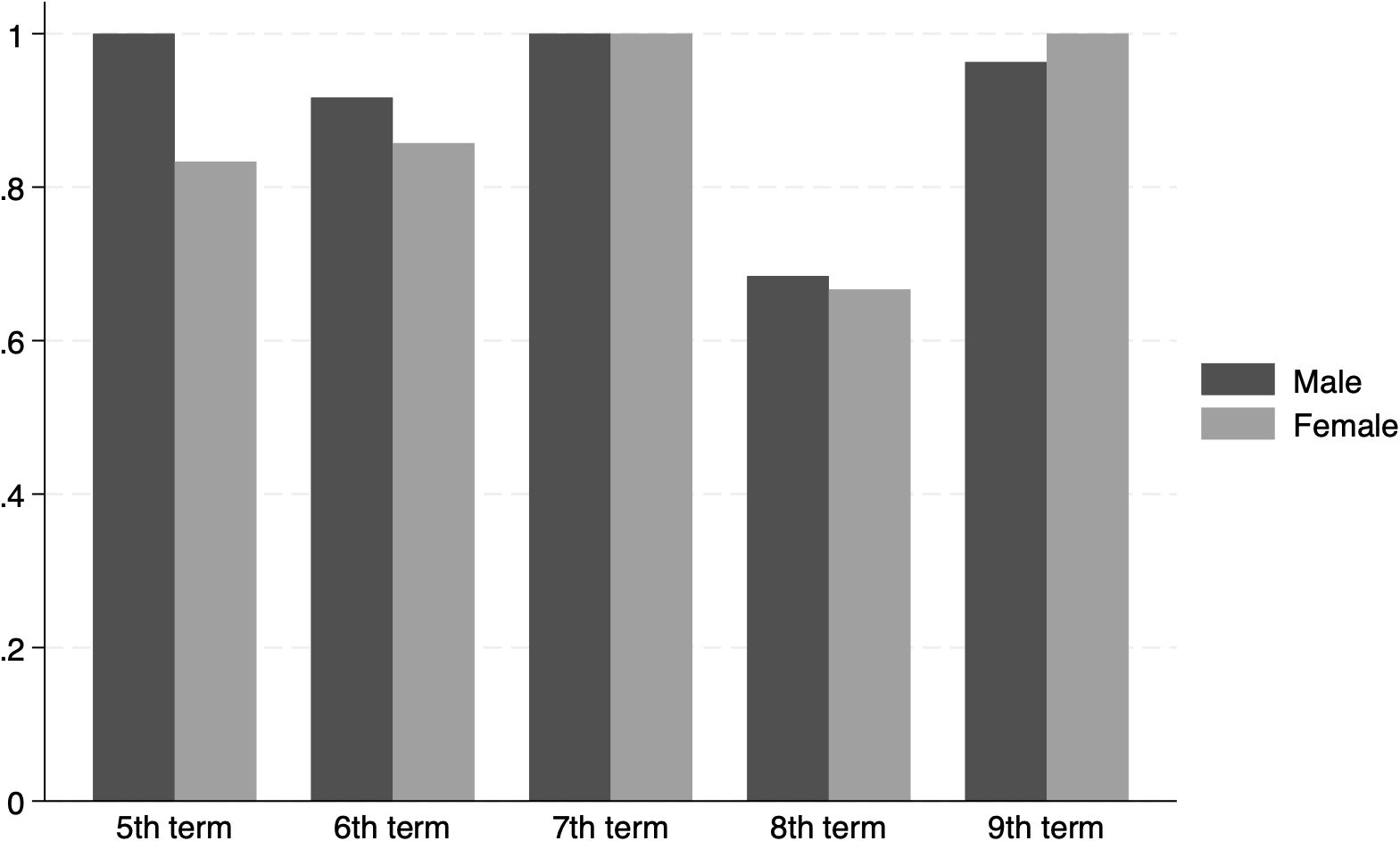
We begin the analysis by presenting descriptive patterns in our dataset, which spans five parliamentary terms from 2004 to 2020. Figure 1 shows the proportion of male and female MPs who posed at least one question during each parliamentary term. Compared to men, a larger proportion of female MPs asked at least one question in the fifth, sixth, and seventh terms. In the eighth and ninth terms, the proportion of male MPs who asked a question slightly exceeds that of female MPs. Figure 2 shows that a great majority of ministers have received at least one question in each term. A greater proportion of male ministers received at least one question compared to female ministers in terms five, six, and eight. In the ninth term, however, a greater share of female ministers received at least one question, and in the seventh term, all female and male ministers answered at least one question. Unlike the rest of the parliamentary terms included in our analysis, the eighth term of the parliament lasted less than a year. Therefore, both the share of MPs and ministers who asked and answered a question, respectively, are significantly lower than in other terms.
Share of MPs who asked at least one question by gender.

Share of ministers who received at least one question by gender.

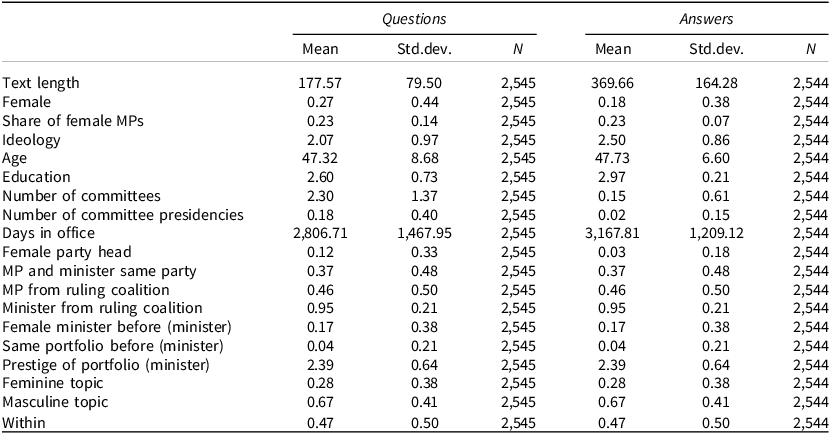
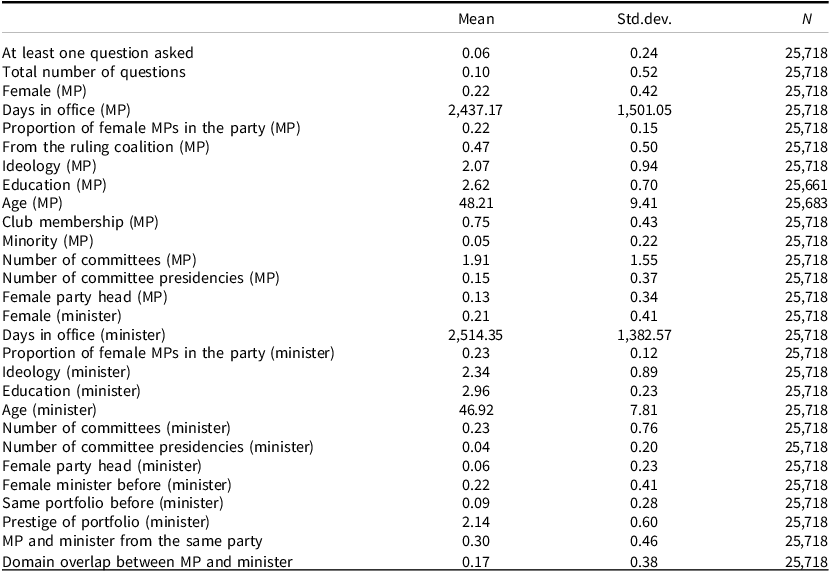
Summary statistics for the question-and-answer datasets are provided in Table 1.Footnote 8 Summary statistics of the dyadic dataset are presented in Table 2. Table 1 shows that answers are approximately twice as long as questions in terms of word count. While female MPs have asked 27 per cent of all questions, female ministers have answered 18 per cent of them. Given that approximately 22 per cent of MPs and about 21 percent of ministers are female (see Figure C1 in the Appendix), it can be observed that female MPs ask more questions, while female ministers answer fewer questions relative to their representation in parliament and the government, respectively. Table 2 shows that at least one question was asked in 6 per cent of all MP–minister dyads.
Summary statistics: Dataset of questions and answers

Table 1. Long description
A table comparing summary statistics of questions and answers by MPs and ministers. The table has 21 rows and 7 columns. Column headers are Mean, Std. dev., N, Mean, Std. dev. N. Each column provides mean, standard deviation, and number of observations for questions and answers. Row 3: Text length, Mean: 177.57, 369.66; Std.dev: 79.50, 164.28; N: 2545, 2544. Row 4: Female, Mean: 0.27, 0.18; Std.dev: 0.44, 0.38; N: 2545, 2544. Row 5: Share of female MPs, Mean: 0.23, 0.23; Std.dev: 0.14, 0.07; N: 2545, 2544. Row 6: Ideology, Mean: 2.07, 2.50; Std.dev: 0.97, 0.86; N: 2545, 2544. Row 7: Age, Mean: 47.32, 47.73; Std.dev: 8.68, 6.60; N: 2545, 2544. Row 8: Education, Mean: 2.60, 2.97; Std.dev: 0.73, 0.21; N: 2545, 2544. Row 9: Number of committees, Mean: 2.30, 0.15; Std.dev: 1.37, 0.61; N: 2545, 2544. Row 10: Number of committee presidencies, Mean: 0.18, 0.02; Std.dev: 0.40, 0.15; N: 2545, 2544. Row 11: Days in office, Mean: 2806.71, 3167.81; Std.dev: 1467.95, 1209.12; N: 2545, 2544. Row 12: Female party head, Mean: 0.12, 0.03; Std.dev: 0.33, 0.18; N: 2545, 2544. Row 13: MP and minister same party, Mean: 0.37, 0.37; Std.dev: 0.48, 0.48; N: 2545, 2544. Row 14: MP from ruling coalition, Mean: 0.46, 0.46; Std.dev: 0.50, 0.50; N: 2545, 2544. Row 15: Minister from ruling coalition, Mean: 0.95, 0.95; Std.dev: 0.21, 0.21; N: 2545, 2544. Row 16: Female minister before (minister), Mean: 0.17, 0.17; Std.dev: 0.38, 0.38; N: 2545, 2544. Row 17: Same portfolio before (minister), Mean: 0.04, 0.04; Std.dev: 0.21, 0.21; N: 2545, 2544. Row 18: Prestige of portfolio (minister), Mean: 2.39, 2.39; Std.dev: 0.64, 0.64; N: 2545, 2544. Row 19: Feminine topic, Mean: 0.28, 0.28; Std.dev: 0.38, 0.38; N: 2545, 2544. Row 20: Masculine topic, Mean: 0.67, 0.67; Std.dev: 0.41, 0.41; N: 2545, 2544. Row 21: Within, Mean: 0.47, 0.47; Std.dev: 0.50, 0.50; N: 2545, 2544.
Note: Female, share of female MPs, ideology, age, education, number of committees, number of committee presidencies, days in office, and female party head refer to MPs in questions dataset and to ministers in answers dataset. Answers dataset has one fewer observation because one question is unanswered.
Summary statistics: Dyadic dataset

Table 2. Long description
The table presents summary statistics for a dyadic dataset, focusing on questions and answers. It includes 29 rows and 4 columns. The columns are labeled Mean, Std.dev., and N. The rows include various attributes such as whether at least one question was asked, total number of questions, gender of MPs and ministers, days in office, proportion of female MPs in the party, ideology, education, age, club membership, minority status, number of committees, number of committee presidencies, female party head, same portfolio before, prestige of portfolio, and domain overlap between MP and minister. Each row provides the mean, standard deviation, and number of observations for each attribute. Notable attributes include the proportion of female MPs and ministers, days in office, and education levels.
Gendering in Parliamentary Interactions: Empirical Evidence
Gendering the volume of questions through interactions
We rely on our dyadic dataset to test hypotheses related to the volume of questions, that is, the number of questions legislators ask as an indicator of visibility (H1a, H1b, and H1c). Our dependent variable is the number of first questions asked in each MP–minister pair in each term. This number is zero for 94 per cent of the MP–minister pairs in our dataset. There are two different reasons for these zero counts. First, some MPs may have had fewer opportunities to ask questions, which leads to systematic zero counts. This can happen because of the rules of parliamentary questions in the Croatian Parliament. According to these rules, MPs who belong to a minority and are not members of a club of MPs can only ask questions at every other session (Croatian Parliament 2018). Additionally, the length of time an MP or minister serves in office also affects MPs’ opportunity to ask questions. Second, some other zero counts occur because some MPs may not have asked questions despite having the opportunity to do so.
A standard negative binomial model would not distinguish between these two different processes for zero counts in our dataset. Therefore, in testing hypotheses 1a, 1b, and 1c, we employ a zero-inflated negative binomial model that explicitly models the zero-generating mechanism separately from the count process. The logit model that predicts the systematic zero observations includes variables that capture whether an MP is a minority, whether an MP is a parliamentary club member, and the number of days the MP and the minister have served in office. The count part of the model includes these variables, along with variables that measure various characteristics of MPs and ministers. Our model with the full set of controls also includes dummies for parliamentary term, for the constituencies of the MP and the minister, and for ministerial portfolios. Finally, since observations from the same MP and the same minister are likely to have correlated error terms, we report two-way clustered standard errors by MP and minister (Cameron et al. Reference Cameron, Gelbach and Miller2011; Gu and Yoo Reference Gu and Yoo2019).
To test Hypotheses 1b and 1c, we add the interaction between the gender of an MP and that of a minister to the model. Our rich set of controls in the count model is designed to ensure that any observed gendered patterns in the question-and-answer behavior of MPs and ministers reflect the effect of gender, rather than alternative factors correlated with both gender and speaking behavior in parliament. Moreover, we account for MPs’ different opportunities to ask questions arising from parliamentary rules by modeling them in the logit (inflation) component of the zero-inflated negative binomial model.
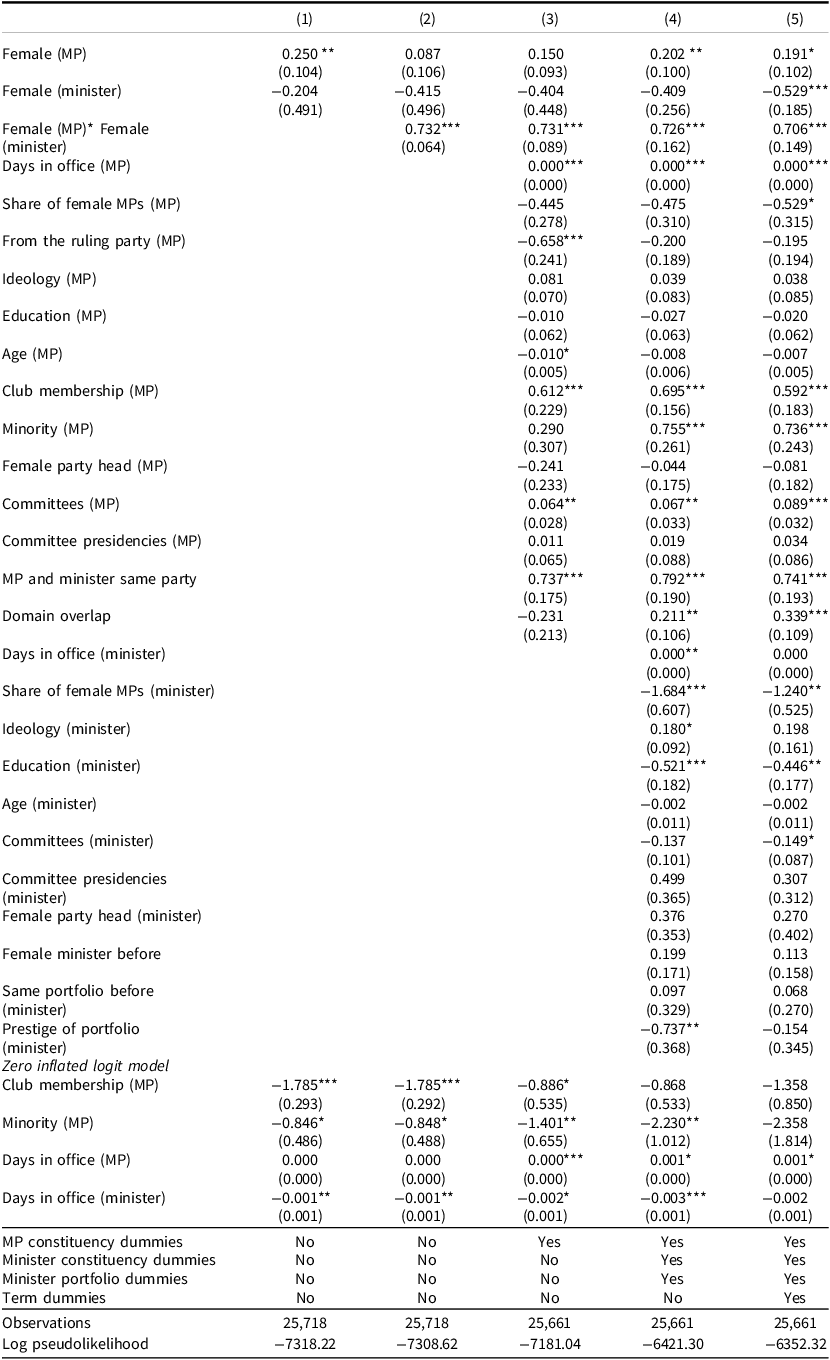
Table 3 presents the results of the zero-inflated negative binomial model. While the first model includes only the gender of an MP and a minister, subsequent models incorporate additional controls for the characteristics of MPs and ministers. Our results indicate that female MPs ask more questions than male MPs, which does not support H1a. These contradict the findings that women ask fewer questions than men, or findings suggesting no difference in female and male MPs’ question-asking activity (Akirav Reference Akirav2020; Rasch Reference Rasch2011). Without considering interactions, this result aligns with research suggesting that women’s underrepresentation in legislatures motivates their greater participation in political debates, increasing their visibility (Pearson and Dancey Reference Pearson and Dancey2011a, 910).
Dependent variable: Number of questions asked in an MP–minister pair (zero-inflated negative binomial model)

Table 3. Long description
A table with five columns and multiple rows, presenting the results of a zero-inflated negative binomial model. The columns are labeled (1), (2), (3), (4), and (5). The rows include variables such as Female (MP), Female (minister), Female (MP) * Female (minister), Days in office (MP), Share of female MPs (MP), From the ruling party (MP), Ideology (MP), Education (MP), Age (MP), Club membership (MP), Minority (MP), Female party head (MP), Committees (MP), Committee presidencies (MP), MP and minister same party, Domain overlap, Days in office (minister), Share of female MPs (minister), Ideology (minister), Education (minister), Age (minister), Committees (minister), Committee presidencies (minister), Female party head (minister), Female minister before, Same portfolio before (minister), Prestige of portfolio (minister). Each row provides coefficients and standard errors for these variables across the five columns. Notable trends include significant positive coefficients for Female (MP) and Female (MP) * Female (minister) in some columns, indicating these factors may influence the number of questions asked.
Note: Two-way clustered standard errors (MP and minister) in parentheses. Signif.: *10% **5% ***1%.
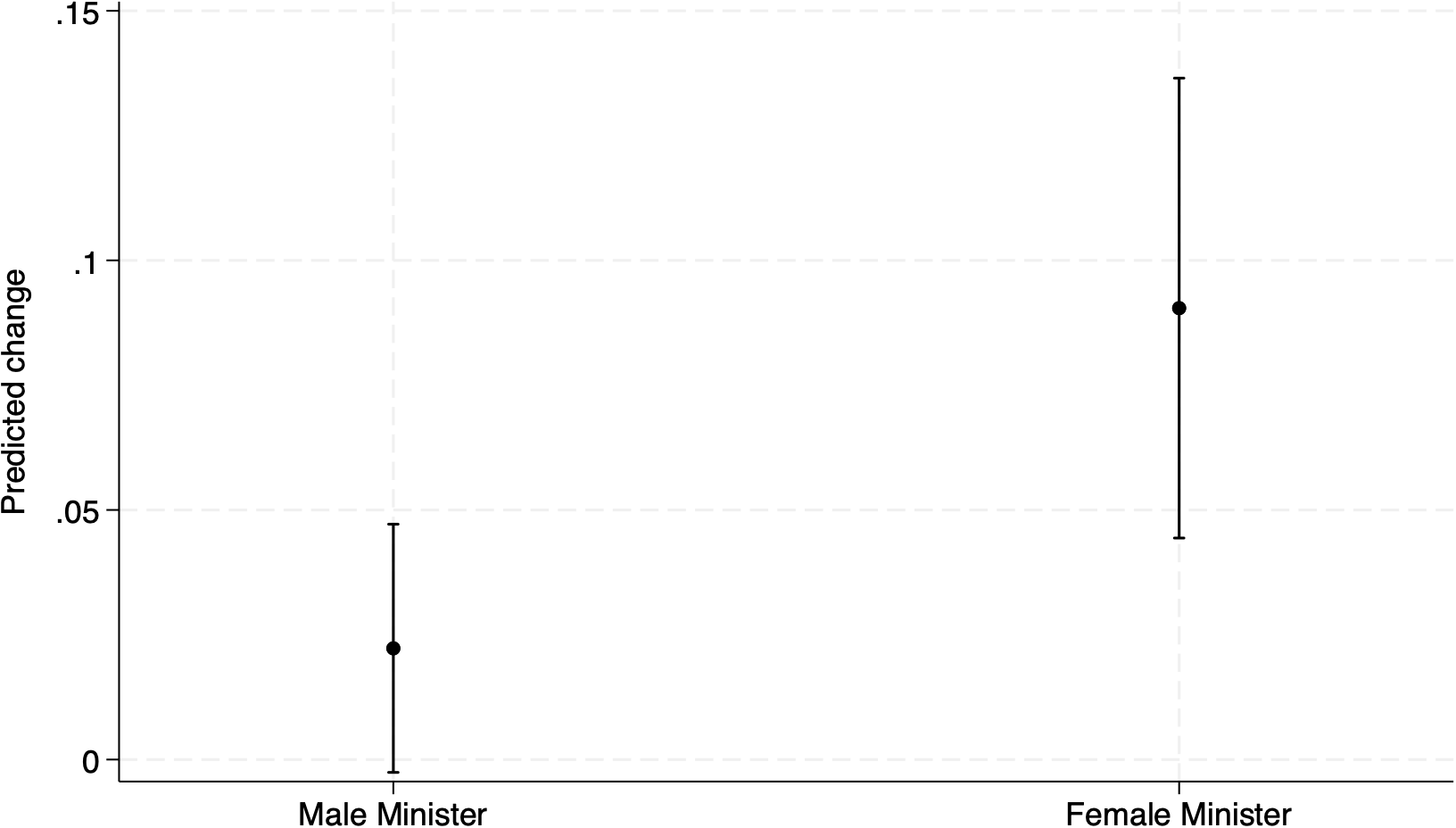
However, in line with our argument, we also need to consider women’s question-asking activity in the context of micro-level interactions in parliament. The coefficient estimate for the interaction term of ‘Female (MP)*Female (minister)’ across all models is positive and statistically significant, which is consistent with H1b. To thoroughly examine whether our results support H1b, we estimate the marginal effects (Brambor et al. Reference Brambor, Clark and Golder2006) of being a female MP on the number of questions addressed to male and female ministers, using the results of Model 5 in Table 3, which includes all our control variables.Footnote 9 Figure 3 plots the estimated difference in the number of questions asked by female and male MPs together with the 95 per cent confidence intervals. Female MPs address more questions than male MPs to female ministers, supporting H1b. The increase in the number of questions asked by female MPs compared to male MPs is approximately 0.09, which is equal to 90 per cent of the average number of questions asked by the MPs in our dataset. Female MPs also address more questions to male ministers, although to a lesser extent. The estimated difference between female and male MPs’ questions to male ministers is approximately 0.02, which is equal to 20 per cent of the average number of questions asked, and the 95 per cent confidence interval barely includes zero. In sum, women MPs ask more questions than male MPs to female ministers. For male ministers, the estimate points in the same direction, but the evidence is weaker.
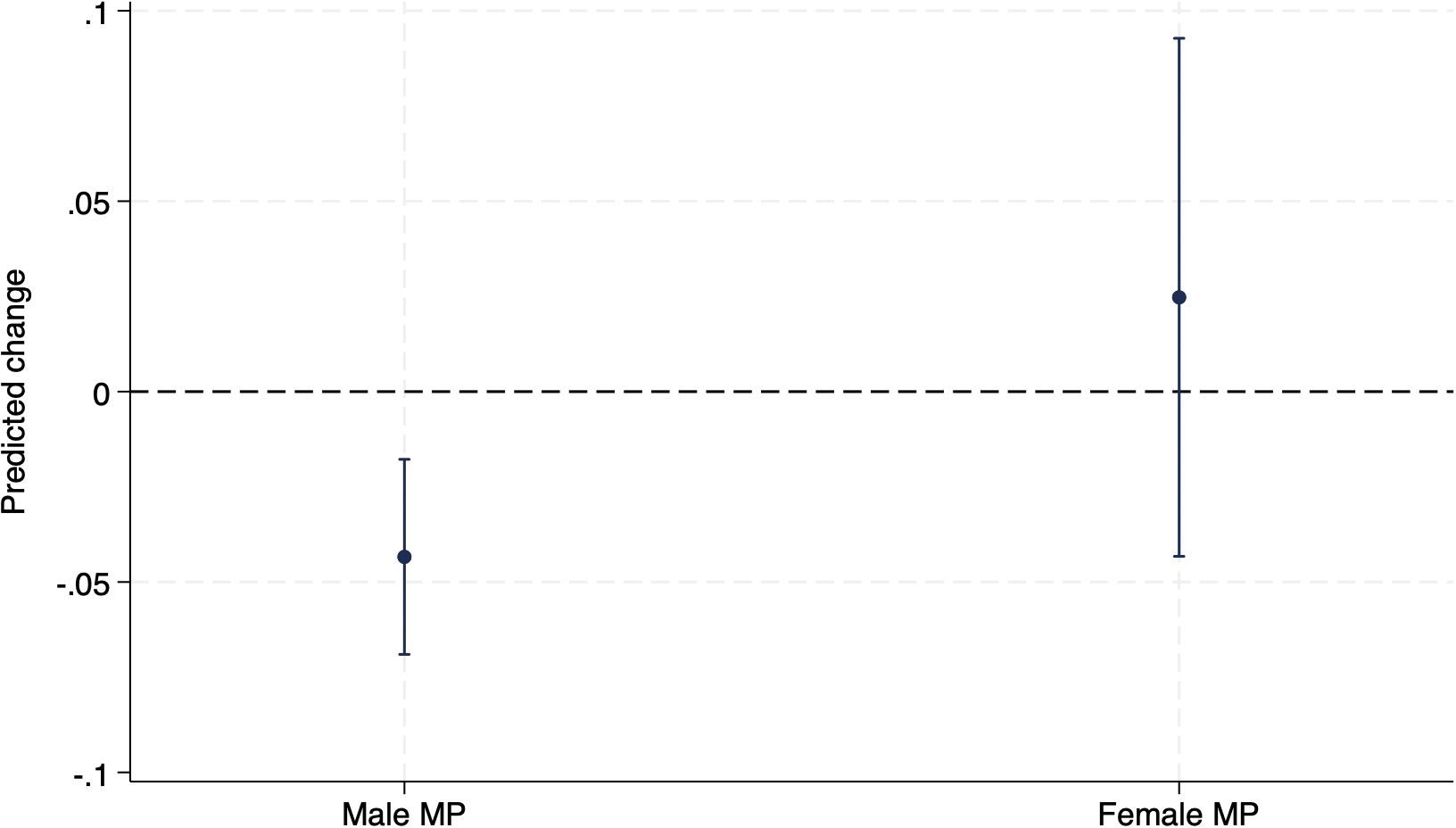
To examine whether our results support H1c, we estimate the marginal effects of being a female minister on the number of questions asked by male and female MPs, again based on the results of Model 5 in Table 3. Figure 4 shows that female ministers, compared to male ministers, receive fewer questions from male MPs, supporting H1c. The estimated difference is approximately 0.04 questions, which corresponds to 40 per cent of the average number of questions, and it is statistically significant. In contrast, there is no statistically significant difference in the number of questions addressed by female MPs to female and male ministers, as the confidence interval of the estimate includes zero. The observed result – fewer questions by male MPs directed towards female ministers compared to male ministers – is based on a regression that controls for various characteristics of the ministers, including their age, education, days in office, number of committee memberships and committee presidencies, prestige of the portfolio, whether the ministry was held by a woman previously, whether the MP and the minister are from the same party,Footnote 10 and dummies for ministerial portfolios. Therefore, this gendered behavior of male MPs towards female ministers cannot be attributed to the differences in experience, competence, seniority, partisanship, or the importance, prestige, and history of the ministerial portfolio of female ministers. Moreover, we do not observe a similar effect when we look at the behavior of female MPs towards female ministers.
Change in the number of questions asked by a female vs male MP.
Note: The figure plots the estimated difference in the number of questions asked by female and male MPs, together with its 95% confidence interval, separately for male and female ministers, using the results of Model 5 in Table 3.

Change in the number of questions asked to a female vs male minister.
Note: The figure plots the estimated difference in the number of questions asked to female and male ministers, together with its 95% confidence interval, separately for male and female MPs, using the results of Model 5 in Table 3.

We also examine whether MP and minister gender are similarly associated with the likelihood that an MP asks at least one question. Our results, which we present in Table D3 in the Appendix, closely resemble those obtained in the previous analysis. Compared with male MPs, female MPs are more likely to ask at least one question to both male and female ministers (Figure D6), whereas male MPs are less likely to ask at least one question to female than to male ministers (Figure D7).
Gender, question length, and interactions
To test our hypotheses related to the length of questions (H2a, H2b, and H2c), we use our first-questions dataset. Our dependent variable is the text length of each question, measured in words. The explanatory variables are the gender of the MP, the gender of the minister, and their interaction.Footnote 11 The full model includes variables for the characteristics of MPs and ministers, the topics of the questions, term dummies, dummies for the constituency of the MP and the minister, and dummies for the ministers’ portfolios.
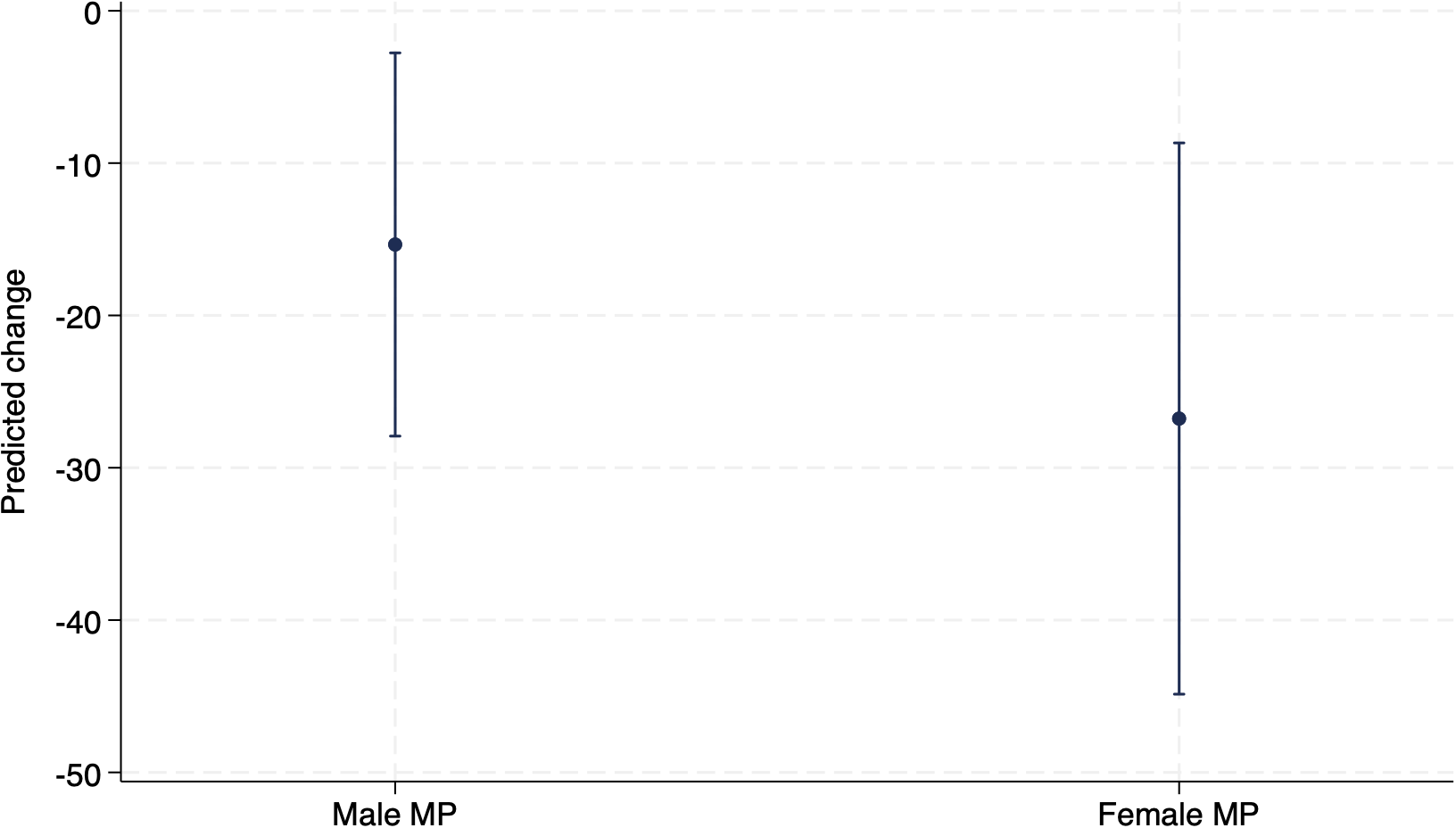
We find some evidence in support of H2a: female MPs ask shorter questions. Results are presented in Models 1–4 in Table E4 in the Appendix. The effect is estimated to be negative across all models but it is significant only in models which do not control for MP and minister characteristics. This finding aligns with other studies indicating that women’s parliamentary speeches tend to be shorter (Bäck et al. Reference Bäck, Debus and Müller2014; Kathlene Reference Kathlene1994). To account for mixed-sex interaction and to examine whether our results support H2b and H2c, we estimate Models 5 and 6 (Table E4), which include the interaction term between the gender of the MP and the gender of the minister. In addition, Model 6 employs dummy variables for the eighty-seven identified topics among these parliamentary questions. Using the Model 6 estimates, Figure 5 plots the marginal effect of minister gender (female versus male) on question length, separately for male and female MPs.Footnote 12
Change in question length directed to female vs male ministers.
Note: The figure plots the predicted differences in the word length of the questions addressed to female and male ministers, together with its 95% confidence interval, separately for male and female MPs, based on the results of Model 6 in Table E4 in the Appendix.

Figure 5 illustrates evidence in support of H2b: male MPs address shorter questions to female ministers, compared to their questions to male ministers. The difference is approximately fifteen words, which constitutes about 9 per cent of the average question length in the dataset. It should be noted that female MPs also ask shorter questions to female ministers compared to the length of their questions to male ministers, which supports H2c. The difference is approximately twenty-seven words, which is about 15 per cent of the average question length. These results cannot be explained by differences in age, education, experience, and ministerial portfolios between male and female ministers, or whether the ministry has been held by a woman previously, or the topics of questions addressed to female ministers compared to male ministers, since our analysis controls for all these factors. Thus, our results indicate gendered behavior by both male and female MPs affecting their interactions with female as compared to male ministers.
Gender, answer length, and interactions
To test for our hypotheses concerning the length of answers (H3a, H3b, and H3c), we use our first-answers dataset. Our dependent variable is the text length of each answer, measured in words. The explanatory variables are the same as in the previous analysis of the question length (Table E5 in the Appendix). Models 1–4 address H3a, which suggests that female ministers’ answers to questions will be longer than male ministers’ answers. In all four models, the estimated coefficient for ‘Female (minister)’ is positive and statistically significant, supporting H3a. Examining the coefficient estimates from Model 4, we observe that the answers by female ministers are estimated to be approximately eighty-four words longer than those of male ministers. This difference amounts to more than 20 per cent of the average answer length in our dataset.
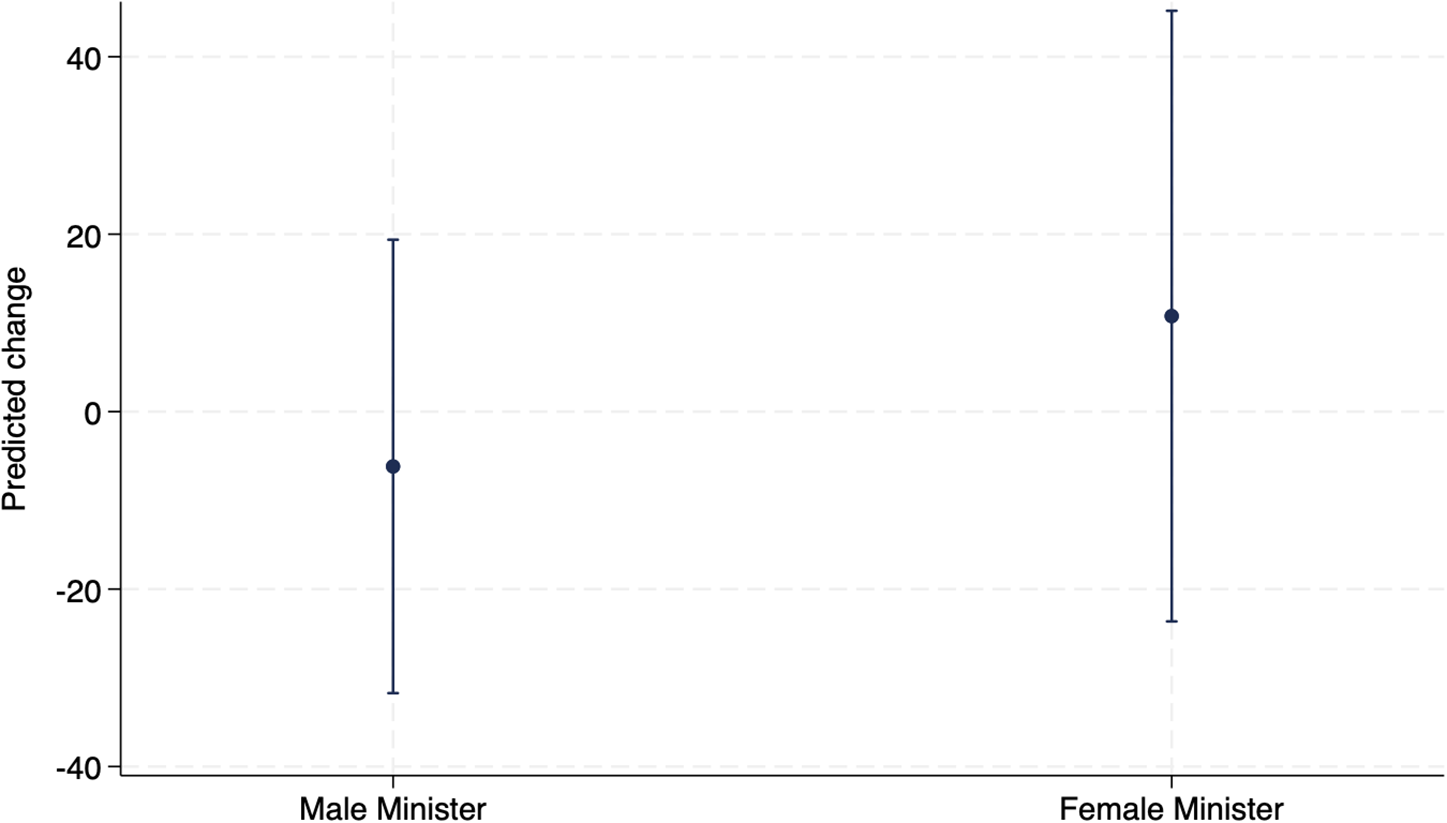
To account for the gender of the interactants and to assess whether our results support H3b and H3c, we estimate the coefficients for Models 5 and 6. Figure 6 shows the marginal effect of asker gender (female versus male) on answer length, by minister gender, using estimates from Model 6 (Table E5, Appendix).Footnote 13 As Figure 6 shows, female ministers’ answer length does not vary by asker gender. The same is true for the answers of male ministers. In both cases, the confidence interval includes zero. These results, therefore, do not support H3b and H3c, which highlight the intersection of status and gender manifested in answer length; ministers of both genders do not vary answer length depending on the asker’s gender, that is, higher status does not influence gender-differentiated answer.
Change in answer length to questions asked by female vs male MPs.
Note: The figure plots the predicted differences in the word length of the answers given to questions from female and male MPs, together with its 95% confidence interval, separately for male and female ministers, using the results from Model 6 in Table E5 in the Appendix.

Gendering interaction length
Finally, to test our H4, we also examine whether interactions between MPs and ministers of the same gender are longer than mixed-gender interactions. We use the same independent variables as before, except that we replace the three variables related to the gender of the MP, minister, and their interaction with a single variable that measures whether the interaction is between an MP and a minister of the same gender. Across all five models (Table E6 in the Appendix), the relationship between ‘Same Gender (MP–minister)’ and interaction length is positive and statistically significant in three of them.Footnote 14 These results provide support for H4, indicating that same-sex interactions are longer than mixed-sex interactions, holding other variables constant. This result is consistent with existing findings that same-gender connections matter in parliamentary settings (Jäckle and Metz Reference Jäckle and Metz2019, 109).
Discussion
By analyzing question-and-answer sequences and taking into account the gender of askers and answerers, we identify interactional patterns that marginalize female ministers in the Croatian Parliament. Marginalization operates through non-cooperation: male MPs direct fewer and shorter questions to female ministers, and female MPs also pose shorter questions to female ministers than to male ministers, thereby also displaying a lack of deference to women’s authority. We read such withholding as a form of power salient to interactions that further reduces women’s visibility and standing, while we also consider alternative explanations for these patterns alongside this interpretation. Our results remain robust after controlling for seniority; portfolio attributes (including prestige and gendered classification); MPs’ and ministers’ experience; topic and issue mix; and party-political factors such as female-led parties, women’s share in the party, coalition status, prior female portfolio holders, co-partisanship, leadership roles, and ideology.
An alternative explanation nevertheless deserves consideration: men may consciously or unconsciously temper scrutiny of women to avoid appearing aggressive, yielding fewer and shorter questions to female ministers. To situate this possibility – which our design cannot rule out – we note that sexism towards female politicians is publicly documented and widely reported in the Croatian media. More specifically, male MPs and ministers in Croatia have routinely dismissed female MPs and ministers as incompetent and undeserving of their positions. Press reports, for instance, record a male deputy speaker telling a female MP that she was ‘as decent as a pole dancer’, and a male MP telling a female deputy prime minister that she should ‘give birth to more children and talk less’ (Jutarnji list 2011; Sintić Reference Sintić2023). These episodes illustrate a broader pattern in which women’s visible political competence provokes demeaning responses (Ljubičić Reference Ljubičić2021). During Kolinda Grabar-Kitarović’s presidency (2015–20), her performance was frequently linked to her appearance. She described such evaluation as ‘an almost unbearable sexism’ (Večernji list 2019).
Although descriptive rather than systematic, additional evidence from our dataset is also consistent with our interpretation of our results as domination through non-cooperation: some male MPs, whose sexist treatment of women has been publicly reported in the media, ask fewer questions to a female minister than to her male predecessor holding the same portfolio during the same parliamentary term. For example, an MP, infamous for comparing a former female prime minister to a ‘runner-up in a beauty pageant’ (Novi list 2011), addressed two questions to a male finance minister but did not address a single question to his female successor within the same parliamentary term. Taken together, these observations weaken the view that men refrain from questioning female ministers merely to avoid seeming aggressive.
Conclusion
Legislative speech is a powerful instrument for constructing and sustaining male dominance in parliaments. This dominance is manifested through verbosity – whether in the form of longer speeches or frequent interruptions of female colleagues – and has been widely documented for its role in undermining women’s authority and reinforcing masculine communication norms (Erikson and Josefsson Reference Erikson and Josefsson2019; Shaw Reference Shaw2000, 416). However, the interactive dimension of these gendered speech patterns has been underexplored. Crucially, all business of parliament is conducted through interactions, and these interactional practices carry broader institutional consequences (Atkinson and Drew Reference Atkinson and Drew1979; Heritage and Clayman Reference Heritage and Clayman2011, 19). The role of parliamentary questions is significant beyond their function as a mechanism of government oversight. As an occasion when the entire parliament meets collectively on a regular basis, the parliamentary question time uniquely contributes to ‘the long-term socialisation and learning process within the parliament’ (Rozenberg and Martin Reference Rozenberg and Martin2011, 397). Building on this interactional premise, we apply feminist conversation analysis, which foregrounds speakers’ exchanges, to reveal gender-based asymmetries in question-and-answer sequences that disadvantage women and contribute to the reproduction of parliaments as masculine institutions.
Drawing on insights from linguistics and discourse studies, particularly the long-standing analysis of talk in mixed-sex and same-sex dyads across private and public domains, we find that women in parliament are marginalized through non-cooperation. In the Croatian Parliament, this appears as men posing fewer and shorter questions to women. As Spender (Reference Spender1980, 128) notes, co-operation in conversation involves ‘being a willing talker’. Reduced engagement is therefore a signal of non-cooperation. These insights challenge prevailing explanations in legislative studies that equate male power solely with the greater volume of their speeches. Linguists urge caution in interpreting language phenomena (Aries Reference Aries1996, 125–26): a man’s lesser volume of talk does not necessarily signal the absence of dominance. On the contrary, a man’s refusal to engage with a woman, as opposed to a man, in an interaction, such as a parliamentary question-and-answer sequence, signals ‘his power to choose whether or not to participate in talk’ (Coates Reference Coates2004, 124) and to impose terms on which he will participate (Fishman Reference Fishman1978, 404). In parliaments, such non-cooperation and non-engagement generate interactional asymmetry that subjects women, both female MPs and female ministers, to epistemic marginalization (Dalmiya and Alcoff Reference Dalmiya, Alcoff, Alcoff and Potter2013; Fricker Reference Fricker2007), manifested as denial of their competence and authority. Furthermore, the gendered nature of mixed-sex interactions impacts the quality of government oversight. Assertion of masculine control through non-cooperation leads to weaker scrutiny of women-run government portfolios.
Female ministers nonetheless assert their authority on the parliamentary floor when performing their ministerial duties and responding to questions. This suggests that women’s institutional status can partly offset gender-based disadvantages in mixed-sex exchanges with lower-status men. Women leverage their executive roles as an ‘interactional resource’ (Swann Reference Swann, Coates and Cameron1989, 139) to challenge men’s domination of speech that renders them invisible. However, female MPs may simultaneously contribute to the reproduction of gendered hierarchies. By posing shorter questions to female ministers than to male counterparts, they join men in signaling a lack of deference to women’s authority. These dynamics invert the ‘queen bee’ phenomenon, in which powerful women in male-dominated settings adopt masculine norms and distance themselves from junior women (Derks et al. Reference Derks, van Laar and Ellemers2016). They also provide additional evidence for a broader ‘tug-of-war’ phenomenon, in which within-group conflict is sparked by scarcity and stereotype pressure (Williams and Dempsey Reference Williams and Dempsey2014). Existing research on cabinet formation reinforces this point: female prime ministers do not appoint more women to cabinet posts than male leaders (O’Brien et al. Reference O’Brien, Mendez, Peterson and Shin2015). Our findings show that junior women can also undermine the authority of senior women with whom they interact. It is an outcome that might be understood through partisan logic. Yet when junior women withhold deference from senior co-partisan women, they not only reinforce masculine norms that disadvantage all women but also act against their own party’s interests. This paradox points to a tangible route towards greater gender equality in the exercise of parliamentary oversight: women can initiate incremental progress by extending the same deference to women’s authority as to men’s, especially among co-partisan MPs and ministers.
From the perspective of feminist institutionalists’ commitment to advancing gender equality in parliaments, interactional asymmetry highlights a risk of a self-fulfilling prophecy. Stereotypical assumptions about women’s lesser competence can lead to their differential treatment in interactions, which in turn undermines women’s effectiveness (Aries Reference Aries1996, 188). However, women in parliament are not a monolithic group (Dittmar Reference Dittmar2020). Women involved in politics navigate their other intersecting identities, such as those associated with race, ethnicity, religion, and sexuality, alongside political divisions and status differences (Hawkesworth Reference Hawkesworth2003; Paxton et al. Reference Paxton, Kunovich and Hughes2007, 276; Taylor-Robinson Reference Taylor-Robinson, Shane Martin and Strøm2014). The evidence on women’s collaboration in legislatures is growing yet contradictory. This makes it essential to examine the underexplored interactive dimension of speaking behavior to understand when and how senior and junior women amplify one another’s voices in parliamentary settings (Blumenau Reference Blumenau2021; Lawless Reference Lawless2015; O’Brien et al. Reference O’Brien, Mendez, Peterson and Shin2015). Our analyses contribute to this endeavor. Drawing on rich datasets spanning multiple parliamentary terms and a variety of model specifications and robustness checks, we document these dynamics using observational evidence. As such, we cannot unambiguously establish a causal relationship between gender and speaking behavior, although extensive controls and supplementary tests lend credibility to our inferences. Future work using alternative research designs could further clarify the links between gender and speaking behavior in parliaments as well as the broader implications of interactions both among women and between women and men.
Supplementary material
The supplementary material for this article can be found at https://doi.org/10.1017/S000712342610177X.
Data availability statement
Replication data for this paper can be found at https://doi.org/10.7910/DVN/IDUNC5.
Acknowledgements
We gratefully acknowledge feedback and comments from attendees of annual conferences and meetings organized by the 2024 European Consortium for Political Research (ECPR), specifically its Standing Group on Gender and Politics, the 2023 European Political Science Association (EPSA), the 2022 Croatian Political Studies Association (CPSA) and the 2022 COMPTEXT association. We also thank the three reviewers and the editors for their useful queries and suggestions.
Financial support
This study is part of the research project ‘Justice Interactions and Peacebuilding: From Static to Dynamic Discourses across National, Ethnic, Gender and Age Groups’ (JUSTINT), which was funded by the European Research Council (ERC) Consolidator Grant [no. 772354] awarded to Denisa Kostovicova and based at the European Institute, London School of Economics and Political Science. The ERC funding is gratefully acknowledged.
Competing interests
The authors declare none.
Ethical standards
The research meets all ethical guidelines. The permission for the study was granted by the London School of Economics and Political Science Research Ethics Committee [ref. 000630].


 Open access

