Introduction
For well over a century, archaeologists have recognised the existence of pseudo stone tools—lithic material, altered by human or natural processes, to resemble, coincidentally, archaeological artefacts (Boule Reference Boule1905; Bennett Reference Bennett1906). In the nineteenth century, for example, Sellers (Reference Sellers1885) observed that stones fractured by the passage of wooden wagon tyres might be mistaken for anthropogenic artefacts. Later, Barnes (Reference Barnes1939) recognised that natural factors might cause stones to fracture in ways that resemble knapped artefacts, providing illustrations of flaked stones produced by his solifluction experiments. Despite arguments that the effect of natural processes on flake and pseudo-tool formation is negligible (Patterson Reference Patterson1983), many authors have subsequently noted that various natural processes, including temperature fluctuations, rockfalls and glaciation can cause lithic fracture (e.g. Crabtree Reference Crabtree1982; Schnurrenberger & Bryan Reference Schnurrenberger, Bryan, Plew, Woods and Pavesic1985), yet we are aware of only a single systematic attempt to characterise and differentiate natural flake features from knapped artefacts (Gillespie et al. Reference Gillespie, Tapakka and Cluney2004). The extent to which the action of heavy-duty, industrial earth-moving machinery might produce flakes and other material indistinguishable from knapping waste has never been assessed.
This article examines the effects of heavy-duty, earth-moving machinery on lithic material at open-air Stone Age/Palaeolithic sites. Industrial development activity in archaeologically sensitive landscapes is an increasingly common occurrence in many parts of the world. To the best of our knowledge, however, no studies have considered the long-term consequences of these activities on scatters of archaeological material and, particularly, how such activities might contribute to the production of pseudo-artefacts. Here we present the results of a technological study of lithic debitage created through machine activity during construction of a solar power facility, in a sensitive Stone Age cultural landscape in South Africa. The experiment produced many debitage categories superficially indistinguishable from knapping waste, as well as perfectly formed flakes with dorsal ridges, reminiscent of un-retouched bladelets. Lithic technological analyses rely heavily on descriptions of cores, flakes and unmodified debitage produced during knapping (see Andrefsky Reference Andrefsky and Andrefsky2001, Reference Andrefsky2005). In particular, debitage variability is an important consideration for understanding the technological processes that led to its production, and, by extension, the cognitive abilities of its makers (Sullivan & Rozen Reference Sullivan and Rozen1985; Andrefsky Reference Andrefsky and Andrefsky2001; Odell Reference Odell2003). Debitage produced via mechanical means may, however, be mistaken for knapping waste, particularly where this occurs in areas that are already rich with archaeological stone artefacts. Based on our results, we present criteria to assist archaeologists to distinguish between archaeological material and debitage created by machine action.
Background
Lithic debitage refers to detached pieces of stone (often flakes) discarded during the reduction process of stone-tool manufacture, and constitutes the most abundant category of archaeological material at most early prehistoric sites (Andrefsky Reference Andrefsky and Andrefsky2001). Lithic reduction strategies may be relatively simple and geared towards expedient use in a wide range of tasks (Hayden et al. Reference Hayden, Franco, Spafford and Odell1996; Johnson Reference Johnson and Odell1996; Bousman Reference Bousman2005). Different attributes, such as platform morphology, may yield information pertaining to matters as diverse as hammer hardness and reduction strategy (Cotterell & Kamminga Reference Cotterell, Kamminga and Hayden1979, Reference Cotterell and Kamminga1987; Parry & Kelly Reference Parry, Kelly, Johnson and Morrow1987; Andrefsky Reference Andrefsky2005). Flakes can detach in several ways, not all of which exhibit characteristic knapping features such as bulbs of percussion (Lawn & Marshall Reference Lawn, Marshall and Hayden1979; Cotterell & Kamminga Reference Cotterell and Kamminga1987). Ultimately, relating debitage to a production stage or specific technology must rely on the general characteristics of an overall assemblage (Johnson Reference Johnson and Andrefsky2001). Archaeological impact assessments and surveys of Stone Age/Palaeolithic sites often rely on lithic debitage densities for site identification and evaluation (Pecora Reference Pecora and Andrefsky2001), an approach intended to mitigate the noise created through a variety of incidental damage (Hayden Reference Hayden1979; Odell Reference Odell2003: 118–32).
Trampling is the most well documented of these varied causes of incidental damage. Edge-damage resulting from trampling by humans or animals on flakes or other flat, angular stones, may be mistaken for retouch or use-wear (Odell Reference Odell2003; Pargeter Reference Pargeter2011; Pargeter & Bradfield Reference Pargeter and Bradfield2012). Other forms of incidental damage, such as roof-collapse falling onto stones, may give the appearance of retouch and are only distinguishable from anthropogenic damage by their random placement (Odell Reference Odell2003: 118–32). The same phenomenon might also produce pseudo flakes, although the chances of this occurring with sufficient regularity to mimic a true archaeological signature are slim. Far more problematic, however, are the potential effects of heavy-duty machinery at open-air Stone Age/Palaeolithic sites. Agricultural processes, such as ploughing, are responsible for unearthing many artefacts that can alert archaeologists to the potential presence of sites. Yet plough blades may also create stone flakes that resemble knapping waste. The primary distinguishing attribute of plough damage appears to be the presence of a V-shaped notch caused by the sharp metal blade as opposed to a blunt hammer stone (Odell Reference Odell2003: 71), and there are many other industrial heavy-duty machines used at development sites that could produce similar effects.
Large-scale development projects, such as mines, solar power plants and wind farms, are altering the landscape in many countries. These developments require the removal of surface vegetation and ground levelling, with the use of various heavy-duty earth-moving machines. Occasionally, these developments are located in archaeologically sensitive landscapes, such as the Kathu Complex in the Northern Cape, South Africa (Figure 1). The Kathu Complex is a protected national heritage site, and the surrounding area can be categorised as a type 4 prehistoric cultural landscape (Orton Reference Orton2016), defined by dense Stone Age artefact accumulations scattered over a wide area (e.g. Beaumont Reference Beaumont, Beaumont and Morris1990; Wilkins Reference Wilkins2013; Walker et al. Reference Walker, Lukich and Chazan2014). The Kathu area has witnessed several infrastructural development projects in recent years, one of which is the Kathu Solar Park facility (Gaigher Reference Gaigher2013; Orton & Walker Reference Orton and Walker2015; van der Walt & Bradfield Reference van der Walt and Bradfield2016) in the immediate vicinity of the archaeological site of Kathu Pan 1 (see Wilkins Reference Wilkins2013). Centuries of aeolian action have, in places, deflated Later, Middle and Earlier Stone Age horizons to less than half a metre of top soil overlying a hard calcrete crust, through which no downward movement is possible. Archaeological monitoring of pylon locations for a power line linking the solar plant to the national electricity grid has revealed many stone-tool scatters comprising formal tools and flaking debitage (van der Walt & Bradfield Reference van der Walt and Bradfield2016).
Map showing the location of the Kathu Solar Park facility in relation to the town of Kathu and known archaeological sites in the area, including the famous site of Kathu Pan 1. The hashed area is littered with lithic artefact scatters. The landscape is shadowed by the Sishen iron ore mine (figure by J. Bradfield).

During the clearing of vegetation and ground levelling, it is inevitable that some lithics will be damaged by contact with metal-edged equipment. Taphonomic edge-damage is a recognised feature of material from such sites, with several studies devoted to quantifying edge-damage patterns in order to help differentiate use-related damage from incidental damage (e.g. Schoville Reference Schoville2014; Schoville et al. Reference Schoville, Brown, Harris and Willkins2016). The results of such analyses have been crucial for advancing the proposal that, half a million years ago, hafted projectiles were used at Kathu Pan 1 (Wilkins et al. Reference Wilkins, Schoville, Brown and Chazan2012, Reference Wilkins, Schoville, Brown and Chazan2015). Little attention has been paid, however, to assessing the extent to which industrial earth-moving machines might replicate an entire knapping debitage assemblage, complete with formally recognised debitage categories. The long-term cumulative effects of industrial activities on open-air Stone Age/Palaeolithic sites and other archaeologically sensitive landscapes are poorly investigated, including the possibility that, over time, these activities might produce a lithic debitage signature that is similar to an archaeological one.
Archaeological research often focuses on caves and shelters (e.g. Dietl et al. Reference Dietl, Kandel and Conard2005; Wright et al. Reference Wright, Thompson, Schilt, Cohen, Choi, Mercader, Nightingale, Miller, Mentzer, Walde and Welling2017) because of the well-preserved stratified deposits that enable dating and high-resolution occupational sequencing. Open-air sites or surface assemblages, on the other hand, often lack these attributes, resulting in a biased record of landscape occupation (Mackay et al. Reference Mackay, Sumner, Jacobs, Marwick, Bluff and Shaw2014). Several researchers have highlighted the need to rectify the existing sheltered vs open-air site bias, whereby most recognised, and therefore studied, sites are in rockshelters (Kuman Reference Kuman1989; Oestmo et al. Reference Oestmo, Schoville, Wilkins and Marean2014). Recent work on open-air sites demonstrates their value to current research questions (Sampson et al. Reference Sampson, Moore, Bousman, Stafford, Giordano and Willis2015; Hallinan & Parkington Reference Hallinan and Parkington2017). Issues pertaining to human landscape-occupation patterns and population movements can only be properly addressed when we include and acknowledge the importance of data from open-air sites.
Cultural Resource Management (CRM) practitioners, conducting non-intrusive pedestrian surveys during the course of impact assessments, typically rely on cursory assessment of surface scatters to categorise Stone Age/Palaeolithic cultural landscapes (Orton Reference Orton2016). Usually, these assessments will concentrate on formal tool categories, but occasionally the need may arise for a more detailed technological study, in which case a representative proportion of the lithic debitage at a surface scatter will need to be collected and analysed. This approach assumes that all debitage at a site is of archaeological origin and makes no allowance for the possibilities of alternative formation processes.
Experimental protocol
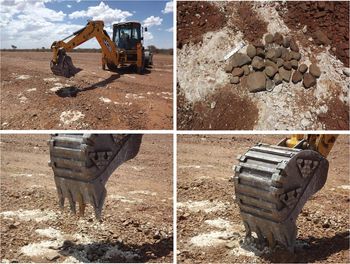
Our experiment sought to replicate the damage typically inflicted to medium-sized stones at industrial development sites. Thirty banded ironstone cobbles were collected from the field under development for a solar plant near to the archaeological site of Kathu Pan 1. This is the same type of raw material that was used in the nearby archaeological site. The cobbles, which ranged in length from 50–120mm, were selected on the basis of their faceted morphology and absence of pre-existing damage. The cobbles were each marked with white correction fluid and placed on a 5m2 patch of calcrete, cleared of all other objects, on a heavily used gravel access road to the solar plant. As this is an active construction site with strict health and safety regulations, no attempt was made to assess surface movement of the assemblage. Other experimental studies at open-air sites subject to ‘normal’ animal trampling in a similarly arid environment, however, suggest that little horizontal movement of artefacts occurs, even over extended periods of time (Forssman & Pargeter Reference Forssman and Pargeter2014). Passing traffic consisted of earth-moving vehicles (large trucks in excess of 3 tonnes) and lighter-weight personnel vehicles. A vehicle/truck drove over the cobbles approximately every 15 minutes, for 10 hours a day, six days a week. The cobbles were left in this position for two weeks, after which they were collected and laid in a heap on another cleared patch of calcrete. The hydraulic arm of a JCB 3DX excavator was then used to reproduce the effects of mechanised excavation on the cobbles (Figure 2). The arm was brought down on the cobble heap with the same force normally used to excavate a hole (e.g. pylon foundations), and then raised vertically to avoid removing any earth from the test area. This action was repeated 15 times. After this, the remaining cobbles and related debitage were collected from the site, washed free of dirt and analysed in a laboratory setting. Where possible, flakes and smaller debitage were refitted to their original core.
Clockwise from top left) the excavator used to reproduce the vertical impact damage experienced by stones during excavation; the placement of the banded ironstone cobbles prior to commencement of the experiment; the downward action of the excavator claw onto the stone cobble pile; the claw being lifted vertically off the cobble pile (photographs by J. Bradfield).

Results
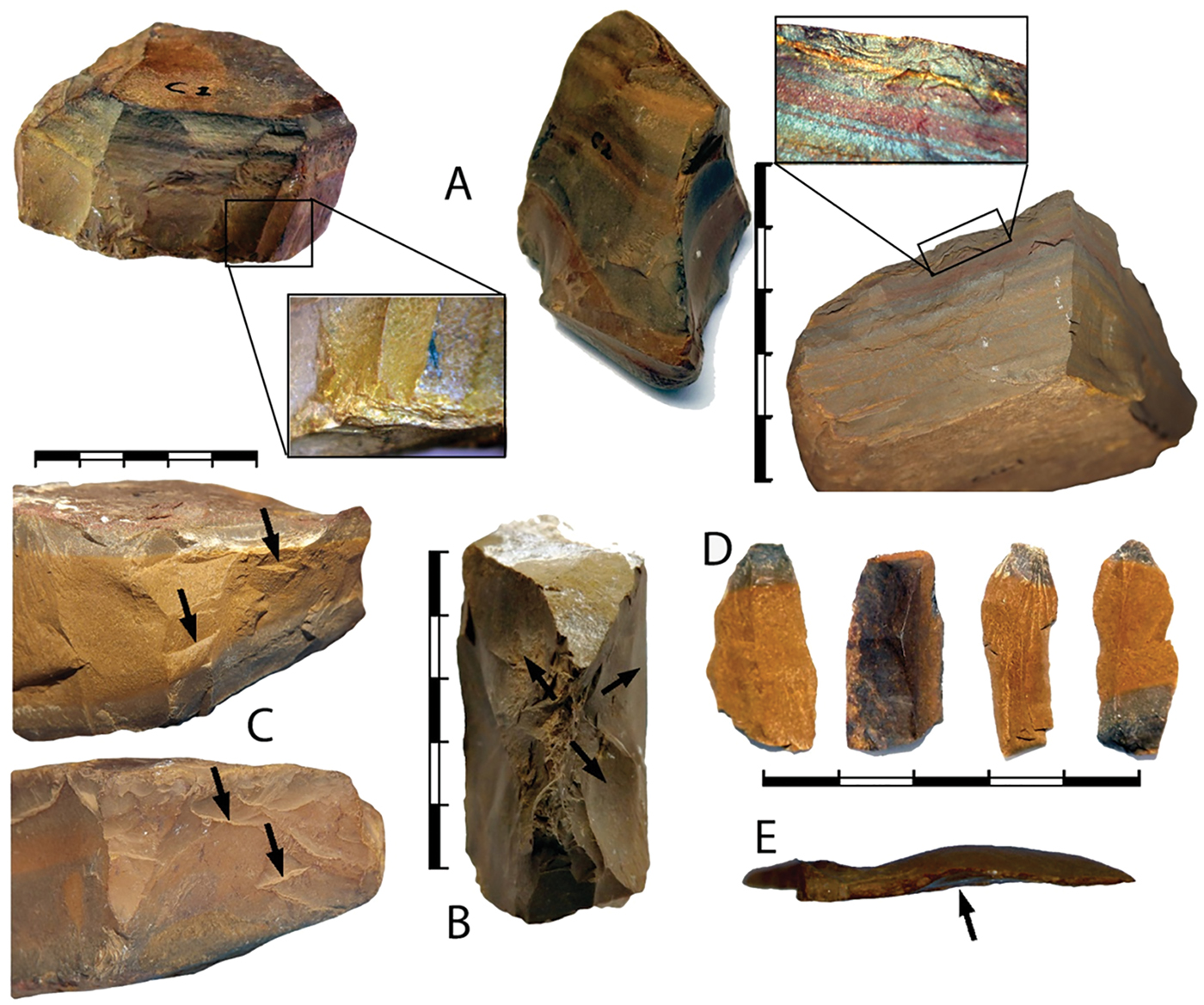
The first phase of the experiment (exposure to heavy-duty traffic) produced no structural damage to the stone cobbles. Only some minor surface scuffing and crushing was noticeable. Conversely, of the 30 cobbles carried over to the second phase of the experiment (hydraulic-arm impact), all but eight sustained damage, resulting in 80 flaked pieces of debitage that were recovered from the test area. Table 1 presents the results of the cobble analysis. Cobbles C6–13 are omitted from this table as they sustained no damage. The vast majority of cobbles sustained multiple removals at acute angles to their points of impact. Removals were predominately unidirectional, but bi-directional and multi-directional removals were also observed (Figure 3A), which, together with the multiple facial aspects of these removals, indicates that the cobbles experienced a high degree of churning or tumbling during the experiment. The presence of bulbs of percussion on some of these removal facets indicates where cobbles were split in two. In these instances, both halves are considered together in the table. The most prevalent type of damage that accrued to the cobbles was heavy crushing at the points of impact (n = 16; Figure 3A insets). This resembles the damage commonly described for adzes (e.g. Odell Reference Odell2003). In three cases (C22, C29, C30), the damage was so extensive as to obliterate the platform facet (Figure 3B). Another less frequent form of damage (n = 6) is the occurrence of multiple step-fractures within the ventral facet of the removal (Figure 3C).
Damage produced by the mechanical action of the hydraulic iron arm of the excavator: A) cobbles with uni-and multi-faceted removals with insets showing heavy step crushing at the platform edges; cobble C1 is presented upside down to show its resemblance to a robust scraper; B) catastrophic damage to platform, the arrows indicate the direction of removals; C) step terminations of the ventral facet of removals; D) bladelets produced during the experiment—note the dorsal ridges; E) aerial view of the proximal end of a bladelet showing thinned platform with arrow pointing to negative converse bulb (scales: 50mm) (photographs by J. Bradfield).

Damage produced on the banded ironstone cobbles by the action of the hydraulic iron arm of a JCB excavator.

Table 2 presents the summarised results of the flake and debitage analysis. A list of attributes for each lithic fragment is provided in Table S1. It is not our intention here to provide a comprehensive technological study, but rather to show the similarities and differences between anthropogenic vs machine-made debitage, and to describe features that may prove helpful to archaeologists (who are often not lithic specialists) for discriminating between these two causal factors. Table 2 provides two sets of flake analysis: that developed by Sullivan and Rozen (Reference Sullivan and Rozen1985), and that used by Andrefsky (Reference Andrefsky and Andrefsky2001, Reference Andrefsky2005), the second of which itself employs categories devised by others (e.g. Frison Reference Frison1968; Raab et al. Reference Raab, Cande and Stahle1979; Flenniken Reference Flenniken1981; Draper & Lothson Reference Draper and Lothson1990; Shott Reference Shott1993).
Summarised counts of technological and metric information provided by detached flakes. SRT stands for the Sullivan and Rozen (Reference Sullivan and Rozen1985) technology nomenclature; this table should be read in conjunction with the full details provided in Table S1.

Conchoidal fractures accounted for almost 60 per cent (n = 47) of the sample, and eight bladelets were produced (Figure 3D). Three flake initiation types (‘bending’, ‘wedging’ and ‘hertzian’) and a variety of flake terminations (‘feather’, ‘snap’, ‘step’, ‘hinge’ and ‘plunging’) were recognised (see Cotterell & Kaminga Reference Cotterell and Kamminga1987; Lombard Reference Lombard2005). Flake initiation and termination types typically provide information about the mechanical forces that caused the stone to fracture, and are used to assess the mode of delivery of a weapon (Lombard Reference Lombard2005). Secondary flake scars are common on the debitage, with some detached pieces exhibiting up to seven removals. Most of the secondary removals are unidirectional and generally follow the same orientation as the parent flake. In examples F08, F27 and F67, however, the orientation of the secondary flake scars is perpendicular to the parent flake, indicating what is commonly known as a side-struck flake. Perhaps contrary to expectation, flakes with a 100 per cent dorsal cortex accounted for only 15 per cent of the assemblage, whereas flakes with no dorsal cortex accounted for 58 per cent of the assemblage. Under knapping conditions, the cortex of a core is usually reduced almost entirely in an attempt to produce favourable knapping angles, whereas under most natural conditions this is not the case (Crabtree Reference Crabtree1982).
Several technological flake types were recognised (Tables 2 & S1). Only 22 (28 per cent) pieces could not be classified according to an established classificatory system. Bipolar flakes, although representing the single highest number of flake types (n = 22), only represent 28 per cent of the whole assemblage. This is followed by cortical flakes (n = 18) and regular flakes (n = 10). Importantly, pieces that conform to the definitions of bifacial thinning flakes (n = 5; cf. Frison Reference Frison1968; Shott Reference Shott1993), platform-preparation flakes (n = 2; cf. Draper & Lothson Reference Draper and Lothson1990) and scraper retouched flakes (n = 1; cf. Frison Reference Frison1968) were also identified. The implication of the presence of these categories in particular is discussed below.
The platforms of 10 flakes (F02, F05, F07, F08, F13, F14, F36, F42, F47, F66) are thinned, show signs of crushing and, in some cases, have a negative, converse bulb of percussion (Figure 3E). Figure 4 illustrates the removals and flake attributes of some of the experimental lithics. The dorsal ridges of older flake scars, and diffuse bulbs of percussion on the flakes are noticeable, along with multiple flake removals on the cobbles. Pronounced adze-like crushing, concentrated at the platform, seems to be a distinctive characteristic of flakes produced by the impact of a large iron percussive implement—a feature not typically found on knapped stone tools.
Line drawings highlighting technological attributes of ‘bladelets’ and ‘cores’ produced during the experiment (figure by L. Deysel & J. Bradfield).

Discussion and conclusions
CRM practitioners and other field archaeologists are regularly required to assess the significance of surface stone-tool scatters at development sites often affected by industrial activities. Most of the machine-damaged cobbles from our analysis would not be mistaken by any well-trained archaeologist for cores or Earlier Stone Age chopper tools. Most of the experimental cobbles sustained just a single steep-angled removal. In four cases, however, the bi- and multi-directionality of numerous removals from several facets meet the technical criteria of a core, being angular and faceted through the removal of two or more flakes (sensu Andrefsky Reference Andrefsky2005). This is contrary to natural damage produced during previous experiments, which found only unidirectional removals resulting from natural processes, such as trampling, glaciation, soil movement, wave action and rapid temperature fluctuations, to name a few (Gillespie et al. Reference Gillespie, Tapakka and Cluney2004). Platform-angle and edge-patterning attributes match those identified elsewhere (Barnes Reference Barnes1939; Gillespie et al. Reference Gillespie, Tapakka and Cluney2004).
A potential criterion for discriminating between archaeological cores and cobbles transformed by machine action is the degree and location of wear traces, particularly step-crushing. An attribute found in our sample—rarely on archaeological artefacts—is ventral facet stepping on the cobbles, indicating that, due to the loading forces occasioned by the heavy mechanical arm, flakes were not cleanly removed, unlike most hard or soft percussive implements employed in knapping. We also found a high incidence of step-crushing at the point of impact where the flakes were detached, which in extreme cases was obliterated. Although platform faceting during overhang removal may result in similar step-crushing features (Shipton et al. Reference Shipton, Clarkson, Bernal, Boivin, Finlayson and Finlayson2013), their incidence in our experimental sample was marked by catastrophic damage to the platform, which is not usually the case for overhang removal. Catastrophic platform damage, however, occurred in only 57 per cent of the cobble sample, meaning that there is a margin of error when using this criterion to distinguish machine-made debris from archaeological artefacts.
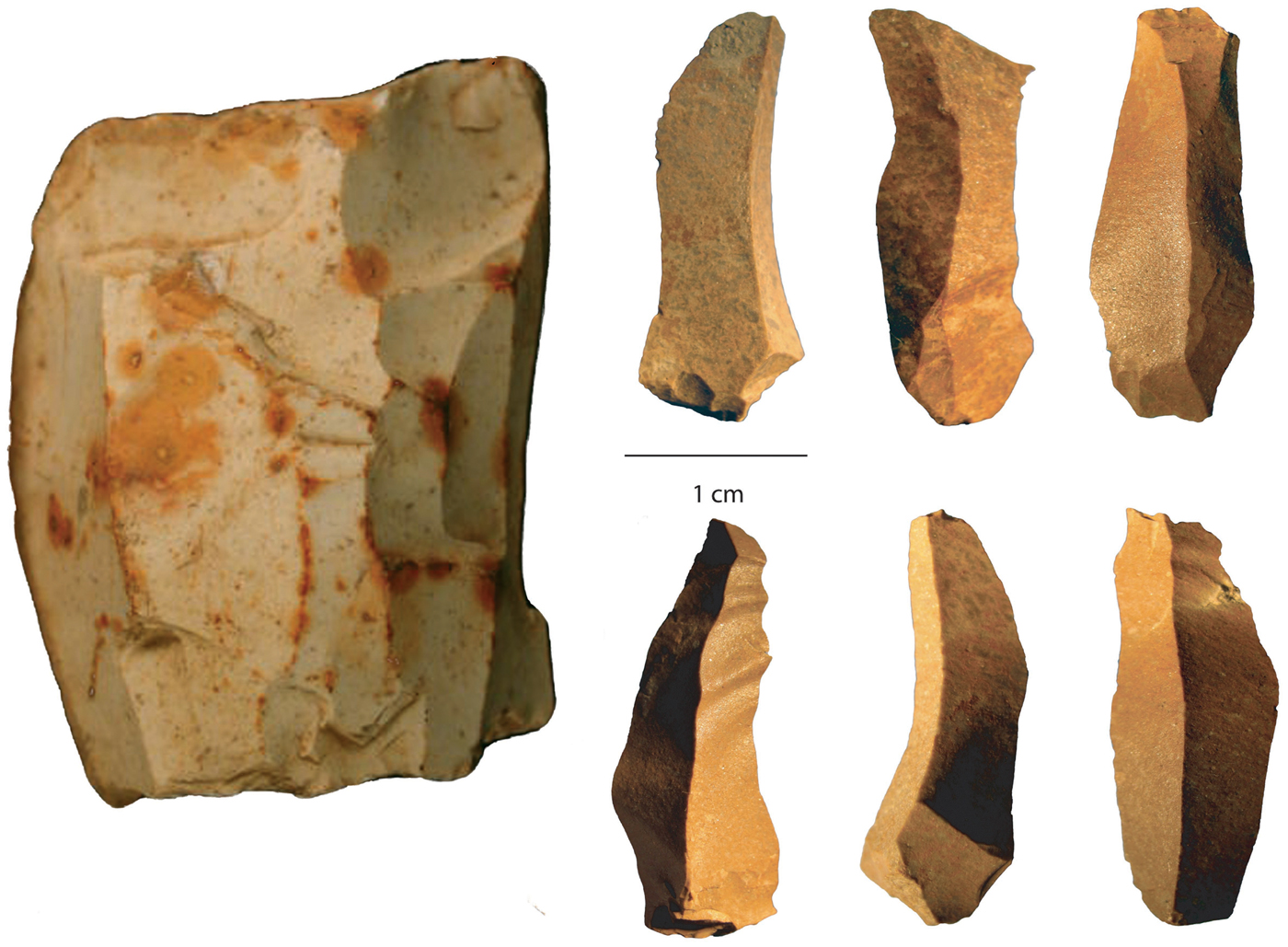
At least some of the debitage produced by heavy-duty earth-moving machines can mimic that resulting from stone-tool production. Six of the eight bladelets produced in our experiment could be mistaken for anthropogenic products based on the presence of prominent dorsal ridges and secondary flake scars. Microlithic bladelet industries are a common phenomenon the world over (Andrefsky Reference Andrefsky2005). The bladelets produced by this experiment could easily be mistaken for microlithic bladelet industries by even moderately experienced archaeologists (e.g. making this distinction might be challenging for CRM practitioners whose expertise lie predominantly in other areas). Some examples in southern Africa, such as the Robberg lithic technocomplex, are characterised by abundant bladelets, similar in size and form to those produced in our experiment (Bousman Reference Bousman2005; Lombard et al. Reference Lombard, Wadley, Deacon, Wurz, Parsons, Mohapi, Swart and Mitchell2012). Another example is the Nebekian industry in the southern Levant that is characterised by assemblages that are almost exclusively composed of microliths, primarily small, narrow, arch-backed, curved and pointed bladelets, under 23mm in length (Byrd & Garrard Reference Byrd, Garrad, Enzel and Bar-Yosef2017). Figure 5 shows a typical Mesolithic bladelet core and knapped bladelets to highlight the similarity of our machine-induced damage to archaeological artefacts.
A European Mesolithic bladelet core and knapped bladelets demonstrating the similarity in form to debitage produced during heavy-duty machine activity. The Mesolithic core is from Leicestershire, UK, reproduced from https://finds.org.uk/database/artefacts/record/id/210186 accession number CORN_A1B311; the bladelets were created from heat-treated silcrete by a skilled lithic knapper, and are reproduced from Pargeter and Bradfield (Reference Pargeter and Bradfield2012).

The occurrence of certain categories of debitage, however, such as bifacial thinning flakes, side-struck platform-preparation flakes and scraper retouch flakes, is more troubling, as these flake categories are loaded with assumptions about the technological choices of their makers (see Harper & Andrefsky Reference Harper, Andrefsky and Andrefsky1998; Andrefsky Reference Andrefsky and Andrefsky2001, Reference Andrefsky2005).
Recognising that these flake types can occur as the result of non-human action has far-reaching implications for technological studies of lithic artefacts from open-air sites that could have been affected by the use of heavy machinery. Indeed, several authors have already acknowledged the difficulties in attempting to distinguish flake-production strategies based on flake morphological attributes (Presnyakova et al. Reference Presnyakova, Archer, Braun and Flear2015) without even going so far as to consider extra-somatic factors. Two possible distinguishing criteria of the flake category are the heavy step-like crushing of the platform associated with diffuse bulbs of percussion, and the negative, converse bulbs present on some of the pieces. Both types of damage seem related to the force and hardness of the percussor, as these features are seldom produced during replicative stone knapping—although, as noted earlier, platform stepping can form as a result of deliberate platform-preparation techniques, such as overhang removal. It is probable that additional damage might have accrued to the flake category had we attempted to replicate tyre damage after the flakes had been produced—the thin edges of the flakes would probably be more vulnerable to damage from passing vehicles than whole cobbles.
Although heavy-duty machinery produced only one pseudo-formal tool in our experiment (C1), most of the debitage mimics that occasioned by knapping. Artificial debitage created in this manner could easily be confused with the knapping by-products of certain un-retouched bladelet-based technologies, such as the Robberg of southern Africa, and could potentially distort lithic technology results at Later Stone Age/Upper Palaeolithic open-air sites. Resemblance to older Stone Age/Palaeolithic technological expressions is minimal, as the debitage produced by heavy machinery shows no evidence of Levallois or other preparation techniques, and lacks the technological and typological features that are considered diagnostic of the southern Africa Early and Middle Stone Ages as defined by Goodwin and Van Riet Lowe (Reference Goodwin and Van Riet Lowe1929). In deflated or otherwise sensitive Stone Age cultural landscapes such as our study area, outside Kathu in the Northern Cape, that are rich in archaeological materials, machine activity can pose a problem for lithic technologists and CRM practitioners by masking legitimate technological signatures. We echo the recommendation of Gillespie et al. (Reference Gillespie, Tapakka and Cluney2004), that context- and artefact-specific attributes are assessed in terms of the possibility that they were produced, not by humans in the past, but by other processes, especially those connected with industrial and development activities. The need for such assessment is borne out by the results of analysis, which suggests that debitage made by knapping and heavy machinery, can be troublingly similar. The long-term effects of industrial and development activities on open-air Stone Age sites must be taken into account by CRM practitioners, and should form part of the research design of large-scale surveys where the importance of open-air sites and surface scatters is fully recognised.
Acknowledgements
The authors wish to thank the management of the Kathu Solar Park facility, especially Jared Padavattan, for facilitating access to the site and machinery and for helping with other logistical aspects of the experiment. Marlize Lombard is thanked for reading through a previous draft of this manuscript. Two anonymous reviewers provided critical and insightful comments that helped strengthen the paper.
Supplementary material
To view supplementary material for this article, please visit https://doi.org/10.15184/aqy.2018.170