While Hurricane Sandy buffeted the East Coast of the United States during October 2012, the news media reported stories of physicians leading care teams in the dark while their hospitals were forced to evacuate patients and stories of physicians in nearby hospitals caring for the long lines of spillover patients sent from hospitals no longer in operation.Reference Bernstein and Hartocollis 1 , Reference Hartocollis 2 These events highlight the critical role that physicians play during public health emergencies in attending to victims and in mitigating the overall health impact in a community.Reference Ofri 3 Moreover, such events are a vivid reminder of the importance of physician emergency preparedness and training.Reference Redlener and Reilly 4 To date, research on physician preparedness suggests that major gaps exist. In the crisis response literature, for example, most articles summarizing challenges for health care institutions or systems make, at best, indirect reference to preparedness among physicians as a critical issue. 5 - Reference Sexton, Alperin and Stobo 9 The few studies that have provided direct, systematic assessment of physician preparedness have tended to focus specifically on the response needs for terrorism-related events rather than on general capacities for all-hazards public health emergencies. The findings from these studies show low levels of physician preparedness on both self-assessed and objective measures and across a variety of areas such as ability to identify likely biological agents, treating victims, public health notification processes, and overall preparedness.Reference Alexander and Wynia 10 - Reference Spranger, Kazda and Harris 15 The data also suggest that shortfalls in training parallel those for preparedness,Reference Kat, Nekorchuk and Holk 13 , Reference Sheikh, McCormick and Pevear 14 , Reference Alexander, Larkin and Wynia 16 , Reference Niska and Burt 17 with only a small proportion of physicians having received training related to handling a bioterrorism- or terrorism-related mass event. When it is provided, training does appear to be associated with higher levels of knowledge,Reference Kat, Nekorchuk and Holk 13 , Reference Sheikh, McCormick and Pevear 14 and physicians appear to be willing to participate in training.Reference McInerney and Richter 18 But the utility of these studies is still limited because they are based on small samples either in specific geographies like rural TexasReference Hsu, Mas and Jacobson 12 or within individual health care institutions.Reference Sheikh, McCormick and Pevear 14
To get a broader perspective on physicians, Alexander et alReference Alexander, Larkin and Wynia 16 collected data from a national survey to assess preparedness and training for both bioterrorism and naturally occurring infectious disease epidemics. Their findings suggest that infectious disease training is somewhat more widespread than bioterrorism training among primary care and emergency medicine physicians. The data, however, do not include assessments of preparedness or training among physicians for other critical public health emergencies such as foodborne illness outbreaks, natural disasters, or chemical or radiological exposures.
There are 3 additional areas of importance where relatively little evaluative research is found. First, in our review of available published studies in major databases, including PubMed 19 and Academic Search Premier, 20 we found no peer-reviewed national studies assessing physician awareness of or involvement in institutional preparedness through practice events, such as drills. Second, we found little analysis of the information resources utilized by physicians for preparedness and response to public health emergencies, although one study suggested that resources from federal agencies are well received.Reference M’ikanatha, Lautenbach and Kunselman 21 Third, only a single study that we could identify examined, even indirectly, the extent to which physicians share preparedness information with their patients. In a study among people presenting at emergency department and outpatient pediatric waiting areas in 2 facilities, Olympia et alReference Olympia, Rivera and Heverley 22 found that 17% had discussed the topic of emergency preparedness with their primary care physicians.
To provide a more comprehensive view of physician preparedness in the United States as a whole, across settings and practice areas, the present study used data from a nationally representative poll of practicing physicians to address 4 areas: (1) physicians’ assessments of their preparedness and training for public health emergencies; (2) physicians’ awareness of and participation in institutional preparedness activities; (3) physicians’ receipt and assessment of emergency information received prior to and during public health emergencies; and (4) physicians’ focus on patient education in settings not affiliated with a hospital. Moreover, we examined these areas with respect to 4 kinds of public health emergencies: natural disasters, major airborne infections, major foodborne illness outbreaks, and chemical, biological, radiological, nuclear, or explosives (CBRNE) incidents.
METHODS
Study Design and Sample
This study used data from a nationally representative poll of 1603 practicing physicians conducted by researchers at the Harvard T. H. Chan School of Public Health. SSRS, an independent company, coordinated field operations. A random sample of physicians was drawn from the SK&A database (Irvine, CA), a comprehensive, commercial listing of practicing physicians built from federal and state licensing and registry sources and verified by telephone every 6 months and by annual independent audits. Potential participants were invited via a mailed letter and could complete the poll through the enclosed print version of the questionnaire or an equivalent online version. To encourage participation, physicians were offered incentives ranging between $50 and $75, depending on their specialty area, as is standard in many physician surveys.Reference Steelfisher, Blendon and Sussman 23 Participants could choose between receiving payment directly or donating it to charity. Researchers also utilized a standardized set of telephone reminders and mailings with printed copies of the questionnaire. Additional copies of the questionnaire were faxed or mailed upon request.
The poll was conducted between October 19, 2011, and January 11, 2012, and the response rate was 28%. 24 The relatively short field time was utilized to ensure the data would provide a comparable baseline for future analyses of the impact of interventions that would aim to prompt higher preparedness levels. This study design and analytic approach followed protocols used in polls of the public, which rely on weighted data to compensate for a lower response rate and still ensure the data reflect the true population. In this field, independent studies have shown that statistically weighting the data to known population demographics provides comparable data to surveys with longer field times and higher response rates.Reference Blendon, Benson, DesRoches and Weldon 25 - Reference Kohut, Keeter and Doherty 28 Data from this study were weighted according to era of graduation from medical school (by gender), census region of the physician’s practice, self-reported medical specialty category, and ethnicity by using the American Medical Association’s Physician Characteristics and Distribution in the United States.Reference Blendon, Kohut and Benson 29
This study was conducted under a cooperative agreement between the Harvard T. H. Chan School of Public Health, the National Public Health Information Coalition (NPHIC), and the Centers for Disease Control and Prevention (CDC). Researchers at the Harvard T. H. Chan School of Public Health and SSRS were independently responsible for the overall strategy, development of study questions, data collection, and analysis. Only researchers at SSRS were involved in any portions of data collection that directly included poll respondents or identifying information, such as sample procurement, interviewing, and data quality review. The study was deemed nonhuman subjects research by the Office of Human Research Administration at Harvard T. H. Chan School of Public Health.
Polling Instrument Design
Researchers at Harvard T. H. Chan School of Public Health developed the questionnaire based on questions from previous polls of physicians that provided informative, consistent results and demonstrated appropriate wording and psychometric properties. The instrument was also pretested with physicians in different medical specialties to ensure participant comprehension. The questionnaire was developed to be parallel in online and mail modes, both of which are were self-administered, with similar visual layouts and no forced responses.
The questionnaire included more than 60 questions about physicians’ views of their own preparedness as well as their experience with preparedness training and emergency-related communications. It also asked about their views of the (level of) preparedness of institutions in which they provide patient care, including hospital settings and nonhospital settings. A nonhospital setting was defined as “a setting that is not part of a hospital, e.g. an ambulatory surgery center that is not part of a hospital, community health center or ambulatory clinic/office that is not part of a hospital.” Physicians who provide care in both settings were able to evaluate both settings. The distinction between setting type was made in order to be able to examine differences between institutions that could have access to a hospital-based emergency preparedness program and those that do not. Finally, the questionnaire asked about physicians’ experiences providing emergency preparedness information to patients in nonhospital settings. Within each of these topic areas, the poll covered 4 major kinds of public health emergencies, including (1) “A natural disaster, like a hurricane or earthquake”; (2) “A chemical, biological, radiological, nuclear or explosives incident” (CBRNE); (3) “A major outbreak of an airborne infection, like pandemic influenza”; and (4) “A major foodborne illness outbreak.” (See Appendix A for full questionnaire wording.)
Analysis
We present the weighted, univariate findings for each relevant question in the poll, and where parallel questions were asked about issues pertaining to hospital and nonhospital settings, we compare responses by using dependent two-tailed t-tests for paired data that account for weighting. All statistically significant differences at the 0.05 level are shown in the tables, although only differences that were also at least 10 percentage points were considered to have practical implications for policy and are therefore mentioned in the text.
RESULTS
Physician Preparedness and Training
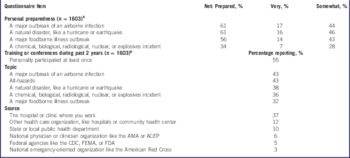
More than one-half of physicians felt “prepared” (either “very prepared” or “somewhat prepared”) to handle a major outbreak of an airborne infection (61%), a major foodborne illness outbreak (61%), or a natural disaster (56%) (Table 1). By contrast, about one-third of physicians (34%) felt somewhat or very prepared to handle a CBRNE incident.
Physician Views of Their Own Preparedness and Training for Public Health EmergenciesFootnote a

a Abbreviations: ACEP, American College of Emergency Physicians; AMA, American Medical Association; CDC, Centers for Disease Control and Prevention; FDA, Food and Drug Administration; FEMA, Federal Emergency Management Association. Table shows percentage of physicians reporting each answer. Total may not equal sum of parts or 100% due to rounding or item refusals. We eliminated “other” categories for some questions because of higher skipped or refusal levels on the print version.
b Among all physicians.
About one-half of physicians (55%) had participated in training or a conference for any of the types of emergencies or all-hazards in the past 2 years. Training related to a major airborne infection and all-hazards training were most common (43% each), whereas training related to a foodborne illness outbreak was least common (32%).
Most frequently, physicians had participated in training provided by the hospital or clinic where they work (37%). Far fewer physicians noted that other organizations had been involved. For example, the institutions that were the next most commonly involved in providing training were other health care organizations and the state or local public health departments, but only 12% and 10% of physicians, respectively, said that their training was provided by these institutions.
Training most commonly used an in-person format, with 37% of physicians participating in such sessions. About one-quarter of physicians (23%) had participated in either a prerecorded webinar (13%) or a live webinar (10%). Less than 10% had participated in a book-based training (8%) (data not shown).
Regardless of whether they had been to training, most physicians (64%) felt an in-person session was the most effective format. Nonetheless, a sizable minority (30%) felt an online format, either live webinar (10%) or pre-recorded (20%), was best. Very few felt a book-based or any other format to be the most effective approach (4% and less than 0.5%, respectively; data not shown).
Physician Awareness of and Participation in Institution Preparedness
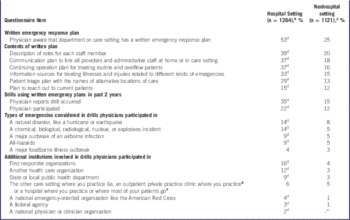
Approximately one-half of physicians in hospitals (53%) said their department had a written emergency response plan, whereas one-quarter of physicians in nonhospital settings (25%) said the same (Table 2). Sizable fractions of physicians practicing in both kinds of institutions did not know whether their care setting had an emergency response plan; 44% in hospitals did not know whether their department had such a plan, and 37% in nonhospital settings did not know whether their care setting had such a plan. Smaller fractions in either setting were able to say with certainty that their department or care setting had a written plan with specific features. For example, approximately 4 in 10 physicians in hospitals said their care setting had a written plan with descriptions of roles for each staff member (39%), a communication plan to link physicians and staff (37%), or a continuing operation plan for treating routine and overflow patients (37%). One-third or fewer of physicians in hospitals said their department had a plan with information sources for treating illnesses and injuries (33%) or a patient triage plan with the names of alternative locations of care (29%). Only 15% of physicians in hospitals said they had a plan that included directions for reaching out to current patients. One-fifth or fewer of physicians in nonhospital settings answered that their care setting had any of the features described (12-20%), which was significantly fewer than the fractions in hospital settings.
Physician Awareness of and Participation in Institution Preparedness: Comparisons of Hospital and Nonhospital SettingsFootnote a

a Table shows the percentage of physicians reporting each answer. Total may not equal sum of parts or 100% due to rounding or item refusals. We eliminated “other” categories for some questions because of higher skipped or refusal levels on the print version.
b Among physicians who practice in hospital settings.
c Among physicians who practice in nonhospital settings.
d Footnotes indicate when “don’t know” responses or refusals are >10% of the total sample.
e Less than 0.5 percent.
In total, 35% of physicians in hospital settings said their institution had drills using the written emergency response plan in the past 2 years, compared to 15% of physicians in nonhospital settings. Just under one-quarter (22%) of physicians in hospital settings had personally participated in at least one of those drills, whereas 12% of those in nonhospital settings had done the same. Given the small share who had participated in any drills, smaller fractions had participated in drills focused on each of the types of emergencies. The greatest share had participated in one or more drills related to a natural disaster, and this was only 14% in hospital settings and 8% in nonhospital settings. The smallest shares had participated in drills related to a major foodborne illness outbreak (4% in hospitals and 3% in nonhospital settings).
When asked about which additional institutions had been involved in such drills, physicians reported most often that a first responder organization (such as emergency medical services or firefighters) or another health care organization, like a hospital or community health center, had been involved. In total, 16% of physicians in hospital settings and 4% of those in nonhospital settings had participated in drills with first responders, whereas 12% and 3% of those in hospital and nonhospital settings, respectively, had participated in drills with another health care organization. Fewer physicians in either care setting had participated in drills that involved other kinds of organizations, such as their state or local public health department (9% in hospital and 3% in nonhospital settings), a national emergency-oriented organization like the American Red Cross (4% in hospital and 1% in nonhospital settings), or a federal agency (3% in hospital and 1% in nonhospital settings).
Emergency Information Prior to and During an Emergency
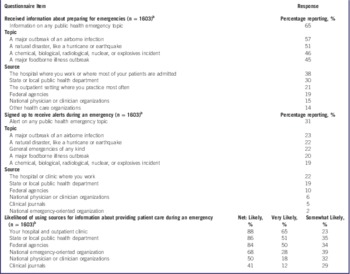
Nearly two-thirds of physicians (65%) said they had received information (aside from formal training) about any of the kinds of emergencies (Table 3). More than one-half (57%) said they had received information about a major outbreak of an airborne infection in the past 2 years, whereas just under one-half said the same about the other types of emergencies.
Physicians’ Receipt and Assessment of Emergency Information Received Prior to and During Public Health EmergenciesFootnote a

a Table shows percentage of physicians reporting each answer. Total may not equal sum of parts or 100% due to rounding or item refusals. We eliminated “other” categories for some questions because of higher skipped or refusal levels on the print version.
b Among all physicians.
Most commonly, physicians received such information from the hospital where they worked or where most of their patients were admitted (38%), although nearly one-third (30%) said they received such information from state or local public health authorities. Other resource providers were less common. Less than one-quarter (21%) said they received information from the outpatient setting where they worked most often and nearly the same fraction said they received information from federal agencies (19%). Fewer received information from national physician or clinician groups like the American Medical Association (15%) or other health care organizations (14%).
Physicians received the information in a variety of formats, though print, websites, and e-mails and listservs were the most common by far (45%, 32%, and 28%, respectively). Other media were much less common, including podcasts (3%), social media (2%), or text messages or smart phone applications (“apps”; 1%) (data not shown).
Regardless of their experience to date, physicians most commonly thought print materials were the most effective format for information received prior to an emergency (41%), although electronic sources ranked higher collectively, with 33% saying website-based materials and 18% saying e-mail or listerv information was most effective. Other formats had very few physicians (<2%) say they were most effective (data not shown).
Just under one-third (31%) of physicians were signed up to receive any alerts in the case of future emergencies, with approximately one-fifth signed up to receive alerts about each type of emergency, including a major outbreak of an airborne infection (23%), a natural disaster (22%), a major foodborne illness outbreak (20%), or a CBRNE incident (19%), or to receive generalized emergency alerts (22%). Most commonly, physicians were signed up to get alerts from the hospital or clinic where physicians worked or the state or local public health department (22% and 19% of all physicians, respectively). Less commonly, they were signed up to get alerts from federal agencies (10%), national physician organizations (6%), clinical journals (5%), or national emergency-oriented organizations (2%).
Most often, physicians were signed up for alerts via e-mail or listservs (23% of all physicians). Less commonly they were signed up to receive information by mail or fax (11%), to receive website-based materials (10%), or to received text messages or app-based messages (4%) or information from social media (1%) (data not shown).
Regardless of their experience to date, physicians most commonly thought e-mail or listservs were the most effective format of receiving alerts (38%), with another 29% citing two other electronic sources, text or phone-based messages (15%) and website-based information (14%) (data not shown).
Most physicians would likely turn to their own hospital or clinic, their state or local public health department, or federal agencies like the CDC for information about providing care during an emergency (88%, 86%, and 84%, respectively). By comparison, two-thirds (68%) said the same about national emergency-oriented organizations and one-half (50%) said the same about national physician organizations. Four in 10 felt they would likely turn to clinical journals (41%).
Physician Involvement in Patient Education and Communication Outside the Hospital Setting
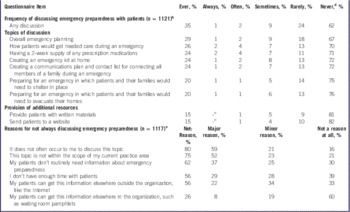
Almost two-thirds of physicians who worked in a nonhospital setting (62%) reported that they never discuss emergency preparedness with their patients in that setting and 24% reported that they rarely do (Table 4). This left just 1 in 10 who said they discuss the topic at least “sometimes,” including only 1% and 2%, respectively, who do so “always” or “often.”
Physicians’ Focus on Patient Education and Communication in the Nonhospital SettingFootnote a

a Table shows the percentage of physicians reporting each answer. Total may not equal sum of parts or 100% due to rounding or item refusals. We eliminated “other” categories for some questions because of higher skipped or refusal levels on the print version.
b Among physicians who practice direct patient care in a nonhospital setting.
c Among physicians who practice direct patient care in a nonhospital setting and do not always discuss emergency preparedness
d “Never” category includes those who never discuss emergency preparedness with their patients and those who never discuss a given topic or never provide patients with written or online materials.
e Indicates less than 0.5 percent.
When physicians who do not always discuss the topic with patients were asked about the major reasons why not, a majority stated that it did not occur to them to discuss the topic (59%) and they considered it outside the scope of their current practice area (52%). Other major reasons included the belief that their patients did not regularly need the information (37%) and time limits during patient visits (29%). Few physicians felt the availability of information elsewhere outside the organization (22%) or within it (8%) were major reasons for not always discussing the topic.
DISCUSSION
With reports suggesting that the rate of natural disasters and related public health emergencies may be on the rise, 30 the need for physician emergency preparedness is greater than ever. The current study provides the most comprehensive assessment to date of physician emergency preparedness, including the views of physicians in different practice specialties across the country and in both hospital and nonhospital settings. It also addresses multiple kinds of public health emergencies, including natural disasters, foodborne illness, airborne infections, and CBRNE incidents. The findings provide much needed direction for next steps in improving physician preparedness by revealing 5 critical gaps in physician preparedness today.
First, although the finding that a majority of physicians believe they are prepared to handle certain kinds of public health emergencies provides some reassurance, that level of preparedness would be inadequate for large-scale emergencies like hurricanes or pandemic influenza where nearly all physicians in relevant regions will be involved.Reference Hodge, Anderson and Kirsch 7 Further, for specific kinds of health threats such as CBRNE incidents, only a minority of physicians believe they are prepared. The consistency of these findings with data from earlier studiesReference Alexander and Wynia 10 - Reference Alexander, Larkin and Wynia 16 implies that there has been little change in physician preparedness despite a decade of substantial federal investment, especially around bioterrorism, such as the Assistant Secretary for Preparedness and Response’s “Healthcare Preparedness Capacities” funding to states and territories.Reference Barbera, Yeatts and Macintyre 6 , Reference Paturas, Smith, Smith and Albanese 31 Limited preparedness combined with the lack of change suggests that the barriers to increasing physician preparedness continue to be pervasive and entrenched. Additional examination of the challenges from the perspective of physicians, especially those who feel less prepared, may reveal useful ways to improve. 32
Second, although most physicians say they are prepared, significant challenges remain to engaging even those physicians in institutional preparedness. While most institutions have written emergency response plans,Reference Sugerman, Nadeau and Lafond 33 the sizable fraction of physicians who are unaware of whether their department or care setting has even this most basic element of institutional preparedness is a testament to their distance from the efforts. Moreover, extremely small shares of physicians are participating in drills, which are a central component of preparedness and a longstanding component of Joint Commission accreditation, which most hospitals seek.Reference Bartley, Stella and Walsh 34 - 36 In a health care environment that has put many pressures on physicians’ time, innovative thinking will be needed to find new strategies to engage physicians in institution-wide efforts. Partnering with hospital and health care system leaders may be critical for agencies seeking ways to facilitate physician involvement. 37 - Reference Waeckerle 39
Third, training for public health emergencies continues to be below a majority threshold among physicians. Although physician organizations and others have established disaster medicine residency training programs as one means of improving this, supplemental training will be needed both as refreshers for physicians who attend such programs and to support those who do not.Reference Cicero, Blake and Gallant 40 , Reference Franc, Nichols and Dong 41 Although specific topics may not be of interest to all physicians, routine training in an all-hazards approach seems a particularly useful way to boost overall preparedness among physicians. Further, there appears to be sufficient interest in online training approaches, which may serve as a cost-effective complement to in-person sessions. More attention to such tools in this context appears warranted.
Fourth, it is clear that the vast majority of physicians are not reaching out to patients with information about emergency health preparedness or protection in a meaningful way. The barriers to physicians sharing emergency health information more regularly are fundamental; they relate to physicians’ understanding of the scope of their profession and relationship with their patients. Emergency preparedness agencies must find ways to encourage physicians to consider this kind of discussion as part of their care and to make it easier for physicians to address the topic of emergency preparedness. Evidence suggests this may improve emergency preparedness among the public.Reference Olympia, Rivera and Heverley 22 Perhaps it makes sense to have a particular focus on physicians who work with patients with disabilities, chronic illnesses, or other special-needs populations who are at greater risk in public health emergencies.Reference Blendon, Connolly and Benson 42 Electronic reminders based in EMR/EHR systems could facilitate that process. Making print and online resources a part of the information physicians routinely share with patients is important, but it may also be important to find new ways of educating patients that do not involve as much physician time, such as online tools and in-person sessions run by other kinds of health care professionals.
Fifth, although a moderate share of physicians has received information about each kind of public health emergency, smaller shares are signed up for alerts during emergencies. This is a potential problem for public health because evidence suggests communication during an emergency is such a critical tool in supporting response and recovery.Reference Barbera, Yeatts and Macintyre 6 - Reference Sexton, Alperin and Stobo 9 More attention needs to be paid to the related challenges of getting more physicians connected with systems for distributing emergency alerts and making such communication tools more useful to them. Given the findings that most physicians would most likely turn toward federal, state, or local public health department and their own care setting for information during an emergency, there may be an important opportunity to partner across these institutions and levels to build stronger integration between public health and health care systems and to develop communication networks to provide more connections with physicians when emergencies strike.Reference Walsh, Craddock and Gulley 43
There were 2 limitations to this study. First, all data in the study were from self-reported assessments and were not verified through external observation. However, self-reported data provide an important—even if not complete—lens for assessing preparedness. Earlier studies have suggested that perceived preparedness is correlated with objective measures.Reference Alexander and Wynia 10 , Reference Alexander, Larkin and Wynia 16 Second, several factors might lead to upward biases in the data. Potential participants were able to see the topic of the poll by looking at the paper version of the questionnaire before they decided to participate. Physicians who chose to respond to the poll may have been more interested in the topic and more prepared than those who did not choose to participate. There may also be some social desirability effects on reporting experiences like training. Such biases would mean that physicians are even less prepared for emergencies than our data suggest. This possibility only serves to reaffirm the need for better engagement and training for physicians. Thus, despite its limitations, the study provides critical information for those involved in developing outreach, communications, training, drills, and other activities to broaden and deepen physicians’ involvement in emergency preparedness and response.
Funding
This poll was conducted as part of a cooperative agreement with the National Public Health Information Coalition (NPHIC) and the Centers for Disease Control and Prevention (CDC).
Conflict of Interest
Gillian K. SteelFisher declares that her husband is a consultant for Eli Lilly. The remaining authors declare that they have no conflicts of interest to declare. Gillian K. SteelFisher had full access to all the data in the study and takes responsibility for the integrity of the data and the accuracy of the data analysis.
Disclaimer
The findings and conclusions in this manuscript are those of the authors and do not necessarily represent the official position of the Centers for Disease Control and Prevention.
Appendix A: Questionnaire
Physician Emergency Preparedness: A National Poll of Physicians
This document includes the complete text of substantive questions asked in the poll, including those not presented in the data, so that the full context of the questions can be seen. Descriptions of skips patterns and respondent instructions are presented in italics.
Section I: Patient Care
Q1. In an average week, approximately what percent of your time do you spend on direct patient care? (Patient care in this case means all activities directly related to the provision of care including consultations, as opposed to other tasks such as administrative tasks/billing, research or teaching) Do you spend less than 10%, 10-24%, 25-49%, 50-74%, or 75% or more?
Q2. Do you ever provide direct patient care in a hospital setting?
a. Yes
b. No
Q3. Do you ever provide direct patient care in a setting that is not part of a hospital?(e.g., ambulatory surgery center that is not part of a hospital, community health center or ambulatory clinic/office that is not part of a hospital)
a. Yes
b. No
[If you provide direct patient care in both a hospital setting and a setting that is not part of a hospital please continue to Q4.]
[If you provide direct patient care in only one of these settings, please skip to the next page.]
Q4. In what kind of practice setting do you provide most of your direct patient care? (Please select only one )
a. A hospital setting
b. A setting that is not part of a hospital
[If you do not provide any care at all in a hospital setting, please skip to section III]
Section II: Planning for an Emergency in a Hospital Setting
Q5. When you practice in a hospital setting , in which department do you provide most of your direct patient care? (Please select only one )
a. Inpatient Unit
b. Emergency Department
c. Ambulatory Department or Office
d. Radiology Practice
e. Other (Please specify___________)
[Please think about this setting for these next questions…]
Q6. In the past 2 years, has your hospital department faced any of the following kinds of public health emergencies? (Responses: Yes, No, Don’t know)
a. A natural disaster, like a hurricane or earthquake
b. A chemical, biological, radiological, nuclear or explosives incident
c. A major outbreak of an airborne infection, like pandemic influenza
d. A major foodborne illness outbreak
Q7. How likely do you think it is that this hospital department will face the following kinds of public health emergencies in the next 2 years? (Responses: Very likely, Somewhat likely, Not very likely, Not at all likely, Don’t know)
a. A natural disaster, like a hurricane or earthquake
b. A chemical, biological, radiological, nuclear or explosives incident
c. A major outbreak of an airborne infection, like pandemic influenza
d. A major foodborne illness outbreak
Q8. How important do you think it is that the staff in this hospital department are prepared for the following kinds of public health emergencies? (Responses: Very important, Somewhat important, Not very important, Not at all important, Don’t know)
a. A natural disaster, like a hurricane or earthquake
b. A chemical, biological, radiological, nuclear or explosives incident
c. A major outbreak of an airborne infection, like pandemic influenza
d. A major foodborne illness outbreak
Q9. How prepared do you think the staff in this hospital department are to handle each of the following kinds of public health emergencies? (Responses: Very prepared, Somewhat prepared, Not very prepared, Not at all prepared, Don’t know)
a. A natural disaster, like a hurricane or earthquake
b. A chemical, biological, radiological, nuclear or explosives incident
c. A major outbreak of an airborne infection, like pandemic influenza
d. A major foodborne illness outbreak
Q10. How prepared do you think the staff in this hospital department are to handle the following aspects of a public health emergency? (Responses: Very prepared, Somewhat prepared, Not very prepared, Not at all prepared, Don’t know)
a.Patient triage
b.Patient care for your usual patients
c.Patient care for “overflow” or “surge” patients in your practice area
d.Patient care for direct victims of the emergency
Q11. In this hospital department , is there a written emergency response plan?
a.Yes, there is a written plan [Continue to Q12]
b.No, there isn’t a written plan [Skip to Q18]
c.Don’t Know [Skip to Q18]
Q12. Does this written plan include each of the following? (Responses: Yes, No, Don’t Know)
a.A description of roles for each staff member
b.Information sources for treating illnesses and injuries related to different kinds of emergencies
c.A continuing operation plan for treating routine and overflow patients
d.A communication plan to link all providers and administrative staff at home or in the care setting
e.A plan to reach out to your current patients – for example, by updating the practice website or reaching high-risk patients through phone messages
f.A patient triage plan with the names of the alternative locations of care
g.Other (Please specify___________)
Q13. Is at least one person in this hospital department assigned to handle each of the following tasks? (Responses: Yes, No, Don’t Know)
a.Emergency preparedness overall
b.Emergency preparedness policy development
c.Staff education concerning emergency preparedness policies
d.Patient education concerning emergency preparedness
Q14. In the past 2 years, how often has the hospital where this department is located had a practice drill that used this emergency plan?
a.About once a month [Continue to Q15]
b.Once every 2-5 months [Continue to Q15]
c.Once every 6-11 months [Continue to Q15]
d.Once a year [Continue to Q15]
e.Less often than once a year [Continue to Q15]
f.Never [Skip to Q18]
g.Don’t Know [Skip to Q18]
Q15. In the past 2 years, how often have you personally participated in a practice drill that used this emergency plan in this hospital ?
a.About once a month [Continue to Q15]
b.Once every 2-5 months [Continue to Q15]
c.Once every 6-11 months [Continue to Q15]
d.Once a year [Continue to Q15]
e.Less often than once a year [Continue to Q15]
f.Never [Skip to Q18]
g.Don’t Know [Skip to Q18]
Q16. Were the following kinds of emergencies considered in any of the practice drills you participated in? (Responses: Yes, No, Don’t know)
a.A natural disaster, like a hurricane or earthquake
b.A chemical, biological, radiological, nuclear or explosives incident
c.A major outbreak of an airborne infection, like pandemic influenza
d.A major foodborne illness outbreak
e.All-hazards
f.Other (Please specify___________)
Q17. Were any of the following organizations involved in the practice drills you participated in? (Responses: Yes, No, Don’t know)
a.An outpatient private practice clinic where you practice
b.First responder organizations, including EMS or firefighters
c.Another healthcare organization, like a hospital or community health center
d.State or local public health department
e.A federal agency, like the Centers for Disease Control (CDC), Federal Emergency Management Agency (FEMA) or Food and Drug Administration (FDA)
f.A national physician/clinician organization like the American Medical Association (AMA) or American College of Emergency Medicine (ACEP)
g.A national emergency-oriented organization like the American Red Cross
h.Other (Please specify___________)
Section III: Planning for an Emergency in a Setting that is not part of a hospital
[If you do not ever provide care in a setting that is not part of a hospital, please skip to section V]
Q18. When you practice in a setting that is not part of a hospital , where do you provide most of your direct patient care? (Please select only one )
a.Ambulatory Clinic or Office NOT part of a hospital
b.Radiology Practice NOT part of a hospital
c.Ambulatory Surgical Center NOT part of a hospital
d.Urgent Care Clinic NOT part of a hospital
e.Community Health Center
f.Other (Please specify___________)
[Please think about this setting for these next questions…]
Q19. In the past 2 years, has this non-hospital setting faced any of the following kinds of public health emergencies? (Responses: Yes, No, Don’t know)
a.A natural disaster, like a hurricane or earthquake
b.A chemical, biological, radiological, nuclear or explosives incident
c.A major outbreak of an airborne infection, like pandemic influenza
d.A major foodborne illness outbreak
Q20. How likely do you think it is that this non-hospital setting will face the following kinds of public health emergencies in the next 2 years? (Responses: Very likely, Somewhat likely, not very likely, Not at all likely, Don’t know)
a.A natural disaster, like a hurricane or earthquake
b.A chemical, biological, radiological, nuclear or explosives incident
c.A major outbreak of an airborne infection, like pandemic influenza
d.A major foodborne illness outbreak
Q21. How important do you think it is that this non-hospital setting is prepared for the following kinds of public health emergencies? (Responses: Very important, Somewhat important, not very important, Not at all important, Don’t know)
a.A natural disaster, like a hurricane or earthquake
b.A chemical, biological, radiological, nuclear or explosives incident
c.A major outbreak of an airborne infection, like pandemic influenza
d.A major foodborne illness outbreak
Q22. How prepared do you think the staff in this non-hospital setting are to handle each of the following kinds of public health emergencies? (Responses: Very prepared, Somewhat prepared, Not very prepared, Not at all prepared, Don’t know)
a.A natural disaster, like a hurricane or earthquake
b.A chemical, biological, radiological, nuclear or explosives incident
c.A major outbreak of an airborne infection, like pandemic influenza
d.A major foodborne illness outbreak
Q23. How prepared do you think the staff in this non-hospital setting are to handle the following aspects of a public health emergency? (Responses: Very prepared, Somewhat prepared, Not very prepared, Not at all prepared, Don’t know)
a.Patient triage
b.Patient care for your usual patients
c.Patient care for “overflow” or “surge” patients in your practice area
d.Patient care for direct victims of the emergency
Q24. In this non-hospital setting , is there a written emergency response plan?
a.Yes, there is a written plan [Continue to Q25]
b.No, there isn’t a written plan [Skip to Q31]
c.Don’t Know [Skip to Q31]
Q25. Does this written plan include each of the following? (Responses: Yes, No, Don’t Know)
a.A description of roles for each staff member
b.Information sources for treating illnesses and injuries related to different kinds of emergencies
c.A continuing operation plan for treating routine and overflow patients
d.A communication plan to link all providers and administrative staff at home or in the care setting
e.A plan to reach out to your current patients – for example, by updating the practice website or reaching high-risk patients through phone messages
f.A patient triage plan with the names of the alternative locations of care
g.Other (Please specify___________)
Q26. Is at least one person in this non-hospital setting assigned to handle each of the following tasks? (Responses: Yes, No, Don’t Know)
a.Emergency preparedness overall
b.Emergency preparedness policy development
c.Staff education concerning emergency preparedness policies
d.Patient education concerning emergency preparedness
Q27. In the past 2 years, how often has the hospital where this department is located had a practice drill that used this emergency plan?
a.About once a month [Continue to Q28]
b.Once every 2-5 months [Continue to Q28]
c.Once every 6-11 months [Continue to Q28]
d.Once a year [Continue to Q28]
e.Less often than once a year [Continue to Q28]
f.Never [Skip to Q31]
g.Don’t Know [Skip to Q31]
Q28. In the past 2 years, how often have you personally participated in a practice drill that used this emergency plan in this non-hospital setting ?
a.About once a month [Continue to Q29]
b.Once every 2-5 months [Continue to Q29]
c.Once every 6-11 months [Continue to Q29]
d.Once a year [Continue to Q29]
e.Less often than once a year [Continue to Q29]
f.Never [Skip to Q31]
g.Don’t Know [Skip to Q31]
Q29. Were the following kinds of emergencies considered in any of the practice drills you participated in? (Responses: Yes, No, Don’t know)
a.A natural disaster, like a hurricane or earthquake
b.A chemical, biological, radiological, nuclear or explosives incident
c.A major outbreak of an airborne infection, like pandemic influenza
d.A major foodborne illness outbreak
e.All-hazards
f.Other (Please specify___________)
Q30. Were any of the following organizations involved in the practice drills you participated in? (Responses: Yes, No, Don’t know)
a.An outpatient private practice clinic where you practice
b.First responder organizations, including EMS or firefighters
c.Another healthcare organization, like a hospital or community health center
d.State or local public health department
e.A federal agency, like the Centers for Disease Control (CDC), Federal Emergency Management Agency (FEMA) or Food and Drug Administration (FDA)
f.A national physician/clinician organization like the American Medical Association (AMA) or American College of Emergency Medicine (ACEP)
g.A national emergency-oriented organization like the American Red Cross
h.Other (Please specify___________)
Section IV: Helping patients prepare for an emergency in a setting that is not part of a hospital
[Please think about this same non-hospital setting for these next questions. If you do not ever provide care in a non-hospital setting, please skip to section v]
Q31. How often do you personally discuss emergency preparedness with your patients in this non-hospital setting ?
a.Always [Continue to Q32 and Q33 and then Skip to Q35]
b.Often [Continue to Q32, Q33, and Q34]
c.Sometimes [Continue to Q32, Q33, and Q34]
d.Rarely [Continue to Q32, Q33, and Q34]
e.Never [Skip to Q34]
f.Don’t Know [Skip to Q34]
Q32. How often do you personally discuss the following topics with your patients in this non-hospital setting ? (Responses: Always, often, Sometimes, Rarely, Never, Don’t know)
a.Overall emergency planning
b.Creating an emergency kit at home
c.Creating a communications plan and contact list for connecting all members of a family during an emergency
d.Having a 2-week supply of any prescription medications
e.How patients would get needed care during an emergency
f.Preparing for an emergency in which patients and their families would need to evacuate their homes
g.Preparing for an emergency in which patients and their families would need to shelter in place (i.e., take shelter where they are rather than evacuate)
Q33. How often do you personally …? (Responses: Always, often, Sometimes, Rarely, Never, Don’t know)
a.Send patients to a website for information about emergency preparedness
b.Provide patients with written materials (i.e., pamphlet or sheet) about emergency preparedness
Q34. For each of the following, please indicate whether it is a major reason, a minor reason or not a reason at all that you do not always discuss the topic of emergency preparedness with your patients?
a.I don’t have enough time with patients
b.This topic is not within the scope of my current practice area
c.My patients don’t routinely need information about emergency preparedness
d.My patients can get this information elsewhere in the organization, such as waiting room pamphlets
e.My patients can get this information elsewhere outside the organization, like the Internet
f.It does not often occur to me to discuss this topic
Section V: Training for Emergencies
[The remaining sections are intended for everyone]
Q35. How likely do you think it is that, during the next two years, you personally will have to provide care for victims of the following kinds of emergencies? (Responses: Very likely, Somewhat likely, not very likely, Not at all likely, Don’t know)
a.A natural disaster, like a hurricane or earthquake
b.A chemical, biological, radiological, nuclear or explosives incident
c.A major outbreak of an airborne infection, like pandemic influenza
d.A major foodborne illness outbreak
Q36. How important do you think it is that you are prepared to care for victims of the following kinds of public health emergencies? (Responses: Very important, Somewhat important, not very important, Not at all important, Don’t know)
a.A natural disaster, like a hurricane or earthquake
b.A chemical, biological, radiological, nuclear or explosives incident
c.A major outbreak of an airborne infection, like pandemic influenza
d.A major foodborne illness outbreak
Q37. How prepared do you think you are personally to handle each of the following kinds of public health emergencies? (Responses: Very prepared, Somewhat prepared, Not very prepared, Not at all prepared, Don’t know)
a.Patient triage
b.A natural disaster, like a hurricane or earthquake
c.A chemical, biological, radiological, nuclear or explosives incident
d.A major outbreak of an airborne infection, like pandemic influenza
e.A major foodborne illness outbreak
Q38. In the past 2 years, how often have you personally participated in training sessions or conferences related to emergency preparedness or response for each of the following? (Response: Once a month or more, Once every 2-5 months, Once every 6-11 months, Once a year, Less often than once a year, Never, Don’t know)
a.A natural disaster, like a hurricane or earthquake
b.A chemical, biological, radiological, nuclear or explosives incident
c.A major outbreak of an airborne infection, like pandemic influenza
d.A major foodborne illness outbreak
e.All-hazards
f.Other (Please specify _______)
[If you personally participated in any training session or conferences, please continue to Q39.]
[If you never personally participated in any training session or conferences, please skip to Q43.]
Q39. Did you receive formal continuing education credits (CEU) for your participation?
a.Yes, I did receive formal education credits (CEU) [Continue to Q40]
b.No, I did not receive formal education credits (CEU) [Skip to Q41]
c.Don’t know [Skip to Q41]
Q40. Was the opportunity to earn CEUs a major reason, a minor reason or not a reason at all that you decided to attend these conference(s) or training session(s)?
a.A major reason
b.A minor reason
c.Not a reason at all
d.Don’t know
Q41. Was the training provided by any of the following sources? (Responses: Yes, No, Don’t know)
a.The hospital or clinic where you work
b.Other healthcare organization, like hospitals or community health center
c.State or local public health department
d.Federal agencies, like the Centers for Disease Control (CDC), Federal Emergency Management Agency (FEMA) or Food and Drug Administration (FDA)
e.National physician/clinician organization like the American Medical Association (AMA) or American College of Emergency Medicine (ACEP)
f.National emergency-oriented organization like the American Red Cross
g.Other (Please specify_____________________)
Q42. Was the training given in any of the following formats? (Responses: Yes, No, Don’t know)
a.In-person session
b.Live webinar or internet-based session with video or slides
c.Pre-recorded or self-paced webinar or internet-based session with video or slides
d.Book-based format
e.Other (Please specify_______________)
Q43. Whether or not you have participated in such training in the past, for you personally, what is the most effective format for emergency preparedness and response training? (Please select only one)
a.In-person session
b.Live webinar or internet-based session with video or slides
c.Pre-recorded or self-paced webinar or internet-based session with video or slides
d.Book-based format
e.Other (Please specify_______________)
Section VI: Receiving Emergency preparedness Information Prior to an Emergency
Q44. In the past 2 years, how often have you personally received information (not formal training) about preparing for each of the following kinds of emergencies? (Response: Once a month or more, Once every 2-5 months, Once every 6-11 months, Once a year, Less often than once a year, Never, Don’t know)
a.A natural disaster, like a hurricane or earthquake
b.A chemical, biological, radiological, nuclear or explosives incident
c.A major outbreak of an airborne infection, like pandemic influenza
d.A major foodborne illness outbreak
e.All-hazards
f.Other (Please specify _______)
[If you personally received any information about preparing for the emergencies above, please continue to Q45.]
[If you never personally received any information about preparing for the emergencies above, please skip to Q47.]
Q45. Did you receive information in any of the following formats? (Yes, No, Don’t know)
a.Print materials (including mail and fax)
b.Website-based materials
c.Emails/listservs
d.Social media sources (e.g., Facebook, Twitter, Blogs)
e.Podcast
f.Text message or Smart Phone app (please name app ____________)
g.Other (Please specify___________________)
Q46. Did you receive information from any of the following sources? (Yes, No, Don’t know)
a.The outpatient setting where you practice most often
b.The hospital where you work or where most of your patients are admitted (e.g., grand rounds)
c.Other healthcare organization, like other hospitals or community health center
d.State or local public health department
e.Federal agencies, like the Centers for Disease Control (CDC), Federal Emergency Management Agency (FEMA) or Food and Drug Administration (FDA)
f.National physician/clinician organization like the American Medical Association (AMA) or American College of Emergency Medicine (ACEP)
g.Other (Please specify_________________________)
Q47. Whether or not you have received such information in the past, for you personally, what is the most effective format for receiving emergency preparedness information? (Please select only one )
a.Print materials (including mail and fax)
b.Website-based materials
c.Emails/listservs
d.Social media sources (e.g., Facebook, Twitter, Blogs)
e.Podcast
f.Text message or Smart Phone app (please name app ____________)
g.Other (Please specify___________________)
h.Don’t know
Section VII: Receiving Information During an Emergency
Q48. Are you currently signed up to receive public health alerts during any of the following kinds of health emergencies? (Responses: Yes, No, Don’t know)
a.A natural disaster, like a hurricane or earthquake
b.A chemical, biological, radiological, nuclear or explosives incident
c.A major outbreak of an airborne infection, like pandemic influenza
d.A major foodborne illness outbreak
e.General emergencies of any kind
[If you are signed up to receive alerts during any of the health emergencies above, please continue to Q49. ]
[If you are not signed up to receive alerts during any of the health emergencies above, please skip to Q51. ]
Q49. Will these alerts be sent in any of the following formats? (Responses: Yes, No, Don’t know)
a.Print materials (including mail and fax)
b.Website-based materials
c.Emails/listservs
d.Social media sources (e.g., Facebook, Twitter, Blogs)
e.Podcast
f.Text message or Smart Phone app (please name app ____________)
g.Other (Please specify___________________)
Q50. Are you signed up to get alerts from any of the following sources? (Yes, No, Don’t know)
a.The hospital or clinic where you work
b.Other healthcare organization, like hospitals or community health center
c.State or local public health department
d.Federal agencies, like the Centers for Disease Control (CDC), Federal Emergency Management Agency (FEMA) or Food and Drug Administration (FDA)
e.National physician/clinician organization like the American Medical Association (AMA) or American College of Emergency Medicine (ACEP)
f.National emergency-oriented organization like the American Red Cross
g.Other (Please specify_____________________)
Q51. Whether or not you currently get alerts, for you personally, what is the most effective format for receiving alert during an emergency? (For this question, please assume there is electricity, Internet access and telephone service available) (Please select only one )
a.Print materials (including mail and fax)
b.Website-based materials
c.Emails/listservs
d.Social media sources (e.g., Facebook, Twitter, Blogs)
e.Podcast
f.Text message or Smart Phone app (please name app ____________)
g.Other (Please specify___________________)
h.Don’t know
Q52. During an emergency, how likely are you to use each of the following sources for information about providing patient care? (Responses: Very likely, Somewhat likely, Not every likely, Not at all likely, Don’t know)
a.The hospital or clinic where you work
b.Other healthcare organization, like hospitals or community health center
c.State or local public health department
d.Federal agencies, like the Centers for Disease Control (CDC), Federal Emergency Management Agency (FEMA) or Food and Drug Administration (FDA)
e.National physician/clinician organization like the American Medical Association (AMA) or American College of Emergency Medicine (ACEP)
f.National emergency-oriented organization like the American Red Cross