Introduction
Research with family carers frequently measure constructs such as burden, depression, or stress (Dickinson et al., Reference Dickinson, Dow, Gibson, Hayes, Robalino and Robinson2016). This approach is consistent with the stress coping model (Lazarus and Folkman, Reference Lazarus and Folkman1984) and its successors (Pearlin et al., Reference Pearlin, Mullan, Semple and Skaff1990; Aneshensel et al., Reference Aneshensel, Pearlin, Mullan, Zarit and Whitlatch1995). This model views stress occurring when demands on an individual exceeds their perceived or actual resources. These frameworks have been critiqued for solely focusing on the negative aspects of caring and thus providing an incomplete picture of a carer’s well-being (Dickinson et al., Reference Dickinson, Dow, Gibson, Hayes, Robalino and Robinson2016).
Assessing carers’ strengths or positive traits are areas of research that some believe have been neglected (Tarlow et al., Reference Tarlow, Wisniewski, Belle, Rubert, Ory and Gallagher-Thompson2004). Qualitative research has evidenced that carers have also described positive experiences such as personal growth and a closer relationship with the person they provide care for (Sanders, Reference Sanders2005). Furthermore, family carers have recommended that clinicians ask them about positive aspects of caring in addition to the negative facets (Lloyd et al., Reference Lloyd, Patterson and Muers2016). This is an important and under-researched area as positive experiences can safeguard carers against burden (Koerner et al., Reference Koerner, Kenyon and Shirai2009; Pope et al., Reference Pope, Baldwin and Lee2018).
The positive psychology framework offers an alternative to the stress coping model and refers to how positive emotions, human strengths, and capabilities can contribute to well-being or flourishing (Seligman, Reference Seligman2002). Such strengths or capabilities include but are not limited to instances of growth, mastery, drive, and building one’s character (Seligman, Reference Seligman1998). There are numerous qualitative positive psychology accounts of the caring experience (Cohen et al., Reference Cohen, Colantonio and Vernich2002), but fewer quantitative studies. Such quantitative efforts have been praised for their intent but often critiqued for not using psychometrically robust outcome measures (Stoner, Reference Stoner2019).
The psychometric properties of such outcome measures should be an important consideration for researchers (Dow et al., Reference Dow, Robinson, Robalino, Finch, McColl and Robinson2018; Seligman et al., Reference Seligman, Steen, Park and Peterson2005). If a measure’s psychometric properties lack validity or reliability, then the quality of data collected with it are uncertain. The authors of such measures typically conclude that their measure possesses adequate psychometric properties. Literature reviews, however, demonstrate that these measures range from low to medium quality (Stansfeld et al. Reference Stansfeld, Stoner, Wenborn, Vernooij-Dassen, Moniz-Cook and Orrell2017; Stoner et al., Reference Stoner, Orrell and Spector2015). Many development and validation papers fail to evidence the responsiveness or sensitivity to change of their respective measure. This is important as the aim of interventional research is to demonstrate significant differences using the measure in question across time. If responsiveness has not been suitably evidenced, then significant differences found using the measure in interventions could be due to other factors.
A recent literature review (Stansfeld et al., Reference Stansfeld, Stoner, Wenborn, Vernooij-Dassen, Moniz-Cook and Orrell2017) evaluated 12 positive psychology outcome measures that were developed or validated specifically with family carers. However, there are many such measures currently in use that were not developed or validated with family carers. As such, these measures were not included within the Stansfeld et al. (Reference Stansfeld, Stoner, Wenborn, Vernooij-Dassen, Moniz-Cook and Orrell2017) review. This review did not include information pertaining to the responsiveness of each outcome measure.
The aim of this paper was to extend the Stansfeld et al. (Reference Stansfeld, Stoner, Wenborn, Vernooij-Dassen, Moniz-Cook and Orrell2017) review by identifying all positive psychology outcome measures in use with family carers over the last 20 years. The intention was then to evaluate these measures using an established quality appraisal tool. In addition, data regarding measures’ responsiveness were included. This extends to the previous review measures that were not excluded if originally developed or validated with a population other than family carers and data on responsiveness were purposefully sought.
Method
Design
A systematic search was carried out to identify positive psychology outcome measures used in studies with family carers of people living with dementia. The authors adhered to the principles set by the PRISMA group (Moher et al., Reference Moher, Liberate, Tetzlaff and Altman2009) with respect to searching, screening, and appraising the texts. When an appropriate measure was identified, a search using the reference was conducted to identify the development or validation paper.
Search strategy
Searches were conducted within the Ovid MEDLINE, PsychINFO, and Web of Science databases on August 19, 2019. Searches used the following headings from which search terms were derived. “Dementia” AND “carer” AND “positive psychology” AND “intervention.” The positive psychology search terms were influenced by Seligman’s definition of positive psychology emphasizing strengths, virtues, and positive emotions enabling people to thrive (Seligman et al., Reference Seligman, Steen, Park and Peterson2005). It was also influenced by related literature reviews (Stansfeld et al., Reference Stansfeld, Stoner, Wenborn, Vernooij-Dassen, Moniz-Cook and Orrell2017; Stoner et al., Reference Stoner, Stansfeld, Orrell and Spector2017). The heading “intervention” was chosen with the intent to locate interventional research using outcome measures. Synonyms of the above headings were used as follows.
Search terms for dementia included: “Dementia” or “cognitive impairment” or “Alzheimer” or “senile.” Search terms for carer included: “Caregiver” or “family carer” or “relative” or “family” or “friend” or “spouse” or “informal carer” or “carer” or “supporter” or “supportive other.” Search terms for positive psychology included: “positive psychology” or “self-efficacy” or “gain” or “satisfaction” or “hope” or “resilience” or “wisdom” or “growth” or “development” or “outlook” or “coherence” or “autonomy” or “pleasure” or “uplift” or “self-realization” or “agency” or “gratitude” or “happiness” or “optimism” or “meaning” or “transcendence” or “affability” or “positivity” or “self-concept” or “humour” or “creativity” or “spirituality” or “love” or “compassion” or “mindfulness” or “acceptance” or “wellbeing” or “independence”. Search terms for intervention included: “intervention” or “therapy” or “treatment” or “group” or “group psychotherapy” or “support” or “support groups” or “education” or “psychoeducation” or “cognitive behaviour therapy or “psychotherapy” or “online therapy” or “computer assisted therapy.”
Language was phrased to account for both British English and American English spelling. Truncations of search terms were used where appropriate. All texts were imported into Mendeley reference management software. Duplicates were removed, and the remaining papers were screened against the inclusion and exclusion criteria.
Inclusion criteria
-
1. A positive psychology outcome measure, as denoted by search terms, was employed.
-
2. The measure was used with family carers of people living with dementia.
-
3. The development (or validation) paper of the measure was published in a peer-reviewed journal.
-
4. The research paper citing the measure was published in a peer-reviewed journal.
-
5. The study using the measure was published between 1999 and 2019.
-
6. Available in English.
Exclusion criteria
-
1. The development or validation paper of the measure was not freely available.
-
2. Outcome measures related to external factors (such as social support) were excluded to limit the scope of this review to internal qualities contributing to or measuring an individual’s well-being.
Screening process
Throughout screening, if the title, abstract, or methodology were vague, they were included in the next phase of the process until certainty was provided. Research involving carers and those they cared for as a “dyad” was included throughout.
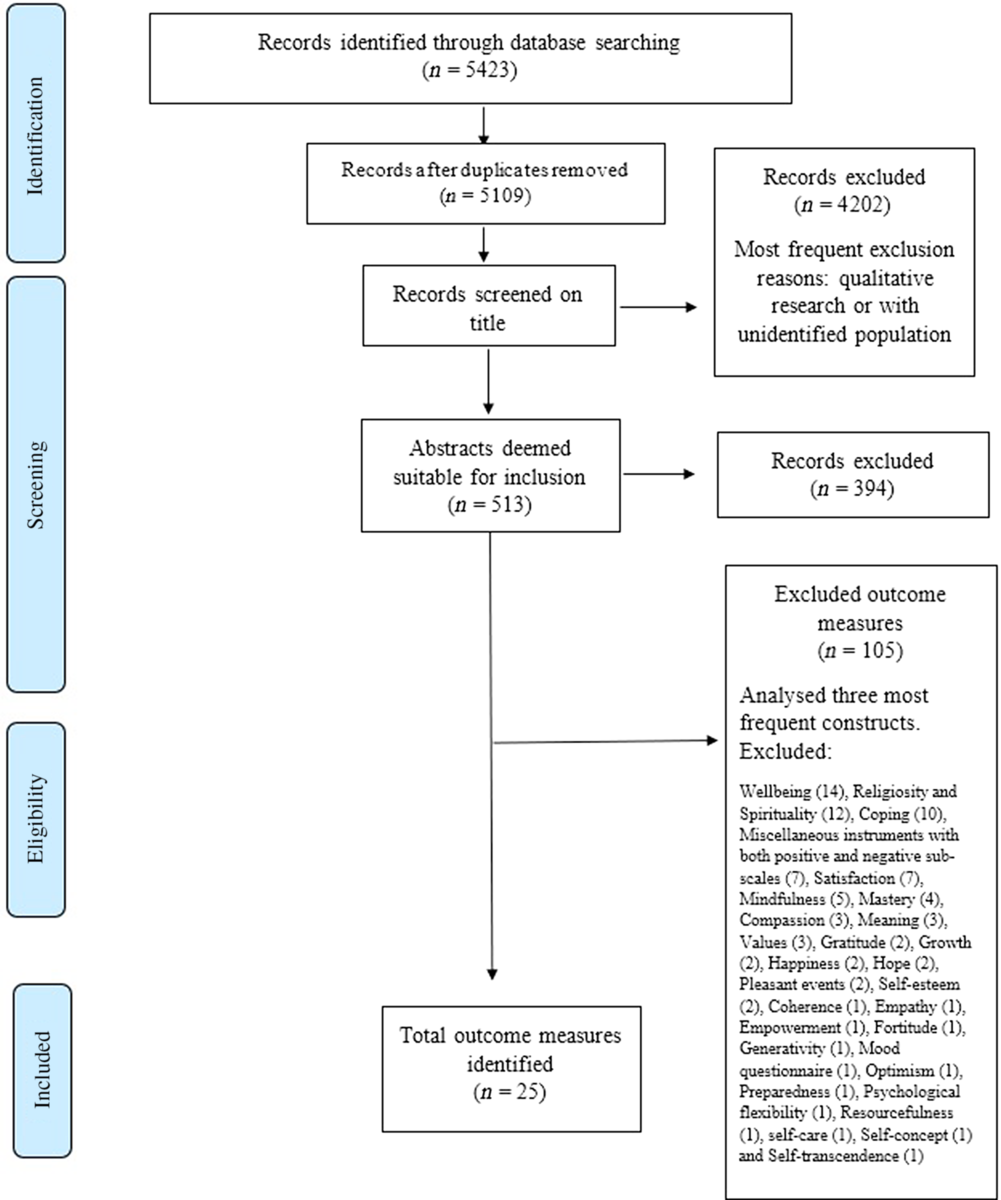
First, 5109 titles were screened to determine if family carers were the target population. The abstracts of 907 papers were then assessed to determine whether a suitable methodology was employed. This led to a retrieval of 513 full texts where each method section was examined to identify positive psychology outcome measures. This yielded 130 measures suitable for appraisal.
Throughout screening, the most frequent reasons for exclusion were the omission of positive measures, the use of a qualitative methodology, or a population other than family carers (Figure 1).
PRISMA search protocol.

Refinement of inclusion criteria
Due to a large number of results and to ensure this review was manageable, two additional criteria were subsequently added. First, constructs not deemed to be accurate reflections of positive psychology were excluded. Examples of this were “well-being” (n = 14 measures) and coping (n = 10 measures; Figure 1). Coping for instance, implies the presence of a negative or stressful event to be managed, rather than a positive emotion or trait as outlined in positive psychology approaches. Second, from the remaining constructs, the three most prevalent, assessed by the frequency of associated outcome measures, were selected for appraisal.
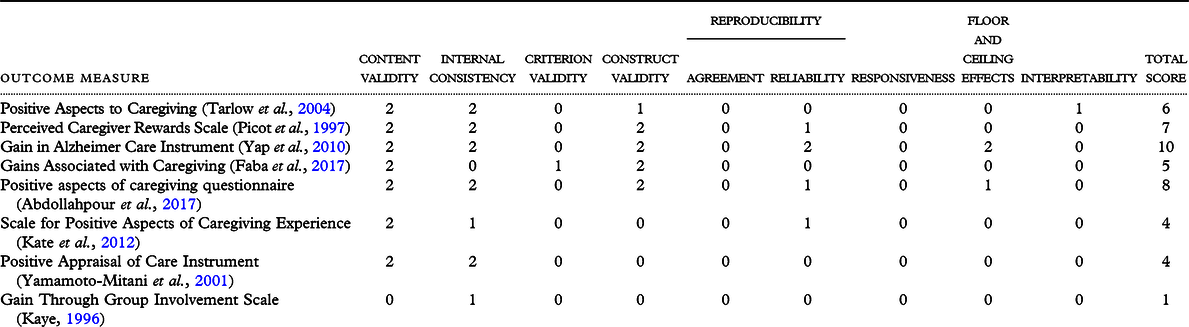
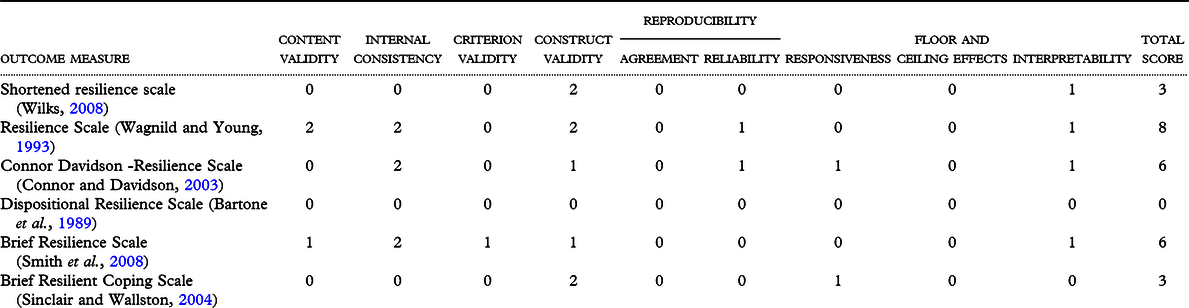
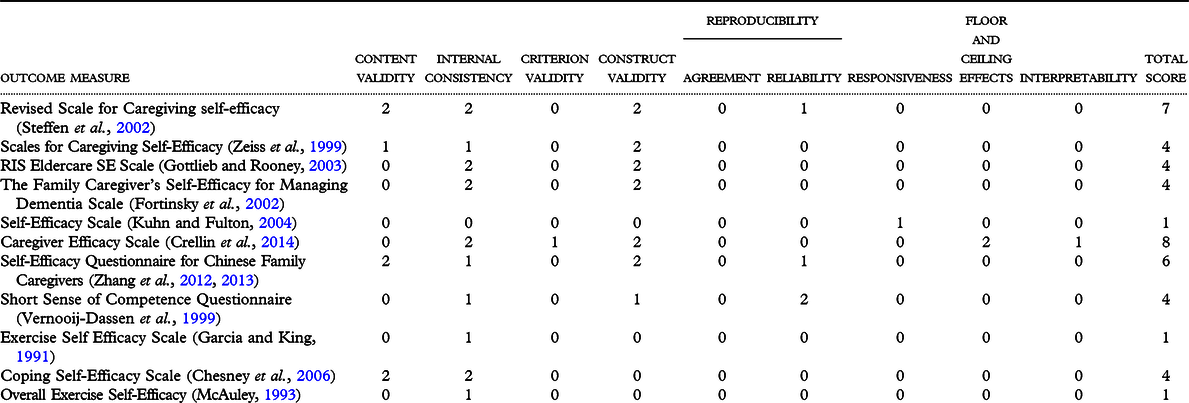
This resulted in self-efficacy (n = 16 measures), resilience (n = 10 measures), and positive aspects to caregiving (n = 10 measures) being selected. When these measures’ corresponding development texts were searched for, a proportion of them did not meet the inclusion or exclusion criteria after closer inspection. Therefore, a quality appraisal of positive aspects to caregiving (n = 8; Table 1), resilience (n = 5; Table 2), and self-efficacy (n = 11; Table 3) was carried out.
Quality appraisal scores for positive aspects to caregiving measures

Quality appraisal scores for resilience measures

Quality appraisal scores for self-efficacy measures

Quality appraisal tool
Assessment of measures’ psychometric properties was conducted using an established quality appraisal tool designed to determine properties of health status questionnaires (Terwee et al., Reference Terwee2007). This has been used successfully in related research (Stansfeld et al., Reference Stansfeld, Stoner, Wenborn, Vernooij-Dassen, Moniz-Cook and Orrell2017; Stoner et al., Reference Stoner, Stansfeld, Orrell and Spector2017) and evaluates measure development on nine criteria. Each criterion produces a score between zero and two indicating how well it had been evidenced within the text. A score of two indicates satisfactory reporting of the relevant statistics and/or an acceptable description of the design. A score of one was given if there were some methodological deficits or design flaws. Zero was awarded if the measure had serious methodological problems or no evidence was provided.
The assessed criteria include content validity, internal consistency, criterion validity, construct validity, agreement, reliability, responsiveness, floor and ceiling effects, and interpretability. Content validity measures how well the construct is measured by items in the questionnaire. It also relies on adequate consultation with the target population and experts. Internal consistency is appraised by satisfactory Cronbach’s alpha and factor analyses. Cronbach’s alpha scores were considered satisfactory if they fell between α = 0.70 and 0.95. Scores exceeding this range were considered to indicate multicollinearity. In this instance, multicollinearity refers to the likelihood that there were one or more redundant items within the measure. The internal consistency criteria also stipulate that factor analyses are completed with enough participants. This must include a minimum of 100 participants or seven times the number of items on a measure (Terwee et al., Reference Terwee2007). Criterion validity measures the extent to which the measure correlates with the gold standard. Construct validity is achieved through suitable relationships with theoretically related constructs. Frequently, this involved examining Pearson’s correlation coefficients. A coefficient was adjudged to be small (r = ±0.1 < 0.3), medium (r = ±0.3 < 0.5), or large (r ≥ ±0.5) (Field, Reference Field2009). Agreement measures the absolute measurement error. Reliability measures temporal stability using an Intraclass Coefficient (ICC) or weighted kappa (≥0.70) using a minimum of 50 participants. Responsiveness evaluates the ability to identify clinically important changes over time. Floor and ceiling effects are considered absent if less than 15% of respondents score the minimum or maximum score of the measure. Interpretability is assessed through the degree in which qualitative labels to quantitative scores.
The total possible score was 0–18. To increase the interpretability of the total score, descriptive labels were given. Scores from 0–4 were “poor,” 5–9 were “moderate,” 10–14 were “good,” and 15–18 were described as “very good.” RP and AC independently undertook the quality appraisal. A consensus meeting was held to discuss and resolve disagreements.
Interventional and cross-sectional research using the measures
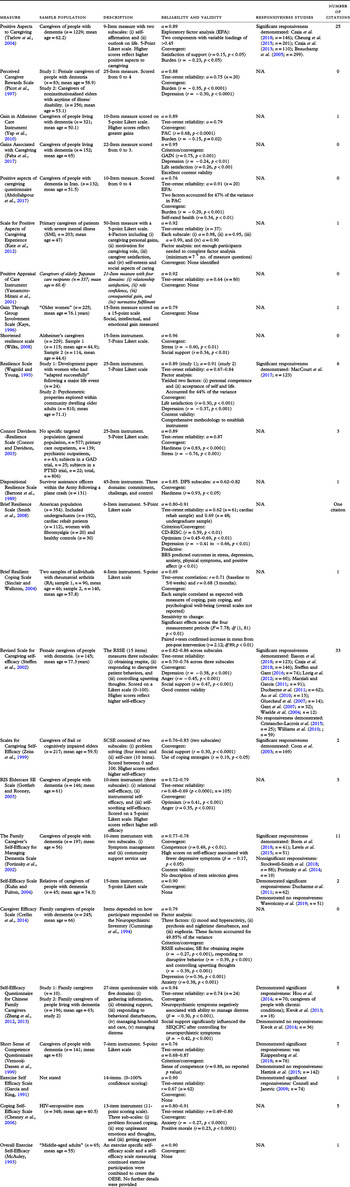
The search strategy yielded 113 papers which collectively cited the selected 25 measures. This information was used to determine both the responsiveness and the frequency with which each measure was employed. Of the 113 texts, 30 were interventions and determined whether there were any statistically significant changes in an intervention using the measure. The remaining citations used the measures within a cross-sectional design. The number of citations each measure received was recorded (Table 4) to provide information regarding acceptability by researchers. This was not a factor in determining the overall score of a measure.
Detailed analyses of included measures

Results
After the screening process, 25 outcome measures representing three constructs were subjected to quality appraisal. These constructs included positive aspects to caregiving, self-efficacy, and resilience. The Gain in Alzheimer Care Instrument (GAIN; Yap et al., Reference Yap, Luo, Ng, Chionh, Lim and Goh2010) was found to be the highest scoring measure across all constructs. The Resilience Scale (RS; Wagnild and Young, Reference Wagnild and Young1993) was the highest scoring measure for resilience. Finally, the Caregiver Efficacy Scale (CES; Crellin et al., Reference Crellin, Charlesworth and Orrell2014) was the highest scoring self-efficacy measure. The Revised Scale for Caregiving Self-Efficacy (RSSE; Steffen et al., Reference Steffen, McKibbin, Zeiss, Gallagher-Thompson and Bandura2002) possessed the highest number of citations evidencing significant differences following interventions using the measure.
Quality appraisal
Each construct contained measures not originally developed for carers of people with dementia but nevertheless had been used in research. For clarity, the measures developed for other populations have been identified as such within the appraisal. Each measure’s score on the Terwee et al. (Reference Terwee2007) quality appraisal criteria is presented in Tables 1–3. The relevant statistics contributing to each measure’s score have been presented in Table 4.
(i) Positive aspects to caregiving
For the purposes of this review, positive aspects to caregiving included positive appraisals, gains, or rewards linked to being a family carer. Five measures were developed for family carers: Positive Aspects of Caregiving (PAC; Tarlow et al., Reference Tarlow, Wisniewski, Belle, Rubert, Ory and Gallagher-Thompson2004), Perceived Caregiver Rewards Scale (PCRS; Picot et al., Reference Picot, Youngblut and Zeller1997), GAIN (Yap et al., Reference Yap, Luo, Ng, Chionh, Lim and Goh2010), Gains Associated with Caregiving Scale (GAC; Faba et al., Reference Faba, Villar and Giuliani2017), and the Positive Aspects of Caregiving Questionnaire (PACQ; Abdollahpour et al., Reference Abdollahpour, Nedjat, Noroozian, Salimi and Majdzadeh2017). Three measures were developed for other populations: the Scale for Positive Aspects of Caregiving Experience (SPACE; Kate et al., Reference Kate, Grover, Kulhara and Nehra2012; people with severe mental illnesses), Positive Appraisal of Care Instrument (PACI; Yamamoto-Mitani et al., Reference Yamamoto-Mitani2001; carers of older Japanese people), and the Gain Through Group Involvement Scale (GAINSCL, Kaye, Reference Kaye1996; older women).
Measures developed or validated with family carers (PAC, PCRS, GAIN, GAC, and PACQ)
The GAIN obtained the highest total with a good score (10/18). The remaining measures all obtained moderate scores. Although all measures obtained maximum content validity, the GAC comprehensively evidenced this through in-depth qualitative and quantitative engagement with a multitude of family carers.
Internal consistency was reported via Cronbach’s α in all five papers. Four of the papers ranged from acceptable (PACQ; α = 0.76) to good (PAC, PCRS, GAIN; α = 0.88–0.89). The GAC’s internal consistency was α = 0.95 indicating multicollinearity. Test–retest reliability was reported for three of the measures (GAIN, PCRS, and PACQ). Only the GAIN, however, evidenced a methodologically sufficient retest to fully satisfy the reliability criterion.
Convergent validity was presented for all measures with all reported results being significant. The PAC had small correlations with burden (r = 0.23) and well-being (r = 0.15). The GAIN had a large correlation with the PAC (r = 0.68) and a small correlation with burden (r = −0.15). The GAC possessed small correlations with life satisfaction (r = 0.26) and depression (r = 0.24). The PACQ moderately correlated with self-rated health (r = 0.34) and had a small correlation with burden (r = −0.29). The PCRS obtained a small to medium correlation with depression (r = −0.30) and a medium strength correlation with burden (r = −0.35; Table 4).
The PAC scored one point on the interpretability criterion through providing means and standard deviations of four different samples of participants. As it did not provide a minimal important change (MIC) score, it could not receive full credit for this criterion. The GAIN was the only measure to report an absence of floor and ceiling effects within this construct.
Measures developed or validated with other populations (SPACE, PACI, and GAINSCL)
All three measures scored poorly. The SPACE, however, demonstrated good content validity through detailed consultations with its target population.
All cited internal consistency using Cronbach’s α which varied from acceptable to excellent. The SPACE and PACI shared the highest score (α = 0.92). In the development paper for the SPACE, the factor analysis was not completed with enough participants, limiting its internal consistency score. The measures did not demonstrate criterion or convergent validity. The SPACE was the only measure to demonstrate test–retest reliability but did so with less than 50 participants indicating a methodological limitation.
Use in carer research
The PAC was the only measure to demonstrate responsiveness in interventions (n = 4; Table 4). Three such studies using the PAC demonstrated responsiveness through a virtual intervention. All other texts citing positive aspects to caregiving measures had utilized them in cross-sectional research (PAC; n = 21; GAIN, n = 1; SPACE, n = 1; GAINSCL, n = 1).
Positive aspects to caregiving summary and recommendation
No positive aspects to caregiving measures evidenced responsiveness or agreement. The GAC was the only measure attempting to obtain criterion validity through a large positive significant relationship with the GAIN. Owing to its comprehensive development, it is recommended that the GAIN be used to measure positive aspects to caregiving.
(ii) Resilience
The Resilience Scale 15 (RS15; Wilks, Reference Wilks2008) was the only measure found to have been developed or validated with family carers. Five instruments were found to measure resilience that were developed for populations other than family carers: the RS (Wagnild and Young, Reference Wagnild and Young1993; women who adapted after a serious life event), the Connor–Davidson Resilience Scale (CD-RISC; Connor and Davidson, Reference Connor and Davidson2003; different American populations), the Dispositional Resilience Scale (DRS; Bartone et al., Reference Bartone, Ursano, Wright and Ingraham1989; survivor assistance officers in the army), the Brief Resilience Scale (BRS; Smith et al., Reference Smith, Dalen, Wiggins, Tooley, Christopher and Bernard2008; different American populations), and the Brief Resilient Coping Scale (BRCS; Sinclair and Wallston, Reference Sinclair and Wallston2004; people with rheumatoid arthritus).
Measures developed or validated with family carers (RS15)
The RS15 (Wilks, Reference Wilks2008) scored poorly. It did not evidence content validity sufficiently and no points were given for internal consistency as the reported Cronbach’s α indicated multicollinearity. Convergent validity was achieved via a large significant correlation with perceived stress (r = −0.60) and a moderately significant correlation with social support (r = 0.34; Table 4).
Measures developed or validated with other populations (RS, CD-RISC, DRS, BRS, and BRCS)
The RS was the highest scoring measure (8/18) within the resilience construct. The remaining measures varied from poor to moderate. The RS was the only instrument to involve the target population sufficiently to satisfactorily illustrate content validity. The RS, CD-RISC, and BRS were the only measures to report acceptable Cronbach’s α scores (α = 0.81–0.91). The RS and CD-RISC reported test–retest reliability but did not obtain the full score for methodological reasons.
Convergent validity was present for all measures with all reported results being significant. The RS obtained small to moderate correlations with life satisfaction (r = 0.30) and a medium strength correlation with depression (r = −0.37). The CD-RISC possessed large correlations with hardiness (r = 0.83) and perceived stress (r = −0.76). The DPS had a large correlation with hardiness (r = 0.93). The BRS attained convergent validity through a large correlation with the CD-RISC (r = 0.59) and moderate correlations with depression (r = −0.41) and optimism (r = 0.45; Table 4). The BCRS obtained a small negative correlation with depression and a small positive correlation with life satisfaction.
Use in carer research
The RS was the only resilience measure to demonstrate sensitivity to change with 123 family carers (MacCourt et al., Reference MacCourt, McLennan, Somers and Krawczyk2017). It found a significant increase in resilience following a grief intervention. All other texts citing resilience measures used them within cross-sectional research (RS, n = 5; CD-RISC, n = 3; DRS, n = 1; BRS, n = 1; BRCS, n = 1; Table 4).
Resilience summary and recommendation
No resilience measures evidenced the absence of floor and ceiling effects or provided information on MIC to aid their interpretability score. Despite this measure not being developed for family carers, the RS is the recommended instrument to measure resilience. It was the highest scoring measure and demonstrated responsiveness in one research paper.
(iii) Self-efficacy
There were eight measures developed for family carers: the RSSE (Steffen et al., Reference Steffen, McKibbin, Zeiss, Gallagher-Thompson and Bandura2002), the Scales for Caregiving Self-Efficacy (SCSE; Zeiss et al., Reference Zeiss, Gallagher-Thompson, Lovett, Rose and McKibbin1999), the RIS Eldercare Self-Efficacy Scale (RIS; Gottlieb and Rooney, Reference Gottlieb and Rooney2003), Caregivers’ Self-Efficacy for Managing Dementia Scale (CSEMDS; Fortinsky et al., Reference Fortinsky, Kercher and Burant2002), the Self-Efficacy Scale (SES; Kuhn and Fulton, Reference Kuhn and Fulton2004), the Caregiver Efficacy Scale (CES; Crellin et al. Reference Crellin, Charlesworth and Orrell2014), the Self-Efficacy Questionnaire for Chinese Family Caregivers (SEQCFC; Zhang et al., Reference Zhang, Edwards, Yates, Ruth and Guo2013), and the Short Sense of Competence Questionnaire (SSCQ: Vernooij-Dassen et al., Reference Vernooij-Dassen, Felling, Brummelkamp, Dauzenberg, Bos and Grol1999). Three measures were found which were developed for other populations: the Exercise Self-Efficacy Scale (ESES; Garcia and King, Reference Garcia and King1991; population not specified), the Coping Self-Efficacy Scale (CSES; Chesney et al., Reference Chesney, Neilands, Chambers, Taylor and Folkman2006; men with Human Immunodeficiency Virus), and the Overall Exercise Self-Efficacy instrument (OESE; McAuley, Reference McAuley1993; middle-aged adults).
Measures developed or validated with family carers (RSSE, SCSE, RIS, CSEMDS, SES, CGSES, SEQCFC, SSCQ)
The scores varied from poor (SES; 1/18) to moderate (CES; 8/18). The RSSE and SEQCFC were the only measures to evidence content validity effectively. The other instruments failed to involve the target population or experts in their respective development phase.
Every measure cited Cronbach’s α, varying from acceptable to excellent. The SEQCFC obtained the highest score for internal consistency (α = 0.94) and the RIS obtained the lowest (α = 0.72–0.79). The absence of factor analyses limited the internal consistency score for the SCSE and SES. The SEQCFC completed a factor analysis with too few respondents to adequately satisfy the internal consistency criterion. Test–retest reliability was not suitably demonstrated for a single measure. Those that attempted to measure test–retest reliability were marred by methodological shortcomings such as a small retest sample size.
Convergent validity was evidenced for all measures (excepting the SES and SSCQ) with all reported results being significant. The RSSE obtained moderate correlations with depression (r = −0.38) and social support (r = 0.47). The SCSE attained small- to medium-sized correlation with social support (r = 0.30) and a small correlation with logical analysis (r = 0.19). The RIS possessed moderate correlations with optimism (r = 0.41) and anger expression (r = −0.35). The CSEMDS had a moderate correlation with sense of competence (r = 0.49). The CES obtained moderate-sized correlations with depression (r = −0.36) and anxiety (r = −0.38; Table 4). The SEQCFC found social support significantly affected all of its subscales while controlling for the care recipeint’s neuropsychiatric symptoms. Multiple regression confirmed care recipients’ neuropsychiatric symptoms were negatively associated with the caregivers’ ability to manage distress. The SSCQ inferred convergent validity through a large positive significant correlation with its longer version counterpart; the Sense of Competence Questionnaire (SCQ; Vernooij-Dassen, Reference Vernooij-Dassen1993).
Measures developed with other populations (ESES, CSES, OESE)
All three measures scored poorly. Both exercise instruments obtained a point for reporting on the Cronbach’s α score which were found to be acceptable. The CSES demonstrated good content validity, internal consistency, and factor structure. However, the measures did not evidence any other psychometric properties contributing to their collective poor scores.
Use in carer research
The RSSE had nine citing texts indicating responsiveness to an intervention, and two papers indicating an effect had not been found. On the balance of probabilities, the RSSE is likely to be responsive to change. Other measures with citing texts indicating responsiveness were the SCSE (n = 1), CSEMDS (n = 2), SES (n = 1), SSCQ (n = 1), ESES (n = 1), and the SEQCFC (n = 2). There were a variety of texts citing these measures that used them within cross-sectional research (RSSE, n = 24; CSEMDS, n = 7; CSES, n = 5; SEQCFC, n = 5; SSCQ, n = 5; RIS, n = 3; SCSE, n = 1; OESE, n = 1; Table 4).
Self-efficacy summary and recommendation
Both the ESES and the SES were the lowest scoring instruments within this construct (1/18). No measures evidenced agreement or interpretability. The CES was the only measure to evidence a lack of floor and ceiling effects. The CES obtained the highest score (8/18). Owing to how the CES is linked with the Neuropsychiatric Inventory (Cummings et al., Reference Cummings, Mega, Gray, Rosenberg-Thompson, Carusi and Gombein1994), the CES is recommended when measuring carers’ confidence ratings in managing behavioral and psychological symptoms of dementia (BPSD). The CES evidenced good internal consistency, construct validity, and some information on interpretability. It was the only self-efficacy measure to demonstrate an absence of floor or ceiling effects. As carers were not involved in the development of the CES, it could not score a point in the content validity criterion. However, that is not to suggest that there is no content validity present within the measure. Its development was informed by relevant self-efficacy literature (Bandura, Reference Bandura, Urdan and Pajares2006).
If confidence in managing BPSD is not the focus of interest, then the RSSE would be recommended as the next highest scoring self-efficacy measure (7/18). The RSSE comprehensively demonstrated its content validity through a robust process of item selection and factor analyses. It evidenced good construct validity and could have scored higher on its reliability criterion had it used a kappa or ICC statistic for the test–retest. Additionally, it was the most frequently cited self-efficacy measure and many studies demonstrated its responsiveness (n = 10). This is important as it suggests that if an intervention does lead to an increase in one’s self-efficacy, then the RSSE is likely to detect this.
Discussion
Twenty-five positive psychology outcome measures were identified as having been developed, validated, or in use with family carers of people living with dementia. These measures represented the constructs of resilience, self-efficacy, and positive aspects to caregiving. This review extends previous research by identifying and examining the psychometric properties of all measures used with family carers. It is also the first review that includes data regarding each measure’s responsiveness. This is an important and often overlooked psychometric property that has implications for research and interventions.
All measures except the GAIN obtained a “poor” or “moderate” score in the quality appraisal. No measure satisfactorily evidenced criterion validity, agreement, responsiveness, or interpretability. Many measures adequately evidenced content validity which has been suggested to be the most valuable criterion (Terwee et al., Reference Terwee2007). The highest overall scoring measure was the GAIN (Yap et al., Reference Yap, Luo, Ng, Chionh, Lim and Goh2010) mirroring the finding of a related review (Stansfeld et al., Reference Stansfeld, Stoner, Wenborn, Vernooij-Dassen, Moniz-Cook and Orrell2017). The GAIN measured positive aspects to caregiving. The highest scoring resilience measure was the RS (Wagnild and Young, Reference Wagnild and Young1993). The highest scoring self-efficacy instrument was the CES (Crellin et al., Reference Crellin, Charlesworth and Orrell2014).
Clinicians or researchers employing a positive psychology outcome measure may choose to utilize the recommended measures from this review. The choice of measure may also depend on the instrument required. There is ample variability with respect to how instruments measured their corresponding construct. For example, the positive aspects to caregiving construct include instruments measuring rewards (PCRS), gains in caregiving (GAC, GAIN), and PACI.
Limitations
This review had initially identified 130 positive psychology outcome measures suitable for a quality appraisal. As this was beyond the scope of a single review, the additional criteria to exclude certain constructs and select the three most prevalent were added. An alternate method could have selected the 20 measures most frequently cited. This would not have resulted in a single recommended measure per construct, however. Through choosing the three most frequent constructs, it was hoped that the review captured the most prevalent and thus important positive psychology traits.
The review’s search strategy used the key search term “intervention.” The intention was to locate measures within interventional research to provide information on responsiveness. Many of the papers, however, were cross sectional in nature. The wide-ranging search terms used may have contributed to this. Given the vast number of instruments found, it was assumed that an appropriate number of measures had been accumulated and no further refinements were made. This review was influenced by Seligman’s definition (Reference Seligman1998) of positive psychology. It is possible that other positive psychology frameworks such as Ryff’s Scales of Psychological Wellbeing (1989) could have yielded other results.
As responsiveness is a key psychometric property, the review included all papers citing measures within interventions, but this was also subject to limitations. The GAIN, for example, was found to be the highest scoring measure but had only one citation. Several explanations could account for this. It is possible that as the measure was developed in Singapore, research citing it could be published in another language. Conversely, it is conceivable that researchers are not using the GAIN, or English translations of it do not exist.
This review was somewhat limited by the quality appraisal criteria. The content validity criterion, for example, had many measures scoring the maximum score. As this is a crucial criterion to assess, this could be scored on a scale from 0–3 as opposed to 0–2. This would enable instruments to be differentiated from each other with respect to how they satisfied this criterion.
An additional example of being constrained by the appraisal criteria involved being unable to reward measures demonstrating responsiveness in studies citing the measure since their development. Had this been the case, the RSSE would have been the highest scoring self-efficacy measure owing to the many interventions finding significant differences using it.
Future research
The screening process elicited 130 eligible instruments for appraisal. The additional criterion of analyzing the three most cited constructs left 105 unanalyzed measures. Such constructs included “coping,” “well-being,” and “satisfaction” and could undergo a similar quality appraisal process. Future authors could separate these reviews through appraising measures relating to internal positive psychology factors such as this one or external factors.
As this review highlighted a lack of focus on responsiveness across all instruments, future reviewers could complete a multi-lingual review. This would focus on finding interventions where instruments have been used in languages other than English to bring together a cohesive account of positive psychology outcome measures around the world.
It was noted that many measures could have increased their quality appraisal score through evidencing additional psychometric properties. Only 2 of 25 measures provided data detailing a lack of floor and ceiling effects. It is possible that more instruments did not have floor or ceiling effects, but due to a lack of evidence, could not satisfy this criterion. Therefore, we recommend future authors to design instruments fulfilling criteria on established quality appraisal tools (e.g. Terwee et al., Reference Terwee2007) when developing measures. This can serve as a checklist to ensure that all criterions have the potential to be evidenced.
We also recommend that a validation study of the RS with a family carer sample is conducted to obtain further psychometric properties. Although authors of the RS15 (Wilks, Reference Wilks2008) attempted to do this, the psychometric properties were not sufficient, so further work is needed.
The recommended measure for self-efficacy was the CES, with the RSSE (Steffen et al., Reference Steffen, McKibbin, Zeiss, Gallagher-Thompson and Bandura2002) falling just behind. A major difference between the two instruments was that the RSSE was the most cited measure within the review. The RSSE possessed 10 citations where significant differences in self-efficacy were present within an intervention. The CES had no citations at all. This review recommends that the CES be utilized more within research settings to determine whether it can detect changes over time following an intervention. Due to the nature of what the CES measures, this could look like an intervention which seeks to increase the confidence of carers managing behavior that challenges in those that they care for.
Our final recommendation would be for future researchers to develop a core outcome set for carers of people with dementia. This process is desirable when there are a great variety of measures being used. Having a heterogeneous range of measures can stifle comparisons among studies and complicate meta-analyses. Core outcome set research starts with the broad question of what constructs should be measured. After this, the aim is to identify the most effective instruments to measure each corresponding construct. We recommend that suitable positive measures are included within such a set. A core outcome set has been completed for people living with dementia (Harding et al., Reference Harding2019; Harding et al., Reference Harding2020; Reilly et al., Reference Reilly2020).
Implications for practice
Psychosocial interventions with family carers often include instruments measuring burden, stress, or depression. Measuring these constructs can be an important part of a clinician’s assessment. This could also have the unintended consequence of reinforcing the narrative that caring is inevitably linked with depression, feeling burdened, and burned out. This emphasis may be incompatible with those carers who subscribe to a different narrative. For example, carers who experience personal growth in looking after their loved ones (Wong et al., Reference Wong, Ussher and Perz2009), or who still harbor hopes and dreams about the future.
When planning interventions with family carers, we recommend a variety of measurement tools, reflecting a range of different constructs. This reflects the complexity of the human experience and the capacity to experience a full range of emotions. This could give researchers and carers opportunities to reflect on both positive and negative emotions in relation to any given intervention.
Using less robust measures will have important clinical implications and these will vary in accordance with each unevidenced criterion. For instance, measures that did not evidence convergent validity adequately cannot be assumed to hold construct validity. Clinicians who find changes using a measure across time that has not had its responsiveness evidenced sufficiently would face complexities in analyzing these differences. The differences could be due to the intervention, bias, or to inherent error found within the measure.
Conclusions
This review demonstrates that there are some positive psychology outcome measures with desirable psychometric properties in use for family carers, but there were also many measures which had methodological flaws. The most psychometrically sound positive aspects to caregiving measure were the GAIN (Yap et al., Reference Yap, Luo, Ng, Chionh, Lim and Goh2010). The highest scoring self-efficacy measure was the CES (Crellin et al., Reference Crellin, Charlesworth and Orrell2014). The highest scoring resilience measure was the RS (Wagnild and Young, Reference Wagnild and Young1993). Of these three recommended measures, only the RS demonstrated responsiveness in one study (MacCourt et al., Reference MacCourt, McLennan, Somers and Krawczyk2017). We therefore recommend all three measures be included in future interventions for further evaluation.
While there have been several qualitative research studies investigating family carers’ experiences (Dam et al., Reference Dam, Boots, Van Boxtel, Verhey and De Vugt2018; Hickman et al., Reference Hickman, Clarke and Wolverson2018), there have been concerns regarding the quality of quantitative measurement of positive traits. Positive psychology advocates have appealed for the development of behavior-based domain-specific measures (Seligman et al., Reference Seligman, Steen, Park and Peterson2005), but research using such measures can lack rigorous methodology or use instruments that are not robust (Stoner, Reference Stoner2019). This highlights the importance of both measure development and the need to be selective when choosing measures for clinical or research use.
Conflict of interest
None.
Description of authors’ roles
Study design and concept: Richard D. Pione, Charlotte R. Stoner, and Aimee Spector.
Acquisition of data: Richard D. Pione.
Analysis of data: Richard D. Pione and Anna V. Cartwright.
Drafting of the manuscript: Richard D. Pione.
Critical revision of the manuscript: Aimee Spector and Charlotte R. Stoner.