INTRODUCTION
Human taeniases are caused by consumption of raw or under-cooked beef, pork meat and pork viscera, mainly liver, contaminated with cysticerci of Taenia saginata, T. solium and T. asiatica, respectively (Fan, Reference Fan1995; Ito et al. Reference Ito, Nakao and Wandra2003; Craig and Ito, Reference Craig and Ito2007; Flisser et al. Reference Flisser, Craig, Ito, Palmer, Soulsby, Torgerson and Brown2011). Taenia tapeworm carriers usually present mild abdominal symptoms or may even be asymptomatic. However, neurocysticercosis (NCC), a life-threatening cysticercosis caused by the larval stage (metacestode) of the pork tapeworm, T. solium, in the central nervous system, has been increasingly recognized as a serious public health problem in both developing (Cruz et al. Reference Cruz, Davis, Dixon, Pawlowski and Proano1989; Allan et al. Reference Allan, Velasquez-Tohom, Torres-Alvarez, Yurrita and Garcia-Noval1996; Li et al. Reference Li, Craig, Ito, Chen, Qiu, Qiu, Sato, Wandra, Bradshaw, Li, Yang and Wang2006) and developed countries (Schantz et al. Reference Schantz, Moore, Munoz, Hartman, Schaefer, Perasaud, Sarti, Wilson and Flisser1992; Esquivel et al. Reference Esquivel, Diaz-Otero and Gimenez-Roldan2005; Sorvillo et al. Reference Sorvillo, Wilkins, Shafir and Eberhard2011;Yanagida et al. Reference Yanagida, Sako, Nakao, Nakaya and Ito2012). Animal cysticercoses, due to ingestion of eggs of these three species, have led to a significant economic loss of meat production in endemic regions (Murrell, Reference Murrell1991; Fan, Reference Fan1997). As humans are the sole definitive host of these three Taenia species, detection of taeniasis carriers in endemic areas is important for control and prevention of cysticercosis in humans as well as in animals.
Voiding of segments is often a specific symptom for taeniasis (Craig and Ito, Reference Craig and Ito2007). Thus, a self-detection tool through questioning the history of proglottid elimination as an auxiliary method can be valuable for the diagnosis of taeniasis (Flisser et al. Reference Flisser, Vazquez-Mendoza, Martinez-Ocana, Gomez-Colin, Leyva and Medina-Santillan2005; Li et al. Reference Li, Ito, Chen, Long, Okamoto, Raoul, Giraudoux, Yanagida, Nakao, Sako, Xiao and Craig2012). Conventional techniques for detection of taeniasis carriers include both macroscopic and microscopic stool examinations for detection of proglottids and eggs, respectively. Though microscopy lacks sensitivity, it has very high genus specificity (Pawlowski and Schulz, Reference Pawlowski and Schulz1972) and thus remains one of the most commonly applied tools for the diagnosis of human taeniases in endemic countries. Copro-ELISA tests for human taeniases (Allan et al. Reference Allan, Avila, Garcia Noval, Flisser and Craig1990) were reported to increase the detection of Taenia spp. carriers at least two-fold in endemic areas compared to traditional stool concentration with microscopy for taeniid egg detection (Allan and Craig, Reference Allan and Craig2006). A putative T. solium-specific copro-ELISA was recently reported (Guezala et al. Reference Guezala, Rodriquez, Zamora, Garcia, Gonzalez, Tembo, Allan and Craig2009) but has not been widely assessed at community level. No Taenia copro-ELISA tests are currently available commercially. The advent of coproPCR for detection of DNA in extracts of human stool samples has also contributed to patient diagnosis and greatly improved species identification prior to treatment (Yamasaki et al. Reference Yamasaki, Allan, Sato, Nakao, Sako, Nakaya, Qiu, Mamuti, Craig and Ito2004).
Human taeniases are known to be highly endemic in Tibetan farming areas of northwest Sichuan (Li et al. Reference Li, Craig, Ito, Chen, Qiu, Qiu, Sato, Wandra, Bradshaw, Li, Yang and Wang2006). However, information about the reliability of self-detection tool, coproPCR and stool microscopy for detection of taeniasis in any endemic region of China is lacking. The current study aimed to test and compare the positive detection rate of self-detection, stool microscopic examination with direct smear and a species-specific coproPCR for detection of taeniases in endemic areas of Sichuan Province.
MATERIALS AND METHODS
Study sites
This study was conducted in Tibetan farming communities of Yajiang County, Ganzi Prefecture, Sichuan Province from 2009 to 2012.
Sample collection and diagnostic criteria
Each self-selected participant was asked to provide faecal samples (∼20 g) for microscopy for the presence of Taenia eggs in Sichuan CDC (China) and/or coproPCR for detection of Taenia-specific DNA at Asahikawa Medical University, Japan.
Volunteer villagers were also provided freely with a traditional Chinese medicine for elimination of tapeworms or proglottids, as reported previously (Li et al. Reference Li, Ito, Chen, Long, Okamoto, Raoul, Giraudoux, Yanagida, Nakao, Sako, Xiao and Craig2012). In brief, three different compounds including 120 g of peeled raw pumpkin seeds, 200 mL areca nut extract prepared from 80 g dry areca nut slices for an adult person, and magnesium sulfate solution as a purgative at a dose of 0·5 g/kg body weight were taken in order at 40 min to 1 h intervals in the morning on an empty stomach. Labelled plastic bags were then provided to treated persons to collect faeces during their stay at the clinic for 5 h post-treatment. Subsequent examination of faeces and purge materials was conducted to confirm the presence of tapeworms or proglottids. For those persons who did not expel tapeworms or segments during the period of observation, subsequent self-check was requested for a period of 3 days to determine if tapeworms/segments were later expelled. The expelled proglottids or tapeworms following treatment were stored in ethanol and were later checked by multiplex PCR for Taenia species identification (Yamasaki et al. Reference Yamasaki, Allan, Sato, Nakao, Sako, Nakaya, Qiu, Mamuti, Craig and Ito2004).
Persons who were Taenia egg-positive by stool microscopy and/or expelled tapeworms or proglottids post-treatment were diagnosed as taeniasis cases.
Parasite species identification
Parasite isolates were analysed by multiplex PCR for differentiation of three human Taenia species as described previously (Yamasaki et al. Reference Yamasaki, Allan, Sato, Nakao, Sako, Nakaya, Qiu, Mamuti, Craig and Ito2004). Briefly, the cytochrome C oxidase subunit 1 gene (cox1) was used as a target gene. Three forward primers were used to amplify different sizes of products, specific for T. saginata, T. solium Asian genotype and T. asiatica, respectively. A PCR cocktail contained mixed primers and 0·125 μL of the ExTaqDNA polymerase Hot Start (TakaRa, Tokyo, Japan) in 25 μL of a reaction mixture. Multiplex PCR protocols were composed of 1 cycle of initial denaturation (30 sec at 98 °C), 35 cycles of denaturation (30 sec at 94 °C), annealing (30 sec at 58 °C), and extension (90 sec at 72 °C), plus 1 cycle of final extension (5 min at 72 °C).
Self-detection by questionnaire
For each participant, a questionnaire was completed to provide information on the history of expulsion of ‘noodle-like worms’ (tapeworms) within the previous one year, if any, information about the duration of worm expulsion and the frequency of expulsion (frequently or occasionally).
Stool microscopy
Faecal samples were examined under the microscope with direct smear for the presence of Taenia eggs. Three slides were requested to check for each Taenia egg-negative stool sample.
CoproPCR
Faecal samples were also examined by coproPCR for detection of Taenia-specific DNA, as described previously (Yamasaki et al. Reference Yamasaki, Allan, Sato, Nakao, Sako, Nakaya, Qiu, Mamuti, Craig and Ito2004), with a minor revision. That is, before using a QIAamp DNA stool mini kit to extract DNA, faecal samples were treated with glass beads for egg disruption (Nunes et al. Reference Nunes, Lima, Manoel, Pereira, Nakano and Garcia2006). The same protocols as described above (for multiplex PCR) were used in coproPCR, except that 50 μL of a reaction mixture was used with coproDNA samples, and annealing was performed at 55 °C.
Statistical analyses
A Chi-square test was used to compare the occurrence rate of segment expulsion between T. saginata- and T. solium-infected persons and the positive detection rate of microscopy and coproPCR for taeniasis, and also applied to compare the positive detection rate of microscopy and coprPCR between the cases infected with a single tapeworm and with multiple tapeworms. P values equal to or less than 0·05 were considered indicative of statistical significance.
RESULTS
A total of 220 persons were confirmed to be Taenia tapeworm carriers in this study (2009–2012), due to expulsion of tapeworms or proglottids following treatment in 204 and the presence of Taenia eggs in 16 untreated cases. Of these 220 cases, 140 were male and 80 were female. Subject ages ranged from 8 years to 68 years (mean age 38·2 years).
Tapeworms or proglottids were collected in 164 of 220 taeniasis cases, and the species were identified by multiplex PCR as follows: 144 T. saginata, 15 T. solium, 2 T. asiatica and 3 dual infections of T. saginata and T. solium. The remaining 56 cases released tapeworms or segments following treatment, but parasite materials were not obtained. Whole tapeworms were collected in 95 of 164 taeniasis cases, of which 68 were confirmed to be infected with a single tapeworm, whereas the remaining 27 were found to harbour multiple worms, ranging in number from 2 to 20. All the 20 tapeworms expelled by one case were confirmed as T. solium (Ito et al. Reference Ito, Li, Chen, Long, Yanagida, Nakao, Sako, Okamoto, Wu, Raoul, Giraudoux and Craig2013).
Microscopy with direct smear
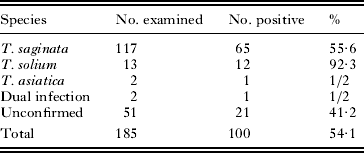
Stool microscopic examinations were conducted in 185 of 220 taeniasis cases including T. saginata (117), T. solium (13), T. asiatica (2), dual infection (2) and unconfirmed (51). As a result, 54·1% (100) were Taenia egg- positive. These Taenia egg-positive cases were composed of T. saginata (65), T. solium (12), T. asiatica (1), dual infection (1) and unconfirmed (21) (Table 1). Thus, 55·6% (65/117) of T. saginata- and 92·3% (12/13) of T. solium-infected persons were detected by microscopy with direct smear. No additional taeniasis cases were detected by repeated stool examinations.
Results of stool microscopy with direct smear in 185 taeniasis cases
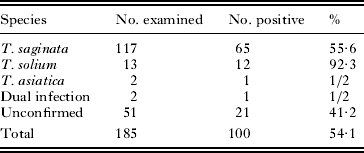
Dual infection: with both T. saginata and T. solium.
Unconfirmed: the species confirmation was not performed, since we failed to recover parasite specimens.
Fifty-six of 68 cases infected with a single tapeworm were examined, and 53·6% (30) were Taenia egg-positive. In 27 cases infected with multiple tapeworms, 21 were checked and 52·4% (11) showed positive microscopy. The positive detection rate of microscopy between the cases with a single tapeworm and with multiple tapeworms was not significantly differerent (P = 0·8704).
CoproPCR
CoproPCR was performed in 132 of 220 taeniasis cases, consisting of T. saginata (84), T. solium (9), T. asiatica (1), dual infection (2) and unconfirmed (36). Of the 132 cases, Taenia-specific DNA was amplified in 92 (69·7%), including T. saginata (61), T. solium (9), T. asiatica (0), dual infection (1) and unconfirmed (21). Of the 21 unconfirmed cases, 20 were therefore identified as T. saginata and 1 as T. solium.
Forty-five of 68 cases infected with a single tapeworm were tested, and 64·4% (29) showed positive results with coproPCR. In 27 cases infected with multiple tapeworms, 15 were analysed, and Taenia-specific DNA was amplified in 10 (66·7%). Statistical analysis indicated that the positive detection rate of coproPCR was not different between the cases infected with a single tapeworm and with multiple tapeworms (P = 0·88).
Stool examinations by both microscopy and coproPCR
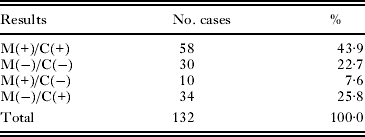
Both microscopy with direct smear and coproPCR were performed concurrently in 132 of 220 taeniasis patients. Of these, 51·5% (68) were Taenia egg-positive under microscope and 69·7% (92) with positive coproPCR. Statistical analysis indicated that the positive detection rate of coproPCR for taeniasis was significantly greater than microscopy with direct smear (P = 0·0038). Among the 132 cases, 58 (43·9%) were detected by both microscopy and coproPCR, whereas 30 (22·7%) showed negative results with both methods. In addition, ten (7·6%) cases showed positive with microscopy but negative with coproPCR, while 34 (25·8%) showed positive with coproPCR but negative with microscopy (Table 2). In other words, combination of microscopy and coproPCR detected 77·3% (102/132) of taeniasis infected persons.
Results of stool examinations by both microscopy with direct smear and coproPCR in 132 taeniasis cases
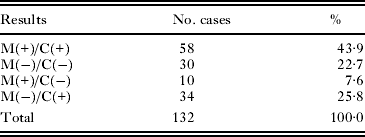
M: microscopy with direct smear.
C: coproPCR.
(+): positive.
(−): negative.
Self-detection by questioning the history of proglottid expulsion
A total of 224 persons who reported a history of segment expulsion within the previous year were treated, and 195 (87·1%) eliminated proglottids or tapeworms following treatment. Of the 195 cases, 142 were confirmed as T. saginata, 14 as T. solium, 2 as T. asiatica, 3 with dual infection of both T. saginata and T. solium, and 34 with unconfirmed species.
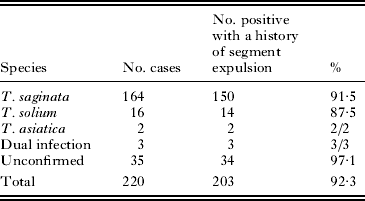
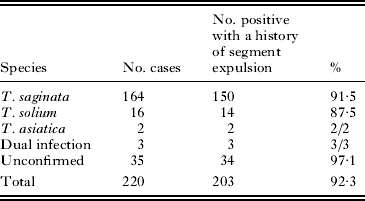
According to the results of multiplex and coproPCR, in 220 taeniasis cases, 164 were confirmed with T. saginata, 16 T. solium, 2 T. asiatica, 3 with dual infections and 35 remained unconfirmed. Of these 220 cases, 203 (92·3%) reported a history of proglottid expulsion within the previous one year. The 203 cases included T. saginata (150), T. solium (14), T. asiatica (2), dual infection (3) and unconfirmed (34) (Table 3). In other words, 91·5% (150/164) of T. saginata-infected persons reported a history of proglottid expulsion within the previous year, and 87·5% (14/16) for T. solium cases. There was no significant difference in expulsion between T. saginata- and T. solium-infected persons (P = 0·428). The remaining 17 cases without a history of segment expulsion comprised 14 T. saginata, 2 T. solium and 1 with unconfirmed species.
Rate of proglottid expulsion in 220 taeniasis cases
Information about the duration of proglottid expulsion and expulsion intervals was obtained from 104 patients (93 T. saginata and 11 T. solium). In 93 T. saginata-infected persons the duration varied from 5 months to 30 years (mean 7·7 years), and 53·8% (50) of persons had experienced voiding of tapeworm proglottids for over 5 years. Among the 93 persons, 90 reported that tapeworm proglottids were expelled at an interval of days, and the remaining 3 people described that proglottid expulsion occurred daily. By contrast, the time period for worm expulsion in 11 persons with T. solium infection ranged from one month to 3 years (mean 23 months), and proglottid expulsion was reported to occur occasionally by all patients at an interval of months. In eleven T. solium-infected persons, the longest interval for segment expulsion was 10 months.
DISCUSSION
Results from the current study on human taeniases in western Sichuan Province (China) indicated that self-detection through questioning about history of segment expulsion was highly reliable for detection of tapeworm carriers including all three human species, T. saginata, T. solium and T. asiatica. In these Tibetan farming communities of Sichuan Province, over 80% of history-positive individuals were confirmed to have current taeniasis following treatment with a traditional Chinese areca-based anthelmintic (Li et al. 2012), and more than 90% of confirmed taeniasis cases reported a history of proglottid expulsion within the previous one year. At stool examinations, 69·7% of confirmed taeniasis cases were detected by coproPCR, which was considerably greater than that by direct-smear microscopy alone (51·5%). The positive detection rate of either microscopy or coproPCR was not different between carriers infected with a single tapeworm or those with multiple tapeworms. Moreover, identification of Taenia species was achieved by coproPCR in 58·3% of taeniasis cases for whom parasite material failed to be obtained after treatment.
Tapeworms are well known by villagers as `noodle-like` worms in the study area, and the vast majority of local people could distinguish tapeworms from other human intestinal parasites, for instance Ascaris. Our present study revealed that the positive detection rate of the self-detection method, through questioning the history of segment voiding, was over 80%, indicating its usefulness in population screening for taeniases in this region. This result also confirms previous data from Mexico regarding the feasibility of self-detection of tapeworm carriers (Sarti et al. Reference Sarti, Schantz, Plancarte, Wilson, Gutierrez, Lopez, Robert and Flisser1992; Schantz et al. Reference Schantz, Cruz, Sarti and Pawlowski1993; Flisser et al. Reference Flisser, Vazquez-Mendoza, Martinez-Ocana, Gomez-Colin, Leyva and Medina-Santillan2005). However, the clinical history of proglottid expulsion was reported previously to have a reliability of less than 50% in Honduras (De Kaminsky, Reference De Kaminsky1991). This difference might be due to the fact that persons with T. solium infection comprised 71·4% (15/21) of taeniasis cases in the Honduras study, whereas in the current study 74·5% (164/220) were infected with T. saginata. It is usually reported that in T. solium-infected persons, voiding of proglottids normally occurs occasionally at an interval of months, and also the expulsion is passive (together with faeces), while with T. saginata spontaneous expulsion of segments (independent of defaecation) happens frequently at an interval of days, even daily (Craig and Ito, Reference Craig and Ito2007). Therefore, T. saginata carriers might have more opportunities to recognize the presence of a tapeworm compared to T. solium carriers. However, in the current study the reported rate of proglottid expulsion was not significantly different between T. saginata- and T. solium-infected persons. It is likely that the vast majority of self-reporting and the voluntarily treated villagers had a history of proglottid expulsion within the previous one year, accounting for 97·4% (224/230). Furthermore, mass treatment of the population was not carried out in the present study which, in other studies, has detected many more tapeworm carriers than either microscopy or self-detection (Hall et al. Reference Hall, Latham, Crompton and Stephenson1981; De Kaminsky, Reference De Kaminsky1991; Allan et al. Reference Allan, Velasquez-Tohom, Torres-Alvarez, Yurrita and Garcia-Noval1996). Another possibility is that in the current study area, local residents usually defaecated in the open and habitually checked the faeces afterwards, therefore tapeworm proglottids are more likely to be found once they are released including those of T. solium. However this may not apply for all endemic areas in the region, such as in ethnic Yi communities in Liangshan Prefecture (Sichuan Province), where T. solium was known to be actively transmitted between humans and pigs (Chen et al. Reference Chen, Li, Ito, Sako, Qiu, Xiao and Craig2010); nevertheless few T. solium taeniasis carriers were detected through questioning about their history of proglottid expulsion. In Liangshan it was observed that local people were not in the habit of checking their stools after defaecation in the open air, or they felt too embarrassed to report it even if tapeworm segments were noticed. Thus, self-detection, when used as a mass-screening tool for tapeworm carriers, may not be feasible in every area endemic for taeniasis.
The conventional technique for detection of human taeniasis is stool examination by microscopy. Various methods of microscopy were previously employed for diagnosis of tapeworm infection, such as the Kato cellophane thick smear, direct smear and concentration techniques (ether sedimentation and formalin–ether concentration). The Kato cellophane thick smear showed 80% reliability for taeniasis infection (De Kaminsky, Reference De Kaminsky1991), about 62–68% of T. saginata- and 38% of T. solium-infected persons were detected by microscopy with concentration techniques (Hall et al. Reference Hall, Latham, Crompton and Stephenson1981; Deplazes et al. Reference Deplazes, Eckert, Pawlowski, Machowska and Gottstein1991; Allan et al. Reference Allan, Velasquez-Tohom, Torres-Alvarez, Yurrita and Garcia-Noval1996). In the current study, the positive detection rate of microscopy with direct smear for T. saginata was 55·6%, which was lower than that recorded in the previous studies, within which 62–68% of T. saginata were diagnosed by microscopy with concentration techniques (Hall et al. Reference Hall, Latham, Crompton and Stephenson1981; Deplazes et al. Reference Deplazes, Eckert, Pawlowski, Machowska and Gottstein1991). By contrast, a greater proportion of T. solium cases (12 out of 13) were detected by microscopy in the present study, compared to a previous report in which only 38% of T. solium-infected persons were diagnosed by stool concentration with microscopy (Allan et al. Reference Allan, Velasquez-Tohom, Torres-Alvarez, Yurrita and Garcia-Noval1996). More additional taeniasis cases were detected by repeated stool examinations (Hall et al. Reference Hall, Latham, Crompton and Stephenson1981), but it was not the case in the current study. In general, the positive detection rate of microscopy with direct smear was low, detecting about half of tapeworm carriers in this study.
Several coproPCR technique-based detection methods for Taenia species, such as the multiplex PCR method with mitochondrial DNA (Yamasaki et al. Reference Yamasaki, Allan, Sato, Nakao, Sako, Nakaya, Qiu, Mamuti, Craig and Ito2004), PCR-restriction fragment length polymorphism method with mitochondrial DNA (Nunes et al. Reference Nunes, Dias, Dias, Aoki, de Paula, Lima and Garcia2005), and nested-PCR method with the Tso31 gene encoding the T. solium oncosphere-specific protein (Mayta et al. Reference Mayta, Gilman, Prendergast, Castillo, Tinoco, Garcia, Gonzalez and Sterling2008), were reported to contribute to patient diagnosis and to improve Taenia species identification. In our current study, about 30% of taeniasis cases could not be detected by coproPCR, probably caused by inactivation of Taq DNA polymerase used in PCR by inhibitors present in these faecal samples (Monteiro et al. Reference Monteiro, Bonnemaison, Vekris, Petry, Bonnet, Vidal, Cabrita and Megraud1997). Even so, the coproPCR method was indicated to have significant advantages in the current study: (1) the positive detection rate of coproPCR was much higher than microscopy (69·7 vs 51·5%); (2) coproPCR improved the species identification in patients (21 out of 34) from whom parasite materials were not obtained. However, the coproPCR technique is time-consuming and costly, and it is therefore difficult to employ coproPCR as a mass-screening tool for taeniases in endemic areas.
In the current study, about 85·5% (224/262) of persons with a history of proglottid expulsion were voluntarily treated for elimination of tapeworms, whereas only 1·0% (6/585) of history-negative individuals received treatment. If all the registered participants were treated, more additional taeniasis patients would have been diagnosed, which might allow a more accurate positive detection rate of the self-detection tool for taeniasis in this endemic area. This was a limitation of the current study.
CONCLUSIONS
Combined use of self-detection and stool microscopy were found useful in a community-based mass screening for tapeworm carriers in this Tibetan area and the application of coproPCR was important for identification of Taenia species. For future control of taeniasis/cysticercosis, development of a commercially available easily-operated, low-cost sensitive and specific detection tests, such as Taenia coproELISA and/or coproPCR, is needed in endemic countries, including China.
ACKNOWLEDGEMENTS
We would like to thank the former director Adouta of Yajiang County CDC for his contribution to organization and Tibetan-Chinese translation work in the field.
FINANCIAL SUPPORT
This study was supported by Financial Department of Sichuan Province, China to taeniasis/cysticercosis control program (PI, T.L), and by Grant-in-Aid for Scientific Research from the Japan Society for the Promotion of Science (JSPS)(21256003, 24256002 to AI; 21406009, 24406011 to MO), by JSPS Asia-Africa Scientific Platform Funds to AI (2006–2011), by JSPS-Japan/China Bilateral Medical Joint Project to MN (2009–2010), by the Japan-China Medical Association Fund to YS, and the Special Coordination Fund for Promoting Science and Technology (2010–2012) from the Ministry of Education, Culture, Sports, Science & Technology in Japan (MEXT) to AI.