

Introduction
In broad terms the right to silence refers to a cluster of rights linked to the basic presumption of innocence in criminal matters and to the adversarial nature of the criminal justice system whereby the burden of proof lies with the prosecution. The right to silence, therefore, refers to the right of a suspect to remain silent during both police interview and trial in order to avoid self-incrimination (Nicholson, Reference Nicholson2000; New South Wales, 2000; Northern Territory Law Reform Committee, 2002). A police caution typically informs suspects of their rights and ensures that any statement made to police can later be used in a court of law. Most Western countries have a version of the right to silence enshrined within their criminal justice system.
Commonly suspects are verbally cautioned by police. Whether this may be the optimal mode of delivery is questionable as suspects may be disoriented, stressed, frightened and confused about what is happening to them when apprehended. Among Australian jurisdictions, New South Wales is the only state or territory to show suspects the police caution in writing in addition to verbally administering the caution. All other states and territories require only that the caution is administered verbally, although Section 431(2) of the Police Powers and Responsibilities Act 2000 requires Queensland police officers to provide a written caution if a suspect is hearing impaired. The actual content of the police caution varies considerably among Australian jurisdictions although a common element is the explicit advice to suspects that they do not have to answer police officers’ questions. Arguably, of Australian cautions Queensland's is the most comprehensive:
Before I ask you any questions I must tell you that you have the right to remain silent. This means you do not have to say anything, answer any question or make any statement unless you wish to do so. However, if you do say something or make a statement, it may later be used as evidence. Do you understand? You have the right to telephone or speak to a friend or relative to inform that person where you are and to ask him or her to be present during questioning. You also have the right to telephone or speak to a lawyer of your choice to inform the lawyer where you are and to arrange or attempt to arrange for the lawyer to be present during questioning. If you want to telephone or speak to any of these people, questioning will be delayed for a reasonable time for that purpose. Is there anyone you wish to telephone or speak to? (Police Powers and Responsibilities Act 2000).
For some time comprehension studies in other countries have raised questions regarding the extent to which the caution is well understood and rights are protected. For example, Shepherd, Mortimer and Mobasheri's (Reference Shepherd, Mortimer and Mobasheri1995) study of the general public suggested that the UK caution was not only complex but found that, even when simplified, less than half of their participants explained all three sentences. Moreover, many people believed, incorrectly, that they understood its meaning.
Similarly, Clare, Gudjonsson and Harari (Reference Clare, Gudjonsson and Harari1998) tested comprehension of the UK police caution with three sample groups: students, members of the general population and police officers. The general population group was administered three sub-tests of the Wechsler Adult Intelligence Scale - Revised (Wechsler, Reference Wechsler1981): Vocabulary, Comprehension and Picture Completion, in order to produce an estimate of overall intellectual ability. The researchers first read the caution in its entirety, as occurs in real life, and asked participants to explain its meaning in their own words. Participants then received a printed copy of the caution; each sentence was read aloud in turn and participants were asked to explain in their own words what it meant. They found that 8% of students, 7% of the general population and only 48% of police officers could correctly explain all three sentences when the caution was presented in its entirety. In contrast, 63% of students, 13% of the general population and 86% of police officers correctly explained all three sentences when the caution was presented sentence by sentence. These findings suggest that the mode of delivery of the police caution is an important determinant of its comprehension.
Utilising an ecologically valid participant population, Fenner, Gudjonsson and Clare (Reference Fenner, Gudjonsson and Clare2002) compared understanding and comprehension of the UK police cautioning statement between 30 police suspects and an intellectually matched group of 24 non-suspects. When the caution was read in full, 96% of the participants reported that they understood the caution. However, no participant from either group was able to correctly explain all key points of the police caution. When the caution was read sentence-by-sentence, 10% of police suspects, and 13% of non-suspects were able to demonstrate their understanding of the full meaning of the caution. These results are concerning, as in the UK a person can be disadvantaged in court for not speaking to police, and yet the results of this study suggest that only a small proportion of police suspects may be able to understand this concept. These findings also add weight to the notion that the mode of delivery of the UK police caution may be inappropriate for many of those who are hearing it.
In a related investigation, Eastwood and Snook (Reference Eastwood and Snook2010) examined Canadian undergraduate students’ understanding of the right to silence caution, and the right to legal representation caution. They found that when the cautions were presented verbally in full, only 4% of participants fully understood the right to silence caution, while only 7% fully understood the right to legal representation caution. However, when the cautions were presented sentence by sentence in writing, 48% of participants understood the right to silence caution, while 32% understood the right to legal representation caution. Participants’ comprehension of the cautions was not affected by gender, experience with the caution, or whether the participant was a police recruit or a regular student. This study also suggests that the mode of caution delivery by police may be inappropriate, particularly when the level of comprehension demonstrated by university students is low, even when surveyed in a non-stressful environment. Similarly, in a more recent investigation, Chaulk, Eastwood and Snook (Reference Chaulk, Eastwood and Snook2014) measured level of comprehension of two police cautions in a sample of adult Canadian offenders and predicted comprehension with measures of cognitive ability. Their results showed that offenders understood 30% of their rights and that the measures of cognitive abilities were weak predictors of comprehension.
Although Australia does not have any constitutional protections for the right to silence, as may occur in other countries, State and Federal laws and administrative directions recognise this right. Before a suspect can be formally questioned in Australia they must be notified of their legal rights.
In the first study of its kind in Australia, Roe and Moston (Reference Roe and Moston2009) compared the recall and understanding of the Queensland Police Service (QPS) caution among 26 Indigenous participants and 26 non-Indigenous participants. Each participant was read the caution in full and asked to recall as much as they could. They were then read the caution again, sentence by sentence, and after each sentence they were asked to explain what it meant in their own words. Additionally, participants were asked eight legal awareness questions. Interviews were audio recorded, transcribed and assessed for scoring accuracy. The results indicate that both groups demonstrated poor recall of the police caution, although understanding was marginally better than recall. Moreover, Indigenous participants performed significantly less well on the legal awareness assessment (47% correct) than non-Indigenous participants (84% of questions answered correctly).
The present study aimed to assess awareness and comprehension of the Queensland police caution among undergraduate university students while controlling for existing understanding of legal concepts and the police caution. We hypothesised that those who had heard the QPS caution before would have greater awareness and comprehension of the police caution and higher levels of legal knowledge as measured by the Australian Legal Awareness Questionnaire (ALAQ) than those who had not. It was also expected that those who understood the QPS caution would have greater awareness and comprehension of the QPS caution and greater legal knowledge as measured by the ALAQ than those who had not understood the caution. It was also hypothesised that there would be a significant difference between awareness and actual comprehension of the QPS caution, and that higher scores on the Australian Legal Awareness questionnaire would be associated with higher levels of awareness and comprehension of the QPS caution.
Method
Participants
The participants were 140 students enrolled at a university in North Queensland, Australia (mean age = 25.95 years, SD = 10.75). Students did not receive credit for their participation. There were 36 males (mean age = 21.22, SD = 4.74) and 104 females (mean age = 27.59, SD = 11.75). Thirteen participants reported previously hearing the QPS caution, while seven indicated that they had heard a police caution from another country or a different Australian state.
Measures
Participants received information and consent materials in addition to the Australian Legal Awareness Questionnaire and questions relating to awareness and comprehension of the QPS caution. The caution was delivered both orally and visually (by projection) to the participants. The caution is comprised of 34 individual concepts (Roe & Moston, Reference Roe and Moston2009) separated by a backslash (see example below).
“Before I ask you any questions / I must tell you / that you have the right to remain silent. / This means you do not have to say anything, / answer any question / or make any statement / unless you wish to do so. / However, if you do say something / or make a statement, / it may / later be used as evidence. / Do you understand? /
You have the right to telephone / or speak / to a friend / or relative / to inform that person where you are / and to ask him or her / to be present during questioning. /You also have the right to telephone / or speak to a lawyer / of your choice / to inform the lawyer where you are / and to arrange / or attempt to arrange / for the lawyer to be present during questioning. / If you want to telephone / or speak / to any of these people, / questioning will be delayed / for a reasonable time / for that purpose. / Is there anyone you wish to telephone / or speak to?”
The Australian Legal Awareness Questionnaire (ALAQ) is based on the UK Legal Awareness Questionnaire (Pearse, Gudjonsson, Clare, & Rutter, Reference Pearse, Gudjonsson, Clare and Rutter1998) but with the addition of two questions to ensure its utility in the Queensland judicial system. The ALAQ is comprised of the following items:
Q1 – If a police officer asks for your name and address, could you be prosecuted for failing to provide it?
Q2 – Do you have to answer the police questions even if you don't really want to?
Q3 – If you talk to the police and they record what you say, and your case then goes to court, can the recording be heard in court?
Q4 – If you don't answer the police's questions will this count against you if you appear in court?
Q5 – Is it true that you only need a solicitor if you’ve done the crime you’re being questioned about (i.e. you’re guilty)?
Q6 – Do you need money in order to have a solicitor to help you at the police station?
Q7 – If you ask the police to tell your family, or someone who cares about you, that you’re at the police station, will they normally contact them?
Q8 – Do you have to give the police money before they’ll contact someone who cares about you?
Q9 – If you say anything to the police, do you have to tell them the truth?
Q10 – If you don't want a solicitor to help you, or tell someone that you’re at the police station, straightaway, are you allowed to change your mind later?
Procedure
Participants were advised that police are required to read a caution to suspects prior to interview and they were then asked to write what they believed the wording of the caution to be. In an experimental analogue of police procedure in Queensland the entire caution was then read aloud, slowly and clearly, to each of four groups of participants. The caution was simultaneously projected on a screen. Participants indicated whether they had understood the caution and were then asked to write the caution in their own words. Participants then responded to the Australian Legal Awareness Questionnaire. Each question of the ALAQ was presented visually and read aloud.
Results
Awareness of the QPS caution
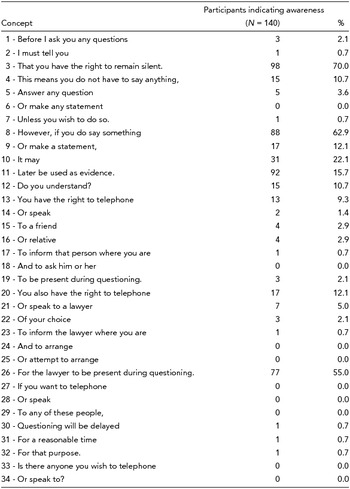
Based on participants’ written responses indicating awareness of the caution prior to hearing it, the maximum number of concepts reported was 13 of a total of 34 (M = 3.60, SD = 2.04; see Table 1). The most commonly mentioned concepts included: ‘That you have the right to remain silent’, ‘Later be used as evidence’ and ‘However, if you do say something’. Nine concepts were not mentioned by any participant: ‘Or make any statement’, ‘And to ask him or her’, ‘And to arrange’, ‘Or attempt to arrange’, ‘If you want to telephone’, ‘Or speak’, ‘To any of these people’, ‘Is there anyone you wish to telephone’, and ‘Or speak to’.
Awareness of the QPS Caution

Comprehension of the QPS caution
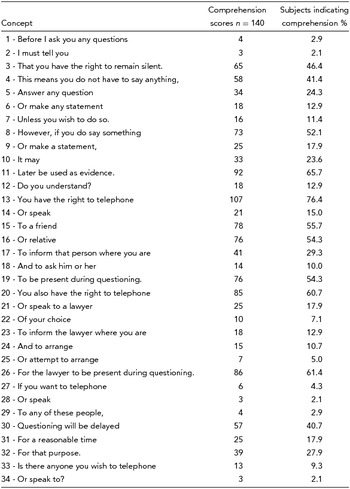
In the comprehension phase the QPS caution was projected visually and read aloud to participants who were then asked to write it in their own words. Participants’ scores ranged between 0 and 22 on recall of 34 discrete concepts (see Table 2). The average number of recalled concepts was nine (SD = 4.30). The most frequently recalled concept was ‘You have the right to telephone (friend/family member)’. Other concepts commonly recalled by participants were: ‘Later be used as evidence’, ‘For the lawyer to be present during questioning’, ‘You also have the right to telephone (lawyer)’, ‘(speak) to a friend’, ‘Or relative’, and ‘To be present during questioning’. Unlike the awareness results there were no concepts that were not recalled by anyone, nor were there any concepts that were recalled by only one person.
Queensland Police Caution Comprehension Scores

Australian Legal Awareness Questionnaire (ALAQ)
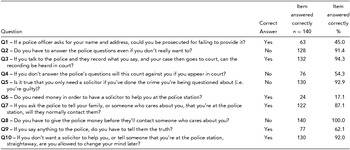
The ALAQ comprises 10 questions with a Yes/No response format and measures knowledge of legal matters. The mean of participants’ scores was 7.30 (SD = 1.13). The question that all participants answered correctly was Question 8 (Do you have to give the police money before they’ll contact someone who cares about you?). Other questions that most participants answered correctly were Question 3 (If you talk to the police and they record what you say, and your case then goes to court, can the recording be heard in court?), Question 5 (Is it true that you only need a solicitor if you’ve done the crime you’re being questioned about (i.e. you’re guilty)?) and Question 10 (If you don't want a solicitor to help you, or tell someone that you’re at the police station, straightaway, are you allowed to change your mind later?). All questions were answered correctly by more than 50% of participants, but for two and these were Question 1 (If a police officer asks for your name and address, could you be prosecuted for failing to provide it?) and Question 6 (Do you need money in order to have a solicitor to help you at the police station?). Participants’ ALAQ results are shown in Table 3.
Australian Legal Awareness Questionnaire Scores

The Effects of Prior Knowledge of the QPS caution
Independent-samples t-tests were used to compare awareness and comprehension of the QPS caution for participants who had heard the caution before and participants who had not. With regard to awareness there was no significant difference in scores of participants who had heard the caution before (M = 4.00; SD = 3.56) and those who had not before heard the caution (M = 3.56; SD = 1.84; t(138) = −0.44, p = 0.67). Similarly, when comprehension was considered there was no significant difference in scores of participants who had heard the caution before (M = 8.31, SD = 5.47) and those who had not (M = 9.06; SD = 4.19; t(138) = −0.60, p = 0.55). Comparison of the ALAQ scores of participants who had heard the caution before (M = 6.92, SD = 1.61), and participants who had not (M = 7.34, SD = 1.07), also indicated no significant difference (t(138) = −1.27, p = 0.21).
Awareness and Comprehension of the QPS caution
The difference between awareness and comprehension scores after participants were shown the Queensland Police caution was assessed with a paired samples t-test. There was a statistically significant increase in scores from the awareness phase (M = 3.60, SD = 2.04) to the comprehension phase (M = 8.99, SD = 4.30), (t(139) = −14.83, p < 0.0005), and eta squared (−2.72) indicated the effect size to be large.
Associations between Awareness and Comprehension of the QPS caution, and results on the ALAQ
There was a small positive correlation between awareness and comprehension of the QPS caution (r = 0.24, n = 140, p = 0.005) but neither awareness (r = 0.05, n = 140, p = 0.59) nor comprehension (r = 0.02, n = 140, p = 0.85) was significantly correlated with scores on the ALAQ.
QPS Caution: Awareness, Comprehension and Legal Awareness
ALAQ scores were split at the mean to establish high and low scoring groups. Independent samples t-test results indicated that there was no significant difference between these groups on levels of QPS caution awareness (high caution awareness, M = 3.64, SD = 2.48; low caution awareness, M = 3.57, SD = 1.68; t(138) = −0.20, p = 0.84). Similarly, when comparing comprehension of the caution there was no significant difference between low and high ALAQ groups (high caution comprehension, M = 8.43, SD = 4.01; low caution comprehension, M = 9.43, SD = 4.46; t(138) = 1.39, p = 0.17).
Discussion
Our first hypothesis, that people who have heard the QPS caution before will score significantly higher than people who have not heard the QPS caution before, on awareness and comprehension of the QPS caution, and scores on the Australian Legal Awareness Questionnaire, was not supported. This may be due to so few participants (13) reporting they had been read the QPS caution by a police officer, whereas 127 participants reported they had not been read the QPS caution by a police officer. Our second hypothesis could not be tested as only one participant stated they did not understand the QPS caution. However, it is important to note that although 99.29% of participants reported that they understood the caution, the average number of identified concepts was nine of a total of 34. On average, participants correctly identified 26.5% of the concepts comprising the QPS caution. This relatively low level of understanding is concerning, especially considering that participants were shown the QPS caution and heard it read aloud, before being asked to re-state it in their own words.
The third hypothesis was supported as the results show that participants’ scores on the comprehension phase were significantly higher than their scores on the awareness phase. As such, this research provides a baseline of participants’ awareness of the QPS caution and demonstrates that their comprehension increases simply by having the caution read aloud and shown on screen. Interestingly, whereas participants’ scores overall on the comprehension phase were higher than their awareness phase scores, awareness of two concepts (3 – That you have the right to remain silent, and 8 – However, if you do say something), was higher than their comprehension scores. It is unclear why this was the case as both are important concepts. Perhaps this can be explained by information overload or it may be that participants believed that as they had mentioned these concepts in the awareness phase they did not need to be mentioned in the comprehension phase.
The fourth hypothesis, that results on the awareness phase will correlate with results on the comprehension phase, and that results on the awareness phase will correlate with results on the Australian Legal Awareness Questionnaire, and that results on the comprehension phase, will correlate with results on the Australian Legal Awareness Questionnaire, was partially supported as there was a small positive correlation between scores on awareness and comprehension of the QPS caution. However, there was no correlation between performance on awareness of the QPS caution and the Australian Legal Awareness Questionnaire, or between performance on comprehension of the QPS caution and the Australian Legal Awareness Questionnaire. It is possible that awareness and comprehension of the QPS caution are essentially independent of the constructs measured by the ALAQ, although it is not unreasonable to assume that people who have a high level of legal awareness would demonstrate better awareness and comprehension of the QPS caution. These findings suggest, however, that this is not the case.
Finally, our fifth hypothesis, that participants who score higher on the Australian Legal Awareness Questionnaire, will score significantly higher on awareness and comprehension of the QPS caution than participants who score lower on the Australian Legal Awareness Questionnaire was not supported. This also may be due to the inherent differences between constructs measured by awareness and comprehension of the QPS caution, on the one hand, and the ALAQ on the other.
Although the present study was not a direct replication of similar studies undertaken in the UK (the QPS caution, for example, is longer than the caution used by police in the UK), our findings are similar to those reported by Shepherd et al. (Reference Shepherd, Mortimer and Mobasheri1995) where participants typically stated that they do understand the caution although their performance indicates that they do not. Our findings add weight to the argument that the current mode of delivery in Queensland is not appropriate if understanding of the police caution is to be maximised. This was also found to be the case by Clare et al., (Reference Clare, Gudjonsson and Harari1998), Fenner et al., (Reference Fenner, Gudjonsson and Clare2002), Eastwood and Snook (Reference Eastwood and Snook2010) and Roe and Moston (Reference Roe and Moston2009). Moreover, as the QPS caution is lengthier than the caution used in other Australian jurisdictions, it might be expected that general levels of comprehension of the caution in Queensland would be lower than in other states. The only other Australian study to investigate the QPS caution (Roe & Moston, Reference Roe and Moston2009) used the Legal Awareness Questionnaire as opposed to the ALAQ. These researchers reported that Indigenous participants on average answered 47% of questions correctly, whereas non-Indigenous participants on average answered 84% of questions correctly. The comparison finding in the current study was that participants correctly answered on average 73% of questions correctly.
Limitations and Future Research Directions
The limitations of the present study include the greatly disproportionate numbers of participants who had or had not previously heard the QPS caution, and who failed to understand the QPS caution. Additionally, it can be argued that the studied group of university students was not an ecologically valid population with whom to test awareness and comprehension of the QPS caution and that generalisability of the results is constrained. There is, however, precedent for utilising university students in similar studies (e.g., Eastwood & Snook, Reference Eastwood and Snook2010; Clare et al., Reference Clare, Gudjonsson and Harari1998). Moreover, it seems reasonable to assume that where university students have difficulty comprehending the QPS caution, police suspects who often have a lower level of education than university students and who are in a far more stress provoking environment than a group testing situation, would demonstrate even lower levels of comprehension of the caution. Finally, our study may be limited by the order in which measures were provided to participants. Conceivably, findings may have differed had the ALAQ been presented prior to the tests of awareness and comprehension due to the possible effects of order and the content of the ALAQ.
Worthwhile future directions could include studies of matched samples of participants comprised of those who, for example, had previously heard the QPS caution and those who had not. Additionally, utilising a matched sample of participants on self reported status of understanding the QPS caution could more clearly determine whether this is an influential predictor of performance on awareness and comprehension of the QPS caution, or of performance on the Australian Legal Awareness Questionnaire. Moreover, given that standard QPS procedure is to read the caution aloud to suspects, it seems worthwhile to investigate differences in suspects’ understanding depending upon the mode of delivery of the caution. It could be expected, for example, that those who were read aloud the police caution and shown it in writing would better understand and comprehend the caution, compared with suspects who were read the police caution alone (see also Clare et al., Reference Clare, Gudjonsson and Harari1998; Eastwood & Snook, Reference Eastwood and Snook2010; Fenner et al., Reference Fenner, Gudjonsson and Clare2002; and Roe & Moston, Reference Roe and Moston2009).
Conclusion
In brief, the results of this study demonstrate that even when people say they understand the police caution, it is apparent that in actuality, they may not. It follows that the current practice of assessing comprehension by asking ‘Do you understand?’ may be seriously flawed as suspects may be likely to acquiesce and state that they do understand even though they do not. Either revision of the procedure or the wording of the QPS caution to bring it into line with versions used in other Australian jurisdictions may ensure that suspects are better able to understand their right to silence. Perhaps the most serious implication here, however, is that these disconcerting results were obtained under optimal conditions with university student participants. Having regard for the high frequency with which Indigenous Australians, whose first language will likely not be English, come into contact with the criminal justice system in this region, it is likely that the QPS caution will not be understood by a majority of these people. While the disproportionately high rates of incarceration of Indigenous people in this region are evidence of a broader social problem, it is likely that this situation is exacerbated by poor awareness and understanding of the QPS right to silence caution.
Acknowledgments
The authors gratefully acknowledge the contribution of Associate Professor Stephen Moston to the early conceptualisation and establishment of the project on which this article is based.