Implications
Substitution of lard in the diet of chickens with the fat of rape seeds and rendered fish oil would increase the content of n-3 polyunsaturated fatty acids (PUFAn-3) while decreasing the PUFAn-6/n-3 ratio in the carcass lipids. Increased dietary levels of vitamin E (vE) and selenium (Se) would result in their further incorporation into the chicken meat; thus, a 100-g portion of such meat would account for 21% of the recommended daily intake for vE and 49% of that for Se in humans. The improved meat had pro-health effects without negative effects on lipid metabolism when included in a rat diet, and thus might be considered a functional food.
Introduction
Over the past 40 years, many studies have demonstrated the essential role of PUFAn-3, including eicosapentaenoic acid (C20:5n-3, EPA) and docosahexaenoic acid (C22:6n-3, DHA) for normal growth and development (reviewed by Simopoulos, Reference Simopoulos2000), prevention of many diseases (reviewed by Calder, Reference Calder2006) and brain development (reviewed by McCann and Ames, Reference McCann and Ames2005). Currently, great attention is paid to enriching the human diet with these fatty acids. EPA and DHA may be synthesized from their precursor α-linolenic acid (C18:3n-3, ALA), but in infants and elderly people, this synthesis may be insufficient (Brenna, Reference Brenna2002). A good source of PUFAn-3 in the human diet is marine fish but these fish are in short supply and are expensive in many parts of the world (Nyquist et al., Reference Nyquist, Rødbotten, Thomassen and Haug2013).
Chicken meat is a widely accepted and relatively inexpensive food of high nutritional value, and its consumption has increased during the last decades. Moreover, chicken meat can be easily enriched with PUFAn-3 by changing the dietary fatty acid (FA) composition (Ribeiro et al., Reference Ribeiro, Lordelo, Alves, Bessa, Costa, Lemos, Ferreira, Fontes and Prates2013; Konieczka et al., Reference Konieczka, Barszcz, Chmielewska, Cieślak, Szlis and Smulikowska2015 and Reference Konieczka, Czauderna, Rozbicka-Wieczorek and Smulikowska2017). Chicken meat could also be a delivery route for bioactive compounds such as vE and Se to humans. For adults the recommended daily intake (RDI) of vE is 12 mg (EFSA NDA Panel (EFSA Panel on Dietetic Products, Nutrition and Allergies), 2015) and that of Se is 70 μg (EFSA NDA Panel (EFSA Panel on Dietetic Products, Nutrition and Allergies), 2014). Vitamin E and Se provide protection from oxidative stress and help regulate reproduction. Decreased intake of either vE or Se has been linked to serious disorders in humans (Bjorneboe et al., Reference Bjorneboe, Bjorneboe and Drevon1990). Some authors recommend increasing Se levels in food because its deficiency in the human diet is recognized as an urgent global problem (Fisinin et al., Reference Fisinin, Papazyan and Surai2009). Therefore, an increase in the level of dietary vE and Se may have a beneficial effect not only in the prevention of oxidation in PUFA-enriched meat products but also on the nutritional enrichment of the final product. It is well documented that chicken meat can be enriched with PUFA, vE and Se by altering the composition of feed (Nyquist et al., Reference Nyquist, Rødbotten, Thomassen and Haug2013; Olmedilla-Alonso et al., Reference Olmedilla-Alonso, Jiménez-Colmenero and Sánchez-Muniz2013; Ribeiro et al., Reference Ribeiro, Lordelo, Alves, Bessa, Costa, Lemos, Ferreira, Fontes and Prates2013; Konieczka et al., Reference Konieczka, Barszcz, Chmielewska, Cieślak, Szlis and Smulikowska2015 and Reference Konieczka, Czauderna, Rozbicka-Wieczorek and Smulikowska2017), but further investigations are needed to prove that such modifications are beneficial for consumer health.
The objective of the current study was to verify the functional properties of chicken meat with a reduced PUFAn-6/n-3 ratio and increased vE or vE and Se content in young rats. It was hypothesized that inclusion of such meat in the rat diet would result in improvement of parameters related to lipid metabolism and health of rats.
Material and methods
Materials
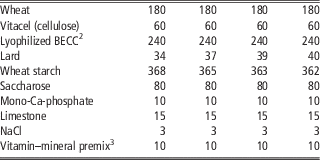
Chicken carcasses were obtained using an experimental procedure previously described by Konieczka et al. (Reference Konieczka, Barszcz, Chmielewska, Cieślak, Szlis and Smulikowska2015). In brief, four groups of broiler chickens kept in individual cages were fed ad libitum diets based on wheat, maize and soya bean meal with the same level of crude fat but differing PUFAn-6/n-3 ratios and vE and Se levels during the last 3 weeks before slaughter. Chickens in the control group were fed a diet containing lard as a supplemental fat (PUFAn-6/n-3 ratio: 21.5) and the same vE and Se levels as in commercial diets for Ross 308 broilers (80 and 0.3 mg/kg, respectively). Chickens in the experimental groups were fed the following diets with supplemental fat derived from rape seeds and rendered fish oil (PUFAn-6/n-3 ratio 4.6, on average): diet RF, the same levels of vE and Se as in the control diet; diet RFE, 150 mg vE and 0.3 mg Se/kg; and diet RFES, 150 mg vE and 0.7 mg Se/kg. The feed consumption and BW of chickens was measured at the beginning and at the end of experiment. The final BW of chickens averaged 2.31 kg. Birds were slaughtered, plucked and eviscerated. The heads and legs were cut off and then carcasses (without edible giblets) from respective groups were pooled and autoclaved for 30 min with the use of an ELMI ESS-201 autoclave (Warszawa, Poland) at 110°C and a pressure of 0.11 MPa. After removal of the bones, the meat and liquid, hereafter referred to as boiled edible components of chicken carcass (BECC), were lyophilized with the use of a Gamma 2-16 LSC lyophilizer (Martin CHRIST GmbH, Osterode, Germany), ground, vacuum packed and stored at −20°C until analysis. After the chemical composition was determined, the lyophilized BECC was included into the diets of the rats (Table 1).
Composition of rat diets (g/kg of diet)

1 Diets contained boiled edible components of chicken carcass (BECC) prepared from chickens fed between 22 and 35 days of life diets differing in composition of added fat, vitamin E (vE) and selenium (Se) content, as follows.
2 L=lard, 80 mg vE and 0.3 mg Se/kg; RF=rape seeds and fish oil, 80 mg vE and 0.3 mg Se/kg; RFE=rape seeds and fish oil, 150 mg vE and 0.3 Se/kg; RFES=rape seeds and fish oil, 150 mg vE and 0.7 mg Se/kg.
3 Provided per kg of diet: vitamin A, 15 000 IU; vitamin D3, 1000 IU; vitamin E (α-tocopherol acetate), 30 mg; vitamin K3, 5 mg; vitamin B1, 12 mg; vitamin B2, 12 mg; nicotinic acid, 40 mg; vitamin B6, 10 mg; vitamin B12, 0.05 mg; biotin, 0.2 mg; folic acid, 4 mg; choline, 1500 mg; Ca-pantothenate, 20 mg; Fe, 75 mg; Mn, 10 mg; Cu, 8 mg; Zn, 25 mg; I, 0.15 mg; Co, 0.15 mg; Se, 0.1 mg; inositol, 100 mg.
Rat diets
Four semipurified diets were prepared each containing 240 g/kg lyophilized BECC from the respective groups described in the previous section (Table 1). The BECC was the major source of protein, constituting approximately half of the total dietary fat (48.7% in the RFES diet to 56.9% in the L diet), and was an additional source of vE and Se in the diets of the rats. The diets were manufactured in the form of pellets in a commercial specialized plant according to ISO 9001 procedures.
Animals and experimental design
The experiment was performed on rats of the Wistar crl:WI (han) strain purchased from the Experimental Medicine Center of Medical University of Bialystok, Poland. The experimental procedures were approved by the 3rd Local Animal Care and Ethics Committee in Warsaw, Poland.
Forty 10-week-old male rats were weighed and randomly allotted to four groups with 10 animals in a group, and the average initial BW was 358±9 g. Animals were housed individually in polypropylene cages littered with wooden shavings in a room maintained at a temperature of 21±1°C, humidity of 55±10% and a 12/12 h light/dark cycle. Diets and water were available ad libitum. The experiment lasted 8 weeks. Feed intake was recorded individually during the whole period and final BW was measured.
Sampling procedures
All rats were sacrificed under CO2; blood samples were obtained by heart puncture; and the liver, brain, heart, spleen and abdominal fat were dissected and weighed. Blood was collected in tubes with ethylenediaminetetraacetic acid and gently shaken and analyzed after 30 min for haematological markers. Samples of blood were also collected into centrifuge tubes, kept on ice for 30 min, and centrifuged (4600×g, 10 min at 4°C), and the serum was stored at −30°C for further analyses. The brains and livers were vacuum-packed and stored at −30°C for further analyses.
Analytical methods
Dry matter, total nitrogen, crude fat and crude ash in the BECCs and in rat diets were determined according to the Association of Official Analytical Chemists (AOAC, 1990). Haematological markers in the whole blood of rats were measured using the ABC Vet Hematology Analyzer (Horiba ABX Inc., Irvine, CA, USA).
Biochemical parameters of blood plasma were determined spectrophotometrically on a MAXMAT PL multidisciplinary diagnostic platform (Erba Diagnostics France SARL, Montpellier, France) using standards supplied by ELITech (ELITech Group, Puteaux, France).
For determination of Se, BECC samples were mineralized in a mixture of 5 ml of 65% HNO3 and 2 ml of 30% H2O2 in hermetic high-pressure vessels by heating for 19 min in a microwave oven (MARS 5 CEM Multiwave Sample Preparation System, USA). The following microwave oven programme for mineralization was used: 450 W for 3 min, 0 W for 2 min, 550 W for 3 min, 0 W for 1 min and finally 700 W for 10 min. Subsequently, the solution was cooled and then diluted to 50 ml with deionized water. An AAS SOLAAR M6 atomic absorption spectrometer (Wilmington, DE, USA) with a graphite furnace atomizer equipped with a pyrolytic graphite tube (GF 95) was used for the determination of Se. Background correction was based on the Zeeman effect and a mixture of Mg(NO3)2 and Pd(NO3)2 was used as the chemical modifier in the graphite tube. Argon was used as a purge gas. The drying, pyrolysis, atomization and cleaning temperatures were 90°C/130°C, 1200°C, 2400°C and 2500°C, respectively. Selenium was quantified in two replications using the most sensitive line (196 nm).
The concentration of tocopherols in BECCs and rat livers and that of cholesterol in rat livers were determined according to Czauderna et al. (Reference Czauderna, Kowalczyk and Niedźwiedzka2009). Analyses were performed using ultra-fast-performance liquid chromatographic equipment (SHIMADZU, Kyoto, Japan). This equipment consisted of a Kinetex C18 column (particle size: 2.6 μm; Hydro-RP, 150×2.1 mm; Phenomenex, Torrance, CA, USA) in conjunction with a guard column containing Kinetex C18 pellicular packing material (2.6 μm; 4×2 mm, Phenomenex). The samples were analysed at 22°C using a linear binary gradient programme. The fluorescent detector wavelength was set at 295 nm for analysis of α-, δ- and γ-tocopherol and at 284 nm for α-tocopherol acetate. The photodiode array detector was set at a wavelength of 193 nm for cholesterol detection.
The feed and tissue samples were extracted, saponified and methylated according to Czauderna et al. (Reference Czauderna, Kowalczyk, Korniluk and Wasowska2007). Analyses of fatty acid methyl ester composition were performed on a SHIMADZU GC-2010 gas chromatograph equipped with a BPX70 fused silica capillary column (120 m×0.25 mm i.d.×0.25 μm film thickness), a quadrupole mass selective detector (Model GCMS-QP2010 Plus EI,Shimadzu, Tokyo, Japan), and an injection port. Helium as the carrier gas was used at a constant pressure and a flow rate of 1 ml/min.
Statistical analysis
The results were subjected to one-way ANOVA with Tukey–Kramer post hoc tests using STATGRAPHICS® Centurion XVI ver. 16.1.03 (1982-2010). Data were analysed according to the following model:
 $$y_{{ij}} {\rm \,{\equals}}\,\mu {\rm {\plus}D}_{i} {\rm {\plus}}e_{{ij}} $$
where y ij is the individual observation, μ the overall mean, D i the effect of diet (L, RF, RFE and RFES), e ij residual error.
The main effects of dietary: (i) lipids – animal fat v. other lipids, (ii) vE – basal v. increased, (iii) Se – basal v. increased, were analysed using orthogonal contrasts analysis according to the following model:
-
(i). 1 L – 1/3 (RF+RFE+RFES)
-
(ii).
 ${\raise0.7ex\hbox{$1$} \!\mathord{\left/ {\vphantom {1 2}}\right.\kern-\nulldelimiterspace}\!\lower0.7ex\hbox{$2$}}$
(L+RF) –
${\raise0.7ex\hbox{$1$} \!\mathord{\left/ {\vphantom {1 2}}\right.\kern-\nulldelimiterspace}\!\lower0.7ex\hbox{$2$}}$
(RFE+RFES)
-
(iii). 1/3 (L+RF+RFE) – 1 RFES


All statements of significance are based on P⩽0.05.
Results
Composition of boiled edible components of chicken carcasses and rat diets
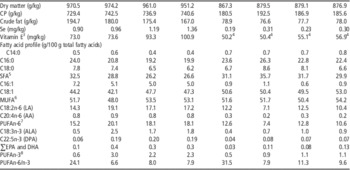
The content of the most important components and the FA profile of BECCs and rat diets are shown in Table 2. The BECCs contained 729 to 742 g/kg CP and 167 to 195 g/kg crude fat; 51% to 59% of the fat in the rat diets was derived from the respective BECC. The concentration of vE was ~73 mg/kg in BECCs of chickens from groups fed diets with the basal vE level, and averaged 97 mg/kg in BECCs of chickens fed diets with the increased vE level. In the rat diets, 40% to 47% of the vE was derived from the respective BECC. The concentration of Se was on average 1 mg/kg in BECCs of chickens fed diets with the basal Se level and 1.36 mg/kg in BECCs of chickens fed diets with the increased Se level. In the rat diets, 47% to 68% of the Se was derived from the respective BECC. In the BECCs and in the respective rat diets, monounsaturated fatty acid (MUFA) constituted 48% to 53% of the total FA, followed by 26% to 35% of saturated fatty acid (SFA). Linoleic acid (LA) was predominant among PUFAn-6 and ALA was predominant among PUFAn-3. The PUFAn-6/n-3 ratio in the L BECC and in the L diet was high (24.1 and 31.5, respectively), whereas in the RF, RFE and RFES BECCs it was 6.6 to 7.9, and in the diets containing these BECCs it was 7.9 to 11.3 (Table 2).
Composition and fatty acid profile of boiled edible components of chicken carcass (BECC) and rat diets (g/kg)

SFA=saturated fatty acid; MUFA=monounsaturated fatty acid; PUFA=polyunsaturated fatty acid; ALA=α-linolenic acid; DPA=docosapentaenoic acid; DHA=docosahexaenoic acid; EPA=eicosapentaenoic acid
All values for unsaturated fatty acids represent a mix of isomers.
1 Chickens were fed diets differing in composition of added fat, vitamin E (vE) and selenium (Se) content as follows: L=lard, 80 mg vE and 0.3 mg Se/kg; RF=rape seeds and fish oil, 80 mg vE and 0.3 mg Se/kg; RFE=rape seeds and fish oil, 150 mg vE and 0.3 Se/kg; RFES=rape seeds and fish oil, 150 mg vE and 0.7 mg Se/kg.
2 Diets contained BECC from respective groups of chickens (240 g/kg).
3 Sum of δ-, γ-, α-tocopherol and α-tocopherol acetate
4 Calculated.
5 SFA=C14:0+C16:0+C18:0+C20:0+C22:0+C24:0.
6 MUFA=C16:1+C17:1+C18:1+C20:1+C21:1+C22:1.
7 PUFAn-6=C18:2n-6+C18:3n-6+C20:2n-6+C20:3n-6+C20:4n-6+C22:4n-6.
8 PUFAn-3=C18:3n-3+C20:5n-3+C22:5n-3+C22:6n-3.
BW and feed intake of rats
Throughout the 8 weeks of the study, none of the animals were dropped from the study. There were no significant differences between the experimental groups in feed intake, which was 1406±45 g, on average, or in final BW, which was 529±16 g, on average. In addition, the relative weight of the internal organs and fat tissue did not differ between the experimental groups (data not shown).
Fatty acid composition of liver and brain lipids in rats
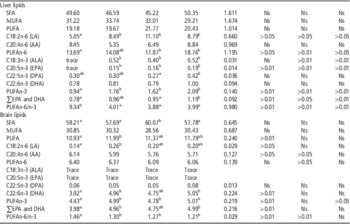
The FA composition of the liver and brain lipids of the rats are shown in Table 3. In the liver, the proportions of total SFA, MUFA and PUFA did not depend on dietary lipids, vE and Se and averaged 48%, 32% and 20% of the total FA, respectively. Analysis of contrasts revealed significant differences within PUFA; the proportions of PUFAn-6 and LA, PUFAn-3, EPA and the sum of EPA and DHA were higher in all experimental groups compared with the L group (P<0.05 and <0.01, respectively). The PUFAn-6/n-3 ratio in the L group was 9.34, but in all groups fed modified meat it was significantly lower and averaged 3.96 (P<0.01).
Effect of feeding diets containing boiled edible components of chicken carcass (BECC) on the lipid profile in the brain and liver of rats

FA=fatty acid; vE=vitamin E; Se=selenium; SFA=saturated fatty acid; MUFA=monounsaturated fatty acid; PUFA=polyunsaturated fatty acid; ALA=α-linolenic acid; DPA=docosapentaenoic acid; DHA=docosahexaenoic acid; EPA=eicosapentaenoic acid
All values for unsaturated fatty acids represent a mix of isomers.
a,bMeans with different letters within rows differ significantly (P⩽0.05).
1 Diets contained BECC (240 g/kg) from chickens fed diets differing in composition of added fat, vE and Se content as follows: L=lard, 80 mg vE and 0.3 mg Se/kg; RF=rape seeds and fish oil, 80 mg vE and 0.3 mg Se/kg; RFE=rape seeds and fish oil, 150 mg vE and 0.3 Se/kg; RFES=rape seeds and fish oil, 150 mg vE and 0.7 mg Se/kg.
2 L v. RF, RFE, RFES.
3 L, RF v. RFE RFES.
4 L, RF, RFE v. RFES; SFA=C14:0+C16:0+C18:0+C20:0+C22:0+C24:0; MUFA=C16:1+C17:1+C18:1+C20:1+C21:1+C22:1; PUFAn-6=C18:2n-6+C18:3n-6+C20:2n-6+C20:3n-6+C20:4n-6+C22:4n-6; PUFAn-3=C18:3n-3+C20:5n-3+C22:5n-3+C22:6n-3.
In the brain, the proportions of SFA and MUFA were 58% and 30% of the total FA, on average, and were not affected by the experimental treatments. The proportion of PUFA was higher (P<0.01) in the RF, RFE and RFES groups than in the L group. Analysis of contrasts revealed significant differences within PUFA; the proportion of LA and PUFAn-3 (mainly DHA) was higher (P<0.01) and the PUFAn-6/n-3 ratio was lower (P<0.01) in rats fed modified meat compared with the L group. The increase in vE level was associated with a lower LA, PUFAn-6 and PUFAn-6/n-3 ratio (P<0.05 and P<0.01), whereas with increased dietary Se level, only an increase in PUFAn-3 proportion was observed.
Concentration of tocopherols and cholesterol in the rat liver
α-Tocopherol acetate was the predominant form of vE incorporated into the liver of rats from all groups, followed by α-tocopherol, δ-tocopherol and γ-tocopherol (Table 4). The levels of α-tocopherol did not differ, whereas the levels of other forms of tocopherol in the liver were higher in the RF, RFE and RFES groups compared with the L group (P<0.01). Analysis of contrasts revealed that the levels of γ-tocopherol and α-tocopherol acetate were higher in groups fed diets with increased levels of vE in comparison with groups L and RE having lower levels of vE. The level of cholesterol in the liver tissue averaged 1.5 mg/g and was similar among the experimental groups.
Effect of feeding diets containing boiled edible components of chicken carcass (BECC) on concentrations of tocopherols (µg/g) and cholesterol (100 mg/g) in the liver of rats (n=10)

vE=vitamin E; Se=selenium.
a,bMeans with different letters within rows differ significantly at P⩽0.05.
1 Diets contained BECC (240 g/kg) from chickens fed diets differing in composition of added fat, vE and Se content as follows: L=lard, 80 mg vE and 0.3 mg Se/kg; RF=rape seeds and fish oil, 80 mg vE and 0.3 mg Se/kg; RFE=rape seeds and fish oil, 150 mg vE and 0.3 Se/kg; RFES=rape seeds and fish oil, 150 mg vE and 0.7 mg Se/kg.
2 L v. RF, RFE, RFES.
3 L, RF v. RFE RFES.
4 L, RF, RFE v. RFES.
Biochemical and haematology markers and immunoglobulins in blood
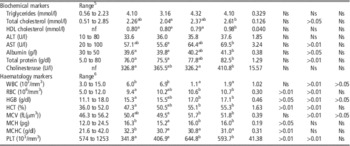
The levels of biochemical and haematology markers in the blood of the rats are shown in Table 5. The concentrations of triglycerides and total protein were higher in all groups, whereas the concentrations of other biochemical markers were within the average range for Wistar rats of similar age (Evans, Reference Evans2009). The analysis of contrasts revealed that neither dietary FA profile nor Se content had a significant effect on biochemical markers, but the concentrations of total cholesterol, total protein, albumin and aspartate aminotransferase were higher in groups fed diets with an increased vE level compared with the L and RF groups with the basal level of vE (P<0.05 and <0.01).
Effect of feeding diets containing boiled edible components of chicken carcass (BECC) on biochemical and haematology markers in rats (n=10)

vE=vitamin E; Se=selenium; HDL=high-density lipoprotein; ALT=alanine aminotransferase; AST=aspartate aminotransferase; WBC=white blood cells; RBC=red blood cells; HGB=haemoglobin; HCT=haematocrit; MCV=mean corpuscular volume; MCH=mean corpuscular haemoglobin; MCHC=mean corpuscular haemoglobin concentration; PLT=platelet count; nf=not found.
a,bMeans with different letters within rows differ significantly (P<0.05).
1 Diets contained BECC (240 g/kg) from chickens fed diets differing in composition of added fat, vE and Se content as follows: L=lard, 80 mg vE and 0.3 mg Se/kg; RF=rape seeds and fish oil, 80 mg vE and 0.3 mg Se/kg; RFE=rape seeds and fish oil, 150 mg vE and 0.3 Se/kg; RFES=rape seeds and fish oil, 150 mg vE and 0.7 mg Se/kg.
2 L v. RF, RFE, RFES.
3 L, RF v. RFE RFES.
4 L, RF, RFE v. RFES.
5 For Wistar rats aged 6 to 12 weeks (Evans, 2009).
6 For Wistar male rats aged 8 to 16 weeks (Giknis and Clifford, 2008).
The haematology markers were within the range for Wistar rats of similar age (Giknis and Clifford, Reference Giknis and Clifford2008), with the exception of lower white blood cell (WBC) counts in rats from the RFE and RFES groups and lower platelet counts (PLT) in the L and RF groups (Table 5). The analysis of contrasts revealed that WBC counts were lower in RFE and RFES groups fed diets with higher vE and Se levels, compared with groups fed lower levels of vE and Se. Red blood cell counts, haemoglobin levels, haematocrit and PLT counts were higher in rats fed BECC from chickens fed modified dietary lipids compared with that fed animal fat, and rats fed BECC from chickens fed an increased level of vE and Se (RFE and RFES groups) compared with basal levels of vE and Se (P<0.05 and <0.01).
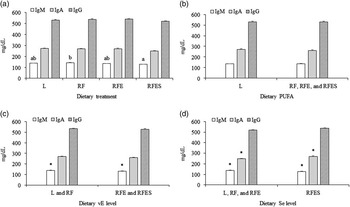
Dietary FA profile did not affect on the concentrations of immunoglobulin M (IgM), immunoglobulin A (IgA) and immunoglobulin G (IgG) in the blood of the rats (Figure 1). The concentration of IgM was lower (P<0.05) in the RFE and RFES groups than in the L and RF groups (P<0.05) and the concentration of IgM and IgA was higher in RFES group compared with L, RF and RFE groups (P<0.05).
Concentrations of immunoglobulin M (IgM), immunoglobulin A (IgA) and immunoglobulin G (IgG) in the blood of rats (n=10) as an effect of feeding diets containing boiled edible components of chicken carcass differing in polyunsaturated fatty acid (PUFA) composition, vitamin E (vE) and Se level: (a) dietary treatments, (b) main effect of dietary PUFA (animal fat v. other lipids), (c) main effect of dietary vE (vE basal v. increased), (d) main effect of dietary Se (Se basal v. increased). a,bMeans are statistically different at P<0.05. L=lard, 80 mg vE and 0.3 mg Se/kg; RF=rape seeds and fish oil, 80 mg vE and 0.3 mg Se/kg; RFE=rape seeds and fish oil, 150 mg vE and 0.3 Se/kg; RFES=rape seeds and fish oil, 150 mg vE and 0.7 mg Se/kg

Discussion
In the present study, the functional properties of edible parts of chicken carcasses with nutritional values modified by dietary interventions (described in detail in Konieczka et al., Reference Konieczka, Barszcz, Chmielewska, Cieślak, Szlis and Smulikowska2015) were investigated. In contrast to many other studies, we did not evaluate the values of raw lean meat but studied the BECC, including meat, skin and fat tissues, as they are often used together for culinary purposes and as raw material for manufacture of different chicken-derived products. Such raw material contained relatively high amounts of fat (17% to 19% in the present study), with MUFA prevailing in the FA profile. Our results show that during the final stage of chicken growth, the substitution of dietary animal fat with fat from rape seeds and fish oil did not change performance indices (Konieczka et al., Reference Konieczka, Barszcz, Chmielewska, Cieślak, Szlis and Smulikowska2015 and Reference Konieczka, Czauderna, Rozbicka-Wieczorek and Smulikowska2017) but effectively enriched the chicken carcass with PUFAn-3 and lowered the PUFAn-6/n-3 ratio.
In the current study, diets with modified BECCs and diets with BECCs from control chickens were equally utilized by rats, and the BW and relative weight of the internal organs of the rats was not affected. These results are consistent with studies showing no effect on the growth performance or relative weight of internal organs of rats as a result of change in dietary PUFA composition (Vijaimohan et al., Reference Vijaimohan, Jainu, Sabitha, Subramaniyam, Anandhan and Shyamala Devi2006).
According to Quinn (Reference Quinn2005), 13.8 days of rat life correspond to 1 human year, on average. At the beginning of our experiment, the rats were 70 days old, and at the end, they were 126 days old. The duration of the experimental period can thus be extrapolated to 4 years, from the ages of 5 to 9 years, for humans. Our study demonstrated that including chicken meat enriched with PUFAn-3 into the diets of rats resulted in modification of the FA profile, not only for the liver lipids but also for the brain lipids. An increase in PUFAn-3 level, decrease in the PUFAn-6/n-3 ratio and increase in the DHA level were observed in the lipids of the brain. The increase in DHA level would likely be particularly beneficial, as DHA is an essential FA that is needed for brain development. Salem et al. (Reference Salem, Lin, Moriguchi, Lim, Salem and Hibbeln2015) suggested that the brain takes priority with regard to DHA utilization as a result of its selective uptake and incorporation into the brain lipids. Our study, which demonstrated increased incorporation of DHA into the brain lipids of rats fed PUFAn-3-enriched BECCs, supports this suggestion. According to Brenna (Reference Brenna2002), the conversion to DHA from its precursors in humans is very low, particularly in infants and elderly people. Therefore, our results indicating that chicken-based food might be a valuable source of PUFAn-3 with DHA being bio-available and effectively incorporated into the brain lipids may be important. Moreover, it should be noted that this beneficial changes in chicken BECC composition were achieved with the use of readily available feed components (Konieczka et al., Reference Konieczka, Barszcz, Chmielewska, Cieślak, Szlis and Smulikowska2015). Considering the above, we maintain that it is reasonable to add rape seeds and rendered oils from fish by-products to commercial chicken feed as it sufficiently improves the FA composition of meat and make it a significant source of PUFAn-3 for consumers.
In the present study, the crude fat content in the rat diets averaged ~8%; thus, its level was ~60% higher than the estimated optimal level for growth of rats (NRC, 1995). It has been reported that feeding rats a diet with elevated fat content may induce disorders in hepatic cholesterol metabolism, as observed in humans under such dietary regimens (Woods et al., Reference Woods, Seeley, Rushing, D’Alessio and Tso2003). In the current study, to determine whether feeding rats with the experimental diets induces disorders of cholesterol homeostasis, the concentration of total and HDL cholesterol in blood and that of total cholesterol in liver tissue were measured. Consumption of high-fat diets resulted in levels of triglycerides in blood that were higher than the normal values, but the total cholesterol was within the normal range for rats at a similar age (Evans, Reference Evans2009), even though it increased with an increased amount of vE in the diet. The liver cholesterol level in our study was similar to that reported by Jiang and Sim (Reference Jiang and Sim1992) in 8-week-old rats fed a high-fat diet for 28 days, but it was 2-, 3- and 4.5-fold lower than that reported by Ruiz-Gutierrez et al. (Reference Ruiz-Gutierrez, Perez-Espinosa, Vázquez and Santa-Maria1999) in rats fed for 12 weeks with diets supplemented with a mixture of 2% unspecified lipids, 10% olive oil and 10% fish oil, respectively. The reduction of the dietary PUFAn-6/n-3 ratio did not affect total cholesterol or HDL cholesterol in blood or total cholesterol content in the rat liver.
When investigating the effect of administration of the PUFA-enriched diet on the parameters related to lipid metabolism, care must be taken in regards to hepatic vE status. The liver is the key organ engaged in metabolism and distribution of vE (Bjorneboe et al., Reference Bjorneboe, Bjorneboe and Drevon1990), and increased dietary levels of PUFA, particularly PUFAn-3 may lead to lipid peroxidation and consequently may impair liver function (Konieczka et al., Reference Konieczka, Rozbicka-Wieczorek, Więsyk, Smulikowska and Czauderna2014 and Reference Konieczka, Czauderna and Smulikowska2016). In the present study the carcasses of the chickens were autoclaved before lyophilization, but the level of α-tocopherol acetate was substantially higher in BECCs from chickens fed increased levels of vE compared with those fed diets with the basal vE level. Tuśnio et al. (Reference Tuśnio, Taciak, Barszcz, Paradziej-Łukowicz, Olędzka, Wiczkowski, Szumska, Pastuszewska and Skomiał2014) reported that the loss of vE in the pelleted feed of rats during autoclaving under mild conditions was minor. The increased Se levels in chicken diets resulted in higher incorporation of Se into the BECC compared with commercial levels. The recommended daily intake (RDI) for adult persons is 12 mg of vE (EFSA, 2015) and 70 µg of Se (EFSA, 2014). Based on our results, it can be considered that a standard portion of fresh meat with fat (100 g, 25% DM) from chickens fed diets with increased levels of vE and Se will account for 21% of the RDI for vE and 50% of the RDI for Se, while still providing 119-fold and eightfold less than the tolerable upper intake levels for vE and Se, respectively. Thus, this meat is a rich and safe source of bioactive compounds, which may contribute to consumer health.
Diets containing BECCs from chickens fed feed mixtures fortified with vE and Se were equally utilized by rats when compared with diets containing BECCs from control and RF chickens, as the BW and relative weight of the internal organs of the rats was not affected. These results are consistent with studies showing no effect on the growth or relative weight of internal organs of rats as a result of dietary supplementation with vE (Javouhey-Donzel et al., Reference Javouhey-Donzel, Guenot, Maupoil, Rochette and Rocquelin1993), or adding Se in the form of selenized yeast (Sochor et al., Reference Sochor, Pohanka, Ruttkay-Nedecky, Zitka, Hynek, Mares, Zeman, Vojtech and Kizek2012). Other studies have indicated that the elevated hepatic content of antioxidants (tocopherols) protects the liver from the damage caused by a high-fat diet (Yang et al., Reference Yang, Lin, Liu and Chen2014).
Our study further demonstrated that the meat of chickens fed increased levels of PUFAn-3 and vE may be a source of biologically active forms of vE for consumers. The dietary vE level supplied in the vitamin–mineral premix added to all experimental rat diets was equal (30 mg/kg diet), indicating that the differences in vE content in the livers of rats must have been a consequence of the higher content of vE in the enriched chicken meat. The dominant form of vE incorporated in the rat liver was α-tocopherol acetate, which was the form of vE used in the chicken diets and predominantly transferred to the meat.
In order to assess the long-term effect of dietary treatments on rats, selected biochemical and haematology parameters in the blood were measured. There were no adverse changes in the biochemical and haematology markers in the blood of rats after administration of the diets containing modified chicken meat through the 8-week feeding period. Our results indicated only minor differences among the four experimental groups in the investigated parameters, which were mostly within the reported range for Wistar rats of similar age (Giknis and Clifford, Reference Giknis and Clifford2008; Evans, Reference Evans2009). Among the biochemical markers, only total protein in the RFES group was found to be above the reported range for rats. It is possible that the results documented in this study were a long-term consequence of feeding the rats diets high in protein; the protein content was 24% higher than that required for the optimal growth of rats (NRC, 1995). The increase in half of the measured biochemical markers in the blood of rats provided a higher level of dietary vE warrants further investigation into whether disorders in blood parameters occur after longer periods than the feeding period investigated in this study. The counts of white blood cells decreased, whereas counts of red blood cells and platelets as well as the concentration of haemoglobin and MCV increased with higher dietary vE and Se levels, which may be seen as a positive effect. Nevertheless, the observed excess in most particular biochemical and haematology markers was minor in magnitude and was within the range of variation for each particular parameter, and therefore should not to be linked with metabolic disorders. Our results are in accordance with other studies, in which the biochemical (Tso et al., Reference Tso, Caldwell, Lee, Boivin and DeMichele2012) and haematological (Liu et al., Reference Liu, DeMichele, Palombo, Chuang, Hastilow, Bobik and Huang2004) profiles of blood were not negatively affected by feeding rats with diets differing in PUFA levels.
A recent study also demonstrated that diets with meat enriched with PUFA did not induce an immune response in rats. It has been reported (Calder, Reference Calder2006) that elevated levels of dietary long-chain PUFAn-3 may decrease the production of inflammatory eicosanoids, cytokines and reactive oxygen species and the expression of adhesion molecules. Our data show that in rats fed modified chicken meat, the blood levels of IgM, IgA and IgG did not differ. Also Gu et al. (1998) reported similar level of IgA, IgG and IgM in the serum of rats fed diets differing in PUFA profile. The level of IgM was higher in rats fed basal level of vE and Se in diet and decreased with increased level of these additives, and the concentration of IgM and IgA was higher in rats fed diet with higher Se level compared with basal level of this antioxidant. These findings are consistent with previous reports on the protective role of antioxidants in an autoimmune manifestation induced by a PUFA-enriched diet in rats (Yamada et al., Reference Yamada, Hung, Yoshimura, Taniguchi, Lim and Sugano1996). Thus, from the present observations in rats and the similarities in the pathways of allergy and metabolic disorder aetiology induced by food components in humans, PUFA- and antioxidant-enriched meat is not expected to induce abnormalities in immune function in consumers.
Conclusions
The use of rape seeds and rendered fish oil supported by higher levels of vE and Se in chicken diets reduced the PUFAn-6/n-3 ratio and increased the content of bioactive compounds in chicken meat. Feeding modified meat to rats for an 8-week period increased the DHA level in the brain lipids and did not induce an allergic response. Health benefits from feeding rats BECCs with higher levels of vE were more pronounced, but increased levels of Se did not provide additional benefits. Our findings suggest that chicken meat with a modified PUFA composition enriched with vE may be considered a functional food with high potential for implementation.
Acknowledgements
This research was realized within the project ‘BIOFOOD – innovative, functional products of animal origin’ no. POIG.01.01.02-014-090/09 co-financed by the European Union from the European Regional Development Fund within the Innovative Economy Operational Programme 2007-13.