It is the striving after the new in a competition that knows no equilibrium, only constant comparison, and that never comes to rest, only works as a driving force ever anew like the unrest of a clock.
Herbert Giersch, 1982Footnote 1
Freedom is synonymous with decentralization.
Herbert Giersch, 1979Footnote 2
The effects of neoliberal policies are often understood in geographic terms. The outsourcing of manufacturing since the 1970s and the subsequent deindustrialization of large parts of the global North may be the most visible and politically consequential example. The shrinking cities of the US rust belt, the UK Midlands, and former socialist east Central Europe are matched by construction booms and “instant cities” across Asia. Although social scientists have tracked the “uneven geographical developments” produced by the combination of technological advances and neoliberal policies,Footnote 3 intellectual historians have not followed suit. The last decade has seen a wave of studies of the formative ideas of the so-called Neoliberal Thought Collective (NTC) around the Mont Pèlerin Society (MPS), but the dominant themes have been the rebalancing of state and market, new subjectivities associated with entrepreneurship and self-quantification, the expanding role of economic expertise in society, and the status of democracy under so-called market rule.Footnote 4 Apart from some explorations of neoliberal proposals for imperial reform and international federation, space has been largely absent from the history of neoliberal ideas.Footnote 5 One would search in vain for analyses of how the spatial transformations attendant on neoliberal globalization were narrated within the work of neoliberals themselves. One scholar even sees the intellectual histories of the NTC and the work of critical geographers as two distinct and disconnected fields of investigation.Footnote 6
The most obvious reason for the disconnect is that the best-known neoliberal thinkers did not engage directly with questions of space, whether one considers the Chicago school of Milton Friedman, George Stigler, and Gary Becker; the Austrian school of F. A. Hayek, Ludwig von Mises, and Fritz Machlup, the Virginia school of James F. Buchanan and Gordon Tullock, or the ordoliberal school of Wilhelm Röpke, Franz Böhm, and Walter Eucken. This article presents an exception to this rule in the overlooked figure of the German economist Herbert Giersch, and thus seeks to bridge the persistent gap between the intellectual history and critical geography of neoliberalism. Remembered after his death in 2010 as “the German Milton Friedman . . . a virtuoso on the keyboard of public opinion,” and the nation's “most influential economist,” Giersch was the director of the influential Kiel Institute for the World Economy from 1969 until 1989, and president of the Mont Pèlerin Society from 1984 until 1986.Footnote 7
Giersch blended German traditions of location theory with the globalism of the Kiel Institute to lay the foundation of what this article identifies as a neoliberal economic geography. Though he lacked the international visibility of Hayek or Friedman, Giersch played a comparable role as a self-described “public economist” in the Federal Republic.Footnote 8 A widely read commentator on economic issues, Giersch was a regular contributor to the weekly economic magazine Wirtschaftswoche and Germany's most important public advocate of neoliberal-style globalization from the 1970s until the 2000s. Coining the term “Eurosclerosis” in 1985, Giersch offered a ready diagnosis of the supposed structural obstacles to growth posed by what he called the “guild socialism” of labor unions.Footnote 9 His ideas also resonated through Chancellor Gerhard Schröder's Agenda 2010 from 2003, which restructured Germany's welfare state along lines similar to those of of President Bill Clinton in the US and Prime Minister Tony Blair in the UK.Footnote 10
In his public speech and his written work from the 1970s onward, Herbert Giersch elaborated a coherent global economic and geographic imaginary to replace the nationally organized Keynesian welfare state. His work was especially relevant to the German context where globalization debates in the 1980s revolved around the spatial categories of location (Standort) and locational competition (Standortwettbewerb) Locational competition replaced long-standing goals of national socioeconomic evenness and equality with those of hierarchy, regional differentiation and specialization. Like the concept of “clusters,” which originated with the business strategist Michael Porter in the 1990s, locational competition became a useful piece of jargon to explain projects of restructuring and selective state investment at the regional level. In 1990, the frequency in printed material of the phrase Standort Deutschland overtook the previously more common Modell Deutschland, replacing a notion that foregrounded consensus and the social state at the national level with one that emphasized competition and flux at the global level. Signaling its importance, Chancellor Helmut Kohl made Standort Deutschland the slogan of his reelection campaign in 1994.Footnote 11 The term had its roots in Kiel, having been coined by a student of Giersch's, Gerhard Fels, who first put it forth in a 1976 report that Giersch identified as a point of origin for the return of neoliberal policies in the Federal Republic.Footnote 12
Scholars have studied the policy effects of the neoliberal turn in fin de millénium Germany.Footnote 13 Yet they have offered no history of its core concepts. The work of Giersch offers a chance to bring economic geography into the historiography of the neoliberal intellectual movement, while providing a genealogy of the crucial public debates of the 1990s and 2000s. We show the origins of the globalist approach at Kiel through the work of the institute's founder, Bernhard Harms; the precedents from which Giersch built on in German location theory; and why Giersch's focus turned to global competition, flexible labor markets, and structural change in the 1970s. We find that Giersch's neoliberal economic geography emerged out of two perceived necessities. On the one hand, he saw a need to break German industry out of its “productivity malaise” through the “salutary jolt” of import competition with the global South.Footnote 14 On the other hand, he felt the need for a compelling and ethically defensible global imaginary to pose against that of both traditional German social democracy and the redistributive promise of the New International Economic Order championed by global South leaders at the United Nations.
Giersch's contribution to the emerging neoliberal economic geography entailed a decoupling of region from nation, a belief in the centrality of the entrepreneur as the primary agent of economic history, and an affirmation of the necessity of risk, inequality and constant reorientation to shifting circumstances to realize long-term economic growth. He departed from traditional (inside-out) perspectives of regional economic development to a dynamic thinking of global (outside-in) competition, which recombined local and global factors of production. Key to Giersch's neoliberal economic geography was his orientation to Austrian economist Joseph Schumpeter and the ideas of innovation, entrepreneurship, and the knowledge economy. In place of the national framework, Giersch proposed the metaphor of a landscape of so-called Schumpeterian volcanoes in which regions were locked in perpetual struggle for temporary monopoly positions against competitors. While marginal to the discipline of economics as such, and later eclipsed by the more mathematically rigorous New Economic Geography identified with Nobel Memorial Prize-winner Paul Krugman, Giersch's vision provides a powerful distillation of the geographic imaginary at the heart of the neoliberal movement since the 1970s. His world of Schumpeterian volcanoes offered a vivid metaphor for the economic globalization of the late twentieth century and helps bring to light both the productive and the destructive facets of the German neoliberal imagination.
In order to appreciate why neoliberal economic geography emerged in Kiel, we first outline the important prehistory of the world-economy approach that Herbert Giersch adapted from his predecessor, Bernhard Harms, who founded the Kiel Institute in 1913. Harms and other contributors to German spatial economics opened up a global economic geography based on methodological individualism in a marriage of marginalism and space. We follow Giersch's radicalization of regional economics in two steps. The first explores the early phase of his work during which he can be considered a moderate Keynesian macroeconomist in favor of macro-coordination. It was only his disillusionment with Keynesian macroeconomic policy that led him to disaggregate the national economy. Confronting the demand of global South actors for macro-coordination in the form of a New International Economic Order, he devised a research program that emphasized regional competitiveness in the global market by merging German economic geography with the Austrian economic dynamic of Schumpeterian innovation. We conclude with a critical interpretation of Giersch's cosmopolitan capitalism, revealing its continued reliance on a strong state not easily observed in the Hayekian discourse of decentralization, regionalism, competition, and freedom.
THE BIRTH OF THE WORLD-ECONOMY APPROACH IN KIEL
It is no coincidence that Germany's first research institute devoted to the world economy was located in the port city of Kiel, north of Hamburg. In its location on the northern coast, Kiel shared the outward orientation of former Hanseatic cities like Greifswald and Rostock, where universities aimed their efforts toward maritime issues and naval expansion in the imperial period in Germany (1871–1918).Footnote 15 The establishment of the Institute for the World Economy (Institut für Weltwirtschaft—IfW) was due to the special efforts of its founder, Bernhard Harms. Born the son of a salesman on 30 March 1876 in Detern in East Friesia and originally trained as a bookbinder, Christoph Bernhard Harms studied at the University of Tübingen, where he was a university instructor (Privatdozent) from 1903 to 1906.Footnote 16 After a brief stint in Jena as the first occupant of a chair in social policy (Sozialpolitik), he was called to a chair in economics (Nationalökonomie) at the University of Kiel in 1908, where the future founder of ordoliberalism, Walter Eucken, was among his students.Footnote 17 He would teach at Kiel until his forced retirement in 1934.
Harms sought to establish a separate institute for the study of the world economy from early in his time at Kiel. In addition to professional ambition, he was motivated by a nationalist conviction that more attention to foreign trade and world-economic matters would help expand Germany's stature in the world, and a belief that the welfare of German workers could only be secured through an expansion in overseas trade.Footnote 18 The study of economics at the time had little influence on public policy and was still contained within the broader discipline of “state sciences” (Staatswissenschaften).Footnote 19 Harms felt that part of the shortcoming of academic economics was the narrowness of its geographical focus. He argued in 1912 that “German industry would never be able to offer the foundation for social policy if it remained essentially constructed as ‘national economic.’”Footnote 20 In his institute, he proposed the foundation of a discipline of “world economics” that would exist in parallel to that of “national economics.”Footnote 21
The Prussian state rejected Harms's original request for funding by arguing that the existence of the Imperial Statistical Office made it redundant. They relented, however, when he secured private funds and would not require a state contribution.Footnote 22 The main funder was the Kiel entrepreneur and shipowner Heinrich Diedrichsen, who donated 309,000 marks to the institute and became the chair of the society of supporters.Footnote 23 Reliance on the private sector was more than a matter of expedience. Harms believed that tailoring scholarly research toward the needs of German business more directly was another way of both increasing the relevance of economics and rendering service to the greater glory of imperial Germany. Founded on the emperor's birthday, the institute was known officially as the Imperial Institute for Maritime Commerce and World Economy at the University of Kiel (Königliches Institut für Seeverkehr und Weltwirtschaft an der Universität Kiel).
In its funding model and its name, the IfW wore its status proudly as a site of applied research at the border of the public and private sectors. At the same time the institute featured strong and innovative academic ambitions. Investigations were global in their scope and interdisciplinary in their analysis. Alongside Harms's work on the world economy, Ferdinand Tönnies led research on sociology and Gerhard Mackenroth on demographics.Footnote 24 The research approach at Kiel would later prove highly influential and is seen by some as a forerunner to the Frankfurt school of social research.Footnote 25
In terms of approach, Harms called himself one of the “outsiders” (using the English word) and portrayed himself as a dissident from the mainstream of German academic economics, the so-called historical school.Footnote 26 His first rupture with the reigning orthodoxy was his redefinition of the Volk in Volkswirtschaft, or national economy. The work of historical economists, including Max Weber's famous work on the Protestant ethic and Werner Sombart's on “the Jews and modern capitalism” (both of which Harms criticized), understood culture and race as central economic categories.Footnote 27 By contrast, Harms argued that the only intellectually defensible way to define Volk for the purpose of economics was as “residents” (Einwohner) in the sense of actors inhabiting a given bounded territory of exchange and production. For Volk to mean “identical language, unified culture, etc. seems to lie outside the category” of the discipline. He put it polemically: “Same race, same language, common feelings, ideas and mores! According to this, there is neither an Austrian nor a Swiss national economy, and in Germany, Poles would stand outside the German national economy.”Footnote 28
Harms turned instead for his definition to a geographer, the father of geopolitics, Friedrich Ratzel. He quoted his definition of “a nation [Volk] to mean any politically bound group of groups and individuals, that must not be related by pedigree or language, but are bound spatially through shared territory.” He called this spatial definition “the only relevant conception for economics. All ideas of the same language, race, religions etc. are alien to the concept of ‘national economy.’”Footnote 29
Even more fundamental than the replacement of race with space was Harms's targeting of historical economists’ model of the world economy. Historical economists understood the past through an evolutionary “stage theory” (Stufentheorie), seeing human activity and organization scaling upward over time, from the house and village economy to the city economy and, most recently, the national economy.Footnote 30 Yet Harms believed it was an error to see the organizational forms of the world economy and the national economy as mutually exclusive. Rather, he saw a doubled world in modern capitalism. On the one hand, there was the world of states, which showed no sign of disappearance. But “next to it,” he observed, “we see a second society of exchange [Verkehrsgesellschaft], that stretches across the whole earth.”Footnote 31
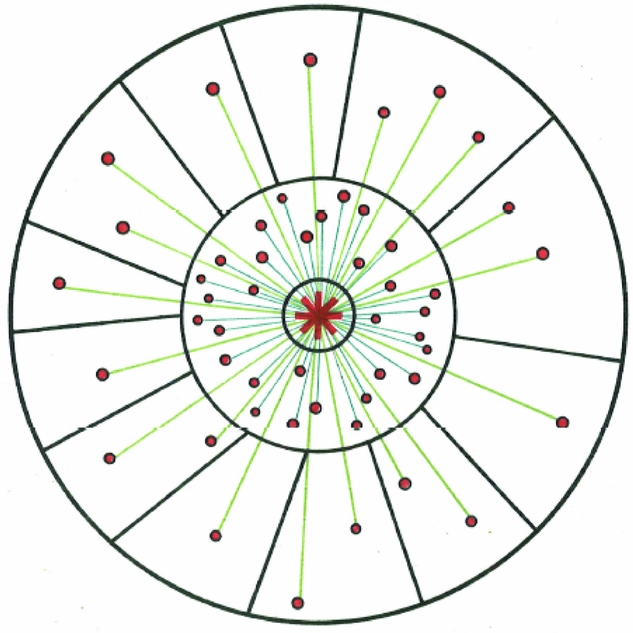
Harms visualized his fusion of methodological individualism and spatial economics in a pair of striking diagrams he included in his 1912 opus. The first presented the world economy from what he called the “atomistic–individualistic” perspective of a single microeconomic unit, with lines linking the individual economic actor (Einzelwirtschaft) to other actors (depicted as red dots) through exchange (Figure 1).Footnote 32 The diagram—or what could be better called a diagraph, as it tells its own story—made clear that interactions are denser with those within the inner ring of the national economy “delimited by a state's territory,” but they also happen in the surrounding ring representing the entire surface of the Earth.Footnote 33
Bernhard Harms's depiction of the world economy from the perspective of the individual, 1912.

The diagram paid apparent homage to the father of German economic geography, who would also be influential on Giersch: Johann Friedrich von Thünen. Also a native of East Friesia, Thünen's work on “the isolated state,” first published in 1826, began with the idealized model of a large city in the center of an empty plain. From this model, he deduced a relationship between distance and price, and predicted future land use on the plain divided into “rather sharply divided concentric circles.”Footnote 34 The “Euclidean severity”Footnote 35 of Thünen's vision inspired a series of followers, including Alfred Weber and one of Giersch's self-described influences at Kiel, August Lösch, who continued Thünen's approach of drawing conclusions about the location of economic activity from abstract models of space, often depicted in circular diagrams.Footnote 36
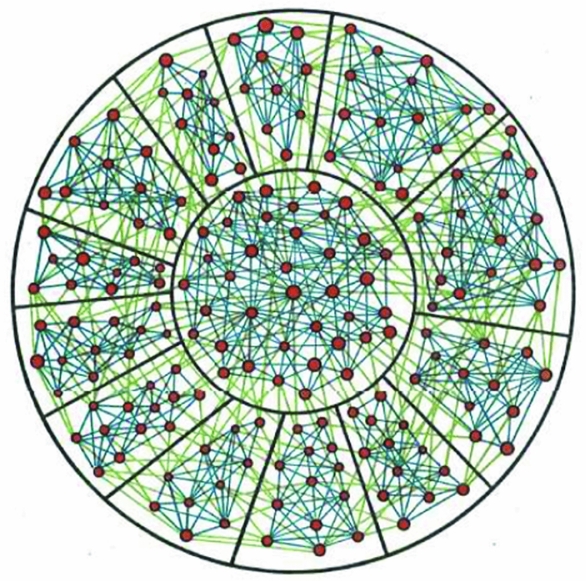
In a departure from the methodology of economic geographers, who preferred the small-scale model, Harms paired his diagram of the individual perspective with one from “the perspective of the totality” (Standpunkt der Einheit), combining many microeconomic entities to create a far denser web of relationships, or “a network of threads running to and fro across the entire Earth.” Exchanges within nations were colored in blue and depicted as existing alongside those across national borders, which were colored in green (Figure 2).
Bernhard Harms's depiction of the world economy from the perspective of the totality, 1912

Though intended as objective descriptions, Harms's schematic diagrams were also normative portrayals of an optimal world economy, where exchange happened smoothly within and across national boundaries. Harms's diagrams expressed his holistic conception of the world economy as a “network that has no end and no beginning.”Footnote 37 While the implication of Harms's model seemed to be one of a universalist world economy stripped of differences beyond the simultaneous and overlapping acts of exchange, it is important to recall that his scholarly undertaking was explicitly nationalist. His goal was not simply to observe the network objectively from afar but to intervene through applied knowledge to help expand the share of German actors in the global sphere of commerce and trade. This would remain the mandate of the Kiel Institute under Harms's direction and afterward.
USEFUL WORLD-ECONOMIC KNOWLEDGE
From 1914 to 1945, the world-economy approach at the Kiel Institute was applied to a range of national political projects, from the imperial war economy of the Great War, to reconstruction of world trade in the Weimar period, to the genocidal expansionism of the Nazi period. A matter of months after the institute's founding, Harms's approach was given immediate practical application with the outbreak of conflict. He hastened to fill his patriotic duty by putting the institute's resources at the services of the Kaiserreich.Footnote 38 The economic archive became a war archive with over half a million holdings by the conflict's end, and the institute published a special series on “economic war” (Wirtschaftskrieg).Footnote 39 The IfW's private funders, who included business people in export industries as its core, grew to nearly a hundred by 1914 and over six thousand by 1919, as German entrepreneurs prepared to “reconquer the German share of world trade” after the conflict.Footnote 40
In the event, the postwar period was a time of defeat rather than victory. After turning to the state for funding after 1922, Harms used the IfW to help coordinate the German response to their economic predicament under the weight of reparations. As the head of a thirty-six-member government committee on export chances for the German economy, he coined the term “structural change” (Strukturwandel) to describe the challenges Germany faced after losing its territory and operating in a new regional and international business environment.Footnote 41 While the term may have been novel, the core of the idea was very similar to those explored before the First World War by Alfred Weber, who investigated the relocation of industry under the conditions of “enormous displacements of economic forces” both between and within nations in the first age of globalization.Footnote 42 Harms's term—melded with Weber's methodology—would end up being central to Giersch's own conceptions of political economy after the Second World War.
Many of the Kiel Institute's economists were close to the Social Democratic Party (SPD) and proposed proto-Keynesian strategies of countercyclical state spending against Chancellor Brüning's austerity policies.Footnote 43 Among these were economists who would become influential in their field, including Adolph Lowe, Jacob Marschak and Bank of Sweden Nobel Memorial Prize laureate Wassily Leontief.Footnote 44 Working closely with Tönnies, Harms helped promote a left-leaning strain of sociology at Kiel in the 1920s.Footnote 45 The institute was in the vanguard of global business statistics and business-cycle research during the years of the Weimar Republic.Footnote 46 Several scholars of the institute received funding from the Rockefeller Foundation during the 1920s.Footnote 47 In January 1931, the officer of the Rockefeller Foundation John Van Sickle wrote that Kiel had “the best facilities for research in problems of world economics that I have ever seen.”Footnote 48 The foundation followed up with a three-year grant of $10,000 per year beginning in April 1931.Footnote 49
The Nazi seizure of power in 1933 led to a sudden change in Kiel and a sharp turn away from its left-leaning free-trade orientation. Harms was forced from the directorship after defending his Jewish colleagues, Gerhard Colm and Hans Neisser, who both went on to illustrious careers in the US.Footnote 50 Harms nominated his own successor, Jens Jessen, an economist and Nazi Party member from Göttingen, who was himself replaced by Andreas Predöhl one year later.Footnote 51 Predöhl had written his dissertation under Harms and worked as his research assistant in the 1920s.Footnote 52 He continued Harms's synthesis of geography and pure theory (although more firmly within the tradition of Thünen), but put his scholarly efforts in the service of an entirely different political project. Predöhl's own work focused on the world economy, but also on the all-important category of Großraum, or “large space,” providing intellectual legitimacy for Nazi projects of continental expansion and domination.Footnote 53 Although losing his position as director after 1945, Predöhl survived in the West German academy like many other scholars close to the regime.Footnote 54 After returning briefly to Kiel, he taught at the University of Münster from 1953 to 1964, where the students included two future directors of the Kiel Institute: Giersch's successor, Horst Siebert, and Giersch himself.
GIERSCH'S GLOBAL TURN
Herbert Giersch's first experience at the Kiel Institute was during the years of the Second World War. Born in 1921 and raised in a small textile town in Lower Silesia (then a province of Prussia), he was drafted into the compulsory German labor service (Reichsarbeitsdienst) in April 1939, and subsequently joined the German Navy.Footnote 55 He and his family experienced the negative effects of imperialism and war firsthand, including forced migration and resettlement. Giersch managed to study economics for the first three years of the war, first in Breslau (today's Wrocław in Poland), where he recalled being impressed only by the lectures of later MPS president Günther Schmölders, and then at the Kiel Institute in 1941–2.Footnote 56
In retrospect, Giersch referred to his wartime experience at Kiel, among other places, in an effort to explain his “system of thought which comes up in my mind whenever I try to understand the growth of the global economy.” He described it as “a vision rooted in the German tradition of Johann Heinrich von Thünen (1783–1850), Walter Christaller (1893–1969) and Alfred Weber (1876–1963). It has inspired August Lösch (1906–1945) and Andreas Predöhl (1893–1974) who were among my teachers.”Footnote 57 Beyond Kiel, a few other stations of migration were important in Giersch's intellectual formation. After being captured on a submarine at the end of the war, he spent time in a British prisoner-of-war camp, where his reading included Adam Smith's The Wealth of Nations, before his release in October 1946. He received his first position as an assistant at the University of Münster, where he wrote a dissertation accepted by Walther Hoffmann and one of the leading lights of German neoliberalism, Alfred Müller-Armack. He spent the 1948–9 academic year at the London School of Economics, where he met Lionel Robbins, F. A. Hayek, Gottfried Haberler, and Ludwig Lachmann. In 1950 he completed his academic qualification in Münster with a Habilitation under Walther Hoffmann.Footnote 58
Despite such early encounters with leading neoliberals, Giersch's work developed in closer proximity to the mainstream economics of the time.Footnote 59 He embraced the Keynesian “neoclassical synthesis” developed and popularized by John Hicks and Paul Samuelson in his early work on regional and foreign economics and on business cycles and growth (1950s and 1960s).Footnote 60 To offer one example, Giersch's inaugural lecture at the University of Münster advocated the social democratic measures of insulating national industries from the shock of industrial adjustment due to foreign competition (including potentially international transfers or “credits from a European bank”), welfare policy (Sozialpolitik), and policies geared toward “national and international full employment.” All of these policies were vigorously opposed by neoliberals at the time.Footnote 61 Indeed, in the same year as Giersch, Wilhelm Röpke published an excoriation of precisely such “national and international measures for full employment.”Footnote 62 Early mainstream proclivities notwithstanding, Giersch's later turn to neoliberalism would be facilitated by his early connections to the network of key figures like Hayek, whom he considered a personal friend and mentor from the early postwar years onward.Footnote 63
After short-term positions in Münster and Braunschweig, Giersch received a call for a professorship in Saarbrücken, where he taught macroeconomics from 1955 until 1969. Attesting to his wittiness, he explained his choice in economic terms: “being a refugee I had full freedom of choosing the location with the best long-run prospects.”Footnote 64 Giersch's second book after a dissertation on “compensation for war damages from the perspective of social justice” (1948) was a general introduction to economic policy published in 1960.Footnote 65 In this first of two planned volumes, Giersch briefly discussed the major theoretical and social-philosophical frameworks of economic policy in Germany. He criticized the ordoliberal commitment to full competition, judging the social market economy concept of Germany's leading party at the time, Christian democracy, as more flexible and closer to reality.Footnote 66 In his discussion of democratic socialism developed by Social Democratic economists like Karl Schiller, he emphasized the shared commitment of so-called “neosocialists” (Social Democrats after their reformist turn at the 1957 Bad Godesberg conference) and neoliberals to the free-market order. He referred to the postwar British Labour government and that of Sweden as models for German democratic socialism, contrasting problematic ordoliberal assumptions regarding high levels of employment against the Keynesian concept of full employment that relied on national budget calculations and macroeconomic coordination.Footnote 67 The effort to combine the decentralized market economic order with macroeconomic policy-making capacity clearly appealed to the young economist who became one of the key supporters of later Finance Minister Karl Schiller's “global steering” (Globalsteuerung).
In 1964, Giersch was offered a position on Germany's newly created Council of Economic Advisers (Sachverständigenrat für Wirtschaft—SVR). While supporting the social market economy concept, Giersch was not considered an overt neoliberal at the time.Footnote 68 The social market economy was closely associated with ordoliberal and pragmatic Christian Democratic economic policy ideas in opposition to modern Keynesianism and democratic socialism.Footnote 69 Yet Giersch was also versed in the new art of public finance and national accounting, which fell into the realm of modern Keynesianism. According to Otto Schlecht, one of Ludwig Erhard's key advisers in the Ministry of Economics, Giersch was considered a good candidate to combine the market-oriented ideas of Ordnungspolitik (institutional framing) with modern business-cycle politics.Footnote 70
Despite being its youngest member, Giersch was the de facto head of the Council of Economic Advisers.Footnote 71 He was also the only one with overseas experience, with his time at the LSE, two stints at the OEEC in Paris, and a guest professorship at Yale.Footnote 72 In order to deal with the rise of inflation, Giersch translated the goal of the Ministry of Economics of wage moderation into the concept of “concerted action” to align employers, trade unions, and the government to reduce inflation in favor of full employment. In retrospect, he played down the idea of coordination and state-led alignment of economic actors. Although appointed one of Erhard's “inside men,” Giersch did not always end up following the chancellor's wishes—nor the chancellor his. When Erhard and the Bundesbank opted for a sharp monetary contraction in 1965–6 instead of adhering to the advice from Giersch's council of experts, unemployment rose sharply, leading to an election loss for the ruling Christian Democrats.Footnote 73 While Erhard's minister of economics, Kurt Schmücker, prepared the Law on Stability and Growth, Erhard continued to emphasize the need for price stability rather than growth.
During his final weeks as chancellor, even Erhard's close friends, such as Alfred Müller-Armack, tried to convince him that economic growth and even structural imbalances needed to be addressed.Footnote 74 Yet more proactive modern macroeconomic coordination only came into being after Erhard stepped down, in the form of the Law on Stability and Growth passed by the new coalition government of Christian Democrats and Social Democrats in 1967. Economics Minister Schiller was most closely associated with the new doctrine of balanced macroeconomic policy making: the so-called “magic square” of price-level stability, high employment, external trade balance, and stable growth.Footnote 75 Although the idea of concerted action was essential to the balancing of activities designed to meet equally ranked goals, Giersch's enthusiasm did not last long. He recalled that
the approach was successful in the upswing after 1967, but it collapsed under the impact of imported inflation in 1969, when the fruits of wage restraint were not internalized by an appreciation of the currency. Trade union leaders lost the confidence of the rank and file, and a wage explosion following wildcat strikes became a quick substitute for a change in the exchange rate.Footnote 76
Giersch later referred to this as a “revolt of labor,” which helped to prove that the traditional tools of Keynesian macroeconomic management had become obsolete.Footnote 77
Schiller's failure to convince Social Democratic delegates and state governments to lower social expenditures in the boom after 1970 – at a point when Schiller was serving as both economics and finance minister – and subsequent wage increases in the public sector of up to 11 percent (in the famous “Kluncker round” in 1974, named after the head of the public-sector union) destroyed all of Giersch's hopes for a “managed-growth regime” and stability-oriented fine-tuning of the economy. Schiller attempted to exercise the German version of stability-oriented Keynesianism (or ordo-Keynesian compromiseFootnote 78) until 1972, before he stepped down and left the SPD to join Erhard and the opposition in the German Bundestag against Keynesian macroeconomic coordination and the expanding welfare state.Footnote 79 Giersch, unencumbered by party affiliation and government position, defected from the macro-coordination camp earlier to join the supply-side opposition.
Giersch's weaning from macroeconomic coordination ambitions coincided with his move to Kiel in 1969, where he was appointed successor of the Keynesian director Erich Schneider, another important mentor in his career. Ironically, he received the call to this position based in part on his Keynesian credentials at the very moment when he was preparing to abandon demand-side-oriented “global steering” for good. From 1969 onward, he blamed the ensuing stagnation and inflation (stagflation) on the rigidities created by trade unions and misguided state policies.Footnote 80 In the face of the revolt of labor, he began to emphasize endogenous impediments to economic growth and the need for structural adjustment, arguably helping to pave the way for what would become New Growth economics.Footnote 81
Taking a global turn, Giersch began to argue that the world economy itself must act as the disciplinarian: free exchange rates combined with free trade would force-feed the “medicine of imported competition” to the West German economy, compelling it to innovate and adapt while undermining entrenched interest groups that blocked further specialization and progress.Footnote 82 “By accepting and inviting more competition from abroad and more structural adjustment,” he argued in 1975, “the national economy is faced with an additional employment risk ex ante, but as a whole and ex post, the economy is certain to gain in terms of productivity and real incomes.”Footnote 83 Giersch's change of perspective was reflected in the second volume of his economics textbook on business-cycle and growth policy, published in 1977.Footnote 84 Schiller's “democratic socialism” was no longer presented as a viable option. Rather, Giersch described a confrontation of Keynesian ideas and monetarism. The final chapter on growth policy emphasized locational quality, the socioeconomic atmosphere of population centers, and their attractiveness for success-oriented mobile factors.Footnote 85
Thus the first axis of conflict on the way to Giersch's neoliberal economic geography was the breakdown of a national macroeconomic coordination and a steering perspective based on countercyclical fiscal policy. Initially complementing macroeconomic considerations, regional economics and the world economy came to play a new role. As one of his students recalled, for Giersch at Kiel it was “far less about global steering and far more about globalization.”Footnote 86 If Harms had coined the term “structural change” to describe large-scale transformations beyond the control of any one nation, Giersch prescribed a willed structural change to adapt to shifting global circumstances. Giersch summoned the global economy as an exogenous agent of reform. The shock effect of more competition would result in the relocation of labor-intensive industries to the low-wage countries of the global South through outsourcing, or what he called “locational innovation,” thus disciplining stubborn labor unions and entrenched special interests and inducing a more productive use of Germany's human and natural resources.Footnote 87 Giersch accused those who sought to shelter the existing structure of German industry through subsidies, protection, and an undervalued currency of recuperating “our old political–military nationalism . . . reborn as export nationalism.”Footnote 88 The “populist policy of expensive labor and cheap capital” was distorting the world economy, to the detriment of all.Footnote 89
Giersch's research at Kiel turned the tables on the traditional economic perspective in Germany. Instead of looking at the globe from the perspective of the nation, Kiel researchers looked at the national economy from the perspective of the global economy. The outside-in view on the world economy recalled the second of the two optics introduced by Harms in 1912. In a twist, however, while Harms turned to the world economy to buttress the German social state, Giersch saw it necessary to dismantle parts of the social state to be competitive in the world economy. While the ultimate goal of increasing German prosperity was never in question for Harms, Giersch's objective was both national economic growth and the economic growth of the world as a whole.
SCHUMPETER VOLCANOES AGAINST THE NEW INTERNATIONAL ECONOMIC ORDER
When Giersch assumed the directorship of the Kiel Institute in 1969, its reputation had faded since its high point of interwar business-cycle research, especially in comparison to the other economic research institutes that sprang up in the 1950s.Footnote 90 Giersch thrust the institute back into the spotlight in his outspoken criticism of the government. The position extended the career as a public economist that he had begun as the leading member of the SVR and contributed to his combative posture. As economic expert adviser to the government, he had learned to defend his expertise in somewhat hostile circumstances. During his tenure both at Kiel and on the SVR, his positions on central issues of monetary and wage policies were not always appreciated by key players in government and the interest groups of labor and capital.Footnote 91 West Germany's leading newsmagazine Der Spiegel acknowledged Giersch's success in 1985, writing that “no other institution has influenced the debates around economic policy in recent years more than the Kiel Institute for the World Economy.”Footnote 92 At the same time, the author noted the monotony of the message: more wage restraint and more international competition. He compared Giersch unfavorably to the institute's founder: “Bernhard Harms had been proud that there was no ‘Kiel line’ . . . Giersch is different. He has trimmed the institute down to one line—his own. A place of research has become a recipe factory.”Footnote 93
What was Giersch's recipe at Kiel? Departing from his previous combination of ordoliberalism and Keynesianism, he began to develop his own synthesis of Hayekian neoliberalism, Schumpeterian entrepreneurialism and German location theory. Like Harms, Giersch's primary intellectual task was to reconcile the Austrian marginalist sensitivity to time and expectations with the German attention to geography and space. Testifying to the Austrian influence, he wrote to Hayek in the early 1980s saying, “since my first encounter with you in 1948 . . . your words and writings have influenced me so much that I was rescued just in time from taking the wrong turn toward macro.” He described an “Austrian renaissance in Kiel,” declaring that “even practiced econometricians are sitting with the books of Hayek, Mises, Böhm-Bawerk and Menger!”Footnote 94 Giersch's marriage of Hayek and Schumpeter with the luminaries of location theory, Johann Heinrich von Thünen and the Kiel-educated August Lösch, created the mental map to which he oriented his policy prescriptions. One scholar has called Giersch's goal the integration of the vision of spatial equilibrium in the allocation paradigm of Thünen with the vision of evolution and change over time from Schumpeter's innovation theory.Footnote 95
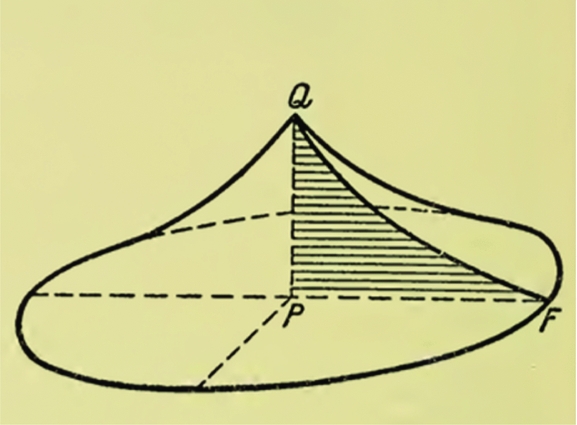
For over fifty years, Giersch's conceptual geography returned to a specific mental construct derived primarily from the defining works of two economists: Thünen's The Isolated State (1826) and Lösch's The Economics of Location (Die räumliche Ordnung der Wirtschaft) (1940). In one of his earliest published works in 1949, Giersch first followed Thünen in proposing the image of a “large plain” with no legal impediments to the movement of goods, capital, or people. While Thünen was concerned primarily with agriculture and land rent, Giersch followed Lösch (who was himself influenced by his dissertation adviser at Bonn, Schumpeter) to focus on the decisions of entrepreneurs. With distance as the only relevant variable, entrepreneurs would gather naturally at the center of the plain, securing optimal access to all markets. “The whole system of networks,” Giersch wrote, “tends to become denser in the center,” leading to what he followed location theorists like Alfred Weber in calling “agglomeration.”Footnote 96 The path-dependent emergence of centers would produce an advantage resulting in growing incomes, growing wages, and eventually growing property prices, leading some intrepid actors to compensate by moving out onto the plain to establish new centers. Borrowing an image from Lösch, Giersch called the centers on the plain “demand cones,” referring to the graphs produced by mapping distance on the x axis and demand on the y axis. Lösch included graphic versions of these demand cones in his 1940 book, producing a mathematical diagram which also doubled as a topography in the construct of the “plain” (Figure 3). Lösch's demand cones were consistent with a marginalist geography, representing a relationship of both space and price.
Lösch's demand cone. P = price, Q = quantity, F = marginal price point. August Lösch, The Economics of Location (London, 1954), 106.

During a second research year spent at Yale in 1977–8, Giersch recalled Lösch's admonition to “take space seriously” and made a crucial adaptation to the metaphor, reconciling Thünen and Schumpeter by transforming the cone into a volcano.Footnote 97 In the model to which he would return for the next two decades, prices and demand were not based merely on natural endowments in the manner of David Ricardo (“Ricardo goods”) or location in the manner of Thünen (“Thünen goods”) but on innovation, producing what he called “Schumpeter goods” in eruptions of the “lava of knowledge (transfer of technology).”Footnote 98 The ease of imitating such innovations produced pressure for unceasing development of new products. As he put it, “When knowledge flows down from the top, it raises total factor productivity wherever it is applied but once it is applied in competitive places it destroys the original gains from innovation in the center . . . in order to maintain these gains, the center must continuously generate new knowledge and Schumpeter goods.”Footnote 99
Since Weber's work in the early twentieth century, location theorists had been primarily concerned with the location of industry. Their rebuttal of the frictionless vision of the classical liberal free-trade theorists was to reassert the importance of transport costs.Footnote 100 Adapting Thünen, Weber proposed the idea of “isodapanes” (for “same costs”) as zones where transport costs were equal. Weber could not have foreseen the world that Giersch confronted in the 1970s where transport costs had fallen almost to zero in the wake of containerization and other advances in logistics. When the world was approximating a single isodapane, the obstacle to structural adaptation was not the need to overcome space but, as mentioned above, the obstacle of high wages (in relation to productivity) produced by labor unions and state-produced tariff and non-tariff barriers to trade.
Technological changes meant a new level of dynamism in the world economy. Rather than the increasing concentration that Weber forecast after an initial period of industrial relocation, Giersch's geography saw a path-dependent advantage for early industrializers susceptible to erosion as new “volcanoes” emerged on the landscape. In contrast to the Thünen cone's suggestion of mountain-like solidity, the volcano emphasized flux and tectonic shift. Giersch observed that the landscape had already changed in the twentieth century. While “the world economy could once be thought of as one great Thünen-Schumpeter system,” with the north Atlantic at its center, by the 1970s it included “at least three centers,” in Asia, Europe, and the United States.Footnote 101 Drawing inspiration from the regional success of expanding low-wage manufacturing and services in the US Southwest, aided by open-shop union policies, he referred to the countries of the South as “the global sunbelt.”Footnote 102 The decentralization of industrial capacity based on global patterns of innovation, imitation and adaptation was one of the reasons that Giersch declared the third quarter of the twentieth century the “age of Schumpeter” in 1984 as the era after the foregoing “age of Keynes.”Footnote 103 The relocation of mobile factors of production, especially capital, was celebrated as a virtue in its own right. In a telling conflation, Giersch wrote in 1979 that “freedom is synonymous with decentralization.”Footnote 104 Countervailing factors such as cultural attachment to particular varieties of production or traditional bonds to territory had no place in his analysis.Footnote 105
Giersch first elaborated on the imagery of the Schumpeter volcano in three articles in 1978.Footnote 106 Why did he turn to the language of destruction just then? One can find a hint by looking at the work that directly preceded this. In 1977, he condemned the “dirigiste concept of the New International Economic Order,” in which the global South was acting as a bloc to make demands for stability in commodity prices, the right to nationalize foreign-owned assets, and increased aid for more rapid industrialization.Footnote 107 The Declaration for the Establishment of a New International Economic Order was passed by a UN resolution of the General Assembly in May 1974. It represented the high point of mobilization of the so-called G77 nations of the global South, emboldened by the effective muscle flexed by the OPEC countries during the oil embargoes. Along with the Charter of the Economic Rights and Duties of States, the NIEO made strong demands from increased lending to reparations for colonialism.Footnote 108
Giersch saw the NIEO as a series of demands for what he called “open or hidden income transfers” in pursuit of outcomes of substantive equality rather than the formal equality of the marketplace.Footnote 109 His concerns echoed attacks from fellow MPS members Peter Bauer, Deepak Lal, and Karl Brunner, who similarly “took aim” at the NIEO.Footnote 110 The thrust of the NIEO, with its vision of macro-planning in the developing world, was not compatible with Giersch's norms of competition in open economies that required a greater degree of flexibility to global demand. Giersch felt that the global South would also be well advised to realize that they were in competition for foreign investment from the Eastern Bloc, which had begun taking large loans from Western banks by the late 1970s.Footnote 111 He stated that it was necessary to “break apart the bloc of the developing nations” and encourage the creation of “free investment areas.”Footnote 112 In the early decade, Giersch had turned to competition from the global South as a bludgeon to break open structural blockages in German industry. But if the global South itself refused to cooperate in the game of liberal capitalism, as the NIEO suggested, then the dynamic system would cease to function.
Yet even as he expressed his antipathy for the NIEO, Giersch realized that “the West must present a morally supportable solution if it does not want to be trapped on the defensive.”Footnote 113 Thus, as he said before the American Enterprise Institute in 1976, if the first reason to open markets was to force structural adjustment on Germany,
the second reason . . . relates to the whole Third World and its demand for a New International Economic Order. The more we dislike the idea of an integrated commodity scheme modeled along the lines of Europe's Common Agricultural Policy—and we dislike it very much in Bonn as well as in Kiel—the more we have to work for the opening of our markets to the labor-intensive products of the LDCs [least developed countries].Footnote 114
In the late 1970s and early 1980s, Giersch began to reframe protection of German industry as a system which “discriminates against the poor abroad,” describing “an international class struggle not between capital and labor but between the labor class in rich countries and the labor class in poor countries.”Footnote 115 Much like Bauer's quip that foreign aid was “a process by which poor people in rich countries help rich people in poor countries,” Giersch's neoliberal turn in development economics claimed the moral high ground while rejecting the demands of the most visible spokespeople of the global South itself.Footnote 116
Giersch's metaphor of a volcanic landscape gave graphic expression to his own counterimaginary to the NIEO. He posed his geography and policy prescriptions as truly universalist and responsive to the structural needs of world economic growth against the discriminatory demands for wage equality within nations and transfers between nations based on past supposed transgressions. Even colonialism must be seen for its benefits. He pointed by example to the “free transfer of knowledge capital that had been accumulated over the centuries” to sub-Saharan Africa.Footnote 117 In place of a world of blocs characterized by common political purpose under what he followed Hayek in calling the “vague” objective of social justice, Giersch offered a fluctuating landscape of regions in constant competition for mobile capital.Footnote 118
Giersch embraced the volatile vision of the world expressed by the globe of volcanoes. The sudden violence of eruption was apposite. As he put it, “a temporary crisis may be both inevitable and necessary to bring about the destruction which Schumpeter considered to precede creation or to go along with it.”Footnote 119 As a graphic depiction of “creative destruction,” a term Giersch used from his own very earliest work, the world of volcanoes reminded the leading economies that they must innovate or face obsolescence.Footnote 120 As he put it in 1984, in the age of Schumpeter, “competition also prevails among governments and central banks. Such policy competition . . . is efficient in the medium run as a process of discovery and learning although—or because—it offers unpleasant short-run lessons to the misbehaving countries and central banks.”Footnote 121 Referring to Hayek's notion of “competition as a process of discovery,” which Hayek first elaborated in a talk given at Kiel in 1968, Giersch also invoked Hayek's ideas of evolution: if institutions did not adapt successfully, they would be rendered extinct.Footnote 122 More than once, Giersch used the evocative metaphor of the clock: “There can be no reliable calm in dynamic competition, not even the peace of cartels, because the unrest of new knowledge keeps events moving through jolts, like the unrest of a clock's gears. The energy supply for the mechanism comes from the shocks that burst forth from the source of new knowledge.”Footnote 123 Giersch's geography was one of landscapes of unrest. Constant innovation was necessary to prevent fickle flows of capital from moving on to the next site of investment. The payoff was more prosperity, technological progress, and access to goods for all. The necessary drawback was greater inequality and perpetual exposure to risk.
Giersch's world was not one of nation-states but of regions defined by centers of high income and creativity—a core from which new products and refined processes emanated. He pushed competition rather than redistribution between national regions, inequality rather than equity between wages at the national level, economic growth over social justice. He decoupled regions from nations. Like Michael Porter and his cluster theory and other prophets of spatial-growth strategies, he promoted policies that targeted high-performing locales but, unlike Porter, he remained keenly aware of the temporary monopoly effects of innovation and the need to adjust constantly. His argument for the need to overcome wage and regional equality in support of his new economic regionalist perspective was certainly overdrawn as there were already considerable regional wage disparities in most countries in line with the hierarchies between centers and peripheries. The key factor he presented to explain the rise of centers—his neologism of “co-opetition”—was likewise at odds with the image of constant change and fluctuating landscapes. But these contradictions dissolve once one distinguishes between positive and normative analysis in the style of the Chicago school. Structural impediments to competition exist, but they should be dismantled to encourage the only type of competition that can lead to success, namely the real innovative “Schumpeterian” competition that leads to temporary competitive advantage and monopoly profit. From this angle, wage and regional policy oriented toward equality is irrelevant at best and, more likely than not, counterproductive.
Giersch's explanation of regional centers across national borders produced its own misleading reality effects. Europe's so-called “blue banana” region, for example, stretching from London across the Channel through the German Rhineland down to Italy's northern industrial centers, suddenly seemed to be due to common economic patterns regardless of the long tradition of social democratic and Keynesian policies designed to narrow the gap between center and periphery. In Giersch's account, fiscal federalism and traditional convergence-oriented regional economic policy amount to a futile effort to swim against an overpowering current. Not only would backward regions not be able to catch up by way of cross-subsidies, but also the policy regime was considered likely to impede Schumpeterian development in the regions that would then be forced to invest in the wrong places for the wrong reasons. Yet Giersch's empirical evidence was not as solid as his language of conviction seemed to suggest. There were many successful regions outside his Düsseldorf-centered circles (in Scandinavia, for example), and the highly successful blue banana region of Bavaria arguably came into being due to historical happenstance (relocating Siemens from Berlin to Munich) and generous funds directing investments from wealthy northern regions like Hamburg and Bremen to the agrarian hinterland of Germany's south thanks to military investment and fiscal federalism.
Such corrections do not diminish the constructive accomplishment of Giersch's new economic geography. His insight into competitive regionalism helps illuminate the end of traditional regional planning policy in Germany, as observed by Neil Brenner.Footnote 124 New economic geography was also translated into new programs of state intervention at the regional level with a focus on knowledge creation, academic–industrial partnership, and innovation. Yet Giersch's project did not reject government. It redirected government to embrace a more fine-grained support of certain regions, and to actually increase support in some places at the expense of others. Schumpeterian regions required competition states uninhibited by fiscal federalism, and enabled by competitive federalism. Giersch's harsh criticism of old-style regional policy in Germany (as fiscal equalization, or Länderfinanzausgleich) gave way to a new agenda of entrepreneurship regionalism embraced by all parties, if for different reasons.
At the same time, one must note that Giersch's revival of Schumpeterian entrepreneurship was actually at odds with Schumpeter's own sociological analysis of the decline of entrepreneurship in the age of managerial capitalism.Footnote 125 Schumpeter's quite elitist and exceedingly rare species of entrepreneurs (as described in Capitalism, Socialism and Democracy)Footnote 126 was quietly replaced by a perspective that claimed a nearly unlimited supply of entrepreneurs. In Giersch's geography, everyone, including the regions themselves, became potential entrepreneurs in a mutating terrain of competition.Footnote 127
CONCLUSION
Speaking at the seventy-fifth anniversary of the Kiel Institute on the eve of the collapse of the German Democratic Republic, Giersch offered his vision of the world to come. In place of a planet split into the blocs of the Cold War, he foresaw one united in a single capitalist economy. For Giersch, there was no doubt that the “short twentieth century” stretching from the Russian Revolution to the demise of the Soviet Union was coming to an inevitable and well-deserved end.Footnote 128 Communism had cracked under the pressure of the forces descried by its own founders. Marx and Engels, he recalled, wrote that “the bourgeoisie, by the rapid improvement of all instruments of production, by the immensely facilitated means of communication, draws all . . . nations into civilization.”Footnote 129 By “civilization,” he explained, they meant “nothing other than the world economy.”
Using another communist to attack communism, Giersch adapted Oskar Lange's writing on “revolutionary courage” to call for a “revolution that liberalizes everything simultaneously,” or what would later be called shock therapy, as the return road to capitalism. Giersch presented the world economy as “a total social utopia.”Footnote 130 It combined opportunities with dangers, profit incentives with the risk of bankruptcy, and chances for upward mobility with the threat of unemployment.Footnote 131 He took the logic of economic geography one step further than his predecessors. Lösch had contained the denationalizing potential of the regional approach by emphasizing that “many customs are determined by the character of a landscape, by its history, and perhaps biologically too, and can be changed only slowly or not at all . . . up to a certain point national boundaries will still remain economic boundaries.”Footnote 132 Lösch finished his magnum opus by insisting that “the mighty elements of spatial discipline tend toward preserving geographical and cultural roots in spite of freedom.”Footnote 133 Giersch, by contrast, portrayed his own neoliberal economic geography as antinationalist and “cosmopolitan,” in the sense that it “weighted the life chances of those distant equally to those close at hand.”Footnote 134 The nature of politics transformed in Giersch's neoliberal economic geography. Elected political structures “lose the weight of their role as sovereign.”Footnote 135 Governments were to serve as handmaidens of economic development, helping nations find their most productive place in an international division of labor. Advocating what critics have called “the competition state,” Giersch stated that, “in the world-economy approach, competitiveness becomes the yardstick of . . . politics.”Footnote 136
Giersch created a genealogy of his own neoliberal economic geography by selectively coopting aspects of economic thought from Thünen through Schumpeter, Harms, Lösch, and Hayek. He described a world economy of the competition state, in which regions and individuals struggled to realize the profits innate to their endowments of human and physical capital.Footnote 137 His world-economy approach stipulated an evolution from localism and parochialism to cosmopolitanism and voluntary individualism. It reduced the role of the national political systems and subordinated all activities to the logics of economic exchange and competition. Giersch's flexible presentation (and reinterpretation) of Harms and Schumpeter in conjunction with key neoliberals like Hayek yielded a radical strain of both neoliberal geography and what could be called cosmopolitan capitalism.
Giersch's own students acknowledge the partiality of his model. They observe that he was correct in its prediction of the speed of imitation by latecomers like China but failed to incorporate the disruptive effects of financial markets.Footnote 138 He saw financial institutions only as benevolent granters of capital, and not as potential agents of systemic risk. Perhaps more significant is the way that Giersch's stated intention of working for cosmopolitanism and against nationalism has not been realized. Standort Deutschland has become, in fact, another way of expressing nationalism in economic terms. Even as neoliberal economic geography seeks to provide the contours of a landscape of unrest beyond the world of states, its terms and categories continue to be integrated in ways that reinforce rather than diminish the (nation-)state to secure the priorities of cosmopolitan capitalism.