Post-operative arrhythmias are a major cause of morbidity and mortality following surgery for congenital heart disease.Reference Yueh-Tze, Lee and Wentzel 1 Temporary pacing wires have been placed to assist in the management of post-operative arrhythmia for more than 40 years.Reference Muller, Deal and Strasburger 2 Whereas some programmes institute routine placement of temporary epicardial pacing wires, some have employed a more selective approach. In 2008, Fishberger et alReference Fishberger, Rossi and Bolivar 3 reported that with continued improvement in cardioprotective measures and surgical techniques cardiac surgery without routine use of pacer wires was possible and can be successful.
Our current programmatic approach to post-operative arrhythmia has been to place temporary pacing wires only in those patients who develop haemodynamically significant arrhythmia intra-operatively. If a patient requires placement of temporary pacing wires, the usual protocol is to place both atrial and ventricular wires unless the intra-operative arrhythmia is sinus bradycardia or paroxysmal supraventricular tachycardia in which case only atrial wires are placed. The purpose of this descriptive study was to evaluate our current programmatic protocol for placement of temporary pacing wires and to determine whether our approach is sensitive and predictive of who will develop post-operative arrhythmia. We also sought to evaluate our institutional incidence of arrhythmia and identify any mortalities or adverse events that may have resulted from post-operative arrhythmia or from the placement or removal of temporary pacing wires.
Methods
Following institutional approval by the Arnold Palmer Medical Center IRB, we retrospectively searched our surgical database to identify all patients newborn to 18 years of age who underwent surgery for congenital heart disease requiring cardiopulmonary bypass from January, 2005 to December, 2012. We then searched operative and post-operative notes from electronic medical records to identify patients who underwent placement of temporary pacing wires, if those patients had intra-operative arrhythmia, and if so which arrhythmia they experienced. We then determined which of these patients also experienced post-operative arrhythmia and if the temporary pacing wires were utilised. We then searched for patients who experienced haemodynamically significant post-operative arrhythmia but who did not experience intra-operative arrhythmia and therefore did not have temporary pacing wires. In addition, pharmacy records were searched for antiarrhythmic medication use in an attempt to ensure that no haemodynamically significant post-operative arrhythmia was missed in the review. We also searched for mortalities associated with the arrhythmia or any adverse events associated with placement or removal of the pacing wires. Other variables collected include patient age, weight, cardiac lesion, and type of cardiac surgery.
Our institutional protocol is to place temporary pacing wires in a prophylactic manner in those patients who have a past history of arrhythmia but who have not met criteria for placement of a permanent pacing system. These patients were excluded from this study. Patients who did not experience intra-operative or post-operative arrhythmia were also excluded, as were patients with permanent pacing systems already in place.
Results
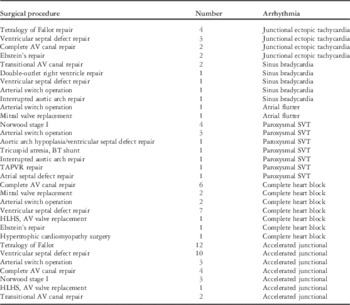
From January, 2005 to December, 2012, 1766 patients underwent cardiac procedures at Arnold Palmer Hospital for Children. Of these, 880 patients underwent cardiac surgery requiring cardiopulmonary bypass. A total of 87 patients (9.9%) over this time period experienced haemodynamically significant intra-operative arrhythmia and underwent placement of temporary pacing wires: of the 87 patients with intra-operative arrhythmia and pacing wires, 35 had accelerated junctional rhythm without meeting criteria for junctional ectopic tachycardia, 20 had complete heart block, 12 had paroxysmal supraventricular tachycardia, 12 had junctional ectopic tachycardia, six had sinus bradycardia, and two had atrial flutter. Of these patients, 59 (67.8%) went on to experience the same post-operative arrhythmia as they experienced intra-operatively, requiring utilisation of the temporary pacing wires (Table 1). The remaining 28 (32.2%) patients did not experience post-operative arrhythmia and therefore the pacing wires were not utilised. A total of 68 patients had atrial and ventricular wires placed (78%), whereas 19 had only atrial wires placed (22%).
Surgical procedures and associated intra-operative arrhythmia.

AV=atrioventricular; SVT=supraventricular tachycardia; BT=Blalock–Taussig; HLHS=hypoplastic left heart; TAPVR=total anomalous pulmonary venous return.
Of note, three patients with a history of pre-operative arrhythmia had temporary pacing wires placed despite the fact that they did not have an intra-operative arrhythmia – two had a history of supraventricular tachycardia and one had a history of sinus node dysfunction. None of these patients experienced a post-operative arrhythmia. These patients were not included in the study.
There were four patients with post-operative arrhythmia who went on to require permanent pacemaker placement, three for complete heart block and one in a patient with single-ventricle physiology with persistent junctional rhythm and atrioventricular dysynchrony.
There were a total of seven patients who did not experience intra-operative arrhythmia and therefore did not have temporary pacing wires placed but who went on to experience haemodynamically significant post-operative arrhythmia, requiring medical management with either an amiodarone or procainamide infusion. Of these, four patients developed junctional ectopic tachycardia, two experienced automatic atrial tachycardia, and one experienced paroxysmal supraventricular tachycardia. There was one patient with junctional ectopic tachycardia who also required oesophageal pacing because of haemodynamic instability secondary to atrioventricular dysynchrony. None of these patients required placement of epicardial pacing wires post-operatively.
Of these 94 patients, 87 with intra-operative arrhythmia and seven without intra-operative arrhythmia who were reviewed, there were eight mortalities. There were five mortalities in the group that had temporary pacing wires placed and three in the group with no pacing wires. No mortality was related to arrhythmia or the placement or removal of pacing wires. Of the 8 mortalities, seven were patients with single-ventricle physiology. There were two patients who died while awaiting heart transplantation, one with worsening atrioventricular valve regurgitation and the other was status post atrioventricular valve replacement. Other causes of death included two from sepsis and one from recurrent restriction of the atrial septum; one patient died at home likely from shunt thrombosis. The one patient who was not a single ventricle had a complex medical history including congenital diaphragmatic hernia requiring extracorporeal membrane oxygenation for 2 weeks pre-operatively and had lung hypoplasia with double-outlet right ventricle who eventually expired because of bowel perforation and sepsis.
Using intra-operative arrhythmia as an indicator for placement of temporary pacing wires led to a sensitivity of 89.3% in terms of identifying all patients who developed post-operative arrhythmia. Intra-operative arrhythmia was also predictive of the likelihood of developing post-operative arrhythmia (70.2%).
Discussion
The data presented suggest that our current protocol of selective temporary pacing wire placement is effective and reasonable for our programme. Intra-operative arrhythmia appears to be sensitive and predictive of post-operative arrhythmia.
Fishberger et alReference Fishberger, Rossi and Bolivar 3 reported in 2008 that cardiac surgery without routine use of pacer wires was possible and can be successful. Many programmes practice routine placement of pacer wires, whereas some take a more selective approach to placement following surgery for congenital heart disease.
Although complications following the placement or removal of temporary pacing wires are rare, they have been reported. Complications range from mild bleeding, infection, retained wires to severe haemorrhage, tamponade, and death.Reference Del Nido and Goldman 4 – Reference Kanoh, Ishikawa and Suzuki 9 Misuse and asynchrony of the pacing system have also been reported and can lead to fatal arrhythmia.Reference Chung 10 – Reference Preisman and Cheng 12 These complications have factored into our decision as a programme to avoid routine placement of pacing wires.
Our institutional incidence of junctional ectopic tachycardia and complete heart block were calculated as 2.2% and 2.3%, respectively. Previous publications have reported an incidence of junctional ectopic tachycardia ranging from 0.8% to as high as 14.3% in children under 1 year of age.Reference Fishberger, Rossi and Bolivar 3 , Reference Zampi, Hirsch and Gurney 13 – Reference Mildh, Hiippala and Rautiainen 15 Although our incidence of these arrhythmias appears relatively low, we feel that temporary pacing wires do play a substantial role in the management of post-operative arrhythmia. Their use can range from restoring atrioventricular synchrony to rapid atrial and overdrive pacing for arrhythmia termination. In addition, an atrial electrocardiogram can be vital in diagnosing and differentiating among arrhythmias.Reference Muller, Deal and Strasburger 2 , Reference Batra and Balaji 16 For these reasons, we do not feel that the total abandonment of temporary pacing wires is justified and therefore we adhere to an approach that involves their selective placement.
The data presented do suggest that with a relatively high sensitivity and predictive value we are able to intraoperatively identify the majority of patients who will develop post-operative arrhythmia. Of note is that a total of only seven patients out of 880 (0.8%) without intra-operative arrhythmia went on to develop haemodynamically significant post-operative arrhythmia and were therefore missed by our selective approach to pacing wire placement. In addition, analysis of this small subset of patients suggests that those who may be missed by our protocol can be managed medically and also have a low likelihood of developing significant complications from the arrhythmia as none of these patients required temporary wire placement post-operatively and there were no mortalities related to the arrhythmia. No patient developed complete heart block post-operatively without first developing intra-operative heart block. All arrhythmias in these patients were amenable to medical therapy and in one case trans-oesophageal atrial pacing was used to restore atrioventricular synchrony in a patient with junctional ectopic tachycardia.
Although these seven patients responded to medical management, the fact that one required oesophageal pacing suggests that at minimum this patient, and perhaps others, may have been better served with temporary epicardial pacing wires. Our protocol appears to be effective for our programme; however, we believe we could further improve our sensitivity. Owing to the fact that four of the seven patients who were not identified by our protocol had junctional ectopic tachycardia, we believe that identifying patients who are at high risk for this arrhythmia such as those with tetralogy of Fallot who are low body weight at the time of surgery, neonatal complete repairs, prolonged bypass time, and other high-risk lesions such as atrioventricular canal and ventricular septal defects, and placing temporary pacing wires in these patients regardless of whether or not they develop intra-operative arrhythmia would increase our sensitivity.Reference Zampi, Hirsch and Gurney 13 – Reference Mildh, Hiippala and Rautiainen 15
Of the seven patients not identified by our protocol, five had single-ventricle physiology, including two patients who were status post Norwood procedure, two status post fenestrated Fontan, and one status post bidirectional Glenn. In 2011, Ceresnak et alReference Ceresnak, Pass and Starc 17 reported that Fontan procedure, use of circulatory arrest, and intra-operative arrhythmia were associated with haemodynamic improvement with post-operative pacing and suggested that these might represent indications for empiric intra-operative placement of temporary pacing wires. Owing to the fact that these seven patients did not experience intra-operative arrhythmia, empiric placement of pacing wires would have identified four additional patients, two of whom underwent Fontan procedure and two Norwood patients who underwent circulatory arrest.
Longer aortic cross-clamp and cardiopulmonary bypass times, severely reduced ventricular function, high serum lactate at the time of discharge from the operating room, and presence of two or more intracardiac catheters have been reported as predictors for the use of pacing wires post-operatively.Reference Moltedo, Rosenthal and Delaney 18 , Reference Gupta, Jines and Gossett 19 It is well known that patients with single-ventricle physiology require atrioventricular synchrony to maintain adequate cardiac output. Using the above-mentioned predictors in single-ventricle patients and those lesions previously mentioned at highest risk for developing junctional ectopic tachycardia could improve our programmatic sensitivity substantially to near 100% based on the data presented.
This paper is a report of our institutional approach to post-operative arrhythmia and the selective placement of temporary pacing wires. Although the data presented do suggest that our current approach is effective and reasonable for our institution, it is important for each programme to investigate its individual incidence and evaluate which protocol works best for their patients.
Limitations
A limitation of this study is in identifying patients in the electronic medical records who did not experience intra-operative arrhythmia but who went on to experience post-operative arrhythmia. We were able to identify patients who experienced haemodynamically significant post-operative arrhythmia by searching the pharmacy records for those who required antiarrhythmic medications. There may, however, be a cohort of patients unidentified who did not experience a haemodynamically significant arrhythmia but who may have benefitted from temporary pacing.
Financial Support
This research received no specific grant from any funding agency, commercial or not-for-profit sectors.
Conflicts of Interest
None.