






1 Introduction
Throughout the paper
 $\kappa $
will denote a regular uncountable cardinal, and
 a cardinal greater than or equal to
 $\kappa $
.
The paper is concerned with the value of
 , which denotes the least size of an unbounded subset of
 . This two-place function has been around for a long time, but its importance was recognized gradually. Consider for instance the famous conjecture of Menas [Reference Menas20] that any stationary subset of
 splits into
 disjoint stationary pieces. Thanks to Shelah [Reference Shelah, Sands, Sauer and Woodrow23] we now know that
 the least cardinality of any stationary subset of
 . It follows that the conjecture will fail if
 . But can this happen at all? Sure. In fact it is not difficult to see that
 if
 . So if
 $\aleph _3$
Cohen reals are added to a model of GCH, then in the generic extension the conjecture fails for
 $\kappa = \omega _1$
and
 .
Now what if
 ? Then we cannot have that
 , since it can be shown that
 . So the question is whether
 assumes (here too) its least possible value, i.e.,
 . It turns out that (relative to the existence of large cardinals), the answer may be negative (note that if CH holds and
 $\kappa = \omega _1$
, then
 $u(\kappa , \kappa ^{+\omega }) = \aleph _\omega ^{\aleph _0}$
). Even though there is no fixed value for
 in this case, Shelah found a formula for it that gives a nice representation of
 as a true cofinality. This will also work for larger values of
 as long as
 stays close to
 $\kappa $
.
Fact 1.1 [Reference Shelah24, Theorem 3.6, p. 66], [Reference Holz, Steffens and Weitz7, Theorem 8.4.7].
Suppose that
 $\kappa $
is a successor cardinal, say
 $\kappa = \nu ^+$
, and

. Then

This theorem of Shelah is quite famous because it is used in Shelah’s proof of his celebrated result [Reference Shelah24, Conclusion 2.3, p. 274] that if
 $2^{\aleph _0} < \aleph _\omega $
, then
 $\aleph _\omega ^{\aleph _0} < \aleph _{\omega _4}$
. One may of course wonder whether Fact 1.1 can be extended. Is the assumption that
 $\kappa $
is a successor cardinal essential? How large can
 be? There are hints in the literature that there might be room for improvement. For instance in [Reference Abraham, Magidor, Foreman and Kanamori1], the conclusion of Fact 1.1 is derived from the assumptions that
 $\kappa $
is a successor cardinal,
 is singular and
 . We do obtain a generalization of Fact 1.1, but after a detour. We were motivated by this other result of Shelah:
Fact 1.2 [Reference Shelah24, Claim 3.7, p. 384].
Suppose that
 $\kappa $
is a successor cardinal, say
 $\kappa = \nu ^+$
,

is a singular cardinal, and

. Then

Now it is known that in some cases we actually get equality. For example (see the discussion on page 457 of [Reference Shelah24]), for
 $\kappa = \omega _1$
and
 ,
 . Most results in the present paper are derived from Theorem 3.9 that gives a representation of
 as a pseudopower provided that
 $\kappa $
is a successor cardinal and
 is not too far from
 $\kappa $
. The theorem follows fairly easily from a number of deep results of pcf theory. It has probably not reached its final form yet. We hope that it can be improved, in particular with respect to the situation when the relevant cofinality is
 $\omega $
. Representation in terms of the pcf function is given in Section 6, while the case when
 $\kappa $
is a limit cardinal is dealt with in Section 7. We study
 as a function of
 $\kappa $
(respectively,
 ) in Sections 4 and 9 (respectively, in Section 5).
The nice representation of
 can be combined with some extra hypotheses to construct (in Section 8) pseudo-Kurepa families in
 of maximal size. We thus obtain in Sections 10 and 12 optimal results concerning square bracket partition relations or (weak) saturation of ideals. To give an example, it is shown that if
 and
 , then no
 $\kappa $
-complete ideal on
 is weakly
 -saturated. We do not know whether
 $\omega _4$
can be replaced with, say,
 $\omega _3$
. There are also some partial results concerning specific ideals such as the nonstationary ideal or game ideals. Finally, in Section 11 we give a new version of Solovay’s result that the Singular Cardinal Hypothesis holds above a strongly compact cardinal.
2 Basic material
In this section we review some material concerning covering numbers, the pp functions and ideals on
 .
Definition 2.1. For a cardinal k,
 $FP(k)$
denotes the least fixed point of the aleph function greater than k.
Note that each cardinal
 $\theta $
with
 is either a successor cardinal, or a singular cardinal.
Fact 2.2 (Folklore).
-
(i) Let k and
 $\theta $
be two cardinals such that
$\mathrm {cf}(\theta ) < k < \theta < FP(k)$
. Then there are two ordinals
$\alpha $
and
$\delta $
such that
,
and
$\theta = \omega _\alpha ^{+\delta }$
.
-
(ii) Let
$\theta $
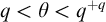
be a singular cardinal that is not a fixed point of the aleph function. Then there is a regular uncountable cardinal q such that
$q < \theta < q^{+q}$
.







-
(i) Set
$\theta = \omega _\eta $
.Claim. There is
$\beta < \eta $
such that
$\theta < \omega _\beta ^{+\omega _\beta }$
.PutProof of the claim. Suppose otherwise. Then for any
$\gamma < \eta $
,
. Since
$\eta $
is an infinite limit ordinal, it follows that
. This contradiction completes the proof of the claim.
$\theta = \omega _\beta ^{+\zeta }$
. If
, then clearly
$\alpha := \beta $
and
$\delta := \zeta $
are as desired. Now suppose that
$\omega _\beta < k$
. Set
$k = \omega _\beta ^{+\xi }$
and
$\zeta = \xi + \delta $
. Then
$\alpha := \beta + \xi $
and
$\delta $
are as desired.
-
(ii) There must be a cardinal k such that
$\mathrm {cf} (\theta ) < k < \theta < FP (k)$
. By (i) we may find an ordinal
$\alpha $
such that
$\omega _\alpha < \theta < \omega _\alpha ^{+ \omega _\alpha }$
. Then
$q := \omega _{\alpha + 1}$
is as desired.⊣







Definition 2.3. For a set A and a cardinal
 $\rho $
,
 $P_\rho (A) = \{ a\subseteq A : \vert a \vert < \rho \}$
.
Definition 2.4. Given two infinite cardinals
 ,
 $u(\rho , \sigma )$
denotes the cofinality of the poset
 $(P_\rho (\sigma ), \subseteq )$
.
Fact 2.5 (Folklore).
Let
 be two infinite cardinals. Then
 $\sigma ^{< \rho } = \max \{2^{<\rho }, u(\rho , \sigma )\}$
.
Fact 2.6 [Reference Donder and Matet2].
-
(i) Let
$\pi $
be a regular cardinal such that
. Then
. -
(ii) Let
$\sigma $
be a cardinal such that
. Then
.



Let us next recall the definition of Shelah’s covering numbers (see e.g., [Reference Shelah24, p. 85]).
Definition 2.7. Given four cardinals
 $\rho _1, \rho _2, \rho _3, \rho _4$
with
 $\rho _1 \geq \rho _2 \geq \rho _3 \geq \omega $
and
 $\rho _3 \geq \rho _4 \geq 2$
,
 $\mathrm {cov} (\rho _1, \rho _2, \rho _3, \rho _4)$
denotes the least cardinality of any
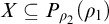 $X \subseteq P_{\rho _2}(\rho _1)$
such that for any
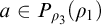 $a \in P_{\rho _3}(\rho _1)$
, there is
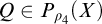 $Q \in P_{\rho _4}(X)$
with
 $a \subseteq \bigcup Q$
.
Note that
 $u(\rho , \sigma ) = \mathrm {cov} (\sigma , \rho , \rho , 2)$
.
Fact 2.8 [Reference Shelah24, pp. 85–86], [Reference Matet12].
Let
 $\rho _1, \rho _2, \rho _3$
and
 $\rho _4$
be four cardinals such that
 $\rho _1 \geq \rho _2 \geq \rho _3 \geq \omega $
and
 $\rho _3 \geq \rho _4 \geq 2$
. Then the following hold:
-
(i) If
$\rho _1 = \rho _2$
and either
$\mathrm {cf}(\rho _1) < \rho _4$
or
$\mathrm {cf}(\rho _1) \geq \rho _3$
, then
$\mathrm {cov} (\rho _1, \rho _2, \rho _3, \rho _4) = \mathrm {cf}(\rho _1)$
. -
(ii) If either
$\rho _1> \rho _2$
, or
$\rho _1 = \rho _2$
and
, then
$\mathrm {cov} (\rho _1, \rho _2, \rho _3, \rho _4) \geq \rho _1$
. -
(iii)
$\mathrm {cov} (\rho _1, \rho _2, \rho _3, \rho _4) = \mathrm {cov} (\rho _1, \rho _2, \rho _3, \max \{\omega , \rho _4\})$
. -
(iv)
$\mathrm {cov} (\rho _1^+, \rho _2, \rho _3, \rho _4) = \max \{\rho _1^+, \mathrm {cov} (\rho _1, \rho _2, \rho _3, \rho _4)\}$
. -
(v) If
$\rho _1> \rho _2$
and
$\mathrm {cf}(\rho _1) < \rho _4 = \mathrm {cf}(\rho _4)$
, then -
(iv) If
$\rho _1$
is a limit cardinal such that
$\rho _1> \rho _2$
and
$\mathrm {cf}(\rho _1) \geq \rho _3$
, then -
(vii) If
$\rho _3> \rho _4 \geq \omega $
, then -
(viii) If
,
and
$\rho _1 < \rho _2^{+\rho _4}$
, then
$\mathrm {cov} (\rho _1, \rho _2, \rho _3, \rho _4) = \rho _1$
. -
(ix) If
$\rho _3 = \mathrm {cf}(\rho _3)$
, then either
$\mathrm {cf}(\mathrm {cov} (\rho _1, \rho _2, \rho _3, \rho _4)) < \rho _4$
, or
$\mathrm {cf}(\mathrm {cov} (\rho _1, \rho _2, \rho _3, \rho _4)) \geq \rho _3$
. -
(x) Suppose that
$\rho _3> \mathrm {cf} (\rho _2) \geq \rho _4$
and
$\mathrm {cf} (\rho _3) \not = \mathrm {cf} (\rho _2)$
. Then
$\mathrm {cov} (\rho _1, \rho _2, \rho _3, \rho _4) = \mathrm {cov} (\rho _1, \rho , \rho _3, \rho _4)$
for some cardinal
$\rho $
with
$\rho _2> \rho \geq \rho _3$
.





























Definition 2.10. Let X be an infinite set. An ideal on X is a nonempty collection J of subsets of X such that
-
•
$X \notin J$
. -
•
$P(A)\subseteq J$
for all
$A\in J$
. -
•
$A\cup B\in J$
whenever
$A, B\in J$
.


Given an ideal J on X, we let
 $J^+ = P(X) \setminus J$
,
 $J^\ast = \{ A\subseteq X : X \setminus A\in J\}$
, and
 $J\vert A = \{ B\subseteq X : B \cap A\in J\}$
for each
 $A\in J^+$
.
For a cardinal
 $\rho , J$
is
 $\rho $
-complete if
 $\bigcup Q \in J$
for every
 $Q \subseteq J$
with
 $\vert Q \vert < \rho $
.
 ${\textrm {cof}} (J)$
denotes the least cardinality of any
 $Q \subseteq J$
such that
 $J = \bigcup _{A\in Q} P(A)$
.
Given a set Y and
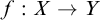 $f : X \rightarrow Y$
, we let
 $f(J) = \{ A\subseteq Y : f^{-1} (A) \in J\}$
.
Given two infinite cardinals
 $\sigma $
and
 $\rho $
, J is
 $(\sigma , \rho )$
-regular if there is
 $C_\alpha \in J^\ast $
for
 $\alpha < \rho $
such that
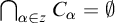 $\bigcap _{\alpha \in z} C_\alpha = \emptyset $
for any
 $z \subseteq \rho $
with
 $ \vert z \vert = \sigma $
.
Definition 2.11. For an infinite cardinal
 $\nu $
,
 $I_\nu $
denotes the noncofinal ideal on
 $\nu $
.
Definition 2.12.
 denotes the collection of all
 such that
 $\{ a\in A : b\subseteq a\} = \emptyset $
for some
 .
An ideal J on
 is fine if
 .
Definition 2.13. For a
 $\kappa $
-complete ideal J on
 ,
 $\overline {\mathrm {cof}} (J)$
denotes the least cardinality of any
 $X\subseteq J$
with the property that for any
 $A\in J$
, there is x in
 $P_\kappa (X)$
with
 $A\subseteq \bigcup x$
.
We now recall the definition of the game ideal
 (see [Reference Matet11, Reference Matet16]).
Definition 2.14. Let
 $\mu $
be a regular infinite cardinal less than
 $\kappa $
. For
 ,
 denotes the following two players game consisting of
 $\mu $
moves. At step
 $\alpha < \mu $
, player I selects
 , and II replies by playing
 . The players must follow the rule that for
 $\beta < \alpha < \mu $
,
 $b_\beta \subseteq a_\alpha \subseteq b_\alpha $
. II wins just in case
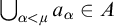 $\bigcup _{\alpha < \mu } a_\alpha \in A$
.
 denotes the collection of all
 such that player II has a winning strategy in
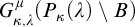 .
 is abbreviated as
 .
Fact 2.15 [Reference Matet11, Reference Matet16].
The following hold:
-
(i)
is a normal, fine ideal on
. -
(ii)
is nowhere weakly
-saturated. -
(iii)
. -
(iv) The set of all
such that
$\mathrm {cf} (\sup (a \cap \delta )) = \mu $
for any limit ordinal
with
lies in
.





Thus in the sense of
 , almost all elements of
 have uniform cofinality
 $\mu $
.
Let us next consider some members of the big family of Shelah’s pseudopower functions (see e.g., [Reference Shelah24, p. 41]).
Definition 2.16. Let A be an infinite set of regular infinite cardinals. We set
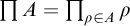 $\prod A = \prod _{\rho \in A} \rho $
. Given an ideal I on A, we define
 $<_I$
on
 $\prod A$
by:
 $f <_I g$
if and only if
 $\{a : f (a) < g (a) \} \in I^\ast $
. For a cardinal
 $\pi $
,
 $\mathrm{cf}(\prod A/ I ) = \pi$
(respectively,
 $\mathrm{tcf}(\prod A/ I ) = \pi$
) means that there exists a cofinal (respectively, an increasing, cofinal) sequence
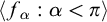 in
 $(\prod A, <_I)$
.
Definition 2.17. Let
 $\chi $
be a cardinal. We let
 $REG (\chi )$
denote the set of all regular infinite cardinals less than
 $\chi $
. For each cardinal
 $\sigma \geq \chi $
, we let
 $REG [\chi , \sigma ]$
(respectively,
 $REG (\chi , \sigma )$
) denote the set of all regular infinite cardinals
 $\tau $
with
 (respectively,
 $\chi < \tau < \sigma $
).
Definition 2.18. Let
 $\rho < \chi $
be two infinite cardinals, and I be an ideal on
 $\rho $
. We put
 $\mathrm {pp}_I^\ast (\chi ) = \sup Y$
, where Y is the set of all cardinals
 $\pi $
for which one can find a sequence
 of members of
 $REG (\chi )$
with supremum
 $\chi $
such that
 for all
 $\xi < \chi $
and
 $\mathrm {tcf}(\prod _{i < \rho } \chi _i / I ) = \pi $
.
Definition 2.19. Let
 $\sigma $
and
 $\chi $
be two infinite cardinals such that
 . We let
 $\mathrm {pp}_\sigma (\chi ) = \sup X$
, where X is the set of all cardinals
 $\pi $
for which one may find A and I such that
-
•
$A \subseteq REG (\chi )$
and
$\sup A = \chi $
; -
•
; -
• I is a prime ideal on A such that
$\{A \cap a : a \in A \} \subseteq I$
; and -
•
$\pi = \mathrm {tcf}(\prod A /I )$
.





It can be shown (see e.g., [Reference Holz, Steffens and Weitz7, Lemma 9.1.1]) that
 $\mathrm {pp}_\sigma (\chi ) = \sup T$
, where T is the set of all cardinals
 $\nu $
for which one may find an infinite cardinal
 and an ideal I on
 $\rho $
such that
 $\nu = \mathrm {pp}_I^\ast (\chi )$
.
Definition 2.20. For a singular cardinal
 $\chi $
, we let
 $\mathrm {pp} (\chi ) = \mathrm {pp}_{\mathrm {cf} (\chi )} (\chi )$
.
Definition 2.21.
Shelah’s Strong Hypothesis (SSH) asserts that
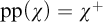 $\mathrm {pp} (\chi ) = \chi ^+$
for every singular cardinal
 $\chi $
.
The following is due to Shelah [Reference Shelah24, p. 59], [Reference Shelah, Sands, Sauer and Woodrow23] (see also [Reference Matet12]).
Fact 2.22. The following are equivalent:
-
(i) SSH holds.
-
(ii) For any regular uncountable cardinal k, and any cardinal
$l \geq k$
,
$u (k, l)$
equals l if
$\mathrm {cf} (l) \geq \kappa $
, and
$l^+$
otherwise.


Definition 2.23. Let
 be three infinite cardinals. We let
 $\mathrm {pp}_{\Gamma (\tau , \sigma )} (\chi ) = \sup \{ \mathrm {pp}_I^\ast (\chi ) : I \in Z \}$
, where Z is the set of all I such that I is a
 $\sigma $
-complete ideal on some infinite cardinal
 $\rho < \tau $
.
The pcf functions are also due to Shelah (see e.g., [Reference Shelah24, p. 4]).
Definition 2.24. Given a set a of regular cardinals,
 $pcf (a)$
denotes the set of all cardinals
 $\pi $
such that
 $\pi = \mathrm {tcf}(\prod a /I )$
for some ideal I on a.
For each cardinal
 $\sigma $
, we let
 $\mathrm {pcf}_\sigma (a) = \bigcup \{ \mathrm {pcf} (b) : b \in P_{\sigma ^+} (a) \}$
.
Note that
 $\mathrm {pcf} (a) = \mathrm {pcf}_{\vert a \vert } (a)$
(see e.g., [Reference Holz, Steffens and Weitz7, Lemma 3.3.4 h)]).
3 Representation of
in terms of the pp function

Assuming that
 $\kappa $
is a successor cardinal,
 is not too far from
 $\kappa $
and
 , we will give a representation of
 as a pseudopower. This result, which is the main one in the paper, can be seen as a (more informative) variant of the standard inductive computation of
 $\aleph _\alpha ^{\aleph _\beta }$
, but a variant that is only valid in a limited number of cases. It is obtained by compiling a number of results in pcf theory. One could say that it was not stated before because nobody looked for it.
Fact 3.1 [Reference Shelah24, Theorem 5.4, p. 87].
Let
 $\sigma $
and
 $\chi $
be two infinite cardinals such that
 . Then
 .
Proof. Suppose otherwise. Then we may find
 $A \subseteq REG (\chi )$
, and a prime ideal I on A such that
-
•
$\sup A = \chi $
; -
•
; -
•
$\{A \cap a : a \in A\} \subseteq I$
; and -
•
$\mathrm {tcf}(\prod A /I)> \mathrm {cov}(\chi , \chi , \sigma ^+, 2)$
.


Select
 $B \subseteq P_\chi (\chi )$
such that
 $\vert B \vert = \mathrm {cov} (\chi , \chi , \sigma ^+, 2)$
and
 $P_{\sigma ^+} (\chi ) = \bigcup _{b \in B} P_{\sigma ^+} (b)$
. For
 $b \in B$
, define
 $g_b \in \prod A$
by:
 $g_b (a)$
equals
 $\sup (a \cap b)$
if a is greater than the size of b, and
 $0$
otherwise. Let F be cofinal in
 $(\prod A, <_I)$
. Define
 $\varphi : F \rightarrow B$
so that
 $ran (f) \subseteq \varphi (f)$
for all
 $f \in F$
. Then clearly for each
 $f \in F$
,
 . It follows that
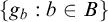 $\{g_b : b \in B\}$
is cofinal in
 $(\prod A, <_I)$
. This is a contradiction, since any cofinal family in
 $(\prod A, <_I)$
must have size at least
 $\mathrm {tcf}(\prod A /I)$
.⊣
Lemma 3.2. Let
 $\sigma $
and
 $\chi $
be two infinite cardinals such that
 . Then
 .

Fact 3.3 [Reference Shelah24, Lemma 1.5, p. 317], [Reference Holz, Steffens and Weitz7, Theorem 9.2.4].
Suppose that A is an infinite set of regular infinite cardinals with
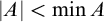 $\vert A \vert < \min A$
,
 $A = \bigcup _{m < \omega } A_m$
, where each
 $A_m$
is infinite and
 $A_0 \subset A_1 \subset A_2 \subset \cdots $
, and
 $\pi \in \mathrm {pcf} (A) \setminus \bigcup _{m < \omega } \mathrm {pcf} (A_m)$
. Then
 $\pi \in \mathrm {pcf} (X)$
for some countable
 $X \subseteq \bigcup _{m < \omega } \mathrm {pcf} (A_m)$
.
Lemma 3.4. Let
 $\theta $
, A, I and
 $\pi $
be such that
-
•
$\theta $
is a singular cardinal of cofinality
$\omega $
; -
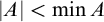
•
$A \subseteq REG (\theta )$
,
$\sup A = \theta $
and
$\vert A \vert < \min A$
; -
• I is an ideal on A with
$\{A \cap a : a \in A\} \subseteq I$
; -
•
$\mathrm {tcf}(\prod A/I) = \pi $
; and -
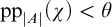
•
$\mathrm {pp}_{\vert A \vert } (\chi ) < \theta $
for any singular cardinal
$\chi $
with
and
$\min A < \chi < \theta $
.







Then
 $\mathrm {tcf}(\prod B/J) = \pi $
for some countable
 $B \subseteq REG (\theta )$
with
 and
 $\sup B = \theta $
, and some ideal J on B with
 $\{B \cap b : b \in B\} \subseteq J$
.
Proof. We can assume that A is uncountable, since otherwise there is nothing to prove. Select an increasing sequence
 of cardinals of cofinality
 $\omega $
so that
-
•
$\sup \{ \theta _m : m < \omega \} = \theta $
and -
• for each m,
$\sup (A \cap \theta _m) = \theta _m$
.


Now clearly,
 $\bigcup _{m < \omega } \mathrm {pcf} (A \cap \theta _m) \subseteq \theta $
. Hence by Fact 3.3,
 $\pi \in \mathrm {pcf} (X)$
for some countable set X of regular cardinals with
 $X \subseteq \theta \setminus \min A$
. The desired conclusion easily follows.⊣
Fact 3.5 [Reference Shelah24, Claim 3.9, p. 387].
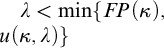
Suppose that
 $\kappa = \nu ^+$
and
 . Then
 and
 .
Actually, the conclusion of [Reference Shelah24, Claim 3.9, p. 387] asserts that
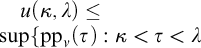 and
 . We corrected the typo.
Fact 3.6 [Reference Shelah24, Conclusion 2.3 (2), p. 57].
Let
 $\sigma , \tau $
and
 $\chi $
be three infinite cardinals such that
 . Then
 .
Fact 3.7 [Reference Shelah26, Lemma 6.13(1)].
Let
 $\sigma , \rho $
and
 $\theta $
be three cardinals such that
 . Then
 $\mathrm {cov} (\theta , \theta , \rho , \sigma ) = \sup Z$
, where Z is the set of all cardinals
 $\pi $
for which one can find A and I such that
-
• A is a set of regular cardinals less than
$\theta $
with supremum
$\theta $
; -
•
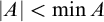
$\vert A \vert < \min A$
; -
• I is a
$\sigma $
-complete ideal on A such that
$\{A \cap a : a \in A \} \subseteq I$
; -
• there is
$B \in I$
with
$\vert A \setminus B \vert < \rho $
; and -
•
$\mathrm {tcf}(\prod A/I) = \pi $
.





Fact 3.8 [Reference Shelah24, Conclusion 1.6 (3), p. 321].
Let
 $\sigma $
and
 $\theta $
be two cardinals such that
 . Suppose that
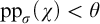 $\mathrm {pp}_\sigma (\chi ) < \theta $
for any large enough singular cardinal
 $\chi < \theta $
with
 . Then
 $$ \begin{align*}\mathrm{pp}_\sigma (\theta) = \mathrm{pp}(\theta) = \mathrm{pp}_{\Gamma((\mathrm{cf}(\theta)^+, \mathrm{cf}(\theta))} (\theta) = \mathrm{pp}^{\ast}_{I_{\mathrm{cf}(\theta)}} (\theta).\end{align*} $$
Theorem 3.9. Suppose that
 $\kappa $
is a successor cardinal, say
 $\kappa = \nu ^+$
, and
 . Then there is a (unique) cardinal
 $\theta $
such that
-
•
and
. -
•
. -
•
$\mathrm {pp}_\nu (\chi ) < \theta $
for any cardinal
$\chi $
with
. -
•
. -
• If
$\mathrm {cf}(\theta ) \not = \omega $
, then
$ \mathrm {pp}(\theta ) = \mathrm {pp}_{\Gamma ((\mathrm {cf}(\theta )^+, \mathrm {cf}(\theta ))} (\theta ) = \mathrm {pp}^{\ast }_{I_{\mathrm {cf}(\theta )}} (\theta )$
.









Proof. Let X denote the set of all cardinals
 $\chi $
such that
 , and put
 . We define
 $\theta $
as follows. First suppose that
 $Y = \emptyset $
. Then by Fact 3.5,
 . We let
 . Next suppose that
 $Y \not = \emptyset $
. Then by Fact 3.6, for every
 $\chi \in X$
,
 for every
 $\chi \in X \cap \min (Y)$
. We set
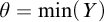 $\theta = \min (Y)$
.
Let us check that
 $\theta $
is as desired. Clearly,
 $\theta \in X$
, and moreover by Fact 3.5 and Lemma 3.2,
 . It follows from Fact 3.6 that
 $\mathrm {pp}_\nu (\chi ) < \theta $
for each
 $\chi \in X \cap \theta $
. Again by Fact 3.6, we obtain that
 for each
 $\chi \in X \setminus \theta $
. If
 $\mathrm {cf}(\theta ) \not = \omega $
, then by Fact 3.8,
 $$ \begin{align*}\mathrm{pp}_\nu (\theta) = \mathrm{pp}(\theta) = \mathrm{pp}_{\Gamma((\mathrm{cf}(\theta)^+, \mathrm{cf}(\theta))} (\theta) = \mathrm{pp}^{\ast}_{I_{\mathrm{cf}(\theta)}} (\theta).\end{align*} $$
Furthermore by Fact 3.7,

Now suppose that
 $\mathrm {cf} (\theta ) = \omega $
. Clearly
 . Assume toward a contradiction that this inequality is strict. Then we may find
 $A, I$
and
 $\pi $
such that
-
•
$A \subseteq REG (\theta )$
,
$\sup A = \theta $
and
; -
• I is an ideal on A with
$\{A \cap a : a \in A\} \subseteq I$
; and -
•
$\mathrm {pp} (\theta ) < \pi = \mathrm {tcf}(\prod A/I)$
.





By Lemma 3.4,
 $\pi = \mathrm {tcf}(\prod B/J)$
for some countable
 $B \subseteq REG (\theta )$
with
 and
 $\sup B = \theta $
, and some ideal J on B with
 $\{B \cap b : b \in B\} \subseteq J$
. Now clearly,
 , which yields the desired contradiction.
Finally, by Fact 3.1,

⊣
We do not know whether
 remains true in case
 $\mathrm {cf} (\theta ) = \omega $
. Also, it would be nice to prove a version of the theorem for the case when
 .
Definition 3.10. Assuming that
 $\kappa $
is a successor cardinal and
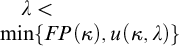 , we let
 denote the cardinal
 $\theta $
described in the statement of Theorem 3.9.
Corollary 3.11. Suppose that
 $\kappa = \nu ^+$
,
 , and
 for every cardinal
 $\theta $
such that
 and
 . Then
 for every cardinal
 $\sigma $
with
 .
Proof. Suppose otherwise, and fix
 $\sigma $
such that
 and
 . Then
 . Contradiction.⊣
Fact 3.12 [Reference Shelah24, Theorem 2.2, p. 373].
Let
 $\theta $
be a singular cardinal. Suppose that
 $\theta = \omega _\alpha ^{+\delta }$
, where
 $\alpha $
and
 $\delta $
are two ordinals such that
 $\delta < \omega _\alpha $
. Then
 $\mathrm {pp}(\theta ) < \omega _\alpha ^{+\vert \delta \vert ^{+4}}$
.
Corollary 3.13. Suppose that
 $\kappa $
is a successor cardinal and
 . Then
 .
Proof. We can assume that
 , since otherwise the result is obvious. Define
 $\kappa _i$
for
 $i < \omega $
by:
 $\kappa _0 = \kappa $
and
 $\kappa _{i+1} = \omega _{\kappa _i}$
. Note that
 $FP (\kappa ) = \sup \{\kappa _i : i < \omega \}$
. Let i be such that
 . Set
 $\kappa _i = \omega _\eta $
and
 . Then by Fact 3.12,
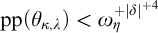 . Clearly,
 $\eta < \kappa _i$
and
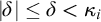 , so
 $\eta + \vert \delta \vert ^{+4} < \kappa _i^{+4} < \kappa _{i+1}$
. Hence
 .⊣
It follows that if
 $\kappa $
is a successor cardinal and
 , then
 is not a weakly inaccessible cardinal.
Corollary 3.14. Suppose that
 $\kappa $
is a successor cardinal. Then
 $u(\kappa , FP(\kappa )) = \mathrm {cov} (FP (\kappa ), FP (\kappa ), \kappa , 2)$
.
Thus if l is a fixed point of the aleph function, but not a limit of fixed points of the aleph function, then there is
 $k_0 < l$
such that
 for any two regular uncountable cardinals
 $k, k'$
with
 . We do not know whether
 $k_0$
can be chosen so that
 $u (k, l) = u (k', l)$
for any two regular uncountable cardinals
 $k, k'$
with
 .
Corollary 3.15. Suppose that
 $\kappa $
is a successor cardinal and
 . Then
 for any cardinal
 $\sigma $
with
 .
Proof. Put
 $\kappa = \nu ^+$
. Let us first show that

. Suppose otherwise. Then by Corollary 3.13,

. Obviously,

. If

, then

which yields a contradiction. Thus

, but then

which again yields a contradiction.
Now let
 $\sigma $
be a cardinal with

. Then

⊣
Let us also make the following observation.
Proposition 3.16. Suppose that
 $\kappa $
is a successor cardinal and
 . Then
 .

To conclude this section, let us discuss Theorem 3.9 in terms of cardinal exponentiation. First we recall this crucial result of Shelah (see e.g., Theorems 9.1.2 and 9.1.3 in [Reference Holz, Steffens and Weitz7]).
Fact 3.17. Let
 $\tau $
and
 $\chi $
be two infinite cardinals such that
 . Suppose that
 $\pi ^\tau < \chi $
for every cardinal
 $\pi < \chi $
, and either
 $\mathrm {cf} (\chi )> \omega $
, or
 $\chi $
is not a fixed point of the aleph function. Then
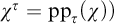 $\chi ^\tau = \mathrm {pp}_\tau (\chi ))$
.
The following is standard (see e.g., Theorem 5.20 in [Reference Jech8] or the more detailed Lemma 1.7.3 in [Reference Holz, Steffens and Weitz7]).
Fact 3.18. Given two infinite cardinals
 $\nu < \sigma $
, the following hold:
-
(i) Suppose that
$\rho ^\nu < \sigma $
for every cardinal
$\rho < \sigma $
. Then
$\sigma ^\nu $
equals
$\sigma $
if
$\mathrm {cf} (\sigma )> \nu $
, and
$\sigma ^{\mathrm {cf} (\sigma )}$
otherwise. -
(ii) If there exists some cardinal
$\rho < \sigma $
with
$\rho ^\nu \geq \sigma $
, then
$\sigma ^\nu = \rho ^\nu $
. -
(iii) Suppose that
$2^\nu < \sigma ^\nu $
, and there is a cardinal
$\rho < \sigma $
such that
$\rho ^\nu \geq \sigma $
. Let
$\chi $
be the least such
$\rho $
. Then (a)
, (b)
$\pi ^\nu < \chi $
for every cardinal
$\pi < \chi $
, and (c)
$\sigma ^\nu = \chi ^{\mathrm {cf} (\chi )}$
.





Concerning (i), Lemma 1.7.3 in [Reference Holz, Steffens and Weitz7] adds to the conclusion that
 $\sigma ^\nu = \sup \{ \tau ^\nu : \tau < \sigma \}$
, but this may not hold if
 $\sigma $
is a successor cardinal.
Assuming that
 $\sigma < FP (\nu )$
, let us sketch a proof of Fact 3.18 based on Theorem 3.9. Put
 and
 $\kappa = \nu ^+$
. Then
 .
Case 1.
 . Note that in this situation, Theorem 3.9 can be used to compute
 (that is possibly smaller than
 ), giving thus information about what goes on below
 $2^{< \kappa }$
.
Case 2.
 , and there is a cardinal
 $\tau < \kappa $
such that
 . Then
 . It follows that
 $\tau ^{< \kappa }> 2^{< \kappa }$
, and moreover
 . Notice that
 $2^{< \kappa } < \theta _{\kappa , \tau }$
, since otherwise
 .
Now let
 $\mu $
be a cardinal less than
 . If
 , then
 , and hence
 . If
 , then
 . Finally, assume that
 $\kappa < \mu < \theta _{\kappa , \tau }$
. We claim that
 $u (\kappa , \mu ) < \theta _{\kappa , \tau }$
. Suppose otherwise. Then
 $u (\kappa , \mu ) = u (\kappa , \theta _{\kappa , \mu }) = \mathrm {pp} (\theta _{\kappa , \mu }) < \theta _{\kappa , \tau }$
, since
 . Contradiction. Thus
 $\mu ^{< \kappa } = \max \{ 2^{< \kappa }, u (\kappa , \mu ) \} < \theta _{\kappa , \tau }$
.
We have shown that
 $\theta _{\kappa , \tau } =$
the least cardinal
 such that
 . Since
 $\theta _{\kappa , \tau }$
is not a fixed point of the aleph function, it follows by Fact 3.17 that
 .
Case 3. For any cardinal
 $\tau < \kappa $
,
 . Then
 . If
 , then
 (so,
 ), and moreover
 (by Fact 3.17 since
 is not a fixed point of the aleph function).
Our point is that some, if not all, classical results on cardinal exponentiation can be established via pcf theory.
4 The function
$k \rightarrow u (k, l_0)$

Given an infinite cardinal l, we are interested in the behaviour of the function f defined on
 $REG (l)$
by
 $f (k) = u (k, l)$
. One important open problem is whether this function is nondecreasing. Another is whether it is consistent (relative to a large cardinal) for the range of f to be infinite. Note that if SSH holds, then f is indeed nondecreasing, and moreover it takes at most two values (one if l is regular, and two otherwise). We will attempt to identify infinite subsets Y of
 $REG (l)$
on which f is finite-to-one or even constant.
Remark. Let l be an uncountable cardinal that is not a fixed point of the aleph function. Let X be the set of all successor cardinals k such that
 $k < l < \min \{FP(\kappa ), u(k, l)\}$
. For
 $k \in X$
, set
 $k = \nu _k^+$
.
Now let
 $k_1 < k_2$
in X such that
 $\theta _{k_1, l} \not = \theta _{k_2, l}$
. Then it is simple to see that one of the following holds:
-
•
$\theta _{k_2, l} < \theta _{k_1, l}$
and
(and hence by Fact 3.6,
). -
•
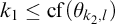
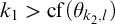
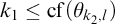
$\theta _{k_1, l} < k_2$
and
$k_1> \mathrm {cf} (\theta _{k_2, l})$
(and hence
$u (k_1, l) = \mathrm {pp}_{\nu _{k_1}} (\theta _{k_1, l}) \geq \mathrm {pp}_{\nu _{k_1}} (\theta _{k_2, l}) \geq \mathrm {pp} (\theta _{k_2, l}) = u (k_2, l)$
). -
•
$\theta _{k_1, l} < k_2$
and
.





Theorem 4.1. Let l be an uncountable cardinal that is not a fixed point of the aleph function, and Z be the set of all infinite successor cardinals k such that
 $k < l < \min \{FP(k), u(k, l)\}$
. Then the set
 $\{ u (k, l) : k \in Z \}$
is finite.
Proof. Suppose otherwise. Select an infinite subset T of
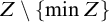 $Z \setminus \{ \min Z \}$
such that
 $u (k, l) \not = u (k', l)$
for any two distinct elements
 $k, k'$
of T. By Ramsey’s theorem for pairs and the remark preceding the statement of the theorem, we may find
 $k_1 < k_2 < \cdots $
in T such that one of the following three cases holds:
-
(a)
$\theta _{k_j, l} < \theta _{k_i, l}$
whenever
$i < j$
. -
(b)
$u (k_j, l) < u (k_i, l)$
whenever
$i < j$
. -
(c) For any i,
$\theta _{k_i, l} < k_{i+1}$
and
.






Clearly, we must be in case (c). Put
 $\theta = \theta _{k_1, l}$
. Then by Fact 2.2, we may find an infinite cardinal
 $\sigma $
and an infinite ordinal
 $\delta $
such that
 $\theta = \sigma ^{+\delta }$
and
 $\vert \delta \vert < \sigma $
. Since
 $\theta $
is less than
 $k_2$
, so are
 $\sigma $
and
 $\vert \delta \vert $
. Hence by Fact 3.12,

which yields the desired contradiction.⊣
Let us observe that there is no finite upper bound to the size of the finite set of Theorem 4.1. In fact by a result of Gitik and Shelah [Reference Gitik and Shelah5], for any m with
 $1 < m < \omega $
, there is a generic extension of a model with m strong cardinals in which
-
•
$\omega _\omega $
is a strong limit cardinal. -
•
$\aleph _{\omega _m} < \aleph _{\omega _m}^{\aleph _0} < \aleph _{\omega _m}^{\aleph _1} < \dots < \aleph _{\omega _m}^{\aleph _m}.$


By Fact 2.5, in this generic extension,
 $$ \begin{align*}\omega_{\omega_m} < u (\omega_1, \omega_{\omega_m}) < u (\omega_2, \omega_{\omega_m}) < \dots < u (\omega_m, \omega_{\omega_m}).\end{align*} $$
Theorem 4.2. Let X be a nonempty set of regular cardinals, and l be a cardinal such that
 . Then there is
 $k_0 \in X$
such that
 $u (k, l) = u (k', l)$
for all
 $k, k' \in X \setminus k_0$
.
Proof. Suppose otherwise. Then clearly
 $\sup X \notin X$
, and moreover by Theorem 4.1 we may find two infinite subsets
 $Y_1, Y_2$
of
 $X \setminus \{\min X\}$
, and two cardinals
 $\sigma _1 < \sigma _2$
such that for
 $i = 1, 2$
,
 $\sup Y_i = \sup X$
, and
 $u (k, l) = \sigma _i$
for all
 $k \in Y_i$
.
By the remark preceding Theorem 4.1, the following hold:
-
(a) Let
$k \in Y_1$
and
$h \in Y_2$
be such that
$k < h$
. Then
. -
(b) Let
$k \in Y_1$
and
$h \in Y_2$
be such that
$k> h$
. Then
$\theta _{h, l} < k$
.


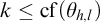


Note that if
 $k \in Y_1$
and
 $h \in Y_2$
are such that
 $k> h$
, then by (b),
 $\theta _{h, l} < k$
. It follows that
 $\theta _{h, l} < \sup X$
for every
 $h \in Y_1$
. Select
 $k_j \in Y_0$
and
 $h_j \in Y_1$
for
 $0 < j < \omega $
so that
 $k_j < h_j < k_{j+1}$
. Note that by (a),

. Put
 $\theta = \theta _{h_1, l}$
. Then by Fact 2.2, we may find an infinite cardinal
 $\sigma $
and an infinite ordinal
 $\delta $
such that
 $\theta = \sigma ^{+\delta }$
and
 $\vert \delta \vert < \sigma $
. Since
 $\theta $
is less than
 $k_2$
, so are
 $\sigma $
and
 $\vert \delta \vert $
. Hence by Fact 3.12,

which yields the desired contradiction.⊣
In particular, for any singular cardinal l that is not a fixed point of the aleph function, there is
 $k_0 < l$
such that
 $u (k, l) = u (k', l)$
for all regular cardinals
 $k, k' $
with
 . For more about this see Section 10.
Fact 4.3 [Reference Gitik4].
Suppose that there is no inner model with a strong cardinal. Then for any cardinal
 $\pi> 2 ^{\aleph _2}$
,
 $\vert \{ \theta < \pi : \mathrm {cf} (\theta ) < \theta $
and
 $\mathrm {pp} (\theta ) \geq \pi \} \vert < \aleph _1$
.
Proposition 4.4. Suppose that there is no inner model with a strong cardinal. Let X be a nonempty set of regular cardinals such that
 $\sup X \notin X$
and
 $\mathrm {cf} (\sup X) \geq \omega _2$
, and l be a cardinal greater than
 $2^{\aleph _2}$
such that
 . Then there is
 $k_0 \in X$
and a singular cardinal
 $\theta $
with
 such that
 $u (k, l) = \mathrm {pp} (\theta )$
for every
 $k \in X \setminus k_0$
.
Proof. Using Fact 4.3, set
 $$ \begin{align*}\chi = \sup \{ \theta < \sup X : \mathrm{cf} (\theta) < \theta \mbox{ and } \mathrm{pp} (\theta) \geq l \}\end{align*} $$
and
 $k_0 =$
the least t in X such that
 $t> \max \{ \chi , \mathrm {cf} (l), \min X \}$
. By Theorem 4.2, there is
 $k_0 \in X \setminus t$
such that
 $u (k, l) = u (k', l)$
for all
 $k, k' \in X \setminus k_0$
. Now appeal to Theorem 3.9.⊣
In particular, if there is no inner model with a strong cardinal, and l is a singular cardinal with
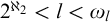 $2^{\aleph _2} < l < \omega _l$
and
 , then there is an infinite cardinal
 $k_0 < l$
such that
 $u (k, l) = \mathrm {pp} (l)$
for every
 $k \in REG (k_0, l)$
.
Let us mention another result in the spirit of Theorem 4.2. The proof will rely on the following.
Fact 4.5 [Reference Erdös, Hajnal, Maté and Rado3, p. 48], [Reference Shelah22, p. 164].
Let l be an infinite cardinal. Then the set
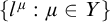 $\{ l^\mu : \mu \in Y \}$
is finite, where Y is the set of all cardinals
 $\mu $
such that
 $2^\mu < l$
.
Proposition 4.6. Let
 $\tau $
be an uncountable strong limit cardinal, and l be a cardinal greater than or equal to
 $\tau $
. Then there is a cardinal
 $k_0 < \tau $
such that
 $u (k, l) = u (k', l)$
for any two regular cardinals k and
 $k'$
with
 .
Proof. By Facts 2.6(i) and 2.8,

for any two regular cardinals k and
 $k'$
with
 $k < k' < l$
. The result now readily follows from Fact 4.5, since by Fact 2.5,
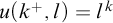 $u (k^+, l) = l^k$
for any infinite cardinal
 $k < \tau $
.⊣
Question. Is the following situation consistent (relative to a large cardinal): there is a limit cardinal
 $\tau $
, and a cardinal
 $l> \tau $
such that for any
 $k_0 < \tau $
, one may find two regular cardinals
 $k, k'$
such that
 and
 $u (k, l) \not = u (k', l)$
?
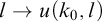
5 The function
$l \rightarrow u (k_0, l)$
This time we fix k and let l vary.
Fact 5.1 [Reference Shelah24, Fact 1.9, p. 324].
Suppose that
 , and
 $\nu $
is an infinite cardinal less than
 . Then there is an increasing, continuous sequence
 of cardinals greater than
 $\nu $
with supremum
 , such that either
(a) for any
 , and any cardinal
 $\tau $
with
 and
 ,
 $\mathrm {pp}_\nu (\tau ) < \chi _{j + 1}$
or
(b) for any infinite limit ordinal
 ,
 .
Theorem 5.2. Suppose that
 $\kappa $
is a successor cardinal, say
 $\kappa = \nu ^+$
, and
 . Then there is an increasing, continuous sequence
 of cardinals greater than
 $\kappa $
with supremum
 , such that either
(i) for any
 ,
 equals
 if
 , and
 otherwise,
or
(ii)
-
• for any
and any cardinal
$\tau $
with
and
$\mathrm {cf} (\tau ) < \kappa $
,
, -
• and there is a cardinal
$\rho $
with
such that
$\theta _{\kappa , l} = \rho $
for any cardinal l such that
and
$u (\kappa , l)> l$
,


or
(iii)
-
• for any infinite limit ordinal
,
, -
• and there is a cardinal
$\rho $
such that
for any infinite limit ordinal
with
$\mathrm {cf} (i) < \kappa $
.




Proof. Let
 be as in the statement of Fact 5.1. Let us first suppose that (b) holds. Then it is simple to see that
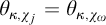 $\theta _{\kappa , \chi _j} = \theta _{\kappa , \chi _\omega }$
for any infinite limit ordinal
 with
 $\mathrm {cf} (j) < \kappa $
. Now assume that (a) holds.
Case 1: There is
 such that
 $\mathrm {pp}_\nu (\theta _{\kappa , \chi _\omega }) < \chi _{j_0}$
.
Claim. Let
 be such that
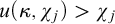 $u (\kappa , \chi _j)> \chi _j$
. Then
 $\theta _{\kappa , \chi _j} = \chi _j$
.
Proof of the claim. Let
 $\theta < \chi _j$
with
 $\mathrm {cf} (\theta ) < \kappa $
.
Case 1:
 $\theta < \chi _\omega $
. Then
 .
Case 2:
 $\theta \geq \chi _\omega $
. There must be an infinite
 $h < j$
such that
 . Then
 .
We have shown that
 $\theta \not = \theta _{\kappa , \chi _j}$
, which completes the proof of the claim.
Note that it follows from the claim that for any
 ,
 $u (\kappa , \chi _j)> \chi _j$
if and only if
 $\mathrm {cf} (\chi _j) < \kappa $
.
Case 3:
 . Put
 $\rho = \theta _{\kappa , \chi _\omega }$
. Now let l be a cardinal with
 and
 $u (\kappa , l)> l$
. Then
 $\theta _{\kappa , l} \geq \rho $
, since
 for any cardinal
 $\eta $
with
 $\kappa < \eta < \rho $
and
 $\mathrm {cf} (\eta ) < \kappa $
. In fact
 $\theta _{\kappa , l} = \rho $
, since
 for any cardinal
 $\tau $
with
 $\kappa < \tau < \theta _{\kappa , l}$
and
 $\mathrm {cf} (\tau ) < \kappa $
.⊣
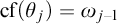
Consider for instance the model of Gitik and Shelah described above. There must be cardinals
 $\theta _1> \theta _2 > \dots > \theta _m$
such that for
 ,
-
•
$\omega _j < \theta _j < \omega _{\omega _m}$
and
$\mathrm {cf} (\theta _j) = \omega _{j-1}$
, -
•
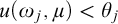
$u (\omega _j, \mu ) < \theta _j$
for each cardinal
$\mu $
with
$\omega _j < \mu < \theta _j$
, and -
•
$u (\omega _j, \pi ) = u (\omega _j, \theta _j)$
for each cardinal
$\pi $
with
.






6 Representation of
in terms of the pcf function

In this section we extend Fact 1.1. We need the following which is well-known (see e.g., the proof of Lemma 9.2.7 in [Reference Holz, Steffens and Weitz7]).
Fact 6.1. Let
 $\nu $
be an infinite cardinal, and a be a set of regular cardinals with
 , and I be a prime ideal on a such that
 $\mathrm {cf} (\prod A /I)> \sup a$
. Then
 for some cardinal
 $\chi $
with
 .
Proof. We let
 $\chi =$
the least cardinal
 $\pi $
such that
 $a \cap (\pi + 1) \notin I$
. Then clearly,
 . Moreover by Lemma 3.3.4 of [Reference Holz, Steffens and Weitz7],
 $\chi $
is a limit cardinal and
 $a \cap \chi \notin I$
. Clearly,
 $\chi = \sup (a \cap \chi )$
, so
 . Now put
 $J = I \cap P (a \cap \chi )$
. Then it is simple to see that J is a prime ideal on
 $a \cap \chi $
extending the noncofinal ideal on
 $a \cap \chi $
. Finally by Lemma 3.1.8 of [Reference Holz, Steffens and Weitz7],
 .⊣
Fact 6.2 [Reference Holz, Steffens and Weitz7, Lemma 9.2.7].
Let
 $\nu $
be an infinite cardinal, and
 $\sigma $
be a cardinal such that
 , and
 $\mathrm {pp}_\nu (\chi ) < \sigma $
for every cardinal
 $\chi $
with
 . Then
 $\mathrm {pp}_\nu (\sigma ) = \sup \{\max \mathrm {pcf} (a) : a \in X \}$
, where X consists of all sets a of regular cardinals with
 and
 $\sup a = \sigma $
.
Theorem 6.3. Suppose that
 $\kappa $
is a successor cardinal, say
 $\kappa = \nu ^+$
, and
 . Then
 .
Proof. For each cardinal
 $\chi $
with
 , put
 $\rho _\chi = \sup \{\max \mathrm {pcf} (a) : a \in Z_\chi \}$
, where
 $Z_\chi $
consists of all sets a of regular cardinals with
 and
 . It is simple to see that
 $\rho _\chi = \sup \mathrm {pcf}_\nu (REG [\kappa , \chi ]))$
.
Claim. Let
 $\chi $
be a cardinal with
 . Then
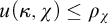 .
Proof of the claim. We proceed by induction. Thus suppose that
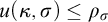 for each cardinal
 $\sigma $
with
 .
Case 1:
 $\chi $
is singular and
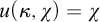 $u (\kappa , \chi ) = \chi $
. Then by Fact 2.8 (vi),
 .
Case 2:
 $\chi $
is regular and
 $u (\kappa , \chi ) = \chi $
. Set
 $b = \{\chi \}$
. Then
 $\mathrm {pcf} (b) = b$
, and therefore
 $\max \mathrm {pcf} (b) = \chi = u (\kappa , \chi )$
. Thus
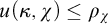 .
Case 3:
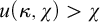 $u (\kappa , \chi )> \chi $
. Then by Fact 6.2,
 $u (\kappa , \chi ) = \mathrm {pp}_\nu (\theta _{\kappa , \chi }) = \sup \{\max \mathrm {pcf} (a) : a \in X \}$
, where X consists of all sets a of regular cardinals with
 and
 $\sup a = \theta _{\kappa , \chi }$
. Since obviously
 $X \subseteq Z_\chi $
, it follows that
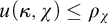 .
This completes the proof of the claim.
By the claim,
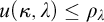 . Assume to the contrary that
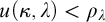 . Then we may find
 and a prime ideal I on a such that
 . By Fact 6.1 there must be a cardinal
 $\tau $
such that
 and
 . However by Lemma 3.2,
 , so we have a contradiction.⊣
Note that if
 , then since
 , it also holds that
 .
7 Representation of
when


We start with a variant of Theorem 6.3.
Fact 7.1 [Reference Abraham, Magidor, Foreman and Kanamori1, Theorem 5.14 and Exercise 5.17].
Suppose that
 $\kappa $
is a successor cardinal, say
 $\kappa = \nu ^+$
, where
 $\nu = \mathrm {cf} (\nu )$
,
 is singular and
 . Then the following hold:
-
(i)
. -
(ii)
.


Theorem 7.2. Suppose that
 $\kappa $
is the successor of a regular cardinal and
 . Then
 .


In Section 3 we computed
 assuming that
 $\kappa $
is a successor cardinal and
 . The first assumption can be dropped if we strengthen the second, the point being that
 in case
 .
Proposition 7.3. Suppose that
 . Then
 .
Proof. By Facts 2.6(ii) and 2.8,

so
 . Suppose to the contrary that this inequality is strict. Since
 ,
 . Hence by Lemma 3.2,
 . Contradiction.⊣
The result is optimal in the sense that under SSH,
 $u(\kappa ^+, \kappa ^{+\kappa }) = (\kappa ^{+\kappa })^+> \kappa ^{+\kappa } = u(\kappa , \kappa ^{+\kappa })$
. Note that by the following result of Shelah, if
 , then
 .
Fact 7.4 [Reference Shelah25, Claim 2.1(1)].
Let
 $\rho $
be a cardinal such that
 and
 . Then
 .
Theorem 7.5. Suppose that
 . Then the following hold:
-
(i)
. -
(ii)
is a successor cardinal. -
(iii) Suppose that
. Then
is a limit cardinal with
.





Proof.
Case 1:
 $\kappa $
is a successor cardinal. To prove (i), let
 be as in the proof of Theorem 6.3. Then clearly
 , so
 . To reverse the inequality, observe that for any
 ,
 and hence
 . (ii) follows from (i) and Corollary 3.13. Finally for (iii), let
 $\kappa = \nu ^+$
. Then by Theorem 3.9, for any limit cardinal
 $\chi $
with
 ,
 . The desired equality follows.
Case 2:
 $\kappa $
is weakly inaccessible. Let us prove (i). If
 , then
 , since
 . Otherwise, by Proposition 7.3 and the first part of the proof,
 , where a is the set of all regular cardinals
 $\sigma $
with
 . Now
 , so
 . Since
 $a \subset \mathrm {pcf} (a)$
, it follows that
 . Finally, (ii) and (iii) follow from Proposition 7.3 and the first part of the proof.⊣
Definition 7.6. A set x of regular cardinals is an interval if it is either empty, or such that any regular cardinal
 $\mu $
in
 $\bigcup _{\chi \in x} ((\chi + 1) \setminus \min x)$
lies in x.
Fact 7.7 [Reference Holz, Steffens and Weitz7, Theorem 3.3.6].
Let a be an interval of regular cardinals such that
 $\vert a \vert < \min a$
, and
 $\sigma $
be a cardinal. Then
 $\mathrm {pcf}_\sigma (a)$
is also an interval.
Corollary 7.8. Suppose that
 $\kappa = \nu ^+$
and
 . Then
 .
Proof. Clearly,
 is an interval of regular cardinals, and therefore by Fact 7.7, so is
 .⊣
Corollary 7.9. Suppose that
 . Then
 the cofinality of the poset
 , where
 $f < g$
just in case
 $f (\rho ) < g (\rho )$
for every
 $\rho $
in
 .
Proof. By [Reference Shelah24, Lemma 3.1 p. 6] (see also [Reference Holz, Steffens and Weitz7, Theorem 3.4.21]),
 the cofinality of
 .⊣
We return to the problem of whether
 .
Fact 7.10 [Reference Shelah24, Lemma 1.5, p. 317], [Reference Holz, Steffens and Weitz7, Lemma 9.2.5].
Let
 $\rho $
be an uncountable regular cardinal, d be a set of regular cardinals with
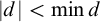 $\vert d \vert < \min d$
, and
 be a sequence of subsets of d which is increasing under inclusion and such that
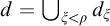 $d = \bigcup _{\xi < \rho } d_\xi $
. Further let
 $\pi \in \mathrm {pcf} (d) \setminus \bigcup _{\xi < \rho } \mathrm {pcf} (d_\xi )$
. Then there is a closed unbounded subset C of
 $\rho $
, and a sequence
 such that
 $l_\eta \in \mathrm {pcf} (d_\eta ) \setminus \bigcup _{\delta < \eta } \mathrm {pcf} (d_\delta )$
and
 $\pi = \mathrm {tcf} (\prod _{\eta \in C} l_\eta / J)$
, where J is the noncofinal ideal on C.
Proposition 7.11. Suppose that
 $\kappa $
is a successor cardinal and
 . Then the following are equivalent:
-
(i)
. -
(ii) There is a closed unbounded subset D of
consisting of singular cardinals greater than
$\kappa $
such that
$\theta _{\kappa , \chi } = \chi $
for every
$\chi \in D$
. -
(iii) There is a cofinal subset T of
consisting of singular cardinals greater than
$\kappa $
such that
$\theta _{\kappa , \chi } = \chi $
for every
$\chi \in T$
.


Proof. (i)
 $\Rightarrow $
(ii) Set
 , and pick an increasing continuous sequence
 of singular cardinals greater than
 $\kappa $
with supremum
 . Let d be the set of all regular cardinals
 $\mu $
with
 . For
 $\xi < \rho $
, put
 $d_\xi = d \cap \sigma _\xi $
.
Claim 1. Let
 $\xi < \rho $
. Then
 .
Proof of Claim 1. By Theorem 7.5,
 $u (\kappa , \sigma _\xi ) = \max \mathrm {pcf} (d_\xi )$
. If
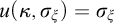 $u (\kappa , \sigma _\xi ) = \sigma _\xi $
, then
 . Otherwise,
 , which completes the proof of Claim 1.
Set
 . Since
 , it follows from Claim 1 that
 $\pi \notin \bigcup _{\xi < \rho } \mathrm {pcf} (d_\xi )$
. On the other hand by Theorem 7.5,
 $\pi \in \mathrm {pcf} (d)$
. Hence by Fact 7.10, there is a closed unbounded subset C of
 $\rho $
and a sequence
 such that
 $l_\eta \in \mathrm {pcf} (d_\eta ) \setminus \bigcup _{\xi < \eta } \mathrm {pcf} (d_\xi )$
and
 $\pi = \mathrm {tcf} (\prod _{\eta \in C} l_\eta /J)$
, where J is the noncofinal ideal on C. Let
 $C'$
be the set of all infinite limit points of C.
Claim 2. Let
 $\eta \in C'$
. Then
 $\theta _{\kappa , \sigma _\eta } = \sigma _\eta $
.
Proof of Claim 2. Suppose otherwise. Then there is
 $\xi < \eta $
such that
 . Then
 $\theta _{\kappa , \sigma _\eta } = \theta _{\kappa , \sigma _\xi }$
, and hence by Theorem 7.5,
 $\max \mathrm {pcf} (d_\eta ) = \max \mathrm {pcf} (d_\xi )$
. In fact by Fact 7.7,
 $\mathrm {pcf} (d_\eta ) = \mathrm {pcf} (d_\xi )$
. This contradiction completes the proof of Claim 2.
Thus
 $D := \{\sigma _\eta : \eta \in C' \}$
is as desired.
(ii)
 $\Rightarrow $
(iii): Trivial.
(iii)
 $\Rightarrow $
(i): Suppose to the contrary that
 . There must be
 $\chi \in T$
such that
 . Then
 , which yields the desired contradiction.⊣
Let us conclude this section by showing that if
 $\kappa $
is weakly inaccessible, then Theorem 7.5 remains valid for
 .
Theorem 7.12. Let
 $n < \omega $
. Suppose that
 $\kappa $
is weakly inaccessible and
 . Then the following hold:
-
(i)
, where b is the set of all regular cardinals
$\sigma $
with
. -
(ii)
is a regular cardinal. -
(iii) Suppose that
. Then
is a limit cardinal with
.





Proof. We proceed by induction on n. Theorem 7.5 shows that the assertion is satisfied in case
 $n = 0$
. Suppose now that the assertion is valid for n, and
 .
Claim 1.
 $u(\kappa , \kappa ^{+(\kappa \cdot (n+1))}) = \kappa ^{+(\kappa \cdot (n+1))}$
.
Proof of Claim 1. Suppose otherwise. Then by Fact 2.8, we may find
 $\zeta < \kappa $
such that
 $u(\kappa , \kappa ^{+(\kappa \cdot n + \zeta )})> \kappa ^{+(\kappa \cdot (n+1))}$
. There must be a limit ordinal
 such that
 $u(\kappa , \kappa ^{+(\kappa \cdot n + \zeta )}) = \mathrm {pp}(\kappa ^{+(\kappa \cdot n + \xi )})$
. But by Fact 3.12,
 $\mathrm {pp}(\kappa ^{+(\kappa \cdot n + \xi )}) < \kappa ^{+(\kappa \cdot n + |\xi |^{+4})} < \kappa ^{+(\kappa \cdot (n+1))}$
. This contradiction completes the proof of Claim 1.
By Theorem 7.5, the following hold:
-
•
, where b is the set of all regular cardinals
$\sigma $
with
. -
•
is a regular cardinal. -
• Suppose that
. Then
is a limit cardinal with
.




So we will be done if we prove the following claim.
Claim 2.
 .





8 Pseudo-Kurepa families
Definition 8.1. For two cardinals
 and
 ,
 asserts the existence of a size
 $\pi $
subset B of
 such that
 $\vert B \cap P(a) \vert < \kappa $
for all
 .
The set B in Definition 8.1 is called a pseudo-Kurepa family (it would be a Kurepa family if it satisfied the stronger property that
 $\vert \{b \cap a : b \in B\} \vert < \kappa $
for all
 ). The study of such families has been initiated by Todorcevic [Reference Todorcevic28–Reference Todorcevic30].
Fact 8.2 [Reference Matet13].
-
(i)
holds. -
(ii) If
holds, then
. -
(iii) If
holds, then so does
for every cardinal
with
.


Thus
 , and
 .
Definition 8.3. An
 -sequence is a one-to-one sequence
 of elements of
 with the property that
 $\vert \{\alpha < \pi : y_\alpha \subseteq a\} \vert < \kappa $
for every
 .
Note that there is an
 -sequence if and only
 holds.
Definition 8.4. Given a sequence
 of elements of
 , we let
 denote the set of all
 such that
 .
Note that if
 is an
 -sequence and
 $\kappa = \nu ^+$
, then
 .
We defined
 as a property of
 , but, as the following shows, it can also be seen as a property of
 $P_\kappa (\pi )$
.
Fact 8.5 [Reference Matet12, Reference Matet14, Reference Matet, Péan and Shelah19].
The following are equivalent:
-
(i)
holds. -
(ii)
is
$(\kappa , \pi )$
-regular. -
(iii)
is
$(\kappa , \pi )$
-regular for some
. -
(vi)
for some
$X \in I_{\kappa , \pi }^+$
. -
(v)
for some
$\kappa $
-complete, fine ideal J on
$P_\kappa (\pi )$
. -
(vi)
is isomorphic to
$(X, \subset )$
for some
$X \in I_{\kappa , \pi }^+$
.


Let us also recall that there is a pseudo-Kurepa family of maximal size if and only if there is a cofinal pseudo-Kurepa family.
Fact 8.6 [Reference Matet9].
The following are equivalent:
-
(i)
holds. -
(ii) There is
such that
$\vert B \cap P(a) \vert < \kappa $
for all
. -
(iii) For any
, there is
such that
$\vert B \cap P(a) \vert < \kappa $
for all
.





It is known [Reference Matet13] that if
 holds, then
 .
We will establish (in ZFC) the existence of cofinal Kurepa families in a number of situations, for instance when
 .
We start by recalling Shelah’s Almost Disjoint Set principle (see e.g., [Reference Shelah24, p. 51]).
Definition 8.7. For a cardinal
 ,
 asserts the existence of a sequence
 such that
-
• for any
$\beta < \pi $
,
$z_\beta $
is a cofinal subset of
of order type
and -
• for any
, there is
with the property that
$\big (z_\beta \setminus g(\beta )\big ) \cap (z_\gamma \setminus g(\gamma )\big ) = \emptyset $
whenever
$\beta < \gamma $
are in e.


Note that if
 is as in the definition, and
 , then
 $\vec z$
is an
 -sequence, and moreover
 .
Fact 8.8 [Reference Matet18].
-
(i) Let
$\tau $
,
$\theta $
and
$\pi $
be three infinite cardinals such that
, and I be an ideal on
$\tau $
. Suppose that
, and
$\pi $
is either singular, or the successor of a regular cardinal. Then there is
$f_\alpha : \tau \rightarrow \theta $
for
$\alpha < \pi $
with the property that for any
$e \in P_{\theta ^+} (\pi )$
, there is
$g : e \rightarrow I$
such that
$f_\alpha (i) < f_\beta (i)$
whenever
$\alpha < \beta $
are in e and
$i \in \tau \setminus ( g(\alpha ) \cup g(\beta ))$
. -
(ii) Let
$\theta $
and
$\pi $
be two infinite cardinals such that
, and
$\pi $
is the successor of a regular cardinal. Then
$\mathrm {ADS}_\theta (\pi )$
holds.


Definition 8.9. Suppose that
 $\kappa $
is weakly inaccessible,
 , where
 $n < \omega $
, and
 . We let
 .
Note that by (the proof of) Theorem 7.12,
 .
Theorem 8.10. Suppose that
 , and either
 $\kappa $
is a successor cardinal and
 , or
 $\kappa $
is weakly inaccessible and
 . Let
 $\pi $
be a cardinal with
 . Then the following hold:
-
(i) Suppose that
$\pi $
is the successor of a regular cardinal, and
. Then
holds. -
(ii) Suppose that either
$\pi $
is the successor of a regular cardinal and
, or
$\pi $
is a singular cardinal. Then there is an ideal I on
extending the noncofinal ideal on
, and
for
$\alpha < \pi $
with the property that for any
, there is
$g : e \rightarrow I$
such that
$f_\alpha (i) < f_\beta (i)$
whenever
$\alpha < \beta $
are in e and
.


Proof. By Fact 8.8.⊣
Consider for example the case when
 $\kappa = \omega _2$
and
 . By work of Merimovich [Reference Merimovich21], it is consistent relative to a cardinal
 $\nu $
such that o
 $(\nu ) = \nu ^{+({\omega + 2})} + \omega _1$
that
 $2^{\aleph _1} = \kappa $
,
 and
 . Note that in this model,
 , and therefore
 for any infinite limit ordinal
 of cofinality
 $\omega $
. It follows that
 . Furthermore,
 . Hence by Theorem 8.10
 holds. Observe that
 . Thus
 holds, but (by Fact 8.2(ii))
 doesn’t.
Another tool we need is Shelah’s notion of weak approachability (see e.g., [Reference Shelah24, p. 14]).
Definition 8.11. For two regular infinite cardinals
 $\sigma < \pi $
,
 $E^\pi _\sigma $
denotes the set of all infinite limit ordinals
 $\alpha < \pi $
such that
 $\mathrm {cf}(\alpha ) = \sigma $
.
Definition 8.12. For two infinite cardinals
 $\sigma $
and
 $\chi $
such that
 ,
 $I [\chi; \sigma ]$
denotes the collection of all
 $T \subseteq \chi $
such that for some closed unbounded subset C of
 $\chi $
,
-
(a) each
$\alpha $
in
$T \cap C$
is an infinite limit ordinal such that
$\mathrm {cf}(\alpha ) < \alpha $
and -
(b) there is a sequence
such that-
•
$u_\xi \in P_\sigma (\chi )$
for all
$\xi < \chi $
and -
• for any
$\alpha \in T \cap C$
, there is a cofinal subset B of
$\alpha $
such that
$o.t. (B) = \mathrm {cf}(\alpha )$
and
$\{B \cap \eta : \eta < \alpha \} \subseteq \bigcup _{\xi < \alpha } P(u_\xi )$
.
-


Fact 8.13 [Reference Matet13, Reference Matet18].
Let
 $\tau $
and
 $\theta $
be two cardinals with
 , and I be an ideal on
 $\tau $
. Suppose that
 $\mathrm {pp}_I^* (\theta )$
is the successor of a singular cardinal. Then the following hold:
-
(i) Suppose that
$\kappa $
is a successor cardinal and one of the following conditions is satisfied, where
$\rho $
denotes the largest limit cardinal less than
$\kappa $
:-
•
$(\max \{\rho , \tau \})^{+3} < \kappa $
. -
•
and
$2^\tau < \kappa $
. -
•
$\tau < \mathrm {cf} (\rho )$
. -
•
and I is
$(\mathrm {cf} (\rho ))^+$
-complete. -
•
and
$\mathrm {pp} (\rho ) < \kappa $
. -
•
$\kappa = (\max \{\rho , \tau \})^{+j}$
, where
$j \in \{ 1, 2, 3 \}$
, and
$E^{\mathrm {pp}_I^* (\theta )}_{(\max \{\rho , \tau \})^{+k}} \in I [\mathrm {pp}_I^* (\theta ); \theta ]$
for some k with
.
Then
${\mathcal A}_{\kappa ,\theta } (\tau ^+, \mathrm {pp}_I^* (\theta ))$
holds. -
-
(ii) Suppose that
$\kappa $
is a limit cardinal. Then there is an
${\mathcal A}_{\kappa ,\theta } (\tau ^+, \mathrm {pp}_I^* (\theta ))$
-sequence
$\vec y$
such that
$B\subseteq N_{\kappa , \theta } (\vec y)$
, where B denotes the set of all
$b\in P_\kappa (\theta )$
such that-
•
$\vert b \vert $
is a limit cardinal greater than
$\tau $
and -
• either
$\mathrm {cf} (\vert b \vert )> \tau $
, or I is
$(\mathrm {cf} (\vert b \vert ))^+$
-complete.
-


We do not know whether the condition in (ii) that
 $\vert b \vert $
is a limit cardinal can be eliminated.
Theorem 8.14.
-
(i) Suppose that
$\kappa $
is a successor cardinal,
,
and
is the successor of a singular cardinal. Suppose further that one of the following holds, where
$\rho $
denotes the largest limit cardinal below
$\kappa $
:-
•
$\rho ^{+3} < \kappa $
. -
•
$\mathrm {cf} (\rho ) \not = \omega $
. -
•
$\rho = \omega $
and
$2^{\aleph _0} < \kappa $
. -
•
$\mathrm {cf} (\rho ) = \omega < \rho $
and
$\mathrm {pp} (\rho ) < \kappa $
. -
•
$\kappa = \rho ^{+j}$
, where
$j \in \{ 1, 2, 3 \}$
, and
for some k with
.
Then
holds. -
-
(ii) Suppose that
$\kappa $
is a successor cardinal,
,
and
is the successor of a singular cardinal. Suppose further that one of the following holds, where
$\rho $
denotes the largest limit cardinal below
$\kappa $
:-
•
. -
•
and
. -
•
. -
•
and
$\mathrm {pp} (\rho ) < \kappa $
. -
•
, where
$j \in \{ 1, 2, 3 \}$
, and
for some k with
.
Then
holds. -
-
(iii) Suppose that
$\kappa $
is weakly inaccessible,
,
and
is the successor of a singular cardinal. Then there is an
-sequence
$\vec y$
such that
, where D consists of all
such that
$\vert b \vert $
is a limit cardinal of uncountable cofinality. -
(iv) Suppose that
$\kappa $
is weakly inaccessible,
,
and
is the successor of a singular cardinal. Then there is an
-sequence
$\vec y$
such that
, where D consists of all
such that
$\vert b \vert $
is a limit cardinal greater than
, and
.






Proof. Use Fact 8.13.⊣
Question.
-
(i) Does
${\mathcal A}_{\omega _3,\omega _\omega } (\omega _3, \omega _{\omega + 1})$
always hold? -
(ii) Does
${\mathcal A}_{\omega _2,\omega _\omega } (\omega _2, \omega _{\omega + 1})$
always hold?


9 Representation of
when
$\kappa $
is sufficiently close to


Let l be a singular cardinal that is not a fixed point of the aleph function. We saw that if k is a regular uncountable cardinal not too distant from l, then
 $u (k, l)$
is
 $\mathrm {pp} (\theta )$
for some
 $\theta $
possibly less than l. We will now prove that if k is sufficiently close to l, then
 $u (k, l) = u (l, l)$
.
Proposition 9.1. Let l be a singular cardinal that is not a fixed point of the aleph function. Suppose that there exists
 $\tau < l$
such that
 $\mathrm {pp} (\theta ) < \mathrm {pp} (l)$
for any singular cardinal
 $\theta $
with
 $\tau < \theta < l$
. Then the following hold:
-
(i)
$\mathrm {pp} (l) = u (l, l)$
. -
(ii)
$\mathrm {pp} (l) = \mathrm {pp}_\sigma (l)$
for any cardinal
$\sigma $
with
.


Proof.
-
(i) There must be a regular infinite cardinal n such that
$n^+ < l < FP (n^+)$
. Then for any infinite cardinal
$\nu $
with
,
$\theta _{\nu ^+, l } = l$
and hence
$\mathrm {pp} (l) = \mathrm {cov} (l, l, \nu ^+, 2)$
. The desired conclusion easily follows. -
(ii) Let
$\sigma $
be a cardinal such that
. Then by (i) and Fact 3.1,
.⊣


In particular,
 .
Lemma 9.2. Let
 $\tau $
, l and
 $\pi $
be three infinite cardinals such that
 . Suppose that there are cofinally many regular uncountable cardinals
 $k < l$
such that
 holds. Then
 .
Proof. By Fact 2.8, there must be a cardinal
 $k_0$
such that
 and
 $\mathrm {cov} (l, l, \tau ^+, 2) = \mathrm {cov} (l, k_0, \tau ^+, 2)$
. We may find a regular uncountable cardinal
 $k_1$
such that
 and
 holds. Then by Fact 8.2,
 .⊣
Theorem 9.3. Let
 $\tau $
and l be two infinite cardinals such that
 . Then there is
 $r < l$
such that
 for any cardinal
 $\theta $
with
 $r < \theta < l$
and
 .
Proof. If
 $l = \rho ^{+ \omega }$
for some cardinal
 $\rho $
, then
 $r := \rho $
is as desired. Otherwise, select an increasing sequence
 of singular cardinals greater than
 $\tau $
with supremum l. Set
 $\chi = \mathrm {cov} (l, l, \tau ^+, 2)$
, and suppose toward a contradiction that the conclusion of the theorem fails. For each
 $i < \mathrm {cf} (l)$
, pick a cardinal
 $\theta _i$
such that
 ,
 and
 $\mathrm {pp} (\theta _i)> \chi $
. Put
 $k_i = \theta _i^{+ 4}$
. Then by Facts 8.8 and 8.13,
 ${\mathcal A}_{k_i,\theta _{i + 1}} (\tau ^+, \chi ^+)$
holds. Thus
 holds for cofinally many regular uncountable cardinals
 $k < l$
, which contradicts Lemma 9.2.⊣
Fact 9.4 [Reference Shelah24, Claim 3.7, p. 384].
Let
 $\sigma $
and l be two infinite cardinals such that
 $l = \sigma ^{+ \delta }$
, where
 $0 < \delta = \sup \delta < \sigma $
. Then for any cardinal
 $\tau $
with
 ,
 $\mathrm {pp}_\tau (l) = \mathrm {cov} (l, l, \tau ^+, 2)$
.
In particular, if l is a singular cardinal that is not a fixed point of the aleph function, then
 $\mathrm {pp} (l) = \mathrm {cov} (l, l, (\mathrm {cf} (l))^+, 2)$
.
Corollary 9.5. Let l be a singular cardinal that is not a fixed point of the aleph function. Then there is
 $r < l$
such that
 for any cardinal
 $\theta $
with
 $r < \theta < l$
and
 .
Corollary 9.6. Let
 $m < \omega $
and a cardinal l be such that
 $\omega _m = \mathrm {cf} (l) < l < \omega _{\omega _{m + 1}}$
. Then there is
 $r < l$
such that
 for any singular cardinal
 $\theta $
with
 .
Theorem 9.7. Let
 $\sigma $
and l be two infinite cardinals such that
 $l = \sigma ^{+ \delta }$
, where
 $0 < \delta = \sup \delta < \sigma $
. Then there is an infinite cardinal
 $k_0 < l$
such that for any regular cardinal k with
 ,
 and
 $\mathrm {cf} (\theta ) < \theta \}$
.
Proof. By Theorem 9.3 and Fact 9.4, there is a cardinal
 $r < l$
such that

for any cardinal
 $\theta $
with
 $r < \theta < l$
and

. Set
 $k_0 = \max \{r, \sigma \}$
. Now let
 $k'$
be a fixed regular uncountable cardinal with

. Then by Lemma 3.2,

Set
 and
 $\mathrm {cf} (\theta ) < \theta \}$
. Now fix a regular cardinal k with
 . By Proposition 9.1,
 . Suppose to the contrary that
 $u (k, l) < \chi $
. Select a singular cardinal
 $\theta $
such that
 and
 $u (k, l) < u (\theta , \theta )$
. Since by Fact 2.8,
 , we may find a cardinal
 $\nu $
with
 such that
 . Contradiction. Thus,
 $u (\theta _{k, l}, \theta _{k, l}) = u (k, l) = \chi $
, and therefore
 and
 $\mathrm {cf} (\theta ) < \theta $
}.
It remains to observe that by Fact 9.4,
 and
 $\mathrm {cf} (\theta ) < \theta \} = u (k, l)$
.⊣
Question. Is it consistent (relative to a large cardinal) that there is a singular cardinal l (fixed point of the aleph function) such that
 $u (l, l)$
is singular?
10 Weak saturation
Definition 10.1. Let X be an infinite set, and J be an ideal on X. For a cardinal
 $\sigma $
and a collection Q of subsets of X, J is Q-
 $\sigma $
-saturated if there is no size
 $\sigma $
subset W of
 $J^+$
such that
 $A \cap B \in Q$
for any two distinct members
 $A, B$
of W. J is weakly
 $\sigma $
-saturated if it is
 $\{\emptyset \}-\sigma $
-saturated, and
 $\sigma $
-saturated if it is
 $J-\sigma $
-saturated. J is nowhere weakly
 $\sigma $
-saturated (respectively, nowhere
 $\sigma $
-saturated) if
 $J \vert A$
is weakly
 $\sigma $
-saturated (respectively,
 $\sigma $
-saturated) for no
 $A \in J^+$
. J is prime if it is
 $2$
-saturated.
This section is concerned with weak saturation properties of ideals on
 . Note that
 is weakly
 -saturated for each
 with
 .
Recall that
 asserts the existence of
 with
 $\vert B \vert = \pi $
such that
 $\vert B \cap P(a) \vert < \kappa $
for all
 .
Fact 10.2.
-
(i) [Reference Matet12] Suppose that
$\kappa $
is a successor cardinal, and
$\pi $
is a cardinal such that
and
holds. Then no
$\kappa $
-complete, fine ideal J on
is weakly
$\pi $
-saturated. -
(ii) [Reference Matet13] Suppose that
$\kappa $
is weakly inaccessible, and J is a normal, fine ideal on
. Suppose further that there is
with
such that
. Then J is not weakly
$\vert X \vert $
-saturated.


By strengthening the hypothesis of (i), we may obtain a stronger property:
Fact 10.3 [Reference Matet10].
Suppose that
 $\kappa $
is a successor cardinal, say
 $\kappa = \nu ^+$
, and
 holds. Suppose further that one of the following two conditions is satisfied:
-
(a)
$\kappa \rightarrow [\kappa ]^2_\kappa $
does not hold. -
(b) There is
$Z \subseteq [\kappa ]^\nu $
with
such that
$Z \cap P(A) \not = \emptyset $
for all
$A \in [\kappa ]^\kappa $
.


Then for any
 $\kappa $
-complete fine ideal J on
 , there is
 with the following property: for any
 $B \in J^+$
and any
 $\xi < \pi $
, there is
 $a \in B$
such that
 $\{b \in B : F(\sup (a \cap \kappa ), b) = \xi \} \in J^+$
.
Note that (a) (respectively, (b)) holds if
 $\nu $
is regular [Reference Todorcevic30] (respectively,
 ).
Theorem 10.4. Suppose that
 $\kappa $
is a successor cardinal, and let
 $\rho $
denote the largest limit cardinal below
 $\kappa $
. Suppose further that one of the following holds:
-
(i)
and
$\kappa> \rho ^{+3}$
. -
(ii)
$\rho $
is regular and
. -
(iii)
, where
$0 < l < \omega $
and
$\kappa> \rho ^{+(l+3)}$
.


Then no
 $\kappa $
-complete, fine ideal on
 is weakly
 -saturated.
Proposition 10.5. Suppose that
 $\kappa $
is weakly inaccessible and

. Then no normal ideal J on

such that

is weakly
 -saturated.
Let us now consider some situations when Theorem 10.4 and Proposition 10.5 do not apply.
Fact 10.6 [Reference Matet16].
Let
 $\kappa '$
be a regular cardinal with
 , and
 $\sigma $
be a cardinal with
 . Then there is
 such that
-
•
. -
• For any regular infinite cardinal
$\mu < \kappa $
,
.


Remark. Assuming that
 $\kappa '$
and
 $\sigma $
are in the statement of the fact, the following hold:
-
• Set
. Then
(and hence if
, then
). -
• For any regular infinite cardinal
$\mu < \kappa $
, and any cardinal
$\pi $
, and
-
• If
, then by Fact 2.8,
.





Theorem 10.7. Suppose that
 , and let
 $\mu $
be a regular infinite cardinal less than
 $\kappa $
. Then
 is not weakly
 -saturated.
Proof. If
 , then the desired conclusion holds by Fact 2.15. Now assume otherwise. Set
 $\kappa ' = \kappa ^{+ 3}$
. Note that by Fact 2.8 and Proposition 7.3,
 and
 . By Theorems 8.10 and 8.14 and Fact 10.2,
 is not weakly
 -saturated, and so by the remark after Fact 10.6 neither is
 .⊣
Let us stress that the result is valid for every possible value of
 $\mu $
, so that there is no forbidden (“critical”) cofinality.
An easy modification of the argument yields the following.
Proposition 10.8. Suppose that
 is singular and there is a regular cardinal
 $\sigma \geq \kappa $
such that
 , and let
 $\mu $
be a regular infinite cardinal less than
 $\kappa $
. Then
 is not weakly
 -saturated.
11 A result of Solovay revisited
In this section we revisit Solovay’s celebrated result that SCH holds above a strongly compact cardinal:
Fact 11.1 [Reference Solovay and Henkin27].
Suppose that
 is regular and
 $\kappa $
is
 -compact. Then
 .
Fact 11.2 [Reference Matet12].
Let
 $\chi $
be a cardinal greater than or equal to
 $\kappa $
. Suppose that the following hold:
-
•
for every infinite cardinal
$\rho < \kappa $
. -
•
$\mathrm {pp} (\theta ) = \theta ^+$
for every cardinal
$\theta $
with
and
$\mathrm {cf} (\theta ) = \omega $
.


Then
 .
Proposition 11.3. Suppose that
 , and
 $\mathrm {pp} (\theta ) = \theta ^+$
for any cardinal
 $\theta $
with
 and
 $\mathrm {cf} (\theta ) = \omega $
. Then
 .

Thus Solovay’s result is equivalent to the statement that if
 $\kappa $
is
 $\theta $
-compact (i.e., if there is a 2-saturated,
 $\kappa $
-complete, fine ideal on
 $P_\kappa (\theta )$
), where
 $\kappa < \theta $
and
 $\mathrm {cf} (\theta ) = \omega $
, then
 $\mathrm {pp} (\theta ) = \theta ^+$
.
Definition 11.4. Suppose that
 , and let I be an ideal on
 , and
 $\pi $
be a cardinal greater than or equal to
 . Then
 asserts the existence of
 for
 $\alpha < \pi $
with the following property: for any nonempty
 $e \in P_{\kappa ^+} (\pi )$
, there is
 $g : e \rightarrow I$
such that
 $f_\alpha (i) \not = f_\beta (i)$
whenever
 $\alpha < \beta $
are in e and
 .
 means that
 holds with
 .
Observation 11.5. Suppose that
 and
 holds. Then
 holds.
Notice that the property described in Definition 11.4 is weaker than the one in Fact 8.8 (i) in two respects. Firstly, we now require that
 $f_\alpha (i) \not = f_\beta (i)$
instead of
 $f_\alpha (i) < f_\beta (i)$
. Secondly, the condition on e, which was that
 , is now that
 (which makes the new assertion dependent on
 $\kappa $
as well).
Lemma 11.6. Let I be an ideal on
 , and
 $\pi $
be a cardinal greater than
 . Suppose that
 ${\textrm {cof}} (I) < \kappa $
and
 holds. Then no
 $({\textrm {cof}} (I))^+$
-complete, fine ideal on
 is weakly
 $\pi $
-saturated.
Proof.
Case 1:
 $\pi $
is regular. Set
 ${\textrm {cof}} (I) = \sigma $
, and let J be a
 $\sigma ^+$
-complete, fine ideal on
 . Pick
 $B_\eta \in I$
for
 $\eta < \sigma $
so that
 $I = \bigcup _{\eta < \sigma } P (B_\eta )$
. Define
 by
 . Select
 for
 $\alpha < \pi $
with the property that for any nonempty
 $e\in P_{\kappa ^+} (\pi )$
, there is
 $g_e : e \rightarrow \sigma $
such that
 $f_\alpha (i) \not = f_\beta (i)$
whenever
 $\alpha < \beta $
are in e and
 . Pick a bijection
 , and set
 for each
 $\alpha < \pi $
. For
 , set
 $e_b = \{ \alpha < \pi : y_\alpha \subseteq b \}$
.
Claim 1. Let
 . Then
 $\vert e_b \vert < \kappa $
.
Proof of Claim 1. Suppose otherwise, and pick
 $x \subseteq e_b$
with
 $\vert x \vert = \kappa $
. Then it is readily checked that the function
 $k : x \rightarrow b$
defined by
 $k (\alpha ) = \psi (p (g_x (\alpha )), f_\alpha (p (g_x (\alpha ))))$
is one-to-one. This contradiction completes the proof of Claim 1.
For
 $\alpha < \pi $
and
 $\eta < \sigma $
, put
 and
 $ g_{e_b} (\alpha ) = \eta \}$
. Select
 $r : \pi \rightarrow \sigma $
such that
 $S^{r (\alpha )}_\alpha \in J^+$
for all
 $\alpha < \pi $
, and define
 by
 $t (\alpha ) = (r (\alpha ), f_\alpha (p (r (\alpha ))))$
. There must be
 $Q \subseteq \pi $
with
 $\vert Q \vert = \pi $
, and
 such that t takes the constant value
 $(\eta , \delta )$
on Q.
Claim 2. Let
 $\alpha _1 < \alpha _2$
in Q. Then
 $S^\eta _{\alpha _1} \cap S^\eta _{\alpha _2} = \emptyset $
.
Proof of Claim 2. Suppose otherwise, and let
 $b \in S^\eta _{\alpha _1} \cap S^\eta _{\alpha _2}$
. Then for
 $j = 1, 2$
,
 $y_{\alpha _j} \subseteq b$
, and moreover
 $\psi (p (g_{e_b} (\alpha _j)), f_{\alpha _j} (p (g_{e_b} (\alpha _j)))) = \psi (p (\eta ), f_{\alpha _j} (p (\eta ))) = \psi (p (\eta ), \delta )$
, which contradicts the fact that
 $f_{\alpha _1} (p (\eta )) \not = f_{\alpha _2} (p (\eta ))$
. This completes the proof of Claim 2.
Case 2:
 $\pi $
is singular. Pick an increasing sequence
 of regular infinite cardinals with supremum
 $\pi $
. Now let J be a
 $({\textrm {cof}} (I))^+$
-complete, fine ideal on
 . By the first part of the proof there is a partition
 of
 with each
 $S_h$
in
 $J^+$
. Moreover for each
 $h < \mathrm {cf} (\pi )$
, there is a partition
 $S^h_l : l < \pi _h \rangle $
of
 $S_h$
with each
 $S^h_l$
in
 $J^+$
. Then clearly,
 and
 $l < \pi _h \rangle $
is a partition of
 into
 $\pi $
pieces in
 $J^+$
.⊣
Theorem 11.7. Suppose that
 and there is a weakly
 -saturated,
 -complete, fine ideal on
 . Then
 (and hence
 ) fails.
Proof. By Observation 11.5 and Lemma 11.6.⊣
Fact 11.8 [Reference Matet18].
Suppose that
 is singular and
 , where
 $n < \omega $
. Then
 holds.
Theorem 11.9. Suppose that
 and
 , where
 $n < \omega $
. Then no
 -complete, fine ideal on
 is weakly
 -saturated.
Our version of Solovay’s result reads as follows.
Corollary 11.10. Suppose that
 and there is a weakly
 -saturated,
 -complete, fine ideal on
 . Then
 .
Note that the assumption does not look like a statement involving large cardinals. In fact if
 , then every ideal on
 is weakly
 -saturated.
12 Saturation
Our results on (non-)saturation are far more modest. We only deal with specific ideals (namely the game ideals). Furthermore we have few results dealing with full non-saturation (i.e., nowhere saturation). We start with these, obtaining instances of (a strong form of) diamond star.
Definition 12.1. Given an ideal J on
 and a collection
 ${\mathcal Y}$
of subsets of
 ,
 asserts the existence of
 $w_a^\delta \subseteq P(a)$
for
 such that for any
 $B\in {\mathcal Y}$
, the set
 lies in
 $J^\ast $
.
 means that
 holds for
 .
Lemma 12.2. Suppose that
 holds, where J is a normal, fine ideal on
 , and
 is such that
 . Then J is nowhere
 -
 $\vert P (Y) \vert $
-saturated.
Proof. Let
 $w_a^\delta \subseteq P(a)$
for
 be such that for any
 $B \subseteq Y$
, the set
 lies in
 $J^\ast $
. Fix
 $A \in J^+$
. For
 $B \subseteq Y$
and
 , put
 $X_B^\delta = \{ a \in A : \delta \in a$
and
 $B \cap P (a) = w^\delta _B \}$
. Define
 so that
 $\{ X^{h (B)}_B : B \subseteq Y \} \subseteq J^+$
. There must be
 $Z \subseteq P (Y)$
with
 $\vert Z \vert = \vert P (Y) \vert $
such that h is constant on Z. Now given
 $B_1, B_2 \in Z$
with
 $B_1 \not = B_2$
, pick
 $e \in B_1 \bigtriangleup B_2$
. Then clearly,
 . ⊣
Let us recall the definition of the density numbers.
Definition 12.3. Given two infinite cardinals
 ,
 $d (\tau , \sigma )$
denotes the least cardinality of any
 $X \subseteq \{ a \subseteq \sigma : \vert a \vert = \tau \}$
with the property that for any
 $b \subseteq \sigma $
with
 $\vert b \vert = \tau $
, there is
 $a \in X$
with
 $a \subseteq b$
.
Fact 12.4 [Reference Matet15].
Suppose that
 $\kappa = \nu ^+$
, where
 $d (\mu , \nu ) = \nu $
and
 holds for some cardinal
 . Then
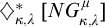 holds.
Fact 12.5 [Reference Matet17].
Let
 $\mu $
be a regular infinite cardinal less than
 $\kappa $
,
 $\pi $
be a cardinal greater than
 , and
 be an
 -sequence. Suppose that
 $\diamondsuit _{\kappa ,\pi }^\ast ~[NG_{\kappa ,\pi }^\mu ]$
holds. Then
 holds, where
 $Y = \{ y_\alpha : \alpha < \pi \}$
.
Proposition 12.6. Let
 $\mu $
be a regular infinite cardinal less than
 $\kappa $
. Suppose that
-
•
$\kappa = \nu ^+$
, where
$d (\mu , \nu ) = \nu $
; -
•
; -
•
; and -
•
holds.


Then
 holds for some
 with
 .
Suppose for instance that
 $\mu = \omega _1$
,
 $\kappa = \omega _4$
and
 is a limit cardinal less than
 $\omega _{\omega _1}$
. Suppose further that
 and
 . Then by Theorems 8.10 and 8.14 and Proposition 12.6,
 holds for some
 with
 . Hence by Lemma 12.2,
 is nowhere
 -
 -saturated. Note that by Facts 2.8 (iii) and 10.6, it follows that for
 $\chi = \omega _2$
or
 $\omega _3$
,
 is not
 -
 -saturated.
We just considered some situations when
 (and hence the restriction of the normal ideal
 to the set of all a in
 of uniform cofinality
 $\mu $
) is not
 -
 -saturated. The next result only yields non-
 -
 -saturation. (For the definition of the approachable ideal
 $I[\pi ]$
, see e.g., [Reference Shelah24, p. 14]).
Lemma 12.7. Suppose that
 , where A is an infinite set of regular cardinals with
 $\vert A \vert < \min A$
and
 , and I is an ideal on A with
 $\{A \cap a : a \in A\} \subseteq I$
. Let
 $\mu $
be a regular cardinal less than
 $\kappa $
such that either I is
 $\mu ^+$
-complete, or
 $\mu> \mathrm {cof}(I)$
, and
 $\sigma> \pi $
be a cardinal such that
 $NS_\pi \vert E^\pi _\mu $
is nowhere
 $I_\pi $
-
 $\sigma $
-saturated. Then
 is not
 -
 $\sigma $
-saturated.
Proof. By Proposition 7.1 and Corollary 7.5 in [Reference Matet16], there is
 such that
-
•
and -
• for any
$S \in NS^+_\pi \cap P(E^\pi _\mu ) \cap I[\pi ]$
,
.
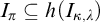


Moreover by a result of Shelah [Reference Shelah, Sands, Sauer and Woodrow23], since
 $\mu ^+ < \pi $
,
 $NS^+_\pi \cap P(E^\pi _\mu ) \cap I[\pi ] \not = \emptyset $
.⊣
Fact 12.8 [Reference Gitik and Shelah6].
Let
 $\pi $
be an infinite successor cardinal, say
 $\pi = \tau ^+$
. Then for every regular cardinal
 $\mu $
in
 $\pi \setminus \{\mathrm {cf}(\tau )\}$
,
 $NS_\pi \vert E^\pi _\mu $
is nowhere
 $I_\pi $
-
 $\pi ^+$
-saturated.
Proposition 12.9.
-
(i) Suppose that
$\kappa = \nu ^+$
,
and
. Let
$\mu < \kappa $
be a regular infinite cardinal such that
$\mu \not = \mathrm {cf} (\tau )$
. Suppose that
$\mu> 2^{\aleph _0}$
if
, and
otherwise. Then
is not
-
-saturated. -
(ii) Suppose that
$\kappa $
is weakly inaccessible,
and
. Let
$\mu < \kappa $
be a regular infinite cardinal such that
$\mu \not = \mathrm {cf} (\tau )$
. Suppose that
$\mu> 2^{\aleph _0}$
if
, and
otherwise. Then
is not
-
-saturated.


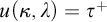


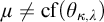


Acknowledgements
The author is thankful to the referee for the suggestions that improved the text.



