INTRODUCTION
The first professional historians of precolonial sub-Saharan Africa thought a good deal about the impact of imported guns.Footnote 1 Insofar as Central Africa is concerned, the consensus formed in these pioneering years was that the role of firearms in determining military and political outcomes in the eighteenth and nineteenth centuries had probably been less significant than previously assumed. The most important statement to this effect was put forward by Andrew Roberts in a 1971 article that cautioned against attributing to firearms alone the general increase in violence that accompanied the westward advancement of the frontier of merchant capitalism and the long-distance trade in slaves and ivory.Footnote 2 Having only become common in north-eastern Zambia from the 1880s, firearms – Roberts argued – could not have influenced decisively earlier Bemba territorial expansion or altered in any profound way their military tactics based on shock attacks by swarms of spearmen. And, even when the Bemba did acquire firearms in considerable quantities, the inferior quality of the muskets at their disposal militated against such weapons making a substantial contribution to elephant-hunting or to Bemba resistance against better armed European forces.
Commendable for steering clear of crude technological determinism, and appealing also to scholars bent on exploding racist assumptions about Africa's precolonial ‘heart of darkness’, these conclusions have stood the test of time and have by and large been corroborated by more recent studies of neighbouring areas and peoples. Joseph Miller, in particular, viewed the ‘unreliability’ of imported weapons – only a ‘small percentage’ of which ‘survived the first few attempts to fire them’ – as one of the principal causes of the continuity in military hardware and organization that characterized the Angolan interior in the eighteenth century.Footnote 3 In a similar vein, Achim von Oppen's study of the precolonial economy of the upper Zambesi and Kasai region in the nineteenth century presents the ‘remarkably poor’ performance and ‘very limited durability’ of the lazarinas, the often untested flintlock muzzle-loaders that dominated the Ovimbundu-run trade between the Bihé plateau and the Zambesi headwaters, as indications that neither the reported disappearance of elephants in the area from c. 1850 nor the depletion of game in general can be ascribed with any certainty to the spread of guns.Footnote 4
My starting point is that an emphasis on the technical shortcomings of the new weapons of destruction, and on the endurance of African military and hunting traditions vis-à-vis exogenous innovation, is hard to reconcile with Central Africa's unquenchable demand for European guns from the eighteenth century onwards and the fact that, as Miller himself is aware, firearms always constituted ‘the “very soul of commerce” in the exchange of people for goods with the Europeans’.Footnote 5 If firearms had really been invariably inefficient, and therefore of only marginal economic and military significance, then it is not at all clear why the majority of Central Africans – whose ‘political economy of rights over people’ could just as easily have been energized by exchanges of other foreign wares – consistently insisted on obtaining them throughout the era of the long-distance trade. This article's main objective is to confront this unresolved contradiction by taking a fresh look at a range of fairly well-known, but rarely comprehensively cross-examined, nineteenth-century sources.
We should be aware that, as has long been recognized, European travelogues are not free from problems. Coloured by the ‘racial, cultural and political shortcomings of their writers’, they are often myopic and Eurocentric in both tone and content.Footnote 6 Nineteenth-century travel records tell us less than we would like to know – and what they tell us should not always be taken at face value. Yet, given the narrowly political perspective of formal oral traditions and the questionable reliability of focused oral interviews centring on so early a period, explorers' diaries remain indispensable in providing data of a socioeconomic nature.Footnote 7 Moreover, the travellers' interest in military affairs in general, and guns in particular, was not infrequently magnified by their backgrounds and, especially, by the hazardous circumstances in which they operated.
When associated with the evidence produced in the wake of the formulation of colonial gun laws, the systematic study of European precolonial travelogues indicates that the importance of firearms in Central Africa in the nineteenth and early twentieth centuries has been unduly underrated in the specialist literature. For, if they are examined through the perspectives of science and technology studies, both sets of sources throw light on processes of technological appropriation that enabled Central Africans to minimize the deficiencies of imported weapons, using them profitably for both hunting and military purposes, and to infuse them with innovative social functions that were no less meaningful for being often at variance with those for which the weapons had originally been devised in their European settings. In reassessing the historical significance of guns in Central Africa, in other words, what Clapperton Mavhunga calls the specific ‘roles that Africans gave to firearms in contexts internal to their circumstances’ need to be explored alongside more predictable patterns of gun usage.Footnote 8 By so doing, this article contends that the enthusiasm with which most north-western Zambians responded to the advent of firearms from c. 1800 was a consequence of both the adaptable nature of the new technology and the extent to which different groups imbued it with different social meanings related to pre-existing interests and political structures.
This article is subdivided into three sections. I begin by charting the nineteenth-century expansion of the gun frontier in what would become colonial North-Western Rhodesia and the variegated processes of technological appropriation that underlay it.Footnote 9 The second section focuses on the early years of colonial rule; it foregrounds the survival of precolonial patterns of trade well into the twentieth century and the extent to which such continuities broadened and consolidated earlier forms of gun usage. Although colonial authorities had long posited a causal link between the ubiquity of firearms and the imperfect administrative normalization of substantial portions of North-Western Rhodesian territory, it was only in the early 1920s that they finally achieved comprehensive regulation of African gun ownership and exchange. The implementation and far-reaching social consequences of this long-delayed policy form the subject of the article's last section.
THE GUN FRONTIER IN THE NINETEENTH CENTURY
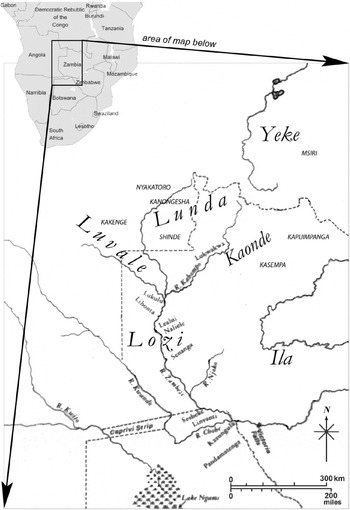
North-western Zambia in the nineteenth century. Adapted from A. D. Roberts, A History of Zambia (London, 1976), 128. Drawn by Judith Weik and Mauro Sanna.

The appearance of the gun along the present-day border between Zambia and Angola was inscribed in the broader processes of violent socioeconomic change occurring in the area from the late eighteenth century. The advancing frontier of the Angolan slave trade – driven mainly by Afro-Portuguese and Ovimbundu entrepreneurs (locally known as ‘Mambari’) – ushered in both new dangers and also opportunities for both the small- and large-scale societies located on the southern periphery of what Jan Vansina has felicitously called the ‘Lunda commonwealth’.Footnote 10 Further geopolitical transformations owed less to the peripheral workings of merchant capitalism than to the northern manifestations of the demographic dislocations of the South African ‘Mfecane’. The most dramatic population movement to affect the region under discussion was that which led a group of Sotho-speaking migrants, the Kololo, to overrun the area's most populous and complex polity, the Luyana or Lozi kingdom of the upper Zambezi floodplain and surrounding districts, in the early 1840s. It is to this area that we turn first in our attempt to chart the movement of the gun frontier through north-western Zambia in the course of the nineteenth century.
Slow beginnings in Barotseland
Unlike Walima Kalusa, who has recently described Barotseland and the Caprivi Strip under the Kololo as awash with guns,Footnote 11 I view Livingstone's and Silva Porto's overall paucity of references to modern weapons in the area, the ‘immense’ number of elephants and other game near both Linyati and Sesheke and in the floodplain,Footnote 12 the weapons' abnormally high prices,Footnote 13 and the attested poor marksmanship of the Kololo as indications that firearms were still rare in Barotseland in the 1850s.Footnote 14 A few Kololo royals had some ‘wretched’ guns which they ‘wretchedly used’,Footnote 15 and King Sekeletu's opponent, Mpepe, the governor of Naliele, was given ‘a small cannon’ – or ‘a large blunderbuss to be mounted as a cannon’ – by Silva Porto in 1853.Footnote 16 But stabbing and throwing spears and shields made of hides remained the dominant Kololo weapons throughout the decade – as is also borne out by the facility with which the trader James Chapman conned Ponwane, ‘the headman of Linyati’, and other Kololo grandees in 1853. Having been asked to repair some guns, he took advantage of their ‘ignorance’ of modern arms, ‘selected 5 of the easiest and repaired them for a tusk worth £15, at which rate [he] pocketed [his] pride’.Footnote 17 It was this same ignorance on the part of the Kololo that apparently prompted the Tawana chief Letsholathebe to challenge Sekeletu's authority by appropriating some of the latter's ivory. Having recently acquired guns, Livingstone explained, Letsholathebe now considered himself ‘more than a match’ for the less well armed Kololo.Footnote 18
To say that firearms were scarce in mid-nineteenth-century Barotseland is not to say that the Kololo resisted their introduction. The opposite, in fact, was true, for the conquerors of the Lozi were clearly keen on European weapons, the destructive potential of which they had experienced at the hands of Griqua musketeers at the start of their northward migration in the 1820s, and which they expected to use to contain the threat posed by Mzilikazi's Ndebele.Footnote 19 It is clearly significant that, when he first met Livingstone's party in 1851, Sebitwane, Sekeletu's father and predecessor, was convinced that ‘our teaching was chiefly the art of shooting … and that by our giving him guns he would thereby procure peace’.Footnote 20 Thus, the fact that Barotseland remained lightly armed until at least the early 1860s ought not to be ascribed to cultural opposition to military innovation on the part of assegai-wielding warriors. More simply, it was the result of the area's comparatively late incorporation in Ovimbundu and Afro-Portugese trading networks. This, in turn, was a consequence of the very specific requirements of the upper Zambesi floodplain's political economy. The internal need for slaves for agricultural purposes and public works had led the last pre-Kololo Lozi king, Mulambwa Santulu, to shut his country to Mambari slave and gun traders in the early nineteenth century.Footnote 21 It was only after the death of Mulambwa, the civil war that followed it, and the related Kololo conquest in the 1840s that Angolan traders returned in force to Barotseland, whose new rulers were now ready to export some war captives and, more importantly, ivory to the Ovimbundu plateau and, thence, the west coast. The ideal conditions faced by Silva Porto in early 1850s' Bulozi, where ivory was cheap and plentiful and foreign wares scarce and expensive, prove that the long-distance trade was still in a relatively embryonic stage,Footnote 22 and that the Kololo, for all their eagerness to experiment with foreign imports, had not yet managed to bridge the technological gap that separated them from some of their neighbours.
Guns and Luvale men
Spurned by the Lozi in the early part of the nineteenth century, Angolan traders had found more willing partners around the headwaters of the Zambesi. The first recorded trading visit to the Luvale (‘Lovar’), then living mainly along the middle Luena river, took place in 1794–5. At the time, the people of Kakenge Footnote 23 (‘Caquinga’) and Chinyama (‘Quinhama’) were already said to be ‘warlike’ (‘muito inclinados a Guerra’), but still only armed with ‘bows and arrows, spears and knives, and wooden shields’.Footnote 24 A coeval anonymous report confirmed that they had no firearms, ‘because they [did] not know how to use them’.Footnote 25 The situation, however, evolved rapidly, with gun imports increasing in direct proportion to slave and, from the 1830s, ivory and beeswax exports. By the early 1850s, the Luvale, like their western neighbours, the Chokwe, had accumulated ‘many guns’,Footnote 26 and they were among the most important suppliers of slaves to Angola.Footnote 27 The then Kakenge boasted a long connection with Mambari traders, by whom, however, he was feared, for he and other ‘wild Luvale’ (‘wilden Ka-lóbar-Völkern’) were not averse to attacking passing caravans with their weapons.Footnote 28
Numbers, however, tell only part of the story. What really matters are the uses to which the Luvale put their abundant muskets and the ways in which the latter interacted with pre-existing socioeconomic structures and gender identities. The relationship between hunting and the spread of firearms among the Luvale was probably complex and dialectical: if well-developed autochthonous hunting traditions are very likely to have facilitated the rapid adoption of guns, firearms themselves must have transformed and strengthened such traditions. Technological considerations are significant, too. Storey has recently argued with reference to South Africa that, in comparison with the later breech-loaders, ‘the old muzzle-loaders’ constituted an ‘adaptable and “flexible” technology’.Footnote 29 Since muskets were typically made from wrought iron (as opposed to steel), pre-existing iron-working skills – as the record clearly bears out for the Luvale's immediate neighbours, the ChokweFootnote 30 – could be so refined as to greatly prolong the lifespan of a damaged weapon and/or to keep a defective one in serviceable order. While gun-flints were manufactured locally,Footnote 31 single-shot muzzle-loaders could also be loaded with most kinds of home-made ammunition and easily used in association with earlier hunting equipment. When all these factors are borne in mind – and due allowance is made for the patrimony of shooting skills that the Luvale are likely to have accumulated through sheer practice – it is easier to understand why the lazarinas became a crucial tool of production around the headwaters of the Zambesi – one whose extensive deployment would have a significant environmental impact.
It is worth noting that, when describing the situation obtaining among the Lunda of Shinde, the Luvale antagonists, Livingstone asserted that ‘their bows and arrows [had] been nearly as efficacious in clearing the country of game as firearms’.Footnote 32 Yet he remained convinced that guns did give Luvale hunters a distinctive advantage over the less well-armed Lunda. In comparison with the Luvale, who ‘enjoy[ed] the privilege of hunting on both sides’ of the upper Zambesi, the ‘Balonda [were] able to do little’ – he remarked in July 1855, when he also noted that the Lunda-controlled left bank was still richer in game than the right one, which had been ‘much hunted by the Balobale who have guns’.Footnote 33 Without being dismissive of traditional elephant-hunting techniques, the skills demanded by which he had had the chance to admire in Linyati,Footnote 34 Livingstone was also in no doubt as to the ultimate consequences of the diffusion of firearms for elephant herds. The Kololo had only just begun to hunt elephants with guns, he wrote in 1853; if they continued, ‘very soon none will appear in this part of the country. They retire before the gun sooner than any other animal.’Footnote 35 Indeed, environmental degeneration was rapid among the gun-rich Luvale, for it was at about this time that the middle Luena seems to have exhausted its ivory supplies. Thereafter, whatever little ivory the Luvale continued to export alongside slaves and beeswax came mainly from newly conquered Lunda territory.Footnote 36
Hunting and warfare have been described as ‘intimately connected’ activities, not least because ‘the hunt is often the training ground for war’ and ‘shooting skills that developed in one setting could be transferred to the other’.Footnote 37 Livingstone might well have subscribed to this view, for, contra much recent scholarly literature, he never questioned the military significance of firearms, going so far as to theorize that, by making local conflicts ‘more terrible’ and by reducing the gap between ‘the strong and the brave’, on the one hand, and ‘the weak & cautious’, on the other, guns would work towards reducing the incidence of war in Central Africa.Footnote 38 The available written sources do not permit us to gauge the extent to which the lazarinas affected Luvale tactics and organization. On the basis of oral evidence alone, Papstein concluded that warfare on the upper Zambesi remained the affair of small bands of marauders bent on taking the enemy by surprise. But, even if one accepts this hypothesis (and the unsubstantiated contention that the gun was more often used in war ‘as a blunderbuss rather than as a precision instrument’Footnote 39), there is no doubt that the wide availability of firearms increased Luvale military potential. This is borne out by their reported ability to repel a Kololo party in the 1840sFootnote 40 and, especially, by their successes during the nineteenth-century phase of the so-called Wars of Ulamba, in the course of which gun-wielding Luvale slave raiders attacked – and gradually encroached upon – the territories of the Lunda of Shinde to the east of the Luena and the southern Lunda of Katema, Kapenda, and others to the north-east.Footnote 41 By the time of Livingstone's passage in the 1850s, the Lunda of Shinde had been in touch with Ovimbundu traders for almost as long as their Luvale enemies.Footnote 42 Yet, for reasons that remain unclear, they had been less successful in modernizing their armament, and their best responses to Luvale aggression were to beef up their ranks by absorbing fleeing Luvale refugees and to strengthen the defences around their villages and even individual households.Footnote 43
By about 1870, guns had fully permeated Luvale society, changing it and being changed by it. In 1875, the small party of armed Luvale hunters whom Verney Cameron met to the north of Nana Kandundu, the Nyakatoros's new capital in former Lunda territory, were very intrigued by the explorer's breech-loading rifle. Even though they examined it ‘with much admiration’, however, ‘they did not consider it sufficiently long, their own weapons being lengthy Portuguese flint-locks’. It took a practical demonstration of the rifle's penetrative power and accuracy to dispel the hunters' knowing scepticismFootnote 44 – one that distinguished them sharply from the gun-poor Kololo, who, as we have seen, placed a blind trust in Chapman and other foreign ‘experts’ in the new technology. Not only did the Luvale continue to pose a threat to Mambari caravans and other travellers plying the increasingly important trade route between Angola and Katanga,Footnote 45 but their gun-driven prowess in hunting and warfare also nurtured a strong, gendered martial ethos. This was much in evidence in 1895, at the time of François Coillard's visit to Kakenge, then living very close to the spot where Livingstone's Shinde had resided some forty years earlier. On the day that preceded his first meeting with the chief, the missionary and his Lozi escort were made the target of repeated hostile demonstrations on the part of ‘young men all armed with guns’. After a tense night punctuated by war dances and continuous discharges of firearms, Coillard was finally brought to the presence of Kakenge: ‘The place was full of men, decked in their war-paint, and surrounded by bundles of guns.’ The menacing atmosphere eased a little on the following day, but Kakenge still warned Coillard not to ‘“take the Balubale for women”’.Footnote 46 The link between guns and masculinity among Luvale hunters and raiders was confirmed a few years after Coillard's passage, when a British official explicitly reported that it was ‘unusual and so rare an occurrence to see a man without a gun [at Kakenge's], as it [was] to encounter a woman without her infant’.Footnote 47
Guns and royal power among the Lozi
As the Luvale consolidated their gun-centred social system, Barotseland, free from Kololo overrule since 1864, was undergoing a dramatic transformation. By means of enhanced contacts with ivory traders and hunters from the west and the south, Sipopa, the restored Lozi Litunga, had embarked on a programme of accelerated military overhaul with a view to consolidating his still fragile internal position.Footnote 48 By the mid-1870s, Barotseland's firepower had increased exponentially. Having spent several months in Sesheke in 1875, the Czech explorer Emil Holub hazarded an estimate of ‘the number of guns that had been introduced into the country from the south and west’ over the course of the previous few years. This, he believed, ‘amounted to 500 flint muskets, 1,500 ordinary percussion muskets, eighty percussion elephant-guns, 150 rifles, thirty double-barrelled guns of various sorts, ten breech-loaders, and three revolvers’.Footnote 49 Thanks also to the more advanced and specialized firearms that the southern traders were importing into the country alongside older models, the Lozi, unlike the Kololo, were now routinely hunting elephant with guns, though they still used them in tandem with locally-produced iron ‘elephant assegai[s]’.Footnote 50 During the great hunt of 1875, as many as ‘10,000 shots’ were said to have been fired in the general mêlée that followed Sipopa's ill-timed first shot.Footnote 51 Before long, the fauna of Barotseland – just like that of the Luvale heartland a few decades earlier – began to show signs of exhaustion.Footnote 52 By the mid-1880s, Lubosi Lewanika, the Lozi king since 1878, was clearly concerned by the environmental consequences of the widespread adoption of firearms in hunting. It was probably for this reason that, in 1886, he forbade the use of guns during the annual royal hunt.Footnote 53
Lozi rulers drew on a tradition of political and economic centralization that set them apart from the more fragmented Luvale chieftainships to the north. It is therefore not surprising that, unlike the latter, the former always did their best to exert a close control over the kingdom's external trade and the movement of firearms that came in its wake. Not only did Sipopa resolve to spend most of his time in Sesheke, to the south of the floodplain proper, with a view to being closer to Westbeech and other traders from the south,Footnote 54 but his monopolistic ambitions also led him to forbid most kinds of exchange between his subjects and visiting merchants.Footnote 55 Ivory, which Sipopa accumulated through the payment of tribute or by sponsoring the activities of hunters, was considered ‘crown-property, and it [was] a capital offence for anyone to carry on any transactions with regards to [it] on his own account’.Footnote 56 The trade in guns was another exclusive royal prerogative.Footnote 57 Distribution, too, was closely monitored. Unlike other products, Holub was told, firearms were never permanently given away by Sipopa, but only ‘lent’ to hunters, chiefs, and subjects with the proviso that they could ‘be recalled at any moment at the royal pleasure’.Footnote 58 So prominent were firearms in the entourage of Sipopa that the same eyewitness was led to believe that the second most important ‘officer of state’ in the Lozi kingdom was ‘Masangu’, the ‘governor of the arsenal’, whose principal responsibility was the ‘supervision of the ammunition and guns distributed to the vassals’.
He was likewise superintendent of all the native smiths. I found him employed in repairing a gun, for which he was using hammers, chisels, pincers, and bellows, all of his own making, and of the most perfect construction that I had yet seen in South Africa.Footnote 59
This competence, of course, was a recent development in Barotseland, and it attests powerfully not only to the increasingly significant role of firearms in the region's political and economic life but also to the effectiveness with which Central Africans were learning to overcome some of the new technology's limitations by honing pre-existing iron-working skills. There is, indeed, some evidence that Sipopa was closely associated with firearms in the minds of his people: when the king was ousted in 1876, one of the rebels' first actions was to throw ‘the great bulk’ of his guns into the Zambesi.Footnote 60
Lubosi Lewanika, who wrested the kingship from Mwanawina, Sipopa's successor, in 1878, started off with comparatively few guns, as demonstrated by his attempt to requisition all the arms and powder in the possession of Alexandre de Serpa Pinto, who visited the royal capital of Lealui in August–September of the same year.Footnote 61 However, by the time he raided the cattle-rich Mashukulumbwe or Ila in 1882, Lewanika had certainly obtained some guns, for the exploits of the ‘weapon with the lightning’ made a huge impression on its victims.Footnote 62 Lewanika's trading policies mirrored Sipopa's. In June 1886, Holub, on his second trip to the north of the Zambesi, became acquainted with ‘Liomba’, the ‘trade minister’ whom Lewanika had sent to intercept Westbeech at the Kazungula ferry and make ‘all the purchases for the royal household as well as to purchase all arms for the empire on the king's account’.Footnote 63 A few months later, Watson, one of Westbeech's partners, bought some ivory from the headman of Sesheke. Both parties were aware of committing ‘a capital crime … since all ivory is private property of the king, which he uses, in turn, to buy arms and ammunition for all his subjects’.Footnote 64 And firearms Lewanika did continue to buy throughout the late 1880s, for Coillard was ‘astonished’ by the number of guns available to the Lozi at the time of their second raid against the gun-poor Ila early in 1888. Even though he thought the assegai was ‘still the national weapon’, the missionary could not help noticing that the Lozi now had arms of ‘every calibre. To be sure, they are not the most modern pattern; the majority are flint-lock. Never mind, they are guns! And to a Morotsi the name alone is magic.’Footnote 65 Lewanika's enduring interest in guns – which the Lozi were now undoubtedly employing in warfare, alongside hunting – is also attested by Frederick Selous, who, in September 1888, offered the king ‘a very good hammerless shot gun’,Footnote 66 and by the nature of the presents given to him by the concession-seekers Ware and Lochner in 1889 and 1890, respectively. Invariably, these included considerable quantities of Martini-Henry rifles and ammunitions.Footnote 67
Barotseland's centralized political system and monarchical tradition shaped the social role attributed to firearms in the region. As pointed out above, the Lozi kings' manifest monopolistic tendencies found no equivalent among the Luvale, where political and economic power was, as Coillard put it, much more ‘diffused’.Footnote 68 It follows that, on the headwaters of the Zambesi, ordinary villagers participated earnestly in the market economy as epitomized by Ovimbundu and Afro-Portuguese caravans, and that the trade's by-products, including firearms, spread well beyond the chiefly strata.Footnote 69 In Barotseland, conversely, access to firearms, powder, and ammunitions seems always to have been closely dependent on the Litungas' patronage. Thus, it probably makes sense to describe gun use among the Lozi as being more elitist than among the Luvale. To put it differently, among the Lozi, firearms were less an attribute of masculinity than a means of political centralization and a symbol of high birth or proximity to the royal court. In Barotseland, as a Marxist historian once argued, firearms served mainly to strengthen the ‘coercive apparatus’ of the landowning aristocracy;Footnote 70 among the Luvale, they were the common man's weapons of choice and a critical component of his social identity.
A Kaonde currency
While the cattle-keeping Ila of the middle Kafue river remained lightly armed until the end of the century, other groups on the furthest reaches of Mambari commercial penetration responded more readily to the new opportunities for investing in military modernization. This was a particularly attractive option for people, such as the Kaonde of the present-day Solwezi and Kasempa districts, whose livelihoods had long depended to a considerable extent on hunting.Footnote 71 Near the modern Congolese border, the aggressiveness of Msiri's Yeke must have also contributed to accelerating the process of Kaonde rearmament.Footnote 72 The traditions or reminiscences recorded by Melland in the early 1920s certainly suggest that some guns were being used in warfare among the Kaonde of Kapijimpanga and the neighbouring Lamba of Mulonga and Kalilele in the latter part of the nineteenth century.Footnote 73 The evidence is more detailed for southern Kaonde groups. Around present-day Kasempa, firearms were relatively uncommon until the late 1870s. In 1878 or 1880, when he killed his cousin Kabambala to assume the dignity of Kasempa, Jipumpu is said to have had ‘only one muzzle loader’ at his disposal.Footnote 74 However, thanks to both his temporary alliance with Yeke raiders and partnership with Mambari traders, Jipumpu – who is also remembered as a great elephant hunter – must have been able to beef up his arsenal quickly and effectively. For, between the 1880s and the 1890s, he became a minor regional warlord in his own right, raiding some Ila communities for slaves, expelling the Nkoya leader Mwene Kahare from his capital, and even defeating a large expedition sent by Lewanika in c. 1897 to support Jipumpu's rival, the fellow Kaonde chief Mubambe Mushima.Footnote 75 Jipumpu's great victory owed something both to the fact that most of his men were now ‘armed with muzzle loaders’ and to the impregnable nature of his stronghold on Kamusongolwa's hill, a high ‘kopje … well provided with good deep caves where most of the people could entirely hide themselves from being shot’.Footnote 76
It was from about this time that the Kaonde – among whom cattle, the key form of transferable wealth in the territories to the south and west, could not thrive on account of the presence of the tsetse fly – began to conceive of muzzle-loaders ‘as a form of currency … serving most of the purposes … for which other natives use[d] cattle or slaves’.Footnote 77 Gradually, ‘all transactions regarding wives, inheritance, succession, compensation, illness, deaths, burials, and initiation ceremonies’ came to entail ‘the loaning or passing of guns and powder’.Footnote 78 It is not clear whether, in using firearms as standards of value for social payments and even everyday transactions, the Kaonde were inaugurating an entirely novel system or modernizing an earlier tradition of regulated exchanges of hunting weapons. What is certain, however, is that such practice explains the extraordinary extent to which the muzzle-loader embedded itself in the Kaonde social structure and culture.
GUN-RUNNING IN THE EARLY TWENTIETH CENTURY
Colonial rule and gun control laws went hand in hand in most localities. Not so in North-Western Rhodesia, where the unlicensed importation of guns, powder, and ammunitions was forbidden in 1901,Footnote 79 but where ownership of firearms by Africans remained initially unregulated, since the whole of the country was
by a fiction … treated as having been under the suzerainty of and acquired by treaty with Lewanika. Consequently the natives of that portion of Northern Rhodesia have benefited in that they have been able to obtain firearms without much difficulty.Footnote 80
Early local experiments in voluntary registration of guns did take place in select North-Western Rhodesian localities, such as the Batoka district from 1903.Footnote 81 But these uncoordinated initiatives did not amount to a coherent effort at gun licensing or, even less, to an attempt at enforcing such near universal African disarmament as that brought about by the unyielding North-Eastern Rhodesia's ‘Fire-Arms Restricting Regulations (Natives and Asiatics)’.Footnote 82 Game laws were similarly skewed in favour of North-Western Rhodesian Africans. Whereas their North-Eastern Rhodesian peers had been expected to take out hunting licences from as early as 1900,Footnote 83 Africans living within the boundaries of North-Western Rhodesia were explicitly exempted from the stipulations of the first game preservation regulations to be issued in the country in 1905. Once more, this privilege was ‘in accordance with the provisions of the Concession granted by King Lewanika Paramount Chief of the Barotse Nation to the British South Africa Company dated October 17th 1900’.Footnote 84
The absence of internal regulations concerning African gun ownership and hunting turned gun-running from Portuguese West-Central Africa into one of the defining features of the early colonial period in North-Western Rhodesia. A number of additional factors help explain the substantial proportions assumed by the phenomenon. While the demand for captive labour in Angola remained high long after the formal abolition of slavery,Footnote 85 Portuguese officials struggled to establish even the barest form of administrative control over the sprawling territory that made up the central and eastern regions of the colony.Footnote 86 Moreover, they were strongly suspected of having a stake in the illicit trade,Footnote 87 which was also fuelled by the seemingly unrestricted importation and sale of gunpowder in the country under their charge.Footnote 88 Finally, Ovimbundu and Afro-Portuguese smuggling activities were greatly facilitated by both the extent of the frontier between Angola and North-Western Rhodesia and, especially, the uncertainty surrounding its definition until 1905, the year in which the king of Italy was requested to adjudicate the long-running boundary dispute between the British and Portuguese governments. This meant that, throughout the early 1900s, Mambari traders could continue to operate in North-Western Rhodesia, safe in the knowledge that all that was required to avoid prosecution and/or the confiscation of their merchandise was to beat a quick retreat to such contested border areas as British patrols dared not encroach upon for fear of causing a diplomatic incident.Footnote 89
As in the nineteenth century, Barotseland's wealth remained a powerful magnet for Angolan traders, some of whom were reported to be buying cattle in Lealui in June 1900 in exchange for ‘gunpowder, arms and calico’.Footnote 90 Another ‘large caravan … from Bihe’ made its entry into Bulozi a few days later, prompting the Acting British Resident to voice his ‘apprehension’ at ‘the constant increase of the importation of arms and ammunition from the West Coast to this country’.Footnote 91 At first, the impact of the import regulations of 1901 was clearly negligible. In 1903, Lewanika – who still used the allocation of firearms and, especially, ammunitions as a means to bolster his position vis-à-vis an aristocracy who were bearing the brunt of the British South Africa Company (BSAC)'s steady encroachment upon many of their former prerogativesFootnote 92 – was able to persuade the administration to order as many as 4,000 Martini and other cartridges for distribution among his trusted indunas. The Company acceded to the king's request, for it expected that this ‘very marked concession’ would ‘stop all illegal traffic in powder and cartridges’.Footnote 93 In fact, seemingly condoned by Lewanika,Footnote 94 gun-smuggling remained common,Footnote 95 though the boundary award of 1905 finally equipped British officials to deal with it more effectively. The ‘half-caste’ trader Ferreira was one of the first traffickers to experience the fast-improving boundary-policing capacity of the BSAC in Barotseland. First expelled from the district when found in possession of ‘65 guns and a large supply of ammunition’ in July 1911, he had his stock (which included 25 flintlocks) confiscated and his large camp burned down when he was apprehended for a second time inside British territory a few months later.Footnote 96
The gradual – and never entirely complete – closing down of Barotseland from 1905 did not pose insurmountable problems for Mambari gun-runners, who were also very active in the still almost entirely unpoliced territory to the north, where, of course, they boasted long-established trading links with the Luvale, whose aggressive militarism and masculinity they had helped to beget over the course of the previous century. Among the Luvale of Kakenge and Nyakatoro, the slave trade was still thriving in c. 1900, with ‘a gun or 40 or 80 yards of calico’ being ‘the purchase value of an adult slave’.Footnote 97 Rubber exports were also being paid in guns and gunpowder, which Luvale men bought ‘far more readily than ordinary trade goods’.Footnote 98 Undoubtedly many of these guns also found their way to the Luvale and Lunda inhabiting what would become the Balovale sub-district of Barotseland in 1907–8. Writing some 45 years after the events, Native Commissioner Venning, the first official in charge of Balovale (present-day Zambezi), still remembered vividly the ‘large numbers of guns’ owned by ‘both the Malunda and Malovale’ and the troubles he faced in bringing illegal imports from Angola under control. Venning also claimed to have witnessed ‘the last slave raid’ to occur in the area.Footnote 99 This may have been so, but there is no doubt that Mambari gun-runners remained a force to be reckoned with for some years to come. For instance, a large trading outpost in a fortified Luvale village was discovered in 1911. Venning's successor surmised it must have been ‘established there quite a long time’.Footnote 100
The trade in slaves and guns was also much in evidence in neighbouring Mwinilunga, where, again, no administrative work took place until the beginning of 1908, when the Balunda sub-district of Kasempa district was established by Native Commissioner Bellis. Mambari dealers had certainly been at work in the area at the end of the nineteenth century,Footnote 101 and they continued their frequent visits throughout the 1900s. In 1904, the then Kanongesha ‘had seven or eight slaves for sale and was expecting the arrival of Mambari purchasers’.Footnote 102 Two years later, Copeman, the Kasempa District Commissioner, and an escort of Barotse native police travelled to within fifty miles of Mwinilunga with a view to intercepting ‘certain Portuguese traders’ who had been reported to be ‘trading guns, powder and caps in return for slaves, ivory and rubber’. Three ‘stores’ were eventually located at Salimi's. A ‘large quantity’ of forbidden goods was discovered, while the ‘many empty powder canisters which were found in the different stores and lying about the camps testified to the large trade which has been going on in this commodity’.Footnote 103
As has been argued above, the Kaonde of Kasempa had responded enthusiastically to the long-distance trade in the latter part of the nineteenth century, incorporating Mambari-imported guns into their hunting economy and recasting them as a form of transferable wealth. By 1901, their area was ‘flooded with guns and ammunitions’Footnote 104 – a state of affairs that prompted the BSAC to inaugurate a police post at ‘Fort Kasempa’ in 1902.Footnote 105 In the face of Mambari obduracy, however, the task of controlling the district proved far from straightforward. In 1903, Sub Inspector Macaulay intercepted and dispersed two Mambari caravans between Kasempa and the Congo Free State border.Footnote 106 It was probably on this occasion that he confiscated, inter alia, ‘about 50 guns’ and ‘100 bags of gunpowder’.Footnote 107 Another Mambari camp was surprised near the then Mushima's village at about the same time. In this instance, only 3 guns were destroyed and 14 bags of gunpowder impounded.Footnote 108 One of the problems faced by local administrators in dealing with Angolan smugglers was that the ‘natives will give no information [as to] their whereabouts’. This was scarcely surprising, given that the Mambari were the Kaonde's principal suppliers of firearms and that, by now, ‘every native ha[d] a gun and a great many … two or three in their possession’. It was these same guns, Macaulay surmised, that accounted for the considerable quantity of ivory still exported from the district and the presumed decrease in elephant populations.Footnote 109
THE 1922 PROCLAMATION
By the early 1910s, Angolan gun-runners were everywhere on the retreat. However, from the point of view of struggling BSAC territorial officials, the damage had already been done. Supplementing the already substantial quantities of firearms that had entered North-Western Rhodesia in the course of the nineteenth century, the additional guns introduced into the country at the height of smuggling in the 1900s consolidated earlier forms of gun usage among Africans and enhanced their potential for resisting, if not colonial rule as a whole, at least the normative apparatus that came with it. Especially in the gun-rich and thinly occupied North-West, where the early years of colonial rule were punctuated by several episodes of gun-related violence involving both Africans and Europeans, local administrators came quickly to the conclusion that disarmament was an absolute pre-condition for asserting the authority of the colonial state and symbolizing that curtailment of African citizenship rights on which the edifice of European domination itself was predicated.Footnote 110
In 1912, the Kasempa District Commissioner (DC), Hazell, sought an audience with Administrator Wallace in Livingstone, the capital of the newly unified Northern Rhodesia, to recommend the urgent need for the immediate disarmament of the district. Both the Lunda and the Kaonde of Kasempa, he submitted, ‘are far from being in a proper state of control, and … this has been brought about … by the fact of their ability through the possession of firearms to defy and resist authority’.Footnote 111 Wallace, however, thought that Hazell's scheme – one which envisaged the detention of all chiefs ‘pending surrender of such guns and powder as they and their people possess’ and which would require the deployment of at least 400 policeFootnote 112 – would merely multiply the chances of armed confrontation by requesting the ‘natives … to decide without any warning whether or not to obey an order for disarmament on the spot’. He thus put forward a counter-proposal for the more gradual registration and licensing of firearms.Footnote 113
In April of the same year, Wallace reiterated his views in a meeting with Viscount Gladstone, the High Commissioner for South Africa, in Cape Town.Footnote 114 A comprehensive ‘Arms and Ammunition Proclamation’ to this effect was drafted. Informed by the belief that ‘the inhabitants of the Kasempa and Lunda Districts have beyond question far more guns than they ought to’, it gave local BSAC officials ‘full power of refusal of a licence’; the expectation was that ‘after the law comes into operation every native-owned rifle will become prima facie illegally owned unless a licence can be produced’.Footnote 115 Though falling short of promoting complete African disarmament, the proclamation's obvious objective, as pointed out by the Secretary for Native Affairs, was to ‘[hinder], in every legitimate way, the natives of this Territory from acquiring additional firearms and fresh supplies of ammunition’.Footnote 116 However, the arrest of Sakutenuka, the district's most notorious outlaw, in May 1912, and the desire not to antagonize local Africans meant that the proclamation was cast aside, and the attempt to re-establish a modicum of order in the troubled north-western marches delegated to the Collective Punishment Proclamation.Footnote 117
In 1914 the sale and exchange of modern rifles throughout Northern Rhodesia were made conditional upon obtaining the permission of the administration.Footnote 118 But it was only the post-First World War Treaty of St Germain for the Control of the Traffic in Arms that brought back to the fore the still unresolved question of the former North-Western Rhodesia's missing gun legislation. After a convoluted legal history that need not retain our attention, ‘The Northern Rhodesia Firearms Restriction (Natives) Proclamation 1922’ was finally gazetted in January 1923.Footnote 119 Its most important provision stipulated that ‘no native shall be entitled to have or possess arms or ammunition in the Territory, unless by the written permission of the Administrator’ or authorized district officials.Footnote 120 Alongside ‘permits to possess’ – the concession of which was made dependent upon payment of a fee of sixpence from the beginning of 1924 – identically priced ‘permits to transfer’ were also introduced to regulate gun exchanges.Footnote 121
The debate that followed the issuing of the proclamation of 1922 shows that, with the disruptions of the early 1910s a full ten years behind them, local officials in the North-Western Province and elsewhere were now more willing than their predecessors had been to view firearms as more than just a threat to law and order (which they undoubtedly were) and to consider the multiple social uses to which muzzle-loaders had been put since their introduction in the region in the course of the nineteenth century. Practical troubles in implementing the law were anticipated in the Solwezi sub-district, where ‘ten Messengers, unable to read, will have to deal’ with as many as ‘about 4,000’ Kaonde gun owners, all of whom were wont to view firearms not only as fundamental hunting tools but also as an essential lubricant of social relationships. Hall, the Kasempa DC, thought that ample time should be given for registering the guns, since ‘wholesale confiscation’ was initially to be avoided so as not to ‘seriously antagonize nearly the whole population’.Footnote 122 In light of the ‘extraordinary’ ubiquity of muzzle-loaders among the Kaonde, Hall's Native Commissioner was even more pessimistic than his superior about the licensing exercise's real prospects of success:
I can imagine that an efficient registration system in the Kasempa district might easily present a number of problems comparable (in a lesser degree of course) to an attempt to register the ownership and transfer of sovereigns or half-crowns in the United Kingdom.Footnote 123
The same official pointed out that gun ownership in the Kasempa district was ‘a matter requiring greater delicacy of treatment, probably, than in other districts’.Footnote 124 But misgivings were also expressed in Barotseland and Balovale. For instance, Yeta, Lewanika's successor, and a number of his councillors, long accustomed to the privilege of ready access to firearms, questioned the need for permits to transfer. ‘When we shoot’, they explained to the Resident Magistrate,
we do not shoot for sport nor pleasure, but we do so for sustenance of life. It would, therefore, be difficult … to obtain permits every time when one wishes to send one of his family to go and shoot game and ducks as many gun owners are old people and members of the Khotla [central council] and cannot always go out shooting as they have to attend to official business.Footnote 125
The adoption of strategies of evasion was foreboded in Balovale. Given that the majority of his messengers were illiterate, the sub-district's Native Commissioner was certain that theoretically illegal temporary transfers of individual permits would become very common among Luvale men: ‘if the owner of the gun hands over his permit to possess to the person whom he wishes to hunt for him the chances of being discovered would be slight’.Footnote 126
Despite all of these concerns, the new gun legislation was put into effect. While no violent opposition to registration manifested itself, discontent in Kasempa was clearly palpable during the law's ‘difficult’ first year.Footnote 127 It was probably not coincidental that it was in the course of 1923 that the district witnessed the first strong patrol by the Northern Rhodesia Police since the beginning of the First World War. Having followed the course of the Lunga and combed the Jiwundu swamp near Solwezi, the police arrested a number of tax-defaulters and seized as many as one hundred unregistered guns.Footnote 128 The Kaonde – who clearly feared that registration would in due course be followed by the requisition of their most valuable possession – reacted by seeking to dodge the Proclamation's provisions. Much evasion also took place among the Lunda of Balunda or Mwinilunga sub-district, where the registration exercise began in September 1923. After one year, permits to possess had been issued for 600 guns, but the DC was ‘pretty sure there [were] over 3,000 in that Sdt’.Footnote 129
Prosecutions and confiscations for failure to register and obtain the necessary licences began in earnest in the Kasempa district in the summer of 1924.Footnote 130 This had the unintended immediate effect of bringing registration to a complete halt. Since ‘everyone found with an unregistered muzzle loader got two month I[mprisonment] [with] H[ard] L[abour] without the option of a fine and the gun was confiscated as well’, the ‘natives had no choice but to conceal unregistered guns’.Footnote 131 After Hall's successor reverted to ‘a more moderate course from the beginning of 1925, 669 new guns were registered’ and licensed. The end of the exercise was still not in sight but, as the new DC commented, this was scarcely surprising. After all, it was ‘probably the ambition of every male native to own one or more of these guns’, and it was therefore ‘fairly certain that many thousands of them must now exist in N.W. Rhodesia’. In ‘view of the deep suspicion with which most natives would at first regard any law which sought to control anything they highly prized’, the DC thought the ‘Firearms Proclamation ha[d] been carried out as efficiently as could be expected’ and was confident that, ‘provided no harsh or repressive measures [were] adopted … a fairly complete registration will in due course be effected’.Footnote 132
CONCLUSION
This article has attempted to show that guns spread throughout the bulk of North-Western Zambia in the course of the nineteenth century. The enthusiasm with which the imported technology was taken up by the peoples of the region was in large measure the result of their ability to deploy it successfully for a variety of both predictable and innovative purposes. Guns had different meanings in different places, and the modalities of their appropriation were closely related to local sociopolitical circumstances. Among the Lozi after the Kololo interlude, guns played a central role as symbols of royal power and means of political centralization; among Luvale hunters and raiders, they became defining features of masculinity; among the Kaonde, firearms probably served both of the above purposes, while also being used as a polyvalent form of currency. However, throughout the region under discussion, guns never lost their original function of means of human destruction and material production, whose inherent shortcomings, the evidence suggests, Africans learnt to minimize by drawing creatively on the opportunities afforded by the accessible nature of the new technology. The initial weakness of the colonial administration meant that this internally differentiated process of technological adaptation continued during the early years of the twentieth century, only being brought to an end from 1922, when the hitherto unregulated right to possess and exchange guns was taken away from the peoples of north-western Zambia.
The effects of the Proclamation of 1922 were compounded shortly thereafter by its logical sequel: the extension to the bulk of the former North-Western Rhodesia of such game laws as had governed African hunting in the eastern part of Northern Rhodesia since the beginning of the century.Footnote 133 The phased imposition of ‘native hunting licences’ constituted another major external interference in the lives of communities who had relied on game meat as one of their primary sources of animal proteins for centuries.
The colonial assault on unrestricted hunting and gun ownership in North-Western Rhodesia was a long time in the making. But when it did materialize, its consequences were momentous, for it marked the beginning of the end of a number of gun-based systems of economic and social relationships that had dominated large stretches of north-western Zambia for several decades – systems that previous historians have largely underestimated.