Introduction
Much has been written about party systems in Eastern Europe and especially how and why they differ from Western European ones. In general, party systems in Eastern Europe are considered to be more volatile, and thus more unstable than their western counterparts (Gherghina Reference Gherghina2014). The stability of a party system is considered an important component for democratic consolidation and effective programmatic representation that reduces political uncertainty (Casal Bértoa, Deegan-Krause, and Haughton Reference Bértoa, Fernando and Haughton2017). Unstable party systems on the other hand can generate democratic weakness, undermine electoral institutions and hinder effective policymaking. The academic debate has, nevertheless, largely ignored cases from Southeast Europe, as well as structural conditions of societal diversity in new democracies where political parties formed around existing (or emerging) ethnic cleavages. Publications that did include such cases have miscalculated or misinterpreted their findings (see Powell and Tucker Reference Powell and Tucker2014; Crabtree and Golder Reference Crabtree and Golder2016). Instead of open party competition, ethnically divided societies often display segmented party systems where competition is limited within ethnically defined party blocks. A comparison of countries where ethnic identities form the main political cleavage can help examine the role of ethnic identity and ethnic parties as stabilizing factors of party systems. This article compares party systems in two ethnically divided countries in Southeast Europe: Bosnia and Herzegovina (BiH), where identity is more stable, and Montenegro, where it is malleable.
We argue that the stability of ethnic cleavages and salience of identity affects the stability of party competition and that this effect can be measured. Established ethnic cleavages stabilize party systems by creating a segmented party system that limits competition between blocks, thereby closing the system off to non-ethnic challengers, while allowing for instability within such blocks. But when ethnic cleavages are malleable and situational, this opens competition to parties that seek to bridge ethnic divisions, leading to more instability. Political parties that try to defy ethnic-based politics often end up being pushed back into one of the ethnic party blocks. In both cases this form of stability negatively impacts democracy, as it allows ethnic parties to dominate the electoral arena and sidelines any non-ethnic options and programmatic linkages. This article sets out to test how different levels of rigidity in ethnic identification stabilize party systems and lead to closure.
We empirically investigate our argument through a comparison of party systems of two ethnically divided post-communist countries in Southeast Europe, Bosnia and Herzegovina and Montenegro. These countries share many common characteristics relevant to the political context but differ in relation to the stability of ethnic cleavages and their levels of integration into the institutional context. This makes it possible to isolate the effect that levels of ethnic identity rigidity have on the degree of segmented ethnic competition, our dependent variable. Basically, we are comparing two new and ethnically heterogeneous democracies where one (BiH) has a political cleavage based on firm ethnic identities, while in the other (Montenegro) it is based upon malleable and situational ethnic identity. In both cases this is reflected through political parties where the main parties represent clearly defined ethnic group interests. We expect to find that more salient cleavages, such as in BiH, limit electoral competition across ethnic lines. Where cleavages are malleable, such as in Montenegro, the possibility for parties representing a non-ethnic “center” to emerge still exists. Relying on original survey data and official electoral data for parliamentary elections since independence, we map the party systems in both countries. We then utilize measures of block volatility and within block volatility to establish a link between the strength of ethnic identity in politics and party system stability.
We find that party system stability in multiethnic Southeast European countries is related to the level of cleavage closure along ethnic lines. This research has implications for the study of party systems in other ethnically divided societies. From a theoretical point it addresses debates on party systems in ethnically divided societies and allows us to conceptualize the role of non-ethnic parties more precisely. From a comparative aspect, it introduces models of the mechanisms by which firm and malleable ethnicity leads voters and candidates to converge on stable patterns of exchange in a segmented electoral market. Finally, this article introduces new data on a subset of neglected post-communist countries and party systems in Southeast Europe.
The rest of the article is structured in the following way. The second section traces the debate on party system stability and instability. The third section covers case selection, methodology, and measurement of volatility. The fourth and fifth sections provide an overview of the development of political pluralism based on ethnic cleavages in BiH and Montenegro. In the sixth section, we use volatility as a measure to compare party dynamics in the two countries, with special focus on the difference between total volatility and volatility between ethnically defined blocks and within them. In the concluding section we consider the consequences that different levels of ethnic identity rigidity have on party system stability and on non-ethnic parties in such a system and discuss theoretical and practical implications of our work.
Party System Stability and Instability in Southeast Europe
Party systems in democracies can be understood as “the system of interactions resulting from inter-party competition” (Sartori Reference Sartori2005, 39). The party system of democratic states is based on rules and behavioral patterns, which arise through myriad competitive relations and interactions among political parties. They make party competition more predictable and mutually dependent within the social framework of power struggles. In light of persistent competitive relations among the same political parties, we can talk about institutionalization of a party system, even though other authors prefer attributes such as “structuring” or “systemness through closure” (Kitschelt Reference Kitschelt, Boix and Stokes2007, 525).
An extensive literature looks at party systems in Central and Eastern Europe, especially focusing on party system institutionalization and differences between party systems in West and East Europe (Casal Bértoa Reference Casal Bértoa2014; Gherghina Reference Gherghina2014). Without going into detail, two major approaches can be identified. The first is defined by Peter Mair and the other by Herbert Kitschelt. Mair (Reference Mair1997) looked at structural differences in party system development between Western and Eastern Europe and found instability in the East. He concluded that Eastern European party systems were likely to remain highly unstable due late development of party competition and an overlap of parties and other social institutions, such as movements and interest groups. All these traits are also present in Southeast Europe. Kitschelt, on the other hand, looked at cleavage formation and their salience as the main element of party system development (Kitschelt et al. Reference Kitschelt, Mansfeldova, Markowski and Tóka1999). He concluded that, while being different than in the West, Eastern European party systems are based on relatively stable cleavages. This is also mostly true in Southeast Europe. The difference in perspective is linked to the question whether authors examine the supply side of political competition, based on the institutionalization of political parties, or its demand side, based on cleavages and their salience (Bielasiak Reference Bielasiak2002; Thorlakson Reference Thorlakson2018). We argue that these two approaches are not mutually exclusive, and that it is beneficial to combine both in order to understand party system development and stability in ethnically divided societies.
Our understanding of ethnic identity is based on a constructivist perspective which views ethnicity as both structural and descent-based, but also situational and activated through political practices (Chandra Reference Chandra2012). To distinguish levels of identity salience we use the label “firm” to describe more stable ethnic identity in BiH that overlaps with the religious divide. A more fluid and self-ascribed ethnic identity which can be observed in Montenegro is labeled as “malleable” (Dzankic Reference Dzankic2013). The difference between “firm” and “malleable” ethnic identity portrays ethnicity as a process of constituting and re-configuring groups by defining boundaries between them (Wimmer Reference Wimmer2008, 1027), which can be observed through electoral and party politics. Identity is “translated” through cleavages with different levels of closure. According to Deegan-Krause, a full cleavage must include cumulative institutional, attitudinal, and structural elements, while a cleavage difference and a cleavage divide include only one or two, respectively (Reference Deegan-Krause, Dalton and Klingemann2007, 539–540). This makes a full cleavage more persistent and potent for political mobilization, indicating a closure of social relationships.
The role of agency is highlighted in the literature as relevant for cleavage formation and reinforcement (Bornschier Reference Bornschier2009; Enyedi Reference Enyedi2005), while reinforcing ethnic ties is especially appealing to political elites (Horowitz Reference Horowitz1985). Kitschelt et al. (Reference Kitschelt, Mansfeldova, Markowski and Tóka1999, 59) emphasize that ethnic cleavages enable easier mobilization and monitoring of clientelist exchange between patrons/politicians and clients/voters. The transactional costs of such exchange are the lowest: information exchange is easier and faster, monitoring is safer and more efficient, and targeted clients are “cheaper” (Corstange Reference Corstange2018). Opportunity costs incentivize politicians to compete for voters within their own ethnic group instead of across groups. By appealing to their own group and providing only within-group compensation, parties also make it very costly for voters to escape ethnic loyalty. This kind of dynamic keeps any potential cross-cutting cleavage from emerging and has a stabilizing role in party competition. Hale (Reference Hale2008) describes ethnic identity as a means of reducing uncertainty, which is prior to and distinct from the (rational) formation of ethnic politics and interests. Birnir (Reference Birnir2007) sees ethnic identity as a stable but flexible political attractor that draws individuals to electoral politics in order to pursue interests of their own group through institutional means. The vehicle for any such action is the ethnic party. Ethnic parties are defined as those who champion the particular interests of one ethnic category or set of categories, where these categories can change over time (Chandra Reference Chandra2011, 155). There is no single or universal indicator to identify ethnic parties but a set of indicators to be adapted to each individual context. Chandra identifies eight indicators to classify parties as (non/multi)ethnic: the party name (and party symbols), the categories explicitly advocated for in campaign messages, implicit campaign messages, issues advocated for in explicit messaging, the groups who support it, the arenas of contestation, the composition of party leadership, and composition of the party’s votes in electoral contest (Chandra Reference Chandra2011, 157).
Where ethnicity tends to make political competition more predictable, it is advantageous to look at party systems as composed of relatively sound blocks of parties representing the same ethnic group. This enables more nuanced examination of party systems in multiethnic countries and analysis of the role that ethnic identity rigidity plays in stabilizing party systems. There has been little empirical exploration of this topic. Early work by Horowitz (Reference Horowitz1985) and work by Chandra (Reference Chandra2005) explore models where the more rigid ethnic identity leads to more perfect segmentation of the party system along ethnic lines. In a more recent article Piacentini (Reference Piacentini2019) looks at multiethnic parties that attempt to position themselves within a segmented electoral market defined by ethnic patronage, relying on interview data.
Case Selection and Methods
Southeast European countries have been largely neglected in studies of party system stability. In most countries of the region, the primary politically relevant cleavage is based on ethnicity, and the structuring of electoral competition and the party systems followed suit. Events in recent history set the grounds for a reinforcement of such ethnicity-based cleavages. In this article we compare two new democracies where critical junctures left traumatic consequences that either strengthened existing ethnic identities through war or redefined them through secession. Today BiH and Montenegro are among the most ethnically diverse countries in Europe, but while ethnic identity can be described as firm in the first case, it is malleable in the second.
In BiH the three main ethnic groups, Bosniaks, Croats, and Serbs, are clearly divided along religious lines. This division has been stable for decades and was the basis for political mobilization during the Bosnian War that further strengthened ethno-religious identities. In the aftermath of conflict, ethnicity was institutionalized through constitutional provisions guaranteeing territorial group autonomy and veto rights. In Montenegro the main division between Serbs and Montenegrins occurs within the Christian Orthodox population along the more recent issue of Montenegrin statehood. While Montenegro has not experienced war in recent history, the Referendum on Montenegrin statehood divided and antagonized a significant part of the population, setting grounds for the construction of new divisions that rely on situational ethnic identities (Jenne and Bieber Reference Jenne and Bieber2014). Levels of historical political violence in the two cases are not comparable, but both events can be seen as critical junctures during which ethnicity became the basis for future political mobilization.
The difference in respect to the stability of ethnic cleavages can be measured using official census data (Table 1).Footnote 1 Below we calculate the volatility of ethnic identification between the 1991 census, when both countries were part of Yugoslavia, and the 2011 (Montenegro) and 2013 (BiH) censuses following independence. While ethnic identity in BiH remained stable, more than one fifth of the Montenegrin population changed the category of their ethnic identity, while remaining within the same religious group. As religion in BiH reinforces ethnic divisions, identity is “stickier” than in the case of Montenegro where a common religious identity explains why ethnic identities are more malleable. Based on this, we identify ethnic identity in BiH as firm and in Montenegro as malleable.
Stability of Ethnic Cleavages in BiH and Montenegro

Apart from the difference in salience of ethnic cleavages, both countries share a common institutional history as part of Yugoslavia, have small parliaments, similar electoral systems, and have experienced little systemic change over the past decade. The electoral systems for the national parliaments of both countries produce similar outcomes and are not sufficient to explain differences in electoral volatility. The 42 members of the lower house of the BiH Parliament and the 81 members of the Montenegrin Parliament are elected by proportional representation, with open lists in BiH and closed lists in Montenegro. Both countries have an electoral threshold of 3%. To ensure proportionality and ethnic representation of smaller groups, the BiH electoral system relies on ethnic majority electoral districts and compensatory seats, while the Montenegrin electoral system employs lower thresholds for registered minority parties. In both cases this makes mobilization along ethnic lines viable even for small groups (contrary to Posner Reference Posner2004). The two electoral systems equally favor small, regional and minority parties and discourage strategic (cross-ethnic) voting, resulting in fragmented and volatile parliaments.
Both cases feature a strong role of agency in cleavage formation during critical junctures and a politicization of ethnic cleavages instead of programmatic linkages between parties and voters during founding elections. This established ethnicity as the permanent axis of political competition. The experiences of war and independence, while still relevant, do not determine political competition on a daily basis, with elections focusing on more pertinent issues. The strong influence of agency in cleavage formation has persisted in Montenegro. In BiH, on the other hand, we can see an institutionalization of ethnicity where public office requirements, ethnoterritorial divisions and electoral institutions, among others, perpetuate differences act as drivers of ethnic cleavages.
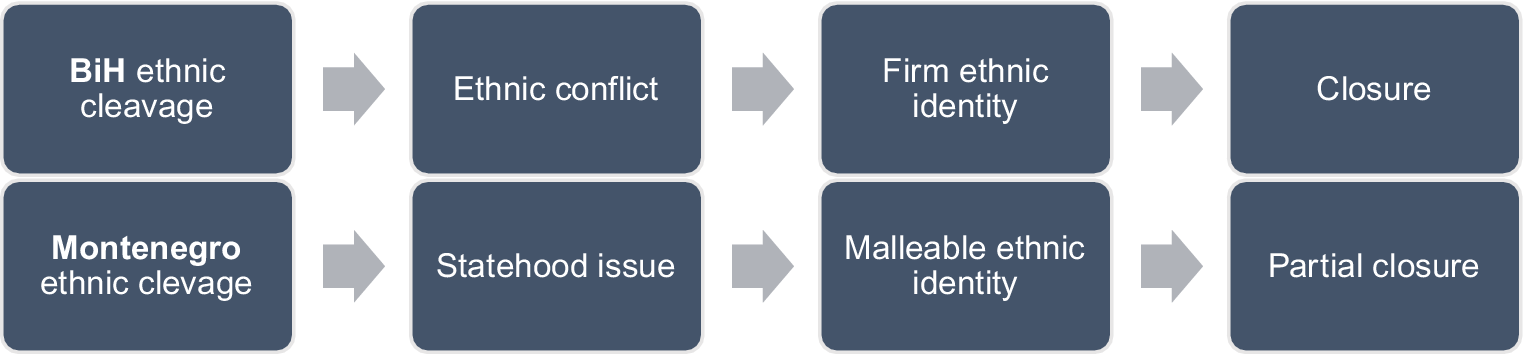
We identified the party systems of BiH and Montenegro that follow a similar logic of organization as suitable for comparison when assessing party system stability. The main differences are the basis of the ethnic cleavage and salience of ethnic identity (Figure 1). The firm ethnic identity in BiH with full closure of the party system along ethnic lines and malleable ethnic identity in Montenegro with partial closure give us the key variables for comparison of the two cases.
Effect of Ethnic Cleavages on Party Systems in BiH and Montenegro

In order to compare the impact of ethnicity (and ethnic parties) on party system stability we use the measure of electoral volatility which measures change in support parties receive from one election to the next. The measure is often used to indicate other important party system qualities such as institutionalization, and to assess consistency and depth of existing cleavages. Interestingly, neither high nor particularly low volatility seems to be desirable with regards to the “health” of the party system. High volatility is often seen as an indicator of a non-consolidated party system and political instability (Kitschelt Reference Kitschelt, Boix and Stokes2007, 530). On the other hand, very low volatility can indicate lack of competition and, indirectly, party system closure (Mair Reference Mair1997). However, the measure itself tends to be “volatile” (Casal Bértoa, Deegan-Krause and Haughton Reference Bértoa, Fernando and Haughton2017) depending on how it is calculated. Especially in recently (re)established party systems, such as in Eastern Europe, the measure of electoral volatility can be distorted or inflated through shifting pre-electoral coalitions, party splits, and leadership-based politics (Sikk Reference Sikk2005). Having in mind that applying different principles when calculating volatility can produce significantly different results, we operationalize the measure more precisely in subsequent sections.
As the value of total volatility masks certain characteristics of electoral movement, we turn to Bartolini and Mair (Reference Bartolini and Mair1990) who introduce an approach to measuring volatility in the presence of segmentally defined blocks of parties.Footnote 2 The measure of block volatility aggregates parties sharing a certain characteristic into blocks and only measure electoral change among such blocks. Any remaining part of volatility necessarily happens within blocks of similar parties, a measure called within-block volatility. Total volatility is thus divided into block volatility and within-block volatility and allows us to measure closure or openness of cleavage lines. Accordingly, high total volatility and low block volatility is indicative of electoral competition among parties within the same block. On the other hand, when block volatility is almost as high as total volatility, this points to electoral competition between different blocks or cleavages (Bartolini and Mair Reference Bartolini and Mair1990, 36, 48–49). As an additional test we calculate the index of cleavage salience (CSI) which represents “the proportion of total electoral interchange which is accounted for by block electoral interchange” (Bartolini and Mair Reference Bartolini and Mair1990, 80). This way we can show the relative importance of a cleavage with respect to other dimensions of competition where more salient cleavages can indicate closure (Federer-Shtayer and Meffert Reference Federer-Shtayer and Meffert2014, 325).
We use indicators to classify all parties and coalitions that contested parliamentary elections in BiH and Montenegro since either country became independent according to the ethnic category whose interest they represent (Chandra Reference Chandra2011). The classification of the most relevant parties is presented in subsequent sections. For party classification we rely on self-presentation of the political parties and archival online material. The data we use for analysis is a combination of publicly available electoral data and opinion poll datasets to which the authors have contributed in the past.Footnote 3 Our party dataset includes a total of 159 contestants in 12 parliamentary elections between 1996 and 2018. We then group political parties in BiH and Montenegro into ethnically defined blocks as Bosniak, (Bosnian) Croat, (Bosnian) Serb, Montenegrin, and (Montenegrin) Serb nationalist parties, as (Montenegrin) minority group nationalist parties, or as non-ethnic or multiethnic parties, and measure and compare block and within-block volatility, in relation to total volatility.
Institutionalization of an Ethnically Segmented Party System in BiH
Bosnia and Herzegovina has a complex political system and a multiethnic population predominantly divided along religious lines. The current political system was established through the Dayton Peace Agreement in 1995 that ended the Bosnian War. It places an emphasis on institutions that reinforce ethnic cleavages, leading to an institutionalization of ethnic divisions through a consociational model of democracy and distribution of political offices along ethnic lines. The resulting electoral competition is heavily influenced by both declared and perceived ethnicity of candidates, political parties, and voters.
Historically, political parties in BiH formed around the cleavage of religious affiliation with the aim to represents Catholic, Muslim and Christian Orthodox interests. Religious identity as a form of individual and collective identification forms the basis of ethnic differentiation in BiH and acts as a tool for political mobilization and legitimization (Abazović Reference Abazović2010). The political system of consociational democracy gave further impetus to the establishment of political parties on the basis of ethno-religious criteria, thus setting up institutional subjectivity of these groups (Bieber Reference Bieber2006, 7; Wolff Reference Wolff2006, 28). Several parties that identify as non-ethnic or multiethnic exist in BiH that are linked with workers’ movements and political parties formed during the early 20th century, as well as secular politics, but do not constitute a full cleavage. Consociationalism enabled a form of political competition that restrained inter-ethnic conflicts. However, this was realized at the cost of reinforcing societal divisions and splitting the electorate along the ethnic lines. As a result, BiH society today functions through several distinct political and social spheres or societal pillars (Kapidžić Reference Kapidžić2017). We can speak of a fully developed ethno-religious cleavage and a divide between the religious and non-ethnic, secular cleavage (Deegan-Krause Reference Deegan-Krause, Dalton and Klingemann2007, 539–540).
The contemporary development of the BiH party system began in anticipation of the first free elections in November 1990 after over four decades of single-party rule. New political parties were (re)established reflecting religious cleavages that were suppressed under communist rule, incorporating the political heritage of national and cultural organizations and parties from the early 20th century. Three ethnic parties brought together members and interests of Bosniaks in the Party of Democratic Action (SDA), Serbs in the Serbian Democratic Party (SDS), and Croats in the Croatian Democratic Union BiH (HDZ BIH). After losing the elections, the ruling League of Communists changed its name to the Social Democratic Party (SDP BIH). These core political parties formed the main segments of BiH politics and most new parties were formed through repeated splintering of the four (Kapidžić Reference Kapidžić2015). The most relevant political parties today can be classified according to the ethnic group they represent (Table 2).
Classification of Relevant BiH Political PartiesFootnote 4

General elections in BiH have been held at regular intervals eight times since the end of the war. In general, elections citizens vote for the House of Representatives (HoR) of the bicameral Parliamentary Assembly of BiH, the three members of the Presidency of BiH, as well as several sub-state bodies at the Entity (Republika Srpska, RS, and Federation of BiH, FBIH) and Canton levels in FBIH. This multilevel contest is framed by the ethnoterritorial administrative divisions of BiH. The only electoral contest where all relevant political parties compete against each other, and where they subsequently need to cooperate to form a government, is for the HoR of the BiH Parliament. This election is most relevant to understanding the segmented nature of the country’s party system and is the main focus of analysis.
The 42 members of the HoR of the BiH Parliament are elected through proportional representation (14 from RS and 28 from FBIH). Only 30 members are directly elected through open list PR from eight multimember districts (three in RS, five in FBIH), with a district magnitude from three to six members from each district. The remaining 12 seats are compensatory seats distributed at the entity level to ensure proportionality of the vote and representation of parties and groups whose support is spread out. An electoral threshold of 3% is applied at the electoral district level (Election Law of Bosnia and Herzegovina 2018). The electoral system is designed to allow both regional and small parties to be elected to Parliament which, together with the small number of seats, results in a highly fragmented legislature. In eight elections for the HoR of the BiH Parliament 127 contestants have been on the ballot, out of which 97 were political parties, 26 pre-electoral coalitions, and 4 independent candidates. All coalitions ran only for a single election while parties often made new coalitions before each election. Also, all but one pre-electoral coalition consisted of parties representing a single ethnic group.
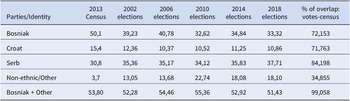
The contemporary multiethnic society of BiH is not mixed but rather a reflection of different communities living side by side instead of living together (Anđelić Reference Anđelić2018, 31). This is replicated through the electoral units that show dramatic heterogeneity between them but are relatively homogenous within (Hulsey Reference Hulsey, Keil and Perry2015, 41). Voter support for ethnic parties is strongly linked to individual voter identities. Table 3 lists aggregate percentages of votes for ethnic and non-ethnic blocks of parties in BiH for the past five elections, as well as recent census results. Most striking is the longitudinal continuity of vote percentages and the high percentage of overlap between average vote and census results, for all groups except for non-ethnic parties and citizens identified as “Other.”
Percentage of Votes for (Non)ethnic Groups in Relation to Census in BiH

Note: includes data for all parties contesting BiH Parliament elections. The identity category “Others” is a residual category that also includes answers “not declared” and “no answer” to the census question on national identity.
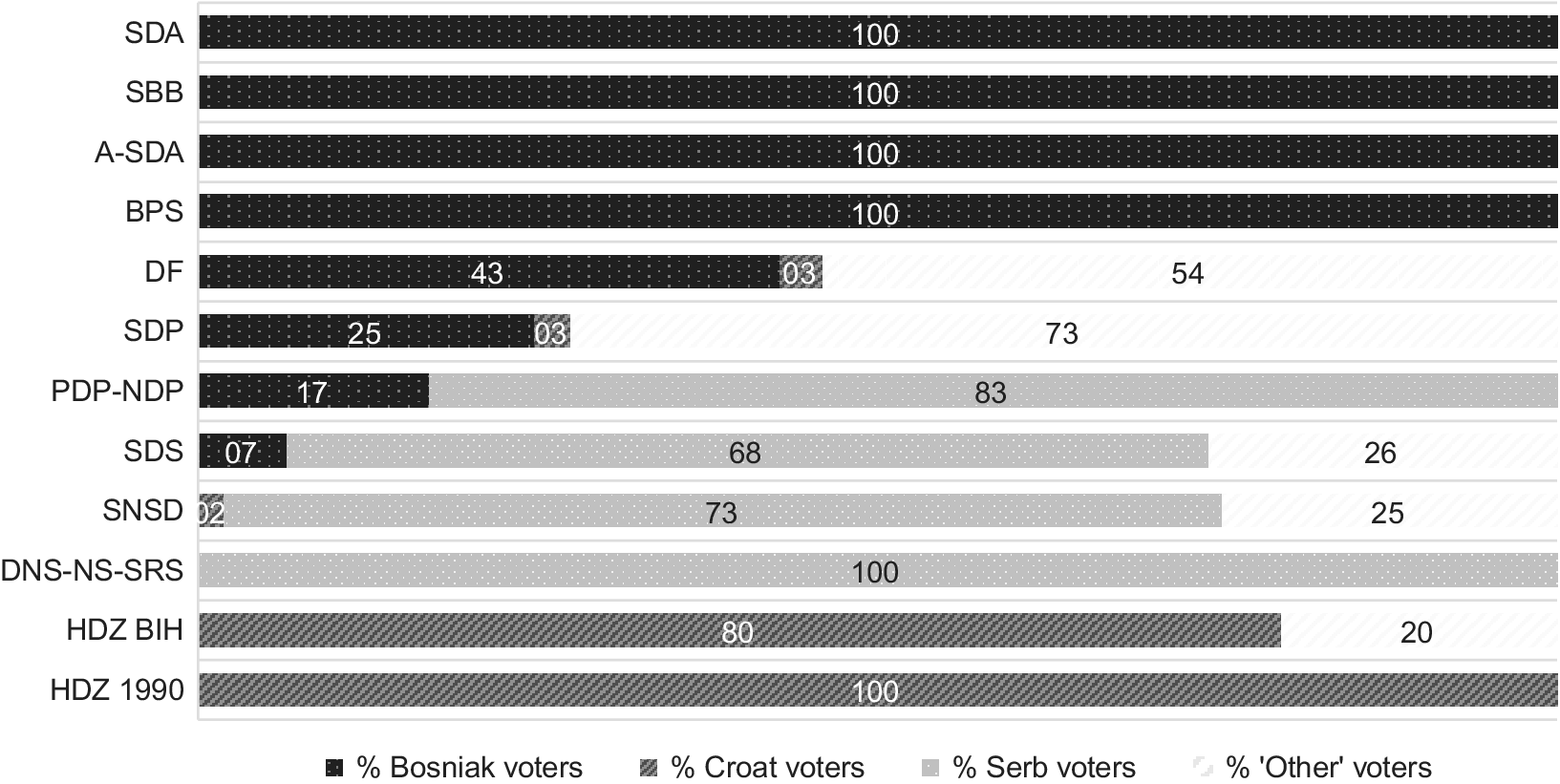
There is sparse data on party-voter ethnic linkage as exit polls are not conducted in BiH. An opinion poll from 2016 gives us a glimpse into (self-identified) ethnic voters’ support for parties (Figure 2). Of particular interest is the complete reliance of Bosniak parties on support from Bosniaks, as well as exclusive support of Serb voters for Serb parties. While support for all ethnic parties overwhelmingly comes from their own ethnic groups, non-ethnic parties rely on a mix of voters identifying as “Others” and Bosniak. The stability of support for ethnic parties and congruence between party and voter ethnicity can be explained through the closure of cleavages (Bartolini and Mair Reference Bartolini and Mair1990) and the concept of “ethnic attractors” that gives a form of stability to the party system (Birnir Reference Birnir2007).
Party Support in % by Voters’ Ethnicity in BiH (2016 Opinion Poll Data)

Political contest in BiH takes place within ethnically defined segments of the population, similar to what is present in other multiethnic regions of Europe where parties compete in a segmented arena (Manning Reference Manning2004, 72). Based on empirical evidence, Kapidžić (Reference Kapidžić2017) and Hulsey (Reference Hulsey, Keil and Perry2015) point to the existence of several party subsystems with little competition for voters between them. In BiH we thus identify a complex party system with three ethnically bound party subsystems and a high degree of independence, and one not-so-well-defined non-ethnic party subsystem.
Malleable Ethnic Identity as the Basis of the Montenegrin Party System
The recent history of Montenegro, with renewed independence in 2006, can be concisely described as a successful interaction between the consequences of a dominant-party system (Komar Reference Komar2013; Vuković Reference Vuković2015) and the exploitation of ethnic diversity to create the main political cleavage. The need to study the role of the agency in cleavage formation and reinforcement (especially in post-communist societies) has already been outlined. However, in the case of Montenegro and its “malleable” identity (Dzankic Reference Dzankic2013), the claim that “cleavages would not exist without elites conceptualizing the conflict situation” seems especially relevant (Enyedi Reference Enyedi2005, 699). Political elites, mainly from the ruling Democratic Party of Socialists (DPS), have managed to elevate ethnic diversity into a cleavage during the late 1990s in order to preserve their position in power. This resulted in the creation of four party subsystems (Montenegrin, Serb, ethnic minority, and non-ethnic or neutral).
The re-emergence of ethnic cleavages in Montenegrin politics is well described in the literature. Authors notice the fragility of the ethnic division within the Orthodox population between those that identify themselves as Montenegrins and Serbs (Morrison Reference Morrison2009; Dzankic Reference Dzankic2013; Jenne and Bieber Reference Jenne and Bieber2014; Komar and Živković Reference Komar and Živković2016). The strengthening of the independence movement in the early 2000s created a split in the ruling DPS party with the splinter Socialist People’s Party (SNP) rallying in favor of remaining in the union with Serbia. The divided elites set the grounds for a re-emergence of the ethnic cleavage and people followed, declaring their identity as Montenegrin (largely in favor of independence and supporting DPS) and Serb (largely against it and favoring SNP), therefore entangling ethnic division with attitudes towards Montenegrin statehood.
Political elites, especially the DPS leadership, used their position of power to create and reinforce an overlap of ethnic structural divisions and attitudes toward Montenegrin independence. This emerging cleavage overlapped a structural element in the Montenegrin-Serb ethnic division, an attitudinal element in the common sense of identity and self-consciousness regarding Montenegro’s independence, and an organizational-behavioral element in the anti- and pro-independence blocs of political parties (Bartolini and Mair Reference Bartolini and Mair1990, 215). Following the 2006 Referendum and independence, one could expect that attitudinal and organizational elements would demise, leaving something resembling a strong divide, but what remained was a full cleavage (Deegan-Krause Reference Deegan-Krause, Dalton and Klingemann2007, 539–540).
The “attitudinal” element of the cleavage, the position towards Montenegrin statehood, and Montenegrin “situational” nationalism as the malleable structural element (Jenne and Bieber Reference Jenne and Bieber2014), created an imperfectly segmented electoral market (Zuber Reference Zuber2012). This means that parties “make offers across ethnic divides” and that ethnic competition within one or several ethnic blocks can be nested within an inter-ethnic arena of party competition (Zuber Reference Zuber2012). In fact, there were several attempts to reach across the ethnic divide, in order to mobilize support against the DPS which occupies a significant share of the “pro-independence” cleavage. So far, all these attempts were unsuccessful and parties that tried to appeal across the “ethnic gap” were swiftly pulled back into ethnic cleavage politics by other clearly aligned parties. One first such attempt was the coalition Popular Unity created between the Liberal Alliance of Montenegro and the People’s Party in 1996. More recent examples include the Movement for Changes (PZP) in the aftermath of the 2006 Independence Referendum, the SNP in 2009, Positive Montenegro in 2012, the Key Coalition in 2016, and Demokrate after their split from SNP. With the exception of Popular Unity, which was disbanded after a resounding electoral defeat significantly influenced by pre-electoral gerrymandering, all other attempts resulted in the party or coalition being pulled back towards one side of the cleavage. The Montenegrin–Serb identity cleavage is continuously reinforced by the main ethnic parties as it overlaps with programmatic issues such as pro-independence vs. pro-union with Serbia, pro-US vs. pro-Russia, pro-NATO vs. anti-NATO, and support for vs. opposition to Kosovo’s independence, thus making issue-based politics challenging. An overview of the most relevant political parties in Montenegro is given in Table 4.
Classification of Relevant Political Parties in MontenegroFootnote 5

Post-independence elections are held for 81 members to the unicameral National Parliament, under proportional representation with closed party lists. The whole country is one electoral district with a threshold of 3% and exceptions for parties or coalitions of minority groups that fall below the general threshold: 0.7% for any single minority and a maximum of three seats, and 0.35% for Croat-minority parties and a maximum of one seat (Zakon o izboru odbornika i poslanika 2018). Lower thresholds for minority parties make mobilization along ethnic lines viable even for small groups, foremost Albanians, Bosniaks, and Croats. This electoral system encourages the formation of coalitions, including representatives of minorities, and enables several small and minority parties to enter Parliament. It does not favor large parties leading to fragmentation through emergence, splintering, and merger (and disbanding).
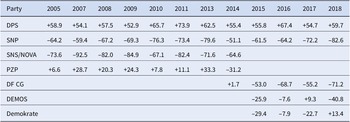
Based on previously unpublished longitudinal public opinion data, we can substantiate the connection between ethnic and political divisions in Montenegro with empirical evidence. Data is compiled from opinion polls conducted in Montenegro from 2005 onward and shows values for political parties with support above 5%.Footnote 6 The opinion polls allow us to illustrate the difference in support for the main political parties based on the respondents’ ethnicity. The values in Table 5 are calculated as the difference in support between Montenegrin and Serb voters for each political party.Footnote 7 The higher the absolute value, the more voters identify a party as representing their ethnic group. In the six instances where the absolute value is smaller than 10.0, we conclude that parties had equal support from both groups. The data indicates an electorate highly polarized along the ethnic cleavage.
Difference in Ethnic Party Support in Montenegro: Montenegrin (+) vs. Serb (–)

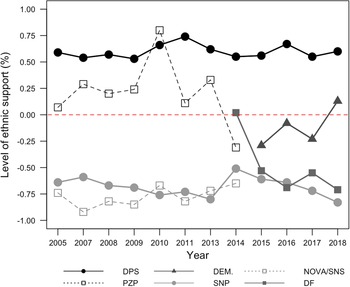
The scale and persistence of ethnic support becomes even more evident when we plot out data from Table 5, where “+1.00” indicates party support from self-declared Montenegrins and “–1.00” support from self-declared Serbs (Figure 3). The graph illustrates the political cleavage between the two camps. It also shows instances when smaller or emerging parties tried to position themselves across the cleavage. Often such parties were squeezed out of the center by large ethnic parties dominating either side of the gap, effectively pushing or pulling the non-ethnic party towards either ethnic block. The data in Table 5 can help us identify breaking points when emerging opposition parties had to choose sides. Having in mind Montenegrin “situational nationalism” and the overall instability of cleavages in post-communist societies, one could expect that parties would be able to establish themselves within a non-ethnic center. However, such positioning was only temporary.
Differences in Ethnic Party Support in Montenegro (2005–2018)

Measuring Party Dynamics Through Electoral Volatility in Bosnia and Herzegovina and Montenegro
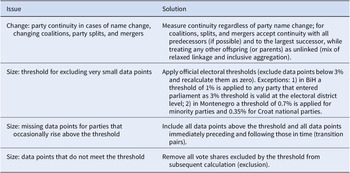
Electoral volatility is one of the most frequently used measures for assessing stability and change in party systems and is expressed through the Pedersen index. As mentioned previously, the measure of total volatility (TV) conceals volatility among party sub-systems (block volatility, BV) or volatility within party sub-systems (within-block volatility, WBV). We use all three measures, TV, BV, and WBV, to capture and compare party system dynamics on the level of the whole party system and within sub-systems formed around ethnic cleavages in BiH and Montenegro. When operationalizing volatility measures, we follow principles set out in Casal Bértoa, Deegan-Krause, and Haughton (Reference Bértoa, Fernando and Haughton2017), but adapt them to the specific circumstances of the two cases (Table 6).
Principles for Calculating Volatility

Total volatility for BiH and Montenegro is presented in Table 7, starting with the first post-independence elections in each country (1996 for BiH and the 2006 post-referendum elections for Montenegro). Overall, there is significant total volatility with every election scoring above 15 points, but this can be considered as average compared to most post-communist democracies (Casal Bértoa, Deegan-Krause, and Haughton Reference Bértoa, Fernando and Haughton2017, 144).
Total Volatility for Elections in BiH and Montenegro

In order to more thoroughly grasp types of electoral movement that occur within and between groups in the population, we look at BV which captures inter-block electoral shifts to assess whether volatility mainly occurs within ethnic segments, not between them. We aggregate electoral results of two or more parties that share a “common property” into blocks and the total net electoral change is calculated between these groups of parties (Bartolini and Mair Reference Bartolini and Mair1990, 22). WBV represents the remaining part of TV that indicates intra-block electoral change among parties belonging to the same group.
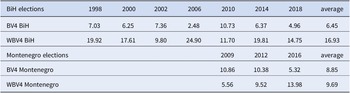
To calculate BV and WBW for the two cases, we group political parties and coalitions into blocks along the primary ethnic cleavage. In the case of BiH these four blocks are Bosniak, Croat, Serb, and non-ethnic/multiethnic. In the Montenegrin case, the situation is less straightforward, but we are able to identify four blocks based on data presented in Table 5: Montenegrin/pro-independence, Serb/pro-union, Minority parties and coalitions, and Non-ethnic/neutral parties that tried to bridge the main ethnic gap in a given election cycle. All parties that contested parliamentary elections are identified as belonging to a block according to previously identified indicators (Chandra Reference Chandra2011). This gives us the measures BV4 and WBV4 (Table 8).
BV4 and WBV4 in BiH and Montenegro

Note: BV4 and WBV4 measure volatility with four distinct subsystems.
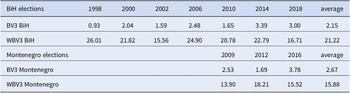
As an additional test of the impact of ethnicity on party system stability we calculate BV and WBV for three blocks of parties where we collapse the non-ethnic block of parties with an ethnic block where there is a large overlap of voter support. In BiH we merge the Bosniak and non-ethnic blocks. In Montenegro we merge the Montenegrin and non-ethnic blocks for the first two election cycles, and the Serb and non-ethnic blocks for the 2016 elections as the non-ethnic center of the electoral arena shifted. This gives us measures BV3 and WBV3 (Table 9).
BV3 and WBV3 in BiH and Montenegro

Note: BV3 and WBV3 measure volatility with three subsystems.
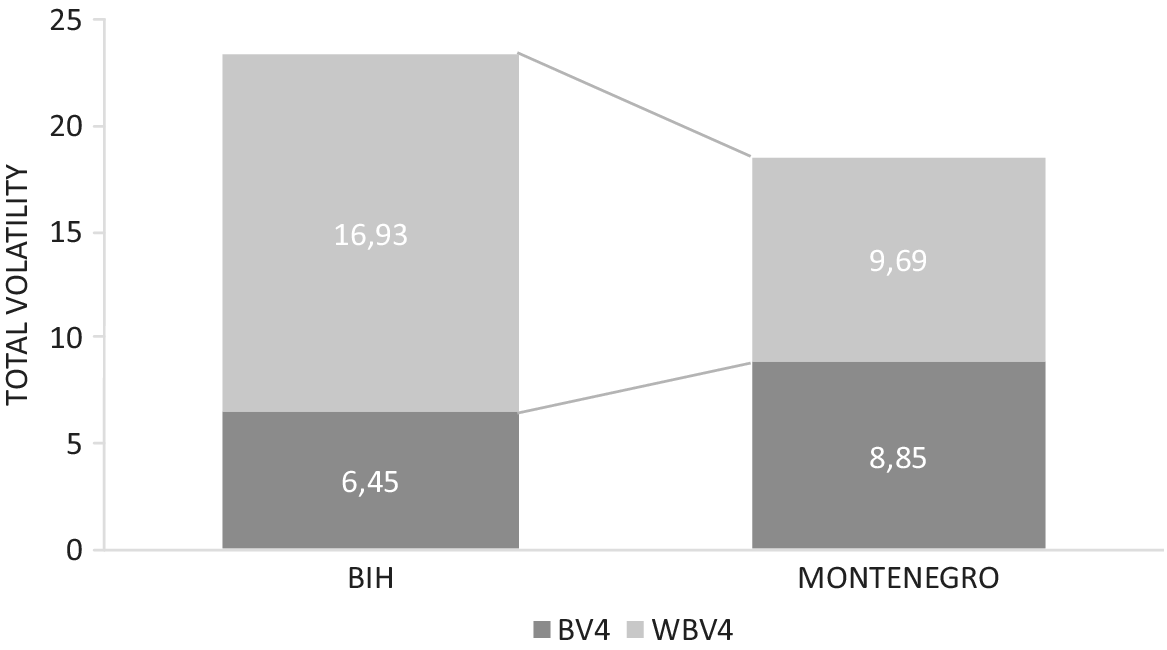
What we first notice is that TV in both countries is relatively high at around 20%, with the value in BiH an average of 4.84 points higher than in Montenegro, but also that there is a relative longitudinal consistence in volatility levels (Table 7). Both values, although high in comparison to Western Europe, are in the lower average for Eastern Europe (Enyedi and Casal Bértoa Reference Enyedi and Bértoa2018). This indicates some form of instability in the two country’s party systems, but also that this instability is consistent through time. Looking into the relation between TV and BV we notice that most of volatility is not explained by movement of voter support between party blocks, although there are noticeable differences between the two countries. If we divide the party landscape into four blocks based on ethnic cleavages, the average of BV4 drops to 6.45 in BiH and 8.85 in Montenegro (Table 8). In BiH BV4 accounts for only 27.6% of TV, while in Montenegro BV4 accounts for 47.7% of TV. If we consider parties as belonging to three blocks, we end up with BV3 averages of 2.15 and 2.67 in BiH and Montenegro, respectively (Table 9). These values indicate a closure of ethnic cleavage lines in both countries, more in BiH than in Montenegro and particularly between Bosniaks, Croats, and Serbs in BiH and between Montenegrins and Serbs in Montenegro.
As BV decreases, so does WBV increase, with the difference being much more pronounced in BiH than in Montenegro. We can therefore see more voter movement between parties belonging to the same ethnic block. While TV almost evenly split between BV4 and WBV4 in Montenegro, it is largely contained as WBV4 in BiH. To illustrate we calculate the difference of average WBV over BV between BiH and Montenegro, for three and four blocks of parties (Table 10). The more stable ethnic cleavages in BiH are able to contain volatility better within ethnic blocks, by an average of 9.64 points for W/BV4, than the more malleable ethnic identity in Montenegro. While firm ethnic identity closes electoral competition into electoral blocks, leading to closure and large WBV, a malleable ethnic identity results in partial closure and more equal volatility within and between blocks. This is illustrated by the relation of BV versus WBV as part of total volatility in Figure 4.
Difference of Average WBV over BV between BiH and Montenegro

Note: the value is calculated as average WBV minus average BV; the difference is calculated as W/BV for BiH minus W/BV for Montenegro
Relation of BV and WBV as Part of TV (averages) in BiH and Montenegro

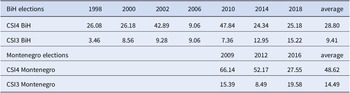
As a final measure we calculate cleavage salience with values ranging from 0 to 100. Low CSI values show smaller volatility across the cleavage, where the cleavage is more salient in relation to total electoral change in the system. This can be indicative of closure along the identified cleavage. The opposite is true for high CSI values. The values for CSI, both for four blocks (CSI4) and three blocks (CSI3) identified along the ethnic cleavages in BiH and Montenegro, are given for each country in Table 11.
Cleavage Salience Index for BiH and Montenegro

Note: cleavage salience with three subsystems in Montenegro (CSI3) was calculated as above.
Cleavage salience differs between cases and confirms the previous observation on stability of identity and relation of WBV as part of total volatility. It is also very much affected by whether we consider the cases to have three- or four-party subsystems. In BiH the ethnic cleavage is very salient in any regard as there is little electoral interchange between ethnic party blocks. Especially the cleavage dividing Croat parties from Serb parties from the combined block of Bosniak and non-ethnic parties are indicative of a full cleavage and closure. Although the BiH party system seems unstable, this instability is contained within ethnic blocks that make electoral competition more predictable, resulting in a semi-stable party system. In Montenegro the CSI values are not as straightforward. While the ethnic cleavage is very relevant, it accounts for only roughly half of electoral interchange with four party blocks. If we collapse the non-ethnic center of the Montenegrin electoral arena by ascribing it to either the Montenegrin or Serb block, the cleavage becomes more salient, but the non-ethnic center is still shifting as happened between 2012 and 2016. This is indicative of a partial closure and an electoral struggle against non-ethnic parties that defines the malleability of the semi-unstable party system in Montenegro.
Discussion and Conclusion: The Stability of Centrifugal Electoral Competition in Ethnically Divided Societies
Party systems in multiethnic Southeast Europe do not readily fit into existing descriptions of party competition in East or West Europe. In this article we introduced a model for empirically assessing the impact of ethnicity on party system stability using electoral data. Identity based on ethnic differences has coalesced into a full cleavage with closure in BiH and partial closure in Montenegro. This creates similar but diverse forms of predictable electoral competition in the two countries. Both cases can be described as having ethnically segmented party systems where electoral competition is concentrated among parties belonging to the same blocks. While total volatility in BiH and Montenegro remains moderately high compared to other European countries, the volatility between the blocks is low. We identify that most of volatility is “hidden” within the ethnically defined blocks of parties. This indicates an unstable party system but also some degree of closure along cleavage lines (Bartolini and Mair Reference Bartolini and Mair1990).
We have shown that firm ethnic identity and closure along ethnic cleavage lines can stabilize party systems and their subsystems even if total volatility remains high. Malleable ethnic identity and partial closure, on the other hand, allow for more open party competition within certain ethnic bounds. The difference between firm ethnic identity in BiH and malleable identity in Montenegro points to the effect of cleavage rigidity in creating and upholding ethnic party subsystems. Closure along the cleavage in BiH, measured through a low level of ethnic identity volatility (6.64), makes it almost impossible for parties to compete for votes across the electorate. The average values of high TV (23.38), very low BV (6.45 for BV4), large difference of WBV over BV (10.48 for W/BV4) and low CSI (28.80 for CSI4) confirm that electoral competition is essentially constrained among parties representing the same ethnic group. In Montenegro the effect of ethnicity is weaker, as ethnic identity volatility is much higher (21.14) and forms a partial closure. The average values of medium-high TV (18.54), medium-low BV (8.85 for BV4), no difference of WBV over BV (0.84 for W/BV4) and higher CSI (48.62 for CSI4) show that the weaker cleavage allows for more electoral movement between party subsystems. In both cases, the subsystem experiencing most instability is the non-ethnic one.
The stability of religious identity in BiH has created a system with significant social and economic constraints to voter movement in comparison to the malleable Montenegrin cleavage with situational fluidity between Montenegrin and Serb identities that are both Christian Orthodox (Dzankic Reference Dzankic2013). BiH parties identifying with either ethno-religious block purposefully limit supportive policies to voters of their own group, backed by strong institutionalization of ethnicity in the BiH political system through electoral institutions and consociational democracy. This severely limits the popular appeal of non-ethnic parties. Distribution of power and resources is contingent on voters’ ethnic identities, which creates a negative form of stability built on exclusionary policies, much in line with the arguments of ethnic attractors and group politics (Horowitz Reference Horowitz1985; Birnir Reference Birnir2007). In Montenegro, the political space created as a result of malleable identities allows for more dynamism as it incentivizes emerging parties to try and fill the void between the two groups. In turn, this provokes a reaction of core Montenegrin and Serb political parties that work to prevent that from happening. Whenever a political party positions itself as non-ethnic, it becomes the target of both Montenegrin and Serb parties forcing it to identify with either group.
The arena within which non-ethnic parties can compete is limited in both cases. Yet, the difference in firm and malleable identity defines two models of how non-ethnic parties contribute to party system (in)stability. In BiH the difference between BV, WBV, and CSI with three and four subsystems indicates that the only partially open cleavage is between blocks of Bosniak and non-ethnic parties. This explains the difficulties that non-ethnic SDP BIH and DF BIH experience when attempting to represent Croat or Serb interests and gain broad electoral support. For example, every time a Croat representative from DF BIH was elected to the BiH Presidency, he was disputed by all major parties of the Croat block. At the same time, Bosniak candidates from SDP BIH faced no problem of being accepted as representatives of that group. As they are not in direct competition for Serb or Croat votes, non-ethnic parties in BiH are accepted as having an electorate that overlaps with the Bosniak party subsystem, thus contributing to the stability of the segmented party system. In Montenegro, the identity cleavage is artificially preserved to safeguard electoral interests within the Montenegrin and Serb blocks instead of being open and allowing non-ethnic parties to emerge. This is seen in the differences between BV and WBV with three and four subsystems, as well as in shifts of non-ethnic support within the electoral arena. A recent example is the Demokrate party that split from the conservative SNP in 2014 and gained votes by stressing issue-based politics. The core ethnic parties (DPS and DF CG) pushed it to align with an ethnic block by associating Demokrate’s position towards several divisive issues, such as NATO membership. By stressing divisive issues and promoting centrifugal electoral competition, Montenegro’s core ethnic parties have created a systemic disadvantage for non-ethnic or neutral political parties, contributing to more instability within the party system. During peer review of this article, parliamentary elections were held in Montenegro in August 2020. A new attempt to “bridge the ethnic gap” was made by the party United Reform Action (URA), which can be perceived as neutral or non-ethnic. Following elections, URA decided to enter into a coalition with several parties that represent the Serb side of the cleavage, with the aim to end thirty years of consecutive rule by the DPS. The reaction from Montenegrin and several minority parties was harsh, accusing URA of crossing to the Serb side and labeling its leader as a traitor. The impact of this development on the future ethnic appeal of URA remains to be explored.
Our research has several theoretical implications. First, we confirm that Bartolini and Mair’s (Reference Bartolini and Mair1990) approach to calculating change in party systems by disaggregating volatility into its components is still valuable and helps us to understand party systems in divided societies. Total volatility is not a valid measure of party system stability in countries marked by strong descriptive (ethnic) representation. On the other hand, measures of block volatility and within block volatility allow for more precise analysis of such party systems, where some are more closed than others. The results of our analysis support the argument of party system stability based on cleavages in Southeast Europe (Kitschelt et al. Reference Kitschelt, Mansfeldova, Markowski and Tóka1999), but with inherent instability on a subsystem, party-based level (Mair Reference Mair1997). Countries marked by societal divisions where parties form around ethnic cleavages predominantly end up with segmented party systems. While this increases predictability of electoral competition it does not lower instability within the ethnic party blocks. Second, we find that firm ethnic identities stabilize a party system at the subsystem level, while malleable ethnic identities allow for more volatility and voter movement across the electoral arena. This means that not all ethnically divided societies can be treated equally and that the effect of identity cleavage closure needs to be taken into account. Third, our research has theoretical implications for studying the role of non-ethnic parties in ethnically segmented party systems. The closure of ethnic cleavages closes off the electoral arena to non-ethnic parties, essentially forcing them to appeal to an ethnic electorate and thus undermine their non-ethnic agenda. On the other hand, malleable cleavages incentivize non-ethnic parties to appeal across the identarian divide as they can gain votes from both sides, but this often provokes a reaction by core ethnic parties that can lead to situational segmentation.
Party systems defined by ethnic cleavages are not specific to Eastern Europe and this research gives us a theoretical and empirical framework for future comparative research in countries with ethnically segmented party systems. Based on new empirical evidence and employing tried and tested methods, our research contributes to a better understanding of party system dynamics in ethnically divided societies. It also advances a theoretical understanding of the impact of stable ethnic identities on different forms of electoral competition within ethnic party subsystems and between them. The research allows us to better understand the role and possibilities that non-ethnic parties and programmatic linkages can play ethnically divided societies. Finally, we expand the literature with new data on a subset of neglected post-communist countries and party systems in Southeast Europe.
Acknowledgements
An earlier version of this article was presented at the International Political Science Association—RC14 Colloquium “Diversity and Democratic Governance” in June 2019. We are grateful to Daniel Bochsler, Nemanja Batrićević, and the anonymous reviewers for their insightful comments on earlier drafts of this article.
Disclosures
Authors have nothing to disclose.