Introduction
Chronological age functions as a significant means of categorisation of one's self and of others throughout the lifecourse. This may start with a child answering an adult's question, ‘how old are you?’, and continue in various ways in our day-to-day interactions until retirement and beyond. Straightforward disclosure (Coupland, Coupland and Giles Reference Coupland, Coupland and Giles1989; Harwood Reference Harwood2007: 89) – telling one's chronological age – is but one example of the ways in which lifespan positioning surfaces in everyday interactions and our situated activities. On closer examination, our day-to-day interactions and social and visual surroundings are full of calendar and age marking, of subtle and direct age-telling, of interactional and institutional displays, and of appraisals of age, change and continuity. These may take various forms: ticking boxes on a form, conveying music or clothes preferences, conversations in everyday and institutional contexts, uses of visual imagery and cultural products, and through a range of actions and references to topics and cultural rituals that carry potential age referencing or age-appropriate meanings (e.g. Featherstone and Wernick Reference Featherstone and Wernick1995; Hockey and James Reference Hockey and James1993, Reference Hockey and James2003; Katz Reference Katz2005; Twigg Reference Twigg2007). In other words, chronological age and lifespan categories and other interactional formulations of age surface and are made relevant for and by us, implicitly or explicitly, as we position each other or describe and account for our own and others' actions in various everyday settings.
In recent decades, discursive and socio-linguistic work on age and ageing has increasingly emphasised the constitutive role of language and the interactive unfolding of lifespan positions and identities. Contributions in this field have closely analysed age in situ: as embedded in various everyday interactional, institutional or inter-generational sites (e.g. Coupland, Coupland and Grainger Reference Coupland, Coupland and Grainger1991; Coupland and Nussbaum Reference Coupland and Nussbaum1993; Coupland and Ylanne McEwen Reference Coupland and Ylanne McEwen1993; Harwood Reference Harwood2007; Hockey and James Reference Hockey and James2003; Jolanki Reference Jolanki2004; Jones Reference Jones2006; Nikander Reference Nikander2002, Reference Nikander, Hall, Juhila, Parton and Pösö2003, Reference Nikander, Holstein and Gubrium2008a; Nussbaum and Coupland Reference Nussbaum and Coupland2004). As a result, an extensive self-reflective literature has emerged that challenges and reassesses earlier assumptions about lifespan concepts, theorising and methods (e.g. Andrews Reference Andrews1999; Biggs, Lowenstein and Hendricks Reference Biggs, Lowenstein and Hendricks2003; Dannefer Reference Dannefer1989; Katz Reference Katz1996; Seltzer Reference Seltzer1992). Touched by the cultural and discursive turn, the field of ageing studies allows increasing space for qualitative, constructionist and language-centred research on age and the lifespan, and discursive research is rapidly establishing itself as a tradition in the social gerontology literature (for overviews see Coupland and Coupland Reference Coupland, Coupland, Giles and Robinson1990; Nikander Reference Nikander2002; Wood and Kroger Reference Wood and Kroger1995).
In this paper I build on this tradition, particularly on the intersection between qualitative research on ageing and discursive psychology, to explore the practices used to manage notions of personal change and continuity in the talk of Finnish baby-boomers. The focus is on the discursive action in and through which meanings of age, change and continuity emerge in interaction and on the dynamic meaning-making and the interactional goals achieved (cf. Tracy and Coupland Reference Coupland, Coupland, Giles and Robinson1990). The analysis is based on the data from interviews in Finland with 22 men and women who were around 50 years of age.
The article combines short empirical examples of interview talk about age, change and continuity with methodological and theory-oriented discussions. The first section overviews recent developments and debates in ‘discursive gerontology’ and identifies methodologies for analysing age identity from the point of view of discursive psychology (e.g. Benwell and Stokoe Reference Benwell and Stokoe2006; Nikander Reference Nikander2002, Reference Nikander, Holstein and Gubrium2008a; Potter Reference Potter, Camic, Rhodes and Yardley2003). The second section describes the interview data. The empirical analysis discusses a recurrent discursive device through which speakers, when talking about turning 50 years of age, construct provisional continuity that allows them simultaneously to acknowledge and distance themselves from factual notions of physical or psychological lifespan change. The concluding section explores the empirical, theoretical and conceptual contributions of discursive approaches in gerontology. The key argument is that the discursive analysis of age-in-interaction differs from the myopic study of ‘mere’ discursive micro strategies, and does not require adherence to radical constructionist or post-modern notions of age identity. Rather, it is claimed firstly that discursive work provides a means for empirical tests of post-modern notions of age, and secondly that analyses of age-talk in everyday and institutional settings provide an analytical and theoretical middle way between the contested macro and micro approaches in gerontology.
Age identity in interaction
Various socio-demographic categories are increasingly featured as topics of empirical research into situated discourse. As compared to research on other obligatory or intrinsic social categories like gender (e.g. Skevington and Baker Reference Skevington and Baker1989; Stokoe Reference Stokoe1998), race and national background (Rapley Reference Rapley1998; Wetherell and Potter Reference Wetherell and Potter1992), that on age and ageing has been slow to adopt language-centred, discursive or interactional approaches. Rather, the tendency to treat chronological age as an empty background variable (Fry Reference Fry and Settersten2003: 274; Holstein Reference Holstein1990: 113) has led research to reduce people into reactive agents; into bearers of a particular ‘social fact’ called age, the effects of which are then operationalised, observed or measured. As a result, most social scientific research on age has for long been marked by ‘theoretical and analytic a priorism’ (Nikander Reference Nikander2002: 29). Thus, studies of age identity have overlooked the significance of age to most people, and the central importance of individual's own active meaning-making and language use. They have also failed to detail the interactional processes whereby positive and negative cultural meanings of age are mobilised in the multitude of immediate local contexts that make up the everyday (for review discussions seeMurphy and Longino Reference Murphy and Longino1992; Nikander Reference Nikander2002). This oversight, as well as the ideal of age identity measurement, is apparent in the following extract from an article on ‘Age identification’ in The Encyclopedia of Ageing:
Self-perceived age identification is a major component of one's self-concept over the life-course. Age identity is a personal assessment of one's relative position in an age-graded system. Operationalization of this widely used concept often takes place by means of adjective check-lists, semantic differentials, and self-selected descriptions of one's age. Multivariate analyses suggest age identity is composed of a number of sub-features (Kastenbaum et al. Reference Kastenbaum, Derbin, Sabatini and Art1972). Among these are biological and physiological, psychological, demographic, socio-economic, and social-psychological (Barak and Stern Reference Barak and Stern1986). This last measurement is usually elicited in response to some variation of the query ‘Would you describe yourself as young, middle-aged, or old?’ Occasionally, a comparative slant is put to the question: ‘Compared with others your age, would you say you are younger, about the same, or older?’ (Hendricks Reference Hendricks and Maddox1995: 34)
The more recent adoption of qualitative constructionist perspectives on age and ageing has reacted to the lack of interactional considerations in gerontology and begun to redress the earlier assumption of homogeneity (e.g. Hendricks Reference Hendricks, Biggs, Lowenstein and Hendricks2003). Instead of treating age identities as a priori, constructionist epistemology means analysing ‘how these things are produced through interaction and how they are used to make sense of experience’ (Gubrium, Holstein and Buckholdt Reference Gubrium, Holstein and Buckholdt1994: 3). Space prevents a full account of the varieties or ‘mosaic’ of social constructionism (for thorough reviews seeHolstein and Gubrium Reference Holstein and Gubrium2008; von Kondratowitz Reference von Kondratowitz, Biggs, Lowenstein and Hendricks2003). Suffice to say that its influences can be detected in studies that approach age as a historically constructed and changing concept (Covey Reference Covey1992; Kirk Reference Kirk1992), and as the backdrop for self-reflective and critical work on the production of academic knowledge about age (e.g. Burman Reference Burman1994; Hazan Reference Hazan1994; Katz Reference Katz1996; Raz Reference Raz and Denzin1995). Constructionism also functions as a theoretical springboard for empirical research that focuses on the relationship between lay and academic theorising (e.g. Gubrium and Wallace Reference Gubrium and Wallace1990), that studies situated language use like story telling (e.g. Wallace Reference Wallace1992), and that examines age in everyday settings (e.g. Gubrium, Holstein and Buckholdt Reference Gubrium, Holstein and Buckholdt1994; Kearl and Hoag Reference Kearl and Hoag1984) and institutions (e.g. Bodily Reference Bodily, Sarbin and Kitsuse1994; Grainger Reference Grainger1993; Nikander Reference Nikander, Hall, Juhila, Parton and Pösö2003, Reference Nikander, Hepburn and Wiggins2007). In sum, social constructionism has clearly provided a solid basis for rethinking the tired assumptions of lifespan studies. It has challenged the notion that ageing is the same for all people, at all times and in all situations (Wallace Reference Wallace1992; see alsoKaufman Reference Kaufman1994), and recast ageing as a topic to be studied as an interactional, situational and social process (e.g. Bytheway Reference Bytheway, Jamieson, Harper and Victor1997; Nikander Reference Nikander, Holstein and Gubrium2008a). At the same time, the analytical focus has moved towards the ways in which age is established in everyday descriptive and textual practices, and towards the detailed analysis of discursive action.
The substantial theoretical and methodological contribution to the study of ageing, change and identity, pertinent to the analytic examples that follow, originated in discursive psychology (e.g. Potter Reference Potter, Camic, Rhodes and Yardley2003; Potter and Wetherell Reference Potter and Wetherell1987). The wealth and analytic strength of research in this field has been demonstrated by the way it continues to generate discussion across disciplinary boundaries (e.g. Hepburn and Wiggins Reference Hepburn and Wiggins2007), and by the increasing adoption of its methodological tools in cognate disciplines. In the field of discursive psychology, identity, along with other traditional psychological concepts and phenomena like attitudes, emotions or mental states, are reassessed as part and parcel of the inter-personal give-and-take in (inter)action (e.g. Antaki and Widdicombe Reference Antaki and Widdicombe1998; Benwell and Stokoe Reference Benwell and Stokoe2006; Nikander Reference Nikander, Hepburn and Wiggins2007; Shotter and Gergen Reference Shotter and Gergen1989). The focus of attention in empirical, discursive analysis shifts from internal psychic or cognitive structures to the relational, interactional and cultural processes between people, i.e. to the action orientation of talk-in-interaction. Rigorous analysis of people's situated discursive action is given central stage, which means that instead of assuming a priori that age categories are salient, the researcher's task is to look for the ways in which the participants use identity as a discursive resource, and for how various contradictory versions and meanings of age are constructed in talk and text.
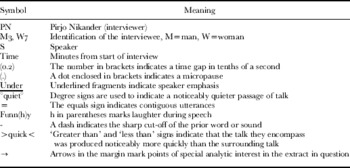
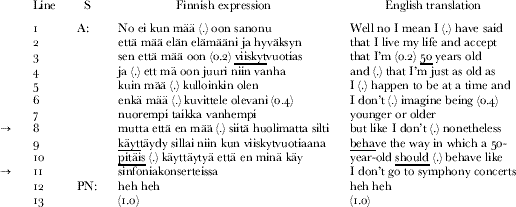
The discursive starting point for the analysis of identity has been defined by Benwell and Stokoe (Reference Benwell and Stokoe2006: 4) as, ‘who we are to each other, then, is accomplished, disputed, ascribed, resisted, managed and negotiated in discourse’. This is exemplified in the first interview extract below. The data extracts are presented in a two-column format that preserves the original Finnish alongside the translation into English, and the transcription conventions are set out in Table 1.Footnote 1 In the extract, the interviewee Anton (A) has just been describing the 50th birthday party he organised for himself, and the various points of view that people seem to have towards their own ageing. Following the interviewer's (PN) question, ‘Well what's your view on that then?’ he said:
Transcription symbols used in the extracts

PN: M2: Anton (29.7–30.1).
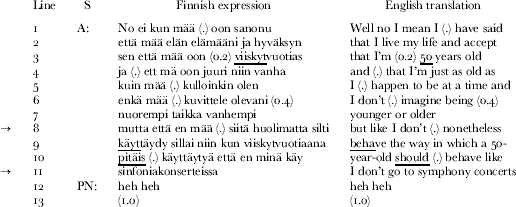
The extract exemplifies the fact that identity-work, as some call it, never happens in a vacuum. Instead, in the case of the interviews about reaching 50 years of age, the speakers entered a discursive or argumentative space with shared cultural resources for defining and intelligibly talking about age. Rhetoric and justification are central incumbents of that space, as speakers engage in active sense-making or mundane theory construction on the implications of chronological age. Dialogic arguments and counter-arguments – various discursive practices for manoeuvring within the theme – are in other words an inescapable part of the rhetorical work. Looking at the example above and putting it broadly, we see that a shared argumentative space emerges between the participants, comprised of various potential models and cultural scripts of being 50 and of age-bound activities, preferences and characteristics that interlock with those scripts and models. Accepting one's ageing process without delusions of being any younger is mentioned, while the speaker makes clear that such acceptance does not necessarily entail conforming to culturally-stereotypical actions or implications tied to a particular chronological age category. Instead, certain behaviours and tastes are rendered ridiculous or laughable in co-operation with the interviewer. Interview talk, alongside any situated interaction, thus builds on and endlessly reshuffles culturally available images of ageing.
Data and analytic process
There is a wealth of discursive research on the situated accomplishments of identity categories like gender (e.g. Stokoe Reference Stokoe1998; Wetherall Reference Wetherall2002), sexuality (e.g. Watson and Weinberg Reference Watson and Weinberg1982), nationality and ethnicity (Joseph Reference Joseph2004; Rapley Reference Rapley1998). As mentioned above, the growing literature on age identity and age-in-interaction displays disparate analytic perspectives and is from diverse empirical settings. Here the examined talk was generated in one-on-one interview conversations on the topics of age, ageing and turning 50. Birthdays make relevant certain culturally-defined means of acknowledging or marking lifetime achievements and stereotypical group qualities of individuals (cf. Bytheway Reference Bytheway2005, Reference Bytheway2009). In the western world, decade boundaries, such as turning 20, 40, 50 or 60 years-of-age, are special milestones that require and deserve special interactional marking (cf. Coupland Reference Coupland2009). This may be particularly the case in Finland where turning 50 is culturally marked, as in major newspapers by birthday interviews with celebrities and key players in finance, politics and academia. Turning 50 as a transition – a rite de passage – is in other words surrounded by culturally-mediated images of lifespan achievement, as well as change and continuity. The data thus also function as an empirical window on to changing and contradictory meanings, norms and moralities concerning specific lifespan positions (Nikander Reference Nikander2000).
The data extracts discussed below are from an 850-page corpus of conversational interviews conducted with 22 Finnish men and women close to their 50th birthday. The interviewees were asked questions on how they viewed ageing in sessions that generally lasted from one to two hours. The interviews were structured in the sense that the same set of questions were the starting point. The data consist of conversational talk during which age was raised as a topic of discussion by the interviewer, and the participants' accounts were recipient-designed for the specific context. This means that the data are not ‘naturally occurring’ but rather ‘researcher-provoked’ talk (on ‘natural’ as against ‘contrived’ data, seeSpeer Reference Speer, Bickman, Brannen and Alasuutari2008; Nikander Reference Nikander, Holstein and Gubrium2008a). In their talk, the interviewees displayed cultural common knowledge about age, theorised about and organised stage-of-life categories, and characterised their own actions and characteristics relative to these. The data have been analysed elsewhere using ‘membership categorisation analysis’ (e.g. Nikander Reference Nikander2000, Reference Nikander2002). The analysis below, however, focuses more narrowly on one recurrent discursive device through which notions of lifespan change and continuity were constructed and actively managed by speakers. Analytic observations are made on how bodily or psychological change and their cultural meanings were discursively worked up in and through interaction.
Doing provisional continuity
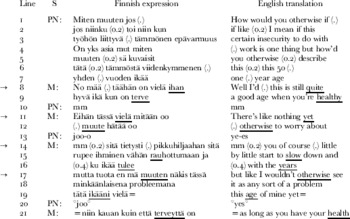
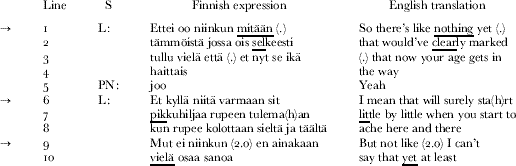
As one might expect, the data set is replete with references to lifespan change, continuity, transitions and potential crises, and to the cultural and personal meanings that the speakers attached to them. The data were first read and coded, and then in line with the analytic procedures of discursive analysis, recurrent patterns of talk were identified and collected for further analysis. Wood and Kroger (Reference Wood and Kroger2000: 117) discussed the distinction between synchronic (used by a particular participant) and diachronic (recurrent in the turn-taking of participants) discourse patterns: these may be found across participants, within or across sections and occasions and so on. Detailed immersion in the data identified a particular recurrent diachronic discursive structure that the speakers used to manage the notion of change as a common fact of human ageing. It was evident, for example, in the following exchange between the interviewer (PN), and a male interviewee Mikael (M). We join the interaction at a point where Mikael's descriptions of his feelings about age and working life are followed by the interviewer's request to elaborate.
PN: M4: Mikael (3.2–3.9).

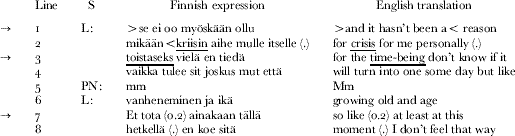
It is particularly interesting in this extract to note the use of temporal markers like still (Lines 8–9: ‘This is still quite a good age when you're healthy’) (Schiffrin Reference Schiffrin1987). The speaker presents his situation and health as transitory, as open to future change. In other words, the interviewee can be heard rehearsing and pointing to possible problems that increasing age normally brings, but simultaneously underlined that he himself did not yet need to worry about such changes. In Lines 14–16, the speaker further acknowledged the notion that changes are an inevitable part of life (‘you of course (.) little by little start to slow down and (0.4) with the years’), but stated that he himself had not yet experienced any significant change (Lines 17–19). Note the way in which the use of temporal markers like ‘still’, and especially the reiteration of ‘yet’ on Lines 11 and 19, simultaneously acknowledge the probability and factuality of change and place it outside the immediate experience of the speaker. The possibility and factuality of change with age are treated similarly in the next extract, in which Leena described ageing through the notion of crisis. It is from a long monologue that circled around issues of continuity and change.
PN: W12: Leena (3.6–4.6).
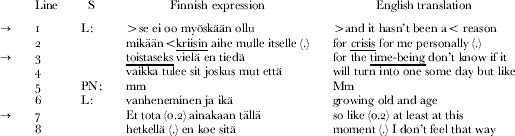
As with the first extract, temporal markers were used when talking about change. This time, however, having ‘a crisis’ was described as probable with greater age but also as something that the speaker had not yet experienced. Leena acknowledged that she might later have a crisis (Lines 3–4: ‘for the time-being don't know if it will turn into one some day), and then she re-stated that it was not the case ‘at this moment’ (Lines 7–8). As a general observation on these two sequences, one might say that the respondents invoked and made reference to future change and to the possible problems that come with increased age, such as physical ill-health (Extract 2) or a psychological crisis (Extract 3). In other words, the participants made it clear that they understood that ageing can bring change, but while acknowledging this possibility the participants simultaneously distanced their present selves from the prospect (cf. Baker Reference Baker1984). The final extract has noticeable similarities with the two already examined. Shortly before the reproduced expressions began, the speaker, Laura (L), had been listing items in her life that supported the feeling of continuity. She then summed up as follows.
PN: W1: Laura (10.3–10.4).
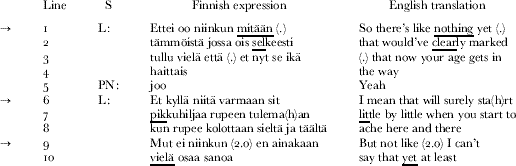
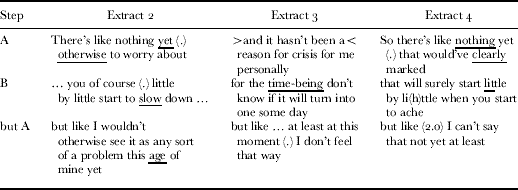
The intriguing commonality in the arguments made in these three extracts is that notions of continuity (in the present day) and of possible future change and decrement were built up using a three-step ‘A, B, but A’ formulation that can be called a ‘provisional continuity device’. At the first step, the significance of ageing to one's personal identity is downplayed, often by using an extreme case formulation of the type, ‘nothing has changed’ (Pomerantz Reference Pomerantz1986). The second step typically has an element that softens the implications of the previous claim by acknowledging either the impending possibility of change or that some change has happened. The third step reiterates the initial claim. The phrases that conveyed the successive senses of the three steps in Extracts 3, 4 and 5 are specified in Table 2.
The A, B, but A formulation of provisional continuity by three interviewees
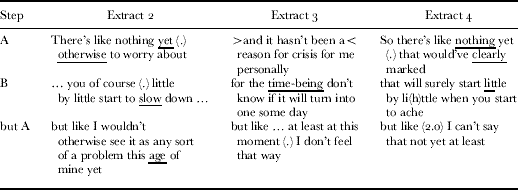
Note: For the sense conveyed at each step, see text.
Note how the second step B establishes that the speaker is aware of the inevitability of change, and typically includes such tokens of acknowledgement as ‘of course’ (Extract 2) and ‘surely’ (Extract 4) that admit that ageing brings change. The first and third steps, on the other hand, typically include both temporal markers and formulations that echo each other, as with ‘yet–yet’ (Extracts 2 and 4). What makes the provisional continuity device so intriguing is that it simultaneously establishes that the speaker is rational, in being aware of the pertinent ‘facts of life’ and not attempting to deny them. Change is brought into the biographical agenda but placed, at least provisionally, outside the immediate experience and identity of the speaker. This makes the device an excellent tool for the discursive management of age as an inevitable, yearly-upgraded de facto indicator of our identity (cf. Bytheway Reference Bytheway2009).
So what?
What has been learned from the close analysis of age-salient talk and the identification of discursive patterns like the one presented above? To what extent is it possible to claim that such patterns are a free-standing device or a typical feature of all talk about age and change more generally? It might perhaps be claimed that we are dealing with a discursive format that reflects the constraints and orientations to recipiency, and that the device simply manages the interviewee's accountability in the specific situation of being interviewed. Among the baby-boom study participants, the provisional continuity device was frequently used in their self-descriptions, but other data are required to establish that it is a general feature of identity talk. As a start, an extract of Widdicombe and Wooffitt's (Reference Widdicombe and Wooffitt1995: 168) data from their study of youth subcultures is of interest. The exchange was between an interviewer (I) and R who identified himself as a punk rocker.
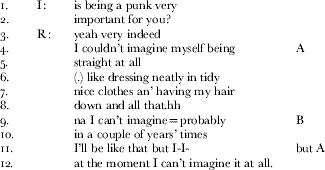
In this extract, the speaker's self-description unfolds very similarly to the pattern used by the baby-boomers. This time the A, B, but A provisional continuity device is used in describing a personal style of dressing and other aspects of self-presentation that are open to change in the future but that nonetheless remain unchanged in the present day. Analysis of other talk across situations may well yield examples of similar discursive patterns.
A more crucial analytic point remains to be made: despite the shortness of the presented extracts and the limited analysis, we can begin to see some of the specific features and dynamics of age as a membership category. As a chronological and numerical category, age readily places cultural and factual constraints on us, and these also come into play and are visible in people's ways of accounting for their ageing and age identity. A further point that cannot be elaborated here is that talk about age and the lifespan also provides a showcase for the analysis of cultural imperatives and moral meanings of age-appropriateness and how these are brought to life in and through interaction (seeJolanki Reference Jolanki2004; Nikander Reference Nikander2000, Reference Nikander2002). The brief examples illustrate some of the features of the rhetorical balancing act that seems to characterise talk about ageing, change and continuity. The analysis has also shown that the factual, numerical nature of age does not exert an all-encompassing power over individuals. Instead, participants were able simultaneously to acknowledge factual notions of change and to downgrade their personal significance. One might claim that the provisional continuity device functions as a discursive device for by-passing corporeal facts and ageist, delimiting notions of lifespan change, similar to the strategy described by Zygmunt Bauman (Reference Bauman1992) with which people in modern western societies bypass notions of death. Change with age is depicted as forever impending, as something others experience and have to cope with, while the speakers skilfully remove its effects from their immediate personal here-and-now.
Microfication or methodological middle ground?
Theoretical debates in gerontology have recently taken place between proponents of macro social theories and those who subscribe to the post-modern or cultural gerontology paradigm. A parallel ongoing discussion concerns the increasing microfication of social research of ageing. According to Hagestad and Dannefer (Reference Hagestad, Dannefer, Binstock and George2001: 4), microfication refers to an analytical trend that results in an over-emphasis on micro-interactions between individuals and renders macro phenomena like social institutions, cohesion, conflict, norms and values invisible. In the final section, I briefly review the complexities that both the micro versus macro and the modern versus post-modern debates bring to the study of ageing identities. Some preliminary points are made about the theoretical and methodological alliance and the distinct contributions discursive analyses can make to the wider field of gerontology.
Social theory has customarily aimed at macro-level analysis and understanding the social divisions, inequalities and oppression among older people that result from race, class and gender differences. The effects of modern capitalist systems on elderly identities have been studied in feminist gerontology (Arber and Ginn Reference Arber and Ginn1991, Reference Arber and Ginn1995) and by adopting a political economy perspective (Estes Reference Estes1979; Phillipson Reference Phillipson1998; Walker Reference Walker1981). Recently, the negative modernist grand narrative produced in this tradition has been increasingly criticised by more positive post-modern images and theories (for an overview seeBiggs, Lowenstein and Hendricks Reference Biggs, Lowenstein and Hendricks2003). Post-modernism produces cultural analyses of ageing identities and replaces the modern homogenising grand narratives on the effects of age, race and gender with an upbeat appreciation of malleability and fluidity (e.g. Featherstone and Hepworth Reference Featherstone, Hepworth, Bond and Coleman1993; Featherstone and Wernick Reference Featherstone and Wernick1995; Gilleard and Higgs Reference Gilleard and Higgs2001; Murphy and Longino Reference Murphy and Longino1997). According to these well-known conceptualisations, there is increasing similarity among age groups, as with their modes of self-presentation, fashion, leisure-time activities and consumer lifestyles. As a consequence, age is increasingly becoming a blurred genre that is blended in and by the uni-age, free-floating styles of post-modern culture. The centrality of age as a means of self-description as well as the predestined narrative of a single core-identity that travels through pre-set structures of the human life cycle are – so the argument goes – increasingly substituted by images of durée (Giddens Reference Giddens1991: 14), by the notion of new and expanding genres and individual latitude for sense-making (Gergen and Gergen Reference Gergen, Gergen, Schaie and Hendricks2000; von Kondratowitz Reference von Kondratowitz, Biggs, Lowenstein and Hendricks2003), and by ‘until-further-notice’ lifespan identities (Raz Reference Raz and Denzin1995). This post-modern flexibility could be opening doors not only for gender blending (Devor Reference Devor1989), but also for age blending.
So far, the modern versus post-modern debate seems to replicate the similarly bipolar discussion a few decades ago between activity and disengagement theories, but genuine dialogue has been rare and is difficult to achieve. It is also noteworthy that both paradigms put across arguments that are based largely on macro-level theorising. Some important headway has been made towards linking empirical analysis on individual ageing experiences and wider structural issues (e.g. Biggs, Lowenstein and Hendricks Reference Biggs, Lowenstein and Hendricks2003). One can also find encouraging examples of theoretical and empirical bridging (Hendricks Reference Hendricks, Biggs, Lowenstein and Hendricks2003; Powell and Longino Reference Powell and Longino2002). My suggestion is that discourse analysis provides one potential means of narrowing the gap between structural contexts and people's discursive agency; an analytic means of focusing on ‘how actors and contexts fuse’ (Hendricks Reference Hendricks, Biggs, Lowenstein and Hendricks2003: 80), while also providing a testing ground for post-modern ideas of the ageing experience. As already discussed, discursive analysis, at least as it is defined here, criticises a priori notions of identity, which sides it firmly with post-modernism. Constructionist epistemology, as the backdrop of discursive gerontology and the alliance with some notions of the post-modernist paradigm, does not necessarily entail subscribing to radical constructionist standpoints. Similarly, the focus on close analysis of people's accounting and situated meaning-making does not equal methodological microfication or theoretical myopia (cf. Hagestad and Dannefer Reference Hagestad, Dannefer, Binstock and George2001; Krause Reference Krause, Schaie and Hendricks2000). Instead, discursive gerontology – provided it continues to venture outside disciplinary confines and engages in fruitful theoretical and methodological dialogue and cross-fertilisation with discourse researchers in neighbouring fields – has considerable potential to provide refined, detailed and rigorous analyses and contextually-anchored understandings of age-in-interaction. Three distinct contributions resulting from discursive gerontological analysis deserve mention.
First, as many critics and commentators have noted, much of the post-modern thesis about identity thrives in theory but fitting its claims to the everyday lived ‘reality’ of people is rarely attempted (cf. Andrews Reference Andrews1999; Katz Reference Katz2005). Empirical analyses that support the idea of post-modern age are often limited in their material to cultural products, like media images, advertising or popular comic strips (e.g. Featherstone and Hepworth Reference Featherstone, Hepworth, Featherstone, Hepworth and Turner1991; Hepworth Reference Hepworth, Jamieson and Victor2002). One clear contribution from discursive gerontology is that it can function as an empirical testing ground for post-modern notions of identity. It seems plausible, for instance, that when studying actual culturally and historically-situated accounts of people in various interactional encounters, the post-modern vocabulary of uni-age remains largely theoretical and ‘far from becoming an everyday reality’ (Featherstone and Hepworth Reference Featherstone, Hepworth, Bytheway, Keil, Allatt and Bryman1989: 145). One potential task for future research on age-in-interaction is thus not only to continue the methodological refinement of our analytic tools, but also to examine further whether and to what extent the so called uni-age culture actually comes to life in people's everyday and institutional encounters.
Second, discursive gerontology provides a theoretical and analytical middle-ground in the micro–macro debate. As an analytic practice, it preserves and appreciates people's agency and active meaning-making while also laying out for view the dynamics through which cultural, ageist and moral notions on age and ageing surface in and through discourse. This middle-ground analysis argument comes close to that of Edley and Wetherell (Reference Edley and Wetherell1997), who claimed that a combination of top-down and bottom-up approaches enables us to look both at how people are effected through discourse and structures and at their active meaning and context production: the middle-ground position thus enables us to see the ways in which ‘people are simultaneously the products and the producers of discourse’ (pp. 205–6). One particularly promising area of research in this respect is the analysis of age in institutional interactions and encounters. There are already several examples of how discursive work can tap into morality or ageism-in-interaction in ways that defy conventional expectations (e.g. Coupland and Coupland Reference Coupland, Coupland and Hamilton1999; Jolanki Reference Jolanki2004). Further analysis of diverse institutional data could yield detailed and data-anchored analysis on how age, intertwined with other social categories like race and gender, surfaces as a practical means of people processing, or as criteria for prioritising or social support allocation in institutional decision-making (e.g. Nikander Reference Nikander, Hall, Juhila, Parton and Pösö2003).
The third and perhaps more demanding long-term contribution from discursive gerontology has to do with the concepts ageing that research has at its disposal. For an explanation, it is useful to look at a social category in which membership can also be taken to be obligatory – gender. Compared with discursive research on the sex–gender distinction, the social dynamics and aspects of age still remain under-researched. This is reflected in the theoretical vocabulary that is employed when talking and theorising about cultural aspects of age and sex. In the case of sex, as Fry (Reference Fry and Settersten2003: 291–2) pointed out, the concept of gender helps to broaden the scope of otherwise predominantly biologically-based connotations. Gender as a concept encapsulates individual variety and a myriad of cultural phenomena and culturally-constructed aspects of sex. It opens the door to analyses and theorising based on variety and diversity, and of situated and discursive constructions. Despite the range of analysis of social, cultural and biological aspects of human ageing, we do not yet have an analogous concept for age. Perhaps one of the long-term contributions of studying age identities and categorisations in various everyday, cultural and institutional arenas will be to help develop a similar, culturally, structurally and interactionally sensitive terminology for gerontology.
The analytic and theoretical mileage to be gained from discursive age research is thus promising. Current research continues to yield detailed information on how cultural stereotypes of age are sustained, re-negotiated, overthrown and re-instated in a myriad of everyday and institutional encounters. As a result of such efforts, pre-discursive, stable notions of age identity continue to be dismantled while also becoming increasingly enriched by analysis of the talk that takes place in a global environment populated by people in different intersectional positions. The contradictions and complexities of ageing in a globalised world continue to multiply (seePhillipson Reference Phillipson, Biggs, Lowenstein and Hendricks2003), and forging links between opposing theoretical camps in ways that elucidate the dialectic between the structural and the discursive proves an ever-more imperative task. This article is a modest attempt in this direction. Discursive gerontology, alongside other culturally and structurally-informed inquiries, however, continues to help form an empirically-grounded picture of doing age, change and continuity and to track how people themselves deal with this human condition.