INTRODUCTION
Bovine babesiosis, caused by the haemoprotozoon Babesia bovis, is a tick-transmissible disease of major economic significance for livestock in temperate and tropical regions. The principal vectors of B. bovis are ticks of the genus Rhipicephalus (Boophilus). In several countries babesiosis is controlled by vaccination with live attenuated parasites (Echaide et al. Reference Echaide, de Echaide and Gugliemone1993; Benavides et al. Reference Benavides, Vizcaino, Britto, Romero and Rubio2000; Bock and De Vos, Reference Bock and de Vos2001; de Wall and Combrick, Reference de Wall and Combrink2006; Shkap et al. Reference Shkap, de Vos, Zweygarth and Jongejan2007). Attenuated B. bovis parasites in the live vaccines establish long-lasting chronic infection in cattle, and induce strong host immunity (Bock et al. Reference Bock, Jackson, de Vos and Jorgensen2004). In general, these vaccines engender wide protective immunity against heterologous virulent field strains (Bock and de Vos, Reference Bock and de Vos2001; Bock et al. Reference Bock, Jackson, de Vos and Jorgensen2004), but differences have been found in protective capacity of the vaccines against heterogeneous mixtures of parasite subpopulations found in field isolates of naturally infected cattle (Cowman et al. Reference Cowman, Timms and Kemp1984; Dalrymple et al. Reference Dalrymple, Jorgensen, de Vos and Wright1992). The differences among the vaccine strains have been associated with the number of fast passages in splenectomized calves during the attenuation process: vaccines containing 2 parasite subpopulations – produced from low passages – were more protective than those produced from higher passages, which contained 1 parasite subpopulation (Bock et al. Reference Bock, de Vos, Lew, Kingston and Fraser1995; Bock and de Vos, Reference Bock and de Vos2001). Vaccine strains have been distinguished from field isolates by PCR assays based on variable alleles of the single-copy Bv80 and BvVA1 genes (Hines et al. Reference Hines, Palmer, Brown, McElwain, Suarez, Vidotto and Rice-Ficht1995; Lew et al. Reference Lew, Dalrymple, Jeston and Bock1997a, Jorgensen et al. Reference Jorgensen, Jeston, Bowles, Croft, Lew, Molloy and Dalgliesh1998; Bock et al. Reference Bock, Lew, Minchin, Jeston and Jorgensen2000; Wilkowsky et al. Reference Wilkowsky, Moretta, Mosqueda, Gil, Echaide, Lia, Falcon, Florin Christensen and Farber2009). An array of individual parasite populations was found in biologically cloned isolates (Rodriguez et al. Reference Rodriguez, Buening, Green and Carson1983), and additional minor populations occurred during attenuation by in vivo or in vitro passages in splenectomized calves or subcultures, respectively (Carson et al. Reference Carson, Timms, Cowman and Stewart1990; Dalrymple et al. Reference Dalrymple, Jorgensen, de Vos and Wright1993).
The present study aimed to analyse the single-copy Bv80 gene of B. bovis in 4 different populations of parasites originating from: (i) virulent field isolates; (ii) upon attenuation in splenectomized calves; (iii) in vitro-cultured and (iv) in vivo-attenuated vaccine strains used for routine field vaccination.
MATERIALS AND METHODS
Babesia bovis parasites and infection of cattle
The Animal Welfare Committee of the Kimron Veterinary Institute approved all the experiments. The animals used in the present study for infection and attenuation of strains were from Friesian dairy herds that were seronegative for Babesia, and that were maintained on a zero-grazing regime under conditions that precluded infestation with ticks.
Four field isolates designated Gon, Gaz, Gal, and KL were obtained from blood taken from beef cattle that were acutely infected when grazing in an endemic area. Of these isolates, KL was from a calf that had been vaccinated with the T-strain vaccine 3 weeks earlier. Since the number of parasites in blood of naturally infected cattle is relatively low, blood from such animals was subinoculated into naïve, splenectomized calves, to obtain a sufficient number of parasites for further studies. At a parasitaemia of 0 1–0 5%, 50 ml of blood was drawn from each animal and was either cryopreserved with 15% DMSO, or subinoculated into another splenectomized animal.
The Gon isolate was examined during attenuation at rapid passages 4, 6, and 17 in splenectomized calves, and the corresponding samples were designated Gon p4, Gon p6 and Gon p17, respectively.
Two Israeli B. bovis vaccine strains, designated T and MH, that are routinely used for field vaccination, were attenuated by passages either in vivo or in vitro (Callow et al. Reference Callow, Mellors and MacGregor1979; Mangold et al. Reference Mangold, Vanzini, Echaide, de Echaide, Volpogni and Gugliemone1996; Shkap et al. Reference Shkap, Leibovitz, Krigel, Hammerschlag, Marcovics, Fish, Molad, Savitsky and Mazuz2005).
DNA, RNA and cDNA extraction
DNA was extracted from the blood samples with the QIAamp DNA Extraction Kit (QIAGEN, Valencia, USA). Additionally, genomic DNA from an uninfected calf was processed similarly and used as a negative control. Extracted DNA was stored at –20°C pending use.
Total RNA (1 μg) from freshly obtained blood infected with the KL field strain was isolated, and preserved in Trizol (Gibco, Carlsbad, USA) according to the manufacturer's instructions. Isolated RNA was digested with DNAse I (Ambion, Austin, USA), and RT-PCR was performed with random hexamer primers for production of cDNA (SuperScript II; Promega, Madison, USA) according to the manufacturer. For the KL field strain the cDNA obtained was used for PCR amplification and cloning as described below. For the negative control RT-PCR was performed in the absence of reverse transcriptase.
PCR and RT-PCR amplification, cloning and sequence analysis of the Bv80 gene
Two sets of primers were used for PCR amplification and cloning of the variable-repeat region of the gene. The first pair of primers – BV80F and BV80R – was synthesized according to the protocol of Lew et al. (Reference Lew, Dalrymple, Jeston and Bock1997a). The second set of primers was designed for the present study according to published sequences (Accession number AY727909): the forward primer was TRf- 5′-GCC AGT TGC TGA AGA ACC AT-3′ (position 711) and the reverse primer was TRr- 5′- CGA CCA CCG TAA CAA GGT CT-3′ (complement to position 1237). Amplifications for PCR assays were performed in a final reaction volume of 50 μl containing: 100 ng of genomic DNA or 5 μl of cDNA (from the first-strand cDNA reaction performed with 1 μg of total RNA) as a template, 100 ng of each primer, 1×of PCR Takara buffer containing: 2 mm MgCl2, 0 2 mm each of deoxynucleotide triphosphate and 1 25 U of Takara Ex-Taq. The cycling protocol was: preheating at 95°C for 3 min; 35 cycles comprising denaturation at 98°C for 10 s, annealing at 62°C for 45 s for the first set of primers and 56°C for 40 s for the second set of primers, and extension at 72°C for 1 min; followed by a final extension at 72°C for 10 min.
All PCR fragments obtained after amplification of the BV80 gene, with the 2 sets of primers described above, were excised and extracted from the low-melting gels with the QIAquick Gel Extraction Kit (QIAGEN, Valencia, USA) and cloned into pGEM-T-Easy with the TA cloning kit (Promega, Madison, USA). Competent E. coli JM-109 were transformed with the ligated vector and plated with ampicillin at 100 μg ml−1, 5 mm isopropyl-1-β-D-thiogalactopyranoside (IPTG), and 5 mm 5-bromo-4-chloro-3-indolyl-β-D-galactopyranoside, for screening of blue and white colonies. The clones were screened for size differences and at least 5 clones per fragment (for each set of primers), were sequenced in both directions.
Sequence and computer analyses
Sequences were analysed with the GCG Sequence Analysis Software (Genetics Computer Group, University of Wisconsin, USA). Nucleotides and amino acids were aligned by means of the BestFit, Pileup, Fasta (GCG) and ClustalW programs.
RESULTS
Amplifications of the tandem repeats (TR) region of the Bv80 gene
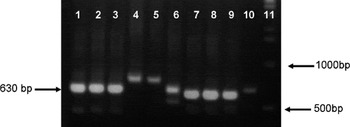
Using the previously published set of primers Bv80F and Bv80R (Lew et al. Reference Lew, Dalrymple, Jeston and Bock1997a), the Bv80 gene was amplified from B. bovis genomic DNA obtained from all studied isolates. Fragments visualized in agarose gel ranged in size between 420 and 744 bp (Fig. 1). In the vaccine T strain, originating from either calf-, or culture-derived parasites, 1 dominant band of 630 bp and 2 faint shorter bands of 550 and 480 bp were found (Fig. 1, lines 1 and 2, respectively). In the MH vaccine strain, 1 dominant fragment of 630 bp, similar to that found in the T strain, and 2 weak fragments (550 and 480 bp) were amplified from culture-derived parasites, whereas only 1 fragment of 750 bp was isolated from the MH calf-derived parasites (Fig. 1, lines 3 and 4, respectively).
PCR amplification of the Babesia bovis Bv80 gene with primers B V80 F + BV80 R. The lanes 1–11 represent: 1- T culture-derived vaccine strain; 2- T calf-derived vaccine strain; 3- MH culture-derived vaccine strain; 4- MH calf-derived vaccine strain; 5- Gal isolate; 6- Gaz isolate; 7, 8, 9- Gon isolate passages 4, 6, and 17, respectively; 10- KL isolate; 11- 1-kb ladder.

Amplification of 4 different virulent field isolates – Gal, Gaz, Gon, and KL – each yielded a dominant PCR fragment, of 740, 630, 580, and 630 bp, respectively. In these isolates several additional different, lower intensity, shorter products of about 500 bp were found (Fig. 1, lines 5–10). Upon attenuation of the field isolate Gon by passages in splenectomized calves the PCR pattern of the Bv80 gene retained stable. As shown in Fig. 1 (lines 7–9), products of the same size that were amplified came from in vivo passages 4 and 6, when parasites were virulent, and from passage 17, when the parasites had been attenuated upon inoculation into cattle. The results obtained with RT-PCR for the KL field strain did not differ from those obtained by the conventional PCR amplification (data not shown).
The patterns of fragments obtained did not change when additional sets of primers (TRf and TRr) were applied to the same samples of parasite DNA in order to exclude the possibility of artifacts or degradation in PCR reactions (data not shown).
Sequence analysis of the variable region of the Bv80 gene
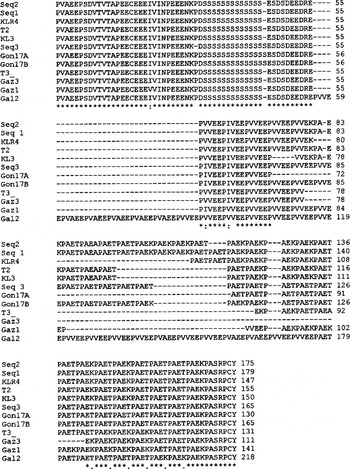
Sequence analysis of the PCR products, obtained after amplification of the BV80 gene with both sets of primers described above, revealed high diversity of the Bv80 gene in either vaccine or field strains (Fig. 2). The variable region of the gene was characterized by the presence of differing numbers of repeats that varied in composition. The number of amino acids in the repeat region ranged from 111 to 218, and this wide variability was found in sequences not only from different strains but also within the same strain.
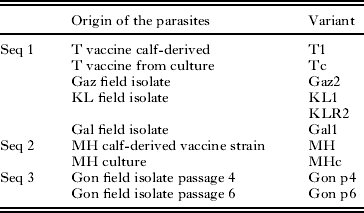
Comparison of the predicted amino acids of the BV80 variable-tandem-repeats region in vaccine T calf-derived (T1, T2, T3), T culture-derived, MH calf- and culture-derived, and field Babesia bovis isolates KL (KL1, KLR2, KL3, KLR4), Gaz (Gaz1, Gaz2, Gaz3), Gal (Gal1, Gal2) and Gon field isolate passage 4, 6, and 17 (Gon17A, Gon17B). Variants of the same isolate were numbered and identical sequences grouped into Seq1, Seq2, and Seq3 (as described in Table 2).

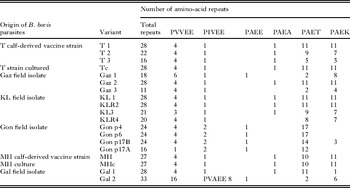
In total, 19 variants with 12 different sequences were detected in 4 vaccine and 4 field strains that were examined (Fig. 2). Thirteen serine amino acids that preceded the tandem-repeat region were detected in all isolates tested, except for the Gon field isolate, in which an additional serine amino acid was found. The repeats comprised 4 or 5 amino acids. The number of tetra-peptide repeats ranged from 6 to 23. Smaller numbers (from 3 to 7) of repeats comprising 5 amino acids were detected in all isolates, except for the only Gal field isolate (variant Gal 2), which contained 24 repeats of 5 amino acids (Table 1). Among the tetra-repeats there was a consensus of 3 amino acids: PAE and the last amino acid was either K, T, A, or E. Two principal combinations – PIVEE and PVVEE – were detected in the region containing 5 amino acid repeats. As shown in Fig. 2, the PVAEE repeat appeared only in the virulent Gal field isolate (variant Gal 2).
Variability and distribution of the amino acid repeats in the variable region encoded by Babesia bovis BV80 among isolates

The ClustalW alignment score of the deduced amino acids ranged from 63 to 100%. As shown in Table 1, in the calf-derived T vaccine, 3 variants were found (T 1-3), of which 1 (T 1) was identical to the sequence obtained from the cultured parasites (Tc). Interestingly, despite the differences found between the fragments sizes of the MH vaccine from calf and from culture, respectively, repeated sequence analyses (of at least 20 cloned fragments) revealed complete sequence identity, although no additional variants could be detected (Figs 1 and 2).
Among field isolates were examples of both differing and identical variants (Table 2). Sequence analyses of the field isolates Gaz, KL, and Gal, (variants, Gaz 2, KL1, KLR2, and Gal 1 respectively) showed 100% sequence identity with those found in variant T1 of the vaccine T strain. The Gon field isolate, which was attenuated by in vivo passages in splenectomized calves, showed complete sequence identity at the lower passages – 4 and 6 – whereas in the higher passage – 17 two new and different variants were detected (Fig. 2).
Babesia bovis Bv80 identical sequences were grouped and designated as Seq1, Seq2 and Seq3
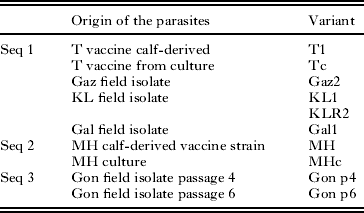
Sequence analyses of fragments obtained in PCR revealed the presence of several variants that differed in number and type of tandem repeats. As shown in Table 1, among all parasite populations examined, the total number of repeats ranged from 11 to 33. There were 3 variants in the vaccine strain (T1, T2, and T3) and in the Gaz field isolate (Gaz1, Gaz2, and Gaz3); in the KL field isolate 4 variants were found – KL1 and KL3 by PCR, and KLR2 and KLR3 by RT-PCR – of which KL1 and KLR2 had identical sequences, but KL3 and KLR4 differed in numbers of predicted amino acids (Fig. 2). The highest intra-strain diversity was observed in 2 variants of the Gal field strain: Gal 2 had a total of 33 repeats, of which 8 were exclusive (PVAEE), and 16 (PVVEE) appeared in all other variants, as many as 6 times (Table 1).
DISCUSSION
Babesia bovis strain discrimination based on analyses of the Bv80 and BvVA1 genes was reported for isolates from distinct geographical regions (Lew et al. Reference Lew, Bock, Croft, Minchin, Kingston and Dalgliesh1997b; Bock et al. Reference Bock, Lew, Minchin, Jeston and Jorgensen2000; Wilkowsky et al. Reference Wilkowsky, Moretta, Mosqueda, Gil, Echaide, Lia, Falcon, Florin Christensen and Farber2009). Three different PCR assays – BvVA1, Bv80, and RAPD – were used to detect and monitor differences in stocks of B. bovis in Australia. Both BvVA1- and Bv80-based PCR were used to distinguish genotypes of B. bovis vaccine strains from those of strains found in cattle that had been naturally exposed to the parasite. Predominant and faint bands seen in the PCR gels were associated with major or minor subpopulations of either vaccine or field virulent parasite stock (Bock et al. Reference Bock, Lew, Minchin, Jeston and Jorgensen2000). As reported, in some stocks of parasites the Bv80 PCR generated same-sized products, which required further discrimination by the BvVA1-based PCR (Lew et al. Reference Lew, Dalrymple, Jeston and Bock1997a).
In the present study, the Bv80 gene of B. bovis from the Israeli isolates was amplified, and the analysed sequences exhibited extensive inter- and intra-strain polymorphism, irrespective of whether attenuated or virulent field isolates were examined. Amplification of the single-copy Bv80 gene by PCR or RT-PCR resulted in multiple fragments, and sequence analyses showed that they represented mixed subpopulations of parasites. Extensive polymorphism of this single-copy gene was found within various isolates, with variants that differed in number and type of tandem-repeat sequences. Our findings support those of Dalrymple et al. (Reference Dalrymple, Jorgensen, de Vos and Wright1992), who showed that most samples of B. bovis taken from a single animal contained more than 1 subpopulation and that these were genetically distant from one another.
In the present study, among the 8 strains examined 12 different variants were found. The tandem-repeat region contained repeats of 4 and 5 amino acids similar to those described earlier, i.e., PAEE, PAEK, PAET, PIVEE, PVVEE, and PVAEE (Hines et al. Reference Hines, Palmer, Brown, McElwain, Suarez, Vidotto and Rice-Ficht1995; Wilkowsky et al. Reference Wilkowsky, Moretta, Mosqueda, Gil, Echaide, Lia, Falcon, Florin Christensen and Farber2009). In addition, the 4-amino-acid repeat, PAEA, was detected as a single repeat in 11 out of 19 variants; it was not described earlier in other B. bovis strains. The high polymorphism detected by the sequence analyses, on the one hand and, on the other hand, the similarity observed among different strains, difficult discrimination between virulent field isolates and attenuated – parasite strains, because no specific patterns of numbers of repeats, order, or motifs were found. In one instance, the sequence of the KL strain, obtained from a vaccinated calf that had developed an acute natural infection a few weeks after vaccination, showed 3 different variants: 1 was identical to the inoculated T vaccine strain, whereas the other 2 appeared to have been acquired from the field infection, since they differed from those in the administered T vaccine. Variation of the BV80 tandem repeats in B. bovis strains from distinct geographical areas were described previously by sequence analyses and by the use of mini- and microsatellite markers (Hines et al. Reference Hines, Palmer, Brown, McElwain, Suarez, Vidotto and Rice-Ficht1995; Perez-Llaneza et al. 2010, Wilkowsky et al. Reference Wilkowsky, Moretta, Mosqueda, Gil, Echaide, Lia, Falcon, Florin Christensen and Farber2009). High levels of variation in the repeat region were detected among 11 geographically distinct B. bovis strains, 10 alleles being identified by the Bv80 satellite marker (Wilkowsky et al. Reference Wilkowsky, Moretta, Mosqueda, Gil, Echaide, Lia, Falcon, Florin Christensen and Farber2009). In searching for virulence markers of B. bovis, expression levels of 66 peptidases were examined in virulent parent and daughter attenuated T2Bo strains using whole genome targeted sequencing and micro-array analyses (Mesplet et al. Reference Mesplet, Palmer, Pedroni, Echaide, Florin-Christensen, Schnittger and Lau2011). As there was no significant difference detected in the expression levels of the enzymes tested, the authors concluded that neither loss of peptidase genes nor reduction in gene expression upon in vivo attenuation is associated with virulence.
In the attenuated culture-derived T and MH strains, despite the presence of additional PCR fragments, which appeared along with the major fragment, cloning and sequence analyses revealed only 1 variant. The faintly presented fragments were elicited by 2 different sets of PCR primers, which were repeatedly applied to the same samples; therefore, it is unlikely that they resulted from PCR artifacts or DNA degradation. It is possible that these fragments, which could not be detected by sequencing, represent a small or negligible parasite subpopulation. It might well be possible that not all forms of the Bv80 gene were analysed. From the results obtained it appears that the different number of variants found in various strains might reflect the existence of reduced diversity in some strains since for each fragment obtained by PCR 10 clones (5 per each of 2 primer sets) were sequenced and analysed. Lew et al. (Reference Lew, Dalrymple, Jeston and Bock1997a) suggested that in BV80 amplification, the intensity of products derived from naturally mixed populations could be roughly correlated with the proportion of each subpopulation. Furthermore, Jorgensen et al. (Reference Jorgensen, Jeston, Bowles, Croft, Lew, Molloy and Dalgliesh1998) suggested that when co-infection by several different strains is present in an animal, 1 strain will be dominant, but in most cases both strains appeared to be established.
The sequence of the Bv80 gene in calf-derived T strain vaccine showed the presence of at least 3 subpopulations. According to Bock and de Vos (Reference Bock and de Vos2001), the Australian vaccine strain that contained 2 subpopulations was more protective than the same strain that comprised only 1 subpopulation, which had resulted from passages of the strain in splenectomized calves. In our study, the vaccine T strain, derived from culture, contained 1 sequenced subpopulation, whereas the calf-derived vaccine parasites comprised 3 subpopulations. In Israel, when older cattle need to be vaccinated, culture-derived avirulent parasites are used in order to mitigate their response to the subsequent inoculation of the calf-derived vaccines (Shkap et al. Reference Shkap, Leibovitz, Krigel, Hammerschlag, Marcovics, Fish, Molad, Savitsky and Mazuz2005).
Similarly to the findings of Wilkowsky et al. (Reference Wilkowsky, Moretta, Mosqueda, Gil, Echaide, Lia, Falcon, Florin Christensen and Farber2009), we found complete conservation of sequences of the Bv80 gene in the virulent Gon isolate at low in vivo passages (4 and 6). Sequence analyses at passage 17, when attenuation had been achieved, revealed 2 distinct sequences representing 2 new subpopulations, whereas those detected earlier in passages 4 and 6 were no longer detectable. Carson et al. (Reference Carson, Timms, Cowman and Stewart1990) described shifting of the proportions of B. bovis from minor to dominant subpopulations during attenuation through splenectomized calves. As shown by Lew et al. (Reference Lew, Dalrymple, Jeston and Bock1997a), the composition of parasite populations can change during in vivo or in vitro passages: in the Bv80 PCR assays a fragment found in passages 8 and 12 of the Dixie strain was not detected in passage 25.
Using pyrosequencing technology, which enables wide genome coverage, genomic analyses of 3 different B. bovis virulent and attenuated daughter strains were performed to reveal gene changes associated with the pathway to attenuation (Lau et al. Reference Lau, Kalyanaraman, Echaide, Palmer, Bock, Pedroni, Rameshkumar, Ferreira, Fletcher and McElwain2011). A high level of sequence diversity in the ves (variant erythrocyte surface antigens) multigene family was found among both the virulent and the attenuated strains, although among the attenuated parasite population there was a significant reduction in the genome diversity of 81% compared to only 60% common base pairs detected among the virulent population. Interestingly, upon SNP analyses (single nucleotide polymorphism) in 14 genes the authors found that all the attenuated parasites could be distinguished from their parent parasites, while non-synonymous changes could not be attributed to either virulence or attenuation of these parasites.
In conclusion, sequence analyses showed high variability and the presence of mixed populations, although only 1 dominant band was detected by PCR. We found that during the attenuation process in various B. bovis strains, although the same patterns of the Bv80 gene were revealed by PCR, there were changes in the composition of the parasite populations. Since genetic diversity may play an important role in the pathogenicity and subsequent epidemiological impact of babesiosis, further analyses of B. bovis populations are required in order to improve our understanding of the dynamics and the mechanisms that induce changes in the proportion of the subpopulations in vitro and in vivo.