The coronavirus disease 2019 (COVID-19) pandemic has challenged health systems globally. The lived experiences and the new knowledge generated has filled contemporary literature and reflects the substantial learning we have all experienced. In Central Adelaide Local Health Network (CALHN), we are no different. CALHN is in South Australia, with the 5th largest population in Australia (Statistics 2020). It incorporates the Royal Adelaide Hospital (RAH), a new purpose-built hospital opened in September 2017 and was the state’s designated pandemic receiving hospital for adults. This study describes our experiences and learnings from managing a campaign style, novel public health disaster response.
Disaster preparedness for CALHN has focused on acute impact, mass casualty incidents. The goal of mass casualty incident (MCI) response is considered to obtain the best possible outcome for the greatest good. Reference O’Neil1 Much of the planning effort and exercising has focused on those events considered and that would have the biggest immediate impact on service delivery. 2 CALHN, as with many health services, has a history of managing several capacity, financial, and cultural challenges that had resulted in a patchy and opportunistic disaster response capability. As with many health organizations, CALHN had a range of plans in place and a unifying framework to respond to external and internal threats or changes in demand. In practice, CALHN’s ability respond to “a sudden onset and/or acute impact incidents” Reference Al-Jazairi3 has been well tested, however, given the experience of severe acute respiratory syndrome (SARS) and H1N1 where local impact was limited, preparedness for an event that would require a campaign style response such as a pandemic remained limited. In February 2020, that all changed.
The RAH was the state’s COVID-19 adult receiving hospital as it had been designed with several pandemic features that situated the hospital to be the receiving hospital for the state. Reference Kropf and Zeitz4 Between the period of February 1, 2020, when the first COVID-19 positive patient was admitted, through to December 31, 2020, the RAH had admitted 146 inpatients with COVID-19, 118 admitted to our hospital in the home service, 18 patients admitted to Intensive Care and 4 patients died while inpatients. During this time CALHN has sustained an active (physical and virtual) Network Incident Command Centre (NICC) supported by a Network Incident Management Team (NIMT). As an NIMT, we wanted to take this opportunity to share our collective learnings in supporting a campaign disaster response over an extended period that was moderated to the clinical needs of the community.
Background
CALHN has maintained a long standing and leading role in responding to disasters in South Australia and more broadly to the Asia-Pacific region in times of need. Operationally, CALHN has specialist staff who are Australian Defence Force personnel (Specialist Reservists) or who are current Australian Medical Assistance Team (AUSMAT) trained, ready for domestic and overseas deployment. CALHN (and in particular RAH) has been at the forefront of disaster response, inclusive of some noteworthy incidents such as the 2002 Bali bombings, 2004 Indian Ocean earthquake and tsunami (Banda Aceh), and other significant bushfire-related activity. These have all been sudden-impact incidents and some with significant lead time to shape a proportionate response.
CALHN has in place a series of plans and arrangements that provide direction for governance, roles and responsibilities, mitigation, preparedness, capacity and capability creation, and management, as well as response and recovery. In addition, CALHN coordinates a training and exercise program intended to support awareness of arrangements as well as expectations of roles and responsibilities.
Disaster preparedness across CALHN sites is supported and coordinated by a Disaster Resilience Unit (DRU). CALHN has focused on the provision of Health Incident Management System (HIMS) and Hospital Major Incident Management and Medical Support (H-MIMMS) program as its core requirement for its Network (tactical level) incident management team personnel.
An early objective of the COVID-19 NIMT was “ensuring sustainability and staying agile with a proportionate capability”. Managing the COVID-19 public health emergency has been different to how other public health challenges are managed. Public health traditionally applies a system of observation, gathering of information, analysis, and comparison with other like jurisdictions to provide a considered and balanced report and recommendations on how to address any emerging public health issue. When faced with disease outbreaks, the public health response (although swift) is thoughtful, measured, and based on well-documented evidence based clinical pathways.
With COVID-19, CALHN required a quick response with little opportunity to gather data and provide in-depth analysis regarding choices. We had a knowledge baseline as how to manage infectious diseases and what good infection prevention and control looked like. We knew what was required to make the health service and community safe, and we knew how to communicate this. What we did not know was how long the pandemic would go for, the ever-changing dynamics of the situation, and the widespread anxiety and stress it would generate for our staff and the community. We implemented a process whereby international and national changes to practice could be evaluated and operationalized to reflect the dynamic evolution of response to COVID-19.
Unlike other disaster management situations, the pandemic did not have a clear end point. Unlike other disaster situations the organization had faced, it was the public health expertise, specifically infectious diseases, infection prevention and control, and clear, simple, often repeated public health messaging that was central and what led CALHN through the maze of COVID-19 pandemic management.
As time progressed, we noted key features of the threat and operating context that differed from previous disaster responses: The threat was evolving; The threat appeared to have no middle or end; Staff were at risk and could have been a threat in and of themselves; Available data were not necessarily shaped to support local decision-making; It would be impractical and undesirable to put a “hard stop” on normal service delivery; and The thirst for information was voracious, and the inability to provide certainty challenged the trust between levels of command, control, and delivery.
Although CALHN has an after-action review framework/immature lessons management process, the ongoing, protracted nature of this event proved challenging to show a sound review process and implement changes. We were fortunate that the Australian Defence Force (ADF) were deployed to support our response and were a valuable resource in various aspects of pandemic planning and response, including their assistance to support doctrine review and after-action reviews.
CALHN established early on a centralized document management system along with a supported plan register, ensuring that version and document control were tightly controlled.
All levels of CALHN staff responded to and were reassured by our strong public health presence at all levels of CALHN’s response. COVID-19 has raised the profile of public health in our service and reinforced its importance. It has now become a standard part of the CALHN IMT operations function.
Results
The following describes our key lessons learnt in relation to the management of a campaign style disaster response. The key themes included: (1) being prepared; (2) traditional command roles and how they apply in this model; (3) operating rhythm – co-stat, gate reviews; (4) building capability and fatigue management; (5) communications; (6) lessons management; and (7) exercising and education.
Being Prepared
As described earlier, CALHN had little exposure to operating under a command model for managing incidents. The experience was limited to short term, sudden-impact events including bushfire responses and capacity demand issues leading to implementing command leadership models.
The NIMT undertook an early rapid review and established the allocation of the key incident functions to individuals (Section Officers). Furthermore, where there were sub-functions identified, then specialists’ cells were established (led by Cell Leads). Cells held an advisory purpose to the command structure. This quickly identified itself as a highly effective way to move through the enormous number of inputs that needed to be considered resulting in consensus views with the most credible knowledge about the way forward while also enabling clear and concise direction from a sole source.
Developing a Recovery function was also challenging. Although it was discussed several times in the initial response, this function was never strong nor integrated in our Command model, in part due to our lack of experience in this space. There were inconsistent views as to what a recovery state looked like and when to start.
Traditional Command Roles and How They Apply in This Model
CALHN had a documented incident management framework focused on short term, sudden-impact incidents, including significant business disruptions.
Previous exercises and training had been largely centered on developing capacity and capability in managing external surge or significant business disruption incidents, all with likely shorter duration of impact and disruption time. The incident command methodology was proven in these situations. However, the campaign style, public health incident had not been well exercised at a state level (strategic), let alone at a Network level (tactical) and the early attempts to implement an incident management approach fell short in various areas.
CALHN, in the initial period, found it difficult to adapt to working within the incident management structure as the NIMT assumed increasing accountability across “standard operations” and COVID-19 response. Limitations in the internal and external planning and preparedness led to individuals mixing operational models and having differing assumptions and expectations of command arrangements. It is a credit to the team and the wider system, that a dynamic rapid improvement method was adopted building out from several “point in time” lesson management reviews. CALHN revised its enduring incident management framework to be a more contemporary, relevant, and sought to deliver some refreshed “just in time” training.
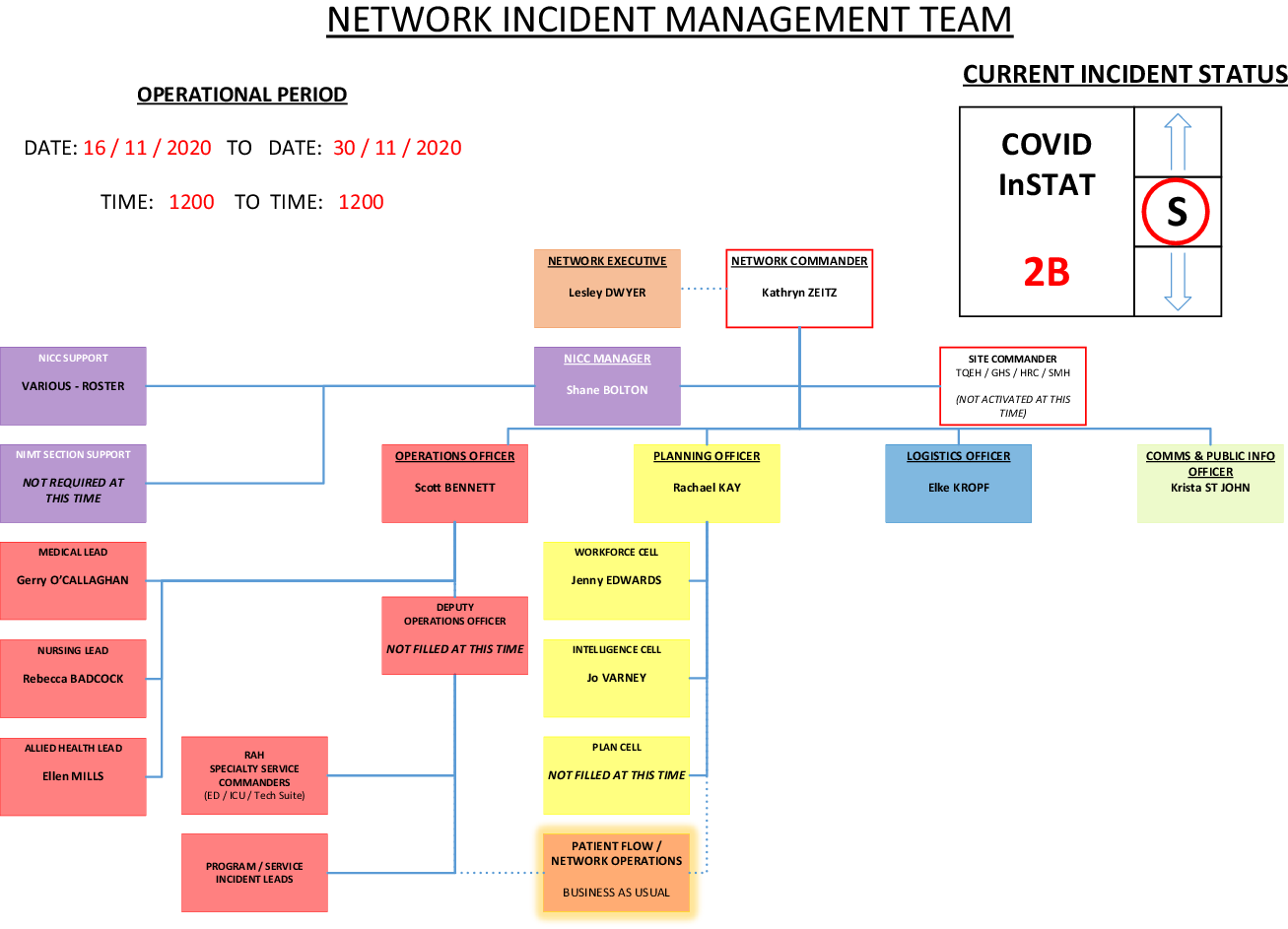
Whereas an incident command model builds on contemporary leadership and management styles, it is quite different from normal operations leadership, particularly in the health setting where operations are shaped by a mix of formal, structural positions, and clinical expertise and opinion. As has been described, leadership “should be less about domination (manifested in hierarchy and authority) and more about collaboration and building effective working relationships in a climate of open communication and trust”. Reference Owen, Scott and Adams5 It took the organization a while to settle into a structured command model as opposed to a democratic, transformational leadership style (Figure 1).
CALHN functional incident management (command) chart with personnel allocation.

Operating Rhythm – Co-Stat, Gate Reviews
It became clear early, as the threat developed, there was a need for a nuanced, proportionate, and communicable structured operational response. CALHN, with its partners needed to reshape and reprioritize its operations along a sliding scale.
It was decided early that, to enable the rapid assimilation of the COVID-19 response into the organization and partner organizations, the NIMT would build off current modes of operational escalation models. The key benefits of this were taking a rounded, matrix style view of the actual and potential impact of COVID-19 on the delivery system; supporting and simplifying the communication of COVID-19 for the organization; providing a framework to assign methods of working and decision-making that could be easily understood; and reducing the risk of cognitive dissonance across the organization between the “lived experience” in part of the systems compared with another, for example, an expanded critical care department would have significant impact on staffing and resources while total numbers may not be extraordinary.
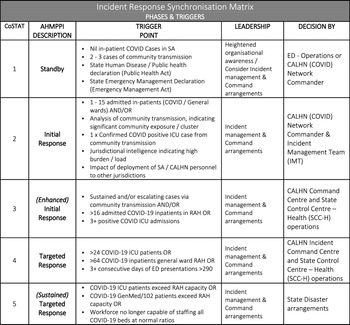
The COVID-19 Status (CoStat) was created (Figure 2), with principles and triggers assigned to support the shift between surge planning and mutual aid arrangements across the Network. Functional plans were then realigned or developed against these levels, and as the response developed. The CoStat matrix was developed in line with Australian Health Management Plan for Pandemic Influenza (AHMPPI) and local, contextualized descriptors detailing 5 stages of response: CoStat 1, Standby; CoStat 2, Initial Response; CoStat 3, Enhanced Initial Response; CoStat 4, Targeted Response; and CoStat 5, Sustained Targeted Response.
CALHN COVID-19 Status matrix (CoSTAT).

The CoStat matrix outlined and guided decision-making, and escalation based on a broad range of considerations and triggers to ensure that CALHN was suitably prepared and operating at the right operational response level in line with the pandemic.
As described earlier, a key difference in the response was the lack of a middle and an end to support decision-making. With the support of the ADF, a formal intelligence analysis process was developed and used to ensure that all decisions and operations were informed as much as possible. CALHN analyzed key factors to define a planning horizon, based on a range of scenarios from most likely to “reasonable worst case.” This system of scenario development was based on the most likely to most dangerous model used by the ADF. The time period was bounded by a “Gate Review” which provided the formal environment to review the situation, modeling (including underlying assumptions), and make recommendations.
The timing between each Gate Review was based on the following: pace of new data inputs for the modeling; result of the model scenarios including to coalescence between scenario outcomes; the ability of the organization to respond to a divergence from most likely to reasonable worst case, for example, the time it would take to shift the first ward from general use COVID-19 compared with the fourth or fifth ward.
The key output of the Gate Review process, led by the Planning Section, was the review of the current CoStat response, which was used to assess the level and make recommendations to the NIMT if a change was required. The Gate Review provided NIMT and the wider leadership team with clear current state and a future state through modeling and intelligence to review COVID-19 status to ensure an appropriate response.
The Gate Review process looked at the following areas:
-
CURRENT STATE - Situation intelligence and awareness summary
-
○ Operations (inclusive of cell reports)
-
○ lanning
-
○ Logistics
-
○ Communications and Public Information
-
○ Command Centre operations
-
-
Operating Environment
-
FUTURE STATE - Modeling and Intelligence, and
-
Recommendations
The Gate Review process proved to be a useful systematic way of assessing the situation and making decisions proportionate to the situation in a very dynamic environment. By providing a tangible planning horizon, the Gate Review structure provided certainty of strategy and tactical approach in an uncertain and shifting environment.
Building Capability and Fatigue Management
Early attempts to manage the disease exposure across IMT personnel and reduce operational fatigue through 4-d rosters were rather unsuccessful. It was initially decided that this approach would support a minimally disruptive process if staff were exposed to the COVID-19 disease and then required to quarantine. This in fact had the opposite effect quite quickly, as we saw feedback suggesting that NIMT personnel found it physically demanding and equally mentally challenging to undertake an NIMT role for 4 days, return to their substantive role before resuming NIMT responsibilities.
Additionally, following a “point in time” review, and recognizing the protracted nature of this incident, the NIMT looked to undertake active mentoring and “just in time” training of key staff to ensure that there was greater depth and capacity in the NIMT team. This also aided with information management and supported the transparency of knowledge and decision-making within the NIMT.
Initial NIMT operations were based around a face-to-face, tactical command center model; however, as the IMT matured, operations shifted to a greater use of virtual platforms to support IMT activity.
As the operational requirement changed (reduced) in tempo, so did the ability to ensure that NIMT personnel were effectively scaled back from their core NIMT responsibilities and could return focus to their substantive roles.
Communications
It is well recognized the importance of effective and prompt crisis communication in any incident response. Reference Ryan6 It is so important that a communications function is usually a key function in incident management teams. The NIMT (through the Communications and Public Information Section) led the provision of prompt, up-to-date information, using multimedia channels over a sustained period. A staff survey undertaken during our response with approximately 360 respondents provided polarizing feedback, with many saying there was too little information and another cohort saying there was too much.
What was fed back from our staff as essential elements of communication included having a single reliable source of information for staff. Our sole source was the NIMT by means of the NICC. All incident-related communications were approved by the Communications function, with the Network Commander’s oversight. Mechanisms included a regular “command” bulletin that separated out essential information from business-as-usual communications. This was usually by means of email but at times hand delivered hard copies were distributed. We relied on the leadership in our NIMT and the specialist cells within the Operations Section to cascade essential information through their teams. This was not always reliable or consistent. We created a workforce-targeted social media platform and, as we got more sophisticated, we commenced all staff “virtual town halls,” which in hindsight we wished we started earlier. We supported all of this by creating a dedicated Internet page to house content. We went with Internet so that staff working from home, in quarantine, or off duty could access the information easily.
Staff also reflected that they believed there was conflicting messaging. The number of fronts we needed to communicate on were many. Visitation and access, screening and testing, availability of Personal Protective Equipment, N95 mask fit testing, clinical care, workforce management, such as quarantine and isolation requirements and admission processes and procedures. The information also changed very quickly. It was a fine balance to meet expectations. Staff wanted timely information, but that information kept changing.
Another challenge was the discrepancy and time lag from State-level (higher command) messaging, including the circumventing of established incident communication and command pathways. This created issues for timeliness, content, and transparency. CALHN constantly reinforced the need for all inbound, downstream communication, requests, and intelligence to come by means of the NICC to ensure a centralized, consistent approach to information management and consistent and timely distribution to key internal stakeholders.
Patient communication was also important. In our initial response we set up technology to support virtual visiting with mobile devices in the Intensive Care Unit (ICU). When we ramped up a second time in response to a new cluster, we established a more systematic Virtual Visitor Pilot. This was aimed at “virtually” connecting patients with their families across the hospital. The pilot involved the use of a mobile device and our telehealth network. The outcomes of the pilot highlighted that technology does not always go smoothly, but when we get it right, the benefits for the patient and the family are significant.
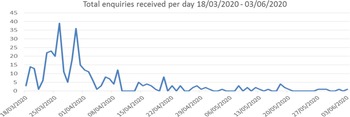
One of the earliest changes we made was to set up a mechanism to enable staff across CALHN to have an added avenue to direct queries, provide suggestions or voice concerns about the COVID-19 response as they arose. A central mailbox was established in March 2020 with initial management by the Communications Unit, separate to the established incident command center mailbox. The purpose of the mailbox was to acknowledge and respond to queries using 3 approaches: linking the enquirer to the proper resources; seeking subject expert advice; or escalation as required. A total of 354 enquiries were received to 3 June 2020. Although the peak of the response saw 40 enquires, the average was 12 enquiries/d. A secondary function was to identify themes, questions, and collate expert responses to contribute to CALHN Frequency Asked Questions (FAQ) documents.
The variety of enquiries was wide. Key themes included COVID-19 testing, personal protective equipment (PPE) requirements and supplies, self-care (ie, self-isolation, working from home, accommodation), and patient journey management (particularly the impact of border closures and visitor management) (Figure 3).
Staff enquiry rates.

Key strategies deployed to support this process included staff with knowledge and experience to manage the mailbox, having access to subject matter experts who were available for assistance and escalation pathways for information if required.
Additional external communications came in directly to the Office of the Chief Executive Officer (CEO) by means of email and telephone, with the team managing a significant increase in their normal workload in the first month of COVID-19 operations, before improved and enduring processes were developed.
Lessons Management
The response to COVID-19 has seen a traditional “post incident debrief/after action review” practice be revised and a more dynamic learning and feedback cycle.
The NIMT looked for more “point in time” reviews as well as periodic feedback. These were done following peaks in activities where the operational landscape and activities required a surge in NIMT oversight.
Across the initial 9 months of IMT led response to COVID-19, CALHN undertook the following processes to support a quality improvement and lessons management approach engaging more than 400 people across all levels of the organization. These included: a large formal face-to-face after-action review; a formal face-to-face exercise, which diverged (in part) into an informal review of some elements; an informal face-to-face after-action review with NIMT and senior leaders; an online survey; and a weekly, 3 question, online survey for the NIMT members.
The success of using the online survey tool was varied. This was in contrast where there was informal feedback about strengths and opportunities identified, but when provided with a mechanism to provide feedback, the uptake was intermittent.
Exercising and Education
CALHN had often exercised various plans as they related to sudden-impact incidents. Recent learnings post exercises were challenging to implement owing to poor governance and often changing senior leaders.
With a novel virus response, the organization had to deal with the need to develop and update its suite of COVID-19 plans. The need to socialize and educate cohorts regarding plan revisions and updates was challenging. Face-to-face and video conferenced in-service sessions and updates were provided, as well as the establishment of digital platforms to ensure that the organization and the NIMT had access to the relevant guidelines in a prompt, accessible manner.
As plans and arrangements were revised and published, there was a real need to test the underpinning planning assumptions through exercising. Exercising allowed NIMT and key staff to further improve the scope of roles, interactions between critical services, and importantly identify where key communication and decision-making weak points were. NIMT undertook 5 exercises between March and December 2020 providing exposure to approximately 100 staff as part of the program. Various exercise methodologies were used, including presentation, discussion/tabletop, and functional styles
Each exercise had a feedback online survey which sought to identify strengths and opportunities that arose post exercise and asked participants to provide confidence levels and success measures of current plans and staff capability.
Summary
Our top 8 considerations for the future are summarized here.
Communication
-
1. Regular structured communications work better over the longer term, learn to coalesce the information, and let people know where to go to find it. It is important there is a clear central source of truth and contact, especially during virtual operations. We found regular webinars with various content experts changes up the message and enables the organization to reflect the “hot issue” of the time.
-
2. There is a need to translate the “science” of the pandemic into language all staff could understand.
-
3. Furthermore, there is a need to have a variety of reliable ways to listen and hear staff concerns and ensure you respond to as many concerns as is practicable.
Capability
-
4. An imperfect, functioning system is better than a perfect, non-functioning system. Normalizing disaster response processes (command-led and function driven operations) in short term, sudden-impact disaster responses and exercising does increase the resilience of the organization in a protracted style response. It helps as staff understand the role delineation and aids everyone to “stay in their lane,” making a more effective NIMT.
-
5. Ensuring there are enough senior workforce specifically trained in disaster management (tactical and operational). In turn, for staff working in any NIMT or NICC role make sure they are well supported and manage their personal well-being, including adequate down time.
-
6. A key requirement is to show what a future state should look like and ensure that there is a Recovery function ready to support the bridge between the NIMT response and the planning toward the transition to a recovery state (new normal).
Governance
-
7. Knowing the importance of devoting energy and resources to the capturing, analysis, and reporting of emerging issues to the health service executive and other key decision-makers. This is best achieved by a centralized document management system accommodating (close to) real-time review and storage of plans/arrangements and version/document control, as well as a framework to support a more dynamic lessons management approach.
-
8. Ensuring there is clarity throughout the organization regarding roles and responsibilities from the governing body, executive, management, NIMT, and specialist clinicians during response activities.
Conclusions
This study has described the key lessons learnt through our campaign disaster response to the COVID-19 pandemic. Whereas the main principles of disaster management remain important to structure a response, the longer-term horizon of response to a pandemic taught us the importance of being flexible and adaptive to ensure a proportionate response.
Our key lessons learnt in relation to the management of a campaign style disaster response included the importance of disaster preparedness and fatigue management. Also, about the challenges of operating in a command model and the role of exercising and education real-time. Finally, the requirements of flexibility in the operating rhythm, building capability, and continuous learning. These lessons, although consistent with disaster response principles, more broadly relate to: you never can do enough communications; capability building before, during, and after; and an agile model for governance.