The degree and direction of personality change in adulthood is a central topic in understanding human psychological development. Several personality theories have emphasized how adult personality tends to develop toward higher levels of psychological maturity (Caspi, Roberts, & Shiner, Reference Caspi, Roberts and Shiner2005; Hopwood et al., Reference Hopwood, Donnellan, Blonigen, Krueger, McGue and Iacono2011; Lucas & Donnellan, Reference Lucas and Donnellan2011; McAdams & Olson, Reference McAdams and Olson2010; Roberts, Wood, & Caspi, Reference Roberts, Wood, Caspi, John, Robins and Pervin2008; Soto, John, Gosling, & Potter, Reference Soto, John, Gosling and Potter2011). Maturity is a somewhat ambiguous concept that attempts to describe directions and end states of personality development that are psychologically healthier and more fulfilling than lower levels of psychological maturity. Developmental theories offer two different views on maturity (Caspi et al., Reference Caspi, Roberts and Shiner2005; Helson & Wink, Reference Helson and Wink1987; Hogan & Roberts, Reference Hogan and Roberts2004; Staudinger & Kunzmann, Reference Staudinger and Kunzmann2005). The perspective of personal growth concentrates on concepts such as insight, integrity, and wisdom. Personal growth is seen as positive development that enables the individual to actualize his or her full potential as a person. The functional perspective, in contrast, equates maturity with adjustment to the society, that is, being a productive contributor to the society and being respected and liked by other people.
Maturity and Psychological Well-Being
Gordon Allport (Reference Allport1961) used six criteria to give maturity (or healthy personality) a definition that, in his words, was a balance between too fine and too coarse distinctions. The first criterion is self-extension, which was defined as authentic participation by the person in some significant spheres of human endeavor, such as work, family life, or politics. The second criterion is the ability to relate oneself warmly to others in both intimate (love) and nonintimate (compassion) contacts. The third criterion is emotional security or self-acceptance, that is, a skill to live with one's emotional states. The fourth criterion is realistic perception, thinking, and appraisals, that is, seeing the world as it is and not bending the reality to fit one's needs. The fifth criterion is insight and humor, that is, knowing oneself and being able to laugh at oneself. The sixth and final criterion is a unifying philosophy of life, that is, a clear comprehension of the purpose of one's life.
Based on the work of Allport and others and the literature on positive functioning, Carol Ryff introduced a model of psychological well-being that also consists of six dimensions (Ryff, Reference Ryff1989; Ryff & Keyes, Reference Ryff and Keyes1995). These dimensions are self-acceptance (positive evaluations of oneself and one's past life), personal growth (sense of continued development and growth as a person), purpose in life (meaningful life), positive relations with others, environmental mastery (being able to manage effectively one's life and the surrounding world), and autonomy (sense of self-determination).
Hogan and Roberts (Reference Hogan and Roberts2004) introduced a socioanalytic model of maturity more recently. According to the model, it is important to distinguish between how people see themselves and how others see them; maturity is defined from both the actor's and the observer's perspective. Maturity is divided into identity elements (self-acceptance and being attentive and responsive to others' needs, expectations, and feelings) and reputational elements (being liked and respected by others). These elements of maturity are associated with success in different roles such as marital stability and career success (Hogan & Roberts, Reference Hogan and Roberts2004).
Mean-Level Change of Personality
Perhaps the most intensively studied modern personality trait taxonomy in relation to personality change is the Big Five. Previous cross-sectional and longitudinal studies have shown that agreeableness, conscientiousness, emotional stability, and social dominance (e.g., social self-confidence) increase from young adulthood to middle age (Lucas & Donnellan, Reference Lucas and Donnellan2011; Luedtke, Roberts, Trautwein, & Nagy, Reference Luedtke, Roberts, Trautwein and Nagy2011; McAdams & Olson, Reference McAdams and Olson2010; Roberts, Walton, & Viechtbauer, Reference Roberts, Walton and Viechtbauer2006; Soto et al., Reference Soto, John, Gosling and Potter2011). McAdams and Olson (Reference McAdams and Olson2010) summed up these findings by stating that “by middle-age, people appear to become more comfortable with themselves as adults, less inclined to moodiness and negative emotions, more responsible and caring, more focused on long-term tasks and plans, and less susceptible to extreme risk-taking and the expression of unbridled internal impulses.” This developmental pattern has also been described as following the “maturity principle,” which implies that people become more mature with age (Caspi et al., Reference Caspi, Roberts and Shiner2005).
There are also some cross-sectional studies that have reported age-related differences in dimensions of psychological well-being (Ryff, Reference Ryff1989, Reference Ryff1991; Ryff & Keyes, Reference Ryff and Keyes1995). Environmental mastery and autonomy increase with age in adulthood, whereas purpose in life and personal growth decrease. Self-acceptance and positive relations with others usually show no age-related differences. Thus, the different facets of psychological well-being do not uniformly increase with age in a way that allows psychological well-being to be equated with maturity of personality.
Rank-Order Stability of Individual Differences in Personality
It is important to distinguish between mean-level personality change, which evaluates how individuals develop over time on average, and rank-order personality change, which is concerned with change in the relative position of individuals on a certain trait over time (Caspi et al., Reference Caspi, Roberts and Shiner2005). Mean-level change coupled with high rank-order stability implies that the observed mean-level change is due to normative (i.e., norm favoring) change in personality (Klimstra, Hale, Raaijmakers, Branje, & Meeus, Reference Klimstra, Hale, Raaijmakers, Branje and Meeus2009). Normative change often occurs to a similar degree in most people in the population.
Previous research suggests that rank-order stability increases with age, indicating that people are less likely to change in respect to others when they become older, and decreases with longer time intervals between the two measurements (Lucas & Donnellan, Reference Lucas and Donnellan2011). One meta-analysis estimated that the rank-order stability of personality characteristics increases from 0.5 to about 0.6 from early adulthood to middle age, when the time interval is about 7 years (Roberts & DelVecchio, Reference Roberts and DelVecchio2000). A more recent meta-analysis reported increasing rank-order stability from 0.6 in early adulthood to about 0.7 in middle age with about 7-year time intervals (Ferguson, Reference Ferguson2010). In a study of Big Five traits in adults aged 30 or older with an average follow-up interval of 10 years, rank-order stability coefficients were all around .8 (Terracciano, Costa, & McCrae, Reference Terracciano, Costa and McCrae2006). A more recent study using only the Big Five traits, a 4-year measurement interval, and a wide age range found that rank-order stability ranged from 0.64 to 0.73 (Specht, Egloff, & Schmukle, Reference Specht, Egloff and Schmukle2011). Thus, there is some variation in the estimates of rank-order stability between different studies, which may be explained by differences in the length of the time interval and the reliability of the measurement scales.
The Psychobiological Theory of Personality
The psychobiological theory of personality (Cloninger, Reference Cloninger2008) postulates that personality is composed of temperament and character, two interrelated domains that are hypothesized to interact as a nonlinear dynamic system regulating the development of human psychological functions. Temperament traits become manifest early in life and reflect biases in automatic responses to emotional stimuli, whereas character traits depict differences in higher cognitive functions underlying a person's goals and values (Cloninger, Svrakic, & Przybeck, Reference Cloninger, Svrakic and Przybeck1993). Temperament involves involuntary emotional processes, whereas character involves voluntary rational processes (Cloninger, Reference Cloninger2008). Temperament and character are considered to interact dynamically in the development of personality across the lifespan (Cloninger, Reference Cloninger2008; Cloninger, Svrakic, & Svrakic, Reference Cloninger, Svrakic and Svrakic1997).
The temperament domain of the psychobiological model originally consisted of three dimensions, which were proposed to be independently heritable (Cloninger, Reference Cloninger1987). These dimensions were novelty seeking (a bias toward initiation of behaviors, like exploratory activity in response to novelty), harm avoidance (a bias to respond intensely to aversive stimuli and to inhibit behaviors), and reward dependence (a tendency to respond intensely to social approval; Cloninger, Reference Cloninger1987). A fourth temperament dimension, persistence (perseverance despite frustration and fatigue), was later distinguished from reward dependence because it was found to be independently heritable (Cloninger et al., Reference Cloninger, Svrakic and Przybeck1993; Heath, Cloninger, & Martin, Reference Heath, Cloninger and Martin1994; Stallings, Hewitt, Cloninger, Heath, & Eaves, Reference Stallings, Hewitt, Cloninger, Heath and Eaves1996).
According to the theory (Cloninger et al., Reference Cloninger, Svrakic and Przybeck1993), the three character dimensions assessed by the Temperament and Character Inventory (TCI) are self-directedness, cooperativeness, and self-transcendence, and they reflect three different aspects of a person's self-concept and object relations. Self-directedness is the extent to which a person identifies the self as an autonomous individual. Cooperativeness expresses empathy and identification with other people, and self-transcendence involves self-awareness of being an integral part of the unity of all things. The temperament traits reflect basic stimulus–response characteristics underlying basic emotions of anxiety, anger, attachment, and ambition, whereas character dimensions aim at depicting the maturity and coherent integration of the multiple facets of each individual's personality in pursuit of particular goals and values over his or her lifespan.
In the psychobiological theory, maturity refers to the character configuration typical of healthy middle-aged individuals, which is characterized by high self-directedness and high cooperativeness (Cloninger et al., Reference Cloninger, Svrakic and Przybeck1993, Reference Cloninger, Svrakic and Svrakic1997; Cloninger & Zohar, Reference Cloninger and Zohar2011; Josefsson et al., Reference Josefsson, Cloninger, Hintsanen, Jokela, Pulkki-Råback and Keltikangas-Järvinen2011). Extreme immaturity, in contrast, is often related to diagnosable personality disorders (Cloninger, Reference Cloninger2010; Svrakic, Whitehead, Przybeck, & Cloninger, Reference Svrakic, Whitehead, Przybeck and Cloninger1993), and extreme temperament variants may differentiate between various subtypes of personality disorder (Cloninger, Reference Cloninger1987).
Character is assumed to develop in adulthood as a result of conceptual learning of the meaning and consequences of one's actions (Cloninger et al., Reference Cloninger, Svrakic and Przybeck1993). However, individual differences in the character traits are as heritable as the temperament traits (Gillespie, Cloninger, Heath, & Martin, Reference Gillespie, Cloninger, Heath and Martin2003), suggesting that the division between temperament and character cannot be made simply on the basis of more and less heritable components of personality. The division is also not supported by factor analysis studies that have reported substantial cross-loadings across the temperament and character traits (Farmer & Goldberg, Reference Farmer and Goldberg2008b; Herbst, Zonderman, McCrae, & Costa, Reference Herbst, Zonderman, McCrae and Costa2000; Maitland, Nyberg, Bäckman, Nilsson, & Adolfsson, Reference Maitland, Nyberg, Bäckman, Nilsson and Adolfsson2009). These results seem to suggest that character and temperament do not represent psychologically separate domains. However, other researchers have argued that it is quite possible for two moderately correlated traits to represent psychologically distinct constructs (Block, Reference Block1995). Other methodological approaches besides factor analysis need to be applied to assess the differences and similarities between temperament and character traits.
Stability and Change of Temperament and Character
Previous research on the stability and change of the TCI traits in adulthood is sparse. Assuming that psychological maturity increases with age and that character traits reflect the degree of personality maturity, one would expect self-directedness and cooperativeness, in particular, to increase with age. Research on character traits has shown that increasing age is strongly correlated with self-directedness and cooperativeness but not self-transcendence by age 35 or 40 years in most cultures (Cloninger et al., Reference Cloninger, Svrakic and Przybeck1993). However, the evidence is contradictory, with some studies providing empirical support for increasing levels of character traits (Cloninger, Reference Cloninger, Staudinger and Lindenberger2003; Cloninger et al., Reference Cloninger, Svrakic and Przybeck1993, Reference Cloninger, Svrakic and Svrakic1997) and some not (Farmer & Goldberg, Reference Farmer and Goldberg2008a). Novelty seeking appears to decrease with age, while no consistent age-related change has been reported for other temperament dimensions (Cloninger, Reference Cloninger, Staudinger and Lindenberger2003; Cloninger et al., Reference Cloninger, Svrakic and Przybeck1993; Trouillet & Gana, Reference Trouillet and Gana2008).
These findings derive from cross-sectional study designs, so the evidence of age-related development of temperament and character traits remains limited (Cloninger, Reference Cloninger, Staudinger and Lindenberger2003; Cloninger et al., Reference Cloninger, Svrakic and Przybeck1993; Trouillet & Gana, Reference Trouillet and Gana2008). Cross-sectional data may not be able to capture true aging effects due to confounding effects of birth cohort differences, which is why longitudinal studies with sufficiently long follow-up spans are needed to assess developmental trajectories in temperament and character. One longitudinal study with two assessments 1 year apart provided support for the cross-sectional results (Cloninger et al., Reference Cloninger, Svrakic and Svrakic1997). However, there have been no long-term longitudinal studies with follow-up after more than 1 year or longitudinal studies in other countries besides the United States.
Regarding rank-order correlations assessing the stability of individual differences over time, short-term (1–2 weeks) test–retest correlations of the revised TCI traits have been shown to range from .81 to .94 (Hansenne, Delhez, & Cloninger, Reference Hansenne, Delhez and Cloninger2005; Pelissolo et al., Reference Pelissolo, Mallet, Baleyte, Michel, Cloninger and Allilaire2005), indicating high reliability of the traits. A study with a 6-month follow-up reported correlations between .68 and .88 (Martinotti et al., Reference Martinotti, Mandelli, Di Nicola, Serretti, Fossati and Borroni2008). In a 1-year longitudinal study, correlations of the TCI traits were between .78 and .85 (Cloninger, Svrakic, & Przybeck, Reference Cloninger, Svrakic and Przybeck2006). A study with an average retest interval of 2 years reported correlations of .68 to .82 for the temperament traits (Gillespie et al., Reference Gillespie, Cloninger, Heath and Martin2003). Because there have not been many longitudinal studies concentrating on the stability of the TCI traits, the evidence regarding the rank-order stability of the TCI traits is limited.
Present Study
The purpose of the present study was to examine the developmental patterns of the TCI traits in a large population-based longitudinal study. First, we assessed rank-order stability and mean-level changes of the TCI traits over a 10-year time span. Second, in order to relate the observed developmental patterns to the concept of maturity, we examined whether the level of maturity is associated with the degree and direction of personality change and whether the personality change patterns of the TCI can be understood as people becoming more mature with age.
The psychobiological theory postulates that temperament traits are stable over time or show mixtures of small increases or decreases with no systematic directional bias in behavioral conditioning from unique individual experiences (Cloninger, Reference Cloninger2004). Both high and low extremes of each temperament can be advantageous or disadvantageous, depending on the situational context (Cloninger, Reference Cloninger1987; Jokela, Hintsa, Hintsanen, & Keltikangas-Jarvinen, Reference Jokela, Hintsa, Hintsanen and Keltikangas-Jarvinen2010). Behavioral conditioning of individuals is expected to have little or no effect on the average levels of temperament traits in the population, which leads to roughly equal numbers of people developing higher or lower scores on each trait.
By contrast, character traits are expected to be stable or to develop toward greater maturity with age due to sociocultural learning and increasing self-awareness and foresight about long-term consequences of voluntary behavioral choices (Cloninger et al., Reference Cloninger, Svrakic and Przybeck1993, Reference Cloninger, Svrakic and Svrakic1997). Self-directedness and cooperativeness are often perceived as socially desirable and to reflect psychological maturity, which may facilitate their development (e.g., Andersson, Reference Andersson2008; Ojala, Reference Ojala2000). Some form of spirituality and connectedness with the world is also often perceived as a sign of maturity (Allport, Reference Allport1951; Cloninger, Reference Cloninger2004). Self-transcendence may thus increase over time because it is associated with greater positive emotion, although such changes may take place only after middle age (Cloninger, Reference Cloninger2004). However, in modern secular cultures, such as that in Finland, more skeptical, rationalistic, and nonspiritual perceptions of the world are often prevalent and valued (Kääriäinen, Ketola, Niemelä, Palmu, & Salomäki, Reference Kääriäinen, Ketola, Niemelä, Palmu and Salomäki2009). This may be observed as decreasing self-transcendence with age as a result of internalization of secular norms. As a result of such systematic directional bias from social norm favoring, the effect size of change is expected to be higher for character traits than for temperament traits.
Based on previous research (Caspi et al., Reference Caspi, Roberts and Shiner2005; Roberts, Caspi, & Moffitt, Reference Roberts, Caspi and Moffitt2001) and the theoretical considerations presented above, we hypothesize that the mean levels of the TCI traits show evidence of increased maturity with age (i.e., the average levels of the character traits have a strong positive developmental direction when comparing people grouped by age, whereas the group averages of temperament traits do not change much with age). Concerning the rank-order correlations, we expect the TCI stability coefficients to be about the same magnitude as the coefficients reported for the Big Five because both represent modern and comprehensive personality inventories comprising traits with complex but strong correlations across inventories (Cloninger, Reference Cloninger, Widiger, Simonsen, Sirovatka and Regier2006). Third, we examine whether initial levels of temperament and character traits can be used to predict the magnitude of personality change over time. Previous research suggests that mature people change less with age than relatively immature people (Caspi et al., Reference Caspi, Roberts and Shiner2005; McAdams & Olson, Reference McAdams and Olson2010; Roberts et al., Reference Roberts, Caspi and Moffitt2001).
Method
Participants
The participants were from the Young Finns study. In this population-based epidemiological study a randomly selected sample of 3,596 participants has been followed for 27 years in eight follow-up phases between 1980 and 2007. The sample consists of six birth cohorts aged 3 to 18 at baseline in 1980. The design of the study and the selection of the sample have been described in detail elsewhere (Raitakari et al., Reference Raitakari, Juonala, Ronnemaa, Keltikangas-Jarvinen, Rasanen and Pietikainen2008). The measurements for the present study were carried out in 1997, 2001, and 2007. In 1997 the participants were 20, 23, 26, 29, 32, and 35 years old. Both temperament and character traits were assessed in 1997 and 2001, but only the temperament traits were assessed in 2007 because of space limitations of the questionnaire. All participants with full data in at least one of the years 1997, 2001, and 2007 were included in the study. Trait scores were calculated for participants if they had answered at least 50% of the trait items. Full data were available for 2,104 participants in 1997, 2,095 participants in 2001, and 2,056 participants in 2007. Of these participants 98.4%, 98.9%, and 99.9% had at most two missing items per trait in years 1997, 2001, and 2007, respectively.
Assessment of Cloninger's temperament and character traits
We used version 9 of the TCI, which has 240 items (Cloninger, Przybeck, Svrakic, & Wetzel, Reference Cloninger, Przybeck, Svrakic and Wetzel1994). Instead of the original true/false response format, we used a 5-point Likert scale (1 = definitely false, 5 = definitely true). Temperament dimensions include harm avoidance (35 items, Cronbach α = 0.92), novelty seeking (40 items, α = 0.85), reward dependence (24 items, α = 0.80), and persistence (8 items, α = 0.64). Character dimensions include self-directedness (44 items, α = 0.89), cooperativeness (42 items, α = 0.91), and self-transcendence (33 items, α = 0.91).
Statistical analyses
Means and standard deviations at different follow-up examinations were calculated separately for men and women. Possible gender by measurement year interactions were tested using mixed measures analyses of variance. None of the gender by measurement year interactions were significant, so the analyses were fitted with men and women combined.
When exploring mean-level stability and change of the TCI traits, participants were divided into 5-year age groups. This resulted in five age groups for temperament (20–24, 25–29, 30–34, 35–39, and 40–45 years) and four for character (20–24, 25–29, 30–34, and 35–39 years). In order to examine longitudinal and within-individual associations, the repeated measurements were pooled into a multilevel format in which measurements were nested within participants. The associations were analyzed with a multilevel linear model (generalized estimating equations with unstructured error structure). Age was modeled both as a categorical and as a continuous variable. To assess aging effects within individuals, we fitted regression models with both within-individual and between-individual associations with the model (Carlin, Gurrin, Sterne, Morley, & Dwyer, Reference Carlin, Gurrin, Sterne, Morley and Dwyer2005),
 $$Y=B_{0}+B_{\rm W} \lpar X - X_{\rm M}\rpar \;+B_{\rm B}X_{\rm M}\comma \;$$
where Y is the trait score, B 0 is the intercept, B W is the within-individual coefficient, X is the participant's time-varying age, X M is the participant's mean age across all measurements, and B B is the between individuals coefficient. Here the within-individual coefficient is the association of interest, because it reflects an aging effect within individuals that is not confounded by stable differences between individuals (e.g., cohort effects). To facilitate interpretation of effect sizes, all temperament and character traits were standardized using the mean and standard deviation of the 20-year-old group as the reference.
The hypothesis of personality maturity being associated with lesser personality change was assessed between the 1997 and 2001 measurements. The degree of personality change was defined as the Euclidean distance between personality trait scores in 1997 and in 2001 (standardized to the mean and standard deviation of the traits in 1997). In the present study, the Euclidean distance describes how different, as a whole, one's personality in 2001 is from one's personality in 1997. For example, a distance of 0.7 for all the TCI traits could mean that one trait has changed by 0.7 SD and that others traits have not changed at all, or that all seven traits have changed by 0.26 SD. The Euclidean distance was calculated separately for character traits, temperament traits, and character and temperament combined. The Euclidean distance in seven-dimensional TCI personality space using the trait change scores from 1997 to 2001 is
 $$\eqalign{\lpar {\rm NS_-}&{\rm change}^{2}+{\rm HA}_-{\rm change}^{2}+{\rm RD}_-{\rm change}^{2}+{\rm PS}_-{\rm change}^{2}\cr&+ {\rm SD}_-{\rm change}^{2}+{\rm CO}_-{\rm change}^{2}+{\rm ST}_-{\rm change}^{2}\rpar ^{1/2}\comma \;}$$
where NS is novelty seeking, HA is harm avoidance, RD is reward dependence, PS is persistence, SD is self-directedness, CO is cooperativeness, and ST is self-transcendence.
Results
Descriptive statistics
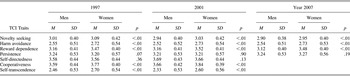
Table 1 presents means and standard deviations of TCI traits in men and women. Women scored higher than men in novelty seeking, harm avoidance, reward dependence, cooperativeness and self-transcendence in all measurement years. There was no statistical difference in the mean levels of self-directedness or persistence between men and women. The only gender difference greater than half a standard deviation was for reward dependence, which is higher in women.
Means and standard deviations of TCI personality traits in men and women

Note: The values are based on the average scores on a 5-point Likert scale. The p values are included for t-test testing for the difference in means between men and women. The number of participants according to year are the following: 1997: 2,104 (841 men = 40%, 1,263 women = 60%); 2001: 2,095 (881 men = 42%, 1,214 women = 58%); 2007: 2,056 (845 men = 41%, 1,211 women = 59%). TCI, Temperament and Character Inventory.
Rank-order correlations over time
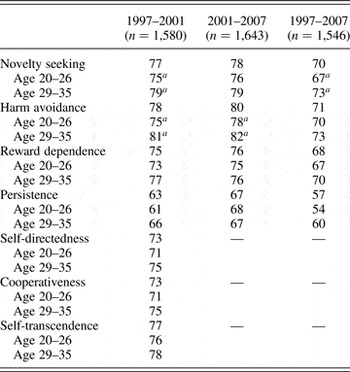
Table 2 shows the correlation of the TCI traits over 4, 6, and 10 years. Except for persistence, both temperament and character had rather high correlations of >.70. Furthermore, the 10-year correlations of temperament were comparable in magnitude to that of shorter time intervals, suggesting little attenuation with the lengthening of the time interval. There was a clear increasing trend in the correlation coefficients with age; correlations in the age group 29–35 were higher than in the age group 20–26 in almost all the comparisons, although the age group differences were statistically significant only for novelty seeking and harm avoidance.
Correlations of the TCI traits over 4 (1997–2001), 6 (2001–2007), and 10 (1997–2007) years of follow-up

Note: The values are correlation coefficients multiplied by 100 (r × 100) for all participants and for two age groups. All correlations are significant at p < 0.01. Age is the age in 1997. TCI, Temperament and Character Inventory.
aThe correlations of the 20–26 and 29–35 age groups differ significantly.
Mean-level stability and change
Stability and change in temperament
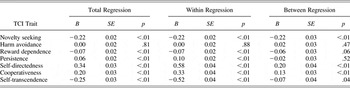
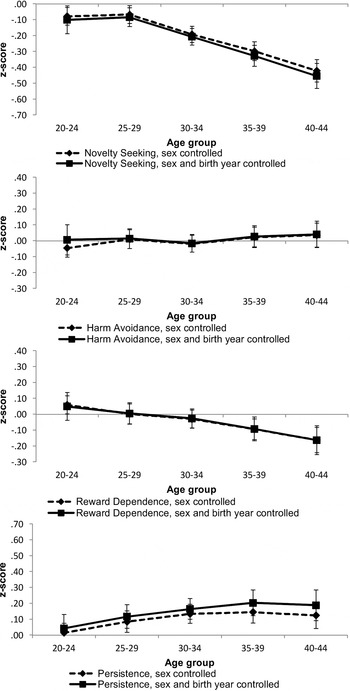
Figure 1 shows the development of temperament scores by age group. Of the four temperament traits, novelty seeking showed most evidence of change over time. Novelty seeking was rather stable between age groups 20–24 and 25–29 but decreased steadily after that. By age 40–44 years, novelty seeking showed a decrease of 0.4 SD. Harm avoidance stayed stable over time and did not show any significant directional change. Reward dependence showed a slight decreasing linear trend with age with a decrease of 0.2 SD by the age of 40–44 years. Persistence showed a slight increasing trend with age (0.1–0.2 SD by the age of 40–44 years). Table 3 shows that within- and between-individuals change coefficients were almost equal for novelty seeking, harm avoidance, and reward dependence, suggesting that the total regression coefficient was not substantially biased by factors other than age. For persistence, the within-individuals coefficient was somewhat higher than the between-individuals coefficient. These results are supported by the actual cohort differences shown in Table 4.
The population z scores plotted against age group for temperament traits. Scores are standardized to the mean and standard deviation of the 20-year-olds, and 95% confidence intervals are included. The results are based on a multilevel model.
Mean-level change of the TCI traits using age as a continuous dependent variable
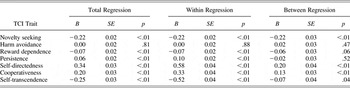
Note: Trait scores were standardized to the mean and standard deviation of the 20-year-olds. The B values are the mean-level changes on a given trait in standard deviations over 10 years. The values are based on a multilevel model (generalized estimating equations). Sex was controlled in all of the analyses. In the within-individual regressions, mean-level differences between individuals have been removed by examining how repeated measurements from the same individual differ from the individual's mean level of the trait. Between-individual regressions compare mean-level differences between individuals by averaging over the repeated measurements within individuals. Total (ordinary) regressions are the weighted average of the within-individual and between-individual regressions. See the Methods Section for statistical details. TCI, Temperament and Character Inventory.
The effect of birth year on the mean levels of temperament and character traits

Note: Trait scores were standardized to the mean and standard deviation of the 20-year-olds and are based on a multilevel model. Age and sex were controlled. The linear trend is the effect of a 10-year increase in birth year in standard deviations. NS, novelty seeking; HA, harm avoidance; RD, reward dependence; PS, persistence; SD, self-directedness; CO, cooperativeness; ST, self-transcendence.
Stability and change in character
Figure 2 shows the development of character scores with age. All three character traits showed evidence of change with age. However, controlling for the birth year increased the mean-score estimates of the three character traits substantially. Self-directedness and cooperativeness increased strongly with age with an increase of 0.7 and 0.4 SD by the age 35–39 years, respectively. Self-transcendence showed a decrease of 0.7 SD by the age 35–39 years. Using age as a continuous variable revealed marked differences between the within-individual and between-individual regression coefficients (Table 3), suggesting that the total regression coefficients underestimated the true aging effects revealed by within-individual associations. Adjusting for birth year amplified the age effects substantially because younger birth cohorts had higher self-directedness, higher cooperativeness, and lower self-transcendence than did the older birth cohorts (Table 4).
The population z scores plotted against age group for character traits. Scores are standardized to the mean and standard deviation of the 20-year-olds, and 95% confidence intervals are included. The results are based on a multilevel model.

Temperament versus character
There are differences between temperament and character traits, as can be seen in Figures 1 and 2 and Table 3. All three character traits changed more with age than any of the temperament traits. In addition, birth year had a strong effect on the mean level of the character traits but not on the mean level of the temperament traits.
TCI traits predicting personality change
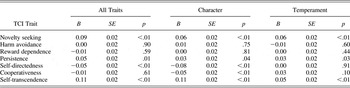
Table 5 shows the standardized mean scores of the TCI traits in 1997 predicting total personality change (a positive coefficient indicating that people high on a given trait change more and a negative one indicating that people high on a given trait change less) from 1997 to 2001. Harm avoidance and reward dependence did not predict overall personality change. High novelty seeking, high persistence, and high self-transcendence predicted consistently larger overall change in personality. The largest change in total personality was predicted by high self-transcendence. Cooperativeness predicted overall change in character traits; low cooperativeness predicted larger change in character. Self-directedness did not predict overall change in temperament, but it did predict change in character and combined temperament and character; low self-directedness predicts larger change in combined temperament and character and in character.
Traits scores in 1997 predicting the total change of all TCI traits, character traits, and temperament traits from 1997 to 2001

Note: The B values are the total change in standard deviations per 1 SD difference on a given trait. Age was controlled. The total change is defined as the Euclidean distance (see Methods Section), which is always positive. TCI, Temperament and Character Inventory.
Discussion
Our findings show that the rank-order stability of the TCI traits is fairly high and is very similar in magnitude for the temperament and the character traits, implying that individuals are likely to retain their relative ranking compared to other individuals over several years. Concerning mean-level changes with age, temperament traits measuring basic emotional response biases changed less than character traits that are suggested to appear later in development. There were no substantial birth year effects in temperament traits, but younger birth cohorts had higher self-directedness, higher cooperativeness, and lower self-transcendence than did older birth cohorts. Finally, people high on novelty seeking, persistence, self-directedness, cooperativeness, or self-transcendence showed more personality change over time than did people low on these traits, providing mixed evidence for the hypothesis that mature personality is less likely to change than immature personality.
Rank-order stability of temperament and character
Temperament and character traits did not differ substantially in the stability of individual differences over time. In agreement with previous literature showing increasing rank-order stability with age, the stability correlations for novelty seeking and harm avoidance were slightly higher for the 29–35 age group compared to the 20–26 age group. However, the differences were modest and not observed for other traits. The increasing rank-order stability may be observed more clearly in older ages than the 20 to 35 years covered in the present study. The 10-year rank-order stability coefficients were all smaller in magnitude than the 4- or 6-year coefficients, which is in agreement with the general pattern of decreasing stability with increasing length of follow-up (Lucas & Donnellan, Reference Lucas and Donnellan2011). The rank-order stability coefficients in the present study are somewhat higher than in previous studies (Cloninger et al., Reference Cloninger, Svrakic and Przybeck2006; Ferguson, Reference Ferguson2010; Gillespie et al., Reference Gillespie, Cloninger, Heath and Martin2003; Roberts & DelVecchio, Reference Roberts and DelVecchio2000) but not exceptionally high (Terracciano et al., Reference Terracciano, Costa and McCrae2006).
Mean-level changes in temperament and character
Even though temperament and character have substantial unique genetic variance, they are equally heritable (Gillespie et al., Reference Gillespie, Cloninger, Heath and Martin2003) and correlate moderately with each other, which has challenged the assumption that they represent qualitatively different domains of personality. The mean-level changes of all the three character traits showed clear and consistent age-related trends with effect sizes larger than the trends observed for any of the four temperament traits. The effect sizes measured by standard deviation (Figure 2) were large for self-directedness (positive age trend, +) and self-transcendence (negative age trend, –) and rather large also for cooperativeness (+). The effect sizes for temperament traits (Figure 1) were moderate for novelty seeking (–), weak for persistence (+) and reward dependence (–), and near zero for harm avoidance. Birth year effects had no or only little relevance in these developmental trajectories of temperament traits but marked birth year effects were observed for character traits. Older cohorts were less self-directed, less cooperative, and more self-transcendent than younger cohorts. Thus, character traits appear to be more sensitive than temperament traits to both aging effects and differences in societal and historical factors that characterize the society in different points in time. Despite the moderately high correlations between, say, harm avoidance and self-directedness (r = –.62 in present study), our results suggest some clear differences between the domains of temperament and character.
Mature personality from the perspective of temperament and character
A good approximation of a person's level of maturity is the sum of self-directedness and cooperativeness scores (Cloninger, Reference Cloninger2004) and the mean levels of both increased with age in our study sample. Having a mature personality makes it easier to regulate one's emotions responsibly and considerately; if one is anxiety prone (high hard avoidance), impulsive (high novelty seeking), and mature (high self-directedness and high cooperativeness) at the same time, maturity helps one to behave rationally in spite of experiencing emotional conflicts. According to this view, maturity is not related to the quality or intensity of emotions but to living a balanced life with awareness and understanding of one's emotions. At the same time, mature personality organization enhances work performance and helps also in other culturally valued tasks. In addition, both high and low extremes of each temperament can be advantageous or disadvantageous depending on the situational context (Cloninger et al., Reference Cloninger, Svrakic and Przybeck1993). For example, being high on persistence helps one to perform well in work despite disappointment, frustration, and fatigue. At the same time, the perfectionistic nature of high persistence might influence one's marriage negatively by predisposing a person to neglect family for work or to pursue an overly perfect relationship, children, and home (Cloninger, Zohar, Hirschmann, & Dahan, in press). There is no one culturally preferred temperament profile. However, maturity of character is culturally preferred to immaturity of character because a mature character is advantageous in most life situations. The increasing trends of self-directedness and cooperativeness are also in line with the Big Five related studies that have found increasing agreeableness and conscientiousness with age.
Our results imply that character profiles of Finnish people tend to develop from disorganized (low self-directedness, low cooperativeness, and high self-transcendence) to organized (high self-directedness, high cooperativeness, and low self-transcendence) by age 40. Disorganized character can be defined as unconventional behavior and also not setting realistic goals, thinking magically and not analytically, and not having emotionally rewarding and trusting relationships (Cloninger, Bayon, & Svrakic, Reference Cloninger, Bayon and Svrakic1998). Disorganized people are illogical, suspicious, and immature while organized people are conservative, efficient, and consistent. Organized people can reason analytically and are generally logical, trusting, and mature. Thus, character seems to develop toward greater maturity. Mature personality is often described as being a productive member of society, being organized and decisive in one's actions, and being considerate toward other people (Caspi et al., Reference Caspi, Roberts and Shiner2005). These qualities, among others, are measured by TCI character traits (Cloninger, Reference Cloninger2008), which supports the proposal in DSM-V to define healthy personality functioning in terms of high self-directedness and cooperativeness (Cloninger, Reference Cloninger2010).
In contrast, immature character (i.e., low self-directedness and low cooperativeness) is typical of individuals with most forms of psychopathology, including mood disorders, schizophrenia, substance dependence, and personality disorders (Cloninger, Zohar, & Cloninger, Reference Cloninger, Zohar and Cloninger2010). High self-transcendence, in turn, is associated with both positive health and particular forms of psychopathology, such as schizophrenia and bulimia. Specific forms of psychopathology are associated with specific temperament traits, such as high harm avoidance with anxiety and mood disorders, high novelty seeking with substance dependence, low reward dependence with schizoid disorders, and high persistence with obsessional disorders (Cloninger et al., Reference Cloninger, Zohar and Cloninger2010; Mulder & Joyce, Reference Mulder and Joyce1997). These observations illustrate the important role that maturation of character has in reducing vulnerability to psychopathology and provides further support for the distinction between temperament and character.
We found that a mature character at age 40 in Finland involves low self-transcendence. As our cohorts age further, however, people will face more suffering and death, which may make an increase in self-transcendence adaptive (Cloninger, Reference Cloninger2004; Coward & Reed, Reference Coward and Reed1996). In cross-sectional studies, people over age 60 are higher in self-transcendence than are those at middle age or younger (Cloninger, Reference Cloninger, Staudinger and Lindenberger2003). Further work on the role of self-transcendence in life satisfaction must examine the course of personality development prospectively and also examine interactions among all the personality dimensions with different aspects of health and happiness (Cloninger & Zohar, Reference Cloninger and Zohar2011).
Although mean-level studies of personality traits show that people mature with age, some people change reliably in the opposite direction than the observed mean-level trends (Roberts, Wood, & Smith, Reference Roberts, Wood and Smith2005). This is probably caused by individual experiences in people's lives (Roberts & Mroczek, Reference Roberts and Mroczek2008). Some life events, for example a divorce, might result in negative changes in personality if the event is interpreted to be relevant to one's identity (Lodi-Smith & Roberts, Reference Lodi-Smith and Roberts2007). What is critical is how important people see their social roles (e.g., work or marriage) to be, what kind of expectations they have for themselves, and what kind of expectations other people have for them (Roberts et al., Reference Roberts, Wood and Smith2005).
Predicting whose personality will change: The role of maturity
The present study also addressed the hypothesis of psychological maturity and degree of subsequent personality change (Roberts et al., Reference Roberts, Caspi and Moffitt2001). High novelty seeking, high persistence, low self-directedness, low cooperativeness, and high self-transcendence predicted greater personality change over 4 years. People with a preference for novelty seek out new experiences, people, and environments. Consequently, there is less stability in their environments, and this instability is probably the driving force behind the personality change of novelty seekers. The effect of persistence can probably be explained by sustained effort, which is required for personality change to take place.
Character traits of people low on self-directedness, low on cooperativeness, or high on self-transcendence were more likely to change over time than were those high on self-directedness, high on cooperativeness, or low on self-transcendence (Table 5). It seems that immature people (low self-directedness and low cooperativeness) are more prone to personality change than are mature people, which is in line with previous studies (Caspi et al., Reference Caspi, Roberts and Shiner2005; Donnellan, Conger, & Burzette, Reference Donnellan, Conger and Burzette2007; McAdams & Olson, Reference McAdams and Olson2010; Roberts et al., Reference Roberts, Caspi and Moffitt2001). Mature people receive less pressure than do immature people from society to change in a norm-favored direction because they already are near the cultural norm. Mature people are also less likely to face important life-changing decisions because they have usually already chosen their path in life (Donnellan et al., Reference Donnellan, Conger and Burzette2007). Maturity might also facilitate the development of resilience to environmental adversity and improve coping in challenging life situations (Caspi et al., Reference Caspi, Roberts and Shiner2005). Furthermore, universal social roles related to work, family, and community in general may explain the observed maturation trend (Donnellan & Trzesniewski, Reference Donnellan and Trzesniewski2010; Roberts & Mroczek, Reference Roberts and Mroczek2008). This explanation is further strengthened by the idea that there are no known human cultures that avoid marriage, work, and living as a family (Roberts et al., Reference Roberts, Wood and Smith2005). These universal social roles might also explain why the maturity effect has been observed in multiple cohorts and nations (Roberts et al., Reference Roberts, Wood and Smith2005).
The role of self-transcendence as the most important predictor of personality change is noteworthy (Table 5). If self-transcendence is associated with personal growth, as some studies have suggested (Staudinger & Kunzmann, Reference Staudinger and Kunzmann2005), our findings can be interpreted to imply that personal growth facilitates personality change. It has been suggested that personal growth is associated with higher levels of personality development (Bauer & McAdams, Reference Bauer and McAdams2004). This would also mean that, paradoxically, young adults are not particularly well adjusted to the society (low self-directedness and low cooperativeness), but their level of personal growth is rather high (high self-transcendence). Then, through complex developmental processes, people's adjustment level rises and their personal growth level lowers to meet the demands of cultural, role, and personal expectations.
Possible causal mechanisms for personality change
The largest changes in personality occur in young adulthood (age 20–40), but personality continues to change even in middle and old age, showing that personality traits can change at any age (Roberts & Mroczek, Reference Roberts and Mroczek2008). In young adulthood, people start a career, get married, and have children. In this time, people shape their identities and choose the long-term goals in their lives (Roberts et al., Reference Roberts, Walton and Viechtbauer2006). These developmental tasks specific to young adulthood are one explanation for the observed changes in personality.
Human development through the lifespan can be seen to comprise age- and stage-relevant tasks (Cicchetti & Rogosch, Reference Cicchetti and Rogosch2002). Success in these tasks opens the possibility for positive development. Failure, however, might lead to maladaptive outcomes. In addition, major life changes and changes in social roles and contexts can affect mental health and even predispose a person to psychopathology (Schulenberg, Sameroff, & Cicchetti, Reference Schulenberg, Sameroff and Cicchetti2004). Through the life course, new developmental tasks arise and interact with the outcomes of prior developmental tasks. Human development can be seen as a dynamic process that is constantly open for change both for the good and for the bad (Cicchetti & Rogosch, Reference Cicchetti and Rogosch2002). However, the longer a person's development follows a maladaptive path, the harder it is to return to a normal healthy developmental path (Cicchetti, Reference Cicchetti1993). The past has an impact on future development, but negative life events do not necessarily lead to maladaption and positive events to adaption: subsequent experience may alter the course of biological and psychological development and alter the effects of prior experience (Cicchetti & Rogosch, Reference Cicchetti and Rogosch2002).
The effect of personality on behavior is not straightforward. The same level of one personality trait can lead to different behavioral outcomes in people depending on its interactions with other personality traits and the types of socializing environments (Frick & Viding, Reference Frick and Viding2009). There are multiple developmental pathways to the same personality profile, and the effects of one environment variable (e.g., divorce) may be different between people (Cicchetti & Richters, Reference Cicchetti and Richters1997). These empirical facts are usually referred to as the concepts of equifinality and multifinality (Cicchetti & Rogosch, Reference Cicchetti and Rogosch1996). Equifinality states that people from different starting points can develop toward a common outcome (e.g., two adolescents with extremely high and low harm avoidance can be equally self-directed as adults). Multifinality means that people with similar backgrounds might develop toward different outcomes of two children with low harm avoidance and high reward dependence: one might grow up to have low harm avoidance and high reward dependence as an adult and the other high harm avoidance and low reward dependence. A complex dynamic transaction of positive and negative processes determines the course of a person's development (Cicchetti & Rogosch, Reference Cicchetti and Rogosch2002).
In general, developmental trends of personality (Agronick & Duncan, Reference Agronick and Duncan1998; Costa & McCrae, Reference Costa and McCrae1982; Srivastava, John, Gosling, & Potter, Reference Srivastava, John, Gosling and Potter2003) may be explained by factors that are unique to an individual (e.g., genes), the social climate in a society at a certain time, or generational differences (i.e., cohort effects). Such cohort effects can cause differences between people born in different years and environments; working-aged adults, for example, might be affected more by a nationwide recession than retired adults.
Our results suggest that cultural norms, values, and expectations do not affect the mean level of temperament traits (i.e., emotional responses) to the same extent as the character traits. It may be that cultural expectations are not related to what kind of emotions and in which situations one should feel but how one reacts and copes with one's emotions. According to this view, it is acceptable culturally for people to feel distressed or anxious as long as they can function normally and perform well in work, for example. Circumstances that require emotional self-regulation to achieve particular goals and express certain values are when being a mature person helps.
It is also possible that, with time, it has become more difficult to reach the definition of being successful and well adjusted. High occupational and leisure time efficiency demands both require people to be highly self-directed and cooperative to be successful (Roberts & Helson, Reference Roberts and Helson1997). Due to changes in the social climate, people work harder to reach these demands than before, and this is seen as the birth year effect in character. This view is supported by a study of first-year psychology student cohorts from 1982 to 2007 (Smits, Dolan, Vorst, Wicherts, & Timmerman, Reference Smits, Dolan, Vorst, Wicherts and Timmerman2011); results showed that the average maturity level of the first-year students increased in 25 years. This also means that, say, a 5-year period from age 20 to 25 may have different connotations for individuals from different birth cohorts due to changing external expectations and the work required to meet them.
According to a different formulation, there are at least two forces, a socialization effect and a selection effect, which can change the mean level of personality traits (Lodi-Smith & Roberts, Reference Lodi-Smith and Roberts2007; Neyer & Lehnart, Reference Neyer and Lehnart2007). Socialization effects refers to group conformity pressure that society exerts on an individual, including cultural norms, practices, values, and beliefs. Disciplinary actions for breaking these cultural expectations vary in accord with what behaviors are culturally regarded as desirable or unacceptable (Cicchetti & Rogosch, Reference Cicchetti and Rogosch2002). For example, employees are expected to show up on time, work hard, and get along with coworkers. These expectations are similar for all employees, and therefore they are assumed to affect personality change within individuals by punishing inappropriate behavior (e.g., by withdrawal of rewards or by losing one's job) or rewarding appropriate behavior (Roberts et al., Reference Roberts, Walton and Viechtbauer2006). Consequently, social signals from other people and society can promote personality change by telling one how one should behave and change to meet expectations, meaning that environmental experiences affect personality functioning (Caspi et al., Reference Caspi, Roberts and Shiner2005).
Selection effects refer to a tendency for more mature people to invest more value in their social roles such as work, family, and marriage (Lodi-Smith & Roberts, Reference Lodi-Smith and Roberts2007). Personality traits select people to have certain experiences, and these same traits are also the most influenced in response to those experiences, creating a feedback effect in selected individuals (Caspi et al., Reference Caspi, Roberts and Shiner2005; Jokela, Kivimaki, Elovainio, & Keltikangas-Jarvinen, Reference Jokela, Kivimaeki, Elovainio and Keltikangas-Jaervinen2009). Based on the aforementioned effects, it could also be predicted that a small sample of individuals growing up in isolation from society would not show the pattern of personality change toward maturity like that seen in most people (Donnellan et al., Reference Donnellan, Conger and Burzette2007).
Our results showed that birth year affects character but not temperament. We suggest that this is due to a combination of socialization and selection effects. In Western cultures childrearing generally aims at socializing children to be autonomous, independent, and responsible toward other people, which correspond to being self-directed and cooperative (Keller et al., Reference Keller, Lamm, Abels, Yovsi, Borke and Jensen2006; Tulviste, Mizera, De Geer, & Tryggvason, Reference Tulviste, Mizera, De Geer and Tryggvason2007). Furthermore, these same qualities help a person to have a successful marriage, career, and social relationships in the individuality-promoting Western cultures.
In the present study, the mean level of three (harm avoidance, reward dependence, persistence) of the four temperament traits showed little or no change with age. The stability of harm avoidance, in particular, differs from the earlier results using the Big Five, according to which emotional stability increases and negative emotionality gets lower with increasing age (e.g., McAdams & Olson, Reference McAdams and Olson2010; Roberts et al., Reference Roberts, Walton and Viechtbauer2006). Our results suggest that general anxiety proneness (harm avoidance) remains stable with age while self-directedness increases. It seems, in the light of our results, that with age people do learn to self-regulate their emotions (high self-directedness), but the actual level of negative emotionality remains stable. We also found that novelty seeking decreased moderately with age. It is possible that repeated exposure to initially novel stimuli may lead to decreased novelty seeking. Thus, having experienced a wide variety of different stimuli may lower the number of sources with further novel stimuli, which might lower novelty seeking because there is less novelty to be sought. Decreasing novelty seeking is in line with the Big Five related studies, which have found a lower level of expression of internal impulses with age (McAdams & Olson, Reference McAdams and Olson2010).
A very interesting result in the present study was the strong decrease of self-transcendence with age. High self-transcendence has previously been found to be associated with both negative and positive affect (Cloninger & Zohar, Reference Cloninger and Zohar2011; Josefsson et al., Reference Josefsson, Cloninger, Hintsanen, Jokela, Pulkki-Råback and Keltikangas-Järvinen2011). People who can see their lives as complex as they are really are as likely to be happy as unhappy (Bauer & McAdams, Reference Bauer and McAdams2004). One explanation for this contradictory result is that being self-transcendent does improve one's well-being, but at the same time, the cultural secular norms may exert pressure to be less self-transcendent, which causes negative affect (Josefsson et al., Reference Josefsson, Cloninger, Hintsanen, Jokela, Pulkki-Råback and Keltikangas-Järvinen2011).
Another explanation is based on the different types of positive personality development and maturity. According to this view, cooperativeness and self-directedness measure adjustment to the society, while self-transcendence measures personal growth (Staudinger & Kunzmann, Reference Staudinger and Kunzmann2005). Previous studies that have found declining personal growth with age support this view (Ryff, Reference Ryff1989; Ryff & Keyes, Reference Ryff and Keyes1995). Personal growth requires plenty of self-examination, motivation, and the right circumstances, which often make it a painful and difficult process. Furthermore, personal growth may not be necessary to be well adjusted to the society. Therefore, unlike developing self-directedness and cooperativeness, developing self-transcendence is not constantly reinforced by the society, and even if a person would like to grow toward greater self-transcendence, finding out how to do that may be difficult. Thus, people focus their time and energy on more concrete goals of forming friendships and having a successful marriage and career. All in all, people try to live good and happy lives. It may be that personal growth requires too much effort and contributes, according to a subjective evaluation, too little goodness and happiness to one's life to be a population-wide phenomenon. Consequently, the mean level of self-transcendence decreases with age as personal growth is not given the attention it needs.
Methodological considerations
A limitation of this study is that, while temperament was measured three times, character was measured only twice. A third measurement would have been useful in clarifying further the developmental trends of the character traits. In addition, women were somewhat overrepresented in all the measurement years, which may introduce some bias to the population estimates.
Furthermore, the Euclidean distance measure used in our study to assess multidimensional personality change is dependent on the scaling of the personality scores. This scale dependence may limit the generalizability of the results to other samples with different distributions of personality traits.
Conclusion
The results of this study are in line with previous research, which has found that personality develops toward greater maturity in adulthood. The most common course of development seems to be that with age people become more responsible and caring and more comfortable with themselves. Increasing self-directedness and cooperativeness with age in our study correspond closely to increasing agreeableness and conscientiousness observed in Big Five related studies (e.g., McAdams & Olson, Reference McAdams and Olson2010; Roberts et al., Reference Roberts, Walton and Viechtbauer2006). Increasing emotional stability observed in Big Five studies did not receive support from the present study because harm avoidance remained stable over time. Novelty seeking decreased with age, which is in line with increasing impulse control observed in the Big Five studies (McAdams & Olson, Reference McAdams and Olson2010). We also observed a strongly decreasing age trend for self-transcendence that supports the previous findings of decreasing purpose in life and personal growth with age (Ryff, Reference Ryff1989; Ryff & Keyes, Reference Ryff and Keyes1995).
To our knowledge, this is the first population-based longitudinal study to examine the TCI traits with more than two study waves and a time span of more than a few years. Our Finnish study also broadens the cultural context of the TCI because most of these studies have been carried out in the United States. Furthermore, studying normal development is important to fully understand psychopathology and to identify abnormal development (Cicchetti & Toth, Reference Cicchetti and Toth2009). Maturing with age seems to be the norm, and if a person shows a decrease in maturity, a serious concern should be raised concerning the well-being of that person. We have shown that as normal healthy people mature, they become more self-directed and cooperative. Overall, changes in temperament were comparatively smaller, although novelty seeking and reward dependence decreased and persistence slightly increased while the participants grew older.
In sum, we have shown the usefulness of the TCI personality model as the descriptor of personality development within an individual over time. The TCI is a valuable tool in understanding and describing the genetic, neurobiological, social, and psychological effects that make us who we are. Moreover, the psychobiological theory postulates that differences between temperament-related procedural learning and character-related propositional learning should lead to qualitative differences between the development of temperament and character (Cloninger, Reference Cloninger, Staudinger and Lindenberger2003, Reference Cloninger2004, Reference Cloninger2008). We have shown that there are qualitative differences between the development of temperament and character. Character and temperament may correlate moderately at one time point, but they show qualitatively distinct developmental patterns. Furthermore, birth cohorts differ on the mean levels of the character traits but not on the temperament traits. This qualitative information would be lost if temperament and character were combined and not treated as distinct domains.