Introduction
Dizziness is a common symptom within all age groups in the general population. In a large, observational study by von Brevern et al. Reference von Brevern, Radtke, Lezius, Feldmann, Ziese and Lempert1 the prevalence of self-reported dizziness throughout a 12-month period was found to be 22.9 per cent. Furthermore, a medical consultation was reported in 1.8 per cent of the investigated 4869 persons throughout a 1-year period. The primary care physician often undertakes the initial diagnostic procedures and commences the appropriate treatment. A large number of dizzy patients have co-morbidities that can account for their dizziness. Cardiovascular disease is the most frequent condition associated with dizziness encountered in primary care.Reference Maarsingh, Dros, Schellevis, van Weert, van der Windt and ter Riet2, Reference Neuhauser, Radtke, von Brevern, Lezius, Feldmann and Lempert3 However, there is a subgroup of dizzy patients seen in general practice in whom a vestibular cause of dizziness is suspected.Reference Neuhauser, von Brevern, Radtke, Lezius, Feldmann and Ziese4
A number of non-cardiovascular conditions have been described in the literature as presenting with dizziness, such as Ménière's disease, vestibular neuritis, phobic postural vertigo, vertigo of cervical origin and migraine-associated vertigo.Reference Kroenke, Hoffman and Einstadter5, Reference Neuhauser and Lempert6 However, retrospective studies suggest that benign paroxysmal positional vertigo (BPPV) is the most frequently diagnosed cause.Reference Isaradisaikul, Navacharoen, Hanprasertpong, Kangsanarak and Panyathong7, Reference Katsarkas8 A German epidemiological study of the general population reported a lifetime prevalence of BPPV of 2.4 per cent.Reference Neuhauser, von Brevern, Radtke, Lezius, Feldmann and Ziese4
Prior studies that have investigated the diagnosis of patients with dizziness have been retrospective, and were often performed in tertiary care centres with a special interest in dizziness.Reference Katsarkas8 No previous study has reported prospective, consecutive data regarding the prevalence and characteristics of the various diagnostic groups of patients presenting with dizziness to ENT practices. This prompted the current study.
Materials and methods
All patients with a primary complaint of dizziness seen at the participating ENT practices were enrolled consecutively and prospectively, and data were recorded in a central database. Patients were referred to the ENT specialist either by their general practitioner, a hospital department, another specialised practice (e.g. neurology) or via self-referral. Patients were only included in the study once. Data were collected over the period August 2011 to February 2012.
Each patient's history was recorded and a thorough ENT examination was undertaken, as well as audiometry and tympanometry. The Romberg balance test, Dix–Hallpike test, supine roll test, head-shake test and head-impulse test were performed. Functional examinations such as caloric testing and video-nystagmography were carried out when judged necessary by the physician. When the physical examination and diagnostic investigations were suggestive of central or retrocochlear pathology, patients were referred for magnetic resonance imaging (MRI) or computed tomography (CT) scanning of the brain, and, depending upon the results, further referred for additional investigation and treatment. Upon obtaining a positive Dix–Hallpike test or supine roll test, a repositioning manoeuvre (e.g. Epley manoeuvre) was performed.
When considered appropriate, patients were referred to a physiotherapist for vestibular rehabilitation (e.g. if they had vestibular sequelae, vertigo of cervical origin or phobic postural vertigo). Upon early diagnosis of vestibular neuritis (i.e. symptom onset in less than 3 days), patients were treated with oral steroids, following current guidelines. If a diagnosis could not be reached, the patient was referred, when relevant, for further investigation at an appropriate, hospital-associated department.
The following parameters were recorded in the database for all patients: most likely diagnosis; probability of diagnosis (i.e. certain, likely or possible); symptom duration; MRI or CT scan performed; duration of sick leave (defined as absence from work); referral to a physiotherapist for rehabilitation; frequency of recurrences; prior, related hospitalisations; and night-time awakening with dizziness.
The following diagnostic categories were defined prior to the beginning of the study as possible vertigo-associated diagnoses: BPPV, vestibular neuritis, Ménière's disease, vestibular schwannoma, phobic postural vertigo, sudden deafness with vertigo, labyrinthitis or fistula, vertigo as an adverse effect of medication, age-related dizziness, migraine-associated vertigo, vertigo of cervical origin, cardiovascular disease, otosclerosis, stress-related vertigo, cerebral neoplasm, vertigo of central origin, and cholesteatoma. When a diagnosis could not be reached, patients were categorised as having dizziness of unknown origin. For patients in whom multiple diagnoses were applicable, only the primary diagnosis was registered in the database (i.e. only one diagnosis was registered for each patient).
When a vestibular cause was identified (i.e. BPPV, vestibular neuritis or Ménière's disease), the probability of the diagnosis was evaluated by the physician as being either certain, likely or possible. For BPPV, the criteria for a certain diagnosis were: characteristic patient history, positive semi-circular canal test results and a positive response to a particle repositioning manoeuvre. For likely BPPV, the criteria were: characteristic patient history and uncertain semi-circular canal test results. For possible BPPV, the criteria were: characteristic patient history and negative semi-circular canal test results. For vestibular neuritis, the criteria for a certain diagnosis were: characteristic patient presentation, positive impulse test results and a difference between sides of more than 25 per cent on caloric testing. For likely vestibular neuritis, the criteria were: characteristic patient presentation and positive caloric test results. For possible vestibular neuritis, the criteria were: characteristic patient presentation, no objective findings and no significant difference between sides on caloric testing. For Ménière's disease, the American Academy of Otolaryngology–Head and Neck Surgery Committee on Hearing and Equilibrium guidelines9 were modified to produce the following criteria. A certain diagnosis of Ménière's disease required: characteristic presentation, documented fluctuating one-sided hearing loss, and other causes excluded. A likely diagnosis was made for patients with: characteristic presentation, fixed one-sided hearing loss, and other causes excluded. A possible diagnosis was made for patients with: characteristic presentation and no objective findings.
The prevalence of each diagnostic group is given together with exact 95 per cent confidence intervals (CIs). Pearson's chi-square test, or Fisher's exact test where appropriate, was used to compare frequencies between the diagnostic groups. All statistical calculations were performed by a statistician at The West Danish Research Forum for Statistical Consultants, Denmark.
The study was approved by the local ethical committees as well as the Danish National Board of Health.
Results
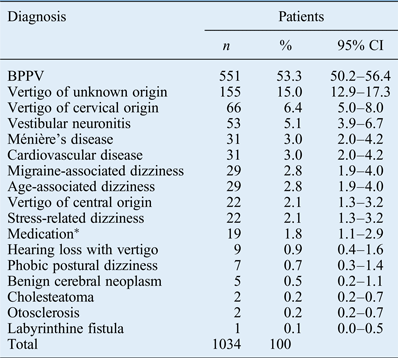
A total of 1034 patients were included in the study. The age distribution of the study population is shown in Figure 1. The median age was 56 years (10th percentile, 29 years; 90th percentile, 78 years). The median symptom duration was four weeks. Of the 1034 patients, 312 were men and 722 were women, corresponding to 30.2 per cent (95 per cent CI, 27.4–33.1 per cent) and 69.8 per cent (95 per cent CI, 66.9–72.6 per cent), respectively. The frequencies of the various diagnoses are shown in Table I.
Age distribution of study population (n = 1034).

Diagnoses amongst patients with dizziness
*Side effects or adverse effects. CI = confidence interval; BPPV = benign paroxysmal positional vertigo
Recurrence
Compared with other vestibular diseases, the frequency of recurrence of BPPV was relatively low: in the BPPV group, 169 out of 551 patients (30.7 per cent; 95 per cent CI, 26.8–34.7 per cent) had experienced similar symptoms previously. Patients with migraine-associated vertigo had a high frequency of recurrence: 58.5 per cent (95 per cent CI, 44.1–71.9 per cent) had suffered prior episodes. A large proportion of patients with a diagnosis of Ménière's disease also had recurrent symptoms, as expected: 21 out of 31 patients (67.7 per cent; 95 per cent CI, 48.6–83.3 per cent) had experienced similar symptoms previously. Of patients diagnosed with vertigo of unknown origin, 11.0 per cent (17 of 155) (95 per cent CI, 6.5–17.0 per cent) suffered recurrence. Amongst the 53 patients with vestibular neuritis, 10 had experienced similar symptoms before (18.9 per cent; 95 per cent CI, 9.4–32.0 per cent). For the remaining diagnoses, the prevalence of recurrence was low (less than 5 per cent).
Imaging
Of the total 1034 patients, 151 underwent MRI or CT scanning of the brain (14.6 per cent; 95 per cent CI, 12.5–16.9 per cent). Of these 151, 24 had abnormal results (15.8 per cent).
Fifteen patients with vertigo of central origin were scanned, 12 of whom had abnormal results.
Sixty-four of the 551 patients diagnosed with BPPV were scanned, 5 per cent of whom had abnormal findings (3 patients). In one case, a meningioma was noted prior to consultation with a neurologist. In another case, scanning revealed a small thrombus behind one eye; the patient had bilateral BPPV and experienced symptom resolution following the Epley manoeuvre (repeated at several sessions), and it was concluded that the thrombus was not responsible for the patient's vertigo. The third patient with BPPV was found to have a thrombus in the cerebellum; this patient had a positive Dix–Hallpike test and responded to the Epley manoeuvre with full resolution of vertigo, and it was concluded that the abnormal imaging results were not the cause of the patient's symptoms.
Of the 155 patients with vertigo of unknown origin, 18 underwent scanning; no abnormalities were noted for any of these patients.
Sick leave
Of the 1034 patients in the study, 206 reported repeated absence from work because of their symptoms (19.9 per cent; 95 per cent CI, 17.5–22.5 per cent). Of the 551 patients with BPPV, 95 (17.2 per cent; 95 per cent CI, 14.2–20.7 per cent) reported being absent from work, 41 of whom required sick leave of more than 7 days. The diagnostic group with the highest proportion of patients absent from work was the vestibular neuritis group, in which 30 of 53 patients reported absence from work as a result of their symptoms (56.6 per cent; 95 per cent CI, 44.2–72.4 per cent).
Night-time awakening
The presence of night-time awakening due to dizziness was recorded for all patients. This event was significantly more common in patients with BPPV, at 59 per cent (95 per cent CI, 54.7–63.1 per cent), compared with patients in other diagnostic groups (χ2 = 46.8, 1 degree of freedom; p < 0.001). Night-time awakening was significantly more common in the BPPV group, compared with the other vestibular disorder groups combined (i.e. vestibular neuritis and Ménière's disease) (χ2 = 241, 1 degree of freedom; p < 0.001).
Diagnostic probability
The degree of diagnostic certainty was highest for the BPPV group and lowest for the Ménière's disease group; this difference was highly statistically significant (χ2 = 27.9, 4 degrees of freedom; p < 0.001).
Hospitalisation
Of the 1034 study patients, 101 (9.8 per cent; 95 per cent CI, 8.0–11.7 per cent) were admitted to hospital as a result of their symptoms.
The highest proportion of admissions was noted in patients with benign cerebral neoplasms (2 of 5 patients, 40 per cent; 95 per cent CI, 5.3–85.3 per cent), followed by Ménière's disease (8 of 31, 25.8 per cent; 95 per cent CI, 11.9–44.6 per cent), hearing loss with vertigo (2 of 9, 22.2 per cent; 95 per cent CI, 2.8–60.0 per cent), vertigo of central origin (4 of 22, 18.2 per cent; 95 per cent CI, 5.2–40.3 per cent) and age-associated dizziness (4 of 29, 13.8 per cent; 95 per cent CI, 3.9–31.7 per cent). Of the 551 BPPV patients, 51 were admitted, corresponding to 9.3 per cent (95 per cent CI, 7.0–12.0 per cent). In the remaining groups, the frequency of admission was less than 7 per cent.
Benign paroxysmal positional vertigo
The largest diagnostic group was BPPV, containing 551 of the total 1034 study patients.
The age distribution of these patients was similar to that of the study population as a whole; however, the median age was higher (61 vs 56 years). Benign paroxysmal positional vertigo was diagnosed in all age groups; the youngest patient thus diagnosed was 11 years old and the oldest was 95 years old. In addition, BPPV was the most frequent diagnosis across all age groups. After dividing patients into 10-year age groups, the following prevalences of BPPV patients were obtained (of the total patients in each age group): 10–19 years, 43 per cent; 20–29 years, 27 per cent; 30–39 years, 43 per cent; 40–49 years, 49 per cent; 50–59 years, 55 per cent; 60–69 years, 66 per cent; 70–79 years, 63 per cent; 80–89 years, 56 per cent; and 90–99 years, 43 per cent.
The absolute number of patients with BPPV was greatest in the 60–69 years group. However, after correcting for the age distribution of the population in the geographical area where the participating clinics were located, it was noted that the incidence of BPPV increased with age in our population.
Discussion
This prospective, multicentre study's primary finding was that BPPV was the dominant diagnostic entity in a population of 1034 consecutive patients referred to ENT practices for dizziness. Other studies that have investigated the occurrence of dizziness and related diagnoses have been retrospective in nature; thus there is a chance that some patients were not included, or were incorrectly categorised, as a result of missing or faulty diagnoses.
A thorough, prospective study by Maarsingh et al. Reference Maarsingh, Dros, Schellevis, van Weert, van der Windt and ter Riet2 conducted in the primary care sector in an older population, found that dizziness was of cardiovascular origin in 57 per cent of cases. In 14 per cent of the patients in that study, a vestibular disorder was determined to be the cause of their dizziness. Several other studies, conducted in either secondary or tertiary care centres, reported higher proportions of patients with vestibular disorders. For example, Kroenke et al. Reference Kroenke, Lucas, Rosenberg, Scherokman, Herbers and Wehrle10 found that 29 per cent of their patients suffered from vestibular disorders. Isaradisaikul et al. Reference Isaradisaikul, Navacharoen, Hanprasertpong, Kangsanarak and Panyathong7 conducted a large, retrospective study of patients seen in the ENT department of a university hospital, and found that 72.9 per cent suffered from vestibular disorders, of whom 52.5 per cent were diagnosed with BPPV. KatsarkasReference Katsarkas8 too found BPPV to be the most frequent diagnosis in their study population, with 39 per cent of patients having BPPV.
Our results are consistent with the findings of these previous studies as regards the most frequent diagnosis; i.e. BPPV. We also found the primary cause of dizziness in our patient population to be vestibular in origin, with 635 of the 1034 study patients (61 per cent) being diagnosed with a vestibular condition (either BPPV, Ménière's disease or vestibular neuritis). Our study also found that the diagnostic certainty was significantly greater for BPPV than for the other vestibular diagnoses (i.e. Ménière's disease and vestibular neuritis). Our finding of BPPV as the most frequent diagnosis, in a prospective study, validates the findings of the retrospective studies of Isaradisaikul et al. Reference Isaradisaikul, Navacharoen, Hanprasertpong, Kangsanarak and Panyathong7 and Katsarkas.Reference Katsarkas8
Two further, major findings of our study were that BPPV was the prevailing diagnosis across all age groups and that its incidence increased with age (after correcting for the demographics of the Danish population). A significant implication of these findings is that BPPV in elderly patients must not be overlooked, since the condition is easily diagnosed and treatable. However, patients over the age of 70 years often have co-morbidities that could contribute to their symptoms, making the diagnosis of BPPV more challenging. Furthermore, these patients are often taking multiple medications, further complicating their clinical picture. This aspect has been investigated by Maarsingh et al. Reference Maarsingh, Dros, Schellevis, van Weert, van der Windt and ter Riet2 who found that 62 per cent of patients with dizziness seen in primary care had more than one possible cause of dizziness; cardiovascular disorders in particular were a frequent contributor in this patient population.
The importance of examining elderly patients for vestibular dysfunction is emphasised by the findings of Oghalai et al. Reference Oghalai, Manolidis, Barth, Stewart and Jenkins11 who observed that elderly patients with BPPV had an increased risk of falling compared with those without BPPV (prevalences of 78 vs 35 per cent, respectively, over a 3-month period). The BPPV patients were also found to have a worse level of functioning in their daily activities (e.g. shopping and cleaning). When taken together with our own observation that BPPV was the dominant diagnosis in older patients (aged over 70 years) with dizziness, these findings emphasise the need to consider this diagnosis in elderly patients.
Fifty-nine per cent of the patients in our study population reported night-time awakening due to dizziness. Similarly, in von Brevern and colleagues' study,Reference von Brevern, Radtke, Lezius, Feldmann, Ziese and Lempert1 49 per cent of patients with BPPV reported being awakened by their dizziness, and 85 per cent reported that symptoms were triggered by turning over in bed. There is good evidence in the literature that BPPV symptoms are characteristic in this respect, and that BPPV is relatively simple to diagnose via a thorough clinical examination.
Notably, the guidelines of the American Academy of Otolaryngology–Head and Neck Surgery recommend that the diagnosis of BPPV be based on a thorough patient history and clinical examination, rather than radiographic imaging.Reference Bhattacharyya, Baugh, Orvidas, Barrs, Bronston and Cass12 Despite this, our study found that approximately 10 per cent of patients with BPPV underwent imaging (CT or MRI). However, our study did not investigate why these patients were referred for scanning. In the experience of the authors, it is not uncommon for patients with BPPV to undergo CT and/or MRI scanning upon acute admission to hospital, despite having characteristic symptoms and signs of BPPV (e.g. positive Dix–Hallpike test).
• This prospective study assessed patients referred to ENT practices due to dizziness
• The majority were diagnosed with benign paroxysmal positional vertigo (BPPV)
• BPPV was the most frequent diagnosis in all age groups, and prevalence increased with age
Our findings and personal experience indicate the need for more clinical education about BPPV. This need has been confirmed by several studies, including Pollak's report,Reference Pollak13 in which only 25 per cent of patients with BPPV were correctly identified upon referral. Furthermore, Fife and FitzGeraldReference Fife and FitzGerald14 found a significant time delay between the first physician contact and commencement of appropriate treatment (an average of 92 weeks from first visit to commencement of treatment). Polensek and TusaReference Polensek and Tusa15 also reported evidence of insufficient awareness of BPPV; in that study, 89 per cent of doctors assessing patients with dizziness did not perform the necessary tests for BPPV diagnosis.Reference Polensek and Tusa15
The relatively high prevalence of absence from work amongst our study population indicates that dizzy patients experience a significant level of morbidity. It is important to note that work absence was probably underestimated in our study, as a large number of our patients were older and thus more likely to be retired. Of further note, there was significant variation in the duration of sick leave between diagnostic groups. Patients with vestibular neuritis took more frequent sick leave, and for longer periods, than patients with BPPV.
For a significant proportion of our patients (15 per cent), it was not possible to reach a diagnosis, despite carrying out a number of tests. This is consistent with a prior report,Reference Katsarkas8 in which no diagnosis could be reached in 21 per cent of cases. It is important to note that we did not have access to rotational chair testing or vestibular evoked myogenic potential testing. It is possible that the availability of more advanced test equipment would have enabled a larger proportion of patients to receive a diagnosis. Further studies are needed to determine whether or not a more intensive diagnostic process could help decrease the proportion of patients without a diagnosis.
Conclusion
We conducted a large, prospective, multicentre study that examined the prevalence and characteristics of different diagnostic entities amongst patients referred to ENT practices for dizziness. Our primary finding was that BPPV was the most frequently diagnosed condition in all age groups, including patients over the age of 70 years, thus validating the findings of previous retrospective studies. Furthermore, we found that night-time awakening was highly indicative of BPPV, and that BPPV was diagnosed with a significantly greater degree of certainty, compared with other vestibular disorders.
Finally, BPPV was the most frequently diagnosed disease in all age groups, emphasising the fact that all clinicians in contact with patients reporting dizziness must consider BPPV as a possible cause, especially in the elderly.
Acknowledgements
The study was financed by the Fund for Professional Development of Specialist Physicians in Private Practice and the Association of Practising Specialist Physicians Region Midt's Fund. The authors thank Dr Annette Therkildsen (ENT Clinic, Randers, Denmark), and Drs Pascal Bonvin, Peder C Frandsen, Kirsten Sander and Niels Bundgaard (ENT Clinic, Buldofi Plads, Ålborg, Denmark) for patient enrolments. We also thank Ms Anne Vingaard Olesen at The West Danish Research Forum for Statistical Consultants for statistical assistance.