The socially ascribed devaluation of women's status persists across countries with varying levels of development and democracy. In these various settings, gender stereotypes—beliefs about the attributes and behaviors of men and women—are activated in a way that women are generally expected to make others feel comfortable through emotional displays such as smiling. However, the empirical evidence for the relevance of gender stereotypes to voter decision-making is inconclusive. Some scholars argue that voters use gender as a cue to make inferences about candidates; in their eyes, gender stereotypes harm the electoral success of women (Alexander and Anderson Reference Alexander and Anderson1993; Fox and Smith Reference Fox and Smith1998; Huddy and Terkildsen Reference Huddy and Terkildsen1993). This approach suggests that the underrepresentation of women in politics can be explained by the prevalence of gender stereotypes as decision-making cues among voters. However, more recent studies have shown that gender cues are outweighed by more important information shortcuts such as party cues and incumbency (Dolan Reference Dolan2014; Hayes Reference Hayes2011; Matland and Tezcür Reference Matland and Tezcür2011) or that the activation of gender stereotypes in vote choice is a more complicated process than commonly thought (Bauer Reference Bauer2015; Ditonto, Hamilton, and Redlawsk Reference Ditonto, Hamilton and Redlawsk2014; Sanbonmatsu and Dolan Reference Sanbonmatsu and Dolan2009).
This study explores the activation of gender stereotypes in elections by focusing on the gendered impact of candidate smiling on electoral performance. Specifically, I answer two questions: (1) whether female politicians express happiness (i.e., smile) more than their male peers in thoroughly contrived public appearances and (2) whether smiling equally helps female and male candidates win elections. Indeed, my central question is whether female candidates are punished for failing to smile enough.
To answer these questions, I analyze data from the 2014 provincial legislative elections in South Korea. Korean provincial legislative elections are low-information affairs characterized by scarce media coverage, and they are held simultaneously with elections for many different local offices. In any Korean election, each candidate presents copies of their campaign poster—which includes their own (and no one else's) photo image—to the applicable election commission by the beginning of the official campaign period. The posters are displayed ubiquitously along many streets and on the walls of private and public buildings, with all the candidates of a district attached together as a set in ascending order of candidate ballot number (from left to right).
Given that these posters are a principal campaign tool, and given that they highlight facial cues and clearly identify the gender of the candidate, they are an ideal subject for careful study to answer my questions. I use an automated process (artificial intelligence, AI) for facial emotion recognition to measure candidate smiles on these campaign posters. My results reveal that the impact of smiling depends on both candidate gender and the number of competitors in the race. The positive impact of smiling on a candidate's electoral fortunes is substantial for women who are competing against multiple candidates. However, the smiling effect is limited for male candidates no matter how crowded the race is and for female candidates facing a single opponent.
Voters need information about issues and candidate positions to make reasoned decisions, and these information costs vary with electoral context. When the cost of information is high, such as in low-profile elections, voters rely on heuristics and selective information (Banducci et al. Reference Banducci, Karp, Thrasher and Rallings2008; Brockington Reference Brockington2003; Popkin Reference Popkin1991). The findings of this study support the argument that voters’ preferences for shallow cues depend on the electoral context, suggesting that the impacts of candidate gender and facial emotional display vary with information costs—specifically, the number of competing candidates in the contest. In other words, voters’ gender stereotypes are activated when they are asked to choose among many unfamiliar candidates in low-salience elections. These “overloaded” voters use candidates’ facial emotional displays as cues, rewarding female candidates who adhere to gender stereotypes while sanctioning women who refuse to do so. Hence, female candidates who smile in these posters garner more votes, and they are more likely to win election or, at the very least, secure their future electability. This study helps identify the conditions under which gender stereotypes are activated in such a manner that female politicians are strongly incentivized to publicly exhibit a smiling face.
THE INTERPLAY OF CANDIDATE SMILES, GENDER STEREOTYPES, AND ELECTORAL CONTEXT
The Gendered Consequences of Smiling
This study connects three distinct bodies of scholarship. The first concerns gender differences in nonverbal communication, a literature developed mostly beyond the bounds of political science. Gender differences in nonverbal communication and behavior have been studied extensively, and the consensus is that women are generally socialized to be more communally oriented, nurturing, and focused on interpersonal relationships—taking on the task of “being nice” more readily than men (Shields Reference Shields2002; Fischer Reference Fischer1993; Brody and Hall Reference Brody, Hall, Lewis and Haviland-Jones2000). In particular, a long line of research has documented gender differences in emotional expression. Women are widely observed to exhibit smiles, or similar positive facial displays, more than men (Fischer and LaFrance Reference Fischer and LaFrance2015; Hall Reference Hall1984; McDuff et al. Reference McDuff, Kodra, Kaliouby and LaFrance2017). For example, female students smile more broadly than men in their photos in college and school yearbooks (Dodd, Russell, and Jenkins Reference Dodd, Russell and Jenkins1999; Morse Reference Morse1982).
Smiles are not only cheerful emotional expressions but also social acts with important consequences (LaFrance Reference LaFrance2011). In business settings, displays of positive emotions during service transactions are positively associated with customer satisfaction (Brown and Sulzer-Azaroff Reference Brown and Sulzer-Azaroff1994) and willingness to return to the store or recommend it to friends (Tsai Reference Tsai2001). Also, nonverbal behavior such as smiling positively affects interviewer ratings and employability (Barrick, Shaffer, and DeGrassi Reference Barrick, Shaffer and DeGrassi2009). Moreover, the gendered impact of smiling is well documented in academic settings. The gendered reward structure of academia operates in such a manner that female professors who do not exhibit strong interpersonal traits such as warmth, friendliness, and frequent smiles are sanctioned (i.e., receive lower student ratings), while male professors who do not exhibit strong interpersonal traits are not (Arbuckle and Williams Reference Arbuckle and Williams2003; Kierstead, D'Agostino, and Dill Reference Kierstead, D'Agostino and Dill1988; Sampaio Reference Sampaio2006).
Gender differences in smiles are likely to be the product of social norms. LaFrance and Hecht (Reference LaFrance, Hecht and Fischer2000) conducted a meta-analysis of nearly 150 studies on gender differences in smiles. They concluded that women in general smile more than men and that the gender gap increases significantly when subjects interact with others or know that they are being monitored. Experimental studies support the idea that women expect to experience higher costs when they do not express positive emotions toward others, and indeed, they are rated more negatively when they do not smile compared with men (Deutsch, LeBaron, and Fryer Reference Deutsch, LeBaron and Fryer1987; Stoppard and Gruchy Reference Stoppard and Gunn Gruchy1993). In sum, different display rules are applied when evaluating men and women.
Candidate Facial Cues in Elections
The second body of literature I consider studies nonverbal cues in electoral behavior. Political science scholars have traditionally focused on variables such as economic conditions, electoral rules, the ideology or policy positions of voters and candidates, and partisanship as determinants of election outcomes. Recently, a growing volume of research pays attention to voters’ use of shallow impressions derived from a candidate's image as a decision heuristic.
For instance, King and Leigh (Reference King and Leigh2009) and Berggren, Jordahl, and Poutvaara (Reference Berggren, Jordahl and Poutvaara2010) support the notion that candidates with beautiful faces tend to garner significantly more votes than less attractive competitors. Little et al. (Reference Little, Burriss, Jones and Roberts2007) highlighted facial shapes as a key determinant of electoral performance, arguing that which face receives the most votes depends on the changing context of war and peace. Also, in some contexts, baby-faced politicians are perceived as more competent (Poutvaara, Jordahl, and Berggren Reference Poutvaara, Jordahl and Berggren2009) and, in Taiwan, tend to win more votes in elections (Chang, Lee, and Cheng Reference Chang, Lee and Cheng2017). Leigh and Susilo (Reference Leigh and Susilo2009) found that voters use candidate skin color in photographs on the ballot as an information shortcut. In sum, judgments about candidates can be made after extremely rapid exposures to facial images, and choices based on such judgments predict candidates’ actual performance in real-world elections (Ballew and Todorov Reference Ballew and Todorov2007; Benjamin and Shapiro Reference Benjamin and Shapiro2009).
Likewise, positive emotional expressions like smiles may help candidates win elections. Asano and Patterson's (Reference Asano and Patterson2018) study of Japanese elections supports that candidates who smile more on their campaign posters receive more votes, controlling for many other covariates. However, the impact of smiles is unlikely to be universal. In a comparative study of Japan and Australia, Horiuchi, Komatsu, and Nakaya (Reference Horiuchi, Komatsu and Nakaya2012) found that while candidate smiles are positively associated with election outcomes in both countries, the magnitude of the smile effect is more substantial in Australia. Their finding suggests that expectations about politicians’ emotional expressions vary with context.
A reasonable extension of this argument can be made with respect to the different expectations and norms between men and women. If gender stereotypes are relevant in voter decision-making, we may observe that voter reliance on candidate emotional displays differs by candidate gender.
Gender Stereotypes in Elections
The third body of literature concerns the power of gender stereotypes in the electoral process. Do women politicians face stronger expectations to smile, encouraging them to smile more than their male peers? Female stereotypes align with the communal roles in which women are generally expected to serve, roles such as homemaker and caregiver, or roles that make others feel more comfortable and relaxed. Carlson (Reference Carlson2001) found that female candidates smiled substantially more than their male counterparts in election campaigning in Finland and the United States, demonstrating persisting gender stereotypes even in places boasting high levels of political representation for women. For instance, Senior, Ridout, and Stewart (Reference Senior, Ridout and Stewart2019) analyzed the nonverbal expressions of Hillary Clinton and Donald Trump using video excerpts taken from the 2016 presidential debates and found that Clinton performed far more intense smile displays than Trump.
If these patterns hold, the nonverbal differences between male and female politicians’ expressions imply that the evaluation of women candidates is likely to depend more on the extent to which they conform to voters’ stereotypical attitudes. Indeed, a voluminous literature using experiments and surveys suggests that voters rely on gender stereotypes when evaluating politicians. For example, Fox and Smith's (Reference Fox and Smith1998) experimental study of a sample of U.S. university students showed that candidate gender affects vote decision. Analyzing U.S. nationwide survey data, Koch (Reference Koch2000) found that voters use gender stereotypes to infer candidates’ ideological orientation in a manner that leads female candidates to be perceived as more liberal than they are, and this misperception affects women's electoral prospects. A survey experiment by Sanbonmatsu (Reference Sanbonmatsu2002) also showed that gender stereotypes affect voters’ predispositions to vote for male or female candidates, suggesting the importance of gender cues as a low-information shortcut.
However, the evidence that gender stereotypes work to the detriment of female candidates is inconclusive at best. Recent findings based on American public opinion data indicate that voters’ stereotypical beliefs do not hurt female candidates in elections (Dolan Reference Dolan2010, Reference Dolan2014; Dolan and Lynch Reference Dolan and Lynch2016; Hayes Reference Hayes2011). These studies claim that, in voter evaluations of candidates, gender stereotypes are limited by the relevance of other factors such as party cues and incumbency. Moreover, the empirical evidence for the gendered impact of nonverbal factors is not solid. Hamermesh and Parker (Reference Hamermesh and Parker2005) demonstrated that beauty has a positive effect on both male and female instructors’ course ratings, but the effect is larger for men. Also, Hamermesh's (Reference Hamermesh2006) study of elections in the American Economic Association suggested that the positive impact of beauty on election outcomes is greater for male candidates than for female candidates. While many experimental studies support the importance of gender cues, Matland and Tezcür's (Reference Matland and Tezcür2011) experiment of reading speeches of candidates from the two major parties in Turkey illustrated that candidate gender has no impact on voting decisions. These findings contradict the common belief that women politicians are evaluated by their appearance more than their male peers.
Perhaps the lack of evidence for gender stereotypes as voting cues is related to insufficient consideration of information costs, especially escalating costs as the number of candidates increases. These high information costs may create a greater incentive for voters to use their predispositions regarding gender roles and nonverbal shortcuts to assess candidate quality. For example, students are not faced with making an election-like choice among multiple professors in course evaluations and are relatively informed about their professors at the time of evaluations. Also, voting at the American Economic Association does not involve high information costs, with the usual competition rate being only 2:1. More importantly, many studies pointing to the weak impact of gender stereotypes on women candidates’ electoral performance are based on contexts involving two-party competition.
Voting is as an information-processing task, and rational voters will try to minimize their information costs. In this regard, the extent to which shallow, intuitive cues determine election outcomes will depend not only on the difficulty of acquiring more candidate information, such as policy positions or past political experience, but also on the amount of information necessary for reasoned voting. As the costs of acquiring information are high in low-information elections, voters are more likely to rely on readily available cues as information shortcuts simplifying their decision-making.
For instance, a study of community council elections in Britain supports that attractive candidates are more likely to win in low-information, nonpartisan elections in which candidate photographs are displayed on the ballot (Banducci et al. Reference Banducci, Karp, Thrasher and Rallings2008). This only makes sense: in crowded contests, information costs will be magnified, and voters will be looking for shortcuts. Lawson et al. (Reference Lawson, Lenz, Baker and Myers2010) had the faces of Brazilian and Mexican candidates rated by uninformed voters from other countries and found that the visual images strongly predicted actual electoral performance, particularly in elections in which a large number of candidates competed. And, to return to the Korean context, if voters are asked to make a choice among more than two unknown candidates and simultaneously process several ballot papers for various levels of public office, information costs will rise even further. In these elections, one would expect gendered cues to play an enormous role in voters’ decisions.
Taken together, it stands to reason that gender stereotypes play a greater role as information costs rise. Faced with the daunting task of collecting and processing information on many candidates in low-information elections, voters are more likely to use gendered criteria, paying more attention to the extent to which female candidates conform to female-stereotypical emotional display rules. However, voter reliance on these gender shortcuts may be more limited when considering male candidates, given that men are in general less bound by emotional display rules than are women.
From the foregoing discussion, hypotheses can be formulated as follows:
• H1: Female candidates smile more broadly than male candidates.
• H2: Smiling has a positive impact on the number of votes a candidate receives.
• H3: The positive impact of smiling on winning votes is greater for women than for men.
• H4: The positive impact of smiling on vote share increases as the number of competing candidates increases.
• H5: The extent to which the number of candidates positively impacts the smile effect varies by candidate gender, and this effect is more substantial for female candidates than for male candidates.
DATA AND METHODOLOGY
To measure smiles and assess these hypotheses, I used campaign posters of candidates in the 2014 provincial legislative elections in South Korea. In Korea, personal interaction with voters through canvassing is prohibited, and election campaigning is strictly limited to about two weeks before Election Day. In parallel with these restrictions, there is a strong institutionalized norm compelling candidates to submit their posters, although failing to do so is not penalized by law. The Public Official Election Act stipulates that these posters must contain the candidate's photo, name, ballot number, and party affiliation, along with a brief biography and the policy programs candidates want to include (Article 64). The size and number of the posters are also strictly regulated by the Election Commission and the Public Official Election Act. Finally, during the official campaigning period, posters of all the candidates in the district are displayed ubiquitously.
Provincial legislative elections are a good example of low-information contexts. While the size of districts in provincial legislative elections is smaller than that of National Assembly elections, these local candidates are generally less known to the public. And although these provincial elections are higher level than their municipal counterparts, municipal candidates tend to maintain greater familiarity and closer grassroots ties with voters because of small district size. Moreover, as chances for public exposure through the media are scarce, provincial candidate posters are especially significant. And while these local elections are partisan, presenting party cues to voters, this source of information is often less than clear, since many voters cross party lines in local elections. In short, these provincial legislative elections are fairly low-information affairs.
The 2014 provincial legislative elections were held as a part of the 6th Local Election on June 4 in 17 regions (nine provinces, six metropolitan cities, and two special metropolitan cities). Provincial legislative candidates are listed on one of the seven ballot papers that Korean voters receive at the polling station on local Election Day.Footnote 1 The elections adopted a mixed rule, combining single-member district plurality (SMDP) and party closed-list proportional representation (PR) with each type of seat, numbering 705 and 104, respectively (a total of 809 seats from 17 regional councils).Footnote 2 From the 705 single-member districts, the number of female and male candidates was 203 (11.70%) and 1,532 (88.30%), respectively. Among the total of 1,735 registered SMDP candidates, those with a publicly available campaign poster featuring a recognizable candidate face numbered 1,643 (1,448 men and 195 women). Among these candidates, there was one dropout during the campaign period and four unopposed candidates who were automatically elected. Accordingly, a total of 1,638 candidates are included in the sample for the regression analysis of the smile impact on election outcomes, and the sample size of the female candidates is large enough for statistical analysis.Footnote 3
The information costs that voters need to pay to make “rational” voting decisions (e.g., evaluations of candidate policy positions) vary with the context of the electoral race. If the number of competing candidates increases, the information costs will rise and voters will be more likely to rely on simpler, more intuitive cues, such as assessments of candidate posters. Although low-information settings are common in Korean provincial legislative elections, the number of candidates varies across districts. In this sample, the average number of candidates is 2.78, with a range of 1 to 5.
Descriptive statistics of the variables

† The higher a ballot number is, the lower the candidate who is assigned the number is placed on the ballot paper. Conversely, a low ballot number means a higher placement on the ballot paper.
Political parties and their assigned ballot numbers in the 2014 local elections

Measuring Candidate Emotional Display in Campaign Posters
I measured smiles using automated face recognition technology, namely, the Azure Face API developed by Microsoft. This biometric AI application offers algorithms that are used to detect human faces in a digital image. Extracting a face-like object, it identifies various muscular components of a human face, especially around the mouth, nose, eyes, and eyebrows, and returns various kinds of face-related data. The detected facial attributes include, but are not limited to, facial hair, glasses, pose, age, gender, and facial emotions. In particular, Face API returns Bayesian estimates of eight types of facial expressions of emotions—anger, contempt, disgust, fear, happiness, sadness, surprise, and neutral expressions—which are understood to be cross-culturally and universally communicated. The separate scores across the eight emotions add up to a single composite score, and in this way, Face API generates a continuous measure (ranging between 0 for no smile and 1 for a full smile) of happiness by evaluating smiles.
The automated process of measuring smiles is useful in that it is independent of voters’ subjective assessments of candidate attributes (Horiuchi, Komatsu, and Nakaya Reference Horiuchi, Komatsu and Nakaya2012). It evaluates smiles regardless of candidate familiarity or reputation among voters, as well as other pieces of candidate information presented in the posters such as party affiliation, education, and incumbency. Another noteworthy distinction of using automation to judge facial expression lies in the sample independence of emotion recognition algorithms, especially when compared with human coding's possible proclivity for sample dependence. This difference makes human coding far more like relative grading, whereas emotion detection algorithms resemble absolute grading. For instance, a candidate classified as displaying a full smile by the automated process may be perceived as smirking by a human coder, depending on the overall level of smiling in a sample.
I acknowledge that some scholars have raised doubts about emotion detection technology (e.g., Barrett et al. Reference Barrett, Adolphs, Marsella, Martinez and Pollak2019; Hoegen et al. Reference Hoegen, Gratch, Parkinson and Shore2019; Lei and Gratch Reference Lei and Gratch2019; Rhue Reference Rhue2018). Critics claim that, contrary to the common belief that a smile is a unique sign of happiness, the meanings of facial movements are variable and context dependent; there is only weak evidence for the reliability of emotion perception of human beings (for more details of their review of more than a thousand studies on human perception and expressions of emotions, see Barrett et al. Reference Barrett, Adolphs, Marsella, Martinez and Pollak2019). This view suggests that emotion recognition algorithms cannot accurately detect feelings. However, it is hasty to conclude that the automated process is less accurate than human perception when a static facial image is given as a source for emotion inference. Indeed, comparing the accuracy of emotion recognition algorithms with human perception is an interesting topic for future study.
As a rough preliminary test, I hired four human coders (Koreans 25 to 40 years old) to check the reliability of the automated process against human coding. The coders were exposed to each of 50 posters (randomly selected from the poster sample of this study) for 10 seconds, and they rated candidate smile on a scale from 0 to 10. The correlation between the smile values averaged across the four coders and the machine-estimated smile values was high (Pearson coefficient = 0.70) and significant at the level of p < .0001, while the correlation between any pair of human coders was also high (Pearson coefficients ranging from .65 to .81). Interestingly, the smile rates by human coders were lower than the machine estimates, which I believe is due to the subjective nature of human coding. Human-coded smiles resembled a normal distribution, whereas machine-estimated smiles formed a negatively skewed distribution.
Admittedly, it is possible that algorithms amplify existing human biases when the technology is used to make hiring decisions or identify threats to public safety. The AI technology used in this study measures facial emotions, ultimately to analyze election outcomes, rather than to make important decisions. It is not used to accurately detect true emotions, but rather to measure the extent to which candidates are doing the labor of smile making, using their facial muscles (and, perhaps, some emotional labor as well) in their campaign posters. It can be reasonably assumed that candidates carefully craft their facial displays on the single static image to be exhibited throughout the election campaign period. In other words, the emotional expressions we see on posters are candidates’ strategic decisions about which emotion they want to convey to the public. I assume that in trying to maximize their payoffs, candidates consider a limited number of stereotyped facial expressions as available choices, rather than choosing a facial expression that is ambiguous.
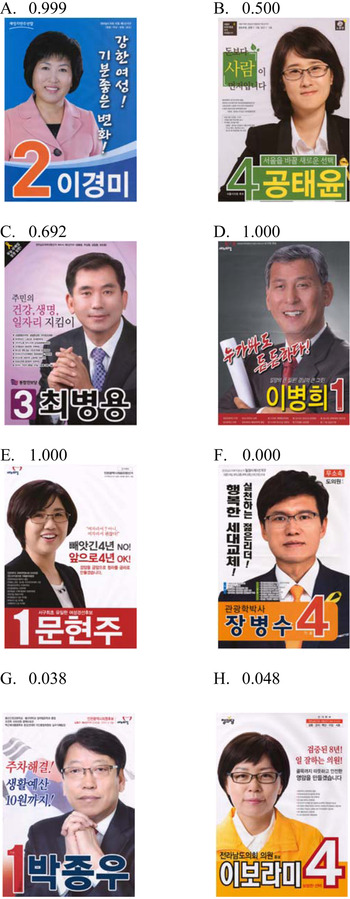
A few selected posters from the data sample are shown in Figure 1. The average smile score is .78, with a standard deviation of .37, as presented in Table 1. As is clear from the posters, a majority of the candidates exhibited a full smile, which contradicts a common observation that Koreans tend not to smile very much. This recognized preference for smiling less may be attributed to the relative homogeneity of Korean society, as a study of emotional expressions across 32 countries argues that cultures lacking a history of immigration tend to eschew smiling (Neidenthal et al. Reference Niedenthal, Rychlowska, Wood and Zhao2018). A rival hypothesis suggests that it may be due to Confucian culture's emphasis on emotional restraint (Wu Reference Wu and Bond1996). In any case, smiles in candidate posters seem to be far more common than expected in cultural context.
Smile scores of candidates: Selected examples.

Control Variables
As a control variable, I included ballot position, as it is well understood that candidates in the top positions on the ballot tend to receive more votes in elections (e.g., Brockington Reference Brockington2003; Koppell and Steen Reference Koppell and Steen2004; Lutz Reference Lutz2010). In Korea, candidates are assigned a ballot number according to their party's seat share in the National Assembly and listed on the ballot papers according to this order. Candidates of fringe parties with no member seated in the National Assembly, as well as independent candidates, are placed in the lower position of the ballot paper. Thus, which number will be assigned is somewhat predictable even months before elections and confirmed upon the completion of candidate registration.Footnote 4 In the 2014 local elections, Three political parties—the Saenuri (SP, assigned 1), the New Politics Democratic Party (DP, assigned 2), and the United Progressive Party (UPP, assigned 3)—received a nationwide fixed ballot number, which other parties were banned from using. While the Justice Party (JP) was assigned four as its ballot number, it could be shared by other parties or independent candidates when no candidate from the JP ran in the district electoral race.
I also controlled for incumbency status (1 for incumbents, 0 if not). Political scientists broadly recognize the electoral advantage of incumbency (Cox and Katz Reference Cox and Katz1995; Jewell and Breaux Reference Jewell and Breaux1988). Incumbents tend to enjoy greater name recognition in their district and beyond, and in Korea, where election campaigning is strictly regulated in various ways (e.g., canvassing is banned, and campaigning activities are severely restricted in duration), the incumbency effect is assumed to be substantial. Furthermore, if the number of times a candidate has run for election serves as a proxy for experiences in politics, it might be assumed that the more times a candidate has run for election, the more votes he or she is likely to receive.
I controlled for criminal convictions, as these public records provide information on a candidate's unlawful behavior and thus may influence electoral outcomes. An analysis of National Assembly election outcomes supports the negative impact of criminal conviction records on candidate electoral fortunes (Yoon and Song Reference Yoon and Song2019). Criminal conviction records are reported by law in candidate pamphlets that are delivered to individual households during a campaign period, as well as on the Election Commission website.
I used two different measures of age. One is the candidate's biological age in the election year, which candidates are obliged to report to the Election Commission. The other is the age estimated from that candidate's poster by the facial detection system. As star brightness is measured in terms of both apparent magnitude (how bright the star appears from Earth macroscopically) and absolute magnitude (the actual luminosity of the star), age measurement is more than a question of years of life. For instance, as assessed by Face API, women candidates appeared on average 16 years younger than their biological ages, while men appeared 11 years more youthful than raw birth data would suggest. The Pearson correlation between the two age variables is .577 (p < .0001).Footnote 5
While both age variables may signal levels of competence or maturity the paths by which this information is delivered to voters differ. While voters can obtain information on candidate age in various ways—for example, by visiting the Election Commission's website or through the media—candidates rarely include this information on their posters. On the other hand, apparent age is quickly and intuitively inferred by exposure to campaign posters. Thus, candidates may strategically mold their photos to look younger or older than their biological age, especially in societies believed to award advantages to those who look young, such as East Asia.Footnote 6 I use both age variables, assuming that each may separately influence voting decisions and, therefore, aggregate election outcomes.
Lastly, I included regionalism as a control variable (1 if a candidate runs in a district that is their party's regional stronghold and 0 if otherwise). Since the regime transition in the late 1980s, regional voting has been the most salient and persistent pattern in every election in democratized Korea. Jeolla provinces have been impregnable strongholds for the DP, and Kyoung-sang provinces for the SP. DP candidates running in Jeolla districts and SP candidates in Kyoung-sang districts were assigned 1 (otherwise, 0).
RESULTS
Do women candidates smile more than men? The results of a simple bivariate t-test showed that the difference in smiles between men and women was statistically significant (p = .018 in a two-tailed test). The mean smile value for men is .77 with a standard deviation of .37; for women, by contrast, the mean smile value is .83 with a standard deviation of .35.
To assess the gender difference in smiles in electoral competition, I ran generalized linear regression models, using the smile index as a dependent variable.Footnote 7 Apparent age was not included in the model, since it is instead a photographic outcome, unlikely to affect a candidate's intentional or unintentional decision about their facial expression. I also excluded regionalism as a dummy variable; while regionalism plays a crucial role in election outcomes, it is unlikely to dictate candidate facial expressions in campaign posters.
Table 3 presents the multivariate regression results. As expected, smiling is correlated with candidate gender, supporting H1. Women candidates score .09 higher on the smile index than men, after controlling for other factors. Put differently, women convey a smile that is 9% more intense than their male counterparts in their election posters. Another interesting finding is that younger candidates tend to smile less.Footnote 8 This may be a strategic decision to look more serious or more emotionally mature to compensate for their young age, as Korean politics has been called an “old men's club.” On the other hand, the more intensive smile of old candidates may be aimed to appeal to young voters, signaling their flexibility and approachability. The significance of gender and age remained when seven ballot number dummies (as proxies for political parties) were controlled for in Model 2. Another significant correlate is ballot number. The better positioned a candidate is on the ballot, the more they smile, holding several other factors constant. Gender, age, and ballot number are consistently significant in a regression model controlling for regionalism (Model 3).Footnote 9
Female candidates smile more than male candidates in election posters (generalized linear regression)

Notes: The dependent variable is the candidate smile score; SE are clustered errors of regression coefficients at the region level (17 regions); N = 1,643.
* p < .1; ** p < .05.
Does smiling matter for the electoral performance of both male and female candidates to the same extent? Alternatively, does smiling matter more for women than for men, as predicted by the simple, conventional view of political gender stereotypes? Table 4 presents the results from three ordinary least squares (OLS) regression analyses.Footnote 10 In Models 1–2, the pooled sample including both men and women was used. Model 1 is a baseline model testing the independent effects of the variables without an interaction term; Model 2 includes the interaction effect between candidate gender and smiling, not allowing other variables’ coefficients to differ between male and female groups. The model specifications of the two separate regressions in Model 3 are identical to Model 1, except that Model 3 allows all coefficients to differ between men and women candidates.
The gendered impact of smiling on vote share is limited: OLS models with two-way interaction term (candidate gender and smiling)

Notes: The dependent variable is vote share (percent); Model 3 shows the separate regression results for male and female candidates; the cell entries are coefficients; the robust standard errors (in parentheses) are clustered errors of regression coefficients at the region level (17 regions).
*p < .1; ** p < .05.
The results from Model 1 suggest that all but apparent age are significant. In particular, the results affirm the claim that nonverbal communication is consequential for elections. As expected, the effect of smiling as a single independent variable is significant, and its significance remains in Model 2 as well. This finding supports H2, namely, that candidates smiling more intensively receive more votes than candidates smiling less. For example, from Model 1, vote share increases by 3% when a candidate chose to smile fully (smile score = 1) instead of not smiling at all (smile score = 0). In Model 2, the coefficients of the interaction term and the smile variable indicate that the positive smiling effect for women is two times larger than that for men. However, the insignificant interaction term of smiling and gender presents weak evidence that the smiling effect differs between male and female candidates.
For further examination, I separated the sample into male and female groups and compared the results (Model 3). First, across the two groups, ballot position, the number of candidates, the number of times running in elections, incumbency, and regionalism are significant in the same, expected directions. As expected, the better (the higher) positioned on the ballot, the fewer the number of candidates, and the more experienced in electoral markets, the more votes one can expect to receive. Incumbent status and running in a traditional stronghold are also factors increasing candidate vote share. These variables are consistently significant throughout Models 1–3.
By contrast, smiling, both age variables, and criminal convictions are significant only for one gender group. First, while smiling is positively associated with vote share for both groups and the magnitude of the effect is larger for women, it is significant only for men. Conviction records are also significant only for men and negatively associated with votes. Additionally, the impacts of candidates’ true age and AI-estimated age are much larger for women than for men, and they have a significant effect only for women. Interestingly, true age and image age have the opposite signs for female candidates: the former is positive, and the latter is negative. In other words, both old age and a youthful look give an advantage to female candidates.
While the parallel contrast of the true age and appearance age effects may sound puzzling for those unfamiliar with Korean society, it seems to reflect the Confucian context in which age is associated with wisdom and power, on the one hand, while baby-facedness is nowadays an essential element of beauty on the other. In Korea, baby-facedness has widely been viewed as a desirable quality, especially for women; however, it is beyond the scope of this study to discuss when or why apparent youthfulness became a virtue.Footnote 11 Whatever the historical reasons, Korean candidates are incentivized to look younger than their age, especially if they are indeed older, by frequently turning to computational graphic editing programs or medical and cosmetic assistance. The significance of the two age variables for women contrasts with its insignificance (and much smaller coefficients) for men, as well as the significance of criminal convictions for male candidates’ electoral fortunes.
From Table 4, it is hard to conclude that the positive effect of smiling on vote share is more pronounced for women than men (H3). Models 2 and 3 in Table 4 lend support for claiming a limited impact of gender stereotypes on election outcomes. Nevertheless, the results do not conflict with the conventional wisdom that women are judged more by shallow cues than men. This ambivalence suggests that we consider contextual factors across electoral races to reveal the subtle mechanisms by which voter gender stereotypes operate.
Table 5 presents the results from three models that include a district-specific context variable, the number of competing candidates. Models 1–2 use the pooled sample. Model 1 tests the interaction between smiling and the number of candidates to assess whether the smile effect depends on the number of candidates, a proxy measure of information costs (H4). Model 2 includes a three-way interaction among smiling, the number of candidates, and candidate gender to test whether the effect of smiling on vote share depends on both information costs and candidate gender (H5). Lastly, Model 3 examines the main and interaction effects of smiling, separately for male and female candidates, as well as the difference in the correlates of candidate electoral fortunes between men and women.
The gendered consequence of smiling on vote share stands out: OLS models with three-way interaction term (candidate gender, smiling, and number of candidates)

Notes: The dependent variable is vote share (%); Model 3 shows the separate regression results for male and female candidates; the cell entries are coefficients; the robust standard errors (in parentheses) are clustered errors of regression coefficients at the region level (17 regions).
* p < .1; ** p < .05.
To begin, the results of Model 1 offer evidence for the prominence of positive emotional expressions as cues when voters must decide among several candidates about whom they know almost nothing. And the significant effect of the interaction term of smiling and the number of candidates in Model 1 points to the electoral premium of smiling in multicandidate elections (H4). Indeed, the smiling effect depends on the number of candidates, and it does not operate independently (the independent effect of smiling is insignificant). All other variables are significant in the same direction as in the Models 1 and 2 in Table 4.
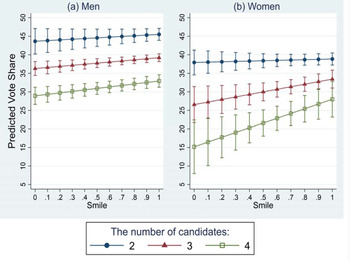
The second model examines the presence of the gendered effect of smiling and whether it varies with the number of candidates. Here, only the coefficients of smiling and the number of candidates are allowed to differ, with the coefficients of all other variables being restricted so as to be the same between the two gender groups. The results suggest that the smile effect depends not only on the number of competitors in the race but also on candidate gender (H5). Figure 2 illustrates how the number of candidates conditions the slope of smiling, first for men and then for women, as estimated from Model 2. For men, the smile effect varies only slightly across the number of candidates in the district (Panel a). Indeed, the predicted vote share increases by less than 2% (from 43.6% to 45.5%) when the smile score changes from 0 (complete absence of a smile) to 1 (full smile) in two-candidate races, holding other variables at their mean. With an equivalent shift in smiling in four-candidate elections, the margin of the predicted votes share doubles (by four percentage points, from 28.9% to 32.9%). This is in sharp contrast to the female group whose smiles exert a marked impact depending on how many candidates run (Panel b). In two-candidate races, the predicted vote share of female candidates rises by only one percentage point from 37.9% (zero smiling) to 38.9% (full smiling). But in four-candidate races, the difference in vote share between zero smile and a full smile is nearly thirteen percentage points (14.9% of the district votes in the absence of a smile and 28.02% of the votes in the presence of a full smile). Finally, it should also be noted that other variables (biological age, ballot number, the number of candidates, previous election experience, convictions, incumbency, and regionalism) appear in their expected directions and are statistically significant in both Models 1–2, except for the insignificant variable of apparent age.
The effect of smiling differs between male and female candidates. Smiling women receive significantly more votes than their non-smiling counterparts, as the number of competing candidates increases. Smiling matters to a much lesser degree for men. Predictive margins with 95% confidence intervals from the results of Model 2 in Table 5.

Is the predicted change in vote share created by smiling somehow decisive in determining winners and losers? Figure A1 in the appendix presents the distribution of candidate vote shares. The average vote share for the losers (N = 991) was 28.54%. Among the losers, 29 candidates (2.93%) fell short of victory with a margin of less than 1% of the votes, and 128 candidates (12.93%) lost with a margin between 1% and 5%. The highest vote share among the losers was 49.92%, marking the narrowest defeat: only 0.15% differentiated winners from losers in that contest.
The average vote share of the winners (N = 647) was 55.45%. Among the winners, the lowest vote share was recorded by a female candidate from the DP in Yeosu, a district of the DP's invincible stronghold. She received 29.59%, defeating the other four candidates from her party. In her poster, she smiles (.999, Figure 1, A) more broadly than the average candidate smile in her district (.937). In this district, where regionalism has long dominated politics, the margin of victory between her and the second-place candidate was less than eight percentage points. It is also interesting to note that the lowest vote share (12.6%) came from the least smiling candidate (smile = .692, Figure 1, C) of the five. In sum, smiling can be consequential for women candidates running in fierce, competitive elections. This suggests that voters use the shallow cue of emotional displays and see politicians through the lens of gender stereotypes when faced with the task of choosing among multiple candidates in low-information settings.
In the third model in Table 5, I compare the correlates of candidate electoral fortunes between female and male candidates and examine whether the number of competitors conditions the smile effect differently for men and women. The separate regressions demonstrate a stark difference in the set of significant correlates. Although regionalism, incumbency, ballot position, and the number of competitors are the common factors, revealing the expected signs for both groups, the results demonstrate that voters use different criteria for male and female candidates. Conviction records are taken seriously for men but not for women, while age and facial youthfulness are associated with votes for women but not for men. For example, among female candidates over age 50 in the sample, those who look as young as 20 years old are estimated to receive a vote share of 48.5%, while those who appear 60 years old are predicted to earn only 32.26%, when other variables are held at their means (estimated from Model 3 for women in Table 5).Footnote 12 More importantly, neither as a main effect nor as an interaction with information costs is smiling significantly related to electoral performance for men. By contrast, the smile effect is significant and much greater in magnitude for women, controlling for other variables.
CONCLUSION
This study seeks to use a recent technological tool to address traditional questions in political science that arise from the gap between the frequently observed fact that women are often judged by their physical appearance and the lack of empirical evidence supporting the relevance of gender stereotypes in elections. By connecting the literature on gender, nonverbal displays, and elections, this study offers evidence that female candidates smile more than male candidates and that the smile effect varies with electoral context. Indeed, two-candidate races mitigate the smile effect for both male and female candidates. Multicandidate races, however, magnify the smile effect for women, while the effect varies little with the number of candidates for men.
The results highlight the role of gender stereotypes in elections entailing high information costs. The democratic expansion of public life has asked citizens to vote more frequently, and due to the multitude of elections in daily life, not all will be regarded as equally crucial by the media and voters. Furthermore, facing a series of choices among several unfamiliar candidates across different levels of public office, voters are easily fatigued and rely more on shallow cues and predispositions, rather than comprehensive evaluations of candidate platforms or performance. The evidence from this study suggests that gender stereotypes are activated particularly under the conditions of high information costs.
Perhaps this, in turn, results in women feeling pressured to perform considerable emotional labor in terms of public facial displays and to conform to common female stereotypes, especially when markets—whether for marriage, labor, or public office—are competitive. While women remain tokenized in various socially important positions, the gender handicap may lead women aspiring to traditionally male-dominant roles to make even greater efforts to look cheerful when faced with fierce competition. A significant body of literature has claimed that presenting as a caring mother or as kind, supportive, and protective is a common strategy for female electoral candidates (Carlson Reference Carlson2001; Kahn Reference Kahn1996; Senior, Ridout, and Stewart Reference Senior, Ridout and Stewart2019; Williams Reference Williams, Cook, Thomas and Wilcox1994). The results of this study suggest that this campaigning strategy is powerful for women candidates facing many competitors, but it may not be universally viable.
While it remains puzzling that, in many opinion surveys, women self-report experiences of happiness more than men, despite relatively lower social status and income (e.g., Helliwell, Layard, and Sachs Reference Helliwell, Layard and Sachs2012), this study offers a clue to understand why women, even those seeking political power, are often observed to display a happier face than men in public appearances. The gender gap in smiles in elections is likely to persist where there are many candidates and where facial displays are readily available information. In fact, in the 2014 Korean provincial legislative elections, districts in which at least one female candidate ran were more crowded than male-candidate-only districts. The average number of candidates for the former was 3.02, whereas for male-only districts the number was 2.68. Apparently, women tend to face a higher number of competitors, and this leads to an additional burden of displaying smiles in low-information elections.
Several interesting questions arise from this study. For instance, is the gender gap in candidate smile peculiar to democratic electoral processes, or can it be observed in elections in less democratic states, such as competitive authoritarian regimes or village-level contests in China? On the voter side, how do voters’ own gender stereotypes determine their evaluation of female candidates’ smiles? Which voters are more likely to respond positively to female politicians’ smiles or to punish those who choose not to represent themselves in this way? Ultimately, do gender stereotypes, combined with a plethora of elections, degrade the quality of democracy by encouraging irrational voting? Delving into these questions in future studies will help us better understand the mechanisms by which gender stereotypes operate in democratic processes, as well as the role of nonverbal expressions in political life.
SUPPLEMENTARY MATERIAL
To view supplementary material for this article, please visit https://doi.org/10.1017/S1743923X20000379