




Introduction
The proletarianization of maritime labour in nineteenth-century Liguria was a multidimensional process shaped by institutional reform, ownership reorganization, and market integration, rather than by technology alone. These forces jointly reconfigured recruitment, authority, and remuneration at sea. In the first half of the nineteenth century, Liguria’s seafaring world still revolved around small sailing vessels, family partnerships, and communal forms of labour. Most Genoese-owned ships traded along the coasts or fished the Mediterranean, while a few larger craft – between 300 and 500 tons – carried passengers across the Atlantic. Ownership and employment were intensely local: crews were recruited from the same coastal towns that financed the ships, and the surplus of seamen fostered a tight labour market regulated by kinship, neighbourhood ties, and reputation. The captain – most often both master and owner – stood at the centre of this system, combining nautical authority, labour discipline, and participation in the commercial outcome of the voyage. Under contracts based on shares (alla parte), sailors were not simply paid for time worked: in favourable circumstances, some could accumulate small sums, reinvest earnings in trade, or eventually purchase a share of a vessel.
In 1881, Captain Giuseppe De Rossi, a Roman shipmaster and shipowner, portrayed this world as proof of the Italian merchant marine’s backwardness.Footnote 1 Writing on the eve of a parliamentary inquiry into maritime conditions,Footnote 2 he blamed Ligurian traditionalism for the sector’s “miserable state”. His opinion was not disinterested: Genoese shipowners and seafarers, dominant in Italian shipping since unification, were his main competitors. Yet De Rossi’s caricature contained elements of truth. From the 1820s to the 1870s, under the Sardinian flag, countless Ligurian shipowners and captains had prospered during what later generations called the “golden age of sail”. In that era of technical maturity for sailing vessels, the shipping industry achieved exceptional economic results. Unlike the later nineteenth century – when large Genoese companies and industrial trusts prevailed – earlier shipping capital was dispersed among numerous small-scale proprietors rooted in coastal villages. These men typically began as sailors, saved from their wages or voyage shares, and eventually became owners. Strong communal ties shaped recruitment: they preferred local crews, often relatives or neighbours. Thanks to this cohesion, small maritime centres long devoted to coastal trade, such as Camogli, Chiavari, or Loano, established durable footholds in major routes like the Black Sea grain trade and early transatlantic passenger services. Camogli emerged as the most successful, surpassing Genoa and almost every Mediterranean port in fleet tonnage by the early 1880s.Footnote 3
Few of these communities, however, managed to adapt to the profound technological and market transformations that followed. The spread of steam navigation, the introduction of iron-hulled sailing ships, and the opening of the Suez Canal in 1869 acted in concert to transform the maritime economy. These concurrent innovations raised investment thresholds, altered the geography of trade, and intensified competition in an already fragile market. In 1876, the Italian merchant marine still employed over 153,000 seafarers,Footnote 4 but the number declined steadily in the following decades, returning to that level only around 1906.Footnote 5 At the same time, new occupations born of steam – engineers, firemen, stokers – expanded rapidly, while many traditional sailors abandoned the profession or emigrated overseas. The maritime labour force was thus transformed in both scale and composition.
Analytically, the proletarianization of maritime labour is approached as the outcome of intersecting processes rather than a linear effect of technology. Institutional reform codified skills and closed informal advancement; ownership reorganization reallocated authority and risk; and market integration reshaped the supply of labour. Together, these mechanisms linked the micro-level of manning practices to the macro-level transformations of maritime capitalism.
Camogli offers a strategic vantage point from which to observe these processes in interaction. It is not treated here as an exceptional anomaly, but as a particularly revealing vantage point on wider nineteenth-century transformations in maritime labour. Its significance lies in the unusual combination of features it combined: a strong community-based sailing tradition, early insertion into Black Sea and Atlantic circuits, dense archival traces on crews, careers, and wages, and a late but intense exposure to the institutional and economic pressures associated with the transition from sail to steam. Precisely because Camogli remained deeply rooted in an older maritime social order while becoming increasingly entangled in global shipping networks, it allows us to reconstruct how market integration, professionalization, and the reorganization of ownership interacted in practice. Through this lens, the article traces how a community of shipowners and seafarers moved, between the 1830s and World War I, from locally crewed, share-based enterprises to nationally and globally integrated wage labour. The analysis proceeds from crew composition and recruitment to labour structures and careers, and finally to the transformation of remuneration. Taken together, these dimensions reveal how technological, institutional, and market change combined to erode the communal organization of maritime work and produce a wage-dependent labour regime.
Crew Origins
At mid-century, the core features of sailing labour in Liguria still resembled those of the late early modern period. Yet practices varied by sector: cabotage used smaller crews and looser hierarchies, while deep-sea navigation had long required stricter ranks and finely divided tasks.Footnote 6 Recruitment was initially highly endogenous – that is, crews were drawn primarily from the owner’s locality and kin networks – so that manning overlapped with community membership. Camogli’s fleet, which shifted over a few decades from coastal trades to oceanic routes, operated almost as a single local labour pool but with three moments of specialization: (a) early-century fishing and charcoal traffic from the Tuscan coast; (b) Black Sea grain routes in the 1840s–1860s;Footnote 7 and (c) late-century oceanic tramping in low-value bulk (guano, ore, timber, rice).Footnote 8 Each phase carried distinct manning patterns and forms of remuneration.
As seen, contemporaries described Ligurian crews as “emigrating families” because of their exceptionally endogenous composition – Camogli included. This held while ships remained within the Mediterranean and until Italian unification (1861) began integrating previously separate labour markets. Direct evidence for the earliest phase is limited, but a sample of twelve Camogli vessels in 1828 (charcoal trade) shows 150 of 156 seafarers (96.15 per cent) resident in Camogli at enrolment.Footnote 9 Surnames prominent in later shipowning (Schiaffino, Lavarello, Mortola, Bertolotto) already dominated the lists.Footnote 10 In short, an early-modern local labour market prevailed, with strong exclusivity by origin and potential vertical mobility within the community.Footnote 11 Yet endogeneity also carried its own constraints. Discipline aboard rested less on formal sanction than on the mechanisms of honour and shame intrinsic to close-knit communities: a captain could check insubordination not merely through contract, but by threatening a sailor’s reputation before his family and neighbours at home. At the same time, the closed recruitment circuit precluded the cultural contacts and comparative wage information that, in later decades, would allow seamen frequenting foreign ports to leverage desertion and labour mobility as genuine bargaining tools.
Richer mid-century data reveal how rising demand for manpower forced adjustments that local supply alone could not meet. Table 1 (1853–1865) and Figure 1 confirm Liguria’s continued centrality (86.16 per cent of personnel overall; 38.69 per cent from Camogli itself) while documenting a steady broadening of origins. This coincided with a functional reorientation of Camogli shipowning: Genoa became the operational hub – because Camogli’s anchorage was limitedFootnote 12– and ships routinely sailed from and returned to Genoa to discharge Black Sea cargoes, refit, and winter. Masters (almost all Camogliesi) could thus draw on Genoa’s larger urban labour market, extend recruitment to the Western Riviera, and, as the town’s success grew, attract in-migrants to Camogli itself.Footnote 13 This transition from purely local to regionally mixed crews did not dissolve the communal logic of manning; rather, it represented an intermediate stage, where community and market still coexisted. Recruitment expanded, but remained embedded in kinship and regional familiarity, delaying the full commodification of labour that would come with global routes and Atlantic migration.
Place of residence of Camogli’s maritime personnel (1853–1865)

Table 1 Long description
Places of residence for Camogli’s maritime personnel are listed with counts and percentage shares for 1853 to 1865, grouped by region and then by specific towns. Eastern Liguria accounts for 1,156 people, or 62.72 per cent, with Camogli the largest single place at 713 people, or 38.69 per cent. Other notable Eastern Liguria locations include Recco at 67 (3.64 per cent), Santa Margherita at 64 (3.47 per cent), Lerici at 52 (2.82 per cent), and an Eastern Liguria “Others” category at 72 (3.91 per cent). Genoa contributes 286 people, or 15.52 per cent, making it the second-largest origin after Camogli. Western Liguria totals 146 (7.92 per cent), with most of that in “Others” at 71 (3.85 percent) and smaller entries such as Savona at 25 (1.36 percent). Tuscany is 53 (2.88 per cent), led by Porto Ferraio at 16 (0.87 per cent) and Livorno at 15 (0.81 per cent). Non-Ligurian and international origins are comparatively small: Two Sicilies 54 (2.93 per cent), Italian Adriatic 31 (1.68 per cent), Austrian Empire 31 (1.68 per cent), Greece 26 (1.41 per cent), and a final “Others” grouping of 52 (2.82 per cent). Several rows use “Others,” so some smaller places are aggregated rather than individually listed.
Source: Data processed from ASGe, Ruoli di equipaggio, 1853–1865.
Place of residence of Camogli’s maritime personnel (1853–1865).

The geography of exogenous recruits mirrored voyage patterns. From Livorno to Istanbul, via Messina, vessels picked up replacement hands along the route to and from the Black Sea. Istanbul – a permanent staging point – was a centre for crew changes and explains the high presence of Greek seafarers, then dominant across the Aegean and Black Sea.Footnote 14 In the Danube ports (Galați, Brăila), Camogli masters encountered the Austrian maritime world; at Malta and the Straits of Gibraltar they met British seamen;Footnote 15 and in the United Kingdom, where grain was increasingly discharged from the 1860s, they recruited men seeking Mediterranean return passages – often Neapolitans, Greeks, or Austrian subjects.Footnote 16 This first stage of change marked the gradual shift from an endogenous model of recruitment to a broader, internationalized system driven by trade expansion, growing labour mobility, and the increasing integration of the international maritime labour market. In this respect, Camogli exemplified a wider trajectory common to many traditional sailing communities, where recruitment progressively extended beyond the locality without immediately dissolving older communal structures.Footnote 17 During the Black Sea phase, the enlargement of crews’ geographical origins did not yet amount to a fully commodified labour market. Recruitment remained partly embedded in proximity, kinship, and regional familiarity, even as the operational horizons of shipowners and masters widened.
Even so, the gradual internationalization of crews had social implications aboard. The available evidence does not support a systematic reconstruction of everyday relations within mixed crews, nor firm conclusions about the frequency of conflict between men of different origins. It does suggest, however, that the older communal model of manning was becoming harder to reproduce. As crews came to include men drawn from different ports, languages, and social backgrounds, ships could no longer rely to the same extent on the dense framework of familiarity, kinship, and reputational trust that had long underpinned discipline in highly endogenous maritime communities.Footnote 18 One case – an altercation involving a sailor from Torre del Greco, a Cypriot seaman, and an Istrian ship’s boy that escalated into a stabbing following an alleged sexual assault – captures how conflicts could arise from the collision of distinct honour codes and communal norms in the confined space of a sailing ship.Footnote 19 Yet such episodes are best treated not as proof of a wholly new regime of onboard sociability, but as signs that older forms of cohesion were under strain. The same caution applies to behavioural change. It would be too strong to claim that the mere presence of foreigners directly produced indiscipline aboard Camogli vessels. Yet scattered evidence from late nineteenth-century Italian shipping suggests that behaviours long associated with Atlantic seafaring were becoming more visible in Mediterranean crews as well. British observers in the 1860s still contrasted the relative sobriety of Mediterranean mariners with the alcoholism that afflicted the British merchant marine,Footnote 20 but by the late nineteenth century cases of drunkenness and public disorder appeared more frequently in Italian documentation.Footnote 21 Sometimes the protagonists were foreign seamen, as in the case of the Chilean G. Fé Burton, who provoked a violent confrontation involving the master and two sailors in Cardiff;Footnote 22 in other cases, Italian sailors themselves were involved in drunken incidents, including fatal falls into the water while attempting to return on board at night, or serious injuries after stumbling aboard ship.Footnote 23 Such episodes do not establish a direct causal link between foreign recruitment and indiscipline. They do, however, suggest that as crews became more heterogeneous and Mediterranean shipping entered Atlantic circuits more fully, Camogli vessels were also drawn into a broader maritime culture in which older communal mechanisms of control were harder to sustain.
After the “golden age” (1850s–1870s), global and local shifts produced a longer phase of resilience before World War I ended Camogli’s sailing era. To survive between the peak (probably 1874–1875) and 1915, owners abandoned the Black Sea, entered the British freight market, and accepted peripheral bulk routes. Some purchased second-hand steamers on the British market for short-haul tramping.Footnote 24 These strategic moves reshaped onboard labour, especially manning.Footnote 25
Table 2 (1886–1914) and Figure 2 show a further, significant, change. Camogli itself still supplied a large share (29.85 per cent, down from 38.69 per cent), but Eastern Liguria lost about a third of its weight. Part of this reflects in-migration into Camogli and the broader urbanization of Genoa, whose contribution rose (from 15.52 per cent to 22.64 per cent) as its population nearly doubled (1861–1911). More broadly, non-Ligurian origins increased from 7.49 per cent to 23.63 per cent, signalling the national integration of maritime labour markets in shipping. The economics behind this are consistent with contemporary wage data. According to evidence reported in the Inchiesta,Footnote 26 two decades after unification, able-bodied (AB) seamen’s wages in Genoa remained markedly higher than those in Southern ports, a differential that gradually narrowed during the 1870s but continued to encourage northward labour flows.
Place of residence of Camogli’s maritime personnel (1886–1914)

Table 2 Long description
Places of residence for Camogli’s maritime personnel are listed with counts and percentage shares, grouped by Italian regions and several foreign areas. Eastern Liguria is the largest origin at 151 people, 37.56 per cent, driven mainly by Camogli with 120 people, 29.85 per cent; La Spezia adds 28 people, 6.97 per cent. Genoa is the next major single place at 91 people, 22.64 per cent. Other Italian areas are smaller: Southern Italy 38 people, 9.45 per cent; Tuscany 35 people, 8.71 per cent; Western Liguria 26 people, 6.47 per cent; and the Upper Adriatic in Italy 22 people, 5.47 per cent. Foreign residences are limited, led by the Austrian Empire at 10 people, 2.49 per cent, and the Iberian peninsula at 8 people, 1.99 per cent; UK and Northern Europe totals 14 people, 3.48 per cent, spread across Cardiff, Hamburg, and other locations. Several categories labeled “Others” appear within regions, indicating small residual groups rather than specific places.
Source: Data processed from ASGe, Giornali nautici, 1886–1914.
Place of residence of Camogli’s maritime personnel (1886–1914), Liguria excluded.

A second late-century shift is the rise in the proportion of foreigners: 9.71 per cent of workers in 1886–1914 versus 5.91 per cent in 1853–1865. This reflected the move from the Eastern Mediterranean to Atlantic circuits. Cross-checking embarkation ports shows that most foreigners joined abroad: Cádiz (salt, outbound to the Atlantic), Pensacola (pitch-pine timber), Santos, New York, and Buenos Aires. Yet the widening of these routes affected crew composition not only by enlarging the pool of available labour; it also made crews less stable, because oceanic shipping increasingly overlapped with the geography of Italian mass migration.
For many would-be migrants, signing on for an oceanic voyage offered a cheaper alternative to purchasing a passenger ticket. When, after formal enrolment, they remained ashore at their destination instead of returning on board, contemporaries classed this behaviour as desertion. In legal terms, desertion referred not simply to men leaving a ship, but to seafarers entered on the crew list and bound by an enrolment contract who failed to embark or abandoned the vessel without a formal authorization by the local consuls.Footnote 27 Desertion, therefore, was both a breach of labour discipline and a punishable maritime offence. Especially in Latin America, this became a chronic problem for Italian shipping in the second half of the nineteenth century. A royal commission (December 1868) investigated remedies;Footnote 28 its proceedings noted a disproportionate share of Ligurians among deserters (52.8 per cent), even allowing for their large presence in the national seafaring population (c.24.8 per cent).Footnote 29 Unlike northern European patterns – where desertion in British and US ports often meant immediate re-engagement under higher-paying flags – Italian desertion in South America tended to imply permanent settlement.Footnote 30
The phenomenon mattered not only because of its scale, but also because enforcement was limited. Although the law provided for sanctions, repression in overseas ports was difficult, costly, and often ineffective. Captains had to rely on consular cooperation, local authorities, and uncertain procedures, while commercial schedules left little room for prolonged litigation or delayed departures.Footnote 31 In most cases, moreover, deserters disappeared at the very moment of departure and were almost impossible to trace. What mattered most to captains, therefore, was not recovering the absconder but meeting the immediate need to complete the crew and resume the voyage. The real tension lay elsewhere: while shipowners demanded harsher penalties in order to deter desertion, the cumbersome machinery of enforcement and the relative ease with which sailors could abscond made such deterrence difficult to achieve. This was one of the concrete mechanisms through which Atlantic migration reshaped crew composition.
For Camogli shipmasters, the main consequence was practical, not judicial. Since pursuing deserters in overseas ports was difficult and costly, masters often replaced them locally, hiring any competent hands they could find. When possible, they recruited Italians for the homeward leg; otherwise, they turned to foreigners. The barque Cadice illustrates the process.Footnote 32 After seven men deserted in Buenos Aires, the master recruited two Italians (Palermo, Castellammare), three Britons, one Portuguese, and one Argentinian. In Pensacola, six disembarked; to return to the Mediterranean he shipped two Britons, two Germans, one Dane, and a New Yorker. Thus, a vessel that had left Marseille in June 1897 with twelve Italians out of thirteen (plus one Mexican) sailed from Pensacola in February 1898 with a crew that was more than half foreign. Compared with the 1820s, when crews were almost exclusively local, the transformation was stark.
Only in this third global phase did the communal regulation of labour begin to give way decisively to a more open, commodified, and wage-based workforce. The internationalization of routes did not merely widen recruitment; through migration and desertion, it also weakened the community’s ability to reproduce stable crews from within. In this sense, Camogli’s manning evolved from highly endogenous crews to hybrid national-international compositions. This evolution exemplifies the market-integration channel: as routes globalized, wage differentials and migration circuits connected previously distinct labour pools. Integration, however, came at a cost – the erosion of community-based regulation and a first step toward a commodified maritime workforce.
Labour Structures, Ranks, and Careers
Having examined the origins of seafarers, we can now turn to the internal organization of labour and to the professional hierarchies that characterized Camogli’s maritime system, a revealing expression of the broader dynamics of Mediterranean seafaring. The emphasis on homogeneity aboard, and its gradual loosening, helps explain one of the defining features of this community: the markedly endogenous and communitarian nature of its maritime enterprise, in which kinship, familiarity, and trust permeated all ranks, from master to cabin boy. Cohesive crews created a sense of belonging both vertically and horizontally; men shared language, cultural background, and ties that extended beyond temporary cooperation at sea. Family and community were the foundations upon which maritime trust was built. Many shipmasters were still the owners of their vessels, and relatives filled the senior positions such as mates or boatswains. In several cases the shipowner was a retired captain who placed his sons or brothers on board as trusted representatives. In 1862, for instance, Agostino Degregori, owner of the brig Dante (278 tons), appointed his sons Giovanni Battista and Luigi as master and mate respectively; two years later, once Luigi obtained his licence, he took command, while his brother was given another family ship, the barque Italico (369 tons).Footnote 33
Seafaring careers generally began early, soon after primary school, which for most sailors represented the highest level of formal education. Maritime culture, transmitted through generations, oriented boys toward the sea. Between eleven and fourteen years of age, they joined short voyages to adapt to life at sea and then enrolled as mozzi (ship’s boys).Footnote 34 Before official enrolment, many underwent their “baptism of the sea” in the context of seasonal fishing, where they learned the rudiments of navigation and discipline. Training was an intergenerational and collective process: technical knowledge was transmitted by observation and repetition of daily operations. The community regarded the service of boys less as a source of cheap labour than as an initiation into maturity and a social duty toward younger members. In maritime historiography – particularly in recent studies – the ship’s boy has often been placed within the category of low-skilled or auxiliary maritime labour, alongside figures such as the British ordinary seaman, though not as an equivalent rank.Footnote 35 In the Ligurian and wider Mediterranean context, however, the mozzo had different features. He represented a transitional workforce, socially protected and collectively trained, whose presence ensured the transmission of skills and the regeneration of the seafaring community. Rather than being merely cheap labour, ship’s boys embodied the community’s investment in its own continuity: they performed basic but necessary tasks while absorbing, through imitation and repetition, the practical knowledge of navigation. This function was also reflected in the frequency of kin-based apprenticeship aboard. During the Black Sea phase, for instance, Giuseppe Bozzo served as master while his son Giovanni Battista was enrolled as ship’s boy on the barque N.S. della Concezione (305 tons, 1859);Footnote 36 similarly, Giacomo Schiaffino, owner-captain of the brig Genio (338 tons), embarked Diodato Schiaffino as a boy.Footnote 37 Where ownership and command coincided, family recruitment at the lower ranks was almost automatic. This transitional role persisted well into the mid-nineteenth century, delaying the segmentation of labour that industrialization and the wage system would later impose.
Hierarchy aboard was therefore not a purely formal or imposed order but a lived and spatial one. The division of labour reflected a graduated exposure to risk and responsibility: experienced men worked aloft, handling sails and spars in constant danger, while novices performed their duties on deck, within safer and more supervised spaces. This vertical and functional differentiation gave material form to maritime hierarchy, defining skill and status not only by rank or pay, but also by proximity to danger. In this sense, seafaring discipline combined technical competence with an internalized sense of hierarchy, reinforced by collective norms of courage, trust, and endurance, but also by the limited alternatives available to men at sea.Footnote 38
Alongside the mozzi, crew lists also regularly included giovanotti, a traditional but legally undefined category absent from formal legislation.Footnote 39 They were usually older boys with limited experience or underaged potential sailors who lacked one of the two requirements – eighteen years of age and twenty-four months of navigation – necessary to be classified as marinai, roughly equivalent to able-bodied seamen.Footnote 40 If the mozzo belonged above all to a communitarian logic of apprenticeship and social reproduction, the giovanotto more clearly reveals the presence of a less qualified and more weakly institutionalized layer of labour, in some respects comparable, in terms of skill level, to the ordinary seamen of Northern European fleets.
The marinai themselves formed the bulk of the crews, between half and two-thirds of the total workforce.Footnote 41 Already by the mid-century their local share had diminished: only 27.9 per cent of AB seamen came from Camogli, compared with 48.4 per cent for the rest of the crew. The pressure for manpower affected above all the central ranks rather than the extremes of command or apprenticeship. Boatswains and stewards, usually experienced ABs entrusted with specific responsibilities, occupied an intermediate position between common sailors and officers.
At the top were the officers, generally a master and one mate, who oversaw navigation and discipline. Their training reflected the professionalization of maritime labour in the nineteenth century. Italian law distinguished between padroni for home cabotage (minimum age twenty-two, thirty-six months at sea), capitani di gran cabotaggio limited to the Mediterranean, the Black Sea, and the North Atlantic to Cape Mogador (minimum age twenty-two, forty-eight months), and capitani di lungo corso without geographical restrictions (minimum age twenty-four, forty-eight months at sea, twelve outside great cabotage).Footnote 42 Throughout the second half of the century about two-thirds of Camogli’s masters and mates were still natives of the town, which suggests that shipowners continued to prefer trustworthy representatives rooted in the local community and capable of combining nautical command with the commercial management of the voyage.Footnote 43
Yet this world was changing. In the earlier sailing economy, command, ownership, and commercial discretion had often overlapped.Footnote 44 The master was frequently also a co-owner, or at least a figure embedded in the same kin-based and communal networks that financed the vessel. He therefore embodied at once nautical authority, labour discipline, and a direct share in the risks and returns of the voyage. In that setting, command was not merely a technical qualification, but also part of a broader social position within the local maritime community. From the mid-nineteenth century onward, however, public licensing and compulsory schooling progressively formalized access to command.Footnote 45 In the context of Camogli, the foundation of a nautical school in 1874 marked this transition: after a few years it was licensing nearly 150 students annually, thus institutionalizing a long-standing local competence and producing a large pool of skilled officers.Footnote 46
Professionalization, however, transformed the relations between officers, shipowners, and the rest of the crew. First, as commercial information circulated more rapidly through submarine telegraphy, decisions over employment, timing, and market strategy were increasingly coordinated ashore by owners, correspondents, insurers, and other intermediaries.Footnote 47 In this context, masters did not cease to exercise authority on board; they remained central to navigation and discipline. What changed was the range of functions concentrated in their hands. The commercial side of shipping no longer depended to the same extent on the autonomous judgement of a captain at sea, and command gradually narrowed into a more specialized professional office. What declined, therefore, was not the master’s authority as such, but the older concentration in one person of nautical command, commercial discretion, and property.Footnote 48 The Camogli evidence captures the result clearly. The percentage of owner-captains fell from 44 per cent in 1831 to 15 per cent in 1865 and about 5 per cent by 1900.Footnote 49 This collapse should not simply be read as the disappearance of communal shipping. Family-based ownership persisted, and the communal dimension of maritime enterprise remained strong. Rather, the figures point to a process of functional differentiation: ownership remained often local and familial, but command was progressively detached from direct control over capital and from the commercial management of the voyage.
The role of the local shipping insurance Mutua helps clarify this transition. Its statutes obliged shipowners to prefer captains born in or resident in Camogli, or otherwise to seek the assembly’s approval. This shows that trust and communal regulation remained important even at a late stage. Yet these very rules also indicate that command had become something to be allocated and supervised within a collective institutional framework, rather than simply embodied by the owner-master himself. Originally intended to guarantee reliability, the same system also fostered an ample reserve of qualified officers whose numbers increasingly exceeded local demand.Footnote 50
From the 1880s, as steam competition reduced opportunities in sailing, the sector could no longer absorb this labour supply. Many seafarers, especially in the lower ranks, abandoned the profession or emigrated; in Camogli the rate at which men left maritime careers almost doubled from mid-century to the fin de siècle. Over-qualification produced paradoxical effects: the market was saturated with licensed captains who accepted demotions to mates or even boatswains. Pietro Folle, a sixty-two-year-old capitano di gran cabotaggio, served as mate on the barque Catterina G. under a younger master,Footnote 51 while in cabotage the fifty-one-year-old padrone Prospero Schiappacasse embarked under the orders of Giovanni Battista Bozzo, aged twenty-eight and a relative of the owner.Footnote 52
In theory, the transition to steam offered easier prospects for officers than for sailors.Footnote 53 According to the legal framework, captains did not require specific mechanical training since engineers were responsible for propulsion; therefore, experienced sailing masters could command steamers without additional qualifications.Footnote 54 Even so, some temporarily accepted lower ranks: Prospero Schiaffino, after commanding for more than a hundred months, served as first mate on the steamer Giovanni M. in 1891,Footnote 55 and Antonio Marini, after his first command in 1893, spent fifteen years as second or first officer on steamships before obtaining another command in 1907.Footnote 56 Engineers, by contrast, enjoyed high salaries and status due to their technical specialization. For common sailors, however, the adjustment was difficult. Steamships, although more heavily manned in absolute numbers, required fewer skilled deckhands and more unskilled engine-room labour. A seafaring world once closed and homogeneous became socially stratified: credentialed officers and technical specialists at the top, and a growing mass of unqualified workers at the bottom.
Across the century, the career pattern of Camogli’s seafarers evolved markedly. In the cabotage era, work alternated with periods ashore; short voyages allowed family life and community participation, and the image of the rootless Jack Tar was far removed from reality.Footnote 57 With the opening of oceanic routes, the rhythm changed dramatically: working days per year increased from roughly fifty or sixty per cent in cabotage to ninety or ninety-five per cent in deep-sea trades, where voyages lasted several years. Seafaring became a totalizing profession marked by long absences, intensive labour, and deteriorating conditions due to the decline of tons-per-man ratios and relentless cost-cutting in competition with steam.Footnote 58 Contrary to the opinion that steam reduced labour intensity through faster and more predictable passages, evidence suggests otherwise: the acceleration of turnarounds merely increased turnover, while the average time spent at work remained very high, between eighty and ninety per cent of the year.Footnote 59
For able seamen trained under sail, the transition to steam brought a deeper crisis. The demand for medium-skilled deck labour contracted sharply, and traditional maritime expertise lost its value in a context that rewarded mechanical efficiency rather than craft knowledge. For the first time in a region so heavily maritimized as Liguria, seafaring tradition ceased to be an asset. By the turn of the century the relative centrality of sailors aboard had diminished, less through wage reductions than through the scarcity of positions and the disappearance of shared participation in voyage profits. Their progressive exclusion from ownership and from the risks and rewards of navigation marked one further step in the proletarianization of maritime labour, a process that would reach full maturity with the generalization of wage payment and the decline of the share system.Footnote 60
The Camogli evidence makes clear, however, that steam did not produce this outcome directly. The transition to a wage-dependent labour regime was mediated by three distinct but reinforcing processes. Institutional reform – through licensing, compulsory schooling, and the nautical school – codified access to command and generated a structural surplus of qualified officers that the local market could no longer absorb, blocking upward mobility before steam had even reorganized the fleet. Ownership reorganization – captured in the collapse of the owner-captain and the growing coordination of commercial decisions ashore – severed the link between labour and capital within the ship’s hierarchy, making the communal logic of shared risk and return increasingly untenable. Market integration then completed the process by widening recruitment networks, exposing wages to international differentials, and concentrating Camogli shipping in lower-margin circuits. Steam provided the context in which these three processes converged and became irreversible; it was not the mechanism that produced proletarianization.
Shares and Wages
Recalling once again De Rossi’s remarks, we may note how he claimed that, in mid-nineteenth-century Liguria, “the contracts are thus made according to gains, or, as commonly said, divided into shares. Each crew member is thus associated with the venture”.Footnote 61 His intention was to denounce the alleged backwardness of Ligurian shipping, still tied to pre-modern forms of organization. Yet, beyond his polemical tone, De Rossi’s depiction was only slightly anachronistic. Profit-sharing systems had long characterized Ligurian maritime labour, persisting well into the modern age. Throughout the history of navigation, seafarers’ remuneration took three main forms: participation in profits (shares), single-voyage lump sums, and monthly wages. Their use varied by sector: as noted by Marcus Rediker, shares predominated in fishing and privateering, lump sums in Northern European cabotage, and wages in long-distance trade.Footnote 62 Ligurian shipping, however, preserved the alla parte system deep into the nineteenth century, adopting wages on a large scale only after mid-century.Footnote 63 Already in 1692 Carlo Targa defined alla parte as “the most common method in small ships, consisting in dividing the freight revenues and the profits of a voyage after deducting expenses”.Footnote 64 This was therefore a form of single-voyage partnership: shipowners supplied hull and gear, and profits were distributed among officers and men according to agreed proportions.
In Camogli, this system remained dominant in cabotage and survived during the expansion to the Black Sea trade: as late as 1859, wages were paid in only 43 per cent of contracts.Footnote 65 Thereafter, monthly salaries gradually replaced alla parte. This shift was not simply a technical adaptation to longer voyages. It reflected a broader reorganization of the shipping enterprise. Profit-sharing had been most compatible with a world in which the voyage remained a relatively bounded commercial unit and in which crew members, however unequally, participated directly in its outcome. As Ligurian vessels entered longer, more volatile, and increasingly multi-stage circuits – such as the wheat-coal exchange between the Black Sea and British ports – and as commercial decisions were more often coordinated ashore, shipowners had stronger incentives to replace participatory remuneration with fixed monthly wages.
Wages made labour costs more predictable, detached seamen from the uncertain returns of each voyage, and concentrated commercial risk and profit more firmly in the hands of owners. By the early 1880s, according to shipowner David Viale, shares survived “only in short-range cabotage, and were already absent from most coal transports from Sardinia and the Maremma”.Footnote 66 The shift from shares to wages also altered the social meaning of maritime work. Under the share system, every man on board was materially involved in the outcome of the voyage: profits and losses were shared, and the success of the enterprise bound owners and crews in a common economic venture. The share proportions, however, were far from equal. Captains and owners commanded disproportionate returns, and the path from common sailor to shipowner, although structurally possible, depended on favourable market conditions, family or communal connections, and accumulated fortune. It was therefore a real but exceptional trajectory.
However, with the spread of fixed wages, this sense of participation gradually disappeared. Sailors were no longer partners in risk and reward but employees performing paid labour, while shipowners came to concentrate both control and profit in their hands. The disappearance of alla parte thus marked a blow to the communitarian framework of maritime labour, closing vertical economic mobility and eroding the material link between skill, risk, and reward. Simultaneously, educational and licensing reforms restricted professional mobility: the lower ranks could no longer rise through experience alone, as they had in the early modern period, when such upward paths were a key attraction of the trade.
During the first decades of the wage system, pay still followed a roughly proportional distribution among ranks, but inequalities widened rapidly thereafter. In the mid-nineteenth century, a shipmaster earned about twice the wage of an able-bodied seaman; by 1900, his income was nearly three times higher. Mates followed a similar trajectory, while boatswains and stewards experienced modest gains. At the lower end, ordinary seamen and ship’s boys saw their relative earnings stagnate or even decline.Footnote 67 This growing gap reflected the premium attached to certified skills and formal education: officers’ pay incorporated the costs of training and licensing, whereas sailors, whose knowledge remained largely practical and informal, lost bargaining power. By the turn of the century, the ship’s hierarchy had become more rigidly stratified, and the social distance between officers and men markedly increased.Footnote 68
This process also restricted avenues for advancement. For medium- and low-skilled sailors, opportunities to improve their economic status were largely external: they could either seek employment abroad or abandon the sea altogether. The wage evidence makes this dilemma visible: when set against the pay offered in major foreign ports, Ligurian earnings increasingly lagged behind. This gap cannot be explained by a general market downturn alone. It may also reflect the specific structure of the Ligurian maritime labour market, which appears to have combined an abundant local supply of seafarers with a still partly community-bound system of recruitment and, by the late nineteenth century, an increasing concentration in the lower-margin segments of global sailing shipping. Under such conditions, shipowners may have been able to contain labour costs more effectively than in the tighter Atlantic labour markets of Britain, the United States, or the Río de la Plata (Figure 3).Footnote 69
Nominal wages of AB seamen (in Italian lira) contracted in Italy, the UK, the US, and South America.

Figure 3 Long description
The graph shows nominal wages of AB seamen in Italian lira contracted in Italy, UK, US and South America from 1860 to 1913. The x-axis represents years and the y-axis represents wages in Italian lira, ranging from 0 to 200. The lines are distinguished by color: Italy (blue), UK (orange), US (gray) and South America (yellow). Trend lines are dashed for each region. Italy′s wages remain constant at 60 lira. UK starts at 120 lira in 1860, peaks at 150 lira in 1862 and stabilizes at 110 lira. US wages rise sharply from 70 lira in 1873 to 140 lira in 1880, then decline to 60 lira by 1887. South America starts at 70 lira in 1896, gradually increasing to 100 lira by 1913. UK generally has higher wages than Italy. US wages spike in the late 1870s, then fall to match Italy. South America shows a gradual rise after 1896. The graph highlights regional wage differences and trends over time.
Wage comparisons reveal how far Ligurian seafarers had fallen behind their foreign counterparts. By the 1860s and 1870s, an able seaman hired in British ports could expect to earn roughly forty per cent more than in Genoa, while pay in the United States was more than double, and in South America about seventy per cent higher. Such differentials made foreign service highly attractive despite the legal risks of desertion and the hardships of long-distance work.Footnote 70 Rather than indicating a fully integrated international labour market, these contrasts show how global trade created widening gaps in opportunity and reward, encouraging mobility among the most enterprising and discontented sailors. This contraction becomes clearer when seafaring pay is measured against industrial wages in Liguria, which reveal a long, steady decline in the relative return to maritime work.Footnote 71
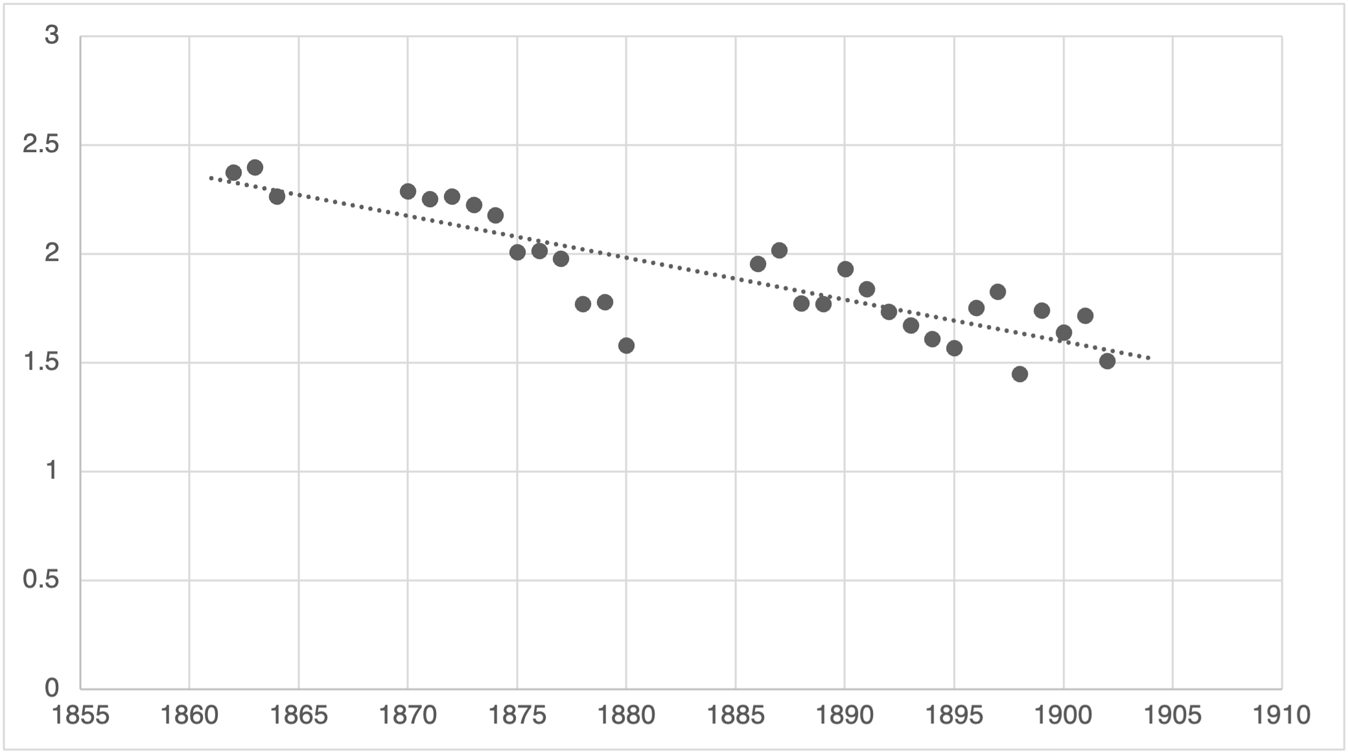
From the mid-1870s, the downturn in global shipping pushed wages downward everywhere, making seafaring progressively less attractive. In Liguria, however, the effects were especially severe because the crisis struck a community still heavily invested in sail and less able to redirect labour rapidly toward more dynamic sectors.Footnote 72 One way to capture this shift is to compare sailors’ pay with the earnings available on shore. Because food and lodging were provided by shipowners, sailors’ real income was higher than their cash wages suggest, but even after accounting for this, the trend is unmistakable. As Figure 4 shows, the earnings gap between maritime and industrial work narrowed steadily across the second half of the century. In 1862 an AB in Liguria earned more than twice the wage of an industrial worker; by 1902 the advantage had nearly halved. The sharpest decline occurred in the late 1870s – the years in which sailing shipping entered its deepest crisis – revealing not only a general fall in maritime earnings, but the particular vulnerability of a local labour market marked by oversupply, blocked advancement, and continued dependence on a declining branch of transport. What made this contraction especially consequential in Camogli was that maritime labour had long remained central to household strategies, local status, and expectations of mobility; when earnings fell, the result was therefore not just lower pay, but sharper pressure to emigrate, seek foreign service, or leave the sector altogether.
Relationship between AB seamen’s wages and industrial workers’ wages in Liguria (1862–1902).

In conclusion, the passage from alla parte to fixed wages might mark the definitive subordination of maritime labour to capitalist relations of production. The sailor ceased to be a partner in a collective enterprise and became a wage worker, detached from both the profits and the risks of navigation. In this sense, the maritime world followed a trajectory comparable to that of land-based labourers who, over the nineteenth century, lost access to profit-sharing and control over the means of production. What disappeared at sea, as on land, was the material link between labour, risk, and return – a link that had long sustained both economic mobility and a sense of professional autonomy. At the same time, professionalization created a narrow elite of officers whose rewards reflected education rather than communal solidarity. The resulting structure – hierarchical, wage-based, and externally regulated – signalled the end of the communal seafaring world described by De Rossi and the emergence of a new, proletarian order at sea.
Conclusions
The Camogli case suggests that the proletarianization of maritime labour did not follow automatically from the advent of steam. It resulted, rather, from the interaction of three processes that became mutually reinforcing in the second half of the nineteenth century. First, institutional reform codified competence through licences, examinations, and nautical schooling, progressively narrowing older routes of advancement based on experience alone. Second, ownership reorganization increasingly separated command from property and commercial management of the voyage: masters retained authority at sea, but no longer combined in the same way nautical command, entrepreneurial discretion, and participation in capital. Third, market integration widened the recruitment base, exposed Ligurian labour to national and international wage differentials, and inserted Camogli shipping into more volatile and lower-margin circuits of global trade.
Taken separately, none of these developments was sufficient to produce a fully proletarian labour regime. Recruitment could widen without immediately dissolving communal forms of discipline; professional credentials could raise the status of officers without eliminating local control; and fixed wages alone did not automatically erase older expectations of mobility. What changed the system more decisively was their convergence. As access to command became credentialized, as the business side of shipping was increasingly coordinated ashore, and as remuneration shifted from shares to monthly wages, seafarers lost not only opportunities for advancement but also direct participation in the economic outcome of the voyage. The material link between labour, risk, and return was progressively weakened.
In this sense, the “progressive exclusion from ownership” was not an abstract or purely juridical process. It unfolded through the contraction of those channels that had once connected maritime labour to maritime property. Under alla parte, crew members were not simply paid for time worked: however unequally, they shared in the result of the voyage, and in favourable circumstances some could save, reinvest, and, at least for a minority, aspire to acquire a stake in a vessel. In the earlier communal system, command itself could still coincide with co-ownership, while advancement remained partly embedded in kinship, locality, and long practical experience. By the late nineteenth century, these channels had narrowed sharply. Profit-sharing gave way to wages; command became more dependent on credentials; and ownership, though often still local and familial, became increasingly detached from those who worked the ship. What proletarianized maritime labour, therefore, was not simply wage payment as such, but the shrinking of the institutional and economic pathways that had once linked labour, promotion, and property.
The evidence from Camogli also helps clarify why this transformation was uneven across ranks. For officers, professionalization brought higher formal status and, in some cases, higher remuneration, but at the price of growing dependence on schooling, licensing, and a labour market increasingly saturated with certified men. Their gains were therefore partly compensatory: they exchanged some of the older autonomy associated with command for credentials that did not always secure an equivalent position. For common sailors, by contrast, the new regime offered fewer compensations. Their earnings stagnated relative both to foreign maritime labour markets and, over time, to industrial wages ashore; their practical knowledge carried less bargaining power in a system that rewarded certified expertise; and their chances of upward mobility narrowed as command and property became more remote. The result was not the uniform degradation of all maritime labour, but a sharper stratification between a credentialed upper tier and a wage-dependent mass below.
Of the three processes, institutional reform appears to have been the most structurally consequential, because it intervened earliest and produced effects that were difficult to reverse independently of market conditions. Licensing and compulsory schooling did not merely codify existing competences: they closed older routes of advancement based on experience, produced a structural surplus of qualified officers, and shifted the definition of legitimate command from the communal to the bureaucratic. Ownership reorganization compounded this by removing the figure – the owner-captain – who had embodied the overlap between labour, authority, and capital, without replacing him with any equivalent form of collective participation. Market integration, finally, accelerated and deepened a transformation already set in motion: by exposing Ligurian labour to international wage differentials and concentrating the fleet in lower-margin circuits, it foreclosed the possibility of recovery through higher returns. Steam mattered in this context, not as a cause but as the condition under which these three processes became mutually reinforcing and irreversible.
The relative weakness of Ligurian wages may also be read in this light. It may not have resulted from the general downturn in shipping alone. It may also reflect structural features of the Ligurian maritime labour market: an abundant locally reproduced supply of seafarers, recruitment still partly embedded in communal ties, and, by the late nineteenth century, a growing concentration in lower-margin branches of global sailing shipping. If so, Camogli entered international competition from a weaker position than the tighter Atlantic labour markets of Britain, the United States, or the Río de la Plata. What made the contraction especially consequential locally was that maritime work remained central to household strategies, social status, and expectations of mobility. Falling earnings therefore meant not only lower pay, but the erosion of a whole social economy built around the sea.
Here too, however, market dynamics were reinforced by institutional and organizational factors: the credential system had generated a labour surplus without expanding positions; ownership reorganization had narrowed the internal redistribution of voyage profits; and communal recruitment ties, once a resource, increasingly functioned as a constraint that kept wages below Atlantic levels.
This wider social economy may also be understood as part of the broader social wage historically attached to seafaring in a community such as Camogli. The return from maritime labour did not lie in cash earnings alone, but also in its embeddedness within a local social order that connected ship and shore, work and household strategy, hierarchy and trust, and labour service with partial participation in the voyage economy. Maritime employment carried with it forms of status, reputational value, and access to communal networks which, for at least some seafarers, could still sustain expectations of advancement, command, or a modest stake in shipping. As crews became less endogenous, as remuneration shifted from shares to fixed wages, and as deck labour lost relative centrality with the spread of steam, these wider returns were progressively weakened. What declined, therefore, was not simply an older maritime culture, but the social and institutional framework that had long sustained a broader maritime social wage.
Viewed from Camogli, the transition from sail to steam appears not as a simple technological rupture but as a cumulative reorganization of labour relations. Recruitment widened beyond the community; command was detached from ownership; promotion was formalized; remuneration was standardized; and access to profit and property narrowed. The outcome was a more sharply stratified maritime order in which officers, technical specialists, and common sailors occupied increasingly distinct positions, and in which work at sea was progressively redefined as wage-dependent labour. In this sense, the Camogli case does not merely illustrate the decline of a local sailing community. It offers a concrete example of how maritime capitalism was made: not by technology alone, but by the combined restructuring of labour markets, institutions, and the social organization of shipping.



 Open access

