In order to improve outcomes, it seems logical to identify modifiable risk factors which might allow corrective intervention, to identify periods of increased stress which might fatally tax the inefficient circulation, and to ensure that the goals of the interstage period are met, namely to maintaining the function of organs and somatic growth. Construction of the bidirectional superior cavopulmonary connection converts the parallel circulation, with its inherit insufficiencies and dangers, to a circulation which is in series, and introduces a period of stability. To date, the timing of the cavopulmonary anastomosis has been arbitrary, despite the obvious benefit of shortening the period of risk by proceeding to the second stage of palliation at an earlier age. In this review, we describe our experience with a programme of enhanced monitoring during the interstage period, as well as our experience with early accomplishment of the second operation.
Interstage monitoring
Scope of the problem and risk factors
Among the greatest successes in the management of congenital cardiac malformations has been the enormous improvement in operative survival for children undergoing the first stage of surgical palliation for hypoplastic left heart syndrome over the past 20 years.13–15 Against this backdrop, sudden death after discharge from hospital has been particularly frustrating and disappointing, given the tremendously intensive regimes undertaken to achieve discharge from initial palliation. The incidence of sudden death in the interstage period has remained fairly constant, at approximately 5–15%, and does not seem to have been eliminated despite the introduction of techniques which have dramatically improved early inpatient survival.3, 5, 6 A variety of risk factors and aetiologies have been proposed for interstage death.
The combination of inefficient parallel circulations after the first stage of palliation, the inferior pumping capability of the morphologically right ventricle, and cyanosis, place the infant at risk for circulatory collapse. Escalated risk of interstage mortality has been linked to anatomical diagnosis, and residual or recurrent lesions. Particularly, the diagnosis of aortic atresia with a diminutive ascending aorta has been associated with an increased risk of late death. The presence of a restrictive atrial communication, obstruction in the aortic arch, obstructed flow across the shunt, pulmonary arterial distortion and atrioventricular valvar insufficiency, have also been associated with interstage mortality.7–12 Non-cardiac diseases, such as gastroenteritis or upper respiratory infection, often result in hypovolaemia and/or acute hypoxaemia, and have also been implicated in sudden death after the initial stage of palliation, presumably as a reflection of a circulatory reserve which is inadequate to meet the increased metabolic demands created by the stress of an infectious illness.8, 9, 16 Any of the aforementioned cardiac or non-cardiac processes place the infant with a morphologically right ventricle supporting parallel circulations at risk for progressive hypoxaemia, causing an unfavourable relationship between supply of and demand for oxygen, which in turn leads to impaired myocardial function, with eventual circulatory collapse and death.
Rational physiological surveillance
Based on the hypothesis that decreased arterial saturation from baseline, poor weight gain, or loss of weight, might foretell the presence of serious anatomical lesions or a developing intercurrent illness, we devised a plan for surveillance at home to identify periods of increased physiological vulnerability, with the intent of allowing for life-saving intervention during the interstage period. In patients with functionally univentricular anatomy and parallel circulations, arterial saturations of oxygen are influenced by the level of haemoglobin, pulmonary venous saturation, the ratio of pulmonary to systemic flows, consumption of oxygen and total cardiac output. Hence, in infants with hypoplastic left heart syndrome after the initial stage of palliation, arterial desaturation from baseline might be indicative of anaemia, respiratory illness, myocardial dysfunction resulting in falling cardiac output, or limited flow of blood to the lungs from stenosis or outgrowth of the shunt, thus providing a reason for careful monitoring of arterial saturation during the interstage period. Hypoxaemia alone, however, might not occur early in acute illnesses that result in elevation in systemic vascular tone, with consequent reduced systemic flow and an increased ratio of pulmonary to systemic flows. Specifically, dehydration that results in hypovolaemic shock from increased fluid loss, such as occurs in gastroenteritis, or decreased intake, might produce such a clinical scene, and be reflected only by failure of expected weight gain or even loss of weight.
Programme for surveillance at home
To provide earlier detection of worsening hypoxaemia from baseline, dehydration, or failure of growth between the first and second stages of palliation in patients with hypoplastic left heart syndrome, we developed a programme for monitoring saturations of oxygen, and changes in weight, while the infant was at home. Following initial palliation, patients are discharged with a pulse oximeter and a weighing scale sensitive to 10 grams, having trained the parents in the use of both devices. We also established criterions for the parents to notify a physician, and modified these after early experience with home monitoring. Under current guidelines, parents are asked to notify a member of the cardiac care team if arterial saturation is below 75%, or acutely decreased from baseline, if there is loss of weight of 30 grams, or failure to gain 20 grams over 3 days. Breach of these criterions is reported by parents, and prompts investigation to rule out an intercurrent illness or an anatomical lesion as the aetiology of the observed abnormality.
At Children's Hospital of Wisconsin, we enrolled a cohort of 139 patients who had undergone the first stage of palliation for hypoplastic left heart syndrome between July 1996 and October 2004 so as to evaluate the impact of the programme. The control group included 58 of the 64 patients who survived initial palliation. They were compared to the next 75 patients, of whom 74 (99%) survived to be discharged from hospital. Of the 74 early survivors, 70 (95%) participated in the programme for surveillance, while four patients thought to be at increased risk of dying were retained as inpatients until the construction of the cavopulmonary anastomosis. All patients were discharged with similar instructions to notify a physician for increased work of breathing, increased cyanosis, poor feeding, fever or lethargy. Patients undergoing surveillance at home were given additional instruction to notify a member of the cardiac care team if any of the criterions for monitoring were breached.
Follow-up has been complete for the entire cohort. Demographics, preoperative support and postoperative haemodynamics were similar between the groups. Intraoperative management was also similar, except the routine use of continuous cerebral perfusion that began at the onset of the programme, and thus was more frequent in this group. Aortic atresia was the most common anatomical entity, and was similar between groups, with two-fifths having an ascending aorta less than or equal to 2 millimetres in both groups. Additional cardiac risk factors, such as moderate or greater atrioventricular valvar insufficiency, anomalous origin of the right subclavian artery, or anomalies of pulmonary venous drainage, were also comparable between groups.
Initiation of the programme was associated with a significant improvement in survival between stages, from 84.5% (48/54) in the control group, to 99% (69/70) in the group undergoing monitoring (p less than 0.01; Fig. 1). In conjunction with improved survival was the younger age at which monitored patients underwent the second stage of palliation due to breach of the criterions for surveillance, at 4.2 plus or minus 1.4 months compared to 5.6 plus or minus 2.1 months (p less than 0.01). Despite the younger age at construction of the cavopulmonary anastomosis, monitored patients were of similar weight to their controls at the second stage of palliation.

Figure 1. Log rank comparison of actuarial survival between those patients who were or were not monitored at home (p < 0.01).
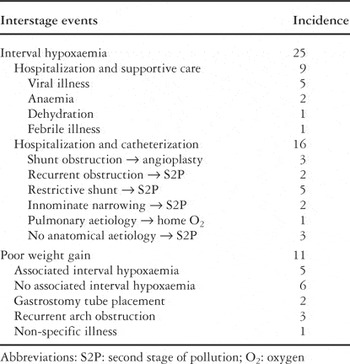
Just over half the monitored patients (57%) breached the criterions for surveillance, with 87% (34/39) of breaches occurring before 100 days of age. Worsening hypoxaemia was the most common reason parents sought medical care, and occurred 43 times in 31 patients. Inappropriate changes in weight occurred 17 times in 13 patients. We have summarized the events marked by a breach of criterions, and their related aetiologies, in Table 1. Stenosis of the shunt, outgrowth of the shunt and narrowing of the brachiocephalic artery, represented the cardiac diagnoses that led to interstage hypoxaemia. Extracardiac aetiologies of desaturation from baseline included viral illness, anaemia and dehydration. In six patients who breached the criterions for saturation of oxygen, we found concurrent breaches of the criterions for weight, whereas seven patients who breached the criterions concerning weight maintained their baseline saturations for oxygen, confirming that the two measures are complementary. Decreasing arterial saturation, and poor growth, may both reflect decreasing cardiac output, and suggest a limited durability after the first stage of the Norwood sequence. Aetiologies for inappropriate changes in weight, or poor gain in weight, included recurrent obstruction of the aortic arch, sepsis, poor oral intake-necessitating placement of a gastrostomy tube and failure adequately to adjust feeds through the gastrostomy tube for suitable gain in weight.
Table 1. Interstage events that breached the criterions for surveillance at home, with subsequent diagnoses and interventions.

Risk factors for interstage events
Monitored patients who did or did not breach the criterions for surveillance were further evaluated to assess whether previously identified risk factors for late death predicted increased risk for interstage events, specifically focusing on the diagnosis of aortic atresia, size of the ascending aorta less than or equal to 2 millimetres, the presence of moderate or greater atrioventricular valvar insufficiency, and early postoperative haemodynamics at the time of the initial palliation. The groups were not different in the degree of preoperative support, age and weight at initial palliation, intraoperative variables, or hospital length of stay. Aortic atresia was the most common diagnosis in patients with and without interstage events. In each group, two-fifths had diminutive ascending aortas of less than or equal to 2 millimetres. The incidence of moderate or greater atrioventricular valvar insufficiency was also similar between groups. Other echocardiographic criterions assessed prior to discharge from hospital were similar in the two groups. Early postoperative haemodynamics were not predictive of increased risk for interstage events.
Progression to the second stage of palliation
Timing of the second stage in patients monitored at home
Although events detected by the programme could in many cases be addressed by medical means, in other cases the ultimate solution was to proceed with the second operation at a time earlier than previously planned. This is reflected in the younger mean age at the time of second palliation in those monitored at home, at 4.2 plus or minus 1.4 months compared to 5.6 plus or minus 2.1 months (p less than 0.01). Just over half the patients (21/39) monitored at home underwent early palliation as a result of interstage events, usually marked by desaturation from baseline. Within this group, those who breached the criterions were younger and smaller at the time of the second stage than those who did not, at 3.6 plus or minus 1.0 month compared to 5.0 plus or minus 1.5 months (p less than 0.01), and 5.8 plus or minus 0.7 kilograms compared to 5.3 plus or minus 0.9 kilograms (p equal to 0.03). Despite the younger age and smaller size at the second stage of palliation in those who breached the criterions, all of those in both groups survived, and their median length of stay in hospital was similar, at 7 compared to 9 days. An unexpected finding for the entire cohort of patients, unmonitored and monitored, was a previously reported significant decline and flattening in growth velocity just after 4 months of age, again indicating the limited durability of the first stage of palliation, and begging the question of the arbitrary traditional delay to the second stage of palliation until after 6 months of age.3
Early second stage palliation
Death between the first and second of palliation prior to development of a rigorous programme for monitoring is reported at between 10% and 15%, with significant reduction in the risk of death after the cavopulmonary anastomosis.1–6 Progression to the cavopulmonary anastomosis eliminates the volume load on the systemic ventricle, reducing wall stress and atrioventricular valvar insufficiency. Furthermore, the second stage creates a more efficient circulation, with improved coronary arterial perfusion through elimination of parallel circulations.1, 3, 4, 11, 17 Previous reports of early construction of the cavopulmonary anastomosis have documented success, but have also described severe hypoxaemia postoperatively, prolonged pleural drainage, pulmonary arterial thrombosis, poor pulmonary arterial growth, early development of pulmonary arteriovenous malformations and excess mortality.18–21 In our series, early second stage palliation became a frequent strategy after identification of interstage instability. The additional insight into limited growth after 4 months of age (Fig. 2) altered our strategy for management, causing us to bring infants back for routine second palliation between 4 and 5 months of age, even in the absence of interstage events.

Figure 2. Interstage growth among survivors of the second stage calculated using over 1400 observations of weights. The regression line and 95% confidence intervals are indicated. Normal growth is depicted in the shaded area, with the dashed line representing 50% for age. The curve indicates the limited growth potential of the patient following the first stage of palliation. In this group of patients, growth into later infancy is limited, unlike a normal infant whose continued growth is expected.
Better to assess the risks of early second palliation, as well as the impact of early creation of the cavopulmonary shunt, we reviewed a series of patients with hypoplastic left heart syndrome who underwent cavopulmonary anastomosis between January 1998 and February 2003. We collected data concerning demographics, perioperative oxygenation and haemodynamics, pleural drainage, days of mechanical ventilation, length of stay in the intensive care unit and hospital, and survival. We compared 33 patients who underwent the second stage of palliation at less than 4 months of age with 52 patients who underwent operation at greater than 4 months of age. The mean age for the groups at the second stage were 3.1 plus or minus 0.7 months compared to 5.5 plus or minus 1.5 months (p less than 0.001), with the younger group weighing less at the time of the procedure, at 4.8 plus or minus 0.8 kilograms compared to 5.8 plus or minus 0.9 kilograms (p less than 0.001). Aortic atresia was the most common diagnosis in each group, and similar between groups. The frequency of concomitant procedures at the time of the second stage of palliation, such as reconstruction of the neoaortic arch, atrioventricular valvoplasty, or pulmonary arterioplasty, was similar between groups. Preoperative haemodynamics determined by cardiac catheterization and intraoperative strategies, including the periods of cardiopulmonary bypass and aortic cross clamping, and anaesthetic techniques, were also not different between groups.
All our patients survived, with an actuarial survival to 1 year of 96% in both groups. In our younger group, two patients died late due to infection, with an additional single late sudden death in the older group. Postoperative support was different between groups, with longer mechanica ventilation required in the younger patients, at 23 compared to 7 hours (p less than 0.001), with a corresponding longer stay in the intensive care unit, at 93 compared to 70 hours (p equal to 0.05), a longer hospital stay, at 8 compared to 6 days (p equal to 0.05), and greater duration of pleural drainage, at 91 compared to 71 hours (p equal to 0.01). These hospital-related indexes of illness place the infant at increased risk for serious complications, although serious morbidity was infrequent in our series. From our young group, one patient developed a pulmonary arterial thrombosis that was successfully treated with tissue plasminogen activator, while two patients in the older group underwent reoperation for atrioventricular valvoplasty and pulmonary arterioplasty. Previous observations that younger patients at the second stage of palliation have lower saturations of oxygen postoperatively were confirmed, despite similar preoperative saturations. This difference had diminished by the time of discharge from hospital (Fig. 3). Furthermore, unpublished continued follow up of these two groups has shown that, at the time of assessment prior to completion of the Fontan circulation, the two groups are essentially identical, with equally good perioperative courses after completion of the Fontan circulation.

Figure 3. Perioperative oxygenation curves before and after the second stage of palliation. (a) Illustrates oxygen saturation curves from the preoperative cardiac catheterization to hospital discharge after the second stage of palliation. Saturations were similar between groups at each interval, except immediately after the second stage, when younger subjects had lower saturations compared to the older group (p < 0.001). (b) Details the oxygen saturation trends during the first 120 hours after the second stage, and illustrates the resolution in differences between groups beyond the immediate postoperative period.
Conclusion
We conclude that the risk of death in children with hypoplastic left heart syndrome awaiting the second stage of palliation may be reduced by the combination of an easily accomplished programme for monitoring two physiological variables at home, namely arterial saturation of oxygen and body weight, and aggressive intervention if physiological derangements are detected. If the required intervention takes the form of earlier performance of the second stage operation, our data suggests that this may be accomplished safely, with predictably good early and late outcomes, up to and including the completion of the Fontan circulation. Lastly, our data concerning the gain in weight after first stage of palliation suggests that there is relatively little somatic growth observed after 4 months of age in patients with hypoplastic left heart syndrome, supporting the concept of moving the elective performance of the second stage of surgery to a younger age.