INTRODUCTION
A central debate in current research on language disorders is whether heterogeneous disorders such as developmental dyslexia are associated with a single underlying cause. Dyslexia is a specific language-based disorder characterized by difficulties in reading and/or spelling that are unexpected in relation to cognitive abilities and age (Snowling, Reference Snowling2000). Apart from problems with written language, a range of symptoms is typically found in children and adults with dyslexia, including impairments in phonological awareness, lexical retrieval, rapid automatic naming, verbal short-term memory, motor timing, (auditory) temporal processing and visual processing (for a review see Vellutino, Fletcher, Snowling & Scanlon, Reference Vellutino, Fletcher, Snowling and Scanlon2004). The finding that dyslexia runs in families allows insight into the developmental trajectory of dyslexia, extending to preschool children at high familial risk (i.e. children who have at least one dyslexic parent). Wider language difficulties have indeed been attested for these children (e.g. de Bree, Wijnen & Gerrits, Reference de Bree, Wijnen and Gerrits2010; Lyytinen, Poikkeus, Laakso, Eklund & Lyytinen, Reference Lyytinen, Poikkeus, Laakso, Eklund and Lyytinen2001; Scarborough, Reference Scarborough1990; Snowling, Gallagher & Frith, Reference Snowling, Gallagher and Frith2003; van Alphen, de Bree, de Jong, Gerrits, Wilsenach & Wijnen, Reference Wilsenach, Wijnen, Brugos, Micciulla and Smith2004).
The substantial co-morbidity between dyslexia and other developmental disorders such as specific language impairment (SLI), attention deficit hyperactivity disorder (ADHD) and developmental coordination disorder (DCD) (Chaix et al., Reference Chaix, Albaret, Brassard, Cheuret, de Castelnau, Benesteau, Karsenty and Démonet2007; McArthur, Hogben, Edwards, Heath & Mengler, Reference McArthur, Hogben, Edwards, Heath and Mengler2000; Snowling, Reference Snowling2000) has led to the proposal that dyslexia is a multifactorial disorder (e.g. Pennington, Reference Pennington2009; Snowling, Reference Snowling2000), with a ‘core’ deficit in (access to) phonological representations (e.g. Ramus & Szenkovits, Reference Ramus and Szenkovits2008; Snowling, Reference Snowling2000). Whereas this viewpoint focuses on the cognitive risk factors of dyslexia, other theories aim at uniting the range of (co-morbid) symptoms in one (biologically motivated) theory. One such hypothesis proposes that a general learning deficit affecting implicit or procedural learning is an underlying cause of language-related disorders (Nicolson & Fawcett, Reference Nicolson and Fawcett2007; Ullman & Pierpont, Reference Ullman and Pierpont2005). At the neuro-anatomical level, the procedural system is composed of a network of interconnected structures rooted in the inferior frontal cerebral cortex, the basal ganglia and the cerebellum. It subserves the learning and execution of motor and cognitive skills, including aspects of (sequential) rule-learning, resulting in implicit knowledge. Implicit learning is generally agreed to be a form of incidental learning without consciously accessible knowledge of what has been learned. The procedural deficit hypothesis posits that a significant proportion of individuals with language-based disorders suffer from abnormalities of this brain network, leading to impairments of the linguistic (e.g. implicit phonological rules) and non-linguistic (e.g. motor) functions that depend on it. In contrast, functions such as declarative memory are expected to remain largely spared. The observation that children with (a familial risk of) dyslexia may have delays in both language development and (motor) skill learning points to an involvement of the procedural system. In line with this hypothesis, dyslexic children and adults show neuroanatomical and functional abnormalities in brain areas associated with procedural learning (e.g. Eckert, Leonard, Richards, Aylward, Thomson & Berninger, Reference Eckert, Leonard, Richards, Aylward, Thomson and Berninger2003; Menghini, Hagberg, Caltagirone, Petrosini & Vicari, Reference Menghini, Hagberg, Caltagirone, Petrosini and Vicari2006).
A form of procedural learning that is especially relevant for language acquisition is statistical or distributional learning, which is needed for building a system of linguistic categories and ‘rules’ or generalizations. At a very early age, children are already able to detect patterns in (artificial) languages by using distributional information such as transitional probabilities. The detection of such distributional patterns may result in skills as diverse as phonetic categorization in infants aged 0;6 (Maye, Werker & Gerken, Reference Maye, Werker and Gerken2002) and syntactic category formation in infants aged 1;6 (Gerken, Wilson & Lewis, Reference Gerken, Wilson and Lewis2005). Category formation (partly) depends on the sequential analysis of distributional information, such as the number of occurrences of elements or the sequential co-occurrence relations among them. As the calculations that need to be made at the phonological and grammatical levels of structure are similar, there may be a single computational mechanism for statistical learning at different levels of language structure. In this view, dyslexia is associated with a deficit in extracting statistical regularities from (transient) sequential input, affecting language (and thus, phonology) as well as other domains (e.g. motor learning).
In support of this hypothesis, dyslexic adults and children have been found to perform worse on implicit (motor) sequence learning in serial reaction time tasks (SRTT), whereas explicit learning is spared (e.g. Howard, Howard, Japikse & Eden, Reference Howard, Howard, Japikse and Eden2006; Sperling, Lu & Manis, Reference Sperling, Lu and Manis2004; Stoodley, Harrison & Stein, Reference Stoodley, Harrison and Stein2006; Vicari, Marotta, Menghini, Molinari & Petrosini, Reference Vicari, Marotta, Menghini, Molinari and Petrosini2003; Vicari, Finzi, Menghini, Marotta, Baldi & Petrosini, Reference Vicari, Finzi, Menghini, Marotta, Baldi and Petrosini2005). Performance on non-sequential forms of implicit learning as measured in a spatial contextual cueing task (SCCT) is also normal (Howard et al., Reference Howard, Howard, Japikse and Eden2006; Jiménez-Fernández, Vaquero, Jiménez & Defior, Reference Jiménez-Fernández, Vaquero, Jiménez and Defior2011; Bennett, Romano, Howard & Howard, Reference Bennett, Romano, Howard and Howard2008). Implicit learning has also been investigated with artificial grammar learning (AGL), thought to involve both sequential information and higher-order rule abstraction. In AGL tasks subjects are typically presented with symbol sequences generated by a finite state language, and tested on novel grammatical and ungrammatical sequences. Pavlidou, Kelly and Williams (Reference Pavlidou, Kelly and Williams2010) show that children with dyslexia were equally good at memorizing sequences of geometric shapes, but were not able to successfully perform grammaticality judgements (i.e. abstract rules implicitly). In sum, the implicit learning deficit found in dyslexic subjects seems to particularly affect sequences, including those in which maintaining the location of the previous stimulus is enough to predict the upcoming target (i.e. first-order sequences). An outstanding question is whether implicit learning difficulties are present in children with a familial risk of dyslexia.
Non-adjacent dependency learning
The current study investigates learning of non-adjacent dependencies, which is potentially crucial for the acquisition of grammatical patterns and categories. Many (morpho)-syntactic patterns are characterized by non-adjacent dependencies between elements. For instance, in patterns such as ‘is X-ing’, the dependent elements are often separated by intervening linguistic material (e.g. he is happily singing), while the surrounding material is invariant. Research with the head-turn preference procedure has established that around age 1;6–1;7, infants perceive the difference between sentences with correct and incorrect non-adjacent dependencies in English (Santelmann & Jusczyk, Reference Santelmann and Jusczyk1998), German (Höhle, Schmitz, Santelmann & Weissenborn, Reference Höhle, Schmitz, Santelmann and Weissenborn2006) and Dutch (Wilsenach & Wijnen, Reference Wilsenach, Wijnen, Brugos, Micciulla and Smith2004). For example, Santelmann and Jusczyk (Reference Santelmann and Jusczyk1998) show that infants aged 1;6 (but not 1;3) distinguished between sentences such as the dog is always barking and *the dog can always barking, which means they can track the morphosyntactic relation between is and -ing. However, children did not show this capacity when the distance between the elements was larger than three syllables. Höhle et al. (Reference Höhle, Schmitz, Santelmann and Weissenborn2006) found that German infants aged 1;7 were sensitive to the auxiliary–past participle dependency with an intervening noun phrase (e.g. das Kind hat den Ball geholt ‘the child has fetched the ball’). Finally, Wilsenach and Wijnen (Reference Wilsenach, Wijnen, Brugos, Micciulla and Smith2004) show that Dutch infants aged 1;7 listened longer to grammatical sentences with an auxiliary–past participle dependency than to ungrammatical sentences in which the auxiliary was replaced by ‘can’ (e.g. opa heeft/* kan langzaam gelopen ‘grandpa has/can slowly walked’). Again, children only distinguished the sentences when the intervening element consisted of two syllables rather than four. Interestingly, Dutch family-risk (FR) infants were not able to track this morphosyntactic dependency even at age 2;2, suggesting a delay of at least six months. This result thus appears to be consistent with the hypothesized distributional learning deficit. Moreover, acquisition of agreement has been found to be delayed for FR infants and children (van Alphen et al., Reference van Alphen, de Bree, de Jong, Gerrits, Wilsenach and Wijnen2004) as well as children and adults with dyslexia (Joanisse, Manis, Keating & Seidenberg, Reference Joanisse, Manis, Keating and Seidenberg2000; Rispens & Been, Reference Rispens and Been2007).
In order to further explore whether this delay is due to an implicit sequential learning deficit, the current study aims at testing a group of FR infants on their sensitivity to non-adjacent dependencies in an artificial language. The experiment is based on head-turn experiments by Gómez (Reference Gómez2002) and Gómez and Maye (Reference Gómez and Maye2005). Gómez (Reference Gómez2002) exposed infants to one of two novel languages containing non-adjacent dependencies. The first language consisted of the patterns aXc and bXd (e.g. pel wadim jic and vot kicey rud), whereas the second language contained the reversed dependencies aXd and bXc (e.g. pel wadim rud and vot kicey jic). As the set of X elements was the same in both languages, they could only be distinguished on the basis of the dependency between the first and third item. The original study by Gómez (Reference Gómez2002) showed that infants aged 1;6 listened longer to ungrammatical strings. However, infants were only able to detect the difference between trained and untrained strings when the set size of middle elements was twenty-four rather than three or twelve. Both adults and infants were most likely to focus on the invariant non-adjacent elements when the middle element was highly variable. In a subsequent study, Gómez and Maye (Reference Gómez and Maye2005) found that infants aged 1;3 show a familiarity effect, i.e. a preference for non-adjacent dependencies they had been trained on, which changed to a novelty preference between ages 1;5 and 1;6.
The question thus arises whether FR infants are equally sensitive to non-adjacent dependencies in an artificial language. Both adults with a history of language disorders (Grunow, Spaulding, Gómez & Plante, Reference Grunow, Spaulding, Gómez and Plante2006) and adolescents with language impairments (Hsu, Tomblin & Christiansen, Reference Hsu, Tomblin and Christiansen2008) have been reported to have more difficulty in deciding whether a string (pel wadim jic) had been presented in the training phase or not. Given the hypothesis of implicit sequential learning difficulties and the overlap between dyslexia and language impairment, we expect that FR children may show difficulties on non-adjacent dependency learning. In order to answer the question whether non-adjacent dependency learning is more difficult for FR infants, a group of FR infants and a group of typically developing (TD) infants aged 1;6 were presented with a task similar to that used by Gómez (Reference Gómez2002). Our expectation was that typically developing infants would be able to discriminate between trained and untrained stimuli, resulting in a novelty effect. If implicit learning is impaired in FR infants, they might not be able to track the non-adjacent dependencies. Alternatively, they might display a preference for the familiar items at this age, indicating that they are delayed with respect to their typically developing peers.
METHOD
Participants
Infants were recruited through written requests to parents of newborns, whose addresses had been provided by the local municipality (Utrecht, NL). All infants had normal birth weight (2500–4500 grams), were not pre- or post-term, had normal hearing and vision, and no known neurological problems.
Thirty infants with a familial risk of dyslexia (11 females, 19 males) were tested, with an average age of 1;6·15 (range: 1;6·3 to 1;6·27). An additional twenty-three infants were tested but not included due to excessive fussiness or crying (n = 15), completing fewer than two valid trained and two valid untrained trials (n = 3), technical difficulties (n = 3), parental interference (n = 1), and uncertainty about parental reading status (i.e. a self-reported history of reading difficulties and affected family members, but reading scores within the normal range) (n = 1). The family-risk group was selected on the basis of parental reading difficulties. The dyslexic parents had a history of reading difficulties (a prior formal diagnosis was available for half of the parents), which were confirmed with two standardized technical reading tests and a verbal competence test. The technical reading tests were: (a) the ‘Een-Minuut-Test’ (EMT; Brus & Voeten, Reference Brus and Voeten1972), a test in which as many existing words have to be read correctly in the time span of one minute; and (b) ‘De Klepel’ (van den Bos, Lutje Spelberg, Scheepstra & de Vries, Reference van den Bos, Lutje Spelberg, Scheepstra and de Vries1994), a pseudo-word reading test, for which the time limit is two minutes. The verbal competence test (Analogies) was taken from the Dutch version of the Wechsler Adult Intelligence Scale (WAIS; Uterwijk, Reference Uterwijk2000). In order for the child to be included in the at-risk group, the parent had to show poor performance on both reading tests but not the verbal competence test, as this is often a relative strength for (higher-educated) people with dyslexia, in contrast with their reading and spelling abilities. Performance had to be below (or equal to) the 20th percentile on both the EMT and the Klepel or below (or equal to) the 10th percentile on either the EMT or the Klepel. Alternatively, there had to be a discrepancy of at least 60 per cent between performance on the verbal competence test and performance on the EMT and Klepel (this criterion applied in 5/30 cases).
The control group consisted of thirty-one infants (17 females, 14 males) with an average age of 1;6·21 (range: 1;6·6 to 1;6·30). An additional twenty-six infants were tested but not included because of excessive fussiness or crying (n = 17), completing fewer than two valid trained and two valid untrained trials (n = 5), technical difficulties (n = 3), or parental interference (n = 1). The typically developing children came from families with no history of reading or language impairments.
Drop-out rates due to infant behaviour (i.e. fussiness and crying) for the FR and TD groups are 31% (15/48) and 32% (17/53) respectively. This indicates that FR infants were not more likely to be excluded than TD children. Furthermore, these rates are close to those reported by Gómez (Reference Gómez2002); viz. 29% (12/42) of typically developing infants aged 1;6. Exclusion rates due to short looking times (i.e. too few valid test trials) are also comparable across groups: 6% (3/48) and 9% (5/53) for the FR and TD group respectively. Again, rates are comparable to earlier studies, e.g. Gómez and Maye (Reference Gómez and Maye2005) report that 3% (1/35) and 15% (6/41) of infants aged 1;6 (set sizes 18 and 12) were excluded due to this reason.
For both groups of children, parents were asked to fill out a questionnaire (standardly used in the Utrecht University Babylab) to provide background information, such as their level of education and family history of medical problems. Background information on the participants is summarized in Table 1. There were no significant differences between the two groups on any of these variables (all ps >·1).
General background information on participants

note: Maternal education was measured on a scale ranging from 1 (primary school) to 6 (university).
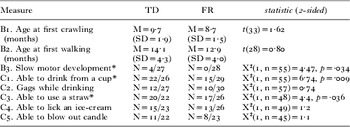
The parental questionnaire also contained questions on general language and motor development, regarding both gross and bucco-facial motor skills. There were no differences between the groups on any of the questions concerning language development, such as the age at which the first word was uttered. Similarly, there were no differences between the two groups in the age at which certain motor milestones were reached (i.e. crawling and walking); see Table 2.
Questionnaire data on motor development

note: * marks significance at α = ·05.
With respect to general motor development, more typically developing infants were considered ‘slow’ by their parents than FR children. The data on bucco-facial motor development show a different pattern: significantly more infants from the family-risk group could not drink from a cup or use a straw at the time of testing (i.e. at age 1;6).
Parents of both groups of children completed the Dutch version of the MacArthur-Bates Communicative Development Inventory (CDI; Zink & Lejaegere, Reference Zink and Lejaegere2002), to establish receptive and productive vocabulary size (see Table 3). Only the mean receptive vocabulary percentile score of the FR group was significantly lower than that of the TD group (t(54) = 2·23, p = ·03).
Mean percentile CDI scores

note: * marks significance at α = ·05.
STIMULI
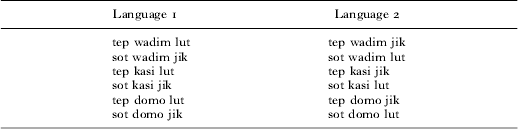
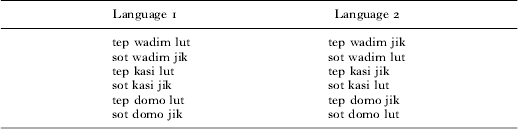
The infants listened to one of two artificial languages, Lang1 or Lang2, consisting of strings of three pseudo-words. Lang1 strings contained the dependencies aXc and bXd and Lang2 strings took the form aXd and bXc. In both languages, the X elements were identical. The elements a and c were tep and lut, the elements b and d were sot and jik (see Table 4). In both languages, the same set of twenty-four X elements was used. A set size of twenty-four was chosen as this yielded the most robust results in previous studies (Gómez & Maye, Reference Gómez and Maye2005).
Test strings for each training language
The twenty-four X items were wadim, kasi, poemer, kengel, domo, loga, gopem, naspu, hiftam, dieta, vami, snigger, rogges, densim, fidang, rajee, seeta, noeba, plizet, banip, movig, sulep, nilbo and wiffel. The items closely resemble the items used by Gómez (Reference Gómez2002), but were altered slightly to match Dutch phonotactics. Similar to the English version, the items featured a strong– weak metrical stress pattern, which is the dominant pattern in Dutch. A female speaker recorded sample strings using a lively, child-friendly voice. Word tokens were spliced from recorded strings and made into new strings for both languages, to ensure that the languages did not differ with respect to pronunciation and to eliminate talker-induced differences in individual strings.
There was a 250 ms inter-stimulus interval between the three pseudo-words in each string, and a 750 interval between strings. The speech stream was thus clearly divided into three-element strings (‘sentences’). Strings were approximately 2 s in duration.
PROCEDURE
The experiment consisted of a familiarization phase and a test phase, using the head-turn preference procedure (see Kemler-Nelson, Jusczyk, Mandel, Myers, Turk & Gerken, Reference Kemler-Nelson, Jusczyk, Mandel, Myers, Turk and Gerken1995). Both phases were run in immediate succession in the same sound-attenuated booth, while the infant was seated on his or her caregiver's lap. The caregiver was fitted with stereo headphones through which music was played during both phases of the experiment, to mask the stimuli presented to the child. An experimenter outside the test booth monitored the looking behaviour of the infant using a button box connected to a PC. A custom-made experiment control application (running under real-time Linux on a HAL computer) initiated trials and registered head-turn responses (see www.let.uu.nl/∼Theo.Veenker/personal/zep/). The experimenter was blind to the condition of the experiment and could not hear the stimuli being played.
In the training phase, infants were familiarized with one of the two languages (Lang1 or Lang2). Infants heard each of the 2 × 24 = 48 strings that comprised their training language once. Training lasted approximately three minutes. Stimuli were presented from two loudspeakers located on either side of the infant. The infant's gaze was first directed to a blinking light in the middle and then towards one of the blinking side-lights, one above one of two loudspeakers. When the infant looked away from the light for 2 s, his or her gaze was again directed to the middle. In the training phase, there was no contingency between lights and sounds.
In the test phase, eight trials were presented, half of which came from Lang1 and half of which came from Lang2, corresponding to trained or untrained trials. The order of test strings was randomized for each participant. Each trial was initiated with a blinking middle light. As soon as the infant fixated on this light, the experimenter pressed a button and one of the two side-lights started to blink. When the child directed his or her head towards the light, the experimenter pressed a button and the test stimulus for that trial played from the loudspeaker below the light, until the infant looked away for 2 s or until the trial had played out. The experiment-controlling program presented the stimuli in a randomized order, and tracked listening times, as well as the amount of time of looking away from the source of the sound. It automatically terminated a trial if a child looked away for more than 2 s.
Looking/listening time data were recoded off-line by a coder who was blind to the trial condition or group that the child was in, using PsyCode software for head-turn preference procedure data (courtesy of Judith Gervain & Luca Bonatti). Trials in which the total listening time was below 2 s were discarded, as an infant needed to hear at least one string to determine whether the stimulus was grammatical or not. If fewer than two valid trials per condition were left, the data for that child were excluded from analysis (see ‘Participants’).
RESULTS
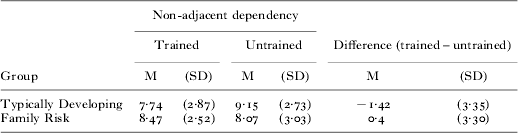
The amount of time an infant oriented towards a test stimulus was taken as the dependent measure. Learning of non-adjacent dependencies presented during the training phase is attested if there is a significant difference between grammatical and ungrammatical strings. Test strings that corresponded to the language heard in training were grammatical, while test strings that corresponded to the other language were ungrammatical. Mean listening times to trained and untrained strings are presented in Table 5.
Mean listening time (seconds) for trained and untrained non-adjacent dependencies
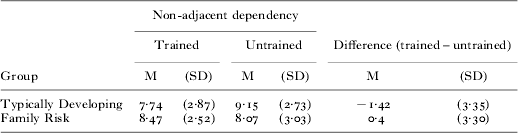
A 2 × 2 mixed repeated measures ANOVA with grammaticality (trained vs. untrained strings) as within-subjects factor and group (TD vs. FR) as between-subjects factor yielded a significant interaction effect of grammaticality and group (F(1,59) = 4·58, p = ·037, η2 = ·07). There were no other main effects or interactions. This interaction resulted from the fact that the TD group had longer listening times to untrained strings than to trained strings (t(30) = −2·36, p = ·025). Twenty of the 31 typically developing children (64%) showed this novelty preference. In contrast, children in the FR group did not discriminate between the two types of strings (p = ·51), with 13 out of 30 children (43%) showing a novelty effect.
To investigate a possible effect of attention, we analyzed average looking times during the familiarization phase. Even though lights were independent of sound at this stage (as training strings played continuously), the amount of time infants were paying attention to the changing lights may be indicative of their general attention levels during learning. Using off-line coding, the amount of time (in seconds) that the infant spent looking at the range of lights (rather than the floor, ceiling, parent or back of the booth), irrespective of whether it was the blinking light, was traced by a naive coder. Results show that the FR infants had shorter average looking times during familiarization (M = 115, SD = 17) than the control infants (M = 126, SD = 11), (t(56) = 3·03, p = ·004). We next analyzed the degree of restlessness of the infants during familiarization, as indicated by moving about or fidgeting, under the assumption that infants with lower attention levels are more likely to display such behaviour. This included instances in which children were playing with a shoe or headset, trying to draw the parent's attention, trying to get off the parent's lap, or whining. The two groups indeed differed on this measure, as restless behaviour was reported for only 2 out of 31 TD children and 9 out of 31 FR children by a naive observer (χ2(1, N = 62) = 5·42, p = ·02).
Hence there is some evidence that FR children were less attentive during the training phase of the experiment, which may have resulted in poorer learning. However, when only the 22 ‘high’ attenders (i.e. the children who did not display restless behaviour) in the family-risk group are selected, the results do not change, as there was again no difference between trained and untrained strings (p > ·1).Footnote 1
DISCUSSION
This study investigated whether infants aged 1;6 at familial risk of dyslexia can track non-adjacent dependencies in an artificial language, a form of implicit sequential learning. Infants were exposed to one of two novel languages containing dependencies of the type a-X-c, b-X-d (Language 1) or a-X-d, b-X-c (Language 2), e.g. tep wadim jik. Sensitivity to the relation between the non-adjacent elements (e.g. tep and jik) is crucial for distinguishing grammatical from ungrammatical strings. Typically developing Dutch infants aged 1;6 listened longer to ungrammatical stimuli, demonstrating learning of non-adjacent dependencies. This result thus replicates earlier findings by Gómez (Reference Gómez2002), who also observed a novelty effect for this age group. In contrast, infants at familial risk of dyslexia were unable to track these dependencies. This is the first indication that family-risk infants perform differently from their typically developing peers in an artificial language learning task, at a very early stage of development. Specifically, this finding supports the hypothesis that children with a familial risk of dyslexia have a deficit in implicit learning of (non-adjacent) dependencies, which may impact on their ability to form grammatical and phonological categories and rules. This result is in line with earlier findings by Wilsenach and Wijnen (Reference Wilsenach, Wijnen, Brugos, Micciulla and Smith2004), who showed that family-risk infants aged 1;7 and 2;2 could not track morphosyntactic dependencies in natural language. As stated earlier, problems with (morpho-)syntactic processing are also attested in older children with dyslexia. For instance, a group of Dutch children with dyslexia had difficulty judging the grammaticality of sentences with agreement violations (Rispens & Been, Reference Rispens and Been2007). These results are consistent with the view that problems of children with (a family risk of) dyslexia are not limited to phonology, but extend to other subdomains of language (e.g. Vellutino et al., Reference Vellutino, Fletcher, Snowling and Scanlon2004). In line with these findings, the current data show a delay in (receptive) vocabulary acquisition for the FR group.
Non-adjacent dependency learning might be especially relevant for the acquisition of grammatical categories, which often occur in ‘frequent frames’ (the co-occurrence of two context words with one intervening target word; Mintz, Reference Mintz2003). In a head-turn experiment with one-year-olds, Mintz (Reference Mintz, Hirsh-Pasek and Golinkoff2006) showed that infants were able to categorize novel words in frequent frames (e.g. I X you) as verbs. Recent work from our lab shows that at age 1;4, Dutch TD infants use ‘frequent morpheme frames’ rather than frequent word frames, consisting of a function word and a bound morpheme (e.g. een X-je ‘an X-dim’ or we X-en ‘we X-plur’) for the categorization of novel words (Kerkhoff, Erkelens, de Bree, de Klerk & Wijnen, Reference Kerkhoff, Erkelens, de Bree, de Klerk and Wijnen2010). However, preliminary data suggest that FR infants aged 1;4 do not use such frames for grammatical categorization, supporting the view that these children are delayed in distributional learning on the basis of non-adjacent lexical co-occurrence patterns.
One evident drawback to the interpretability of these findings is that it is unclear as yet how many children of the FR group will go on to develop literacy difficulties. On the basis of previous research this is estimated to be anywhere between 30% and 65% of FR children. However, the risk of becoming dyslexic has been found to be continuous rather than discrete (Snowling et al., Reference Snowling, Gallagher and Frith2003), which means that (some of) the underlying difficulties could be present in the unaffected FR children. Importantly, the presence of an implicit learning deficit in children with a family risk of dyslexia suggests that at this stage of development, differences already emerge between TD and FR children, which will most likely impact on their developmental trajectory.
In the current task, the FR infants showed a tendency towards a familiarity effect, suggesting that they behave like younger infants. As reported by Gómez and Maye (Reference Gómez and Maye2005), infants aged 1;3 show a familiarity preference on this task. Hence, it could be that rather than being entirely insensitive to non-adjacent dependencies, (a subgroup of) FR infants are merely delayed in learning such patterns. It would be interesting to further explore the developmental path of non-adjacent dependency learning in children and adults with (a familial risk of) dyslexia. Preliminary data from our lab with dyslexic adults show that they perform as well as non-dyslexic adults on this task. This ties in with findings from several AGL studies with dyslexic adults, which failed to find evidence of an implicit learning deficit (e.g. Kelly, Griffiths & Frith, Reference Kelly, Griffiths and Frith2002; Rüsseler, Gerth & Münte, Reference Rüsseler, Gerth and Münte2006). The difference between child and adult studies indicates that there may be maturational effects, and indeed there is evidence that mental age affects implicit learning (Fletcher, Maybery & Bennett, Reference Fletcher, Maybery and Bennett2000), and that adults are better at implicit learning than children (Ferman & Karni, Reference Ferman and Karni2010).
It is unclear to what extent poor attentional resources contribute to the differences in implicit learning shown by the FR group. There is evidence that attention plays a role in implicit learning tasks (e.g. Kelly et al., Reference Kelly, Griffiths and Frith2002; Toro, Sinnet & Soto-Faraco, Reference Toro, Sinnet and Soto-Faraco2005; Wimmer, Mayringer & Raberger, Reference Wimmer, Mayringer and Raberger1999) and infant statistical learning (Yoshida, Pons, Cady & Werker, Reference Yoshida, Pons, Cady and Werker2006). In the present study, the FR children did not spend less time looking at the test stimuli, as no main effect of group was obtained. Nevertheless, their inability to discriminate the two types of strings may have been due to a lack of attention during the familiarization phase. The current results indicate that FR infants had shorter looking times during familiarization, and showed a higher degree of restlessness. Hence, attentional factors may have been (partly) responsible for the impaired performance of the FR group. It is also possible that the ‘restless’ subgroup will show lower attention and increased activity at a later age, in line with the attested overlap between dyslexia and attention deficits (e.g. Pennington, Reference Pennington2009). Future experiments could investigate the effect of attention further, by determining whether dual task conditions affect children with (a risk of) dyslexia more than typically developing children.
The current result is compatible with the hypothesis that dyslexia is characterized by a deficit in procedural or implicit sequential learning (e.g. Nicolson & Fawcett, Reference Nicolson and Fawcett2007; Ullman & Pierpont, Reference Ullman and Pierpont2005). The procedural deficit hypothesis specifically connects poor implicit learning and motor difficulties, which are expected to be co-morbid with dyslexia (e.g. Chaix et al., Reference Chaix, Albaret, Brassard, Cheuret, de Castelnau, Benesteau, Karsenty and Démonet2007) and SLI (Archibald & Alloway, Reference Archibald and Alloway2008). In the current study, parental questionnaire data revealed only subtle delays in certain bucco-facial motor skills for the FR group (i.e. drinking from a cup and using a straw), whereas motor milestones were reached at the same speed or faster than the TD group. In the same way that attentional deficits may co-occur with dyslexia, the fact that these delays are present in only a subset of children indicates that motor difficulty or cerebellar dysfunction is likely to be co-morbid rather than a causal factor underlying dyslexia (see also Chaix et al., Reference Chaix, Albaret, Brassard, Cheuret, de Castelnau, Benesteau, Karsenty and Démonet2007).
A related issue that demands further investigation is the role of working memory, as a limited processing window could also explain the inability of FR children to track non-adjacent dependencies. However, such an account might not be incompatible with the procedural hypothesis, as the procedural memory system is closely linked to Broca's area and working memory (e.g. Ullman & Pierpont, Reference Ullman and Pierpont2005). To further investigate the inter-relationship between poor working memory capacity and poor implicit learning, FR children should also be tested on adjacent dependencies (e.g. Gómez & Lakusta, Reference Gómez and Lakusta2004).
These results raise the question of whether the FR infants employ different computational strategies compared to TD infants. For instance, it is possible that these children focus on the relations among adjacent dependencies, a strategy that is normally employed when variability of the intervening elements is low. This would match findings by Hsu et al. (Reference Hsu, Tomblin and Christiansen2008), who observed learning effects for adolescents with language impairment when the set size was small (X = 2), whereas learning decreased as type frequency increased (set sizes of 12 and 24). Hsu and Bishop (Reference Hsu and Bishop2010) argue that this pattern of results points towards an exemplar-based learning account for the language-impaired individuals, who may store individual strings when token frequency is high and variability is low.Footnote 2 Similarly, Grunow et al. (Reference Grunow, Spaulding, Gómez and Plante2006) show that adults with a history of language-based learning disabilities were unable to learn or generalize non-adjacent dependencies, proposing that this was due to their focus on adjacent dependencies. It is thus an open question whether a decrease or an increase in variability (i.e. using either a very small or very large set size) would aid the FR children in learning the dependencies. Children with poor implicit learning might also benefit from an increased duration of training. Evans, Saffran and Robe-Torres (Reference Evans, Saffran and Robe-Torres2009) show that children with SLI were sensitive to transitional probabilities in speech, but only when the degree of exposure was doubled.
Given the overlap between dyslexia and SLI, it is possible that an implicit learning deficit characterizes both disorders (e.g. Ullman & Pierpont, Reference Ullman and Pierpont2005). Indeed, impaired implicit learning has also been attested in adults and adolescents with language impairment (Grunow et al., Reference Grunow, Spaulding, Gómez and Plante2006; Hsu et al., Reference Hsu, Tomblin and Christiansen2008; Plante, Gómez & Gerken, Reference Plante, Gómez and Gerken2002; Tomblin, Mainela-Arnold & Zhang, Reference Tomblin, Mainela-Arnold and Zhang2007) and children with SLI (Evans et al., Reference Evans, Saffran and Robe-Torres2009; Lum, Gelgec & Conti-Ramsden, Reference Lum, Gelgec and Conti-Ramsden2010; cf. Gabriel, Maillart, Guillaume, Stefaniak & Meulemans, Reference Gabriel, Maillart, Guillaume, Stefaniak and Meulemans2011). However, procedural deficit hypotheses should also be able to account for the apparent differences between these disorders, in terms of technical reading, reading comprehension, oral language and rapid serial naming, for example (e.g. Bishop & Snowling, Reference Bishop and Snowling2004; Bishop, McDonald, Bird & Hayiou-Thomas, Reference Bishop, McDonald, Bird and Hayiou-Thomas2009; de Bree et al., Reference de Bree, Wijnen and Gerrits2010). As suggested by Nicolson and Fawcett (Reference Nicolson and Fawcett2007), dyslexia and SLI may differ in the specific neural circuits that are affected. Also, a broad deficit in implicit learning might be particularly important in (early) learning but resolve or become less relevant later in life, as language and writing skills become specialized. Hence, rather than assuming an implicit learning deficit as the single cause of dyslexia, it may be regarded as a marker for language disorders within a multifactorial approach. Future studies should explore the relationship between dyslexia and SLI further, to determine at what point the developmental paths diverge. For instance, it may well be that the shared domain-general implicit learning deficit ultimately leads to more persistent language problems for children with SLI, as they may have fewer compensatory skills.
To conclude, while these findings contribute to our understanding of the early learning profile of children with (a risk of) dyslexia, they also highlight the need for investigating the developmental trajectory of implicit learning skills in children with dyslexia and SLI, to further explore the nature of the deficit underlying these disorders.