INTRODUCTION
The first studies of the Crustacea Amphipoda along the Algerian coast were done by Lucas (Reference Lucas1849), and only 16 species were recorded. Later, the major research on this group was conducted by Chevreux (Reference Chevreux1888, Reference Chevreux1910, Reference Chevreux1911), mainly his 1910 paper on Algerian amphipod and off the coast of Tunisia; he recorded 117 species in the Algerian sector of the sampling area. More recently, Bakalem & Dauvin (Reference Bakalem and Dauvin1995) compiled the first complete inventory of the marine amphipod on the Algerian coast, accounting for 253 species. New quantitative surveys made between 1995 and 2001 along all of the Algerian coast, from the Moroccan border in the west to the Tunisian border in the east (Figure 1), have permitted the recording of 206 species, identified to the specific level. Among them, there were 45 species that had never before been observed on the Algerian coast (Bakalem & Dauvin, Reference Bakalem and Dauvin1995; Bellan-Santini et al., Reference Bellan-Santini, Karaman, Ledoyer, Myers, Ruffo, Vader and Ruffo1998). Five other species that were reported in the Bakalem & Dauvin inventory, but were unlikely for the Algerian coast and were not reported in the inventory of the Mediterranean Sea amphipod (Bellan-Santini et al., Reference Bellan-Santini, Karaman, Ledoyer, Myers, Ruffo, Vader and Ruffo1998), were collected again during these surveys, thus confirming their presence at least in this part of the western Mediterranean Sea. All were Atlantic species, and their presence was probably due to the influence of the Atlantic waters along the North African coast.
Location of the sampling sites along the Algerian coasts.

In this note, we report the results of recent fieldwork undertaken along the Algerian littoral, which permitted new marine amphipod species to be recorded. For each species, data on the sediment type and the depth at which they were found are given; some additional comments concerning the ecological and geographical patterns of these new Algerian amphipod species are also provided.
General physical features of the study
Rocky shores with sometimes high cliffs dominate the Algerian coast, providing a high variety of morphological forms. There is also a certain amount of sand accumulation, creating beaches and dunes. The Algerian continental shelf is relatively narrow; it disappears at the edge of the high rocky shores along the coast and is more extended in the littoral zones with their sandy beaches and dunes. Terrestrial input from the intermittent rivers facilitates sedimentation in the bays and gulfs; this sedimentation is biogenic in origin. Soft-bottom sediments are distributed over an increasing silt gradient with an inshore-gradient characterized by a succession of fine sand, muddy sand, sandy mud and pure mud (Bakalem, Reference Bakalem2008). Coarse sand and gravel are located in the marine extension of the rocky shores, especially offshore of the capes that form the demarcations between bays and gulfs (Figure 1). Along the Algerian coast, the waters are influenced by the surface waters that come from the north-eastern Atlantic Ocean, crossing into the Mediterranean Sea via the Strait of Gibraltar. These Atlantic waters are about 50 km wide and about 150–250 m deep and have a salinity of 36.25. During their eastward progression, the Atlantic waters progressively mix with the waters of the Mediterranean, which have a higher salinity. The Algerian current becomes more unstable during its eastward progression, creating cyclonic and anti-cyclonic gyres as well as upwelling (Millot, Reference Millot1999).
MATERIALS AND METHODS
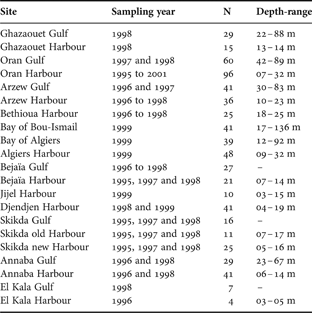
The present study investigated the soft-bottom substratum along the whole Algerian coast, covering about 1180 km of the 1200 km making up the total length of the Algerian coastline. The geographical limits of the sampling were 35°6′N 2°9′00″W near the Moroccan border and 36°54′N 8°26′30″E near the Tunisian border. Nine gulfs or bays and 12 harbours were sampled. At each site, two replicates of a Van Veen grab were taken, for a total substratum surface of 1/8 m2. All the sampling was done from 1995 to 2001 during the summer, between 15 June and 15 August (Table 1). The sampling depths ranged between 3 m and 136 m (Table 1). The annual campaigns were conducted with the oceanographic vessel ‘Mr. Benyahia’ and with the small vessel ‘Ibitacim’ for the shallowest sites. The sieving was carried out on 1-mm mesh. The sediment was fixed with formaldehyde. All the samples were collected by Samir Grimes during his PhD thesis field campaigns. Most of the specimens were deposited at the Soft Bottom Benthos Laboratory (Research Team of Interaction Environment—Marine Biodiversity of the National High School of Marine Sciences (Algiers)).
Main information about the sampling locations and sampling years. N, number of samples per location; total number of samples: 662.

The fauna was sorted and identified (when possible) to the species taxonomic level, using the list of Mediterranean amphipod fauna established by Bellan-Santini et al. (Reference Bellan-Santini, Karaman, Krapp-Schickel, Ledoyer, Myers, Ruffo, Schiecke and Ruffo1982, Reference Bellan-Santini, Diviacco, Krapp-Schickel, Myers, Ruffo and Ruffo1989, Reference Bellan-Santini, Karaman, Krapp-Schickel, Ledoyer, Ruffo and Ruffo1993, Reference Bellan-Santini, Karaman, Ledoyer, Myers, Ruffo, Vader and Ruffo1998). The taxonomy was validated using the ERMS referential for amphipod introduced by Bellan-Santini & Costello (Reference Bellan-Santini, Costello, Costello, Emblow and White2001) (http://www.marbef.org/data/erms.php, consulted on 30 April 2009). This taxonomy is not up to date for certain families. For example, the recent and general reclassification of the domicolous amphipods by Myers & Lowry (Reference Myers and Lowry2003) is not followed, nor are the Lysianassoidea subdivided into a number of different families following many papers by Lowry and co-workers (see De Broyer et al., Reference De Broyer, Lowry, Jazdzewki and Robert2007). Nevertheless, until these new classifications have been included in the ERMS referential, we have chosen to respect the actual ERMS classification.
RESULTS AND DISCUSSION
The new records for the Algerian coast are:
On 8 August 1997 two specimens were collected in the Oran Gulf from one sample taken in coarse sand at a depth of 86 m. This endemic Mediterranean species had previously been recorded in the western basin of the Mediterranean Sea and also in the Adriatic at depths from 10 to 150 m (Bellan-Santini et al., Reference Bellan-Santini, Karaman, Ledoyer, Myers, Ruffo, Vader and Ruffo1998).
On 27 July 1997 one specimen was found in the Skikda Gulf on mud at a depth of 30 m. On 11 August 1998, seven specimens were found in four samples taken in the Ghazaouet Gulf on muddy sand and mud at depths ranging from 22 to 64 m and 11 specimens were found in five samples taken in the Oran Gulf (on 5–6 August 1997), mainly on coarse sand and pebble but also on sandy mud, at depths ranging from 66 to 89 m. On 10 August 1999 four specimens were collected in Bou Ismail Bay from two samples taken in coarse sand and Posidonia meadow and mud at depths ranging from 24 to 71 m. This Atlantic–Mediterranean species (50–650 m) is common on coarse sand and mud. It has been recorded throughout the Mediterranean Sea (Bellan-Santini et al., Reference Bellan-Santini, Karaman, Krapp-Schickel, Ledoyer, Myers, Ruffo, Schiecke and Ruffo1982, Reference Bellan-Santini, Karaman, Ledoyer, Myers, Ruffo, Vader and Ruffo1998) and in the Atlantic from the Iberian coast to the Faeroe Islands (Dauvin, Reference Dauvin1996; Dauvin & Bellan-Santini, Reference Dauvin and Bellan-Santini2002).
On 3 August 1996 one individual was collected in the Arzew Gulf on coarse sand at 65 m in depth. This Mediterranean–Atlantic species has been found in the Mediterranean Sea, on the Iberian coast in gravel and coarse sand at depths ranging from 10 to100 m (Bellan-Santini et al., Reference Bellan-Santini, Karaman, Krapp-Schickel, Ledoyer, Myers, Ruffo, Schiecke and Ruffo1982, Reference Bellan-Santini, Karaman, Ledoyer, Myers, Ruffo, Vader and Ruffo1998) and in the Irish waters in the Celtic Sea (Myers & McGrath, Reference Myers and McGrath1994).
In 1995, ten specimens were recorded in Bou Ismail Bay (Bakalem & Dauvin, Reference Bakalem and Dauvin1995), but according to Bellan-Santini et al. (Reference Bellan-Santini, Karaman, Ledoyer, Myers, Ruffo, Vader and Ruffo1998), the presence of this species was uncertain in the Mediterranean Sea. Five new specimens were found in five samples, including one in the Bejaïa Gulf from 10 to 14 July 1996, one in the Arzew Gulf from 3 to 10 August 1997, one in the Oran Gulf on 14 August 1998, one in Jijel harbour on 1 July 1997 and two in Bou Ismail Bay on 10 August 1999 (34–96 m) on various types of soft bottom sediment with mud and shell. This Atlantic species has been recorded from the western part of the Channel to the African coast around Dakar and along the Moroccan coast (Menioui & Bayed, Reference Menioui and Bayed1986) and in the Indian Ocean, mainly on sandy and muddy bottoms from 0 to 510 m in depth (Bellan-Santini & Dauvin, Reference Bellan-Santini and Dauvin1988).
On 7 August 1997 one specimen was collected in the Oran Gulf on fine sand at a depth of 87 m. This endemic Mediterranean Sea amphipod species had previously been reported only in the shallow waters (3–33 m) of the western basin of the Mediterranean on hard substratum with photophilic algae (Bellan-Santini et al., Reference Bellan-Santini, Karaman, Ledoyer, Myers, Ruffo, Vader and Ruffo1998).
On 10 August 1999 two specimens were collected in Bou Ismail Bay on sandy mud with shell at 52 m in depth (one specimen) and also in Algiers harbour on sandy mud at 20 m (one specimen). This endemic Mediterranean species is usually found at depths between 0 and 57 m and has previously been reported on hard substratum with photophilic algae.
On 5 August 1997 one specimen was collected in the Oran Gulf on fine sand at a depth of 56 m. This endemic Mediterranean species is usually found at depths between 0 and 20 m and has previously been reported on hard substratum with photophilic algae and in Posidonia meadows.
In 1995, six specimens were recorded in Bou Ismail Bay (Bakalem & Dauvin, Reference Bakalem and Dauvin1995), but according to Bellan-Santini et al. (Reference Bellan-Santini, Karaman, Ledoyer, Myers, Ruffo, Vader and Ruffo1998), the presence of this species was uncertain in the Mediterranean Sea. On 6 August 1997, five additional specimens were recorded in the Oran Gulf on coarse sand and shell from 70 to 88 m in depth, and on 10 August 1999, six more specimens were found in Bou Ismail Bay on muddy sand at 52 m in depth. This Atlantic species has been recorded from the North Sea to the Bay of Biscay (Lincoln, Reference Lincoln1979); in 2003 it was found in the Bay of Biscay in both shallow and deep waters (20–250 m) mainly on sand and pebbles (Bachelet et al., Reference Bachelet, Dauvin and Sorbe2003).
On 13 June 1996, two specimens were found on fine sand in the Bejaia Gulf at depths ranging from 16 to 23 m; on 3 July 1997, 21 specimens were found in seven samples taken in mud and coarse sand in the Djendjen harbour between 11 and 18 m in depth. On 24 July 1998, one specimen was found on sand and shell in the Annaba Gulf; on 10 August 1999, 25 specimens were found in one sample from Bou Ismail Bay taken at a depth of 86 m. This cosmopolitan species has been found in the Mediterranean Sea at depths from 30 to 370 m in various sediment types (Bellan-Santini et al., Reference Bellan-Santini, Karaman, Krapp-Schickel, Ledoyer, Myers, Ruffo, Schiecke and Ruffo1982, Reference Bellan-Santini, Karaman, Ledoyer, Myers, Ruffo, Vader and Ruffo1998); its was also recorded along the Moroccan coast (Menioui & Bayed, Reference Menioui and Bayed1986).
On 27 July 1997 two specimens from two samples were recorded in Skikda harbour on fine sand at a depth of 5 m. This endemic Mediterranean species had been previously found in sand, in shallow water (20–30 m) (Bellan-Santini et al., Reference Bellan-Santini, Karaman, Ledoyer, Myers, Ruffo, Vader and Ruffo1998).
On 22 July 1998 one specimen was collected in Djendjen harbour on muddy sand at a depth of 10 m. This shallow-water (0–50 m) endemic Mediterranean species was recently described by d'Udekem d'Acoz & Vader (Reference d'Udekem d'Acoz and Vader2005) from Italian and Malta materials. The authors suggested that all the specimens identified and recorded as Bathyporeia nana Toulmond, 1966, in the western basin of the Mediterranean Sea (Bellan-Santini et al., Reference Bellan-Santini, Diviacco, Krapp-Schickel, Myers, Ruffo and Ruffo1989) including along the Tunisian coast, should be referred to as B. borji.
On 9 June 1996 one specimen was collected in Annaba Gulf on mud at a depth of 41 m. This Indo-Pacific and Mediterranean shallow-water (0–22 m) species has previously been recorded on hard substratum with photophilic algae (Bellan-Santini et al., Reference Bellan-Santini, Karaman, Ledoyer, Myers, Ruffo, Vader and Ruffo1998).
From 5 to 7 August 1997, 13 specimens were found in five samples taken from the Oran Gulf on coarse sand with shell, one specimen was found on mud with shell in the Oran harbour (8 August 1997), and 14 specimens were found in two samples taken at 15 m and 19 m in depth, respectively, on the mud in the Djendjen harbour (3 July 1997). On 10 August 1999, 37 specimens were found in three samples from Bou Ismail Bay. This species was previously recorded in the Marseilles area, and its presence in the Mediterranean Sea required confirmation (Bellan-Santini et al., Reference Bellan-Santini, Karaman, Krapp-Schickel, Ledoyer, Myers, Ruffo, Schiecke and Ruffo1982). The survey of the Algerian coast confirmed the presence of this Atlantic species at least in the western basin of the Mediterranean Sea, usually in shallow waters and on various types of soft sediment (Lincoln, Reference Lincoln1979; Menioui & Bayed, Reference Menioui and Bayed1986; Bachelet et al., Reference Bachelet, Dauvin and Sorbe2003).
On 5 August 1996 five specimens were collected from a single site at a depth of 10 m in the Arzew harbour. This shallow-water (0–35 m) species has a large geographical distribution worldwide and has previously been recorded on hard substratum with photophilic algae and in Posidonia meadows in the Mediterranean Sea (Bellan-Santini et al., Reference Bellan-Santini, Karaman, Ledoyer, Myers, Ruffo, Vader and Ruffo1998), and along the Moroccan coast mainly in the intertidal zone (Menioui & Bayed, Reference Menioui and Bayed1986).
A total of nine specimens was collected in five samples. On 5 August 1996, two specimens were found in one sample in the Arzew harbour; and on 3 August 1997 three specimens were found from the Arzew Gulf on coarse sand at 25 m. One specimen was found in the Bejaïa Gulf on 13 June 1996 on fine sand at 25 m depth, and one specimen was taken in fine sand from the Oran Gulf at a depth of 63 m (on 7 August 1997). On 3 July 1997, two specimens were recorded in the Djendjen on mud at a depth of 14 m. This shallow-water (0–15 m) species has a large geographical distribution worldwide and has previously been recorded on hard substratum with photophilic algae in the Mediterranean Sea (Bellan-Santini et al., Reference Bellan-Santini, Karaman, Ledoyer, Myers, Ruffo, Vader and Ruffo1998).
On 10 August 1999, three specimens were collected in two samples coming from Bou Ismail Bay (two specimens on coarse sand and one specimen in the Annaba Gulf on sand shell) at depths from 20 to 22 m. This shallow-water (0–30 m) Mediterranean endemic species was recorded on hard substratum with photophilic algae and in Posidonia meadows (Bellan-Santini et al., Reference Bellan-Santini, Karaman, Ledoyer, Myers, Ruffo, Vader and Ruffo1998). This species was often confused with Apherusa bispinosa (Bate, 1857) which has a large geographical distribution from the Arctic to the African coast and in the English Channel, it has been found on diverse soft-bottom sediment (Dauvin, Reference Dauvin1999). The presence of A. bispinosa is suspicious in the Mediterranean Sea; and probably, as suggested by Krapp-Schickel & Kulla (Reference Krapp-Schickel and Kulla2002) all the records of this species could be attributed to other species, some of them probably being A. chiereghinii.
On 10 August 1999 one specimen was recorded in Bou Ismail Bay on mud at 24 m. This species has demonstrated both a large vertical distribution (50–2720 m) and a large geographical distribution, especially in the Atlantic and the Mediterranean Sea. It has been recorded on a various types of soft-bottoms (Lincoln, Reference Lincoln1979; Menioui & Bayed, Reference Menioui and Bayed1986; Bellan-Santini et al., Reference Bellan-Santini, Karaman, Ledoyer, Myers, Ruffo, Vader and Ruffo1998; Bachelet et al., Reference Bachelet, Dauvin and Sorbe2003).
On 27 July 1997 one specimen was collected in the Skikda Gulf on mud at 63 m depth. This intertidal and shallow-water (0–20 m) species has a large geographical distribution in the Atlantic and the Mediterranean Sea and has previously been recorded in the Mediterranean Sea on hard substratum with photophilic algae (Lincoln, Reference Lincoln1979; Bellan-Santini et al., Reference Bellan-Santini, Karaman, Ledoyer, Myers, Ruffo, Vader and Ruffo1998).
On 3 July 1997 two specimens were collected on mud in the Djendjen harbour at a depth of 11 m. This Atlantic–Mediterranean shallow-water (0–5 m) species has a large geographical distribution from the Brittany coast to the North African coast and along the north-eastern Atlantic and has previously been recorded in the Mediterranean Sea on hard substratum with photophilic algae and on coarse sand (Bellan-Santini et al., Reference Bellan-Santini, Karaman, Ledoyer, Myers, Ruffo, Vader and Ruffo1998). This species was recorded in the brackish waters of the Bou Regreg Morocco estuary (Menioui & Bayed, Reference Menioui and Bayed1986).
A total of three specimens were found in two samples taken in 1997 and 1998. On 6 August 1997 two specimens were collected from the Oran Gulf on coarse sand at a depth of 87 m, and on 11 August 1998 one specimen was found in the mud sample taken at 64 m depth in the Ghazaouet Gulf. This continental shelf species (90–150 m) has been reported on sediment ranging from coarse sand to mud and is endemic to the Mediterranean Sea (Bellan-Santini et al., Reference Bellan-Santini, Karaman, Ledoyer, Myers, Ruffo, Vader and Ruffo1998).
On 5 August 1997 one specimen was recorded in the Oran Gulf on coarse sand with shell at a depth of 87 m. This shallow-water (1–30 m) species is endemic to the Mediterranean Sea and has previously been recorded on hard substratum with photophilic algae (Bellan-Santini et al., Reference Bellan-Santini, Karaman, Ledoyer, Myers, Ruffo, Vader and Ruffo1998). It was recently recorded in the Tabarka Posidonia meadows (Zakhama-Sraieb et al., Reference Zakhama-Sraieb, Sghaïer and Charfi2005) and in Algeciras Bay (southern Iberian Peninsula) (Conradi et al., Reference Conradi, Lopez-Gonzalez and Garcia-Gomez1997).
On 10 August 1999 one specimen was found in Bou Ismail Bay on fine sand at a depth of 22 m. This Atlantic–Mediterranean species has a large geographical distribution (Bellan-Santini et al., Reference Bellan-Santini, Karaman, Ledoyer, Myers, Ruffo, Vader and Ruffo1998) and has mainly been recorded at depths between 0 and 60 m on hard bottom; it is often associated with sponges (Lincoln, Reference Lincoln1979).
On 5–6 August 1997 two specimens were recorded, respectively, in the Oran Gulf at a depth of 88 m on sandy mud and in Oran harbour on mud with shell. This Atlantic–Mediterranean species is known only in the north-eastern Atlantic and along the Iberian coast in southern Spain and the coast of Portugal (Marques & Bellan-Santini, Reference Marques and Bellan-Santini1993); it has been recorded at depths ranging from 14 to 400 m, mainly on muddy sediments in the Mediterranean Sea (Bellan-Santini et al., Reference Bellan-Santini, Karaman, Ledoyer, Myers, Ruffo, Vader and Ruffo1998).
In August 1999 one specimen was collected in Bou Ismail Bay on sandy mud with shell at a depth of 8 m. This endemic Mediterranean species is known from Italy to the Tyrrhenian Sea and is usually found on deep detritic sediment at depths from 140 to 190 m (Bellan-Santini et al., Reference Bellan-Santini, Diviacco, Krapp-Schickel, Myers, Ruffo and Ruffo1989, Reference Bellan-Santini, Karaman, Ledoyer, Myers, Ruffo, Vader and Ruffo1998).
On 7 August 1997 one specimen was sampled in the Oran Gulf on muddy sand at a depth of 42 m. This endemic Mediterranean species is known from Italy to the Tyrrhenian Sea and is usually found in shallow waters (6–30 m) on coarse sand and fine gravel (Bellan-Santini et al., Reference Bellan-Santini, Diviacco, Krapp-Schickel, Myers, Ruffo and Ruffo1989, Reference Bellan-Santini, Karaman, Ledoyer, Myers, Ruffo, Vader and Ruffo1998).
In 1995, one specimen was recorded in Bou Ismail Bay (Bakalem & Dauvin, Reference Bakalem and Dauvin1995), but according to Bellan-Santini et al. (Reference Bellan-Santini, Karaman, Ledoyer, Myers, Ruffo, Vader and Ruffo1998), the presence of this species was uncertain in the Mediterranean Sea. Twenty-five additional specimens were recorded more recently: on 5–8 August 1997, seven specimens were found in the Oran Gulf on muddy sand at a depth of 42 m; on 16 August 1998, six specimens were found in Arzew harbour on fine sand at depths ranging from 44 to 87 m, and on 3 July 1997, 12 specimens were found in Djendjen harbour on mud at depths ranging from 7 to 19 m. This Atlantic species is known from Norway to North Africa and is present in a large range of depths, from the intertidal zone to 600 m (Lincoln, Reference Lincoln1979).
In 1995, this species was found in some locations on the Algerian coast, the bays of Algiers and Bou Ismail, and the gulfs of Bejaïa and Annaba (Bakalem & Dauvin, Reference Bakalem and Dauvin1995), but according to Bellan-Santini et al. (Reference Bellan-Santini, Karaman, Ledoyer, Myers, Ruffo, Vader and Ruffo1998), the presence of this species was uncertain in the Mediterranean Sea, despite the record for the Bay of Naples (Chevreux & Fage, Reference Chevreux and Fage1925). Fourteen additional specimens have been recorded: from 3 to 7 August 1996 and 7 August 1997 four specimens in the Arzew Gulf on mud at depths ranging from 21 m to 70 m; from 5 to 8 August 1997 and 14 August 1998 12 specimens in the Oran Gulf at depths between 53 and 89 m; on 16 August 1999 two specimens in the Bay of Algiers on mud at 62 m and on coarse sand at 50 m; one specimen in the Bou Ismail Bay on mud with shell at 47 m on 10 August 1999, and one specimen in the Djendjen harbour on mud at 19 m in depth on 3 July 1997. Present in the north-eastern Atlantic, this species has been found at a large range of depths, ranging between 0 and 900 m, mainly in sandy sediment (Lincoln, Reference Lincoln1979). It was also recorded along the Moroccan coast (Menioui & Bayed, Reference Menioui and Bayed1986).
On 5 August 1997 one specimen was recorded in the coarse sand of the Oran Gulf at a depth of 42 m. This Atlantic–Mediterranean species has a wide geographical distribution, from the western Mediterranean Sea, along the Atlantic French coasts and the English Channel, to the Norwegian waters, and is usually found on the continental shelf (30–180 m) on coarse sand (Bellan-Santini et al., Reference Bellan-Santini, Karaman, Ledoyer, Myers, Ruffo, Vader and Ruffo1998; Dauvin, Reference Dauvin1999; Bachelet et al., Reference Bachelet, Dauvin and Sorbe2003).
On 6 August 1997 three specimens were found in the Oran Gulf on coarse sand at 89 m. This endemic Mediterranean species is mainly found on deep muddy sediment at a very large range of depths, from 20 to 3174 m (Bellan-Santini et al., Reference Bellan-Santini, Diviacco, Krapp-Schickel, Myers, Ruffo and Ruffo1989, Reference Bellan-Santini, Karaman, Ledoyer, Myers, Ruffo, Vader and Ruffo1998).
On 5 August 1999 one specimen was collected in Algiers harbour on mud at 9 m depth. This relatively cosmopolitan amphipod species is well distributed in a vast variety of sediment; necrophagous, it is attracted by various types of carrion (Bellan-Santini et al., Reference Bellan-Santini, Karaman, Ledoyer, Myers, Ruffo, Vader and Ruffo1998).
On 5 August 1999 one specimen was collected in Algiers harbour on fine sand at 23 m depth. This Atlantic–Mediterranean species has been found in the Mediterranean Sea in deep mud sediment (Bellan-Santini et al., Reference Bellan-Santini, Karaman, Ledoyer, Myers, Ruffo, Vader and Ruffo1998); nevertheless, it has been recorded in the southern part of the Bay of Biscay in shallow waters (Bachelet et al., Reference Bachelet, Dauvin and Sorbe2003).
On 10 August 1999 one specimen was collected in Bou Ismail Bay on coarse sand with shell at 86 m depth. This boreal species is known in the English Channel around Plymouth (UK) (Lincoln, Reference Lincoln1979; Dauvin, Reference Dauvin1999); it has been recorded in the Mediterranean Sea only at Banyuls-sur-Mer (one specimen at 540 m) (Bellan-Santini et al., Reference Bellan-Santini, Karaman, Ledoyer, Myers, Ruffo, Vader and Ruffo1998). It has also been found in the Atlantic Ocean at depths ranging from 60 to 660 m (Lincoln, Reference Lincoln1979).
On 7 August 1997 one specimen was collected in the Oran Gulf on coarse sand at 65 m depth. This endemic Mediterranean species has previously been reported in shallow waters (15–70 m) on coralligenous sediment.
On 10 August 1999 three specimens were collected in three samples from Bou Ismail Bay at depths ranging from 38 to 86 m and on sediment types ranging from muddy to coarse sand. This Atlantic–Mediterranean species is present from the Arctic to the Mediterranean Sea, where it has been recorded at depths ranging from 0 to 1200 m and on various types of sediment, from mud to coarse sand and gravel (Bellan-Santini et al., Reference Bellan-Santini, Karaman, Ledoyer, Myers, Ruffo, Vader and Ruffo1998).
In 1995, one specimen was recorded in Bou Ismail Bay (Bakalem & Dauvin, Reference Bakalem and Dauvin1995), but the presence of this species is uncertain in the Mediterranean Sea. Bellan-Santini et al. (Reference Bellan-Santini, Karaman, Krapp-Schickel, Ledoyer, Myers, Ruffo, Schiecke and Ruffo1982) remarked that this species was known only in the Gulf of Naples and that its presence needed to be confirmed. One additional specimen was recorded (22 July 1998) on the mud in the Bejaïa Gulf. This north-eastern Atlantic species is common along the European coasts from northern Norway to the Bay of Biscay, where it has been recorded at depths up to 687 m (Bachelet et al., Reference Bachelet, Dauvin and Sorbe2003). It has mainly been recorded on the continental shelf at depths from 10 to 90 m (Lincoln, Reference Lincoln1979).
From 6 to 7 August 1997, four specimens were found in two samples from the Oran Gulf collected on fine sand at 81 m and 93 m depth, respectively. This Atlantic–Mediterranean species has a large geographical distribution and is found along the coasts from Norway to Africa. In the Mediterranean Sea it has been recorded in a large variety of sediments from 38 to 400 m in depth (Bellan-Santini et al., Reference Bellan-Santini, Karaman, Ledoyer, Myers, Ruffo, Vader and Ruffo1998). Its depth distribution is more extended in the Atlantic Ocean (e.g. from 10 to 747 m in the southern part of the Bay of Biscay) (Lincoln, Reference Lincoln1979; Bachelet et al., Reference Bachelet, Dauvin and Sorbe2003).
On 5 August 1997 one specimen was found in the Oran Gulf on coarse sand at 66 m depth. This boreal Atlantic species is also present in the western Mediterranean Sea on corraligenous and muddy bottoms at depths from 55 to 370 m (Bellan-Santini et al., Reference Bellan-Santini, Karaman, Krapp-Schickel, Ledoyer, Ruffo and Ruffo1993, Reference Bellan-Santini, Karaman, Ledoyer, Myers, Ruffo, Vader and Ruffo1998). It has been found in deeper bathyal mud in the Cap-Ferret Canyon in the southern part of the Bay of Biscay (Bachelet et al., Reference Bachelet, Dauvin and Sorbe2003).
On 22 July 1998 two specimens were found in a fine sand sample from the Bejaïa Gulf. On 10 August 1999 eight specimens were found in six samples from Bou Ismail Bay on sediment types ranging from mud to coarse sand and at depths from 24 to 86 m. Bousfield & Chevrier (Reference Bousfiled and Chevrier1996) considered the species to the genus Deflexilodes. This north-eastern Atlantic and Mediterranean species has been found in the Mediterranean Sea on fine and coarse sand at depths from 10 to 360 m (Bellan-Santini et al., Reference Bellan-Santini, Karaman, Krapp-Schickel, Ledoyer, Ruffo and Ruffo1993, Reference Bellan-Santini, Karaman, Ledoyer, Myers, Ruffo, Vader and Ruffo1998).
Four specimens were collected from four samples: on 7 August 1997 at two sites in the Oran Gulf at 70–85 m depth; on 22 July 1998 in the Bejaïa Gulf on fine sand; and on 10 August 1999 in Bou Ismail Bay on coarse sand at a depth of 22 m. Bousfield & Chevrier (Reference Bousfiled and Chevrier1996) considered the species to the genus Deflexilodes. This Atlantic–Mediterranean species is present mainly in muddy sediment at depths from 8 to 360 m (Bellan-Santini et al., Reference Bellan-Santini, Karaman, Ledoyer, Myers, Ruffo, Vader and Ruffo1998).
On 10 August 1999 one specimen was collected in Bou Ismail Bay on coarse sand and in Posidonia meadows at a depth of 28 m. This Mediterranean species is known both in Atlantic waters off the coast of Africa, where it is present in shallow waters (1–40 m) and in the Mediterranean Sea, where it is present in sandy sediment (Bellan-Santini et al., Reference Bellan-Santini, Karaman, Ledoyer, Myers, Ruffo, Vader and Ruffo1998).
On 25 July 1997 one specimen was found in mud taken at a depth of 75 m from the Bejaïa Gulf. This Atlantic–Mediterranean species has been found in the Mediterranean Sea in a very large variety of soft-bottom sediments at depths ranging from 120 to 1856 m (Bellan-Santini et al., Reference Bellan-Santini, Karaman, Ledoyer, Myers, Ruffo, Vader and Ruffo1998).
A total of five specimens were collected from 1997 to 1998. From 5 to 8 August 1997, samples from four sites in the Oran Gulf were taken at depths from 57 to 89 m on coarse sand with shell, and on 22 July 1998, one sample was taken from the mud in the Bejaïa Gulf. This endemic Mediterranean species has been found in various types of soft-bottom sediments at depths from 50 to 400 m (Bellan-Santini et al., Reference Bellan-Santini, Karaman, Ledoyer, Myers, Ruffo, Vader and Ruffo1998).
On 6 August 1997 three specimens were found in three samples of coarse sand with shell collected in the Oran Gulf at depths from 42 to 87 m. This endemic Mediterranean species has previously been reported in shallow waters (18–70 m) on coralligenous bottoms from the Tyrrhenian Sea to Malta (Bellan-Santini et al., Reference Bellan-Santini, Karaman, Krapp-Schickel, Ledoyer, Ruffo and Ruffo1993).
A total of four specimens were recorded in samples taken on coarse sand with shell: two on 7 August 1997 from two sites in the Oran Gulf at depths from 66 to 70 m; one on 22 July 1998 in the Bejaïa Gulf and one in the Skikda Gulf (24 July 1998). This Atlantic–Mediterranean species has a large distribution in the north-eastern Atlantic and has been found in the Mediterranean Sea on muddy sediment at depths from 52 to 2700 m. It has also been reported at a depth of 1000 m in the Bay of Biscay (Bachelet et al., Reference Bachelet, Dauvin and Sorbe2003).
On 11 August 1998 two specimens were recorded in the Ghazaouet Gulf on muddy sand at a depth of 22 m. This endemic Mediterranean species, described as Pleustoides mediterraneus by Ledoyer and validated as Pleusymtes mediterraneus in the Amphipoda fauna of the Mediterranean (Bellan-Santini et al., Reference Bellan-Santini, Karaman, Krapp-Schickel, Ledoyer, Ruffo and Ruffo1993) and in the ERMS list has been returned to the genus Pleustoides by Hendrycks & Bousfield (Reference Hendrycks and Bousfield2004), had previously been collected only in the Marseilles canyons on bathyal mud at depths ranging from 240 to 360 m (Bellan-Santini et al., Reference Bellan-Santini, Karaman, Krapp-Schickel, Ledoyer, Ruffo and Ruffo1993).
On 8 August 1997 one specimen was collected in the Oran Gulf on coarse sand at a depth of 87 m. This endemic Mediterranean species had previously been known only in the Posidonia and coralligenous bottoms of the Gulf of Naples at depths between 12 and 50 m (Bellan-Santini et al., Reference Bellan-Santini, Karaman, Krapp-Schickel, Ledoyer, Ruffo and Ruffo1993).
A total of nine specimens was collected from 1998 to 1999. On 11 August 1998, three specimens were found in one sample of the muddy sands of the Ghazaouet Gulf, taken at a depth of 22 m; on 10 August 1999, six specimens were found in one sample of the coarse sands of Bou Ismail Bay, also taken at 22 m. This Atlantic–Mediterranean species has previously been reported in the southern part of the Bay of Biscay in association with sponges (Bachelet et al., Reference Bachelet, Dauvin and Sorbe2003) and in various locations in the western Mediterranean Sea in association with photophilic algae at depths ranging from 0 to 30 m (Bellan-Santini et al., Reference Bellan-Santini, Karaman, Krapp-Schickel, Ledoyer, Ruffo and Ruffo1993).
On 8 August 1997 one specimen was collected on fine sand in the Oran Gulf at a depth of 87 m. This endemic Mediterranean species has been reported in shallow waters (1–20 m) with photophilic algae in various locations in the western Mediterranean Sea (Bellan-Santini et al., Reference Bellan-Santini, Karaman, Krapp-Schickel, Ledoyer, Ruffo and Ruffo1993).
On 7 August 1997 one specimen was collected on coarse sand with shell in the Oran Gulf at a depth of 42 m. This Atlantic–Mediterranean species has been previously recorded in terrigenous mud with photophilic algae, sponges and ascidians at depths from 6 to 40 m in various locations in the western Mediterranean Sea (Bellan-Santini et al., Reference Bellan-Santini, Karaman, Krapp-Schickel, Ledoyer, Ruffo and Ruffo1993).
From 5 to 7 August 1997 two specimens were collected on coarse sand with shell in the Oran Gulf at a depth of 42 m. This Atlantic–Mediterranean species has a very large geographical distribution in the Atlantic Ocean on soft and hard bottoms among hydroids, Madreporaria and Gorgonaria at depths from 80 to 260 m (Bellan-Santini et al., Reference Bellan-Santini, Karaman, Krapp-Schickel, Ledoyer, Ruffo and Ruffo1993). It has also been reported in the shallow waters of the Atlantic Ocean (Lincoln, Reference Lincoln1979; Bachelet et al., Reference Bachelet, Dauvin and Sorbe2003) and along the Moroccan coast (Belghiti et al., Reference Belghiti, El Kharrim, Ibelhaj, Menioui, Bouchereau, Sorbe and Ahami1995).
BIOGEOGRAPHIC CONSIDERATIONS
The five species reported in the inventory by Bakalem & Dauvin (Reference Bakalem and Dauvin1995) for the Algerian coast (i.e. Ampelisca spinimana, Unciola crenatipalma, Lijeborgia pallida, Hippomedon denticulatus and Cheirocratus intermedius) are confirmed, they are all Atlantic species that have a wide geographical distribution in the north-eastern Atlantic. Among the 45 newly recorded species along the Algerian coast, 18 (40%) are considered to be endemic to the Mediterranean Sea (Bellan-Santini et al., Reference Bellan-Santini, Karaman, Ledoyer, Myers, Ruffo, Vader and Ruffo1998). Twenty-four (53%) are north-eastern Atlantic species: among these, one is known only along the Iberian coast from Spain to Portugal (Leucothoe oboa); two others have a northern limit at the Bay of Biscay (Paracentromedon crenulatum and Stenothoe cavimana), and the last one (Perioculodes aequimanus) is known only on the North African coast. Three species (i.e. Argissa stebbingi, Dexamine thea and Orchomenella nana) have a wide geographical distribution in the Indo-Pacific and the Atlantic Oceans.
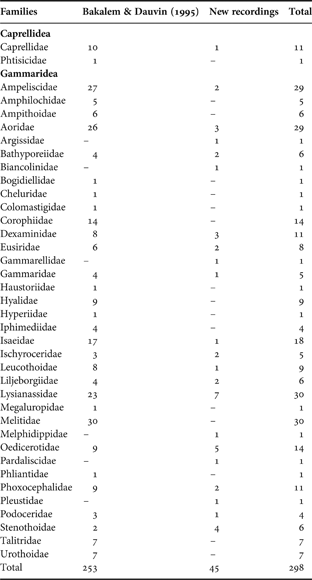
Table 2 gives the current status of the marine amphipod fauna inventory for the Algerian coast. It accounts for a total of 298 species of the 451 species recorded in the mid-1990s for the Mediterranean fauna. In terms of Algerian amphipod fauna, six of the families are new; four of them—Argissidae, Biancolonidae, Gammarellidae and Melphidippidae—account for only one single species in Mediterranean waters (Bellan-Santini et al., Reference Bellan-Santini, Karaman, Ledoyer, Myers, Ruffo, Vader and Ruffo1998). As Bellan-Santini et al. have remarked ‘the knowledge of the Mediterranean remains partial and extremely heterogeneous, and future investigations will no doubt noticeably modify some of our 1998 conclusions’. This paper helps to respond to the need for additional data, providing information mainly about the North African coast.
Number of amphipod species per family along the Algerian coast, based on Bakalem & Dauvin (Reference Bakalem and Dauvin1995) and the new recordings.

In addition, the recent surveys by Bakalem and Grimes focus mainly on the soft bottoms in the shallowest parts of the Algerian continental shelf. Methodical observation of hard-bottom communities and offshore sampling in the bathyal and abyssal zones could reveal other new amphipod species in the Exclusive Economic Zone of Algerian waters. Furthermore, concentrating on new samples from the soft bottoms of the continental shelf could reveal the existence of additional new species of Algerian marine amphipod fauna, which for the moment have only been identified at a genus level (e.g. Cressa, Eriopisella and Syrrhoites and other species whose identification needs to be confirmed with additional information). Establishing a reference collection of the Algerian amphipod species, as well as other invertebrates, is a challenge that future marine researchers in Algeria must pursue.
ACKNOWLEDGEMENTS
The authors are grateful to Dr A. Bakalem for his very useful help, to the captains and the crew of the oceanographic vessel M.S. ‘Benyahia’ during the campaigns, and to Lisa Spencer for her help with the English version of this note. They are also grateful to the referees for their very useful comments on the first version of this note.