INTRODUCTION
The performance of community-based natural resource management (CBNRM) in southern Africa has been constantly brought into the limelight in terms of its significance in contributing to both environmental conservation and rural development. Within some sectors CBNRM has not met the expectations of its enthusiastic inception in the 1980s, as the depletion of vital natural resources and the excruciating effects of poverty have persisted among local communities in areas where CBNRM has been introduced. There are claims of high incidences of failure (Campbell et al. Reference Campbell, Madondo, Nemarundwe, Sithole, De Jong, Luckert and Matose2001; Fabricius Reference Fabricius, Fabricius, Koch, Magome and Turner2004; Dzingirai & Breen Reference Dzingirai and Breen2005), but because CBNRM has the attributes of a complex system, emergent forces continually challenge stability such that phases of success, collapse and reconstruction may be hallmarks of CBNRM (Child Reference Child2004; Nkhata et al. Reference Nkhata, Breen and Abacar2009).
We argue that the perceived dismal performance of CBNRM in southern Africa has much to do with understanding of environmental governance systems and how these are devolved in such a way as to advance the community interest in a natural resource. Environmental governance systems refer to sociopolitical and economic structures and processes that enable society to define and accept or reject alternative environmental agendas (Kay et al. Reference Kay, Regier, Boyle and Francis1999; Boyle et al. Reference Boyle, Kay, Pond and Munn2001; Folke et al. Reference Folke, Hahn, Olsson and Norberg2005; Imperial Reference Imperial2005; Hall Reference Hall, Turton, Hattingh, Maree, Roux, Claasen and Strydom2006; Nkhata & Breen Reference Nkhata and Breen2010). These structures and processes evince the interactions amongst social actors, of which government is just a part, and can be institutionalized at different levels of human interaction (global, national and local) to establish particular sociopolitical and economic regimes (Armitage Reference Armitage2008). They are dynamically complex and comprise interconnected subsystems that are linked for the purpose of regulating social relationships among actors (Nkhata & Breen Reference Nkhata and Breen2010). In this way, environmental governance systems provide the means of social coordination that engender collective action (Ostrom Reference Ostrom1990), ordered rule (Stoker Reference Stoker1998), and allow members of society to share power and make collective decisions (Imperial Reference Imperial2005).
We view CBNRM as the implementation of an environmental governance system at local or community levels (Folke et al. Reference Folke, Hahn, Olsson and Norberg2005) as well as the extension of comanagement processes (Plummer & Armitage Reference Plummer and Armitage2007). Although environmental governance systems are not viewed as a panacea for all CBNRM related problems, we suggest that the extent to which such systems are devolved will result in the community interest being advanced or hindered through CBNRM. This is because we consider CBNRM as an environmental governance system used by society to guide the relationships between government actors and local communities as they go about articulating their interests, exercising their rights, meeting their social obligations and mediating their differences (Wilshusen et al. Reference Wilshusen, Brechin, Fortwangler, West, Brechin, Wilshusen, Fortwangler and West2003; Gruber 2008). CBNRM seeks to facilitate devolution of authority and responsibilities for the governance of natural resources to local communities, who are not agents of the government (Barrow & Murphree Reference Barrow, Murphree, Hulme and Murphree2001; Armitage Reference Armitage2008; Berkes Reference Berkes2009). The term devolution is here distinguished from decentralization, a term with which it is commonly used interchangeably. The former refers to the transfer of authority and responsibilities to governmental or non-governmental institutions, whilst the latter involves the delegation of government functions from the centre to the periphery in an effort to move government closer to the people (ART [Africa Resources Trust] 1999). In this paper, we aim to examine the dynamics underlying the transfer of authority and responsibilities for decision-making and benefit distribution from government to local communities by studying a CBNRM scheme in the Kafue Flats (Zambia).
THE KAFUE FLATS ENVIRONMENTAL GOVERNANCE SYSTEM
The Kafue Flats in central southern Zambia (15°20′–15°55′ S; 26°–28°E) is a floodplain wetland between the Itezhi-tezhi Dam and Kafue Gorge, and covers an area of c. 6500 km2. This wetland is nationally and locally important for environmental conservation (wildlife, fisheries, water resources and livestock grazing) and includes two National Parks (Blue Lagoon and Lochinvar) and a Game Management Area (GMA), which is essentially communal land divided into the North and South Banks. In 1991, the Kafue Flats was designated as a wetland of international importance under the Ramsar Convention (GRZ [Government of the Republic of Zambia] 1995). In 1992, the human population of the Kafue Flats area was c. 120 000 (IUCN [International Union for Conservation of Nature] 1992). The periphery of the wetland is densely populated by Ilas and Tongas, who are traditionally cattle pastoralists (Jeffery Reference Jeffery1993). Although cattle are their prime economic concern, mixed farming plays an important subsistence role in their livelihood strategies as it involves cattle rearing as well as maize, cotton and groundnut production at a semi-commercial scale in the high grounds of the catchment. The flood plain is usually left for cattle grazing during the dry season when water and grass are most limited. Over three-quarters of the nearly 250 000 cattle are driven into the floodplain area to graze for six months. This tradition has been followed by these local communities for many generations (Lehmann Reference Lehmann, Williams and Howard1977).
During 1988–1999 efforts were made to consciously devolve aspects of environmental governance to local communities. These efforts were largely influenced by global and regional trends. In 1988, the government in partnership with local communities, the World Wide Fund for Nature (WWF), and the IUCN started implementing a CBNRM scheme called the WWF-Zambia Wetlands Project. Although this CBNRM scheme operated in two project areas (Bangweulu Basin and Kafue Flats), the focus here is on the Kafue Flats. The project's main goal was to ‘conserve the wetlands’ natural resources and maintain or enhance their productivity by promoting their sustainable use for the development of resident communities' (WWF-Zambia Wetlands Project 1992). As such, it was designed inter alia to devolve some aspects of wetlands governance to local communities (IUCN 1992). However, the resultant efforts were largely unsuccessful because of the limited devolution of decision-making and benefit-distribution processes to the communities, identified as a major contributing factor to the perceived poor performance of the CBNRM scheme in the Kafue Flats.
Devolving decision-making processes
The Lupande Research Project was designed by a government agency then known as the Department of National Parks and Wildlife Service (DNPWS). The results of this Project subsequently led to the initiation of the Lupande Development Project, the pilot project on which most of the CBNRM schemes in Zambia were later founded. This latter project's experiences of involving local communities led to the development of the Zambian government's ADMADE (Administrative Management Design for GMAs) Policy, which largely reflected the government's aim to reduce the rampant poaching of wildlife in and around Zambia's national parks and GMAs through the devolution of wildlife governance to local communities (Gibson Reference Gibson1999). Analysis of the design and implementation of the ADMADE Policy, under whose aegis the WWF-Zambia Wetlands Project operated, suggests that the intentions and efforts embedded in the WWF-Zambia Wetlands Project to devolve decision-making processes to local communities were limited.
While it is evident from the government's stated intentions that the ADMADE Policy was designed to provide for some degree of devolution of wildlife governance to local communities in GMAs, it is also clear from the same policy provisions that the government intended to adopt a limited approach in its efforts to devolve decision-making processes, which are key elements of an environmental governance system. Section 4(1) of the ADMADE Policy stipulated that ‘in order to provide a more effective service of wildlife development and conservation in GMAs, DNPWS will establish a system which will involve local communities’ (GRZ 1988). The initial results of the Lupande Research Project clearly revealed that conflicts surrounding human-wildlife interactions could be effectively dealt with by addressing the issue of shared decision-making (Lewis et al. Reference Lewis, Mwenya and Kaweche1990; Mwenya et al. Reference Mwenya, Lewis and Kaweche1990), but the ADMADE Policy merely espoused the co-option of local communities in management committees responsible for implementing decisions made by government actors, mostly the DNPWS. These management committees were to be established by the Minister responsible for wildlife issues through the DNPWS. Through their participation in these management committees, government envisaged that local communities would be convinced that they had been given back decision-making authority over wildlife, although, as illustrated below, this was never to be the case.
In an effort to devolve wetlands decision-making processes to local communities, the WWF-Zambia Wetlands Project organized the local people of the Kafue Flats around two social units, namely the Blue Lagoon and Lochinvar communities. The Blue Lagoon community comprised the local people on the North bank of the Kafue Flats, whilst the Lochinvar community consisted of the local people on the South bank. The project established two management committees to represent the two communities. These were the Blue Lagoon and Lochinvar Wetlands Management Authorities (WMAs), respectively. In addition, each WMA comprised a number of sub-authorities, which were called community development units (CDUs). Four CDUs were established under the Lochnivar WMA to correspond with the four chiefdoms (Choongo, Nalubamba, Haamusonde and Mungaila) on the South bank. The Blue Lagoon WMA had two CDUs to correspond with the two chiefdoms (Shakumbila and Muwezwa) on the North bank. However, the governance structure of the WWF-Zambia Wetlands Project seems to have compromised the Project's efforts to devolve wetlands decision-making processes to the local communities.
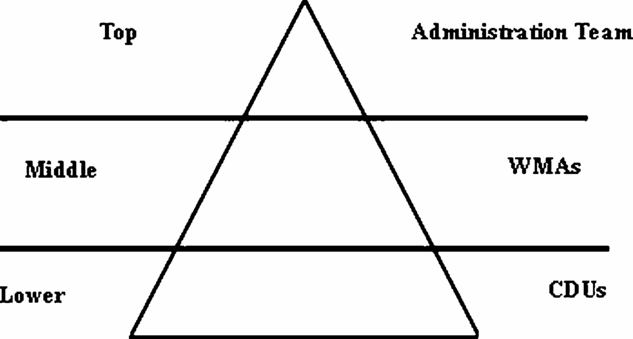
While the Project affirmed that the WMAs and CDUs were the main vehicle through which the integration of local communities in decision-making processes was to be achieved, local communities were only integrated through the middle and lower organizational levels of the governance structure through these committees (Fig. 1). The two organizational levels had little, if anything, to do with the decision-making process of the WWF-Zambia Wetlands Project. The WMAs and CDUs were only responsible for implementing the strategies crafted by the government actors on the top level. The authority for decision-making was vested in the project administration team, which comprised senior civil servants of the DNPWS and some contracted personnel that included a project leader. These government administrators were expected to make all the decisions for the Project and they were to facilitate the establishment and dissolution of the WMAs and CDUs. They reported and were accountable to the directorate of the DNPWS, and not to the local communities.
The three-tiered governance structure of the WWF-Zambia Wetlands Project. WMA = Wetland Management Authority, CDU = Community Development Unit.

Another example of ineffective devolution of decision-making processes can be illustrated through the membership of the WMAs. Each of the WMAs was made up of 26 people, who were mostly government appointed (Nkhata Reference Nkhata2002). With the exception of the vice-chairperson, who was elected by local communities, the chairperson, secretary and ordinary members were all appointed by the government through the DNPWS. Out of the 25 appointed members, only 12 came directly from the local communities, whilst the rest were either DNPWS officials or local politicians. The 12 community members comprised eight CDU representatives and four chiefs, who were regarded as patrons of the WMAs. The appointed members were responsible to and removable only by the DNPWS. Their stay in office was dependent on the quality of rapport they established with the appointing authority.
Both the governance structure of the WWF-Zambia Wetlands Project and membership of the WMAs are particularly important in illustrating the extent to which the Kafue Flats environmental governance system was devolved. Government appointees dominated the WMAs and local communities were only integrated in decision-making processes through the middle and lower levels of the governance structure, and thus it is likely that these communities did not have any effective representation in the significant decision-making processes related to the Kafue Flats; government did not hand over authority for decision-making through appropriate policy frameworks. The local communities could not make any significant decisions that reflected their aspirations. As an example, the Kafue lechwe (Kobus leche kafuensis Haltenorth) is regarded as a traditional symbol by most of the tribes in the Kafue Flats, and the killing of this animal is an important local ritual, which was previously practised on an annual basis (IUCN 1992). Numerous requests made by the Choongo CDU and their patron (Chief Choongo) to hunt two wild Kafue lechwe per year for their use during traditional ceremonies (Nkhata Reference Nkhata2002) were denied by the Minister responsible for wildlife issues, who, according to the Wildlife Act, was solely responsible for issuing special licences (Section 82 of the National Parks and Wildlife Act No. 10 of 1991). The reasons for objection were never specified, and this example suggests that the local communities were left with little or no say over the valuable wetlands resources.
Devolving benefit-distribution processes
The government's intentions to devolve benefit-distribution processes to local communities were reflected in the ADMADE Policy. According to the policy, the DNPWS was required to set up mechanisms through which local communities would be involved in the benefits from the use of wildlife (GRZ 1988). This provision was designed to facilitate the distribution of the associated benefits in an effort to improve wildlife conservation and development. While noting that government's intentions and efforts, at least in part, encompassed a desire to effectively devolve the distribution of benefits, a number of factors negated the meaningfulness of those intentions and efforts. These, singly or in combination, included the uneven sharing of revenues, failure to transfer revenue generation powers to local communities and the withholding of agreed funds due to local communities by the DNPWS.
One of the most important features of the WWF-Zambia Wetlands Project's benefit-distribution mechanism was its proposed revenue-sharing system. The DNPWS had the government's authority to collect revenue from the legal use of wildlife in GMAs. The safari-hunting category, which involved international clients paying in USA dollars (US$), generated more revenue than the other categories. Within this category, the revenue generated was further classified as either statutory (licence fees and GMA permits) or non-statutory (hunting rights and concessions). The non-resident hunting category involved Zambian clients who were not local residents in the GMA and paid in local Zambian currency. Its revenue was classified only as statutory revenue (licence fees and GMA permits). Resident hunting involved Zambian clients who were local residents in the GMA and paid in local currency. Although the revenue generated from this category was also classified as statutory, it only covered licence fees.
The revenues generated from the three hunting categories were shared amongst the central government, DNPWS (which was part of government) and local communities. The central government received the largest portion (50%) of the collected revenue. The remaining 50% was shared between the DNPWS (40% to support wildlife management operations in the GMA and 25% to support the administration of the ADMADE Policy) and local communities (35% to support community development projects in the GMA).
A meaningful critique of these percentages and figures would require additional information, including an analysis of the specific criteria that were used when establishing the sharing formula. This is beyond the scope of this paper. However, it is evident that local communities were receiving only a small proportion (17.5 %) of the overall revenues to carry out their community development projects. The rest (82.5%) went to the government and its functionaries as part of the tax-base, and to support wildlife management administration and operations. An expenditure analysis of the funds allocated to DNPWS revealed that, on average, a large portion (85%) of these monies was merely used to service the allowances of government officials, whilst only about 15% was used for anti-poaching operations. Although the allowances could have been a critical component of governance, this situation corroborates the view that government officials were more committed to obtaining income than contributing to effective devolution. The uneven sharing of the revenue between the government and local communities is also indicative of the government's strategy of reinforcing its dominance in governance processes.
Secondly, although the need for local communities to generate and distribute their own revenue is critical to devolution of benefit-distribution processes, the ADMADE Policy did not provide for this. Local communities did not possess the authority to raise and distribute revenue from hunting. Such powers were solely vested in the government and its functionaries. The DNPWS, through its Wildlife Conservation Revolving Fund (WCRF), undertook the actual collection, sharing and disbursement of the revenue from wildlife use. Effective devolution required local communities to have been granted significant authority to enable them take part in the administration, control and investment of local financial resources. From an environmental governance perspective, such empowerment would have improved the devolution of CBNRM in the Kafue Flats.
Thirdly, the negative implications of the government being solely responsible for the revenue-sharing system were reflected in the system operations. On several occasions, the government did not adhere to the stipulated procedures of the benefit-distribution mechanism. Although the government was expected to disburse the communities' 17.5% share on a quarterly basis, there were several instances when it failed to do so. For example, by 1999, there was a backlog of six unpaid disbursements to the Lochinvar WMA dating back from previous years. The non-remittance of funds to the communities was attributed to the DNPWS diverting the monies to other purposes (Nkhata Reference Nkhata2002). The revenue-sharing system was thus apparently only partially effective, particularly concerning the remittance of agreed funds on time.
Besides the revenue-sharing system, the WWF-Zambia Wetlands Project also offered other types of benefits to the local Kafue Flats communities. These included employment (particularly through the village scouts programme), provision of protein through culling schemes, opportunities for small-scale enterprises, grading of roads, extension services, training and education, a hammer mill, a community shop and a curio shop. However, most of the on-going projects collapsed for various reasons, including inadequate recapitalization, malpractice, and community members' poor organizational and management skills. There were also instances when community members diverted the CDU funds for personal purposes. Efforts to recover the embezzled funds were reported to be futile owing to fear and close relationships amongst the local community members (Nkhata Reference Nkhata2002). Although such practices could be widespread even within better performing community structures, they demotivated the constituents and other stakeholders, and adversely affected the general performance of the CBNRM scheme.
The devolution of critical aspects of benefit-distribution processes to local communities was thus limited. Despite the government's stated devolution intentions, issues surrounding the uneven sharing of revenues, non-transfer of revenue generation powers to local communities and non-remittance of agreed funds by the DNPWS demonstrate the continued dominance of government officials in benefit-distribution processes, contributing to the marginalization and as yet partial integration of local communities in benefit distribution.
DISCUSSION
The CBNRM scheme in the Kafue Flats was originally designed to devolve key components of an environmental governance system, but efforts were largely unsuccessful because of the poor social relationships between government actors and local communities. Although there were some marginal benefits for local communities, the CBNRM scheme could not support the construction and execution of an effective governance system. The intended devolution was compromised by failure to effectively transfer decision-making and benefit-distribution processes to local communities, largely attributed to government's inflexible approach towards building relationships with the communities. The perceived dismal performance of CBNRM can be attributed in some instances to flawed environmental governance systems. Importantly, this study demonstrates how the extent to which such systems are devolved affects the community interest. While community interest is not necessarily a singular unitary concept and there may be several partially overlapping ‘community interests’, the Kafue Flats CBNRM programme shows why devolved environmental governance systems are not simply a matter of attitudes, but also of responsive behaviour. So, to what extent should community interest be incorporated into CBNRM schemes?
The CBNRM scheme in the Kafue Flats appeared to be failing because the transfer of decision-making and benefit-distribution processes from government to local communities was not sufficiently adequate to allow the successful integration of the community interest. A successful environmental governance system must be devolved to appropriate levels of social organization to facilitate adaptive interactions (Armitage Reference Armitage2005) between government actors and local communities. A devolved system recognizes the nature of the dynamic social relationships (Nkhata et al. Reference Nkhata, Breen and Freimund2008) between government actors and local communities operating as nested quasi-autonomous entities (Folke et al. Reference Folke, Hahn, Olsson and Norberg2005). Decision-making and benefit-distribution arrangements in the Kafue Flats indicate the behavioural processes embodied in the environmental governance system.
The importance of devolved decision making in the implementation of an environmental governance system cannot be exaggerated. Devolved decision making provides a platform for negotiating and constructing the community interests that particular CBNRM schemes are supposed to secure. Such processes offer an organizational means to transform community interest into reality. In contrast, the membership of the Kafue Flats WMAs compromised efforts to devolve decision making to local communities, as it failed to truly represent the community interest and was to some extent used to extend and strengthen the decision-making authority of the DNPWS, undermining opportunities for local people to effectively advance their community interest. As government appointees, the local community members in the WMAs were not downwardly accountable to their constituents, but solely upwardly accountable to the DNPWS; this situation left local communities without any significant decision-making authority over wetlands resources in the Kafue Flats.
Conversely, devolved benefit-distribution processes may provide a mechanism for resolving trade-offs to establish and sustain community interest. Benefit-distribution mechanisms in the Kafue Flats were adopted to promote both resource sustainability and community interest. Perhaps surprisingly, these mechanisms were narrowly employed as a way of soliciting support from local communities who were perceived to exhibit resource-degrading behaviours. While the term benefits is better understood in its broadest sense, the Project focus was on an assortment of inducements that would sustain efforts aimed at attaining sustainable use of local wetlands resources in the Kafue Flats. But benefit-distribution processes must go beyond ordinary inducements and focus on institutions that provide ordered rule and collective action (Ostrom Reference Ostrom1990; Stoker Reference Stoker1998; Anderies et al. Reference Anderies, Janssen and Ostrom2004).
The CBNRM interventions in the Kafue Flats demonstrate poor social relationships between government actors and local communities can only be improved if and when local communities are effectively integrated in governance systems. This has particular significance for assessing CBNRM performance in southern Africa. Other studies that have also attempted to analyse and understand the dismal performance of southern African CBNRM programmes have raised a range of similar issues and concerns that include continued state dominance (Gibson Reference Gibson1999), ineffective property rights (Murphree 1996), inadequate devolution of authority and responsibility for nature resources (Murombedzi Reference Murombezi2000), inadequate genuine participation by local communities in decision-making (Dzingirai Reference Dzingirai2003) and insignificant impact of economic benefits on local communities (Emerton Reference Emerton, Hulme and Murphree2001). Furthermore, our findings here accord with similar assumptions in the emerging fields of adaptive governance and comanagement (Olsson et al. Reference Olsson, Folke and Berkes2004; Folke et al. Reference Folke, Hahn, Olsson and Norberg2005; Armitage Reference Armitage2008).
Considering CBNRM as a devolved environmental governance system provides an appreciation of the dynamics that underlie its structures and processes. Governance behind devolution efforts should be a key focus of CBNRM performance management and assessments. Sound governance frameworks can be used as powerful tools to improve understanding of government-local community relationships. Not only can sustainable natural resource use support effective governance, but good governance can also be a powerful tool to promote sustainable natural resource use. Some CBNRM analytical frameworks and operations do not explicitly address environmental governance; generally they are confined to technical issues. Where attempts have been made to include environmental governance issues and concerns, they have more often than not been addressed on an ad hoc basis. Governance of natural resource use will be one of the most important components in the design of the next generation of CBNRM models.
CONCLUSIONS
CBNRM processes are not only about the sustainable use of natural resources, but also the nature and quality of relationships amongst key social actors in environmental governance systems. Environmental governance systems emphasize the important role played by both horizontal and vertical relationships between local communities and other actors. Comanagement and other related approaches are not only about resources, but rather about managing social relationships (Natcher et al. Reference Natcher, Davis and Hickey2005). By drawing attention to such relationships, we here aim to broaden understanding of what goes into CBNRM processes. The implications of ignoring these relationships can be detrimental to the success of CBNRM.
ACKNOWLEDGEMENTS
This work was supported by the Ford Foundation CBNRM Program at the Centre for Environment, Agriculture, and Development, University of KwaZulu-Natal, South Africa. We thank the Zambia Wildlife Authority and the Lusaka Agreement Task Force for their support to Bimo Abraham Nkhata.