Implications
Animal welfare is a multi-dimensional concept. Thus, it is meaningful to use multi-criteria aggregation systems to obtain an overall welfare score, which were included in the Welfare Quality® protocols. The present study analyses whether the aims of the multi-criteria evaluation system were actually fulfilled and the role of each animal-based indicator in the aggregation. It is therewith an important contribution towards the further development of Welfare Quality® and other welfare assessment systems.
Introduction
The public and political interest in animal welfare has constantly grown in the last few decades (Hobbs et al., Reference Hobbs, Hobbs, Isaac and Kerr2002). In order to meet consumers’ concerns with respect to animal welfare in the form of, for example, animal welfare certification schemes, it is necessary to evaluate the welfare status on-farm objectively. Animal welfare is a multi-dimensional concept consisting of different aspects such as the absence of thirst, hunger, discomfort, disease, pain, injuries and stress as well as the possibility to express normal behaviour (Farm Animal Welfare Council, Reference de Vries, Bokkers, van Schaik, Botreau, Engel, Dijkstra and de Boer1992). However, this multi-dimensionality also poses the major challenge with regard to a generally accepted welfare assessment system because all the different aspects have to be taken into account. Furthermore, animal welfare assessment systems face the challenge of providing an easily understandable conclusion, that is aggregating all these different measures on differing statistical scales to a single comprehensible value. The Welfare Quality® system does not only include all the different aspects of animal welfare, but also introduces a multi-criteria evaluation system in order to conclude all the different measures into a single evaluation of the farm as excellent, enhanced, acceptable or not classified (Welfare Quality®, 2009). However, the Welfare Quality® multi-criteria evaluation system has been criticised for its lack of transparency and flexibility, the role of expert opinion and the type of algorithm operator used (de Vries et al., 2012).
The present study analyses the influence of each single indicator and criterion, respectively, in the multi-criteria aggregation system of Welfare Quality® (Welfare Quality® Network, 2009). According to Botreau et al. (Reference Botreau, Winckler, Velarde, Butterworth, Dalmau, Keeling and Veissier2013), the aim of the multi-criteria evaluation system of Welfare Quality® was to be a transparent, standardised measurement method in which the data are meaningfully interpreted and integrated. This system should allow a sensitive distinction of variations among farms. In the procedure of invention, the aim was to avoid the double-counting of measures, that is measures were allocated to only one criterion. Furthermore, compensation between criteria and principles were limited as far as possible (Botreau et al., Reference Botreau, Winckler, Velarde, Butterworth, Dalmau, Keeling and Veissier2013). How far these aims were actually fulfilled was thoroughly examined in the present study. Moreover, this study provides important information on the most important welfare issues in the observed population and provides information on the contribution of the indicators, that is indicators that might be deleted or else are of special importance. Altogether, this study constitutes an additional validation of the Welfare Quality® Assessment protocol for growing pigs.
Material and methods
Data collection
Between January and August 2013, the data were recorded on 24 growing pig farms in Northern Germany. The pigs on the farms were housed either conventionally (four farms) or according to the guidelines of the animal welfare label ‘Tierschutzlabel’ of the German animal welfare organisation ‘Deutscher Tierschutzbund e.V.’ (Deutscher Tierschutzbund, 2013) (20 farms). The pigs housed according to the conditions of the ‘Tierschutzlabel’ had organic material for occupation; the space allowance was increased by one-third compared with conventional systems; if males were castrated, anaesthesia were used and tails were undocked (except for transitional arrangements); functional areas (resting, activity, dunging) were arranged in the stables whereby the resting area was of concrete flooring and for 12 animals at least two drinkers were available in the pen. Three trained observers carried out the Welfare Quality® protocols (Welfare Quality®, 2009) repeatedly on these farms. On 21 of the farms, a total of six protocol assessments per farm took place in the time interval of two consecutive growing periods. Thereby, the first visit took place at the beginning of the growing period with a pig-weight of around 40 kg, the second one in the middle of the growing period at around 75 kg and the third visit at the end of the growing period at a weight of around 110 kg. Three other farms were visited at an interval of every 2 weeks during two consecutive growing periods, resulting in 12 visits per growing period. Thus, altogether, 198 protocol assessments were carried out on these farms. The training of the observers took place in November 2012 and was given by members of the Welfare Quality® project group.
Protocol assessments
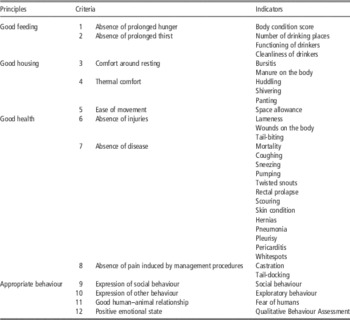
During each farm visit, an assessment according to the Welfare Quality® protocol for growing pigs (Welfare Quality®, 2009) was carried out. Before entering the stable, a certain number of pens and observation points in the stable was chosen randomly. If pigs of different ages were present on a farm, all age categories were included. Hospital pens were excluded. The collected data were aggregated to criteria and principle scores using the algorithm of the Welfare Quality® protocol (Welfare Quality® Network, 2009). Originating from the data collected on-farm, first a score ranging from 0 to 100 is calculated via different mathematical methods for the 12 criteria, and then for the four main principles. A detailed overview of the allocation of indicators, criteria and principles according to Welfare Quality® is given in Table 1. As can be seen, the indicators were allocated to only one criterion in order to avoid double-counting. The individual criteria within a particular principle should not compensate for each other (i.e. a high score in one criterion should not compensate for a low score in another). Therefore, compensation between criteria is controlled and limited as far as possible by the Welfare Quality® aggregation system. Zero presents the worst and 100 the best possible welfare state. Depending on the scores of the four principles, the farms are rated overall as excellent, enhanced, acceptable or not classified. A farm is rated as excellent if it scores >55 in all principles and >80 in two of them; as enhanced if it scores >20 in all principles and >55 in two of them; and as acceptable if it scores >10 in all principles and >20 in three of them. Otherwise, it is scored as not classified (Welfare Quality®, 2009).
Principles, criteria and indicators of the Welfare Quality® protocol for growing pigs

Statistics
In the further analysis of this study, the 198 assessments were treated as independent samples although, naturally, influences were present as the data were collected on a sample of only 24 farms. In order to determine the influence of each single indicator on the criteria scores and the influence of each criterion on the principle scores, the Variable Importance for Projection (VIP) score was calculated with the procedure Proc PLS in SAS 9.2 (SAS Institute, 2008). This variance-based partial least square (PLS) procedure, which is a multivariate linear regression method, allows the estimation of the influence of independent variables (e.g. indicators) on dependent variables (next aggregation step of the Welfare Quality® multi-criteria evaluation system, e.g. criteria) (Nitzl, Reference Nitzl2010). The VIP score is a method for the selection of variables for the PLS model, which is done by estimating the influence the independent variables have. It is calculated for the independent variable j by the following formula:
 $${\rm VIP}_{j} \,{\equals}\,\sqrt {{{\mathop{\sum}\limits_{f\,{\equals}\,1}^F {w_{{jf}}^{2} {\times}{\rm SSY}_{f} {\times}J} } \over {{\rm SSY}_{{{\rm total}}} {\times}F}}} $$
where w jf is the weight value for the independent variable j and the dependent variable f, SSY f the sum of squares of explained variance for the dependent variable f and J the number of independent variables. SSYtotal is the total sum of squares of explained variance for the dependent variables and F is the total number of dependent variables. In the calculations of the given study, only one dependent variable was present in all calculated models. Variable Importance for Projection scores have been extensively used in different fields, and are thus suitable for differing data types (Farrés et al., Reference Farrés, Platikanov, Tsakovski and Tauler2015). Theoretically, VIP scores can take values of 0 or all positive natural numbers. According to Wold (Reference Wold1995), independent variables with a VIP score ⩾0.8 have a significant influence on the dependent variable.
Results
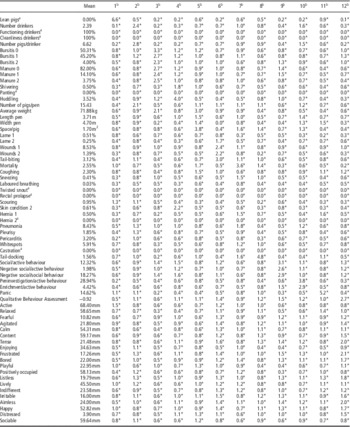
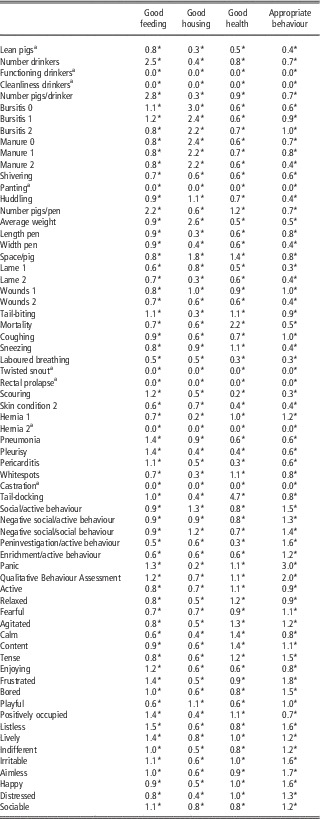
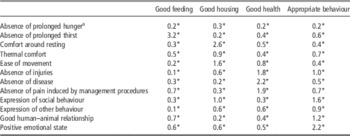
The mean observed prevalences of each indicator are presented in Table 2. The influence of indicators on the criteria and principles is presented in Tables 2 and 3, respectively. The influence of each criterion on the four main principles is shown in Table 4.
Variable Importance of Projection (VIP) scores of all indicators included in the multi-criteria evaluation system of the Welfare Quality® protocol for growing pigs (Welfare Quality®, 2009) in association to the 12 criteria

Meaningful influences are marked by an asterisk.
*VIP score ⩾0.8.
a Indicators which were not observed in the present study and therefore cannot be estimated correctly by the model.
b Criteria of the Welfare Quality® protocol for growing pigs: (1) absence of prolonged hunger, (2) absence of prolonged thirst (3) comfort around resting, (4) thermal comfort, (5) ease of movement, (6) absence of injuries, (7) absence of disease, (8) absence of pain induced by management procedures, (9) expression of social behaviour, (10) expression of other behaviour, (11) good human–animal relationship, (12) Positive emotional state.
Variable Importance of Projection (VIP) scores of all indicators included in the multi-criteria evaluation system of the Welfare Quality® protocol for growing pigs (Welfare Quality®, 2009) in association to the 12 criteria and to the four main principles

Meaningful influences are marked by an asterisk.
*VIP score ⩾0.8.
a Indicators which were not observed in the present study and therefore cannot be estimated correctly by the model.
Variable Importance of Projection (VIP) scores of all 12 criteria of the multi-criteria evaluation system of the Welfare Quality® protocol for growing pigs (Welfare Quality®, 2009) in association to the four main principles

Meaningful influences are marked by an asterisk.
*VIP score ⩾0.8.
a Consists solely of indicators which were not observed in the present study and therefore cannot be estimated correctly by the model.
Usually, those indicators allocated to a given criterion (see Table 1) have the highest influence. However, in all calculations, other indicators also have VIP scores of equal to or >0.8. For example, the indicator lean pigs is the only indicator allocated to the criterion absence of prolonged hunger. This indicator has a VIP score equal to 6.6 and thus a very high influence. However, the indicators bursitis with a score 0 and 1; width of the pen, lame and wounds with a score 1; mortality, coughing, scouring, panic, active, agitated, calm, tense, playful, lively, irritable, happy and sociable also have meaningful influences with VIP scores ranging from 0.8 to 1.5. This also applies to the influence of indicators on their principles (see Table 3). For example, the indicators lame, wounds, tail-biting, mortality, coughing, sneezing, laboured breathing, twisted snout, rectal prolapse, scouring, hernia, pneumonia, pleurisy, pericarditis and whitespots were allocated to the principle good health. Of these indicators, only wounds of score 1, tail-biting, mortality, sneezing, hernia of score 1 and whitespots have a VIP score of equal to or >0.8. However, also the indicators number of pigs per drinker, number of pigs per pen, space allowance per pig, tail-docking, social and negative social behaviour as well as most of the adjectives of the Qualitative Behaviour Assessment (with the exception of the term enjoying and playful) have a meaningful influence.
The criteria social behaviour, other behaviour, human–animal relationship and positive emotional state have VIP scores of equal to or >0.8 for the principle appropriate behaviour, whereas the other criteria have VIP scores of <0.8. This complies exactly with the theoretical allocation. However, the criterion ease of movement also achieved a VIP score equal to 0.8 for the principle good health, in addition to those criteria assigned to that principle. Likewise, the criterion other behaviours also has a significant influence for the principle good housing, although it is not specifically dedicated to this principle. For the principle good feeding, only the criterion absence of prolonged thirst has a meaningful influence despite the fact that the criterion absence of prolonged hunger is also dedicated to this principle.
Discussion
The aim of the present study was to estimate the influence of the indicators in the calculation procedure on criteria and welfare scores as well as the influence of the criteria in the calculation of principle scores. It was expected that only those indicators and criteria, respectively, which are officially allocated to that criterion or principle (see Table 1) should have a meaningful influence. Whether double-counting of and compensation between measures was avoided by the theoretical allocation was evaluated by means of PLS modelling and the evaluation of VIP scores.
The 198 assessments were treated as independent samples although, naturally, influences were present as the data were collected on a sample of only 24 farms. A larger sample of farms would have been beneficial for the informative value of the study, especially as it would probably have enlarged the variance, which was rather low in the present database. However, the observed prevalences of the indicators are comparable with those found in other studies using the Welfare Quality® protocol for growing pigs (Temple et al., Reference Temple, Dalmau, Ruiz de la Torre, Manteca and Velarde2011 and Reference Temple, Manteca, Dalmau and Velarde2013; Meyer-Hamme et al., Reference Meyer-Hamme, Lambertz and Gauly2016). Hence, although the statistical method is dependent on the specific observations of our study (i.e. the 198 protocol assessments on 24 farms in Northern Germany) and therewith cannot be generalised for the whole population, the fact that such prevalences were detected in other studies using the protocol suggests that the statements are valid. Of course, this has to be verified in further studies, carried out at best internationally. For example, the fact that the criterion absence of prolonged hunger did not have a significant influence on the principle good feeding, to which it was theoretically dedicated, might just be due to the fact that no lean animals were observed on the sample of growing pig farms.
Due to the fact that the results are strongly dependent on the sample, it can also be concluded as to what the most important welfare issues are in the population under observation. As the comparison of prevalences shows that these were quite similar to other sample populations also taken in other countries, this suggests that the same welfare issues were of special importance in those populations.
On the level of principles, only the principle appropriate behaviour was in accordance to the theoretical assignment in the Welfare Quality® aggregation system (see Table 1). This was not the case for the other principles. It was revealed that double-counting was present, for example, for the criterion social behaviour, because it did not only have an influence on its assigned principle appropriate behaviour but also on the principle good housing. Although this makes sense as normal social behaviour can only be shown if, for example, enough space is provided and thermal comfort is given (Evans, 1984; Beattie et al., Reference Beattie, Walker and Sneddon1996; Jensen et al., Reference Jensen, Vestergaard and Krohn1998). Double-counting bears the statistical problem of overvaluation of single measures (Schankerman, Reference Schankerman1981; Johannesson, Reference Johannesson1997), which is the reason why it should be avoided (Botreau et al., Reference Botreau, Winckler, Velarde, Butterworth, Dalmau, Keeling and Veissier2013). Another case of double-counting was detected for the criterion ease of movement, which is normally dedicated to the principle good housing, but also had a meaningful influence on the principle good health.
For the calculation of criteria and principles, it was revealed that the dedicated indicators usually had the greatest influence. However, in almost all cases, other indicators also had meaningful influences even if they remained less than those of the dedicated indicators. Due to the nature of PLS modelling and VIP scores, there are several conclusions to be drawn.
First of all, the results point to welfare issues with great importance: for the principle good feeding, although absence of prolonged hunger actually belongs to it, the fact that the VIP score was very low (0.2) is probably due to the fact that lean animals had a very low prevalence in the present study. Thus, their effect is underestimated in the PLS model. The same is to be said regarding the indicators functioning of drinkers, cleanliness of drinkers, panting, twisted snout, rectal prolapse, hernia of score 2 and castration, which simply did not occur at all in the study. Therefore, in the modelling procedure, no influence could be detected. Hence, these indicators were not an issue in the population under observation. Although this needs verification by carrying out the protocol, especially in other countries where these welfare problems might be of greater importance, currently available studies (Temple et al., Reference Temple, Dalmau, Ruiz de la Torre, Manteca and Velarde2011 and Reference Temple, Manteca, Dalmau and Velarde2013; Meyer-Hamme et al., Reference Meyer-Hamme, Lambertz and Gauly2016) imply that this is also valid for a greater population. As the Welfare Quality® protocols have been criticised for being too time-consuming and therewith too costly (Knierim and Winckler, Reference Knierim and Winckler2009), this leads to the proposition that these indicators may be deleted from the protocol in order to be faster in the assessment. This also stands in accordance to recent studies dealing with the Welfare Quality® protocols of the other species. For example, Andreasen et al. (Reference Andreasen, Sandoe and Forkman2016) concluded that the Welfare Quality® protocol for dairy cattle can be simplified as not all indicators are needed for a reliable and valid assessment. Likewise, Buijs et al. (Reference Buijs, Ampe and Tuyttens2016) and De Jong et al. (Reference De Jong, Hindle, Butterworth, Engel, Ferrari, Gunnink, Moya, Tuyttens and Van Reenen2016) came to this conclusion for broiler chicken.
Second, standing in accordance to that, the present results suggest that some of the indicators might have the potential of becoming iceberg indicators, that is one indicator has a conspicuously high prevalence which points at more than one welfare problem. This is, for example, the case for the indicators bursitis, space allowance per pig, tail-docking, social behaviour and the adjectives of the Qualitative Behaviour Assessment, which are linked to several principles. Moreover, what is indicated is that some welfare problems influence each other. For example, it is a well-known fact that one of the factors leading to tail-biting is the water supply (European Food Safety Authority (EFSA), 2007; Scollo et al., Reference Scollo, Contiero and Gottardo2016), which could explain the influence the indicator tail lesions has on the criterion absence of prolonged thirst. Moreover, the indicators tail-biting and tail-docking have several influences, which is in accordance to recent suggestions that one of the most suitable welfare indicators is the absence of the multifactorial problem of tail-biting (EFSA, 2007 and Reference Evans2012).
The third conclusion that can be drawn is that the calculation formulae of the Welfare Quality® multi-criteria evaluation system have to be thoroughly re-examined for those criteria and principles for which indicators had an influence which were not theoretically dedicated if the goal was to cancel these effects (double-counting, compensation) out. This supports the conclusion of de Vries et al. (2012) that the type of algorithm operator used should be reconsidered. Due to the irregularities detected, one should also question the hypothesis of Courboulay et al. (Reference Courboulay, Meunier-Salaun, Edwards, Guy and Scott2009) that the ranking of farms by the final aggregation would stay the same despite observer influences. This is especially important as Czycholl et al. (Reference Czycholl, Kniese, Büttner, grosse Beilage, Schrader and Krieter2016a) detected observer influences, that is low interobserver reliability, for some indicators and other studies revealed deficits regarding the test–retest reliability for other indicators (Temple et al., Reference Temple, Manteca, Dalmau and Velarde2013; Czycholl et al., Reference Czycholl, Kniese, Büttner, grosse Beilage, Schrader and Krieter2016b). Probably, this low reliability on the indicator level also influences the final outcomes calculated by the aggregation system. One solution could be to use the alternative multi-criteria evaluation system to assess animal welfare as proposed by Martín et al. (Reference Martín, Traulsen, Buxadé and Krieter2017a and Reference Martín, Czycholl, Buxadé and Krieter2017b), which should be validated further as carried out in the present study for the Welfare Quality® system. In any case, at present, it is important to learn more about the influences and interactions in order to interpret the aggregation outcomes correctly and to avoid overvaluation.
Conclusion
The aim of the present study was to examine the multi-criteria evaluation system for the overall assessment in order to further validate the Welfare Quality® protocol for growing pigs. It was revealed that some indicators were not important and may be deleted from the protocol in order to increase feasibility. On the other hand, indicators were detected that were of great importance for the assessment of welfare and may have potential as iceberg indicators. Furthermore, some essential information on the multi-criteria evaluation system was gained, in particular, where double-counting and compensation between measures occurred. This needs to be taken into consideration for the further development of the aggregation system and the protocol in general as well as for the correct interpretation of data. Therewith, this study is an important contribution to the future progression of the Welfare Quality® protocols and animal welfare assessment tools in general.
Acknowledgements
This work was financially supported by the German Federal Ministry of Food, Agriculture and Consumer Protection (BMELV) through the Federal Agency for Agriculture and Nutrition (BLE), grant number 2817200913.