Introduction
Canada, among many other countries worldwide, is expected to see its older adult population double in the next 20 years, reaching approximately 10.4 million people over the age of 65 by 2036 (Statistics Canada 2013). While many adults are living longer and healthier into their older years, ageing can also bring multifaceted health and social conditions that limit some older adults' ability to access traditional office-based health and social care services (Smith-Carrier et al. Reference Smith-Carrier, Pham, Akhtar, Nowaczynski, Seddon and Sinha2015). Combined with the commonly expressed desire to live at home for as long as possible, and ultimately, die at home, interest is mounting in the provision of services within the home as opposed to institutional alternatives. Using a qualitative inductive content analysis, this paper explores unpaid care-givers' experiences with and perceptions of home-based primary care (HBPC) in Ontario, Canada, and how these compare to their perceptions of and experiences with the standard office-based approach to care.
Ontario, the most populous of the Canadian provinces, has developed a complex network of health-care organisations and providers, operating in a range of settings (e.g. hospital, home, community). Primary care in Ontario is delivered through a variety of practice models (e.g. family health teams, community health centres, comprehensive care through solo primary care physicians), although largely in a medical office setting. Home visits, once common practice in Canada, have waned dramatically over time (Smith-Carrier et al. Reference Smith-Carrier, Nowaczynski, Akhtar, Pham and Sinha2012) as the shift to the office, with its assumed efficiencies, gained widespread embrace (in the United States of America (USA), see Grumbach and Bodenheimer Reference Grumbach and Bodenheimer2004). As a result, frail and homebound older adults, unable to access the office, have typically been subject to inadequate primary care (Smith-Carrier et al. Reference Smith-Carrier, Sinha, Nowaczynski, Akhtar, Seddon and Pham2016). It is imperative to address this fundamental access to care problem, as well as the questionable care quality that frail and homebound older adults encounter when endeavouring to navigate Ontario's labyrinthine health-care system (see Ravenscroft Reference Ravenscroft2010); a system recognised to be ‘severely fragmented’ despite recent reforms to improve primary care delivery in the province (Hutchison and Glazier Reference Hutchison and Glazier2013).
To address the primary care needs of the frail and homebound populations better, a growing body of research not only stresses the importance of providing comprehensive care in the home, as endorsed in the burgeoning HBPC literature (Stall, Nowaczysnki and Sinha Reference Stall, Nowaczynski and Sinha2014), but also that such care be delivered through teams of health-care providers (Okie Reference Okie2008). Inter-professional teams allow the knowledge and skills of a variety of team members (including but not limited to nurses, social workers, occupational therapists, physicians, dieticians, pharmacists and personal support workers) to be maximised in the comprehensive care of the older adult (Smith-Carrier et al. Reference Smith-Carrier, Pham, Akhtar, Nowaczynski, Seddon and Sinha2015). Although the delivery of primary care through inter-professional teams has grown steadily in Canada over the years (Zygmunt, Asada and Burge Reference Zygmunt, Asada and Burge2015), team-based HBPC is relatively new, and thus limited in Ontario, with only a few HBPC programmes operational in this province. These programmes, differing from the traditional solo practitioner-provided house call, underscore the importance of a team of health-care providers who work together with the patient and her/his family and/or care-givers to formulate an individual care plan that would ensure the ongoing monitoring and treatment of the patient's medical concerns, as well as the co-ordination of home and community care services that enable the patient to live safely at home (see Smith-Carrier et al. Reference Smith-Carrier, Nowaczynski, Akhtar, Pham and Sinha2012). The team, in this context, refers to the patient, her/his care-givers, the co-ordinator/liaison attached to the local community care organisation (responsible for managing home and community care services, e.g. meals, homemaking, etc.), and the health-care practitioners attached to the HBPC programme (e.g. the family health team). The key characteristics of HBPC programmes, as documented elsewhere (see Beales and Edes Reference Beales and Edes2009; Stall, Nowaczynski and Sinha Reference Stall, Nowaczynski and Sinha2013a, Reference Stall, Nowaczynski and Sinha2013b, Reference Stall, Nowaczynski and Sinha2014), include access to ongoing primary and social care through an inter-professional team, availability for urgent care and use of a shared electronic medical record.
The impact of care-giving
Between 75 and 90 per cent of home care in Canada is provided by unpaid care-givers who are family members or friends of a person in need of support (Dunbrack Reference Dunbrack2005). Family care-givers are thus essential to the delivery of home care services. Besides offering crucial emotional and social support (Temkin-Greener et al. Reference Temkin-Greener, Bajorska, Peterson, Kunitz, Gross, Williams and Mukamel2004), family members and/or friends frequently undertake complex nursing and clinical care tasks, including assisting the frail older adult with activities of daily living (e.g. bathing, eating, etc.) and instrumental activities of daily living (e.g. cooking, shopping, transportation, medication management, etc.) (Barg et al. Reference Barg, Pasacreta, Nuamah, Robinson, Angeletti, Yasko and McCorkle1998; Rhodes and Shaw Reference Rhodes and Shaw1999). Without the assistance of these unpaid care-givers, many older individuals would require long-term institutionalised care, and the public costs associated with this care would increase substantially (Armstrong and Banerjee Reference Armstrong, Banerjee, Armstrong, Boscoe, Clow, Grant, Hawoth-Brockman, Jackson, Pederson, Seeley and Springer2009; Arno, Levine and Memmott Reference Arno, Levine and Memmott1999).
Providing care in the home often comes at a considerable cost to unpaid care-givers themselves. Care-giving is associated with poorer physical health (Aoun et al. Reference Aoun, Kristjanson, Currow and Hudson2005; Funk et al. Reference Funk, Stajduhar, Toye, Grande, Aoun and Todd2010; Stenberg, Ruland and Miaskowski Reference Stenberg, Ruland and Miaskowski2010), as well as a myriad of other adverse effects, including disruptions to daily routines (Kinsella et al. Reference Kinsella, Cooper, Picton and Murtagh1998), exhaustion (Singer et al. Reference Singer, Bachner, Shvartzman and Carmel2005), feelings of isolation (Murray et al. Reference Murray, Boyd, Kendall, Worth, Benton and Clausen2002), worsened social and family life (Cameron et al. Reference Cameron, Franche, Cheung and Stewart2002), anger and/or resentment (Payne, Smith and Dean Reference Payne, Smith and Dean1999), financial burdens (Bedard et al. Reference Bedard, Pedlar, Martin, Malott and Stones2000), occupational pressures (Jarrett, Payne and Wiles Reference Jarrett, Payne and Wiles1999), a lower quality of life (Argimon et al. Reference Argimon, Limon, Vila and Cabezas2004) and increased mortality (Schulz and Beach Reference Schulz and Beach1999). Care-givers also experience worse psychological health (Pinquart and Sörensen Reference Pinquart and Sörensen2003), increased rates of depression (Cannuscio et al. Reference Cannuscio, Coldita, Rimm, Berkman, Jones and Kawachi2004), anxiety, stress, family conflict and financial strain as a result of their role (Kim and Shultz Reference Kim and Shultz2008), which may be even more pronounced when caring for a patient with dementia (Covinsky et al. Reference Covinsky, Newcomer, Fox, Wood, Sands, Dane and Yaffe2003).
Although much research has focused on the negative impacts related to care-giving, some studies have highlighted positive aspects as well (Lopez, Lopez-Arrieta and Crespo Reference Lopez, Lopez-Arrieta and Crespo2005; Martire and Schulz Reference Martire and Schulz2007; Roud, Keeling and Sainsbury Reference Roud, Keeling and Sainsbury2006). Peacock et al. (Reference Peacock, Forbes, Markle-Reid, Hawranik, Morgan, Jansen, Leipert and Henderson2010), for example, found that family care-givers viewed their role as an opportunity to give back, to discover personal strengths and to build a stronger relationship with the care-receiver. Connell, Janevic and Gallant (Reference Connell, Janevic and Gallant2001) document other benefits of care-giving, including enjoyment and satisfaction with the care-giving role, gratification, mastery of new skills, personal growth and finding meaning in life.
Person-centred and family-centred care
Caring for patients with multiple chronic conditions is difficult for care-givers in Ontario as they seek to navigate a remarkably complex health-care system, with its multitude of care settings, providers and services (Manderson et al. Reference Manderson, Mcmurray, Piraino and Stolee2012). Consequently, the facilitation of genuine partnerships in health, home and community care has important implications for care-givers. The move towards person-centred care (also patient-, resident- and client-centred care) and family-centred care is burgeoning across the globe. Stewart et al. (Reference Stewart, Brown, Weston, McWhinney, McWilliam and Freeman2003) note that patient-centred care recognises not only the disease, but the experience of the illness to the individual patient. It recognises the ‘whole person’, their needs, values, beliefs and preferences in the planning and provision of care. Although many health-care organisations have embedded, conceptually, patient-centred care and resident-centred care in their mission and vision statements, their actual practice remains elusive (Hebblethwaite Reference Hebblethwaite2013). Moving beyond patient-centred care, family-centred care recognises family/care-givers as central partners in the care of the older adult. Here, not only are the older adult's needs important to consider in the care plan, but those of the family care-giver(s) as well (Feinberg Reference Feinberg2014). Notwithstanding the substantial literature base documenting the needs of care-givers, care continues to be directed to the ailing patient, not their unpaid care-givers, suggesting that the focus on family member(s) in family-centred care in Ontario, as perhaps elsewhere, may be more rhetoric than reality (Ward-Griffin Reference Ward-Griffin2012).
Although research on unpaid care-giver experiences with the homebound population is limited, Ornstein, Smith and Boal (Reference Ornstein, Smith and Boal2009) found that the characteristics of their sample of care-givers tending to urban homebound older adults in the USA were comparable to those of informal care-givers of other populations. Previous systematic reviews report that interventions geared towards unpaid care-givers are either not well developed or have not had broad uptake, particularly in dementia (Gitlin et al. Reference Gitlin, Marx, Stanley and Hodgson2015) and palliative care (Hudson, Remedios and Thomas Reference Hudson, Remedios and Thomas2010). Within the context of HBPC, data on caring for a homebound relative remain particularly thin (Ornstein, Smith and Boal Reference Ornstein, Smith and Boal2009). Considering the important contributions of unpaid care-givers in helping to keep older adults living at home, the purpose of this study, one of the first on HBPC and care-giving in Canada, was to explore unpaid care-givers' perceptions of and experiences with HBPC in Toronto, Canada, and how these compare to their perceptions of and experiences with the standard office-based care model. Here, unpaid care-givers refer to both family care-givers and non-familial care-givers (i.e. friends and neighbours) who provide caring labour without pay.
Design and methods
This research involved a qualitative inductive content analysis, using analytic procedures informed by grounded theory. Charmaz (Reference Charmaz2006) argues that grounded theory principles may be adopted and adapted by researchers to conduct diverse qualitative studies. In this research, we employed the grounded theory principles of concurrent data collection and analysis, memo-taking and use of the constant comparative method (Strauss and Corbin Reference Strauss and Corbin1998) to inductively generate categories and themes that captured the thoughts and experiences of care-givers on HBPC. Data were collected in the winter of 2013 from a sample of 14 care-givers (n = 14). Two unpaid care-givers were sampled from each site in order to ensure representation from all seven research sites. These sites reflected teams attached to five academic family health teams, one community-based family health team and one team operating out of a community social services agency. All teams had a dedicated community care co-ordinator/liaisonFootnote 1 to help co-ordinate (public/private) home and community care services for the patient. HBPC teams operate in their delineated catchment areas, serving patients across all socio-economic strata. Ethics approval was secured from multiple ethics boards/committees prior to study commencement: the Mount Sinai Hospital Research Ethics Board, St Michael's Hospital Research Ethics Board, Sunnybrook Health Sciences Centre Research Ethics Board, Toronto Western Hospital Research Ethics Board, Toronto East General Hospital Research Ethics Board, the University of Toronto Research Ethics Board and two agency research ethics committees.
We adopted a professional referral strategy (Hogan et al. Reference Hogan, Loft, Power and Schulkin2009), recruiting unpaid care-givers through their associated patients' circle of care (i.e. HBPC team members, not including the authors). An inter-professional team member provided a copy of the study information and letter of informed consent to unpaid care-givers meeting the inclusion criteria (i.e. must be English-speaking, attached to a patient in a HBPC programme site), and asked for permission for their contact information to be forwarded to a research assistant (working with the first author) should they wish to hear more about the study. The research assistant contacted interested candidates via phone to review the letter of informed consent, and if candidates verbally consented to participate, to schedule an interview. Interviews were scheduled at the home of the patient under the care-giver's charge (as requested by participants), at which time written informed consent was obtained by the research assistant, prior to commencing the roughly one-hour semi-structured interview.
All interviews were digitally recorded and transcribed verbatim, including memos taken by the research assistant during the interview process. Researchers read and re-read the interview transcripts prior to being uploaded to NVivo qualitative software (version 9), after which three researchers (the first author and two research assistants) analysed the data. Data were collected and analysed concurrently, and a topic guide, reflecting a series of open-ended questions, was employed (e.g. Can you tell me about your experiences with providing care? What about your experiences with HBPC? What is it that you dis/like about HBPC? How could the programme be improved?).
Using the constant comparative method, an iterative process was undertaken whereby initial categories emerging in the interview transcription were continually compared within that transcription, and subsequently, across all transcriptions (Strauss and Corbin Reference Strauss and Corbin1998). We engaged in initial and focused coding procedures. During a round of initial coding, we compared data with data, incident-by-incident, to identify categories and sub-categories for conceptual fit (Charmaz Reference Charmaz2006). Following this process of focused coding, in which categories and sub-categories were clarified and refined, we sought to uncover key themes that cut across the data. To ensure rigour in our research, the interview transcripts were checked by multiple researchers for accuracy, regular peer debriefing meetings were held to discuss and confirm emerging codes and themes (Padgett Reference Padgett1998), and initial results were discussed by the research team's advisory committee to allow for peer scrutiny of the findings (Shenton Reference Shenton2004).
Reflexivity refers to the process of critical self-evaluation in the research endeavour, including the explicit recognition of the researcher's positionality, and how this position may affect the research process and outcomes (Berger Reference Berger2015). Therefore, it is important that we discuss the locations of the authors, as well as any assumptions and biases that they might bring to this research endeavour. The research team comprises both academic researchers and health-care practitioners. To minimise opportunities for bias, the first author – a researcher with no direct experience in HBPC delivery – worked with two research assistants to collect and analyse these data. As the other authors work in health-care settings that either manage and/or provide HBPC services, they had no involvement in the collection and analysis of the data. These authors offered feedback on the initial codes and coding framework, and later edited drafts of the paper; however, their input into the analysis and manuscript writing was limited.
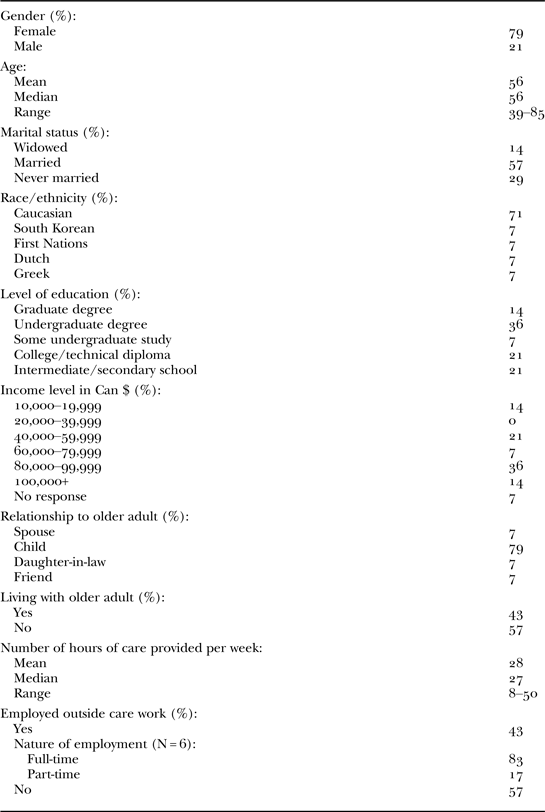
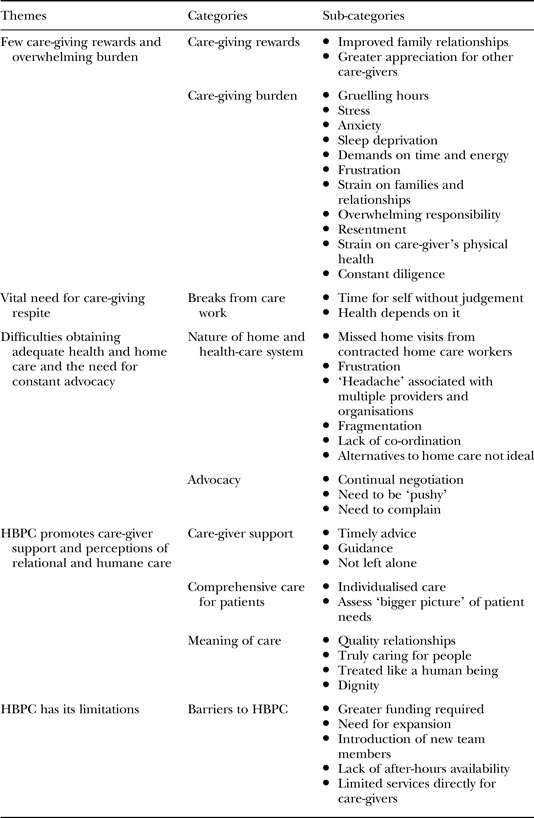
The sample comprised unpaid care-givers who were relatives of the older adult. Many had been providing care for an extended length of time, anywhere from three to 19 years. The patients of these care-givers typically had multiple chronic conditions and/or a form of dementia that rendered many of them frail and homebound. Some of the care-givers had health conditions of their own. See Table 1 for the characteristics of the sample and Table 2 for an overview of the themes, categories and sub-categories identified in the data.
Characteristics of the sample

Note: n = 14.
Themes, categories and sub-categories from home-based primary care (HBPC) care-giver data

Findings
Few care-giving rewards and overwhelming burden
When asked about their experiences of providing care, all of the participants described the intense and manifold challenges associated with care-giving, only a few, however, shared their perceptions of the rewards of such efforts. For example, this care-giver noted how watching her spouse (also a care-giver, but not included in this sample) provide care to his mother improved her relationship with him:
[I]n a European culture, for a man to change his mothers diaper is unheard of, to see her privates … and the fact that he did that, it sort of reinstated my respect for him, so it saved our marriage … so there's a beauty that came out of it that now we're stronger in our marriage … so I feel like I've been blessed because just knowing phenomenal people and seeing that there's decency still alive in this world, but it helped me in so many other ways… (laughs). (C205)
In juxtaposition to the rewards of care-giving work, the participants had much to say about the burden they carried to tend continually to the person under their care. Indeed, participants spoke at length about the ‘gruelling hours, the stress, the responsibility, the sleepless nights' (C211) attached to their work. For some care-givers, the strain was particularly hard-felt as they struggled with health concerns of their own.
It's been a strain. You know, he's 87 and … I'll be 75 next in December, and I've had heart problems … I can't really manage on my own. If he falls down, I can't pick him up. I have to have somebody around to help, really. So … it's been a strain I would say. (C215)
This strain was again vividly depicted by this care-giver highlighting the breadth of the care-giver's role, and the frustration that can accompany it:
[We did] EVERYTHING (with emphasis), EVERYTHING. [My brother] and I help her move her bowels; we feed her; we give her water. We don't breathe for her but, yeah, everything else … At the beginning, you think, oh my god, I can't do this; there's no way I can do this. But, it's like everything else, you just get used to it, and the things you couldn't do, you just do them … My mother is stubborn (laughs), but so am I (laughs), so it does get frustrating and it does get tiring. (C204)
HBPC compared to the usual office-based approach to care
When discussing how their experiences of HBPC differed from their experiences of care prior to HBPC enrolment, many of the participants described the enormous time and energy costs, in addition to the stress, anxiety and pressure, associated with navigating the Ontario health and home care systems. This care-giver noted the ‘headache’ attached to having to go through multiple providers, organisations and specialists as the patient's condition changed:
[T]hey all gave me a headache except for [the HBPC team]. So, we've been through a number of organisations over the last ten years, and the frequency and the amount of the people, and the different specialists change ’cause the patient changes. (C211)
Repeatedly, participants expressed their dismay with the current system for its fragmentation and unco-ordinated approach to care. Consequently, many wished to have somebody to call for advice and support. For example, this participant commented:
If you need to talk to somebody, if you need to get advice, if you need to get support, there's nothing out there. [The home care agency] is very limited in what they know, ’cause I says (sic), ‘What about doctors?’ [They respond]: ‘We don't do that, you're on your own, look in the phonebook’. (C207)
Perceptions of relational and holistic care with HBPC
When asked about what they liked or would recommend about the HBPC programme, several key categories emerged in the data related to how HBPC promotes individualised, holistic care for older adults. One participant noted that the HBPC team was able to have ‘a more comprehensive picture of what was going on’:
What was great was that it was timely for my mum and it was very individualised for her … when they [the HBPC team] came, they actually assessed a bigger picture than just my mom's actual physiological basic medical needs. Like, they actually were observing the environment; they were observing how the care-givers were relating to my mum, so they had actually a more comprehensive picture of what was going on. (C213)
Care provided in the home was deemed by unpaid care-givers to be more relational, and more humane.
It sort of has an old-fashioned sense about it where, you know, [the doctor] never seems rushed. She … always seemed genuinely concerned … there's something very civilised about it, you know (laughs) … like even when I go to see my doctor, I feel kinda like a cow in a … and I have a really nice doctor too, but it's like the whole assembly line sort of process, you know. Here, it just has a really human kind of feel about it, especially if you're an older person. (C206)
Consequently, through HBPC the word ‘care’ is reclaimed to truly mean caring for people. The same care-giver added:
Well, I like that it is actually care. Like, it's not just the word ‘care’; it's the meaning of the word ‘care’. Like, they care, you know … Well, I mean you can be under a doctor's care, and just walk in, and … they look at you; they say ‘what's wrong’ … and they write [the] prescription, but there's not much care … ‘care’ means to have [a] heart, to actually care … ’cause sometimes … and I hate to say this, but there a lot of people in the health profession that don't care, and maybe because they're overburdened … they've been jaded or whatever, but with the [HBPC] team, I do actually feel like they do care, and that's … really, really lovely. (C206)
HBPC supports unpaid care-givers
Not only were inter-professional HBPC teams depicted in these data to be better positioned to provide timely and comprehensive care, but many of the care-givers also felt they had unique access to advice and support not previously afforded under the office-based care model. Under the office-based model, care-givers experienced tremendous difficulties navigating the system, and this caused them significant worry and stress.
It was so much worry before I go to them that – what am I gonna do? Who am I gonna call? I don't know what I was to do. There's no number to call. Who do you contact? Nobody tells you these things. You phone [the home care agency, and they say], ‘Well, this is all we can provide’, and it's like, well that's not enough … Why isn't there other help lines out there? Well, we don't have them. There are cutbacks and this and that, you know, [but] that doesn't help me. (C207)
Through the HBPC team, however, participants had someone to call to discuss their concerns and obtain advice. ‘Because if I need help, I leave a message, and they get back to me’, stated one participant (C209); another participant remarked, ‘Yeah, for her to be able to get help when we need it, even no matter what time, yeah, ’cause sometimes it's just like advice from over the phone or something that we need’ (C210).
As a result of being connected to a HBPC team that would respond to them judiciously, several care-givers discussed feeling less worry and pressure.
It wasn't until the [HBPC team] came around that … it took that much pressure off me. It's like, at least that's one area I don't have to worry about. I can worry about all these other things (laughs), so that's where it helped the most is … it's difficult to put into words what this meant. It was so much worry before… (C207)
Similarly, another participant expressed:
I knew that [the patient] was gonna be followed at home, so I didn't have to worry about it … So it just made [me] much more relaxed and much more confident that, you know what, I don't have to worry … I didn't have to figure all these things out now about who best to call and what to do because, great, [the team is] gonna be on top of this. (C213)
Consequently, many of the participants expressed the peace of mind that comes with knowing there is someone to call for guidance or support. This participant remarked:
I just felt like, if I needed a doctor, it was one less battle. I didn't have to battle. I would just call and they would come, so that was peace of mind, which sometimes is worth a little more than going out to a movie. (C211)
This peace of mind was vital to these care-givers as many had previously felt ‘left alone’ in their care-giving role. The same care-giver went on to explain:
I was ecstatic when she got in [to the HBPC team]. I didn't see it as a negative. I didn't see that, oh my god, they're coming here because my mother's gonna pass or whatever. I was ecstatic because I felt like we weren't left alone on the medical side, we weren't left alone. (C211)
Given the on-going communication and regular interactions between HBPC team members and unpaid care-givers, respect and trust began to be cultivated in many of these care relationships. This participant stated:
’Cause I believe in them. I trust them and I know they're reliable, and that they'll be there … the regular nurse and doctor who attend us, they're good. They're qualified, and yeah, we are so impressed with everything. (C210)
The nurturing of relationships, as this participant implicitly voiced, contributes to more efficient care:
I like the way they have their team organised … like, you phone and you know there's only a few people who handle the calls, so they recognise your voice, so they'll know, oh okay it's time for this or that … you're not going through a whole explanation of the person's care and things, so I like the way they have it organised. It's very, well, efficient. (C202)
Many of the participants felt that the HBPC team provided them with support and assistance that helped to improve care co-ordination for the patient. For example, one participant acknowledged ‘they helped me co-ordinate a lot of that additional stuff that [the patient] needed’ (C202). Likewise, another participant emphasised the importance of ‘continuance and consistency’ in the provision of care:
[The Care Co-ordinator] is the one who is doing the co-ordination with [the team] … and they have been so understanding … now if [the patient] ever gets sick, she has a folder that follows her wherever she goes … and so it's the same [health provider] that's following her progress … so there's continuance and consistency, which I really love. (C205)
Perceptions of having more time and better quality of life
Having the team provide care in the home gave some unpaid care-givers the sense of having more time (although not necessarily for themselves), given that they had to spend less time co-ordinating and/or transporting the patient to and from multiple appointments.
It takes a long time to learn … and to find out who's currently doing [what], and we don't … have to do that, does give us more time. Even though more things are happening and my mother's health is worsening, it feels like we're getting – maybe not getting more time for ourselves, but in fact we are. It would be worse if we didn't have the help that we have now. (C204)
Similarly, this care-giver commented:
Having a good doctor doesn't give you more time for yourself (laughs). It just means your appointments don't – you don't have to take a day off of work, right. Usually [the team] come[s] during the evening. (C202)
Several care-givers discussed how having contact with a variety of inter-professional team members gave them access to information to help them make better, more informed decisions.
[P]robably the best and biggest thing – [they] always gave me the information or the knowledge so that I better understood, then I could make decisions, and she'd lay out what the options were, you know, what the consequences were … It wasn't just this technical ‘come and do this', so there was the compassion and care, along with it being very individualised, and she knew my mom.
For many participants, knowing that they had the support of the HBPC team contributed to an improvement in their quality of life. For example, one unpaid care-giver stated, ‘I think … my quality of life is a lot better because I don't have to worry’ (C206); another affirmed:
Hmm, my quality of life? Well, I think … it has improved because now I know there's someone I could call, 24/7, yeah … So, my quality of life probably improved in that I didn't feel I needed to be here as much, or I could be away for longer periods of time, that my mom felt that [the team] was looking after her. (C210)
HBPC has its limitations
While HBPC was perceived to promote better care by unpaid care-givers in this sample, participants also described a number of challenges with its provision. Typically, these reflected difficulties associated with expanding HBPC's reach, which would require greater funding commitments from governments, and more services and respite support for care-givers.
I wish everybody could have this [HBPC] because I hear so many stories of people who don't have it … and it's like it's time the government wakes up and realises, you know, you need to help. They say they want to help, but they don't. (C207)
Moreover, a few participants felt HBPC teams could be expanded to include other inter-professional team professionals not currently on board. This care-giver reasoned:
My dad … when he was getting to the point where eating was difficult, I think it would have been really helpful to have a dietician as part of that process … if there's one thing that could be changed, I think it's having a dietician as part of the team, and that the dietician is required to come out. (C208)
In addition, the absence of universal after-hours access to a team can be problematic. One participant admitted, ‘on weekends they're not accessible, but luckily he [the patient] hasn't gotten sick on a weekend!’ (C206); as was the lack of access to necessary medical equipment, as acknowledged by this care-giver:
I thought that they [the HBPC team] were superb, but I think that there's a little gap between home and institution, ’cause at one point [the physician] wanted to have my mom come to [the hospital] so he could do [an] ECG and do a CT-scan and a bunch of things … they couldn't be done at home. (C213)
Many of the care-givers affirmed that HBPC teams provided excellent care to their patients, however, services directed specifically to them tended to be limited. The following exchange documents how bereavement counselling and support from the team to the unpaid care-giver was not forthcoming.
Interviewer: How did the team assist you in the grieving process?
Respondent: Nothing – nothing in the grieving.
Interviewer: You mean after mom had passed?
Respondent: No, nothing … No, I didn't hear that they would offer anything. (C209)
Discussion
In providing care for frail and homebound older adults, unpaid care-givers (primarily women) are conscripted into ‘familial care duties'; complex medical tasks for which they may be untrained, unpaid and ill-equipped to perform, yet which will, most likely, adversely affect their health and quality of life (see Guberman Reference Guberman, Grant, Amaratunga, Armstrong, Boscoe, Pederson and Willson2004). Our data confirm the overwhelming, demanding nature of care-giving for older adults with multiple chronic conditions, with many participants in our sample emphasising the tremendous strain of providing ‘24/7’ unpaid care work. While others argue that it is important to present a balanced view of care-giving labour (Brown and Brown Reference Brown and Brown2014), the sheer intensity of the burden our unpaid care-givers experienced overpowered the (relatively few) rewards of engaging in this work. Multi-dimensional psychological, educational, emotional and social supports have been found to be essential in helping care-givers cope under the heavy weight of care-giving demands (Gaugler, Potter and Pruinelli Reference Gaugler, Potter and Pruinelli2014). Care-givers also need to feel their providers are present with them (Cherlin et al. Reference Cherlin, Schulman-Green, McCorkle, Johnson-Jurzeler and Bradley2004), that they will provide them with important information on available services and appropriate training (Yedidia and Tiedemann Reference Yedidia and Tiedemann2008), and will afford them the time and space to discuss their needs and concerns (Wackerbarth and Johnson Reference Wackerbarth and Johnson2002), knowing that they will be heard (Guerriere, Zagorski and Coyte Reference Guerriere, Zagorski and Coyte2013) in an environment of trust and respect (Lévesque et al. Reference Lévesque, Ducharme, Caron, Hanson, Magnusson, Nolan and Nolan2010). Our study suggests that HBPC may be helpful in meeting many of these unpaid care-giver needs.
As our data show, unpaid care-givers felt that having the support of an inter-professional HBPC team was vital. The relationships, built on respect and trust with team members, provided our sample of care-givers with a sense of continuity and consistency not previously afforded under the standard office-based care model. HBPC, according to our sample participants, gave them access to an entire team of providers to call for guidance and support. Team members were seen as knowledgeable about the patient, her/his preferences and the team-developed care plan. Having ‘someone to call’ not only ensured a swift response to emerging concerns, but also helped ease some of the stress and pressure these care-givers persistently experience.
Prior to having their family member enrolled in a HBPC programme, the fragmentation of the health and home care systems appeared highly visible to our sample of care-givers, with no single entity emerging as an appropriate contact for care-givers to go to for timely and patient-informed advice. Several care-givers admitted to using the Emergency Department as their default primary care provider, given the difficult and at times seemingly impossible prospect of accessing office-based care. With less time spent managing appointments and struggling with system navigation, our participants felt they had more time to devote to other areas (including balancing their caring labour and paid work schedules), and greater access to information and advice to make informed decisions. Although certainly not a panacea to remedy care-giver burden, the coalescence of these elements helped in some way to improve the quality of life for many unpaid care-givers in our sample. This finding appears consistent with Ornstein, Smith and Boal's (Reference Ornstein, Smith and Boal2009) study demonstrating that participation in multi-disciplinary team-provided HBPC yielded a statistically significant decrease in care-givers' unmet needs, and a decrease in care-giver burden overall.
Although the literature on care-giver burnout has proliferated over the years, policy changes aimed at alleviating the heavy burden on unpaid care-givers have not. The qualitative study of Lilly et al. (Reference Lilly, Robinson, Holtzman and Bottorff2012) on family care-givers in British Columbia, Canada, suggests that home and community care planning systems recurrently ignore unpaid care-givers until they themselves become patients of the health-care system. Unless the unpaid care-giver demonstrates signs of distress, their ‘support needs are neither systematically assessed or addressed’ (Lilly et al. Reference Lilly, Robinson, Holtzman and Bottorff2012: 110). Given the anticipated future shortfall of unpaid care-givers, and concern over existing care-givers' health and wellbeing, it is important to identify policies and programmes that better support this population now (Lilly et al. Reference Lilly, Robinson, Holtzman and Bottorff2012). HBPC may provide one mechanism through which to embed formal support services earlier in the care-giving trajectory, providing unpaid care-givers greater access to information, advice and support.
In reflecting upon the practice of patient-centred care and family-centred care in HBPC in Ontario, our data suggest that HBPC may foster greater partnerships in care that promote genuine caring relationships, and more holistic care for persons with multiple chronic conditions (Smith-Carrier et al. Reference Smith-Carrier, Pham, Akhtar, Nowaczynski, Seddon and Sinha2015, Reference Smith-Carrier, Sinha, Nowaczynski, Akhtar, Seddon and Pham2016). Teams, however, may not yet be at a place where they can adequately respond to the needs of care-givers under our current health-care arrangements; caring for the complex needs of frail and homebound persons appears to be difficult enough. Indeed, little in the data would suggest that initial and periodic care-giver assessments that ask the unpaid care-giver about their situation, their specific needs, strengths and resources were conducted by the HBPC teams, not only to ensure that care-givers have access to appropriate training, education and supports (e.g. bereavement counselling), but to assess whether the unpaid care-giver was physically and emotionally able to continue providing care (see Feinberg and Levine Reference Feinberg and Levine2015). Therefore, opportunities to expand and enhance HBPC provision exist, not only to scale up the programme and introduce new roles to the inter-professional team, but to assess and support better the needs of unpaid care-givers who assiduously engage in care work.
While these data are not generalisable, they do suggest that HBPC may provide some measure of relief to unpaid care-givers, particularly in providing assistance with system navigation and in offering care-givers the peace of mind that they are not alone, but have someone to call should the need arise. These findings are important, and have wider applicability to health-care systems elsewhere. Increasingly, research is demonstrating the efficacy of the HBPC model in improving access to primary care for frail and homebound older adults; populations that have traditionally not been well served (Smith-Carrier et al. Reference Smith-Carrier, Sinha, Nowaczynski, Akhtar, Seddon and Pham2016). Our findings confirm this research, while also suggesting that the model may have positive impacts on unpaid care-givers who are often burdened by the challenges of caring for an older adult with complex care needs and the difficult emotional and relational work required to negotiate Ontario's disjointed health, home and social care systems. In the context of regular, on-going interaction between HBPC team members, patients and their unpaid care-givers, respect and trust can be cultivated, and positive relationships can be formed; a key indicator of enhanced care quality (see Campbell, Roland and Buetow Reference Campbell, Roland and Buetow2000). Also, linked to care quality, the model may hold promise in improving the continuity of care (see van Servellen, Fongwa and D'Errico Reference van Servellen, Fongwa and D'Errico2006) experienced by frail and/or homebound older adults and their unpaid care-givers. The experience of care as ‘connected and coherent’ (van Servellen, Fongwa and D'Errico Reference van Servellen, Fongwa and D'Errico2006: 186) – markers of continuity of care – appear reflected in these data, and suggest that HBPC could be a model to help mitigate the discontinuities that patients with comorbid chronic conditions and their attendant unpaid care-givers experience within the context of fragmented health-care systems.
Moving forward, it is imperative to assess whether patient-centred care and family-centred care, thought to be the pinnacle of health-care quality, is actually occurring (Wolff and Boyd Reference Wolff and Boyd2015) in Ontario's HBPC teams. Here, it would appear that further work is needed, particularly in inserting ongoing care-giver assessments into HBPC teams' patient-centred care plans. Although further rigorous research is needed, these findings point to a model of care that is poised to not only meet better the needs of a growing population of frail older adults, but also of those who provide them care.
Acknowledgements
We would like to thank Selma Chaudhry, Kera Salvi, Diane Galbraith, Paula Gravel, Michelle Liehmann, Dr Michelle Naimer and the Mount Sinai Family Health Team, Dr Amy Freedman and St Michael's Hospital Family Health Team, Dr Pauline Pariser and Taddle Creek Family Health Team, Dr Jocelyn Charles and Sunnybrook Hospital Family Health Team, House Calls, Stacy Landau and SPRINT, South East Toronto Family Health Team, Toronto Western Family Health Team and the BRIDGES Collaborative. This work was supported by a Building Bridges to Integrated Care (BRIDGES) Grant and a Ministry of Health and Long-Term Care AMO Grant.