


1. INTRODUCTION
A range of studies have shown that during the 17th, 18th and 19th centuries, economic fluctuations in Western countries due to grain price fluctuations or real-wage changes were in the medium- and long-term accompanied by strong responses in mortality, marriage rates and fertility (see e.g. Lee Reference Lee1985; Bengtsson and Reher Reference Bengtsson, Reher and Nuñez1998). At the same time, individuals in poor areas were at greater economic risk than those in rich areas (Galloway Reference Galloway1987, Reference Galloway, Reher and Schofield1993). In Spain, certain authors have established a relationship between economic fluctuation and demographic fluctuation during the same period (Pérez Moreda Reference Pérez Moreda1988; Reher Reference Reher1988, Reference Reher1990; Reher and Ortega Reference Reher, Ortega, Bengtsson and Saito2000; Reher and Sanz-Gimeno Reference Reher and Sanz-Gimeno2000). These responses reflect an important degree of life uncertainty among individuals (Bengtsson and Ohlsson Reference Bengtsson and Ohlsson1985). Besides, analysis has also shown a connection between economic shocks and short-term responses in mortality, marriage rates and fertility. The first checks of this connection were performed using aggregated data (Galloway Reference Galloway1988). In the Spanish case, some authors have also found, from aggregated data, a connection between economic shocks and short-term responses in demographic variables (e.g. Catalán and Lanza Reference Catalán and Lanza2015).
In the last decade, new advances were made in the microdata analysis of the relationship between the economic situations in the short-term and the evolution of fertility. The pioneer articles of the Eurasian Population Project (Bengtsson et al. Reference Bengtsson, Bengtsson, Campbell and Lee2004; Tsuya et al. Reference Tsuya, Feng, Alter and Lee2010; Lundh et al. Reference Lundh and Kurosu2014) and Bengtsson and Dribe (Reference Bengtsson and Dribe2006) developed a microdata methodology to analyse the relationship between short-term economic shocks and demographic variables before the demographic transition. This paper has been developed based on those models.
The goal of this paper is to determine how short-term economic stress affected different socio-economic groups during the pre-transitional period (the period prior to the demographic transition, which took place from the second decade of the 20th century in the study area). The entire period analysed in this paper is included in the pre-transitional period. We specifically wish to explore the living standards of rural individuals and how economic shocks affected their fertility. Were landless and semi-landless workers the most vulnerable individuals in rural Spain? To help us answer this question, information was used on the lives of individuals from ten rural Spanish villages, which was extracted from parish registers and other civil sources. These data present some limitations; for example, the property held by each individual is unknown, as is whether some individuals migrated during crisis years. While these limitations must affect the interpretation of results, they do not invalidate the findings. This paper will allow us to gain knowledge on the relationship between economic crises and demographic changes in the short term. First, it explores a period of significant historical importance, the period previous to the demographic transition. Second, this methodology is applied for the first time to the Iberian Peninsula. Finally, the results of this study will allow us to compare a Spanish rural area with other areas in Europe and Asia.
We used Cox proportional hazards models and carried out three statistical analyses. The first of them used a general basic model based on socio-economic status, without taking the years of crisis into account. The second was a complete model, taking whether the year in which a child was born was a year of cereal price crisis into account. The third analysis was similar to the previous one but considered whether the economic shocks due to price crises had an effect on the fertility of the subsequent year. That is, if the price crises reduced the conception of children.
The paper is structured as follows. Section 2 presents the background of the relationship between fertility and short-term economic stress, and an approximation to the question in some Western countries. Section 3 describes the studied area and the sources. Section 4 provides details of the methodology employed to analyse the microdata and the selection of the sample. Section 5 presents our results, showing how short-term economic stress affected demographic behaviour between 1801 and 1909. The final section presents our conclusions.
2. BACKGROUND: REDUCED FERTILITY DUE TO SHORT-TERM ECONOMIC STRESS
Since Princeton University's European Fertility Project in the 1960s and 1970s, most historians considered fertility ‘natural’ in pre-transitional Europe; in other words, natural fertility can be defined as the state in which married couples had children without exercising any fertility control before the onset of the fertility transition (Henry Reference Henry1961; Coale Reference Coale1973). Women typically had many children during their fertile years, although there were some exceptions, notably in a particular segment of the population—especially the higher socio-economic levels. For example, Henry (Reference Henry1956) showed that the patrician families in Geneva controlled their fertility during the 17th century.
Some publications, such as research by Wrigley and Schofield (Reference Wrigley and Schofield1981) and Lee (Reference Lee, Wrigley and Schofield1981, Reference Lee1985), demonstrated the existence of a relationship between cereal price and wage variations and effects, in the medium and long-term, on demographic variables, especially fertility. The effects of changes in living standards had to be studied with a wide temporal gap. This methodology, with some adaptations, was employed by David Reher, Vicente Pérez Moreda and other authors for the Spanish case (Pérez Moreda Reference Pérez Moreda1988; Reher Reference Reher1988, Reference Reher1990; Bengtsson and Reher Reference Bengtsson, Reher and Nuñez1998; Reher and Ortega Reference Reher, Ortega, Bengtsson and Saito2000; Reher and Sanz-Gimeno Reference Reher and Sanz-Gimeno2000). The results for Spain are similar to those for other Western countries; price increases or lower wages negatively affected fertility. Also using aggregate data, but looking for more immediate effects, some authors sought to the effects of price changes on demographic behaviour in the short-term. In this context, the pioneering paper by Galloway (Reference Galloway1988) is well-known. This methodology also inspired research in different countries.
As previously stated, a new methodology for the study of short-term economic stress from microdata allows researchers to analyse the characteristics of individuals, as done in this paper. This methodology proposes two principal ideas: (1) there was fertility control before the demographic transition in years of short-term economic stress, and (2) the most affected individuals were the net consumers, who were the most vulnerable to economic shocks. Bengtsson and Dribe (Reference Bengtsson and Dribe2006) demonstrate that their hypothesis is true for the case of Scania in southern Sweden. Other studies from microdata, following this methodology, also show a temporary fertility control that affected most of the population. These studies are based on the analysis of the effects of the food-price crises. For example, the hypothesis was tested for various regions in Europe and Asia (Eurasian Population Project: Tsuya et al. Reference Tsuya, Feng, Alter and Lee2010; Germany: Dribe and Scalone Reference Dribe and Scalone2010; the Netherlands: Van Bavel and Kok Reference Van Bavel and Kok2010; Scotland: Jennings et al. Reference Jennings, Quaranta and Bengtsson2017). The results show that there was fertility control in rural society due to short-term economic stress during the 18th and 19th centuries, especially among farm populations, with particular intensity among the landless and semi-landless. In Friuli—a North-eastern region of Italy—analysis shows a relationship between short-term economic stress and demographic responses during the 18th and 19th centuries (Breschi et al. Reference Breschi, Fornasin, Gonano, Manfredini and Seghieri2014). The importance of the analysis based on short-term economic stress lies, as Bengtsson (Reference Bengtsson, Bengtsson, Campbell and Lee2004, pp. 27–28) affirms:
«We propose a new, dynamic concept designed for longitudinal microstudies and comparative purposes. We argue that demographic responses of individuals and households to short-term economic stress depended of their access to resources. Effects of short-term economic stress on migration, nuptiality, fertility, and mortality can therefore be used as an indirect measure of individual living standards. We analyze […] their ability to overcome short-term economic stress.»
In the referenced articles, the response to short-term economic stress differs according to socio-economic status. For the poorest groups, during the 19th and previous centuries, an economic stress year could mean the difference between the survival of all members of a family and the death of one or more of its members due to malnutrition. Or, at the very least, it could have seriously affected their biological situation. For this reason, there has been a lengthy debate in historical demography on whether families used strategies of fertility control to cope with these short-term economic shocks. This is what we call human agency, the set of decisions made voluntarily, and in this case related to fertility control. However, there are alternative explanations for this behaviour linked to involuntary fertility responses—such as spontaneous abortion, temporary sterility or libido loss due to the mother's malnutrition, or even separation of spouses due to temporal migration. Although the hypothesis of this methodology is focused on the fact that the fertility control occurred voluntarily, we cannot totally rule out biological factors having significant effects.
This new methodology analyses the effect of economic shocks on fertility, independent of other demographic variables. This tries to demonstrate the connection between short-term economic shocks and the decision to postpone the birth of another child. However, the economic shocks also had consequences on the rest of the demographic variables in the rural societies of the 18th and 19th centuries (Bengtsson et al. Reference Bengtsson, Bengtsson, Campbell and Lee2004; Tsuya et al. Reference Tsuya, Feng, Alter and Lee2010; Lundh et al. Reference Lundh and Kurosu2014). The effects of mortality crises on fertility, and the decision to replace children who died early, are of particular importance (see e.g. Quaranta Reference Quaranta2013, Reference Quaranta2014).
Not only the 19th century has been analysed. The 20th and 21st centuries have also been subject to discussion. Periods of economic crisis during these centuries in the West have generally led to a change in reproductive behaviour, which some authors have interpreted as a postponement of childbearing, both from aggregate data and microdata (Rindfuss et al. Reference Rindfuss, Morgan and Swicegood1988; Sobotka et al. Reference Sobotka, Skirbekk and Philipov2011). Easterlin (Reference Easterlin1961, Reference Easterlin and Sheldon1973, Reference Easterlin1976, Reference Easterlin, Eatwell, Milgate and Newman1987) proposed one of the most discussed and controversial theories, which was based on family income. The results of his research suggested that fertility includes fluctuations with cycles of 40 years, linked to the relative size of the cohorts. Large cohorts have more competition in the markets, especially in the labour market, so they present lower fertility. The cohorts born in periods of low fertility have less competition in the market, so they have a better social and labour situation and that leads to higher fertility. Therefore, this theory explains the baby boom and the baby bust. The main reason for this behaviour was linked to the standard of living of the parents. Individuals aspire to have a level of life equal or higher to their parents. This hypothesis was confirmed for the case of the United States until the 1980s (Pampel Reference Pampel1993). However, there has not been a clear confirmation for the European case (Ermisch Reference Ermisch1979, Reference Ermisch1980; Chesnais Reference Chesnais1983; Lesthaeghe Reference Lesthaeghe1983; Teitelbaum and Winter Reference Teitelbaum and Winter1985; Demeny Reference Demeny1986). Unfortunately, a new period of very low fertility has not allowed us to contrast Easterlin's hypothesis in the very long term. Other studies have analysed the relationship between the variations in GDP and variations in fertility in Western countries (i.e. Rindfuss et al. Reference Rindfuss, Morgan and Swicegood1988; Goldstein et al. Reference Goldstein, Sobotka and Jasilioniene2009). On the one hand, Butz and Ward (Reference Butz and Ward1979) proposed that fertility evolves in a countercyclical way with respect to economic growth. Good economic times are high income times, therefore the relative costs of having children are higher than in bad economic times. On the other hand, some authors have found links between economic recessions and changes in individual fertility decisions (De Cooman et al. Reference De Cooman, Ermisch and Joshi1987; Kreyenfeld Reference Kreyenfeld2010; Adserà Reference Adserà2011). In all these cases, fertility reacted positively to economic developments. Therefore, the economic crises had the effect of reducing fertility in the short term.
3. AREA AND DATA
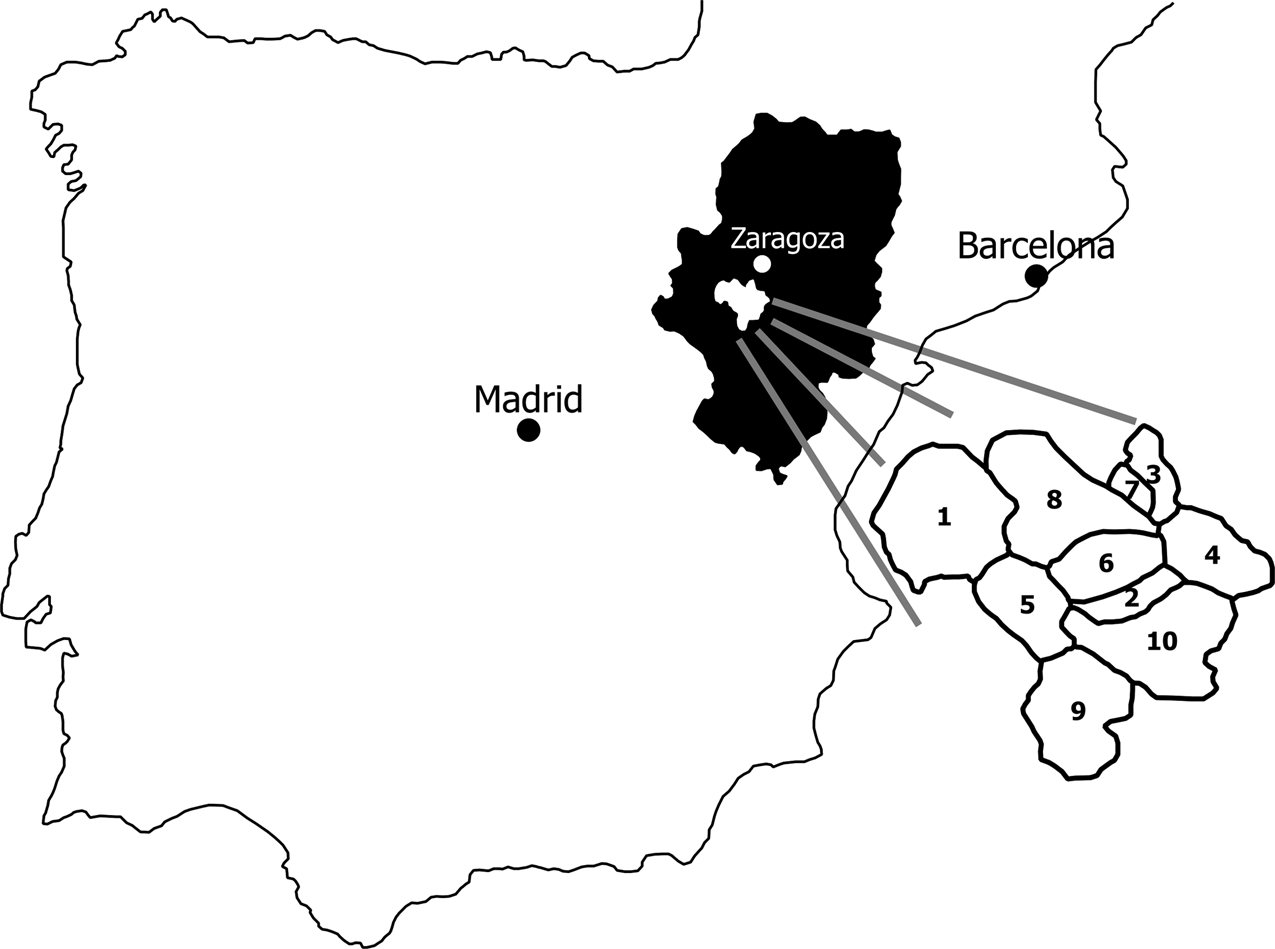
The data are from a rural area—about 500 km2—in Aragón, a region in the northeast of Spain (see Figure 1). The distance from the subject area to the capital city of the region, Zaragoza, is between 19 and 40 km. The current study covers ten parishes: Alfamén, Aylés, Botorrita, Jaulín, Longares, Mezalocha, Mozota, Muel, Tosos and Villanueva de Huerva, which had a total of 5,520 inhabitants in 1800, increasing to 5,884 in 1860, 6,706 in 1887 and 7,765 in 1910. Growth was below the Spanish average (Nicolau Reference Nicolau, Carreras, A and Tafunell2005) due to out-migration to other rural areas and urban centres. The study area is located in the Ebro Valley, near the foot of the Algairén Mountains. The landscape is a mixture of plains and foothills, and not all localities have the same access to fresh water, a decisive factor in agriculture. The Huerva River runs through the villages of Tosos, Villanueva de Huerva, Aylés, Mezalocha, Muel, Mozota and Botorrita, while no rivers cross through Alfamén, Jaulín or Longares. River-facilitated access to water—both for human consumption and to produce horticultural products, mainly in the orchards on shores and next to ditches. The localities next to the river were the only places that could have a wide variety of crops, but it also facilitated the transmission of water-borne diseases, such as the cholera epidemic. For this study an average of 40.3 births per year (4,391 in total) is included in the statistical analysis, oscillating the sample between 30 and 50 cases per year. This number is the consequence of the demands on the sample in quality and quantity of data (occupations, places of birth, marriage, etc.). This sample is representative and contains all socio-economic groups in a proportion similar to that of the whole area. Average marital fertility was 6.4 children per family during the study period, and mortality among children under 5 was around two deceased children per family (mortality had been falling since the 1860s, declining from an average of close to three children from 1800 to 1860 to an average of over one child around 1900–1910).
STUDIED-AREA LOCATION.
Note: The numbers correspond to the following localities: (1) Alfamén, (2) Aylés, (3) Botorrita, (4) Jaulín, (5) Longares, (6) Mezalocha, (7) Mozota, (8) Muel, (9) Tosos and (10) Villanueva de Huerva.
Source: See text.

The database, ‘Alfamén and Middle Huerva Database’ (AMHDB), was built following the family reconstitution method developed by Fleury and Henry (Reference Fleury and Henry1956) and covers 95,817 individuals. The database was built using parish records of births, marriages and deaths for the period from the late 15th to the mid-20th centuries. The parish records contained in the database for the 19th and 20th centuries are of good quality. Only Alfamén presents a partial underreporting of births and deaths in the 1830s, which was noted by the parish priest who arrived at the end of that decade as the result of imprecise work by the previous vicar, which the new priest tried to correct. Extraction was a meticulous process involving compiling all of the information available in the books of baptisms, marriages and deaths. All baptismal registers used for this analysis contain information about parents and grandparents (name and surname, origin, occasionally age, etc.). The database contains all those individuals who were either born in or migrated to the parishes in question, although there is little or no data on out-migration. The high quality of the records means the database does not present greater limitations (at least any more than other Catholic parish archives) but rather only the occasional need for complementary sources due to the requirements posed by statistical analysis. However, some limitations affect the analysis. The data available for the study area do not allow us to know the agrarian and non-agrarian properties of individuals over time to differentiate them according to economic status. Property listings (e.g. ‘amillaramientos’) are scarce for the analysed period and of low informational quality. Data on occupations and literacy are not always available for all individuals, especially for those who spent less time in the study area; therefore, information is missing for about one-quarter of the individuals (in the first years of the analysis, this scarcity affects one-third of the individuals but is very low in the final years). On the other hand, the system of inheritance in the study area (distributing inheritance equally among all children) and the form of residence (almost all individuals lived within the locality, with no dispersed population on farms) generated a social system in which individuals were not mainly farmers or day-labourers; rather, most were, at some point in their lives, owners of some land (in many cases, insufficient for the maintenance of the family). In any case, there is no reason to believe the available data present important biases affecting the results, although they do not allow for a more in-depth analysis.
During the studied period, the area was characterised by the production of grain (especially wheat), wine and by sheep grazing. In addition, Muel's pottery has been well-known for centuries, and the villages of Alfamén and Jaulín were important for the glass production in Aragón during the 18th and 19th centuries. The occupation declared by the individual was used to analyse the occupation of the head of the family and confirmed by those responsible for conducting the census in the population censuses (1857 and 1860), electoral censuses (1890, 1894, 1900 and 1910), population lists (1824, only for Longares, the biggest village) and occupational information that appears occasionally in the parish archives. The priest had no obligation to collect it. The occupation noted by the parishes was especially important in the study of the first decades of the 19th century, since, as a rule of the archdiocese, all priests had to take note of the profession of the head of the family in the registers of baptism, marriage and death. These systematic parish annotations coincide with a period of scarcity of census data. The information on occupation was linked to demographic registers. Individuals who did not mention an occupation were left out of the analysis. For this study, six categories were employed to delineate the social structure, depending on the husband's occupation:
(1) The first group consists of agricultural day-labourers and smallholders—landless and semi-landless—who did not have enough land at their disposal for the entire family to live on as a sole source of subsistence. These individuals appear in the census as day-labourers or day-labourers and farmers.
(2) The second group is composed of farmers. Individuals only appear in this category if they were always (from the age of 21 years old) registered in the censuses as farmers. We have not differentiated by size of land owned, due to the scarcity of quality sources. The sources do also not provide clues about the size of the properties since they use the same word to refer to all farmers (there is no distinction between different kinds of farmers, for example between ‘labrador’ and ‘agricultor’).
(3) The third group is composed of shepherds and goatherds. They were landless or semi-landless. They rented communal lands for feeding their animals and were therefore affected by drought and other water problems. Our sources did not allow us to differentiate between owners and workers.
(4) The fourth group consists of landless or semi-landless artisans—potters, bakers, blacksmiths, tailors, glassmakers, etc., which means that a majority of the families were net consumers of wheat. If the artisans or their wives were from the studied areas, it was common for them to own some land they had inherited or purchased that was dedicated to the production of staple foods for family consumption.
(5) The fifth category includes individuals with prestigious occupations in rural areas—doctors, teachers, veterinarians, notaries, bankers, nurses and station masters. All these occupations required a medium or higher level of education.
(6) The sixth category, ‘others’, includes the rest of the professionals, in a range of occupations—civil servants, military personnel, muleteers, drivers of various vehicles, etc.
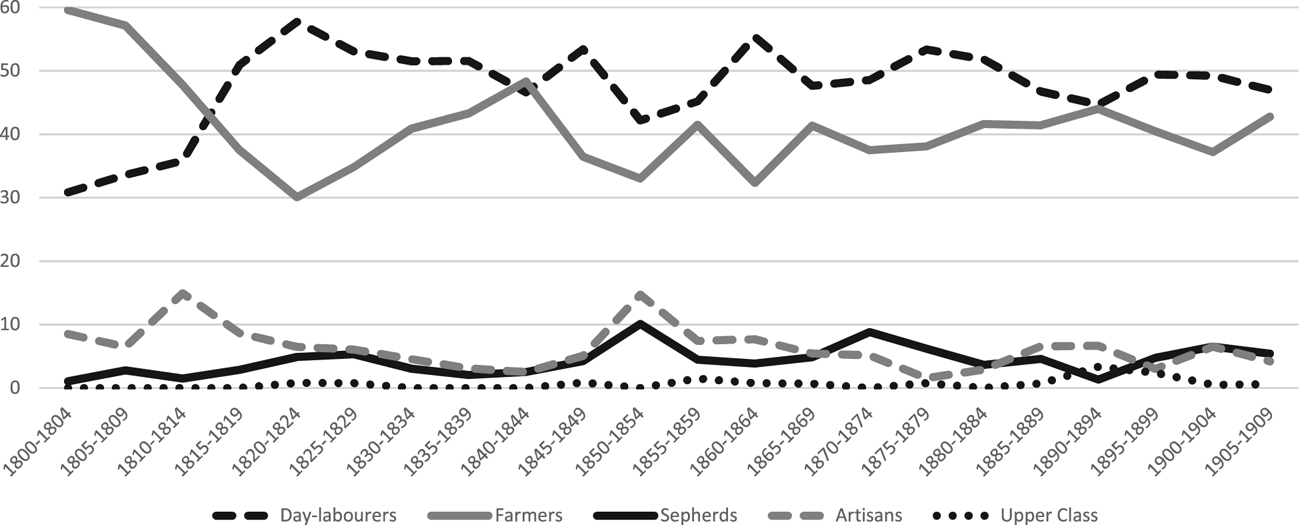
Figure 2 (percentage evolution of socio-economic categories) clearly shows a predominance of day-labourers and farmers, accounting for about 80 per cent of the total. Fewer than 10 per cent were artisans and non-migratory shepherds (permanently in the studied area or in adjacent villages). Finally, workers with medium-high skills were almost non-existent for most of the period. The clear predominance of farmers compared with day-labourers during the first decades of the analysis could be the consequence of the use of parish registers. Church registers are more generous than civilian ones when categorising an individual as ‘farmer’. Besides, the civil sources distinguish an extra category: ‘day-labourer and farmer’, and these individuals are classified as ‘day-labourers’ for this analysis. This trend, the predominance of farmers, was reversed around 1820s, when data from civil sources started to dominate the analysis. The rapid variations in the other categories (artisans, shepherds and upper-class individuals) could be the consequence of several factors: mainly, the small sample size, as a small variation in the number of individuals can significantly impact the data (and the figure). Additionally, a common behaviour in the study area was that all male children of an artisan worked in their adulthood in the same craft occupation. This implies that in a single age group, several new artisans may emerge, whereas before there was only one. Other complementary explanations potentially include nobles' losing the power to impose the exclusive use of their furnaces (for ceramics and glasswork) and changes in ownership of the old noble properties. Finally, the increase in rural social opportunities allowed more native individuals to access higher education and, later, to work as teachers or doctors in their localities of origin.
PERCENTUAL EVOLUTION OF THE OCCUPATION OF THE HEAD OF THE HOUSEHOLD, ACCORDING TO THE DATE OF BIRTH (1800–1909).
Note: The ‘other’ category is not included.
Source: Alfamén and Middle Huerva Database (AMHDB).

The vast majority of the owner farmers were not large landowners. The ownership of the land in the study area was mostly in the hands of the aristocracy and the Catholic church (which devoted it to leasing to shepherds from other areas as pasture lands). The small farmers that characterise the study area were, like the rest of the population, close to subsistence levels (Clark Reference Clark2007). In some cases, the price crises were a consequence of bad harvests that caused a shortage of wheat, which was the main food. The consequences of the bad harvests were aggravated by the prohibition to import wheat between 1820 and 1869 (Gállego Martínez Reference Gállego Martínez2004). In rural Aragón at the beginning of the 20th century, wheat continued to be the main food. There are no valid sources of annual wheat production in the study area, to analyse which price crises were linked to low production. However, there are some indirect sources. The church archive of Alfamén in the year 1812 (a year of price crisis) includes an annotation of the parish priest in which he states that it was practically impossible to find bread in the locality and that they were forced to eat the ‘herbs of the field’. Some studies that analyse wheat production at the provincial level in Spain in the 1880s (see e.g. Barquín Reference Barquín2002) find that the 3 years with the greatest trade deficit in wheat production were 1882, 1887 and 1888. The first 2 years were characterised by a price crisis.
Therefore, the analysed farmers were very sensitive to years of bad harvests, which in many cases entailed price crises. The reason for this is not clear; a possible explanation could be that being small farmers, if the harvest was bad farmers could not sell their produce, given that they needed it to survive, and therefore, unlike the larger producers, could not benefit from the higher prices. In some cases, they could even be forced to buy basic foods for family subsistence, thus having to pay the higher prices themselves. Germán Zubero (Reference Germán Zubero1984) demonstrated that this area had a low index of land concentration in 1930, below the regional average, with the exception of Alfamén (where the land was still owned by noble families). In his book on Francoism, Harding (Reference Harding1984, p. 85) narrates that in a nearby locality with similar land distribution, Ibieca, most of the harvest was dedicated to self-consumption at the beginning of the 20th century (before the Spanish Civil War and Francoism). Therefore, this area was dominated by small farmers at the beginning of the 20th century. Moreover, land ownership in the area did not change significantly during the previous period, except for some sales of noble's properties. In any case, this hypothesis needs to be tested in the future, as there are currently insufficient data on property sizes.
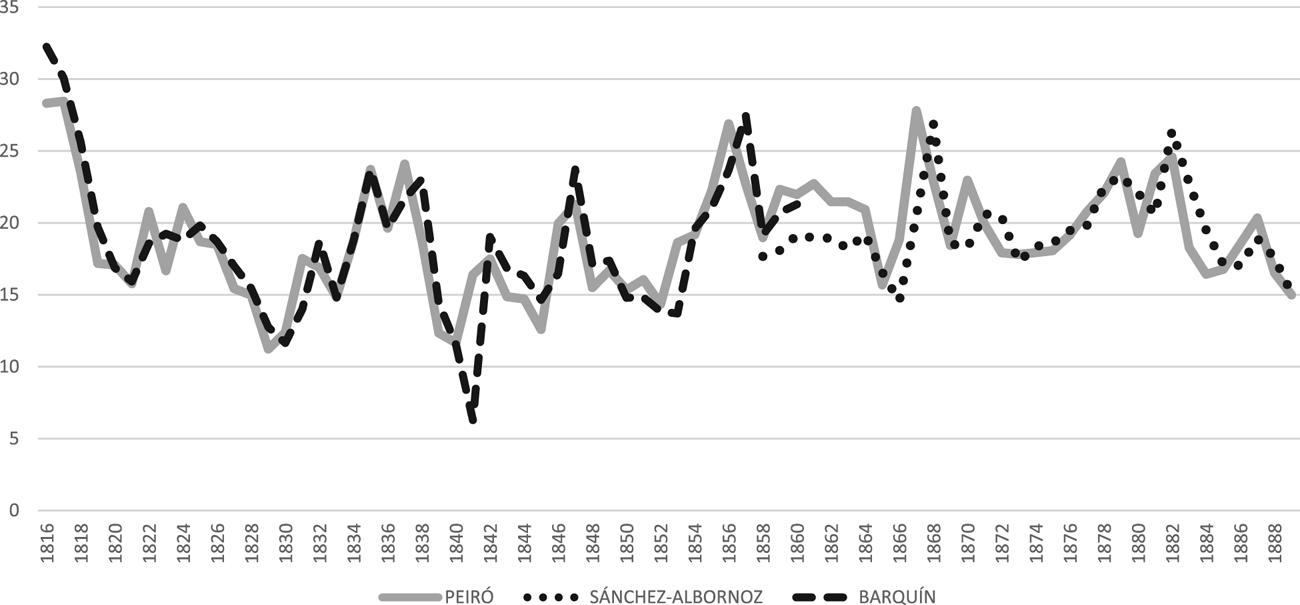
The current study uses the price of wheat in Zaragoza; the surplus of the wheat harvest from the area, once the part for self-consumption had been withheld, was sold directly or through intermediaries on Zaragoza's markets. The wheat-price series were collected by Peiró (Reference Peiró1987) for the period between 1649 and 1919, although only the data from 1801 to 1909 are used in this study. Only annual data exist; monthly series from the 19th century are unavailable for the city of Zaragoza. However, the data series were compared with the monthly series from Sánchez-Albornoz and Carnero (Reference Sánchez-Albornoz and Carnero1975) of the wheat price in Zaragoza between 1858 and 1891, and the incomplete monthly series from Barquín (Reference Barquín1999) of the wheat price in Zaragoza between 1815 and 1860, and it could be concluded that the variations in prices were similar, as seen in Figure 3. The Pearson correlation coefficient between Peiró and Barquín is 0.85, whereas the coefficient between Peiró and Sánchez-Albornoz and Carnero is 0.55.
COMPARISON OF SERIES OF WHEAT PRICES IN ZARAGOZA (1816–1889). THE UNIT OF MEASURE IS PESETAS PER HECTOLITRE (COLUMN Y).
Source: Peiró (Reference Peiró1987), Sánchez-Albornoz and Carnero (Reference Sánchez-Albornoz and Carnero1975) and Barquín (Reference Barquín1999).

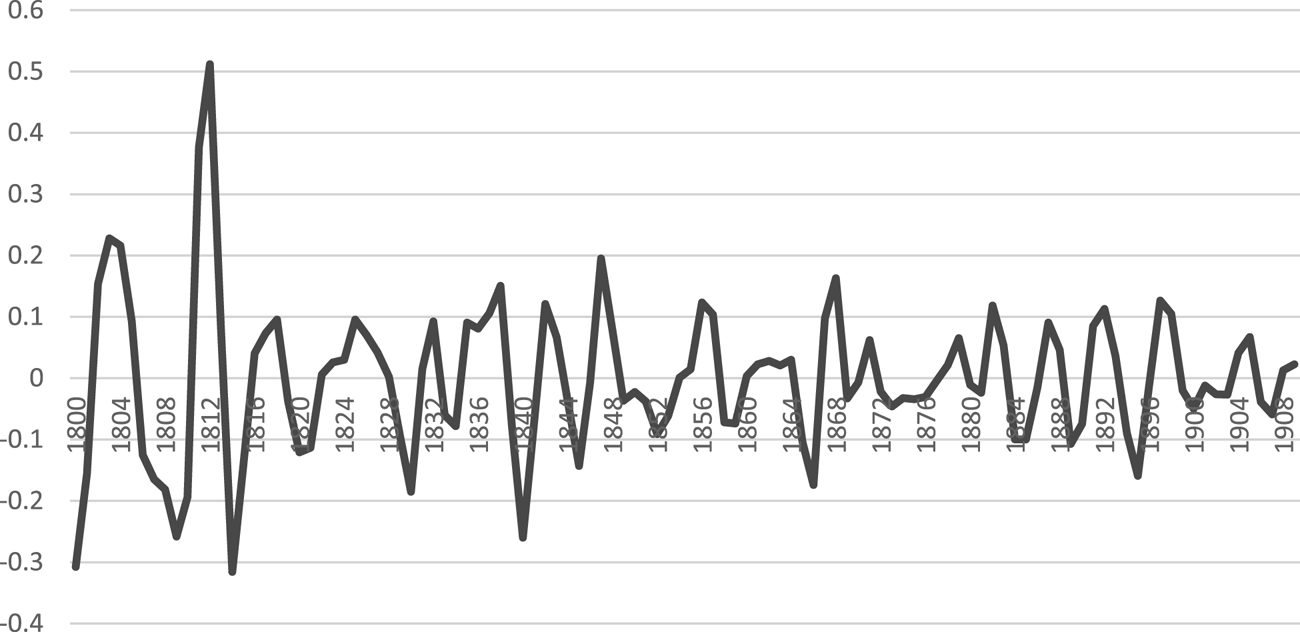
Figure 4 shows the deviations from the average of wheat prices from the Peiró series, on a logarithmic base. The trend was subtracted with a Hodrick and Prescott (Reference Hodrick and Prescott1997) filter, with a smoothing parameter of 6.25, in order to focus on short-term variations in prices. It can clearly be seen that the major crises of high prices corresponded to the beginning of the 19th century (around 1802 and 1810), while, over time, price variations became more moderate. The evolution of wheat prices in Zaragoza is similar to the evolution of prices in the whole of interior Spain (Gállego Martínez Reference Gállego Martínez2004). A 10 per cent price increase, once the trend has been removed, was selected in the analysis, as the threshold for considering the existence of an economic shock due to the increase in the cost of staple foods. This threshold delimits a point from which we can consider that the effects of economic shocks were visible and affected the majority of the population. A 10 per cent variation in prices is serious enough to have an effect on household consumption, and prices reached this threshold several times during the 19th century. This threshold was determined by the pioneer microdata studies of the relationship between short-term economic stress and fertility (Bengtsson et al. Reference Bengtsson, Bengtsson, Campbell and Lee2004; Bengtsson and Dribe Reference Bengtsson and Dribe2006) and was validated in multiple contexts in Europe and Asia (Tsuya et al. Reference Tsuya, Feng, Alter and Lee2010; Lundh et al. Reference Lundh and Kurosu2014). In our studied area, the variations of more than 10 per cent disappeared at the end of the 19th century. Following the 10 per cent threshold between 1801 and 1909, there were wheat-price crises in 1801–1803, 1810–1811, 1836–1837, 1841, 1846, 1855–1856, 1867, 1881, 1891 and 1896–1897.
ANNUAL EVOLUTION OF THE PRICE OF WHEAT IN THE CITY OF ZARAGOZA WITHOUT TREND (AVERAGE PRIZE = 0).
Note: We considered a crisis year to be when the annual price is over 10 per cent compared with average price (column ‘y’ of the graph is in logarithmic base, for that, 10 per cent = 0.1).
Source: Peiró (Reference Peiró1987).

4. METHODOLOGY
To capture the effect of short-term economic stress among socio-economic groups, this study focuses on married women with children. Although single mothers did exist, their fertility did not depend on the economic situation, as extramarital pregnancy was not a desirable situation. Therefore, there is no reason to believe that single mothers postponed the birth of their children because of the economic situation. Moreover, our research analyses the second- and higher-order births because, as presented, in Europe the first birth is often closely knit to the wedding date (Bengtsson and Dribe Reference Bengtsson, Dribe and Tsuya2010). While most of the second- and higher-order births took place in spring, the first order births in the study area had a less precise seasonal pattern and were more linked to the seasonal patterns of weddings. Thus, only women with more than one child born on different dates were considered. The few families without children or with only one child were not part of this analysis due to the methodology used. Besides, although there were in-migrant women who had one or more children before their arrival in the area of analysis, the data limitations do not allow us to determine which position these children occupied in the birth sequence. In all cases, we considered the time to begin when each woman had her first child in the study area, and finish when she reached age 50, if she was still married and the date of her death is known. In other cases, we considered the conclusion of the relevant time to be if she died before age 50, if the husband died, or, if those dates are not known, when the last birth occurred. If a widow remarried, she was placed back into the relevant time, but not until after birth of the first child of the second husband. Unfortunately, the available data do not allow for controlling the temporary migration. Thus, it cannot be determined whether a woman left the study area to return later. The unusually long birth-intervals were not common among the analysed women and can also be due to other causes such as fertility problems or miscarriages. In any case, temporary migration could have had an impact on the reduction of fertility in the years of short-term economic stress.
The aforementioned price series-based logarithm (Peiró Reference Peiró1987) was introduced to the period 1801–1909. Subsequently the years were identified that showed an increase equal to or greater than 10 per cent, employing the methodology of Bengtsson and Dribe (Reference Bengtsson and Dribe2006). If there are several years of food-price crisis, the second and further years of this crisis could cause involuntary fertility responses—such as spontaneous abortion, temporary sterility or libido loss, due to the mother's malnutrition.
We evaluated whether the short-term economic crises affected fertile women's (exposed to ‘natural’ fertility) possibility of conceiving an additional child. To answer this question, we compared demographic behaviour in these short-term economic stress years with the rest of the years to identify any differences and, if so, which of these had an influence on fertility. Not all women behave in the same way in matters related to fertility, whether for biological or behavioural reasons. At the same time, the chances of becoming pregnant change with time and individual characteristics. These factors cannot be controlled in this analysis. The large number of families in the sample does not allow the analysis of a new variable related to family effects. Consequently, and following the methodology of previous papers (Bengtsson and Dribe Reference Bengtsson and Dribe2006; Dribe and Scalone Reference Dribe and Scalone2010), random effects or frailty effects were added to the models in order to control for family specification variations in the sample. Some statistical regressions were carried out, and a Cox proportional hazards model with shared frailty was estimated (Therneau and Grambsch Reference Therneau and Grambsch2000):
 $${\rm ln}\,\,h_{ij}(c,t)\, = \,{\rm ln}\,\,h_0(c)\, + \,\beta X_{ij}\, + \,\Upsilon Z(t)\, + \,\mu _j,$$
as Amialchuk and Dimitrova (Reference Amialchuk and Dimitrova2012) explain, h ij(c,t) is the hazard of woman ‘j’ conceiving a child of parity i at duration c (measured as birth interval) at calendar time t. Therefore, the dependent variable is related to having an additional child, or not, each year during their reproductive life: value one if the analysed woman had a child during that given year, or zero if she did not, while controlling for parity (as it affects the chances of having an additional child and the birth intervals) and the length measured in days since the previous birth. In the model specification, h 0(c) is the baseline hazard (the hazard function when all coefficients on covariates are at zero). β is the vector of parameters for the individual covariates X ij in the model. At the same time, ϒ measures the effect of prices and Z(t) indicates the life status of the previous child. Finally, μ j is a woman-specific random effect (frailty) which is shared across all observations for the same woman and is assumed to follow a normal distribution. Certain individual covariates were introduced to the statistical regression:
(1) Family socio-economic status was taken into account from the head of family's occupation, classified in six groups (landless and semi-landless, farmers, shepherds, artisans, upper class and others). This is an important control variable, because the main aim was to identify differences in fertility due to differences in socio-economic status among families.
(2) Parish. We worked with data from ten parishes, with some differences (e.g. there are differences in access to water, subject to the presence of a river). This variable was introduced to control idiosyncrasy differences (cultural values, political environment, breastfeeding habits, etc.) that generated differences in fertility (about the importance of local idiosyncrasy: Benz Reference Benz1999).
(3) Place of birth of spouses. This indicated whether they lived in the village where they were born (both lived in the same village, only one born in the same village, neither born there). This control variable served to control whether one or both of the spouses imported reproductive or breastfeeding behaviour from another place.
(4) Place of marriage. Were they married in the parish of residence or not? This control variable, although not the main focus of the analysis, was introduced to control for mobility affecting reproductive behaviour during the fertility cycle.
(5) Age of the woman was classified in six groups: 15–24 years old, 25–29, 30–34, 35–39, 40–44 and 45–50. This control variable was introduced because there are differences in the likelihood of becoming pregnant at different ages.
(6) Age difference between spouses. Three groups: wife is older, husband is older by less than 6 years, or husband is older by 6 years or more. This variable was added to analyse whether unequal marriages have a different fertility rate. Some studies (i.e. Jensen and Thornton Reference Jensen and Thornton2003) suggest that women who marry very young or are significantly younger than their husband have less power within the home, which could influence their ability to decide on family fertility. At the same time, there are written testimonies in the West about the possibility that some men who wished to have few children, because of their socio-economic status or because they were widowers with numerous descendants, decided to marry women of an advanced age to avoid offspring (see e.g. Macfarlane Reference Macfarlane1993, pp. 64–67).
(7) Number of children alive. This individual covariate serves to capture shocks caused by the death of a child/children, which may affect the desire of a couple to have an additional child. Some papers demonstrate that historically, and especially during the demographic transition, there was a link between childhood survival and fertility decisions (Reher and Sandström Reference Reher and Sandström2015; Reher et al. Reference Reher, Sandström, Sanz-Gimeno and Van Poppel2017). Families who experience higher childhood mortality are more likely to have an additional child.
(8) Length (in days) since the previous birth. The importance of this control variable is significant because the time since the last birth of a child could be a decisive variable in understanding why, or not, a family has an additional child. This variable captures the effect of breastfeeding habits and spacing strategies of fertility control.
(9) Finally, to discover how short-term economic stress affects fertility, we particularly focused on a bad year's effect on socio-economic status, given our primary goal of determining whether the lowest-income socio-economic groups controlled their fertility more when there was a short-term economic shock.
In total, three regressions were analysed. The first only took the basic variables into account: socio-economic status, the parish of origin and the age of the mother. These variables have the greatest influence on the possibility of having another child. This model (basic model) served as a pillar for the following two regressions. In the second model (full model t), all stated variables were taken into account, including the iterations, for period t. That is, for births that occurred in the same year as the wheat-price crisis. Therefore, we tried to understand if economic shocks had immediate effects on fertility, reducing it by natural methods, for example, increasing the number of spontaneous abortions, or by human intervention, such as the induction of abortion or infanticide. The third model (full model t + 1) also took all the variables enunciated in this section into account, but for the period t + 1. Here we sought to know if there were fewer births as a result of the short-term economic shock produced by prices and, therefore, fewer births in the following year. As explained previously, this reduction could be due to the human will, avoiding conceptions in years of crisis, as well as physiological causes linked to worse nutrition during the years of crisis. In all these regressions, special focus was placed on variables linked to the socio-economic status of the individuals.
5. RESULTS
The Cox proportional hazards model analysis allows us to know whether an economic crisis has greater effects on disadvantaged groups, especially the landless and semi-landless. It explores the relationship between economic shocks, socio-economic status and fertility, while controlling for a number of other important control variables of marital fertility.
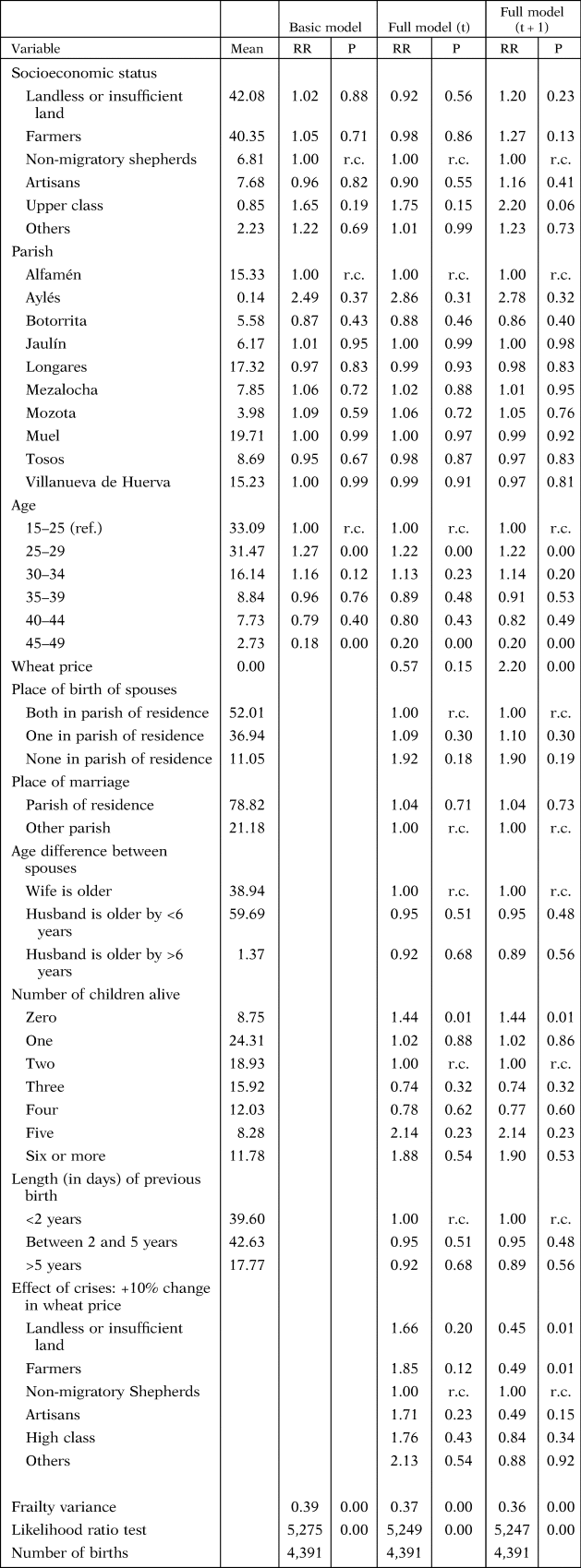
As shown in the basic model of Table 1, socio-economic status did not significantly influence fertility, neither did the village of origin. In contrast, the age of a woman had an important effect on the possibilities to have another child. Thus, younger women were more likely to have another child, as opposed to women over 45 years of age, as expected. In the following models, full model t and full model t + 1, the iteration between short-term economic stress and occupation is introduced. On the one hand, in period t, the iterations are not significant. Therefore, the analysed individuals did not reduce their offspring in the years of economic shock. Conceptions had occurred months ago, and births occurred in a similar proportion to in years without economic shocks. However, the results show a tendency to reduce offspring in the year after the price crisis. On the other hand, the iterations of period t + 1 are significant for farm workers, which includes the landless and the semi-landless (those owning insufficient land) and farmers. The landless or semi-landless, as expected, show the lowest levels of fertility during economic shocks, but these shocks also had an important impact on farm owners. However, it is impossible at this stage to know whether these differences result from behavioural or biological factors, especially during the pre-transitional period. According to the results for period t + 1, a 10 per cent increase in wheat prices lowered the birth rate by 2.75 per cent for the landless or semi-landless and 2.48 per cent for the farmers. Farm workers could have used information about local conditions in agriculture to predict their future economic situation and, therefore, in making decisions about having an additional child. The majority of farmers in the study area spent their entire lives performing the same agricultural tasks and were aware of the weather's effect on the harvest, and they tried to adapt to the situation each year. Nevertheless, some years of low harvest were the consequence of storms and climatic disasters that destroyed their production in just a few hours (impossible to predict it), as the newspapers of the time reflect on multiple occasions. Thus, these farmers could not always anticipate economic shocks, and not all economic shocks were due to production problems. In addition, although they had known of these shocks in advance, most conceptions occurred in the previous summer, long before the crops began to germinate.
COX PROPORTIONAL HAZARDS ESTIMATES OF FERTILITY IN TEN ARAGONESE PARISHES (SPAIN), 1801–1909, FOR ALL WOMEN, SECOND AND HIGHER-ORDER BIRTHS

Note: Relative risks from Cox proportional hazard estimates, P refers to Wald P-value. r.c. = reference category.
Source: Alfamén and Middle Huerva Database (AMHDB).
The results are consistent with those for rural areas in other European countries and are close to those in Sweden (Bengtsson and Dribe Reference Bengtsson and Dribe2006) and Germany (Dribe and Scalone Reference Dribe and Scalone2010), where farm workers, especially the poorest workers, were the most affected by economic shocks, especially in the year after the price crisis took place. The percentage effect was lower than in Sweden but higher than in Germany. However, the results for Italy (Bengtsson and Dribe Reference Bengtsson, Dribe and Tsuya2010), the country most like, and nearest to Spain, are not significant in any category (untaxed, low-taxed or highest-taxed). Unlike the aforementioned paper for other European areas (Bengtsson and Dribe Reference Bengtsson and Dribe2006; Dribe and Scalone Reference Dribe and Scalone2010), farmers appeared to, in a significant way, control their fertility, although to a lesser degree than day-labourers. As previously stated, a possible explanation for this would be linked to the fact that the farmers in the area were mostly made up of owners of small properties who could not have enjoyed a secure economic situation. If the prices were high because the harvest was scarce that year due to weather or pests, the farmers themselves did not have enough harvest to sell in the market and could not even cover their own needs. In any case, this explanation needs to be contrasted with new data. An interesting way to know how many large farmers existed is to analyse the number of households that hired servants for agricultural tasks. This information can be extracted from the Status Animarum for the period 1800–1830 (with the exception of the period 1808–1814 due to the Napoleonic wars). This source is not a perfect proxy, given that some large landowners may have been leasing the land and other possible situations not reflected in the source, but it allows us to approximate to the question. In the available period, very few individuals in the study area had agrarian servants in their homes (below 1 per cent of the households). Although all types of servants are considered, among farmers less than 5 per cent had a servant in their houses. Most of the farmers had low incomes, so they could not hire servants. Servants were common in wealthiest households such as priests' homes. In short, the farmers in the study area, although they never appeared in the registers with another occupational function, were mostly smallholders, who in many cases were affected by the short-term economic shocks, and a large part of their food production was for self-consumption.
Another socio-economic category of note is the ‘artisan'. Artisans did not control their fertility in the same way as day-labourers despite being net consumers. This may be related to the elasticity of demand (because many of them were producing for distant markets beyond the province of Zaragoza) and to their ability to adapt to the economic situation through annual contracts for leasing furnace or, mills or through other licences, which may have reduced their vulnerability. Additionally, taking into account that families did not accumulate significant property but consumed according to their needs, not necessarily the demand for artisan products was closely linked to the economic situation. At the same time, the available sample of artisans is small, which could have affected the results.
In the 19th century the economic shocks affected the landless, the semi-landless and farmers, but the short-term economic stress had stronger effects on the landless or semi-landless. The results show that in the rural areas of Spain, farm workers addressed economic shocks by controlling their fertility. Another interesting result is the importance of childhood survival in human agency. In this period, families without surviving children made greater efforts to try to produce more offspring (Reher and Sanz-Gimeno Reference Reher and Sanz-Gimeno2007; Van Poppel et al. Reference Van Poppel, Reher, Sanz-Gimeno, Sanchez-Dominguez and Beekink2012; Reher and Sandström Reference Reher and Sandström2015; Reher et al. Reference Reher, Sandström, Sanz-Gimeno and Van Poppel2017). In contrast, as we expected, the control variables linked to the place of residence, place of birth, place of marriage and age difference of the spouses did not affect fertility, nor did the distance to the birth of the last child according to the analysis of Table 1. Finally, it should be noted that in the three statistical analyses the younger women were more likely to have more children than the older ones.
6. CONCLUSIONS AND DISCUSSION
The results of this analysis suggest that short-term economic stress had an impact on reproductive behaviour during the analysed period (1801–1909). This impact did not immediately affect the birth of children in the year of the crisis, but it affected the births of the following year. Therefore, responses to grain price increases were negative respect to fertility, with a gap of a few months. This reproductive behaviour is in accord with analyses from other parts of Europe during the pre-transitional period. The inhabitants of rural Aragón also reduced their offspring when faced with economic shocks that affected them directly. However, several authors have questioned whether these responses were deliberate in the pre-transitional period. A delayed negative response is consistent with the nutrition hypothesis, which argues that acute malnutrition caused spontaneous abortion, temporary sterility, libido loss and other health problems. It could also be consistent with the hypothesis that temporary labour migration separated spouses during economic crises (Dribe Reference Dribe2003). However, our sources do not allow us to know if the spouses remained in our study area or if some of them migrated during short periods. In any case, according to the results, individuals reduced their fertility in the year after an economic shock. We have no reason to assume the year after an economic shock was a year of lower labour supply in the area. Therefore, there is no significant reason to believe those years presented a greater volume of temporary migration. In short, it is possible, but not definite, that temporary migration plays a fundamental role in the results. The limitations of the source material not only make it difficult to know the volume of temporary migration but also prevent knowing some characteristics of the individuals analysed (to classify landless, semi-landless and landowning individuals according to their economic situation). However, these limitations are common in most literature on this issue and do not invalidate the findings.
Despite the results, it is difficult to distinguish between a deliberate decision to control fertility and a response to malnutrition or physiological problems. How can we be sure whether a given response is a decision or a physiological reaction? There is no definitive answer to this question. Malnutrition is likely to have influenced fertility among the lower classes in these communities, and families in pre-industrial societies could well have been vulnerable to economic grain price shocks. Several studies from Europe and Asia show that a variation in grain prices leads to an increased risk of adult death, possibly related to nutritional problems (Campbell et al. Reference Campbell, Lee, Bengtsson, Bengtsson, Campbell and Lee2004; Crimmins and Finch Reference Crimmins and Finch2006). Malnutrition could also affect 19th century mothers, inhibiting the possibility a new pregnancy. At the same time, there are examples that contradict the hypothesis of sharp declines in fertility due to malnutrition. For example, 1855 and 1856 were years of grain price crises. However, contrary to what we would expect, during 1856 the number of births increased by around 5.8 per cent with respect to 1855, and the following year saw a further increase of around 8.2 per cent. This is because 1855 was a year of high mortality due to a cholera outbreak. Many adults and children died. This extra mortality of children favoured the ‘replacement effect’ of those children. While in most years only between 10 per cent and 15 per cent of the children were born to parents who lost a child in the previous year (e.g. 13.46 per cent in 1854 and 15 per cent in 1855), in 1856, 23 per cent of parents who had children were replacing a child that had died during the previous year (usually from cholera). Therefore, in this case, despite the 2 years of economic stress, there was an increase in the birth rate due to the ‘replacement effect’. Severe malnutrition or a severe physiological response was not common among women during 1855–1856, although this could be an exception due to the decreased competition for food within the family. The causes of economic shocks and demographic variations are varied and difficult to control. In any case, this paper has shown that there is a relationship between an economic shock and the reduction of fertility in the following year.
To sum up, we can conclude that the landless, the semi-landless and landowners temporarily reduced their offspring during the years of short-term economic stress. Therefore, the effects of a crisis year due to high wheat prices were only felt in the year after the crisis itself, probably because most of the children born in that year had already been conceived when the crisis was felt or anticipated. At the same time, the reduction of the birth rate was especially strong among the landless and semi-landless, that is, the poorest, the most numerous individuals in the study area. These effects were not felt, or felt less intensely, by artisans and individuals belonging to the upper class, possibly because their jobs were not close linked to the evolution of the crops. It should also be noted, as seen in Figure 4, that prices varied less during the 19th century, presenting lower peaks at the end of that century and the beginning of the next. The results obtained in this study show that economic stress is a powerful mechanism that affected the fertility of farm workers during the pre-transitional period.
ACKNOWLEDGEMENTS
I would like to thank the valuable feedback for improving this research by the three anonymous reviewers, David Reher, Vicente Pinilla and Domingo Gállego, as well as the ideas which surfaced from their presentation in the Seminar of Economic History Department of Universidad de Zaragoza (Spain), the European Population Conference 2016, and the annual Seminar of Sociedad de Estudios de Historia Agraria.
SOURCES AND OFFICIAL PUBLICATIONS
Parish archives (baptisms, marriages and deaths) of: Alfamén, Botorrita, Jaulín, Longares, Mezalocha (includes Aylés), Mozota, Muel, Tosos and Villanueva de Huerva (rural Spain).