INTRODUCTION
The aim of this paper is to examine the ancient sources with a view to reassessing the political history of Olbia Pontike in the fifth and early fourth century bc. Several Olbian inscriptions that pertain to a certain Heuresibios son of Syriskos suggest that an episode of tyranny may have taken place in this Black Sea Ionian apoikia during the fifth century bc, which preceded the introduction of democracy in the city. However, most of these inscriptions are in a poor state of preservation. As a consequence, previous research into the political activity of Heuresibios has often been based on questionable reconstructions and overinterpretations of the epigraphic evidence; therefore, the sources deserve careful re-examination. It should also be taken into account that the history of Olbia was intertwined with that of two major territorial powers – the Achaemenid and Athenian Empires. The economic and political relationship between the Bosporus and the Achaemenid Empire has only recently received scholarly attention, which may provide new, important observations on the question of tyranny in the North Pontic region. It is argued that the political and cultural change that took place in Olbia may have been triggered by the Pontic expedition of Pericles as well as by the possible Olbian membership of the Delian League. The approach that is applied in this study takes into consideration not only epigraphic material, but also other written sources as well as numismatic and archaeological material, which serves to provide a broader historical background of the political situation in Olbia during that time.
EPIGRAPHIC MATERIAL
A crucial piece of evidence is the inscription on a statue base of Zeus Soter that has been found in Olbia and dates to the fourth century bc (IOlb. 71 = IGDOlbia 11; see Appendix, no. 1 and Fig. 1). Although the text of the inscription is not fully preserved, it is clear that it represents the list of priests belonging to a religious association centred upon the cult of a local hero named Heuresibios. A prosopographical analysis of the text has indicated that the priests associated with this cult appear to be close relatives and members of at least two families – the family of Leokrates and the family of Leoprepes (Stolba Reference Stolba2013 with fig. 3 with stemmata of the families). The existence of the local hero cult is likely to explain the striking popularity of the name Heuresibios in Olbia. The name was remarkably popular in Olbia from the late sixth century bc until the second century ad; 26 people bore this name in Olbia, whereas it is virtually absent in other Greek cities of the Black Sea region (Stolba Reference Stolba2013, 296 n. 11, 298). The name occurs only twice outside the northern Pontic region – in Apollonia on the western Black Sea shore (fourth century bc) and in Aphareos on Euboea (fourth/third century bc).
Inscription IOlb. 71. Drawing by V.F. Stolba.

The name seems to have been passed down within the same family, which can be supported by a prosopographical analysis of the city's elite (Rusyaeva Reference Rusyaeva2002, 184). A similar name-giving tradition can be observed with regard to the famous Athenian tyrannicides Harmodios and Aristogeiton. According to the LGPN (vols 1–5), in the period following their death 112 identified individuals bore the name Harmodios, while 57 were named Aristogeiton; most of the examples have been attested in mainland Greece. Only a few examples of these names date to an earlier period. Notably, in Late Antiquity giving these names to slaves was forbidden by law (Taylor Reference Taylor1991, 9; see Aulus Gellius, Noctes Atticae, 9.2.10 [second century ad] and Libanios, Apologia Socratis, 5.53 [fourth century ad]).
The reading ἱερεῖς Εὑρησιβίου (in the second line of IOlb. 71), which means ‘the priests of Heuresibios’, was first suggested by the editor princeps Beletskiĭ; however, he rejected such a reading due to his doubts about the existence of an unknown and otherwise unattested local cult of a certain Heuresibios. In its place he proposed a less plausible reading (which disregards the proportion of the stone): ἱερεῖς Εὑρησιβιάδαι, i.e. ‘the priests from the family of Heuresibios’ (Beletskiĭ Reference Beletskiĭ1955, 180).Footnote 1 Such a reconstruction was accepted by Vinogradov, who assumed that this Heuresibios should be interpreted as Heuresibios son of Syriskos, whose existence was supported by two allegedly contemporary dedications to Zeus Eleutherios (Appendix, nos 2 and 3).
The first dedication (Appendix, no. 2) has been interpreted as a dedication of a statue of Heuresibios to Zeus Eleutherios, made by his son. This Heuresibios was identified as the one mentioned in the list of priests discussed above (IOlb. 71). The name of the son in the lacuna has been reconstructed as Leokrates, according to the list of priests, even though other reconstructions are possible as well. Consequently, it has been argued that the inscription dates to the early fourth century bc (Vinogradov Reference Vinogradov1989, 147; Reference Vinogradov1997, 212; IGDOlbia 8; SEG XLII 714).Footnote 2
The second dedication deserves special attention. It is most probably a dedication of the city walls to Zeus Eleutherios, ascribed to the same Heuresibios son of Syriskos (for partial text and translation, see Appendix, no. 3 A and B). The inscription has partly been quoted on several occasions (Vinogradov Reference Vinogradov1981b, 63; Reference Vinogradov1981c, 27; Reference Vinogradov1989, 136 and 138 n. 15; Reference Vinogradov1997, 212; Rusyaeva and Krapivina Reference Rusyaeva and Krapivina1992, 24). However, the complete Greek text remains unpublished. Vinogradov's plans to publish the inscription at a later date have never been fulfilled (Vinogradov Reference Vinogradov1981b, 63 n. 97; Reference Vinogradov1989, 136 n. 3). Vinogradov quotes two passages of the inscription: Ἐλευθερίωι Zηνὶ θεῶμ βασιλεῖ and αὔξωμ μὲν πάτριονFootnote 3 δάπεδον τιμῶν τε δικαίως Zηνὸς ἘλεοθερίοFootnote 4 πάγκρατος εὐδόκιμον, of which only the latter has been included by Dubois in his collection of Olbian inscriptions (IGDOlbia 9; NB – Dubois suggests the reading πᾶγ κράτος instead of πάγκρατος). The inscription was briefly commented on by Beletskiĭ and dated to the late fifth/early fourth century bc; however, only a Russian translation (inaccurate, according to VinogradovFootnote 5) was provided (Appendix, no. 3, I). The stele with a fully preserved four-line inscription written in the elegiac couplet was allegedly found in Olbia in 1971 (Beletskiĭ Reference Beletskiĭ and Baran1975; IGDOlbia 8). Two alternative Russian translations provided by Yaĭlenko in 1990 and Rusyaeva and Rusyaeva in 2004 (Appendix, nos 3, II and III) do not include the original Greek text either.Footnote 6 The translations clearly demonstrate that the first verse of the hexameter (where the name of Heuresibios son of Syriskos should be mentioned) and the beginning of the second verse (with the first ictus of the pentameter) have been omitted by Vinogradov:
According to Levi, the stele was discovered in two pieces in the area of the city walls west of trench E3, and is stored in the Olbian National Historical and Cultural Reserve in Parutino, Ukraine (Levi Reference Levi1985, 23 with n. 73; see also Rusyaeva and Krapivina Reference Rusyaeva and Krapivina1992, 23–4).
Basing on epigraphic and, to a lesser extent, numismatic evidence, Vinogradov argued that the political activity of Heuresibios son of Syriskos was connected with the overthrow of tyranny in Olbia (Vinogradov Reference Vinogradov1981a; Reference Vinogradov1981b; Reference Vinogradov1981c; Reference Vinogradov1989, 109–26; Reference Vinogradov1997, 165–229). An important source used in support of this theory was a poorly preserved epigram dated to the early fourth century bc, in which the overthrow of tyranny was likely to be mentioned (SEG XXXI 702; no. A4) (Vinogradov Reference Vinogradov1989, 142; Reference Vinogradov1981b, 67–74; Reference Vinogradov1997, 217–21, 229 n. 261). According to Vinogradov's restoration, the epigram refers to the same Heuresibios son of Syriskos known from the two dedications, who allegedly liberated Olbia from tyranny; this in turn allowed him and his relatives to establish a prominent position in the city (Vinogradov Reference Vinogradov1981b, 67–74; Reference Vinogradov1989, 135–50). Following this assumption, Dubois has argued that Heuresibios may have enjoyed the status of a local hero shortly after his death, such as the famous tyrannicides Harmodios and Aristogeiton in Athens (Dubois Reference Dubois1996, 26). Accordingly, another Olbian dedication dated to the early fourth century bc has been ascribed to the same Heuresibios (IGDOlbia 12: Ἑρμέω, Εὑρησιβίο).Footnote 7
SEG XXXI 702 has also been examined by A. Lebedev, who has convincingly demonstrated that Vinogradov's reconstruction cannot be accepted for linguistic reasons, examples of which are: unintelligible σπεῦσεν, the unattested combination οὐδὲ … γοῦν (with γοῦν itself being impossible in this position in the text) and τῶν ἀρετῶν (instead of ἀρετῆς) which sounds characteristic of the Byzantine era (Lebedev Reference Lebedev1996, 263). According to Vinogradov's reconstruction, Heuresibios actually did not kill the tyrant and therefore, as Lebedev argues, it would be surprising if the Olbian community indeed honoured him with a statue. However, according to the written record, Harmodios and Aristogeiton also failed to kill the tyrant. They killed the tyrant's brother instead, which did not prevent people from honouring them as ‘the tyrant slayers’ (Taylor Reference Taylor1991; Thucydides 6.57–59). Therefore, Vinogradov's point was that the local hero was praised for his attempt to kill the tyrant, which was perceived as rendering the same invaluable service to the city as in the case of Harmodios and Aristogeiton.
Lebedev has compared the inscription with a parallel fragmentary epigram from Chios (see Appendix, no. 5), arguing that the Olbian epigram was not a local poem but a copy of a fifth-century bc Athenian epitaph honouring the tyrannicide of the legendary Harmodios and Aristogeiton, whose statues were situated in the Agora (Lebedev Reference Lebedev1996, 267; Taylor Reference Taylor1991, 13; for the Chian epigram, see Trypanis Reference Trypanis1960 no. 4). The local Chian and Olbian versions of the epigram have served to reconstruct tentatively the original Attic text (Appendix, no. 6; Lebedev Reference Lebedev1996, 267; cf. Raaflaub Reference Raaflaub, Flensted-Jensen, Nielsen and Rubinstein2000, 262–5). It has been suggested that the Olbian epigram was composed between 451 and 423 bc and that this inscribed version may derive either from the gymnasium of the Hellenistic period or, more likely, from the Big Stoa located between the Olbian agora and the Eastern Temenos (Lebedev Reference Lebedev1996, 266–7).Footnote 8 The stoa was most probably dedicated to Zeus Eleutherios, replicating the dedication of the Stoa of Zeus Eleutherios on the Athenian Agora. Its construction was strongly influenced both politically and culturally by Athens and, analogously, it may have been decorated with monuments glorifying democracy, among which a monument of Harmodios and Aristogeiton may have been placed (Lebedev Reference Lebedev1996, 266). Given the fact that Olbia was most likely a member of the Delian League (at least by 425 bc), the cult of the legendary tyrannicides may have existed as part of the Athenian religious-political propaganda also recorded in cities of other Athenian symmachoi (Lebedev Reference Lebedev1996, 266 and n. 21 with further literature).
Nevertheless, it should be taken into consideration that both the introduction of the cult of Zeus Eleutherios and the popularity of the Athenian tyrannicides in Olbia did not necessarily have to be a result of Athenian imperialistic policy aimed at the subjugation of the allied city through imposing Athenian cults there. As proven on several occasions, purely imperialistic motivations behind Athenian religious activity were not always the case (Parker Reference Parker1996, 142–51; Shapiro Reference Shapiro, Hellström and Alroth1996; Polinskaya Reference Polinskaya2009). Religious practices may have fostered a special relationship and cooperation between Athens and the allied city that was based on mutually beneficial links. In that sense, the requirement imposed on allies to participate in the most important festivals in Athens may have been perceived not only as an obligation, but also as a privilege (see Low Reference Low and Low2008, 117). Therefore, despite noticeable political connotations to the cult of Zeus Eleutherios, its introduction in Olbia may have been recognised as a result of the relationship established between the imperial city and its ally.
OLBIA AND THE DELIAN LEAGUE
The participation of Olbia (and other north-western Black Sea poleis) in the Delian League is suggested by a tribute reassessment list of the members of the League which dates to 425/424 bc (ATL I 157; see also I 528–9 and I 539; IG I3 71, IV). However, the part of the inscription that pertains to the Black Sea region, underneath the heading [πόλες] ἐκ τõ Εὐ̣[χσείνο] (‘cities of Euxeinos’) (IG I3 71 IV line 126), is poorly preserved. Moreover, the part of the text referring to the Pontic tribute has been fully restored (line 171: [Ποντικõ φόρο]). At line 162, an initial omicron has been preserved and may be restored as evidence of Olbian membership of the League. Avram reconstructs the name of the city as Orgame (Avram Reference Avram, Hansen and Raaflaub1995, 197; Reference Avram and Hansen1996, 296; Surikov Reference Surikov2001, 363–4). However, it is far from certain that Orgame had the status of a polis during that time (see Avram, Hind and Tsetskhladze Reference Avram, Hind, Tsetskhladze, Hansen and Nielsen2004, 940). Other evidence in support of Olbian membership in the Delian League should also be taken into consideration. An in-depth discussion of the issue has been presented by Karyshkovskiĭ, who argues that at the time Olbia was an important enough centre to attract Athenian attention, the grain trade being one example of Athenian interest. Moreover, the tribute of one talent shown on the Tribute List would not have been an impossible burden, since, at the time, Olbia was already a large polis with an established relationship with its metropolis and local communities. Karyshkovskiĭ has also examined a fragment of an Olbian copy of the Standards Decree (IG I3 1453) and its impact on local numismatics. The decree demanded the replacement of local silver coins with a series of bronze coin issues (the type with the head of Athena and the letters ΠΑΥΣ, and the type with the letters ΑΡΙΧ) (Karyshkovskiĭ Reference Karyshkovskiĭ1960).Footnote 9 Further Athenian impact on Olbia can also be observed with regard to other aspects such as cult and language. In the second quarter of the fifth century bc Athena started to be worshipped as a separate goddess unlike in the earlier period, during which the combined cult of Athena and Zeus was more common (Rusyaeva Reference Rusyaeva1992, 92). Attic forms appear in the epigraphic material of Olbia around the middle of the fifth century bc, such as Ἰατρõι instead of the Ionian Ἰητρῶι in a dedication to Apollo (IGDOlbia 99) and Διφίλοι instead of Διφίλωι attested on an unpublished private letter from the Olbian necropolis (Vinogradov Reference Vinogradov1989, 130). All of these examples amount to substantial evidence that points to Olbian membership of the Delian League.
DISCUSSION OF OTHER EVIDENCE
With that in mind, it cannot be certain that Heuresibios became a local hero due to the liberation of the city from tyranny. There might have been a number of reasons behind him becoming a local hero; however, the scarcity of evidence does not allow for further investigation. Cults of local heroes appear to be a common feature among local Greek communities, an example of which is the abundant evidence from Attica (Kearns Reference Kearns1989). It should also be considered that Heuresibios son of Syriskos is attested only in Vinogradov's reconstructions of the poorly preserved epigraphic material. Dubois has followed Vinogradov's interpretations, since he was probably not aware of Lebedev's work, which was published in the same year as IGDOlbia. As a consequence, according to LGPN vol. 4, three inscriptions are considered to refer to Heuresibios son of Syriskos (i.e. IGDOlbia 8; 9; 10; Appendix, nos 2, 3 and 4), although in fact none of them mentions the patronymic ‘Syriskos’ and only one contains the name ‘Heuresibios’ (Appendix, no. 2).
Even though Vinogradov's reconstruction of the epigram does not seem convincing, his theory of tyranny in Olbia should not be fully disregarded. There is evidence that seems to suggest that an episode of tyranny may indeed have taken place in the North Pontic region, such as the occurrence of the cult of Zeus Eleutherios in Olbia, the local numismatic evidence, and the archaeological material (see Stolba, Reference Stolba2009, 29; Reference Stolba2013, 299).
The cult of Zeus Eleutherios
The cult of Zeus Eleutherios (i.e. the Liberator) was often introduced in Greek cities after important political changes in order to celebrate freedom and democracy, Syracuse being an example of this. Diodoros tells us that after the overthrow of the tyrant Thrasybulos in 466/465 bc, a colossal statue of Zeus Eleutherios was set up in the city, and also an annual festival was established to celebrate the liberation (Diodorus Siculus 11.72.2; see Vinogradov Reference Vinogradov1981b, 64–5; Reference Vinogradov1989, 136–7; Reference Vinogradov1997, 213; Raaflaub Reference Raaflaub and Franciscono2004, 104). Therefore, it cannot be excluded that the introduction of the cult of Zeus Eleutherios in Olbia was also connected with the political situation in the city. The cult of Zeus with the epithet Eleutherios is also attested by another dedication found in Olbia, which possibly dates to the early fourth century bc (Appendix, no. 7; Vinogradov Reference Vinogradov1989, 135–6 [followed by Dubois IGDOlbia 7]).Footnote 10
The introduction of this cult was not always contemporary with political changes in the city as in the case of Athens. As shown by Raaflaub, the cult of Zeus Eleutherios was introduced half a century after the establishment of democracy in the city. The cult emerged most probably as a reaction to the Persian Wars, and it was used in political propaganda glorifying freedom and democracy, which was connected with a strong anti-tyrannical ideology that developed in fifth-century bc Athens (Raaflaub Reference Raaflaub, Flensted-Jensen, Nielsen and Rubinstein2000; Reference Raaflaub and Franciscono2004, 107).Footnote 11 One of the functions of Zeus Eleutherios was to defend a city from external military danger, which in the case of Athens was associated with the Persian threat. As Raaflaub points out, the aspect of external freedom was primary in this cult, whereas that of internal freedom (i.e. from tyranny) was secondary, which followed the conceptual development of the idea of freedom (Raaflaub Reference Raaflaub and Franciscono2004, 107, 110).Footnote 12 Therefore, it should be taken into consideration that the introduction of this cult in Olbia (most probably in the early fourth century bc) may have also taken place later than the political change in the city.
It is significant that the cult of Zeus Eleutherios has not been attested elsewhere in the Black Sea region; it also does not appear in the epigraphic material of Olbia in later periods. This suggests that the emergence of this cult was a local Olbian phenomenon that most probably occurred under the influence of Athens. Furthermore, the closely related cult of Zeus Soter (the Saviour), that was fairly widespread in the Bosporus from the fourth century bc onwards, was independently worshipped in Olbia during the same time, as attested by IOlb. 71 and SEG XXXII 794.Footnote 13 Graffiti made on black-glazed pottery used at symposia, which is the earliest evidence of the cult of Zeus Soter in the Bosporus, may point to a more private, non-public character of this cult in this region at the time.Footnote 14 It is noticeable that during the Roman period Zeus Soter was regularly worshipped not only in the Bosporus but also in other North Pontic poleis as a city's deity, the patron and guardian of the polis.Footnote 15
Numismatic evidence
A broader historical context of the political situation in the region may be provided by local numismatic evidence. It is significant that in the second half of the fifth century bc the coins of Nikonion, Olbia, Pantikapaion, Nymphaion and Theodosia do not bear ethnic names or the name of the city. It has been argued that these cities may have been governed by local tyrants or dynasts that most probably followed the Achaemenid tradition and struck the coins in their own names (Stolba Reference Stolba1989; Reference Stolba and Peter1998; Reference Stolba2002; Reference Stolba2009, 29; Reference Stolba2016, 84).Footnote 16 Such a probability is strengthened by the fact that from the late fifth/early fourth century bc onwards the ethnic names and the name of the city (occasionally with the names or monograms of the city's officials) appear regularly on the coins (Stolba Reference Stolba2009, 29).Footnote 17 This may indicate that the rule of the local tyrants was disturbed by the political impact of Athens on the region, which may have been intertwined with the Pontic expedition of Pericles that took place in c.437 bc. The case of Sinope, where the removal of the tyrant Timesileos by Pericles' soldiers under the leadership of Lamachus is attested by Plutarch (Plutarch, Pericles 20), is a remarkable example of Athenian influence on a local political situation. According to written sources, there must have been at least two Athenian expeditions to the Black Sea region, as Lamachus sailed again into the Black Sea in 425/424 bc, after Pericles' death. Even though the second expedition turned out to be unsuccessful, since Lamachus lost his ships because of a sudden flood (Thucydides 4.75.1–2; Diodorus Siculus 12.72.4), it demonstrates the Athenian interest in the Black Sea region at the time. It is worth mentioning that Plutarch's account was used to restore tentatively line 3 of an Athenian casualty list (IG I3 1180: ἐν [Σιν]όπει; see Raubitschek Reference Raubitschek1943, no. 5; Bradeen Reference Bradeen1974, no. 17).
Plutarch's account of the removal of the tyrant in Sinope by Lamachus has been linked by Vinogradov to a fragment of an honorary decree found in Olbia. The inscription dates to c.450–425 bc and, according to a rather vague reconstruction, pertains to the former tyrant of Sinope and his brother, who fled to Olbia in 437 bc; a grant of citizenship is given to them through a dogma which is likely to demonstrate a possible non-democratic constitution of Olbia ([δόγμ]α [Όλβιο]πολιτέων; Vinogradov Reference Vinogradov1981a, 74 and 79; Reference Vinogradov1981b, 56; Reference Vinogradov1989, 109–11; SEG XXXI 701; accepted by Dubois IGDOlbia 5). The reconstruction has not been widely accepted due to its highly dubious nature and a peculiar use of the heavily reconstructed word dogma as a ‘decree’, which lacks fully preserved, analogous epigraphic examples; this formula appears very rarely, not only in the Black Sea region but also in the whole Greek world.Footnote 18 The restored decree served to support Vinogradov's theory of a Scythian protectorate over Olbia that was supposed to exist in the fifth century bc (Vinogradov Reference Vinogradov1989, 90–109). The concept of a Scythian protectorate – now thoroughly reassessed and discredited by certain scholars – appeared in Russian literature during the nineteenth century and is based on Herodotus' story about the Scythian ruler Scyles (Herodotus 4.78–80; Vinogradov Reference Vinogradov1980).Footnote 19 The names Arichos and Eminakos, which were found on Olbian coins from that period, were interpreted as the names of an Olbian tyrant and a Scythian king respectively (Vinogradov Reference Vinogradov1989, 93–4; Dubois IGDOlbia 3).Footnote 20 As can be seen, Vinogradov created a close link between the theory of a protectorate and the idea of tyranny, assuming that certain Olbian tyrants may have been of Scythian origin. Also, both aspects of the cult of Zeus Eleutherios were pointed out: internal being connected with the removal of tyranny and external connected with the liberation of the city from its Scythian dependency (Vinogradov Reference Vinogradov1981b, 65). The theory of a Scythian protectorate has long enjoyed popularity; however, recent research has raised serious doubts as to its existence due to the lack of firm evidence.Footnote 21
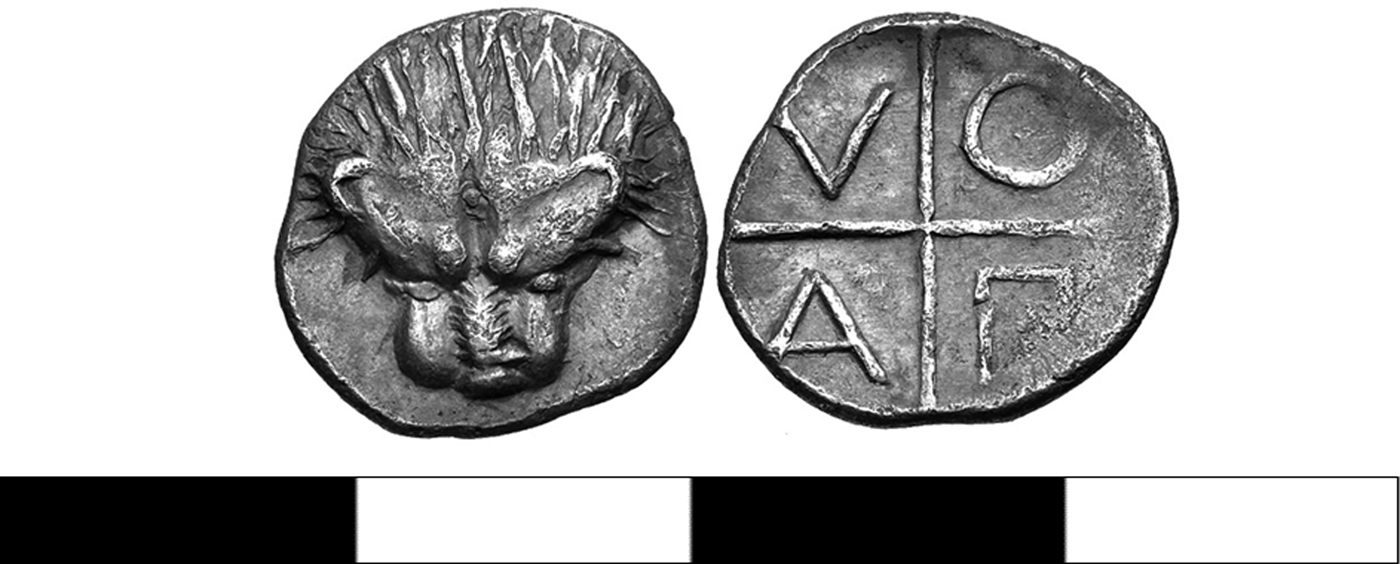
Similar tendencies to express power by local rulers appear to have been displayed in the Bosporus. A crucial piece of evidence concerning the political situation in the region is provided by fifth-century Bosporan coinage and the hotly debated silver coins of Pantikapaion with the letters ΑΠΟΛ (see Fig. 2). The coins have been interpreted either as coinage of an unattested Bosporan city called Apollonia (Shelov Reference Shelov1949) or as coins of the temple of Apollo in Pantikapaion.Footnote 22 The latter hypothesis has been widely accepted by many scholars and still enjoys popularity,Footnote 23 even though it is far from being certain. It has recently been argued that the legend may refer to a theophoric name such as Ἀπολ(λώνιος), Ἀπολ(λωνίδης), Ἀπολ(λόδωρος), rather than to the god Apollo. If this is the case, ΑΠΟΛ could be the name of one of the rulers from the Archaeanactid family, a local dynasty that reigned from c.480 to c.438 bc (Diodorus Siculus 11.31; Stolba Reference Stolba2016, 84–5). It is not without significance that after 438 bc the series of coins with ΑΠΟΛ on them disappears from the Bosporus (Stolba Reference Stolba2009). Therefore, the tradition of striking the names of local rulers on coins, which was well known in the Achaemenid Empire, would closely correspond with the similar phenomenon that seems to have occurred in Olbia and other North Pontic cities during that time.
Coin of Pantikapaion; CNG e-Auc 389 (18.01.2017), lot 200; 12.5 mm, 1.33 g.

Achaemenid impact on the North Pontic region – archaeological evidence
The existence of Persian influence on the North Pontic region is also supported by the archaeological material. A number of objects that were inspired by Achaemenid art, or that originated from the Achaemenid state, have been found in the North Pontic region, particularly in the necropoleis of the Bosporan Kingdom, among which the most usual finds are carved stones (scaraboids) and cylindrical seals dated to the fifth/early fourth centuries bc. A considerable amount of those seals have been found in graves dated to a later period (fourth/third century bc) (Fedoseev Reference Fedoseev1997; Treister Reference Treister, Nieling and Rehm2010, 234–6, 251–2).Footnote 24 Of special interest is an impression of an Achaemenid seal that has been found on a clay weight from Olbia that was made of local clay. The impression represents a seated Persian who tests an arrow (Fedoseev Reference Fedoseev1997, 310).Footnote 25 A similar representation occurs on a Greco-Persian gem and a golden finger ring found in Pantikapaion (Boardman Reference Boardman1972, 316–17 fig. 294; 297, pl. 681).
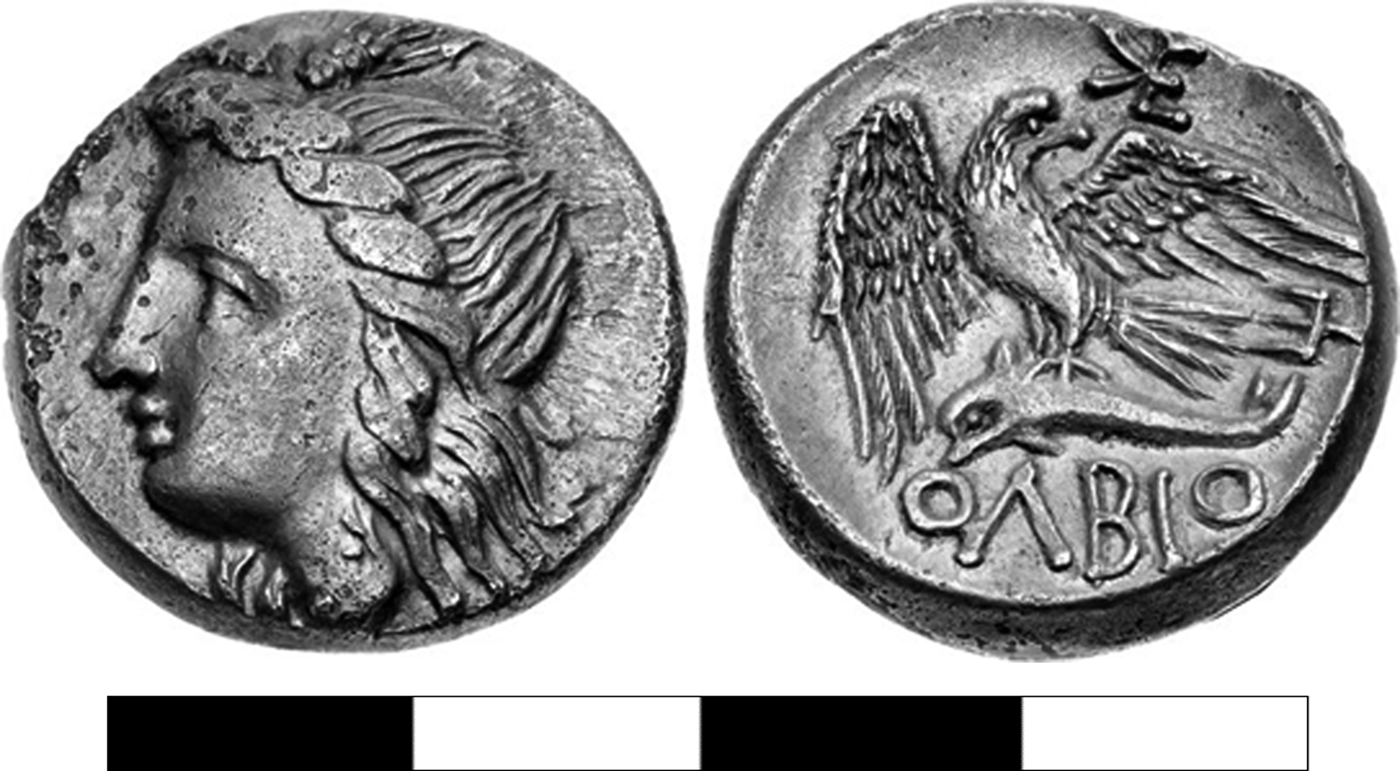
Other possible influences of the Achaemenids on the North Pontic region that have been suggested by scholars are to be found in coin emblems of the Bosporus (such as the type with a lion attacking a stag) and Olbia (the type with an eagle on a dolphin; see Fig. 3) which seem to have their parallels in Persian symbols.Footnote 26 Another parallel is assumed to have existed between Bosporan and Persian weight systems that appeared after 490 bc, a phenomenon that is attested not only in the Bosporus but in the whole North Pontic region (Fedoseev Reference Fedoseev1997, 311–13; Nieling Reference Nieling, Nielig and Rehm2010, 131). The occurrence of Iranian (Persian) names in local onomastics is also worth mentioning (Fedoseev Reference Fedoseev1997, 311–13; see also Treister Reference Treister, Nieling and Rehm2010, 223 with further literature).Footnote 27
Coin of Olbia; CNG Triton XVI (07.01.2013), lot 43; 22 mm, 12.76 g.

The means of distribution of Achaemenid and Achaemenid-style objects varies depending on a given context. The seals are likely to indicate a diplomatic relationship between the Bosporus and the Achaemenid state, even though no far-reaching historical conclusion can be drawn from their occurrence (Treister Reference Treister, Nieling and Rehm2010, 250; Treĭster Reference Treĭster, Vachtina, Gritsik, Zhizhina, Ivanov, Zuev, Kashaev, Sokolova and Chrshanovskiĭ2011). The amount of the Achaemenid and Achaemenid-inspired metalwork found in the North Pontic region does not appear considerable when compared to other regions, unlike the Achaemenid seals. Their concentration in the Bosporus is striking and seems to point to possible diplomatic and economic ties between the Bosporan Kingdom and the Achaemenids. The cylindrical seals used for administration purposes at the Persian court are unlikely to have been trade objects, since they belonged to a particular person and most probably ‘travelled’ to the Bosporus together with their owners. Some of them may also have been brought to the North Pontic region unused, after they had been manufactured in Persia (Treĭster Reference Treĭster, Vachtina, Gritsik, Zhizhina, Ivanov, Zuev, Kashaev, Sokolova and Chrshanovskiĭ2011).Footnote 28 One of these seals is likely to date to the time of Artaxerxes I (Treĭster Reference Treĭster, Vachtina, Gritsik, Zhizhina, Ivanov, Zuev, Kashaev, Sokolova and Chrshanovskiĭ2011, 115). Such an early date would clearly demonstrate that political and economic ties between the North Pontic region and the Achaemenid Empire already existed at the time of Pericles' Pontic expedition.
CONCLUSION
To conclude, the evidence discussed above demonstrates that Heuresibios (whose patronymic is not certain) most probably enjoyed the status of a local hero, as visible in IOlb. 71. This may explain the great popularity of the name ‘Heuresibios’ in the city of Olbia. However, the nature of Heuresibios' political activity cannot be ascertained through the epigraphic material. Nevertheless, the theory of tyranny in Olbia can be explored in more detail by using other kinds of evidence. Local numismatic material suggests that in the fifth century bc the North Pontic poleis may indeed have been governed by local tyrants (or dynasties). The concept of tyranny may have been intertwined with the diplomatic and economic ties of the North Pontic region (especially the Bosporan Kingdom) with the Achaemenid Empire during that time. The rule of local tyrants/dynasties is likely to have been disrupted in the second half of the fifth century bc. This is likely to have been followed by the occurrence of a political cult of Zeus Eleutherios in Olbia in the early fourth century bc (or somewhat later), and the disappearance of the local coin series bearing personal names, which suggests a certain change in the political life of Olbia. The early fourth century bc is also the time when evidence of a democratic constitution becomes visible in Olbian epigraphic material.Footnote 29 It cannot be ruled out that the Pontic expedition of Pericles, whose aim was to demonstrate Athenian sea-power to local rulers, acted as a catalyst for a political change in the region. Such change may have been intertwined with the incorporation of Olbia and other Pontic cities into the Delian League.Footnote 30 This in turn resulted in the establishment of a relationship between Athens and its ally. Most probably an Athenian anti-tyrannical ideology was introduced in the city during that time. This could have later been reflected in the cult of Zeus Eleutherios with its aspect of internal freedom, closely connected to the idea of democracy.
ACKNOWLEDGEMENTS
This research was supported by the National Science Centre, Poland, within the grant: Greek city in the Hellenistic and Roman age and the territorial powers, project No. UMO-2012/05/B/HS2/04025.G. I am deeply grateful to Vladimir Stolba, Krzysztof Nawotka and Caspar Meyer for their critical reading of a preliminary draft and for providing several important bibliographical references. All remaining shortcomings of the article are my own responsibility.
APPENDIX
1. IOlb. 71 (= IGDOlbia 11); text and translation after Stolba Reference Stolba2013:

2. Dedication of a statue to Zeus Eleutherios; IGDOlbia 8 (= SEG XLII 714):
1 [Λεωκράτη(?), εὐ]χὴν τήνδε Εὑρησίβιομ πατέρ̣[α ἐσθλὸν]
[στήσας, τὴν] δ̣’ ἑτέρην Διὶ Ἐλεοθερίωι με ἀνέθηκας.
[Oh Leokrates!] To fulfil the first vow you [set up] a statue of your [good] father Heuresibios, and to fulfil the second one, you dedicated me to Zeus Eleutherios.Footnote 31
3. Beletskiıï Reference Beletskiĭ and Baran1975, 91; Vinogradov Reference Vinogradov1989, 136 and 138:
A) Ἐλευθερίωι Zηνὶ θεῶμ βασιλεῖ
B) αὔξωμ μὲν πάτριον δάπεδον τιμῶν τε δικαίως
Zηνὸς Ἐλεοθερίο πάγκρατος εὐδόκιμον.
(IGDOlbia 9)
I. Translation by Beletskiĭ Reference Beletskiĭ and Baran1975, 91:
Достойным похвалы оказался Евресибий (сын) моего Сириска перед Зевсом Элевтерием царем богов, справедливо увеличивший и почтивший отцовский участок, (посвященный) Зевсу Элевтерию Всемогучему, высокоценимый.
Heuresibios (son) of my Syriskos turned out to be praiseworthy in front of Zeus Eleutherios king of the gods, as he justly enlarged and honoured the paternal soil, (dedicated to) all-powerful Zeus Eleutherios.
II. Translation by Yaĭlenko Reference Yaĭlenko and Golubtsova1990, 263 n. 50:
Достойный похвалы от меня, Гевресибий, сын Сириска, воздвиг Зевсу Елевтерию, царю богов, возвеличивая отеческий край и по праву чтя всю славную мощь Зевса Освободителя.
Heuresibios son of Syriskos, who deserves praise from me, set up (e.g. a tower) to Zeus Eleutherios king of the gods while enlarging the paternal soil and justly honouring the glorious power of Zeus Eleutherios.
III. Translation by Rusyaeva and Rusyaeva Reference Rusyaeva and Rusyaeva2004, 79:
Достойный похвалы Евресибий, сын Сириска, поставил меня (статую) Зевсу Элевтерию, царю богов, укрепляя отеческую землю и по справедливости почитая славное владычество Зевса Элевтерия.
Praiseworthy Heuresibios son of Syriskos set up me (a statue) to Zeus Eleutherios king of the gods while strengthening the paternal soil, and honouring justly the glorious mastery of Zeus Eleutherios.
4. SEG XXXI 702 (= IGDOlbia 10):
1 [σπεῦσ]ε̣ν̣(?) ὁ μυριετὴς χ[ρόνος οὐδ’ Εὑρησιβίοιο]
[γοῦ]ν Λήθηι θεῖναι τῶ[ν ἀρετῶν τὸ κλέος],
ο̣ὐ̣ κτάν’ ὃς ἄνδρα τύρα[ννον, ἐλευθερίην δ’ ἀπέδωκε]
πατρίδι καὶ λαοὺς αὀτ[ονόμους ἔθετο].
Translation by Vinogradov Reference Vinogradov1989, 142:
Тысячелетнее время позаботилось, чтобы воистину (не) канула в Лету (слава подвигов Еврисивия?), который не убил мужа тирана, (однакож вернул свободу) отчизне и (сделал) народ (независимым).
The thousand-year-time took care so that [the glory of Heuresibios' deeds] indeed would [not] sink in the Lethe; he did not kill the tyrant, [however, he returned freedom] to the fatherland and [made] the people [independent].
5. Chian epigram; IG XI-[XIII] (= McCabe, Chios 273):
στῆσαι τοῦτο ἐδόκη[σεν Ἀθηναίοισιν Ἀριστο]-
γείτονος αἰχμητ[οῦ σῆμα καὶ Ἁρμοδίου,]
οἳ κτάνον ἄνδρα τύρα̣[ννον —]
ψυχὰς παρθέμενο[ι —].
It was resolved by the Athenians to set up the statue of Aristogeiton the warrior and Harmodios, who killed the tyrant […] risking (their) life […].
6. Suggested reconstruction of the Attic epigram based on the Chian and Olbian versions, Lebedev Reference Lebedev1996, 264 (with the English translation):
στῆσαι τοῦτο ἐδόκη[σεν Ἀθηναίοισιν Ἀριστο-
γείτονος αίχμητ[οῦ στῆμα καὶ Ἀρμοδίου.]
[φθίς]ει ὁ μυριετὴς χ[ρόνος e.g. οὐρανὸν ηδὲ καὶ αἶην]
[πρὶ]ν λήθη θεῖναι τῶ[νδ’ αρετῆς τὸ κλέος,]
[ο]ἳ κτάνον ἄνδρα τύρα[ννον ἐλευθερίην τ’ ἐσάωσαν]
πατρίδι καὶ λαοὺς αὀτ[ονόμους ἔθεσαν (vel ἐθέτην)].
It was resolved by the Athenians to set up the statue of Aristogeiton the warrior and Harmodios. The ten-thousand-years time will sooner destroy (e.g. heaven and earth), than bury into oblivion the glory of the noblesse of these men (i.e. of those buried here), who killed the tyrant, saved freedom for the motherland and made the people autonomous.
7. Dedication of a statue to Zeus Eleutherios; IGDOlbia 7 (= IPE I [2]. 160):
1 [Ἑκατέων Ἱκ]εσίου
[τὸν πατέρα Ἱκέσιον Ἑκα]τέωνος Διὶ Ἐλευθερίωι.
Hekateon son of Hikesios (dedicated the statue of his) father, Hikesios son of Hekateon, to Zeus Eleutherios.