Introduction
Mood and anxiety disorders are the most common mental disorders across the lifespan, with epidemiological surveys estimating that over 20% of the US population will suffer from one or more such disorder during their lifetime (Kessler et al. Reference Kessler, Berglund, Demler, Jin, Merikangas and Walters2005). Although mood and anxiety disorders are classified separately, co-morbidity is common in both clinical (McElroy et al. Reference McElroy, Altshuler, Suppes, Keck, Frye, Denicoff, Nolen, Kupka, Leverich, Rochussen, Rush and Post2001; Zimmerman et al. Reference Zimmerman, Chelminski and McDermut2002) and epidemiological samples (Kessler et al. Reference Kessler, Berglund, Demler, Jin, Koretz, Merikangas, Rush, Walters and Wang2003; Merikangas et al. Reference Merikangas, Akiskal, Angst, Greenberg, Hirschfeld, Petukhova and Kessler2007), and is often associated with longer illness duration and greater clinical severity than either disorder alone (Lamers et al. Reference Lamers, van Oppen, Comijs, Smit, Spinhoven, van Balkom, Nolen, Zitman, Beekman and Penninx2011). Prospective studies have found that depressive episodes are more prolonged in patients with anxiety co-morbidity, both at the level of anxiety symptoms or syndromes (Coryell et al. Reference Coryell, Endicott and Winokur1992, Reference Coryell, Solomon, Fiedorowicz, Endicott, Schettler and Judd2009). Co-occurrence of an anxiety disorder also increases the risk of suicide attempts in people with major depressive disorder (MDD) or bipolar disorder (BP) (Sareen et al. Reference Sareen, Cox, Afifi, de Graaf, Asmundson, ten Have and Stein2005). Moreover, BP with co-morbid anxiety can pose a significant therapeutic quandary since antidepressants, the treatment of choice for most anxiety disorders, may be problematic in patients with BP, particularly those with rapid cycling (Wehr & Goodwin, Reference Wehr and Goodwin1979).
The term ‘co-mordibity’ was first used by Feinstein to refer to the presence of two independent disorders, with the second disorder potentially affecting ‘the time of detection, prognostic anticipations, therapeutic selections, and post-therapeutic outcome of the index disease’ (Feinstein, Reference Feinstein1970). The appearance of co-morbidity may be due to chance or to ascertainment bias (Berkson's bias). However, the consistent documentation of co-morbid mood and anxiety disorders in community as well as clinical samples suggests that chance or ascertainment bias is unlikely to be primary reasons for the co-occurrence of these syndromes (Kessler et al. Reference Kessler, Merikangas and Wang2007). Feinstein's initial conception of ‘co-morbidity’ assumed the presence of distinct disorders; in psychopathology, however, the term often refers to overlapping symptoms rather than disorder-specific syndromes. Symptom-based overlap between mood and anxiety disorders is extremely common and may represent what has been termed ‘artefactual co-morbidity’ (Maj, Reference Maj2005). The overlap of anxiety syndromes is likely to be closer to Feinstein's conception of co-morbidity and has the potential to be of greater clinical relevance.
All the major mood and anxiety syndromes have been shown to segregate within families (Sullivan et al. Reference Sullivan, Neale and Kendler2000; Hettema et al. Reference Hettema, Neale and Kendler2001). Among the most studied has been the relationship between panic disorder and MDD. Most (Goldstein et al. Reference Goldstein, Weissman, Adams, Horwath, Lish, Charney, Woods, Sobin and Wickramaratne1994; Maier et al. Reference Maier, Minges and Lichtermann1995), though not all (Crowe et al. Reference Crowe, Noyes, Pauls and Slymen1983; Weissman et al. Reference Weissman, Wickramaratne, Adams, Lish, Horwath, Charney, Woods, Leeman and Frosch1993), family studies have provided evidence consistent with shared familiality, which is consistent with findings from twin studies (Kendler et al. Reference Kendler, Walters, Neale, Kessler, Heath and Eaves1995; Mosing et al. Reference Mosing, Gordon, Medland, Statham, Nelson, Heath, Martin and Wray2009). The familial association between major depression and social phobia has been less studied, with only two family studies providing modest evidence for co-aggregation in findings that fall just short of statistical significance (Fyer et al. Reference Fyer, Mannuzza, Chapman, Liebowitz and Klein1993; Stein et al. Reference Stein, Chartier, Hazen, Kozak, Tancer, Lander, Furer, Chubaty and Walker1998). Similarly, twin studies have found only modest evidence for common genetic susceptibility between MDD and social phobia (Kendler et al. Reference Kendler, Neale, Kessler, Heath and Eaves1993, Reference Kendler, Aggen, Knudsen, Roysamb, Neale and Reichborn-Kjennerud2011). To our knowledge, no family study has investigated the co-occurrence of simple or specific phobias and MDD, although there is evidence for a modest degree of co-aggregation from twin studies (Kendler et al. Reference Kendler, Neale, Kessler, Heath and Eaves1993). Finally, perhaps because it is one of the least prevalent anxiety disorders, the relationship between obsessive-compulsive disorder (OCD) and MDD has been explored in only a few family studies of OCD, where the evidence for co-segregation has been inconsistent (Nestadt et al. Reference Nestadt, Samuels, Riddle, Liang, Bienvenu, Hoehn-Saric, Grados and Cullen2001; Carter et al. Reference Carter, Pollock, Suvak and Pauls2004; Hanna et al. Reference Hanna, Himle, Hanna, Gold and Gillespie2011).
Co-morbidity of anxiety syndromes and BP is also common (Merikangas et al. Reference Merikangas, Akiskal, Angst, Greenberg, Hirschfeld, Petukhova and Kessler2007), but far fewer studies have examined the familial relationships between BP and anxiety disorders. In high-risk offspring of BP parents, anxiety syndromes typically precede the onset of mood syndromes (Duffy et al. Reference Duffy, Alda, Crawford, Milin and Grof2007; Sala et al. Reference Sala, Axelson, Castro-Fornieles, Goldstein, Ha, Liao, Gill, Iyengar, Strober, Goldstein, Yen, Hower, Hunt, Ryan, Dickstein, Keller and Birmaher2010), and often persist throughout adulthood (Mantere et al. Reference Mantere, Isometsa, Ketokivi, Kiviruusu, Suominen, Valtonen, Arvilommi and Leppamaki2010). In previous studies of the National Institute of Mental Health (NIMH) Genetics Initiative Bipolar Disorder Consortium, familial aggregation was described for panic disorder (MacKinnon et al. Reference MacKinnon, Zandi, Cooper, Potash, Simpson, Gershon, Nurnberger, Reich and DePaulo2002), specific phobia and OCD (Potash et al. Reference Potash, Toolan, Steele, Miller, Pearl, Zandi, Schulze, Kassem, Simpson, Lopez, MacKinnon and McMahon2007), but these analyses did not control for different rates of diagnoses among sites, or for additional co-morbidity amongst the anxiety disorders. To our knowledge, there has been no twin study that has specifically studied the co-morbidity of BP and anxiety disorders.
While previous studies have provided evidence for the co-familiality of certain anxiety and mood disorders, many have been limited by relatively small numbers of co-morbid cases. Moreover, comparison across these studies has been hampered by the use of varying diagnostic criteria and differing analytical methods, which have not always controlled for potential confounds such as additional co-morbid diagnoses. In the present study we extend prior findings by examining two of the largest available family samples of MDD and BP in order to have sufficient power to study the familiality of each individual anxiety disorder. The aim of this study is to determine whether: (1) cases with co-morbid anxiety have clinical correlates of greater severity than cases without co-morbid anxiety; and whether (2) specific anxiety syndromes show evidence of familial aggregation in mood disorder pedigrees.
Method
Subject ascertainment
In both the BP and MDD family studies, subjects provided written informed consent after hearing a complete description of the study. Subjects were recruited either from in-patient or out-patient clinics, or from a response to advertisement.
The MDD sample was drawn from the Genetics of Recurrent Early-onset Major Depression (GenRED) study, which recruited families with recurrent early-onset MDD (age of onset ⩽30 years in the proband and ⩽40 years in the relative) at six sites (Levinson et al. Reference Levinson, Zubenko, Crowe, DePaulo, Scheftner, Weissman, Holmans, Zubenko, Boutelle, Murphy-Eberenz, MacKinnon, McInnis, Marta, Adams, Sassoon, Knowles, Thomas and Chellis2003). Exclusion criteria were having a relative with bipolar I disorder (BPI), schizophrenia or schizo-affective disorder. For the present analysis, we selected only subjects with a high-confidence MDD diagnosis in pedigrees with at least two first-degree affected relatives. This led to a total of 1726 affected subjects from 675 families, comprising 867 siblings, 134 children and 50 parents.
The BP sample was drawn from waves 1–4 of the NIMH Genetics Initiative Bipolar Disorder Collaborative project conducted at 10 sites. Ascertainment criteria required a proband with BPI and at least one sibling with either BPI or schizo-affective disorder, bipolar type (SABP). To compare with the MDD sample, the primary analysis included only cases with BPI or bipolar II disorder (BPII). This dataset comprised 566 probands with BPI and at least one additional first-degree relative with BPI and BPII. The analysis included 850 such relatives (651 siblings, 132 parents and 67 offspring). To determine whether familial aggregation was also seen in available family members without BP, a secondary analysis was also performed using all available BPI probands (n=652) and all available first-degree relatives (n=1908) regardless of diagnosis. This latter group, consisting of 1335 subjects with BPI and 167 with BPII, was used for the analysis of clinical correlates.
Diagnostic assessment
Both the MDD and BP studies used the Diagnostic Instrument for Genetic Studies (DIGS) (Nurnberger et al. Reference Nurnberger, Blehar, Kaufmann, York-Cooler, Simpson, Harkavy-Friedman, Severe, Malaspina and Reich1994). Two research clinicians subsequently provided a best-estimate diagnosis incorporating the interview data, as well as information from family informants and medical records. Each best-estimate diagnosis was given a confidence level from one to four; for these analyses we used only the diagnoses with confidence levels of three (‘probable’) or four (‘definite’). The DIGS has been shown to have excellent inter-rater reliability for the major mood diagnoses, with κ values greater than 0.7 (Nurnberger et al. Reference Nurnberger, Blehar, Kaufmann, York-Cooler, Simpson, Harkavy-Friedman, Severe, Malaspina and Reich1994). The GenRED study has also evaluated the inter-rater reliability of panic disorder (κ=0.96), social phobia (κ=1.0) and OCD (κ=0.67) (Levinson et al. Reference Levinson, Zubenko, Crowe, DePaulo, Scheftner, Weissman, Holmans, Zubenko, Boutelle, Murphy-Eberenz, MacKinnon, McInnis, Marta, Adams, Sassoon, Knowles, Thomas and Chellis2003).
Diagnoses were based on Diagnostic and Statistical Manual of Mental Disorders (DSM) third edition revised (DSM-III-R) and fourth edition (DSM-IV) criteria, where the presence of a mood disorder is not a hierarchical exclusion to the diagnosis of any of the considered anxiety disorders. The DIGS includes structured questions for the diagnoses of panic disorder (with or without agoraphobia), social phobia, specific phobia and OCD. It does not include structured questions for the diagnoses of generalized anxiety disorder or post-traumatic stress disorder.
Statistical analyses
Initial comparisons of subjects (probands and first-degree relatives) with mood disorders and co-morbid anxiety disorders versus subjects with ‘pure’ mood disorders were performed using Pearson's two-tailed χ2 test for categorical variables and the Mann–Whitney–Wilcoxon test for continuous variables. Significance levels are presented as nominal two-sided p values.
Familial aggregation was tested using logistic regression and generalized estimating equations to account for within-family correlation between probands and their first-degree relatives (Zeger et al. Reference Zeger, Liang and Albert1988). The logistic regression analyses were conducted in hierarchical models adjusting for: age at interview and sex [adjusted odds ratio (aOR1)]; additional anxiety disorder co-morbidity in relatives (aOR2); and additional anxiety disorder co-morbidity in probands (aOR3).
Familial aggregation for each co-morbid anxiety disorder was also tested across the MDD and BP samples. To test whether the effect size of the familial aggregation of each co-morbid anxiety disorder differed in the MDD versus the BP sample, we combined both samples and performed the same aggregation analyses with an interaction term derived from a study covariate (the potential effect modifier) and a covariate indicating whether the relative has a proband with the same anxiety co-morbidity or not (the dependent or predictor variable). A full regression model was run including this interaction term and the statistical significance of the interaction regression coefficient was used to test for between-study differences.
Results
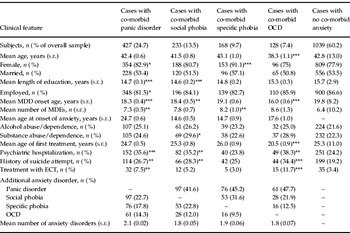
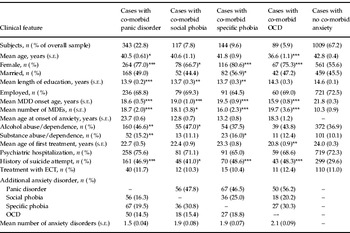
Several prominent similarities were present across the MDD and BP datasets. The MDD and BP samples were comparable in their average age at interview (42.6 years v. 42.0 years, p=0.11) and there were no statistically significant differences in the prevalence of panic disorder (p=0.21), specific phobia (p=0.89) or OCD (p=0.09). Social phobia, however, was found to be more common in the MDD sample (13.5% v. 7.8%, p<0.0001). Further demographic and clinical characteristics are shown in Tables 1 and 2 for the MDD and BP samples, where subjects with one of four co-morbid anxiety disorders were compared individually with subjects without any of the four disorders.
Clinical features of co-morbid anxiety disorders in the major depressive disorder sample

MDD, Major depressive disorder; OCD, obsessive-compulsive disorder; s.e., standard error; MDE, major depressive episode; ECT, electroconvulsive therapy.
* p<0.05, ** p<0.01, *** p<0.001 (comparisons between cases with a specific co-morbid anxiety disorder versus cases without any co-morbid anxiety disorder).
Clinical features of co-morbid anxiety disorders in the bipolar disorder sample

OCD, Obsessive-compulsive disorder; s.e., standard error; MDD, major depressive disorder; MDE, major depressive episode; ECT, electroconvulsive therapy.
* p<0.05, ** p<0.01, *** p<0.001 (comparisons between cases with a specific co-morbid anxiety disorder versus cases without any co-morbid anxiety disorder).
In the MDD sample there were relatively few demographic differences across the four groups. Subjects with any of the anxiety disorder diagnoses generally completed fewer years of education, though this difference was only statistically significant in cases with co-morbid panic disorder (p<0.0001). Clinical correlates were generally more severe in cases with a co-morbid anxiety disorder, with the exception of co-morbid specific phobia. Panic disorder, social phobia and OCD were associated with an earlier age at onset of depression, a greater prevalence of hospitalization, a greater likelihood of treatment with electroconvulsive therapy and an increased risk of suicide attempt (Table 1). Compared with the other anxiety disorders, co-morbidity with OCD was notable for an earlier age of first treatment (p<0.0001) and for an overall pattern of increased severity.
As shown in Table 2, anxiety disorder co-morbidity in BP had many similar phenotypic patterns. There were reductions in the years of education completed, which was most significant for those with panic co-morbidity (p<0.0001). Clinical correlates showed a similar pattern of earlier age of first depression, a substantially higher number of depressive episodes, and an increased risk of suicide attempt across all the anxiety disorders. As in the earlier MDD analysis, co-morbidity with OCD was generally associated with greater severity than co-morbidity with the other anxiety disorders. In the BP sample, co-morbid OCD was associated with the earliest age of onset for depressive episodes (p<0.0001), the earliest age of treatment (p=0.0031) and the highest number of depressive episodes (p<0.0001).
Familial aggregation
There were important similarities seen across the MDD and BP samples in the prevalence rates of each anxiety disorder and in the overall excess of each disorder seen in the relatives of probands with the same disorder (see raw numbers in Tables 3 and 4). When all four anxiety disorders were grouped and analysed together in a logistic regression with correction for age, sex and site of ascertainment, the presence of any anxiety disorder in a proband was associated with comparably higher odds of having any anxiety disorder in relatives in both the MDD [OR 1.77, 95% confidence interval (CI) 1.36–2.30, p<0.001] and BP samples (OR 1.71, 95% CI 1.22–2.37, p=0.002).
Familial aggregation of co-morbid anxiety disorders in the major depressive disorder sampleFootnote a

aOR, Adjusted odds ratio; CI, confidence interval; OCD, obsessive-compulsive disorder.
a All relatives with recurrent MDD diagnosis.
b Adjusted for age at interview, site of ascertainment, and sex.
c Adjusted for age at interview, site of ascertainment, sex, and additional anxiety disorder co-morbidity in relatives.
d Adjusted for age at interview, site of ascertainment, sex, and additional anxiety disorder co-morbidity in relatives and probands.
Familial aggregation of co-morbid anxiety disorders in the bipolar disorder sampleFootnote a

aOR, Adjusted odds ratio; CI, confidence interval; OCD, obsessive-compulsive disorder; BPI, bipolar I disorder; BPII, bipolar II disorder.
a All relatives with BPI or BPII diagnoses.
b Adjusted for age at interview, site of ascertainment, and sex.
c Adjusted for age at interview, site of ascertainment, sex, and additional anxiety disorder co-morbidity in relatives.
d Adjusted for age at interview, site of ascertainment, sex, and additional anxiety disorder co-morbidity in relatives and probands.
Analyses of specific anxiety disorders showed that panic disorder, specific phobia and OCD, but not social phobia, were familial in the MDD sample (Table 3). Familial aggregation of the three anxiety disorders remained statistically significant after controlling for additional anxiety disorders in relatives (aOR2) and for additional anxiety disorder co-morbidity in both relatives and probands (aOR3). Similar effect sizes were seen in OCD (aOR3 2.60, 95% CI 1.29–5.24, p=0.008), specific phobia (aOR3 2.43, 95% CI 1.35–4.38, p=0.003) and panic disorder (aOR3 1.98, 95% CI 1.40–2.78, p<0.001).
The primary analysis of the BP sample included cases and first-degree relatives with BPI or BPII. Familial aggregation was seen for OCD, panic disorder and specific phobia when controlled for age, sex and site covariates (aOR1). After controlling for the additional anxiety diagnoses in the proband and relatives, familial aggregation remained significant, albeit with an attenuated effect, in OCD (aOR3 3.10, 95% CI 1.31–7.09, p=0.009) and panic disorder (aOR3 1.52, 95% CI 1.00–2.30, p=0.047), but not in specific phobia (aOR3 1.94, 95% CI 0.95–3.96, p=0.069). As in the MDD sample, we found no evidence for statistically significant familial aggregation of social phobia.
The BP sample also included an additional 1058 first-degree relatives without a BPI or BPII diagnosis. When familial aggregation of the co-morbid anxiety disorders was tested in these relatives (Supplementary Table S1, available online), similar levels of aggregation were found for OCD (aOR3 2.51, 95% CI 1.15–5.49, p=0.021) and panic disorder (aOR3 1.51, 95% CI 1.08–2.11, p=0.017) compared with the BP-only analysis. We again found no evidence of statistically significant familial aggregation of social phobia (aOR3 1.69, 95% CI 0.84–3.39, p=0.14). However, this analysis did find evidence for aggregation of specific phobia (aOR3 2.12, 95% CI 1.17–3.84, p=0.013), which differs from the primary analysis of BP cases although the effect sizes are similar and the confidence levels show significant overlap.
In further analyses testing differences in ORs between the two samples for each specific anxiety disorder, we found no evidence for statistically significant differences in familial aggregation across the MDD and BP samples.
Discussion
The primary aim of this study was to examine and compare the clinical correlates and familial aggregation of four co-morbid anxiety disorders in MDD and BP pedigrees. Consistent with prior studies, our findings show a strong association of co-morbid anxiety disorders with clinical markers of severity, including earlier age of onset, a greater number of depressive episodes and elevated rates of suicide attempt. In general, indices of clinical morbidity were most associated with co-morbid OCD and panic disorder, and least associated with co-morbid specific phobia. Our results also provide evidence for familial clustering of co-morbid anxiety syndromes when analysed as a group in both MDD and BP samples. In disorder-specific analyses, we found that OCD and panic disorder showed familial aggregation in both MDD and BP pedigrees, while social phobia was not found to be familial in either sample. Specific phobia was familial in MDD pedigrees and showed some evidence of familiality in BP, although findings were just short of statistical significance.
Familial aggregation does not distinguish between genetic or environmental causes; however, the prominent heritability of most psychiatric syndromes suggests that at least part of the familial aggregation seen in this study is likely to be genetic. Several types of segregation can lead to familial aggregation (Klein & Riso, Reference Klein, Riso and Costello1994), including co-segregation of the index and co-morbid phenotypes, segregation of a unitary phenotype with co-morbid features, and independent segregation of the two phenotypes. Since the samples used in this study were originally collected for genetic studies, which did not systematically ascertain all affected and unaffected relatives, our study is unable to distinguish among these segregation patterns. The BP sample did include additional first-degree relatives who were unaffected or affected with a non-BP diagnosis. An analysis of this larger sample showed very similar results, suggesting that the majority of the aggregation was driven by the co-morbidity between the anxiety disorders and the BP phenotype specifically.
In both the MDD and BP samples, OCD was found to be the most strongly familial co-morbid anxiety disorder and the most associated with clinical markers of severity. The familial relationship between mood disorders and OCD has been previously studied primarily from the side of OCD family studies. The largest of these studies has supported a familial relationship between OCD and MDD (Bienvenu et al. Reference Bienvenu, Samuels, Wuyek, Liang, Wang, Grados, Cullen, Riddle, Greenberg, Rasmussen, Fyer, Pinto, Rauch, Pauls, McCracken, Piacentini, Murphy, Knowles and Nestadt2011), though this was not found in prior studies with smaller sample sizes (Carter et al. Reference Carter, Pollock, Suvak and Pauls2004; Fyer et al. Reference Fyer, Lipsitz, Mannuzza, Aronowitz and Chapman2005). BP has generally been too rare to be studied in OCD family studies and even the largest of these has not been able to find evidence for a statistically significant familial association, despite BP being found to be twice as prevalent in OCD relatives compared with control relatives (OR 2.40, p=0.08) (Bienvenu et al. Reference Bienvenu, Samuels, Wuyek, Liang, Wang, Grados, Cullen, Riddle, Greenberg, Rasmussen, Fyer, Pinto, Rauch, Pauls, McCracken, Piacentini, Murphy, Knowles and Nestadt2011). Our current study, with much larger samples, found evidence for familial aggregation of a similar effect size, suggesting that the OCD studies have been underpowered to detect significant familiality for BP.
The familial aggregation of panic disorder with MDD or BP has been previously described in several studies (Leckman et al. Reference Leckman, Weissman, Merikangas, Pauls and Prusoff1983; Maier et al. Reference Maier, Minges and Lichtermann1995; MacKinnon et al. Reference MacKinnon, McMahon, Simpson, McInnis and DePaulo1997). Our study confirms these findings and provides additional evidence that the segregation of panic disorder in both MDD and BP pedigrees remain statistically significant when controlled for other co-morbid anxiety syndromes. The association effect size was slightly greater in MDD (OR 1.98) than in BP (OR 1.52), but these differences were not statistically significant.
The familial aggregation of specific phobia appeared to differ between MDD and BP. However, both the prevalence (9.9% in BP and 9.7% in MDD) and the evidence for aggregation in the first adjusted regression model (aOR1), which controls for age, sex and site differences, showed little differences across both samples (aOR1 2.93 in MDD v. 2.38 in BP). While the evidence for aggregation in MDD remained significant after being controlled for additional anxiety diagnoses in the relatives and probands, the findings in BP fell just short of statistical significance. Findings from twin studies suggest that the risk for specific phobias is due to both genetic and individual environmental risk factors, with the latter being the more prominent of the two (Hettema et al. Reference Hettema, Neale, Myers, Prescott and Kendler2006). If the distinct findings across the two samples represent a true difference, it may indicate that phobias are genetically more associated with MDD, and/or that subjects with MDD may potentially have a greater likelihood of experiencing environmental exposures associated with phobias. On the other hand, since the MDD sample is larger than the BP sample, the difference may be due to decreased statistical power in the BP sample, particularly given the overlapping CIs and the lack of statistical significance in the formal comparison between the two ORs.
Although relatives of probands with social phobia had modestly more elevated rates of social phobia compared with relatives of probands without social phobia, we found no evidence for statistically significant familial aggregation in either BP or MDD. In a large epidemiological twin study social phobia was found to be the least heritable of the anxiety disorders, with most of the susceptibility risk coming from individual environmental risk factors (Hettema et al. Reference Hettema, Prescott, Myers, Neale and Kendler2005). Our failure to detect familial aggregation suggests that these and other risk factors do not appear to be shared between first-degree relatives with mood disorders, although our samples are unlikely to be sufficiently powered to exclude a very modest degree of familial aggregation.
In examining the co-morbidity between mood and anxiety disorders, our study has used categorical diagnoses, which can be seen as complementary to dimensional models of co-morbidity that have been proposed by factor analytical and twin modeling studies (Krueger, Reference Krueger1999; Hettema et al. Reference Hettema, Neale, Myers, Prescott and Kendler2006). The familial patterns of mood and anxiety co-morbidity seen in this study provide some support for Krueger's model of ‘internalizing disorders’, where ‘anxious misery’ (in this study represented by mood disorder) and ‘fear’ subfactors (anxiety disorders) are partly correlated and partly distinct. Furthermore, the similar patterns of familiality across our BP and MDD samples suggest that co-morbidity with the internalizing disorders may not distinguish between the two as has been recently proposed (Goldberg et al. Reference Goldberg, Andrews and Hobbs2009).
Familiality between mood and anxiety disorders may be mediated by personality traits such as neuroticism, which are heritable and strongly associated with many internalizing disorders (Bienvenu et al. Reference Bienvenu, Samuels, Costa, Reti, Eaton and Nestadt2004). Subjects with MDD or BP have been found to have higher levels of neuroticism compared with normal controls (Jylha et al. Reference Jylha, Mantere, Melartin, Suominen, Vuorilehto, Arvilommi, Leppamaki, Valtonen, Rytsala and Isometsa2010; Barnett et al. Reference Barnett, Huang, Perlis, Young, Rosenbaum, Nierenberg, Sachs, Nimgaonkar, Miklowitz and Smoller2011). This could account for some of the familiality seen in this study since neuroticism may partially mediate the development of co-morbid anxiety disorders (Hettema et al. Reference Hettema, Neale, Myers, Prescott and Kendler2006). Unfortunately, we were not able to test this hypothesis since personality measures were not available for most participants.
This study has several strengths. It comprises one of the largest collected samples of MDD and BP pedigrees and has the benefit of a well-characterized and reliable diagnostic instrument used by trained researchers with a clinical background. The large sample size has also allowed us to isolate the effect of specific anxiety disorders rather than having to consider them as a cluster. The MDD and BP samples used identical diagnostic and best-estimate procedures, providing the methodological consistency to compare familiality across the disorders. Diagnoses were made by at least two experienced research psychiatrists or psychologists, which provided the clinical expertise necessary to help distinguish among the various anxiety disorders that often overlap in symptoms.
Our results must be viewed in light of several important limitations. The sample consists of familial cases of BP and MDD, which may limit the generalizability of our results to community samples, since familial cases may be more co-morbid (Verhagen et al. Reference Verhagen, van der Meij, Franke, Vollebergh, de Graaf, Buitelaar and Janzing2008). However, the overall co-morbidity prevalence rates in our study are broadly consistent with those from epidemiological samples (Regier et al. Reference Regier, Rae, Narrow, Kaelber and Schatzberg1998; Merikangas et al. Reference Merikangas, Akiskal, Angst, Greenberg, Hirschfeld, Petukhova and Kessler2007). Our findings are also likely to be representative of cases that seek treatment since this population has been found to have high rates of familiality. Large naturalistic treatment studies of both MDD (Nierenberg et al. Reference Nierenberg, Trivedi, Fava, Biggs, Shores-Wilson, Wisniewski, Balasubramani and Rush2007) and BP (Post et al. Reference Post, Denicoff, Leverich, Altshuler, Frye, Suppes, Rush, Keck, McElroy, Luckenbaugh, Pollio, Kupka and Nolen2003), for example, have found that over half of all patients have a family history of mood disorder.
A further limitation is that ascertainment of the sample was opportunistic and focused preferentially on collecting affected relatives. For the purposes of investigating the nature of co-morbidity, a more informative family study would have included probands with ‘pure’ anxiety and would have ascertained all available family members (Wickramaratne & Weissman, Reference Wickramaratne and Weissman1993). The initial collection of the BP sample included relatives without mood disorders, but the ascertainment was not systematic and focused mostly on affected family members.
The interviews of family members were not conducted blind to the proband diagnosis, which may have biased the assessment. While the use of the DIGS as a diagnostic instrument in a strength of the study in both samples, the DIGS does not include structured questions to diagnose generalized anxiety disorder and post-traumatic stress disorder, and does not provide sufficient information to help distinguish subtypes of anxiety disorders such as generalized versus specific social phobia. Finally, as with most family studies, our diagnoses were based on a retrospective history of mood and anxiety diagnoses, whereas a prospective study would not be affected by the potential for recall bias.
In conclusion, co-morbid anxiety syndromes are common in MDD and BP families. Familial aggregation was seen with panic disorder and OCD in both MDD and BP pedigrees, while familiality of specific phobia was statistically significant only in MDD families. OCD co-morbidity with BP and MDD was found to be most strongly associated with clinical characteristics of illness severity and was found to have the strongest degree of familiality.
Note
Supplementary material accompanies this paper on the Journal's website (http://journals.cambridge.org/psm).
Acknowledgements
Data and biomaterials for the Major Depressive Disorder sample were collected in six projects that participated in the NIMH GenRED project.
From 1999 to 2003, the principal investigators and co-investigators were: New York State Psychiatric Institute, New York, NY, R01 MH060912: Myrna M. Weissman, Ph.D. and James K. Knowles, M.D., Ph.D.; University of Pittsburgh, Pittsburgh, PA, R01 MH060866: George S. Zubenko, M.D., Ph.D. and Wendy N. Zubenko, Ed.D., R.N., C.S.; Johns Hopkins University, Baltimore, R01 MH059552: J. Raymond DePaulo, M.D., Melvin G. McInnis, M.D. and Dean MacKinnon, M.D.; University of Pennsylvania, Philadelphia, PA, R01 MH61686: Douglas F. Levinson, M.D. (GenRED coordinator), Madeleine M. Gladis, Ph.D., Kathleen Murphy-Eberenz, Ph.D. and Peter Holmans, Ph.D. (University of Wales College of Medicine); University of Iowa, Iowa City, IW, R01 MH059542: Raymond R. Crowe, M.D. and William H. Coryell, M.D.; Rush University Medical Center, Chicago, IL, R01 MH059541-05: William A. Scheftner, M.D. Rush-Presbyterian. Data for the BP samples were collected as part of 10 projects that participated in the NIMH Bipolar Disorder Genetics Initiative.
From 1991 to 1998, the principal investigators and co-investigators were: Indiana University, Indianapolis, IN, U01 MH46282: John Nurnberger, M.D., Ph.D., Marvin Miller, M.D. and Elizabeth Bowman, M.D.; Washington University, St Louis, MO, U01 MH46280: Theodore Reich, M.D., Allison Goate, Ph.D. and John Rice, Ph.D.; Johns Hopkins University, Baltimore, MD U01 MH46274: J. Raymond DePaulo Jr. M.D., Sylvia Simpson, M.D., M.P.H. and Colin Stine, Ph.D.; NIMH Intramural Research Program, Clinical Neurogenetics Branch, Bethesda, MD: Elliot Gershon, M.D., Diane Kazuba, B.A. and Elizabeth Maxwell, M.S.W.
From 1999 to 2003, the principal investigators and co-investigators were: Indiana University, Indianapolis, IN, R01 MH59545: John Nurnberger, M.D., Ph.D., Marvin J. Miller, M.D., Elizabeth S. Bowman, M.D., N. Leela Rau, M.D., P. Ryan Moe, M.D., Nalini Samavedy, M.D., Rif El-Mallakh, M.D. (at University of Louisville), Husseini Manji, M.D. (at Wayne State University), Debra A. Glitz, M.D. (at Wayne State University), Eric T. Meyer, M.S., Carrie Smiley, R.N., Tatiana Foroud, Ph.D., Leah Flury, M.S., Danielle M. Dick, Ph.D. and Howard Edenberg, Ph.D.; Washington University, St Louis, MO, R01 MH059534: John Rice, Ph.D., Theodore Reich, M.D., Allison Goate, Ph.D. and Laura Bierut, M.D.; Johns Hopkins University, Baltimore, MD, R01 MH59533: Melvin McInnis, M.D., J. Raymond DePaulo Jr. M.D., Dean F. MacKinnon, M.D., Francis M. Mondimore, M.D., James B. Potash, M.D., Peter P. Zandi, Ph.D., Dimitrios Avramopoulos and Jennifer Payne; University of Pennsylvania, PA, R01 MH59553: Wade Berrettini, M.D., Ph.D.; University of California at Irvine, CA, R01 MH60068: William Byerley, M.D. and Mark Vawter, M.D.; University of Iowa, IA, R01 MH059548: William Coryell, M.D. and Raymond Crowe, M.D.; University of Chicago, Chicago, IL, R01 MH59535: Elliot Gershon, M.D., Judith Badner, Ph.D., Francis McMahon, M.D., Chunyu Liu, Ph.D., Alan Sanders, M.D., Maria Caserta, Steven Dinwiddie, M.D., Tu Nguyen and Donna Harakal; University of California at San Diego, CA, R01 MH59567: John Kelsoe, M.D. and Rebecca McKinney, BA; Rush University, IL, R01 MH059556: William Scheftner, M.D., Howard M. Kravitz, D.O., M.P.H., Diana Marta, B.A., Annette Vaughn-Brown, M.S.N., R.N. and Laurie Bederow, M.A.; NIMH Intramural Research Program, Bethesda, MD, 1Z01MH002810-01: Francis J. McMahon, M.D., Layla Kassem, Psy.D., Sevilla Detera-Wadleigh, Ph.D., Lisa Austin, Ph.D. and Dennis L. Murphy, M.D.
F.S.G. was supported by K99MH86049 and J.B.P. by Arlene and Robert Kogod. The authors express their profound appreciation to the families who participated in this project, and to the many clinicians who facilitated the referral of participants to the study.
Declaration of Interest
None.