Total anomalous pulmonary venous connection constitutes between 1 and 1.5% of all children with CHD. Early case series have reported surgical mortality in the range of 13–25%.Reference Kanter 1 More recent series, however, report mortality consistently <10%, even in the face of obstructed total anomalous pulmonary venous connection.
Total anomalous pulmonary venous connection can be classified by the route of anomalous pulmonary venous drainage into the systemic circulation. The supracardiac type (45%) occurs when the pulmonary veins ultimately drain back to the heart through the superior caval vein, oftentimes via an ascending vertical vein to the innominate vein. The cardiac type (25%) occurs when the pulmonary veins drain directly back into one of the two atria, oftentimes via the coronary sinus to the right atrium. The infracardiac type (25%) occurs when the pulmonary veins ultimately drain back to the heart through the inferior caval vein, oftentimes via a descending vertical vein to the portal vein. The mixed-type (5%) occurs when there is a combination of separate supracardiac, cardiac, and infracardiac drainage patterns.Reference Darling, Rothney and Craig 2
At present, there are no reports in the literature focussing exclusively on patients with mixed-type total anomalous pulmonary venous connection, who seem to be the most problematic subgroup. We aimed to describe a cohort of patients with mixed-type anomalous drainage, highlighting the treatment challenges and identifying risk factors for poor outcome.
Methods
We reviewed the clinical records of patients who underwent repair for mixed-type total anomalous pulmonary venous return between 1986 and 2015. Patient characteristics and pre-procedural factors included weight and age, co-morbidities, pulmonary venous anatomy, and era. Pulmonary venous anatomy was described as supracardiac, cardiac, or infracardiac, depending on the location of the persistent connection that allowed for pulmonary venous drainage. Co-morbidities included chromosomal abnormality, failure to thrive, developmental delay, gastro-oesophageal disease, mechanical ventilation, arrhythmias, and heterotaxy syndrome. Operative details included emergency status, which is defined as haemodynamic instability requiring surgical intervention within 24 hours of admission, concomitant procedures, use of circulatory arrest, and cardiopulmonary bypass duration. Outcome data included duration of intubation, lengths of ICU and hospital stay, and surgical and 1-year mortality. Surgical mortality was defined as a death within 30 days or within the initial hospital stay, and 1-year mortality was defined as a death within 1 year following surgery.
Univariable analysis was performed to assess risk factors for surgical and 1-year mortality. A Mann–Whitney test was used for continuous variables, and a χ2-test was used for categorical variables. Multivariable logistic regression analyses were attempted for risk factors with a p-value ⩽0.1, but numbers were insufficient. Statistical analyses were performed using Medcalc software (Version 13.1.1.0, Mariakerke, Belgium). Institutional Review Board approval was obtained to perform this retrospective study, and individual patient consent was waived.
Results
Patient characteristics and pre-procedural factors
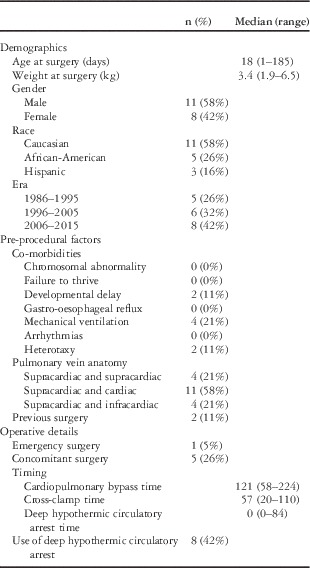
A total of 19 patients were identified. The median age and weight at surgery were 18 days (with a range from 1 to 185) and 3.4 kg (with a range from 1.9 to 6.5), respectively. Venous anatomy included a combination of separate supracardiac (four), supracardiac and cardiac (11), and supracardiac and infracardiac (four) drainage. Preoperative co-morbidities were uncommon: failure to thrive (two), heterotaxy syndrome (two), and mechanical ventilation (four) (Table 1).
Patient characteristics (n=19).

Operative details
Only one patient required emergency surgery for haemodynamic instability within 24 hours of admission. The median cardiopulmonary bypass and cross-clamp times were 121 minutes (with a range from 58 to 224) and 57 minutes (20–110), respectively. A period of circulatory arrest was utilised in eight patients (Table 1).
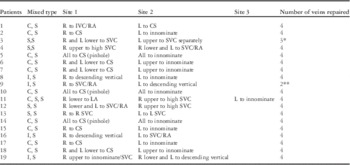
The exact pulmonary venous drainage patterns found at the time of surgery are described in Table 2, as well as the number pulmonary veins incorporated into the repair. Almost all patients (17/19) underwent complete correction of the anomalous pulmonary venous drainage.
Pulmonary venous drainage patterns.

C=cardiac; I=infracardiac; IVC=inferior caval vein; LA=left atrium; RA=right atrium; S=supracardiac; SVC=superior caval vein
* Left upper pulmonary vein not incorporated into repair
** Heterotaxy with unbalanced atrioventricular canal; right veins not incorporated into repair
Atrial septal defect closure was performed in all patients, and five patients underwent additional concomitant procedures: repair of anomalous systemic venous drainage (one), coarctation repair (one), tetralogy of Fallot repair (one), bilateral bidirectional Glenn (one), and cor triatriatum resection (one).
Both patients in our series with heterotaxy syndrome had unbalanced complete atrioventricular canal defects. In one patient, the right pulmonary veins drained to the superior caval vein/right atrial junction, and the left pulmonary veins drained to a descending vertical vein. She underwent isolated left-sided vein repair in the newborn period and accounted for one of the surgical mortalities. In the other patient, the right pulmonary veins drained into a right superior caval vein, and the left pulmonary veins drained into a left superior caval vein. This patient did not require first-stage palliation, and complete repair of the anomalous pulmonary venous drainage was undertaken at the time of bilateral bidirectional cavopulmonary connection; he has survived long term after surgery.
Outcomes
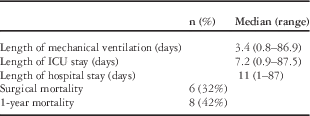
The median duration of intubation was 3.3 days (with a range from 0.8 to 86.9). The median duration of ICU stay was 7.2 days (with a range from 0.9 to 87.5). The median hospital stay was 11 days (with a range from 0.9 to 87.5) (Table 3).
Outcomes.

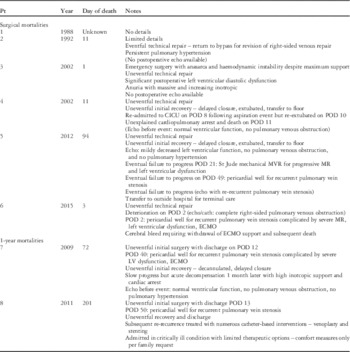
Out of 19 patients, six (32%) died within 30 days or the initial hospital stay; two surgical survivors underwent subsequent operative revision and died from progressive pulmonary vein stenosis at 72 and 201 days, respectively, resulting in 42% mortality within the 1st year (Table 3). A detailed description of the mortalities is provided in Table 4. Follow-up data were available for 8/11 long-term survivors. The median follow-up period was 7.3 years (with a range from 1.8 to 15.7). Only one patient is suffering from recurrent pulmonary vein stenosis.
Mortality description.

CICU=cardiac intensive care unit; CPB=cardiopulmonary bypass; ECMO=extracorporeal membrane oxygenation; MR=mitral regurgitation; MVR=mitral valve replacement; POD=postoperative day
Risk factors
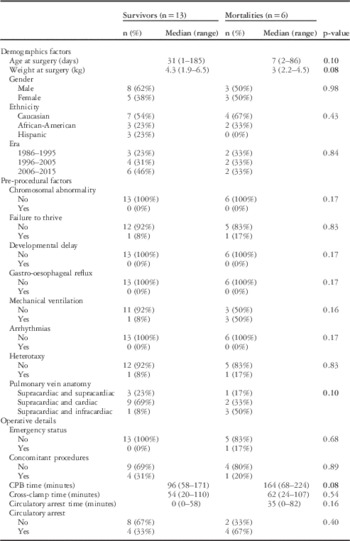
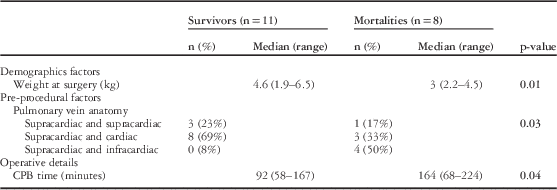
For surgical mortality, no statistically significant risk factors were identified, although the risk trended to be higher (p⩽0.1) with lower age (p=0.10) and weight (p=0.08), an infracardiac component (p=0.10), and prolonged cardiopulmonary bypass (p=0.08) (Table 5). For 1-year mortality, a similar risk analysis was performed. The risk became significant (p⩽0.05) with lower weight (p=0.01), an infracardiac component (p=0.03), and prolonged cardiopulmonary bypass (p=0.04). All other factors remained statistically insignificant (Table 6).
Risk factors for surgical mortality.

CPB=cardiopulmonary bypass Bold values indicate those that reached statistical significance
Significant risk factors for one-year mortalityFootnote *.

CPB=cardiopulmonary bypass
* All other demographic, pre-procedural, and operative risk factors remained insignificantBold values indicate those that reached statistical significance
Discussion
In this series, patients with mixed-type total anomalous pulmonary venous return had high surgical (32%) and 1-year mortality (42%); however, the acceptable status of the survivors has encouraged us to continue to treat this challenging group of patients surgically.
Demographics
In several previous reports looking at total anomalous pulmonary venous connection across all types, lower age and weight were shown to be significant risk factors for mortality. Karaci et al showed a significant age difference (19.3 versus 5.5 months, p<0.01) and weight difference (12.5 versus 4.8 kg, p<0.01) between survivors and non-survivors, respectively, and Padalino et al showed that weight <3 kg was associated with surgical mortality (OR 5.9, p=0.007).Reference Karaci, Harmander and Aydemir 3 , Reference Padalino, Cavalli and De Franceschi 4 Yong et alReference Yong, d’Udekem and Robertson 5 showed that weight ⩽2.5 kg was not associated with surgical mortality, but was associated with late mortality (OR 30.2, p=0.007). Similar to these reports, in our series of isolated-to-mixed-type drainage patterns, lower age and weight trended towards statistical significance for surgical mortality, and weight achieved significance for 1-year mortality. Comparing surgical survivors and non-survivors, median ages were 31 versus 7 days, and median weights were 4.3 versus 3 kg. Comparing 1-year survivors and non-survivors, median ages were 102 versus 7 days, and median weights were 4.6 versus 3.0 kg.
Pre-procedural factors
Non-cardiac medical co-morbidities were relatively uncommon. There was no incidence of chromosomal abnormalities, developmental delay, gastro-oesophageal reflux, or arrhythmias. Failure to thrive and heterotaxy syndrome were each found in two patients. Among all, four patients required mechanical ventilation at the time of surgery. Surprisingly, although three (75%) of the mechanically ventilated patients died, it did not achieve statistical significance as a risk factor for surgical mortality.
In several previous reports looking at total anomalous pulmonary venous connection across all types, the pattern of abnormal pulmonary venous drainage – supracardiac, cardiac, infracardiac, and mixed-type – was not associated with adverse outcome.Reference Karaci, Harmander and Aydemir 3 , Reference Padalino, Cavalli and De Franceschi 4 Specifically, Karaci et alReference Karaci, Harmander and Aydemir 3 reported the following mortalities with no differences between groups: supracardiac 9.8%, cardiac 5.6%, infracardiac 25%, and mixed 20%. In our series of isolated-to-mix-type drainage patterns, the surgical mortality was 32%, and the 1-year mortality was 42%, with an influence of drainage pattern on outcome. Within our mixed-type cohort, those with an infracardiac component fared the worst: three of the four patients (75%) died before discharge and all of them died (100%) before the first year of life. It may be that these patients were sicker preoperatively owing to the higher incidence of obstruction with infracardiac drainage patterns, or it may be that these were the most challenging to repair, leading to a more complicated operation, a prolonged cardiopulmonary bypass time, and an increased risk of subsequent pulmonary vein issues. It is challenging to delineate some of these factors with such small patient numbers.
Operative details
In reports looking at total anomalous pulmonary venous connection across all types, the outcomes of patients requiring emergent surgical repair are poor. HoashiReference Hoashi, Kagisaki, Kurosaki, Kitano, Shiraishi and Ichikawa 6 reported a 21% surgical mortality in those patients operated within the 1st day of life, compared with 3% mortality in those operated on after the 1st day. Yong et alReference Yong, d’Udekem and Robertson 5 showed that emergent surgery, defined as life-saving surgery, was associated with significant mortality (OR 9.1, p=0.005).
Fortunately, in our series of isolated-to-mixed-type drainage patterns, only one patient required emergency surgery (infracardiac component, surgical mortality). The rarity of emergencies may be related to the preponderance of supracardiac and cardiac drainage patterns, which are less prone to obstruction. It may also be related to the mere presence of dual drainage pathways, such that as long as one of the pathways is unobstructed emergent operation may not be required. That being said, our group does believe that infracardiac pulmonary venous drainage is accompanied by some degree of obstruction; however, delaying surgery to better define the anatomy and to allow for multidisciplinary and family discussions may be beneficial if the clinical condition allows it. Only one patient with an infracardiac component, previously mentioned, underwent emergent surgery, whereas the other three patients with an infracardiac component underwent early surgery, but not emergent surgery.
In several previous reports looking at total anomalous pulmonary venous connection across all types, prolonged cardiopulmonary bypass was also shown to be a significant risk factor for mortality. Karaci et al. showed a significant cardiopulmonary bypass time difference (153 versus 201 minutes, p=0.04) between survivors and non-survivors, and Padalino et al showed that cardiopulmonary bypass time greater than 150 minutes was associated with surgical mortality (OR 2.0, p=0.008).Reference Karaci, Harmander and Aydemir 3 , Reference Padalino, Cavalli and De Franceschi 4
Similarly, in our series of isolated-to-mixed-type drainage patterns, prolonged cardiopulmonary bypass time trended towards statistical significance for surgical mortality and achieved significance for 1-year mortality. Comparing surgical survivors and non-survivors, median cardiopulmonary bypass times were 96 versus 164 minutes. Comparing 1-year survivors and non-survivors, median times were 92 versus 164 minutes. It may be that prolonged cardiopulmonary bypass time contributed to downstream sequelae that negatively impacted the postoperative course and outcome – that is, open chest, transfusion requirement, respiratory, and renal insufficiency, etc. Again, the exact nature of these sequelae is challenging to delineate with such small patient numbers.
Finally, decisions often need to be made intra-operatively regarding the technique of surgical repair. Oftentimes, all four anomalous pulmonary veins will be incorporated into the repair. Other times, when only three veins are creating a confluence and the fourth vein drains through a different pathway, the best course of action may be to leave the isolated vein draining into the systemic venous system.Reference Imoto, Kado, Asou, Shiokawa, Tominaga and Yasui 7 In our cohort, 17/19 patients underwent complete repair, incorporating all four veins. With a small patient cohort and a high incidence of complete repair, it is difficult to determine whether a more judicious approach would have been beneficial in some instances.
Limitations
As mentioned throughout, limitations to the analysis exist. First, the study is subject to the usual limitations of a retrospective review. In addition, despite a 30-year review, mixed-type total anomalous pulmonary venous connection is uncommon, making the cohort quite small. This prohibits certain analyses, and affects the ability to draw major conclusions from this small population of patients.
Conclusions
In conclusion, the surgical and 1-year mortality in patients with mixed-type total anomalous pulmonary venous connection is high. Lower age and weight, an infracardiac component, and prolonged cardiopulmonary bypass are associated with mortality. For patients who survive past the 1st year, most have good outcomes without subsequent sequelae. These data may prove useful for risk stratification and patient counselling.
Acknowledgements
None.
Financial Support
This research received no specific grant from any funding agency or from commercial or not-for-profit sectors.
Conflicts of Interest
None.
Ethical Standards
Institutional Review Board approval was obtained to perform this retrospective study, and individual patient consent was waived.