

Over recent years there has been a strong focus on understanding and enhancing the strengths and capacities of people who have an intellectual disability, with a particular focus on self-determination and positive outcomes for people with disabilities (Shogren, Wehmeyer, Buchanan, & Lopez, Reference Shogren, Wehmeyer, Buchanan and Lopez2006). The construct of self-determination has been interpreted in a variety of ways (Karvonen, Test, Wood, Browder, & Algozzine, Reference Karvonen, Test, Wood, Browder and Algozzine2004; Ward, Reference Ward2005), but generally emphasises the value of individuals with a disability directing their own lives (Bambara, Browder, & Koger, Reference Bambara, Browder, Koger, Snell and Brown2006).
Wehmeyer (Reference Wehmeyer2005) has written prolifically on the topic of self-determinism and proposed the following definition, which we have used to inform the framework for this study: ‘Self-determined behavior refers to volitional actions that enable one to act as the primary causal agent in one's life and to maintain or improve one's quality of life’ (p. 117). This implies that self-determination involves conscious choice and intent, as well as self-influence, to achieve a desired result. Prior studies have indicated that
‘promoting and enhancing self-determination contributes to more positive educational and adult outcomes for students with disabilities and . . . there are viable strategies that result in enhanced self-determination’ (Wehmeyer, Field, Doren, Jones, & Mason, Reference Wehmeyer, Field, Doren, Jones and Mason2004, p. 422). Further, Ward (Reference Ward2005) suggested that self-determined students are more likely to live outside their family home, experience greater independence, and work at a job that has better pay and benefits.
Teachers who work with students who have severe to profound intellectual impairment often believe that it is too difficult to focus on skills and knowledge for self-determination for these students (Ward, Reference Ward2005). However, Wehmeyer argued that ‘there are portions of even complex tasks such as decision-making or problem-solving in which students with severe disabilities can participate, thus making them more self-determined’ (Wehmeyer, Reference Wehmeyer2002, p. 3) and noted that ‘small or large, self-determined actions contribute to one's quality of life’ (Wehmeyer, Reference Wehmeyer2005, p. 117).
As such, teachers of this population need to be encouraged to engage in curriculum and pedagogy that supports the development of self-determined behaviour. Providing teachers with resources and education in curriculum and pedagogical strategies to support self-determined behaviour is likely to be important in helping young people to achieve greater independence in their adult life (Test, Browder, Karvonen, Wood, & Algozzine, Reference Test, Browder, Karvonen, Wood and Algozzine2002). Teachers need to teach the skills and knowledge necessary for self-determination and provide ‘activities that optimally challenge the student and promote autonomy by supporting student initiation of activities and allowing choice’ (Wehmeyer & Schwartz, Reference Wehmeyer and Schwartz1997, p. 254).
There are few reports to inform teachers about the ways to implement curriculum that focus on developing student self-determination (Karvonen et al., Reference Karvonen, Test, Wood, Browder and Algozzine2004). Algozzine, Browder, Karvonen, Test, and Wood (Reference Algozzine, Browder, Karvonen, Test and Wood2001) conducted a meta-analysis of 51 studies to identify the effectiveness of self-determination interventions for people with disabilities. They reported that ‘the emerging literature provides an important foundation for promoting self-determination for students with disabilities in current school contexts’ (p. 269). The researchers proposed that more research is needed to explore the ways self-determination can be taught.
In Queensland, Australia, children who have an intellectual disability may receive their education in a segregated special school for children who have a disability or in a special education unit or class that is on the campus of a primary or secondary school. Students who attend a special school have significant intellectual disability and/or multiple disabilities, and usually require specialist teaching and therapy services that support an individualised education program. Students who attend a more inclusive setting in a special education unit in a primary or secondary school may have a range of disabilities, and usually access the mainstream curriculum and receive specialist teaching and therapy services. Where possible, students participate in the school curriculum at the primary or secondary school with support (if necessary) and also have individualised programs. The choice of placement options for students with disabilities can be influenced by a range of factors, such as parent choice and education options available in the local area. More recently, in both special schools and special education classes in Queensland, there has been a greater emphasis on teaching goals that will lead to independent living and employment for adolescents who have an intellectual disability (Carrington & Lennox, Reference Carrington and Lennox2008).
The traditional special education curriculum incorporates skills in choice-making, problem-solving, goal-setting, self-management, and self-awareness (Giangreco, Reference Giangreco, Snell and Brown2006), as well as skills such as dressing, preparation of meals, housekeeping, telephone use, keeping safe, shopping, community leisure, banking, mobility, and transition to employment (Bambara et al., Reference Bambara, Browder, Koger, Snell and Brown2006), particularly for adolescents who have a mild to moderate intellectual disability. In a recent review of evidence-based transition practices (Test et al., Reference Test, Fowler, Richter, White, Mazzotti, Walker, Kohler and Kortering2009), curriculum included employment and life skills, job-related skills, self-advocacy, functional reading of sight words, functional numeracy, food preparation/shopping/cooking, and many other life skills. However, there is no mention of curriculum addressing health and wellbeing, suggesting that these young people are not learning about their bodies, how to lead a healthy lifestyle or how to access health care. Knowledge and skills about health and wellbeing may help young people who have an intellectual disability achieve greater autonomy in making appointments, communicating with doctors, and managing their health records and documents.
In our experience, there are limited curriculum resources and expertise in teaching self-determination about health and wellbeing in Queensland. This is of particular concern because people who have an intellectual disability have been shown to experience poorer health and health care than the general population (Krahn, Hammond, & Turner, Reference Krahn, Hammond and Turner2006; Lennox, Beange, & Edwards, Reference Lennox, Beange and Edwards2000; Ouellette-Kuntz, Reference Ouellette-Kuntz2005). People with an intellectual disability have been found to experience high levels of comorbidity (Beange, McElduff, & Baker, Reference Beange, McElduff and Baker1995; Straetmans, van Schrojenstein Lantman-de Valk, Schellevis, & Dinant, Reference Straetmans, van Schrojenstein Lantman-de Valk, Schellevis and Dinant2007), lower levels of health screening (Lennox, Diggens, & Ugoni, Reference Lennox, Diggens and Ugoni2000; Reynolds, Stanistreet, & Elton, Reference Reynolds, Stanistreet and Elton2008), have higher levels of unmet health needs (Ackland & Wade, Reference Ackland and Wade1995; Baxter et al., Reference Baxter, Lowe, Houston, Jones, Felce and Kerr2006; Cooper et al., Reference Cooper, Morrison, Melville, Finlayson, Allan, Martin and Robinson2006; Lennox et al., Reference Lennox, Bain, Rey-Conde, Purdie, Bush and Pandeya2007) and have a lower life expectancy (Bittles et al., Reference Bittles, Petterson, Sullivan, Hussain, Glasson and Montgomery2002).
Research on barriers to health care for people with an intellectual disability has provided evidence that the communication difficulties they experience make medical assessment and management problematic (Lennox, Diggens, & Ugoni, Reference Lennox, Diggens and Ugoni1997; Millar, Chorlton, & Lennox, Reference Millar, Chorlton and Lennox2004; Wullink, Veldhuijzen, van Schrojenstein Lantman-de Valk, Metsemakers, & Dinant, Reference Wullink, Veldhuijzen, van Schrojenstein Lantman-de Valk, Metsemakers and Dinant2009; Ziviani, Lennox, Allison, Lyons, & Del Mar, Reference Ziviani, Lennox, Allison, Lyons and Del Mar2004). Improved health advocacy may be one way to diminish this barrier and ultimately improve the health of people with an intellectual disability.
The focus of this paper is on the use and outcomes of using a resource, the Ask Health Diary, for teaching self-determination for better health and wellbeing to adolescents who have an intellectual disability.
The Ask Health Diary. The material in the Ask (Advocacy Skills Kit) Health Diary was initially designed to enhance communication and advocacy between the adult patient and their doctor, and was trialled prior to its minor adaptation for adolescent students (Lennox et al., Reference Lennox, Taylor, Rey-Conde, Bain, Boyle and Purdie2004). The diary is a B5-sized folder of materials with a sturdy velcro-bound folder. It is divided into four major sections: (a) All About Me, (b) Health Advocacy Tips, (c) For the Doctor, and (d) Medical Records.
(a) All About Me contains a record of personal details about the patient, including means of communication, previous residences, weekly activities, names and contact details for family members or support organisations and contact details for health practitioners.
(b) Health Advocacy Tips provides information on advocacy and the ways to prepare for an appointment with the doctor. This section includes picture symbols with line drawings of male and female bodies, as well as recording sheets for observations with regard to pain, menstruation, bowels, bladder, and epilepsy.
(c) For the Doctor provides ideas for clinical staff about the ways to work with people with an intellectual disability, as well as information on enhanced primary care initiatives and checklists of health problems associated with specific syndromes such as Down syndrome.
(d) Medical Records is for the doctor. It provides records of diagnoses, operations, medications, immunisations, allergies, family history of disease and medical consultations.
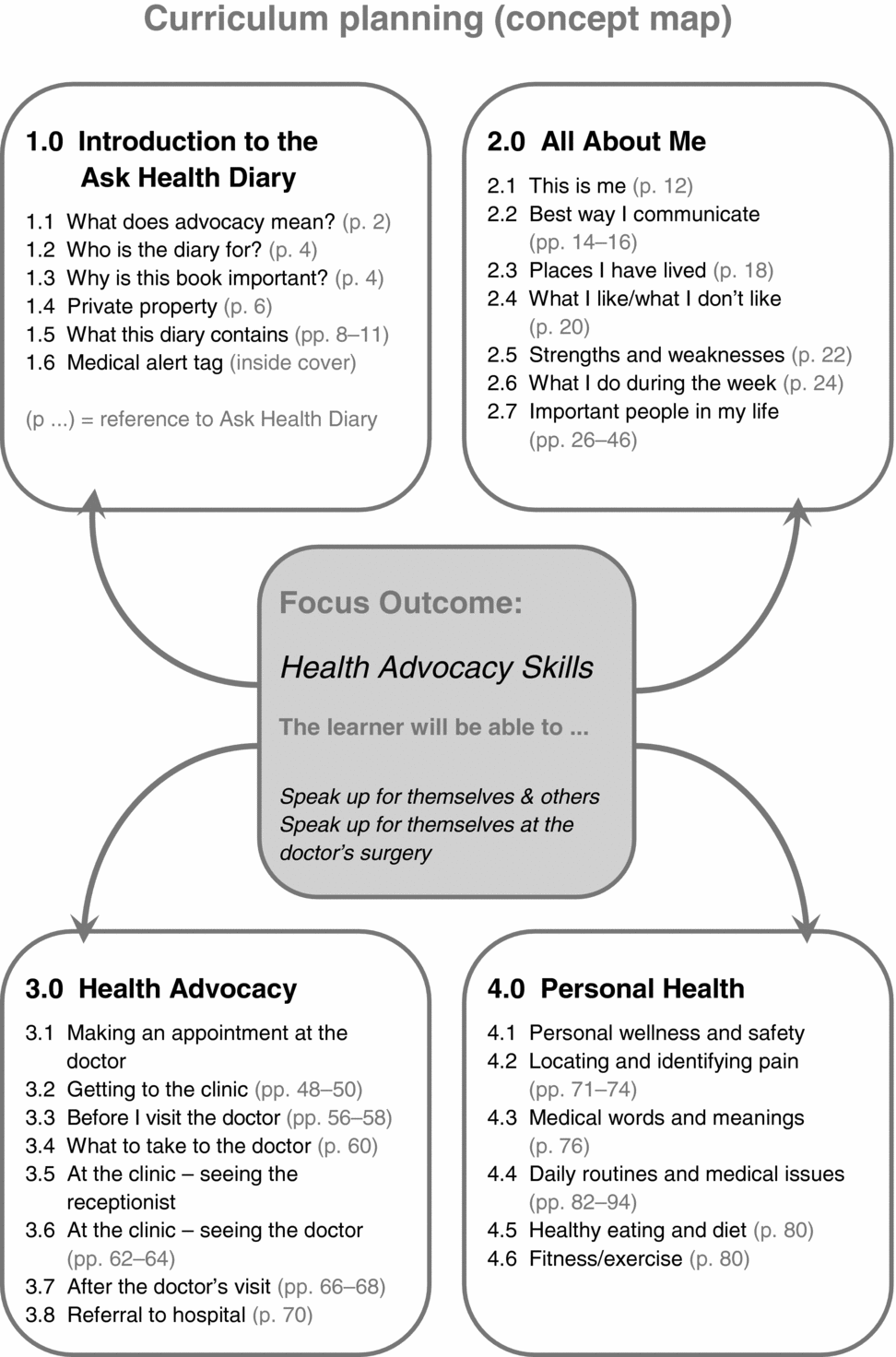
In the classroom, the diary can be used in a number of ways. If the students are able, they can write in personal details and use the diary as a tool to support their own advocacy for health-related matters. A Curriculum Strategy Booklet that outlines lesson plans and resources for teaching the Ask Health Diary curriculum was developed in the pilot study for the project (Carrington & Lennox, Reference Carrington and Lennox2008). This booklet provides aims and suggestions for teaching activities to support each section of the diary. The Curriculum Planning concept map provides an overview of the lesson plans to support the Ask Health Diary (see Figure 1).
Curriculum Planning (Concept Map).

We were interested in two questions. First, ‘How did the teachers use the Ask Health Diary to promote self-determination in health?’, and second, ‘How did teachers, parents/carers and students perceive the benefits and value of the Ask Health Diary?’
Method
Research Design
The data reported in this paper are from a larger dataset from a randomised controlled trial that was conducted in southern Queensland, Australia, to evaluate the effectiveness of a combined education and health intervention package for adolescents with an intellectual disability. This intervention package consisted of:
1. An education component — the Ask Health Diary used by the adolescent to collect personal health information and learn self-advocacy skills. The Ask Health Diary curriculum component involves interactions between the young person and their teacher in the classroom, and also between the adolescent, parent/carer and general practitioner (GP) at the clinic.
2. A health component — a comprehensive health review (the Comprehensive Health Assessment Program or CHAP) performed on the adolescent by her or his GP.
The Ask Health Diary project aimed to determine whether or not (a) adolescents with an intellectual disability using this package receive better health care (e.g., health screening) and improved health outcomes; (b) using this package improves health advocacy by adolescents with an intellectual disability and their parents in the context of visits to the GP; and (c) this package is acceptable to adolescents with an intellectual disability, their families, their teachers, and their GPs.
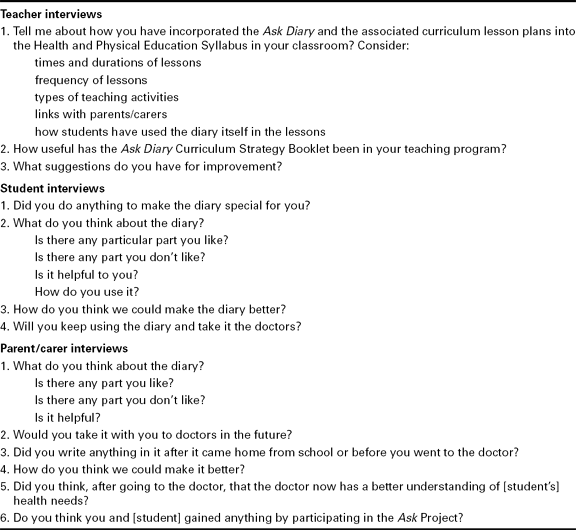
The data reported in this paper results from interviews with the students, their teachers and their parents/carers (see Table 1) and the qualitative data gathered from a questionnaire for teachers (see Appendix). The research design uses a theoretical perspective of social constructivism with interpretivism, also known as a naturalistic inquiry approach (Lincoln & Guba, Reference Lincoln and Guba1985). Social constructivism is a view that all knowledge, and therefore all meaningful reality, is contingent upon human practices being constructed in and out of interaction between human beings and their world, and developed and transmitted within an essentially social context (Crotty, Reference Crotty1998). As a theoretical perspective, social constructivism focuses on the meanings interpreted and recognised by participants in a study, particularly the views, feelings and perspectives of the individuals rather than the gathering of indisputable facts. This research sought to investigate the reactions and opinions of students, teachers and parents/carers by listening to their views regarding their experience with the Ask Health Diary.
Interview Questions
Ethics approval was granted by both the University of Queensland and the Queensland Government Department of Education and the Arts.
Participants and Procedure
The trial took place in Queensland, Australia, between January 2006 and December 2011. Thirty-two special schools and 69 special education units in secondary schools were considered eligible for the Ask Health Diary study in the south-east Queensland area. Of these schools, 85 agreed to participate. At baseline, consent was given to participate in this study from 64 principals, 328 teachers, and 728 adolescents and their parents/carers. Teachers delivered the education component of the intervention as part of the school curriculum in the special schools and the special education units.
Participating schools were sent the Ask Health Diaries and Curriculum Strategy Booklets at the beginning of the 2007 school year in the hope that the program would be taught in the beginning of the year. Sufficient diaries were sent to schools so that all students in the class could be taught, not just consenting project participants. No face-to-face training was provided to teachers on the use of the materials, but the Curriculum Strategy Booklet provided an overview of suggested content for teaching (see Figure 1), with sequences of lesson plans that supported the content of the Ask Health Diary. The development of the Curriculum Strategy Booklet was based on seven teachers’ pilot work about including health, communication and self-advocacy in the curriculum (Carrington & Lennox, Reference Carrington and Lennox2008). Teachers were encouraged to modify the lessons and use the Ask Health Diary resource in ways that supported the individual learning needs of students in their classroom.
Qualitative interviews of educators and adolescents occurred after completion of the educational component of the intervention. A small sample of schools from the larger randomised control study was invited to participate in the interviews. Four special schools and four special education units were selected by location to enable the researcher to conduct the interviews at the eight school sites with reasonable travelling time. Teachers were invited to an interview if they had students in their classroom who could respond verbally to a sequence of interview questions. The students identified by the teachers became the students who participated in the student interviews. The teacher interviews were conducted in July 2007. The teachers were interviewed individually except for three teachers who were asked the same interview questions in a group interview. Two teachers were male and 14 were female, and they had a range of teaching experience of 3–25 years.
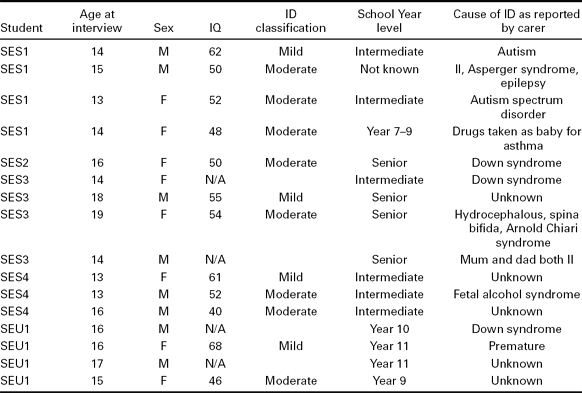
Parents/carers were then contacted to obtain consent for their adolescent and themselves to be interviewed. There were eight male and eight female students interviewed. All 16 students interviewed were in the intermediate or senior years at school. Parents/carers gave a variety of reasons for their children's disability (see Table 2). Only students who had verbal skills were interviewed.
Adolescents Who Were Interviewed
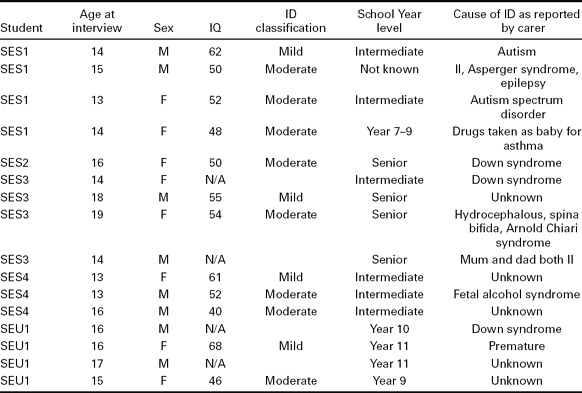
Note. SES = special school; SEU = special education unit; ID = intellectual disability; II = intellectual impairment.
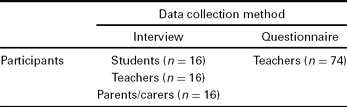
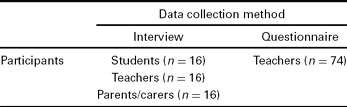
Twelve parents, two grandparents and two foster parents were interviewed by telephone. All had English as their first language and their ages ranged from 40 to 63 years. A questionnaire was sent in September 2007 to all teachers who were known to have taught the Ask Health Diary program in their classroom (n = 129). Seventy-four questionnaires were returned. Table 3 summarises the data collection process.
Summary of Participants and Data Collection
All schools reported difficulty in obtaining student consent. Only 26 teachers reported in the exit questionnaire that they began using the Ask Health Diary in Term 1. Thirty-four teachers indicated that they began using the diaries in Term 2. Others began even later in the year. Teachers also differed in the number of hours per week and the number of weeks in which the program was taught. Teachers were asked to send the Ask Health Diaries home with students once the unit of work had been completed at school to enable students to use the diaries during visits to their doctors. Most diaries were sent home from schools in the middle of 2007. However, some diaries were not sent home with students until later in the year.
Data Collection
Teacher Interviews
The primary focus in the teacher interviews was to understand how the Ask Health Diary had been used in the school curriculum and to explore the teachers’ perceptions about the benefits and value of using the Ask Health Diary in the curriculum. Interviews were conducted at each school in a convenient location and took approximately half an hour.
Student Interviews
The researcher who conducted the student interviews is an experienced special education teacher and researcher, and has worked with adolescents who have an intellectual disability. The semistructured interviews took place at each school in a quiet location where the students were comfortable. An interview schedule was used by the researcher (Richards & Morse, Reference Richards and Morse2007). Care was taken to develop rapport with each student, and visual prompts were utilised, such as displaying a copy of the Ask Health Diary. Interview times varied depending on the students’ abilities (4–13 minutes).
Parent/Carer Interviews
The parents/carers were asked about their views on the benefits of the diary and the ways it could be used when visiting the doctor. Only half of the parents/carers had seen the diary at the time of the interview, so interviews varied greatly in length from 6 to 30 minutes.
Questionnaire
Teachers were asked a number of questions to determine how often the diary was used in the classroom; difficulty or ease of use of the diary in the classroom; suggestions for improvement of the diary for use as a teaching tool; and whether or not using the diary in the classroom prompted the teachers to think differently about what the students could learn about health and self-advocacy. Seventy-four teachers returned the questionnaire (see Appendix).
Data Analysis
All the recorded interviews were transcribed and organised using NVivo software (Version 8; QSR International, 2008) to assist in the management of the large amount of data and investigation of the data from the various sources (Bazeley, Reference Bazeley1999). Responses to the open-ended questions in the exit questionnaire were exported from the Access database in which they had been entered and converted to a Word document, which was also imported into NVivo and coded using the Auto Code function. This process allowed the datasets to be integrated (Bazeley, Reference Bazeley1999).
These qualitative data were then organised and coded using content analysis into categories and subcategories (Graneheim & Lundman, Reference Graneheim and Lundman2004). The first author guided the fifth author in the development of categories and subcategories from the segments of the data, usually sentences and paragraphs, constantly checking the emergent understandings (Marshall & Rossman, Reference Marshall and Rossman1999). Once patterns of data in categories and subcategories emerged the coding was checked by a team of three researchers in the project who conducted independent checks of data coding to enhance reliability (the first, second and fifth authors). Further to this analysis, the categories and subcategories were reported to the larger research team of health and education researchers advising and working on the project for feedback.
Results
The source of the following quotes is indicated by a code, where (T) denotes a teacher, (S), a student, and (C), a parent/carer. Teacher quotes are further identified as coming from interview data (I) or questionnaire data (Q). This prefix is followed by the de-identified participant identification number (ID). Students and their parents/carers share the same ID (i.e., C10 would be the parent/carer of S10).
How did the Teachers use the Ask Health Diary to Promote Self-Determination in Health?
Teachers used the Ask Health Diary in a series of teaching and learning experiences in their classrooms. The way the diary was used in the curriculum was influenced by the abilities and needs of the students in each classroom. In the first section, All About Me, the student (if possible) filled out sections with practical details, such as names and addresses of all health professionals involved in their health care. One teacher commented, ‘students enjoyed filling in info[rmation], lots of discussion generated’ (TQ197). If students themselves were not able to fill in this section of the diary, they were supported by the teacher or teacher aide. Some students also role-played attending a medical consultation and practised what they would say to the doctor.
For the second section, Health Advocacy Tips, adolescents participated in lessons on tips for general good health. For example, adolescents were taught practical knowledge about the doctor's surgery, and skills in organisation before, during and after going to the doctor. Many teachers mentioned using this section and suggested that knowledge and skills about going to the doctor had not been previously addressed. The diary and the Curriculum Strategy Booklet provided a useful framework to plan the class lessons ‘because these students have not been taught in this area’ (TQ205). The Ask Health Diary provided a ‘framework in which to set meaningful role plays’ (TQ195) to enable the students to practise the skills of making appointments, communicating with the doctor and recording information about themselves and their health in the diary.
The majority of special school teachers who teach students with more complex disabilities that could be characterised by difficulties with communication and possible severe/profound cognitive impairment agreed that the Ask Health Diary was too difficult for their students to use: ‘The kids know they take it to the doctor, but apart from that it means little to them’ (TI16). Teachers suggested that students need to have ‘adequate communication skills’ (TQ17) to engage in the discussion and role-plays required to practise the skills involved in visiting the doctor.
How did Teachers, Parents/Carers and Students Perceive the Benefits and Value of the Ask Health Diary?
Teachers
Teachers were asked what they gained from participating in the Ask Health Diary project. The data showed they gained a better understanding of support required for students with disabilities in regard to their health and wellbeing. For example, one teacher said:
It made me realise how haphazard the keeping and collating [sic] all these health details is for all of us and the increased difficulty special needs people have in caring for their own health as well as getting help when they need it. (TQ501)
Participating in the project helped teachers understand how teaching self-determination for better health outcomes could support students’ transition to more independent living. When asked what they had gained, teachers made the following comments: ‘Greater insight into the needs and ability of students in the special education program to advocate their health issues and to be aware of their own feelings’ (TQ32); ‘Better perspective of how to best equip students for independent health management’ (TQ178); and, ‘I gained a better understanding of what my students understood about their bodies and their difficulties in communicating it’ (TQ31).
Some teachers gave some examples of how the Ask Health Diary had prompted them to rethink their expectations about what the students could understand and learn about their health care to promote self-determination. They commented that using the Ask Health Diary ‘helped us to understand our students and what they need to know re health matters for post school life’ (TQ99). One teacher stated that, ‘To a certain degree it raised my expectations of students. They responded positively to having [their] own personal diary and demonstrated more responsibility than I expected’ (TQ53). The process of using the diary in the curriculum prompted the teachers to rethink about the future lives of the students, as shown in comments such as: ‘I never thought about them eventually going to the doctors by themselves’ (TQ57); ‘[I] realised the high support needed for health advocacy and vulnerability of these students’ (TQ111); and, ‘I hadn't previously thought so specifically about advocacy issues’ (TQ234).
Another important idea resulting from the teachers’ data was about the ways adolescents enjoyed owning the diary because it belonged to them and had personal information in it. Many teachers suggested that students were proud of their diaries: ‘They loved owning a diary’ (TQ102); ‘They liked having their own special book! — all about them’ (TQ111); ‘We allowed them to personalise it too . . .’(TQ507). Many students included photographs of themselves in the diary.
Teachers indicated that ‘students became aware of the need to know personal data’ (TQ30) and developed ‘more personal important information about themselves’ (TQ29) and ‘self-knowledge and knowledge [about] how to access and best use health services’ (TQ47). One teacher acknowledged that ‘they all have had a large involvement with health professionals and realise they need to be able to give accurate or at least some information about themselves to be treated adequately’ (TQ56). When asked what students had gained by taking part in the Ask Health Diary project one teacher summed up by saying, ‘That they need to have some responsibility in monitoring their health’ (TQ91).
Some teachers also reported that students developed a better understanding of health issues: ‘It has been a beginning to increase their understandings and awareness of the role of health professionals in their life and the importance of keeping the information all together in a safe place’ (TQ501). Specific knowledge about making appointments and understanding why they need to go to the doctor was mentioned: ‘greater understanding of primary health care’ (TQ53); ‘definitely an awareness of how to make appointments; what to do at the reception desk, in the surgery, etc.’ (TQ98); ‘deeper awareness and understanding of health issues’ (TQ132). One teacher also indicated that students had a better ‘knowledge in medical terms and procedures’ (TQ231).
Many teachers indicated that students gained confidence in expressing themselves. For example, one teacher said, ‘The explicit teaching of health advocacy has built up confidence and self-esteem. They feel they are a part of and have a say in health issues’ (TQ205). A number of other teachers mentioned improvements in confidence: ‘The students gained confidence in talking to health professionals’ (TQ38); ‘increased confidence in decision-making skills and skills in independent living’ (TQ53); ‘confidence in expressing fears/likes, etc., to medical staff’ (TQ114). Several teachers explicitly mentioned self-advocacy and empowerment in their responses: ‘understanding of advocating in their interactions with health professionals’ (TQ105); ‘I think some of them do feel a bit more empowered to speak up for themselves in health related situations’ (TQ110); and one teacher suggested that the Ask Health Diary assisted the students in ‘learning to become independent rather than relying on parents especially when they finish school’ (TQ130). In contrast to these positive findings, some teachers believed that the students in their class did not gain much from the program. One teacher said in response to the question about what gains had been made, ‘Not a lot, but if I had more time maybe more could have been gained. I would like to try it with more able students’ (TQ43), while another said something similar: ‘unsure if they gained much’ (TQ178). One teacher even said, ‘They can't read, so they wouldn't use that booklet . . . I think they'd chuck it in the bin’ (TI52). These comments reflect the challenges that were raised by some school staff, particularly regarding the use of the Ask Health Diary in the curriculum with students who had more severe disabilities and could not engage in the discussion, role-play activities and skill practice.
Parents/Carers
All parents/carers agreed that the project had positive benefits for the young person. For example, two parents said that it prompted the young people to become more interested in health and wellbeing:
Well, I think it's a wonderful idea because, look, I mean, with her the way she is, if we had to go and see a specialist or anything, I'm always — I've always got to explain her situation, what she's like and that, and they don't seem to understand, some specialists. When she's got that diary with her I think it would be better for everyone. I mean, the doctor can actually glance, and go, oh, ok, you know, speak directly to her in simple words etcetera. (C110)
For the future, I mean, that's what I want, for ‘T’ to take more control of his health and be able to ask the questions, but he's still fairly young I think. As he gets older, he's just only turned fourteen. (C372)
Two parents/carers specifically noted that the involvement in the project had value because it had increased their own awareness of the need for development of self-determination and self-advocacy for preparing for the future. First, one parent/carer said, ‘I certainly think it will come more into play as he gets older and more independent — and probably he can go to the doctor by himself and can take it with him’ (C108). The second parent/carer commented:
I think more awareness of him being involved in it rather than me just sort of just taking control all the time, and I think that's good because I won't be here forever and he needs to be more aware of the sorts of things he can talk to or ask questions about. Because he is a bit shy in that area, not in other areas. I think maybe more confidence and being aware of — now that he's sort of in puberty, so there are probably some issues that will arise. (C372)
Parents confirmed the perception that adolescents liked owning the diary. One parent said, ‘I think she's very proud of that little diary too — that she's got like a diary, and I think I've just got to remind her to take that to the doctor’ (C110).
In addition, some parents/carers stated that they gained improved knowledge about the health of people with a disability. For example: ‘I should be taking her for regular check-ups’ (C110). One parent/carer described how the Ask Health Diary assisted his daughter in taking an active interest in her own health: ‘It's got “J” more interested and it's got us more — got me, sort of, more motivated again with making — well, getting her to follow a diet, watch what she eats, and be interested in her own health’ (C79).
Students
Several students indicated that the Ask Health Diary helped them in their interaction and communication with their doctor. One student reported that: ‘I will be able to make appointment at the doctor. I take Medicare card [sic]. If you wait, doctor calls your name. Lets me go in’ (S108). Because important information about the young person is recorded in the diary, one student said, ‘It helps me communicate with the doctor. I don't have to say all of it’ (S79). One student said, ‘Because sometimes you need it, like when you go to the doctor's and don't have any other stuff to write down. Like, here's that book’ (S356). The diary helped students to talk with the doctor because it was ‘just all about me and that’ (S377). In response to the interviewer's question, ‘Why do you think it is important for the doctor to know that?’, one student commented, ‘because he's supposed to . . . some people don't like being touched’ (S356). Another student commented, ‘The diary helped the doctor to know more about me’ (S108).
Discussion
In regard to the question, ‘How did the teachers use the Ask Health Diary to promote self-determination in health?’, all teachers indicated that they used the All About Me section. This section was viewed as practical and appropriate for use in the classroom and was adapted for all students, including those students who had more severe disabilities. The next section, Health Advocacy Tips, influenced teaching about practical knowledge and skills, such as arranging an appointment, visiting, and communicating with the doctor. The diary provided a framework for planning lessons that included, for example, role-plays that enabled the students to practise their skills.
The way the diary was used in the curriculum to teach self-determination for better health and wellbeing was influenced by the abilities and needs of the students in each teacher's classroom. Teachers described the ways they provided the necessary assistance and support where needed for students who had different abilities (Haelewyck, Bara, & Lachapelle, Reference Haelewyck, Bara and Lachapelle2005). However, both the exit questionnaire data and the interview data indicated there were limited benefits of using the Ask Health Diary to teach self-determination skills to students with more severe disabilities. The majority of teachers in the special schools who had students with more severe disabilities in their classroom suggested that the Ask Health Diary was too difficult for their students to use. The need for ‘adequate communication skills’ (TQ17) was an issue raised by teachers.
Nevertheless, teachers and support staff engaged students who did have severe disabilities with the Ask Health Diary by completing the All About Me section on the students’ behalf. This enabled these students to have a ‘voice’, even though this was not a verbal voice from the students themselves (Peck, Reference Peck2004). Photos of the student and the doctor's surgery can prompt a better understanding of the discussion about issues in the diary for the students. A completed diary with information gathered from parents/carers and the students, if possible, can still ensure the students’ voices and stories are represented when visiting their doctor and can lead to greater self-determination in the future. Providing facilitated support for the tasks that require writing, reading and talking in the classroom, as well as the use of facilitated communication, photographs and visual symbols, can ensure that students who have severe disabilities ‘can participate, thus making them more self-determined’ (Wehmeyer, Reference Wehmeyer2002, p. 3).
The second research question was: ‘How did teachers, parents/carers and students perceive the benefits and value of the Ask Health Diary?’ The introduction highlighted the need for teachers to be involved in extending adolescents’ opportunities to learn crucial self-determination skills and ‘optimally challenge the student and promote autonomy’ (Wehmeyer & Schwartz, Reference Wehmeyer and Schwartz1997, p. 254). The findings indicated that teachers gained a better understanding of what support is required by the students in relation to their health and wellbeing, and of what the students understand about their own bodies, which may affect teacher choice of curriculum content for students. The opportunity to engage in the project highlighted to some teachers that they needed to consider teaching their students the self-advocacy skills and knowledge necessary for engaging with health professionals and managing personal health issues. Teachers became more aware of the need to explicitly teach and practise the skills for their ‘independent health management’ (TQ178). There was a greater awareness of the need to teach students knowledge and language that is required to talk about their bodies and their health with parents/carers and doctors to ensure they can become more self-determined in their transition after school. The findings reinforce the need for more examples about the ways in which programs are implemented (Karvonen et al., Reference Karvonen, Test, Wood, Browder and Algozzine2004). Then teachers can use curriculum resources and models of teaching to improve their own practice and ensure they have high expectations of what students could achieve in developing self-determination. As knowledge of health-related matters and development of behaviour to improve health is so important for students who have an intellectual disability, there is a need to improve access to resources such as the Ask Health Diary.
Most parents/carers also agreed that their involvement in the project had benefits, such as increasing their own awareness of the need for advocacy in health and the support required for the young people to be more involved themselves in self-advocacy in relation to their health. These personal benefits were in addition to increasing the students’ interest in their own health and wellbeing, which was encouraged by using the diary. If parents and carers are involved in reinforcing the skills and knowledge in the diary, this will provide further opportunity to practise self-determined behaviour (Ward & Kohler, Reference Ward, Kohler, Powers, Singer and Sowers1996).
Some students who were interviewed were able to describe the ways the diary assisted them to communicate with the doctor. When the students were interviewed, the researcher had a copy of the Ask Health Diary as a prompt and the students enjoyed reporting how they had used the diary and filled in various sections with their own information. One student summed up student views well in their comment: ‘The diary helped the doctor to know more about me’ (S108). Overall, the students expressed happiness knowing the diary contained personal information about them.
Practice in the use of language to describe the body and health matters was another positive outcome for the students, allowing them to build their confidence and promote their skills of self-determination (Ward & Kohler, Reference Ward, Kohler, Powers, Singer and Sowers1996). The parents/carers had many positive responses about the observed outcomes for the students who were involved in the project. Some of the observed outcomes were about student skills that illustrated better self-confidence and empowerment in communicating with health professionals and talking about their own health. These skills, if practised and reinforced at school and at home, will likely lead to more self-determined actions and a better quality of life (Wehmeyer, Reference Wehmeyer2002). The Ask Health Diary prompted both teachers and parents to engage in reinforcing understanding about personal health issues. The classroom activities that focused on completing the section All About Me and learning tips for good health reminded teachers and parents/carers of the need to continually promote good health practices.
Study Limitations
Qualitative research has particular value for exploring the perceived outcomes that are associated with teaching students in classroom settings. However, due to the complexities of working with the variety of teaching approaches in different contexts and with the range of students who participated in this study, there are a number of limitations that need to be acknowledged. First, the diary was used in a range of ways by teachers. This would be expected in Queensland classrooms where Australian teachers are encouraged to engage in reflective practice and ‘personalise’ and ‘individualise’ their teaching practices. In reporting on the effects of interventions to promote self-determination for individuals with disabilities, Algozzine et al. (Reference Algozzine, Browder, Karvonen, Test and Wood2001) indicated that only 20% of the reviewed studies collected data on how accurately the intervention was implemented. This lack of procedural reliability was noted as a problem in this study, which should be addressed in future studies. Second, the diary was used by teachers who were trying to cater for a broad range of disabilities. Therefore the reported results about how the Ask Health Diary was used with students and the findings about the perceived benefits and value vary according to the abilities and circumstances of the students. Third, there were no students included in this dataset whose disabilities were so severe that they were unable to be interviewed, so the views expressed by interview participants may not be representative of the whole student group. Finally, the interviews with the students did not occur directly after the use of the Ask Health Diary in the school, so recalling information may have been difficult for the students. However, the interviewer did present a copy of the diary to the students in the interview to assist the students in remembering how they might have used the diary in the classroom.
Conclusion
The findings reported in this paper indicate that the Ask Health Diary provides a sound curriculum framework for teachers, students, and parents/carers to work together to achieve better health outcomes for young people who have an intellectual disability. The teachers in this project used the Ask Health Diary to plan lessons that introduced health-related language and concepts, such as how to make a medical appointment, and then role-played and practised skills associated with visiting the doctor.
Students who had more severe disabilities benefited by participating with support in documenting their health history and individual characteristics, which would assist in future visits to medical practitioners. It seems evident that the severity of a student's disability does influence engagement in a curriculum to develop self-determined behaviour in relation to health. However, it also seems clear that teachers need to be encouraged to engage in curriculum and have access to resources such as the Ask Health Diary to extend teachers’ expectations about what their students can achieve. The use of the Ask Health Diary prompted the teachers in the special education units to rethink their expectations about what the students in their class could accomplish, and reinforced the need for teachers to provide challenging activities that ensure students have choices and better autonomy to lead to self-determined behaviour (Wehmeyer & Schwartz, Reference Wehmeyer and Schwartz1997).
To allow teachers to do this effectively, teacher preparation and in-service training should focus on expectations of students, pedagogy, and the development of curriculum to support self-determination. Research and teaching resources in self-advocacy and health education for adolescents who have an intellectual disability are scarce. Ideally, education and health professionals need to work together to develop resources and curriculum to assist an education process in schools that would achieve better outcomes for people who have an intellectual disability. Skills in self-determination and the use of a resource such as the Ask Health Diary may represent a major step in addressing deficits in the delivery of health care and subsequently improve health in a population with massively unmet health needs.
Author note
The study was financially supported by the National Health and Medical Research Council (NHMRC) Project Grant No. 401647. NHMRC encourage free access to data and publications arising from their funded projects.
Uniquest (the corporate arm of The University of Queensland) owns the Ask Health Diary, the resource used in this study. The second author would be eligible to receive a share of licensing fees as the inventor of the diary, but no monies have been collected to date.
Appendix The Ask Project #_ _ _
section a: teaching the ask project
A1. In which semester/term did you teach the Ask program?
Semester ____ Term ____
A2. For how many weeks did you teach the Ask program? ________ weeks
A3. On average, how much time per week did you spend teaching the Ask program?
____________ mins
A4. What was the total number of students to whom you taught the Ask program?
_______ students
A5. What health-related matters did you teach your students participating in the Ask program? (Please tick one box for each topic)
A6. When teaching your students participating in the Ask program about health-related matters, did you use: (Please tick the yes or no box for each method)
A7. Did the following problems affect your ability to teach students participating in the Ask program about health-related matters? (Please tick the yes or no box for each problem)
A8. In what ways did the Ask Health Diary help you in the teaching of health-related matters?
_________________________________________________________________
_________________________________________________________________
_________________________________________________________________
_________________________________________________________________
_________________________________________________________________
A9. How much did you use the Curriculum Strategy Booklet?
□ Not at all
□ A little
□ A lot
□ Exclusively
A10. What did you use it for?
_______________________________________________________________
_______________________________________________________________
_______________________________________________________________
_______________________________________________________________
_______________________________________________________________
A11. Is there anything else that would have been helpful when teaching the Ask program?
_______________________________________________________________
_______________________________________________________________
_______________________________________________________________
_______________________________________________________________
_______________________________________________________________
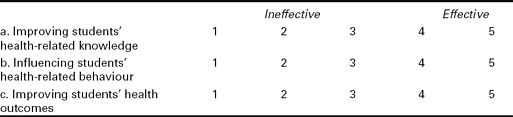
A12. Please rate the overall effectiveness of your teaching of students participating in the Ask program about health-related matters in terms of: (Please circle the appropriate numbers)

section b: the ask diary
B1. How did your students use the Ask Health Diary at school?
________________________________________________________________
________________________________________________________________
________________________________________________________________
________________________________________________________________
B2. Are there specific attributes of the students that enable them to successfully use the Ask Health Diary?
________________________________________________________________
________________________________________________________________
________________________________________________________________
________________________________________________________________
B3. What factors determined how you used the Ask Health Diary in the classroom?
________________________________________________________________
________________________________________________________________
________________________________________________________________
________________________________________________________________
B4. Which sections did you use the most? And why? (list the three most useful/user friendly sections)
________________________________________________________________
________________________________________________________________
________________________________________________________________
________________________________________________________________
B5. Which sections didn't you use? And why? (list the three least useful sections)
________________________________________________________________
________________________________________________________________
________________________________________________________________
________________________________________________________________
B6. How could the Ask Health Diary be improved? (list three suggestions)
________________________________________________________________
________________________________________________________________
________________________________________________________________
________________________________________________________________
________________________________________________________________
B7. How could the Ask Health Diary be best integrated into the school year? (What term; what age groups; linked to what pre-existing school activities and themes, etc.)
________________________________________________________________
________________________________________________________________
________________________________________________________________
________________________________________________________________
________________________________________________________________
B8. Did the Ask Health Diary help you to think differently about your expectations of your students?
□ Yes (Please specify)
________________________________________________________________
________________________________________________________________
________________________________________________________________
________________________________________________________________
________________________________________________________________
□ No
□ Don't know
B9. Did the Ask Health Diary improve communication/interaction between parents and teachers regarding students’ health matters?
□ Yes (Please specify)
________________________________________________________________
________________________________________________________________
________________________________________________________________
□ No (Please specify)
________________________________________________________________
________________________________________________________________
________________________________________________________________
□ Don't know (Please specify)
________________________________________________________________
________________________________________________________________
________________________________________________________________
section c: project evaluation
C1. Please list any difficulties you encountered in taking part in the Ask project?
________________________________________________________________
________________________________________________________________
________________________________________________________________
________________________________________________________________
________________________________________________________________
C2. What did you gain by taking part in the Ask Project?
________________________________________________________________
________________________________________________________________
________________________________________________________________
________________________________________________________________
________________________________________________________________
C3. What did your students gain by taking part in the Ask Project?
________________________________________________________________
________________________________________________________________
________________________________________________________________
________________________________________________________________
________________________________________________________________
C4. Would you teach the Ask program again if the materials were available?
□ Yes
□ No
If not, why not?
________________________________________________________________
________________________________________________________________
________________________________________________________________
________________________________________________________________
________________________________________________________________
Thank you for taking the time to complete this survey.