INTRODUCTION
Researchers have devoted considerable attention to the topic of paternalistic leadership (PL) in recent years (Pellegrini & Scandura, Reference Pellegrini and Scandura2008; Chen, Eberly, Chiang, Farh, & Cheng, Reference Chen, Eberly, Chiang, Farh and Cheng2014). PL has been defined as ‘a style that combines strong discipline and authority with fatherly benevolence’ (Farh & Cheng, Reference Farh and Cheng2000: 91). In return for this benevolence, subordinates of such leaders are expected to be loyal and comply with the leader’s instructions (Aycan, Schyns, Sun, Felfe, & Saher, Reference Aycan, Schyns, Sun, Felfe and Saher2013). PL has been found to positively affect employee attitudes in numerous countries (Silin, Reference Silin1976; Redding, Reference Redding1990; Westwood, Reference Westwood1997; Farh & Cheng, Reference Farh and Cheng2000; Aycan, Reference Aycan2006; Pellegrini & Scandura, Reference Pellegrini and Scandura2006; Aycan et al., Reference Aycan, Schyns, Sun, Felfe and Saher2013).
Whereas most PL research has focused on its effect on work attitudes, some research has begun to examine the effects of PL on leader–member exchange (LMX; the forming of different types of relationships with each of a leader’s subordinates) and work behavior. For instance, Chen et al. (Reference Chen, Eberly, Chiang, Farh and Cheng2014) identified LMX as a mediator of the relationship between a dimension of PL and subordinate work performance. A related area that has not received as much attention involves how LMX differentiations within work teams might affect these relationships. Because employees make social comparisons between their own and their fellow team members’ LMX relationships (Henderson, Liden, Glibkowski, & Chaudhry, Reference Henderson, Liden, Glibkowski and Chaudhry2009), team LMX differentiation might decrease the effect of PL on LMX. We address this gap in the literature by conducting an individual-level analysis of three dimensions of PL, LMX and organizational citizenship behaviors (OCB), as well as a team-level analysis of PL, team differentiations and LMX.
Our study makes several contributions to the existing literature. First, paternalistic leadership involves a particular leadership style whereas LMX involves in- and out-group relationships; thus, it is important to determine how followers of paternalistic leaders evaluate such differentiation. Second, whereas most PL research has focused on its effects on wok attitudes and individual-level LMX, we focus on follower behaviors (OCB) as well as team-level LMX differentiation. Finally, our study contributes to the existing literature by examining these relationships in a Chinese context. Other recent research has found that paternalistic leadership is more closely associated with countries representing high power distance and collectivism such as China (Aycan et al., Reference Aycan, Schyns, Sun, Felfe and Saher2013). Given China’s patriarchal tradition, it is of interest to examine how paternalistic leadership has spilled over from the family into the workplace.
Paternalistic leadership (PL)
Early behavioral management theorists suggested that managers should be paternalistic and nurturing in order to build productive and satisfied work groups (Pellegrini & Scandura, Reference Pellegrini and Scandura2008). Later studies on paternalism in Asian countries showed that paternalistic managers provide support, protection, and care for their subordinates (Silin, Reference Silin1976; Redding, Reference Redding1990; Westwood, Reference Westwood1997; Farh & Cheng, Reference Farh and Cheng2000; Aycan, Reference Aycan2006; Pellegrini & Scandura, Reference Pellegrini and Scandura2006). In examining Chinese business leaders’ behaviors in family businesses and modern organizations, scholars found that the notion of leadership in the Chinese context involves didactic leadership (e.g., Silin, Reference Silin1976). Chinese managers often enact values by setting up centralized structures and by assuming a paternalistic role with a direct and authoritative leadership style (Peng, Lu, Shenkar, & Wang, Reference Peng, Lu, Shenkar and Wang2001). Following Silin’s (Reference Silin1976) research on a large organization in Taiwan, Cheng (Reference Cheng1995) adopted an indigenous approach to describe PL within Chinese family businesses. PL involves fatherly benevolence and moral integrity couched in a paternalistic atmosphere with a strong authority combined with concern and consideration (Westwood & Chan, Reference Westwood and Chan1992). Thus, paternalistic leaders guide both the professional as well as the personal lives of their subordinates in a parental fashion (Gelfand, Erez, & Aycan, Reference Gelfand, Erez and Aycan2007).
Paternalistic leadership was historically examined mainly in Chinese family business contexts, but was later explored in other regions such as the Middle East and Latin America (Uhl-Bien, Tierney, Graen, & Wakayabashi, Reference Uhl-Bien, Tierney, Graen and Wakayabashi1990; Aycan et al., Reference Aycan, Kanungo, Mendonca, Yu, Deller, Stahl and Kurshid2000; Martinez, Reference Martinez2003). Eventually researchers extended such research on paternalism to the Western business context. Pellegrini, Scandura and Jayaraman (Reference Pellegrini, Scandura and Jayaraman2010) compared the attitudes of employees from the United States and India and found that in both cultural contexts, paternalistic leadership was positively related to leader–member exchange and organizational commitment. Thus, paternalistic leadership findings may generalize across cultures.
In addition to its historical roots, current examinations of PL are equally relevant. As organizations strive to keep employees engaged in workplaces with declining levels of loyalty (Weber, Reference Weber2014), the effects of PL would likely be especially important to managers (e.g., employee commitment; performance). The concept is also particularly relevant to recent organizational efforts at examining the ethical behavior of managers (e.g., Mayer, Aquino, Greenbaum, & Kuenzi, Reference Mayer, Aquino, Greenbaum and Kuenzi2012), given that morality is one of three key components of PL. The morality dimension of PL is broadly depicted as a leader’s behavior that demonstrates superior moral character and integrity through acting unselfishly and leading by example (Cheng, Chou, Wu, Huang, & Farh, Reference Cheng, Chou, Wu, Huang and Farh2004). Moral leadership demonstrates concern for the collective good rather than self-interest. Moral leaders are highly respected, admired, and viewed as ideal leaders by Chinese employees (Niu, Wang, & Cheng, Reference Niu, Wang and Cheng2009).
The other two dimensions of PL include authoritarianism and benevolence (Farh & Cheng, Reference Farh and Cheng2000; Aycan, Reference Aycan2006; Farh, Cheng, Chou, & Chu, Reference Farh, Cheng, Chou and Chu2006). First, authoritarianism refers to a leader’s behavior of asserting strong authority and control over subordinates and demanding unquestioned obedience from them (Cheng et al., Reference Cheng, Chou, Wu, Huang and Farh2004). Chinese managers often exhibit these values by setting up centralized structures and by assuming a father-like role with a direct and authoritative leadership style (Peng et al., Reference Peng, Lu, Shenkar and Wang2001).
Second, benevolence implies that a leader demonstrates individualized, holistic concern for subordinates’ personal and familial well-being (Cheng et al., Reference Cheng, Chou, Wu, Huang and Farh2004). Benevolent leaders show concern for and encourage followers when they encounter problems (Farh & Cheng, Reference Farh and Cheng2000). They express interest in the personal lives of their subordinates and may take care of their family members (Cheng, Chou, & Farh, Reference Cheng, Chou and Farh2000; Farh & Cheng, Reference Farh and Cheng2000; Aycan, Reference Aycan2006; Pellegrini & Scandura, Reference Pellegrini and Scandura2006, Reference Pellegrini and Scandura2008).
LMX
LMX theory contends that leaders develop different types of relationships with each of their subordinates through a series of work-related exchanges that can be characterized as high or low quality (Graen & Scandura, Reference Graen and Scandura1987; Graen & Uhl-Bien, Reference Graen and Uhl-Bien1995). In high quality LMX relationships, the exchanges between supervisors and subordinates involve mutual obligation and trust such that there is reciprocal interaction between supervisor and subordinate (Graen & Uhl-Bien, Reference Graen and Uhl-Bien1995). Through role negotiation over time, subordinates engage in decision-making processes that enhance their social status as ‘in-group’ members (Liden, Erdogan, Wayne, & Sparrowe, Reference Liden, Erdogan, Wayne and Sparrowe2006). The in-group form is a special exchange relationship with certain trusted subordinates who serve as assistants or advisors.
In contrast, the out group includes the remaining subordinates with whom the exchange relationship is more formalized and based on role requirements, job descriptions, and the employment contract. In such exchanges information flows unilaterally from boss to subordinate (Wang, Niu, & Luo, Reference Wang, Niu and Luo2004). ‘Out-group’ subordinates in low quality LMX relationships have a greater social distance from their boss and tend to be delegated simple jobs with minimal responsibility
Leaders in LMX relationships conduct a cost-benefit calculation and use resources to meet subordinates’ needs in return for services offered by the subordinate (e.g., performance; Scandura & Schriesheim, Reference Scandura and Schriesheim1994). Dienesch and Liden (Reference Dienesch and Liden1986) included affect, loyalty, contribution, and professional respect as ‘currencies of exchange’ (p. 625).
More recently, Cropanzano and Mitchell (Reference Cropanzano and Mitchell2005) distinguished between two types of social exchange relationships. First, relationships as interpersonal attachment are social exchange relationships involving social transactions. Relationships as transactions are also social exchange relationships, but they include economic transactions that consist of a series of interdependent exchanges. In the current study, paternalistic leadership is expected to be associated with the ‘relationships as interpersonal attachment’ category that primarily involves social transactions.
PL and LMX
Given that PL involves an exchange relationship, it follows that perceptions of certain components of PL would be positively associated with followers’ perceptions of LMX in a Chinese context. Paternalistic leaders take on a father-like role and provide protection and care for their employees’ professional and personal lives in exchange for loyalty and compliance (Pellegrini & Scandura, Reference Pellegrini and Scandura2008). Aycan et al. (Reference Aycan, Kanungo, Mendonca, Yu, Deller, Stahl and Kurshid2000) found that in India, Turkey, China and Pakistan paternalism does not exclusively connote ‘authoritarianism’ but rather a relationship in which subordinates willingly reciprocate the care and protection of paternal authority by showing conformity. Ansari, Ahmad, and Aafaqi (Reference Ansari, Ahmad and Aafaqi2004) suggested that in Malaysia, paternalistic leadership is provided only to those who have high-quality exchange relationships with leaders and that paternalistic treatment is contingent on subordinates’ task accomplishment. In particular, the ‘benevolent leadership’ dimension of PL indicates that managers take a personal interest in workers’ off-the-job lives and attempt to promote workers’ personal welfare (Gelfand, Erez, & Aycan, Reference Gelfand, Erez and Aycan2007). As a result, we expect that subordinates who perceive their leader exhibits benevolent leadership should exhibit positive LMX perceptions.
Recall that the second dimension of PL, moral leadership, includes moral integrity, superior personal virtues, self-discipline, and unselfish behaviors. Such a leader can be expected to work for subordinates’ well-being rather than taking personal revenge in the name of public interest (Silin, Reference Silin1976; Cheng et al., Reference Cheng, Chou, Wu, Huang and Farh2004). As with benevolent leadership, this leadership style should foster social or instrumental exchanges between subordinates and leaders. Thus, we expect that subordinates who perceive their leader exhibits moral leadership should exhibit positive LMX perceptions.
In contrast, authoritarian leadership does not offer the socio-emotional or instrumental benefits needed to initiate reciprocal interrelations. Previous research has suggested that the lack of affective trust engendered by an authoritarian leader provides a sign that the leader–follower relationship is not one of social exchange (Colquitt, Scott, & LePine, Reference Colquitt, Scott and LePine2007). Thus, subordinates who perceive their leader as authoritarian would be expected to have negative perceptions of LMX.
Hypothesis 1: Benevolent leadership will be positively associated with subordinates’ perceived LMX.
Hypothesis 2: Moral leadership will be positively associated with subordinates’ perceived LMX.
Hypothesis 3: Authoritarian leadership will be negatively associated with subordinates’ perceived LMX.
PL and OCB
The next part of our model concerns the relationship between paternalistic leadership and OCB. It has long been argued that organizations cannot succeed by relying strictly on the performance of behaviors delineated in job descriptions (e.g., Katz, Reference Katz1964). Voluntary behaviors that benefit others and the organization include helping co-workers, voicing suggestions and protecting the organization. These behaviors are often referred to as OCB (Smith, Organ, & Near, Reference Smith, Organ and Near1983; Organ, Podsakoff, & MacKenzie, Reference Organ, Podsakoff and MacKenzie2006). The current study focuses on OCBs directed toward other team members.
Because OCBs are less often recognized by the formal rewards system (Organ, Reference Organ1997), researchers have suggested that it is likely that subordinates engage in citizenship behaviors as a means of maintaining a well-balanced or equitable social exchange (Wayne, Shore, Bommer, & Tetrick, Reference Wayne, Shore, Bommer and Tetrick2002). When a leader acts paternalistically with long-term care and concern for the followers’ job-related and personal well-being (Cheng et al., Reference Cheng, Chou, Wu, Huang and Farh2004), the followers are likely to develop warm feelings and gratitude toward the leader, thus forming an emotional bond and a reciprocal relationship to continue the positive cycle (Blau, Reference Blau1964). As a result, benevolence is likely to motivate followers to engage in social exchanges by putting more effort into work and going above and beyond for their leaders (Loi, Mao, & Ngo, Reference Loi, Mao and Ngo2009).
Moral leadership involves the demonstration of integrity and concern for the collective good rather than self-interest. As noted earlier, such leaders are highly respected, admired, and viewed as ideal leaders by Chinese employees (Niu, Wang, & Cheng, Reference Niu, Wang and Cheng2009). A leader’s moral behavior works like an investment in subordinates’ organizational environment, and thus it can in turn arouse subordinates’ moral behavior. As a result it should improve subordinates’ OCB.
According to the over justification effect (Deci & Ryan, Reference Deci and Ryan1995), controlling and rigorous leadership behaviors may reduce employees’ intrinsic motivation for work because the external pressure to perform is made salient by the authoritarian leader. As a result, subordinates working under an authoritarian leader will be less likely to perform extra-role behaviors and should focus their attention on those behaviors rewarded by the organization (Deci & Ryan, Reference Deci and Ryan1995).
Hypothesis 4: Benevolent leadership will be positively associated with subordinate OCB.
Hypothesis 5: Moral leadership will be positively associated with subordinate OCB.
Hypothesis 6: Authoritarian leadership will be negatively associated with subordinate OCB.
The next part of our model identifies LMX as a mediator of the relationship between two dimensions of PL (benevolent and moral leadership) and OCB. Studies have demonstrated that LMX is positively associated with OCBs (Deluga, Reference Deluga1994; Wayne, Shore, & Liden, Reference Wayne, Shore and Liden1997; Hackett, Farh, Song, & Lapierre, Reference Hackett, Farh, Song and Lapierre2003). Owing to social exchange theory (Blau, Reference Blau1964), employees who perceive they have a high-quality relationship with their supervisor are more likely to reciprocate by engaging in behaviors that the leader regards as helpful. When followers perceive positive perceptions of LMX based on the leader’s exhibition of benevolent and moral leadership behaviors, the relationship should be more likely to operate in such a reciprocal manner. For example, if a subordinate perceives that his/her supervisor takes care of him/her and acts virtuously, the subordinate should be more likely to engage in OCBs because this would signal to the employee that he /she works in an exchange relationship where members perform above and beyond what is expected in the job description. There is some initial evidence from which to draw support for this argument. One study on members of a non-profit youth organization in China (Chan & Mak, Reference Chan and Mak2012) and another on military leaders and subordinates in Taiwan (Liang, Ling, & Hsieh, Reference Liang, Ling and Hsieh2007) found that LMX mediated the relationship between benevolent leadership and OCB.
A similar relationship identifying LMX as a mediator of an OCB relationship has been reported in the fairness literature. Specifically, in a study of manufacturing employees and their supervisors, LMX was found to fully mediate the relationship between interactional justice and performance and OCBs (Burton, Sablynski, & Sekiguchi, Reference Burton, Sablynski and Sekiguchi2008). The authors explained their findings by suggesting that LMX served as a mediator because interactional justice fundamentally involves exchanges between an employee and his/her supervisor. In the current study, PL inherently involves exchanges between supervisors and subordinates; thus the mechanism for its effects on OCB is also likely to be LMX.
There is also some research from the voice literature that may provide support for the relationship between PL, LMX and OCB. In a study of over 400 employees and their supervisors, Zhang, Huai, and Xie (Reference Zhang, Huai and Xie2014) found that authoritarian paternalistic leaders reduced subordinates’ voice by diminishing their status perceptions. In contrast, they suggested that benevolent paternalistic leaders promoted employee voice by boosting both LMX and status judgments. Similarly, moral paternalistic leaders were found to positively influence employee voice mainly through LMX processes. Because voice includes raising suggestions to improve work procedures or processes and this may be considered a form of extrarole behavior, we would expect a similar relationship between PL, LMX and OCB.
Hypothesis 7: Subordinates’ perceived LMX will mediate the relationship between benevolent leadership and OCB.
Hypothesis 8: Subordinates’ perceived LMX will mediate the relationship between moral leadership and OCB.
LMX differentiation, PL and LMX
The LMX model was originally conceived to account for how leaders’ differential treatment of multiple subordinates in a work group influences activity within the group (Henderson et al., Reference Henderson, Liden, Glibkowski and Chaudhry2009). Within-group patterns in LMX-quality may create a social context that influences employee attitudes and behaviors (Henderson et al., Reference Henderson, Liden, Glibkowski and Chaudhry2009). As noted earlier, LMX is thought to be the result of social comparison. Employees make social comparisons between their own and their fellow team members’ LMX relationships (Henderson et al., Reference Henderson, Liden, Glibkowski and Chaudhry2009). Research has shown that employees are aware of the differentiated relationships they and their leaders form (e.g., Duchon, Green, & Taber, Reference Duchon, Green and Taber1986; van Breukelen, Schyns, & Le Blanc, Reference van Breukelen, Schyns and Le Blanc2006). The pattern of diverse LMX relationships that develop within the work team provides the parameters and framework for valid social comparisons (Hogg, Martin, Epitropaki, Mankad, Svensson, & Weeden, Reference Hogg, Martin, Epitropaki, Mankad, Svensson and Weeden2005). The development of differential relationships between leaders and their direct subordinates in their work team is referred to as LMX differentiation (Liden et al., Reference Liden, Erdogan, Wayne and Sparrowe2006; Henderson et al., Reference Henderson, Liden, Glibkowski and Chaudhry2009).
Within-team standard deviations have been used to operationalize LMX team differentiations (Schyns, Reference Schyns2006). A higher within-team standard deviation represents a greater variability in team members’ perceived LMX quality, implying more differentiation, whereas low differentiation refers to a context in which the range of overall LMX quality within a team is small (Henderson et al., Reference Henderson, Liden, Glibkowski and Chaudhry2009).
LMX differentiation has the potential to influence work attitudes because it suggests that critical resources such as a leader’s attention, information, autonomy, help and support will be unequally distributed. In particular, LMX differentiation increases subordinates’ perceptions of procedural unfairness when leaders provide different levels of resources and support across members of their work groups (Uhl-Bien, Graen, & Scandura, Reference Uhl-Bien, Graen and Scandura2000). Some studies have tested the interaction effect between LMX differentiation and mean or median LMX quality at the team level (Boies & Howell, Reference Boies and Howell2006; Liden et al., Reference Liden, Erdogan, Wayne and Sparrowe2006). Hooper and Martin (Reference Hooper and Martin2008) found that an employee’s perception that the leader differentiates is negatively related to job satisfaction and well-being and positively related to team conflict. In a study on two samples of employees they found that employee perceptions of LMX variability (the extent to which LMX relationships are perceived to vary within a team) were negatively related to employee job satisfaction and well-being (beyond the effects of LMX); further, this relationship was mediated by perceptions of relational team conflict. The authors explained their results by suggesting that LMX variability runs counter to principles of equality and consistency, which are critical to the maintenance of social harmony in groups. It should be noted that this study measured perceived differentiation as opposed to actual level of differentiation.
In a similar study in a sample of 120 work groups in six organizations, Liden et al. (Reference Liden, Erdogan, Wayne and Sparrowe2006) demonstrated that the impact of LMX differentiation depends on one’s own LMX. The authors defined LMX differentiation as the degree of variability in the quality of LMX relationships formed within work groups. The researchers found that LMX moderated the relationship between LMX differentiation and individual performance: increases in LMX differentiation were accompanied by increases in individual performance for low LMX members, but no change in individual performance for high LMX members. Thus, they found that the performance of low LMX members increased with differentiation. Liden et al. (Reference Liden, Erdogan, Wayne and Sparrowe2006) attributed this finding to members’ efforts to enhance their LMX status and relative standing by improved performance. Similarly, in a study of athletes and their coaches, van Breukelen, Konst and van der Vlist (Reference van Breukelen, Konst and van der Vlist2002) found that greater perceptions of social differential treatment were associated with a lower-quality working relationship between coach and player and in negative perceptions of team atmosphere.
Taken together, previous studies have suggested that differential supervisory behavior toward subordinates becomes part of the work group’s ambient message environment; thus, members of the work group are aware of superior–subordinate relationship distinctions within their group (e.g., Duchon et al., Reference Duchon, Green and Taber1986). The social context may affect group members’ perceptions of impartiality and their own relationship with their supervisor (e.g., Ambrose & Kulick, Reference Ambrose and Kulick1988; Ambrose, Harland, & Kulick, Reference Ambrose, Harland and Kulick1991). Salient social group boundaries have been found to upset work group processes by bringing about competitive intergroup behavior among work group members (Larkey, Reference Larkey1996; Sparrowe & Liden, Reference Sparrowe and Liden1997). It follows that if leaders create in- and out-groups within a group, the positive effects of benevolent and moral leadership on subordinate perceived LMX would be expected to be diminished.
Hypothesis 9: Team LMX differentiation will moderate the relationship between benevolent leadership and subordinate perceived LMX. That is, when team LMX differentiation increases, the positive effect of benevolent leadership on subordinate perceived LMX will decrease.
Hypothesis 10: Team LMX differentiation will moderate the relationship between moral leadership and subordinate perceived LMX. That is, when team LMX differentiation increases, the positive effect of moral leadership on subordinate perceived LMX will decrease.
Based on the theoretical arguments offered above, we present the following framework (please see Figure 1).
Theoretical framework

METHOD
Sample and procedure
Researchers administered surveys on-site during break times in two hotels in Beijing, China. In a pilot study we collected 307 individual data to exam the measures’ reliability and validity. 42.6% of the sample was male. The average tenure was 3 years; 90% were younger than 45 years old; 43.7% were between 20 and 25 years old; 90.1% had undergraduate or high school degrees. Next we surveyed 454 front-line employees in 60 working teams to test our hypotheses. A researcher collected the completed questionnaires by group so that no employee or supervisor would see each other’s responses. Teams with fewer than 80% of employees completing the survey were removed from analyses. The final sample included 180 team members from 47 teams; 41.7% were male, 54.7% were below 25 years old, 23.3% were 35–45 years old, and 16.7% above 45 years old; 83.2% had high school degrees; 27.4% had more than 4 years working experience; 33.5% had 2–4 years working experience, 39.1% had <2 years working experience; 83.9% had a team size of two to five members.
Measures
Paternalistic leadership was assessed by a 6-item scale developed by Cheng, Huang, and Chou (Reference Cheng, Huang and Chou2002) and revised in later studies demonstrating its favorable internal consistency and psychometric properties (Cheng, Shieh, & Chou, Reference Cheng, Shieh and Chou2002; Cheng et al., Reference Cheng, Chou, Wu, Huang and Farh2004; Farh et al., Reference Farh, Cheng, Chou and Chu2006; Chen et al., Reference Chen, Eberly, Chiang, Farh and Cheng2014). The complete scale appearing in the appendix contains sub-scales for benevolent leadership (α=0.82), moral leadership (α=0.86) and authoritarian leadership (α=0.61). Sample items included the following: ‘My supervisor takes very thoughtful care of subordinates who have spent a long time with him/her’ (benevolence), ‘My supervisor doesn’t avenge a personal wrong in the name of public interest when he/she is offended’ (morality) and ‘My supervisor always has the last say in meetings’ (authoritarianism).
LMX was measured by a 7-item scale (α=0.92) adapted from Wang, Niu, and Luo (Reference Wang, Niu and Luo2004) in Chinese, with items similar to the measure used by Liden and Maslyn (Reference Liden and Maslyn1998). Sample items included the following: ‘My team leader would come to my defense if I were ‘attacked’ by others in the organization,’ ‘I do not mind doing additional work for my team leader’ and ‘I admire my team leader’s professional skills.’ LMX differentiation was measured as the standard deviation of team LMX.
OCBs were measured by Williams and Anderson’s (Reference Williams and Anderson1991) 8-item scale (α=0.92). A sample item includes the following: ‘I go out of my way to help new team members.’ A back translation procedure was used to convert to Mandarin Chinese.
All items were rated on a Likert scale ranging from 1 (strongly disagree) to 6 (strongly agree).
RESULTS
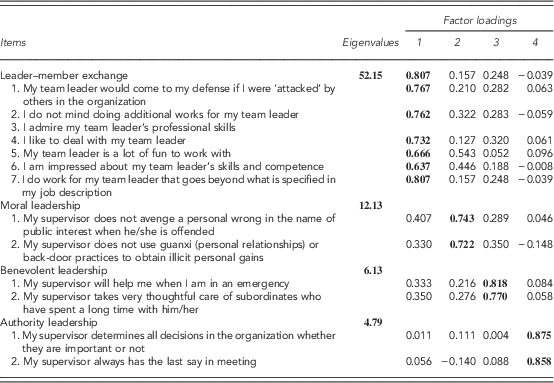
First, we conducted an exploratory factor analysis (n=307) using the principal component method on the three dimensions of PL and employee perceived LMX (please see Table 1). The four factors explained 75.1% of the variance.
Exploratory factor analysis results on paternalistic leadership (n=307)
Next we conducted a confirmatory factor analysis (n=180) on all study items in order to demonstrate that they empirically define five distinct latent factors: benevolent leadership, moral leadership, authoritarian leadership, employee perceived LMX, and employee OCB. Goodness-of-fit indices indicated that the five-factor model provided a superior fit to the data over a one-factor model where all items were set to load on one factor and a three-factor model where the items from the three dimensions of paternal leadership were set to load on the same factor (please see Table 2).
Confirmatory factor analysis (n=180)

Note: LMX=leader–member exchange; OCB=organizational citizenship behaviors.
The one-factor model set all variables to load on one factor. The three-factor model included one PL (combined benevolent leadership, moral leadership and authoritarian leadership into one variable), LMX and OCB. The five-factor model included benevolent leadership, moral leadership, authoritarian leadership, LMX and OCB.
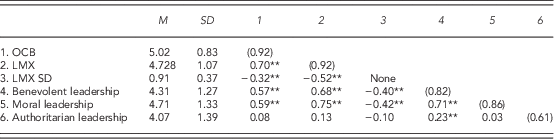
We reported descriptive statistics and zero-order correlation coefficients for all study variables in Table 3. With the exception of authoritarian leadership, the variables exhibited significant and positive correlations with each other.
Means, standard deviations and correlations (n=180)
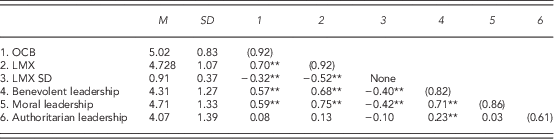
Note: LMX=leader–member exchange; OCB=organizational citizenship behaviors.
**p<0.01, two-tail test; Cronbach’s α reliability coefficients appear on the diagonal.
Multi-level analysis was used to test the moderation hypotheses but not the mediation hypotheses. Although there was only one leader within each team, team members’ perceived LMX might not be the same within teams as leaders form different relationships with different subordinates. Thus, the appropriate level of analysis to test for mediation was the individual level. However, the moderation hypotheses involve the effects of a team variable (LMX differentiation) on the individual; thus, a multi-level analysis was appropriate for this analysis. For simplicity we examined the mediation and moderation models separately rather than combining them.
First, we tested the mediation model’s construct validity by examining the fit indices, which indicated a favorable fit (χ2/df=1.58, RMSEA=0.06, TLI=0.95, CFI=0.96). We followed the steps outlined by Baron and Kenny (Reference Baron and Kenny1986) to exam the mediation effects. To test the hypotheses, after controlling for gender, age, education, and job position, subordinate OCB was regressed on benevolent leadership (β=0.29, p<.01), moral leadership (β=0.37, p<.001), and authoritarian leadership (β=−0.01, p>.05). Then, when LMX was added into the model, benevolent leadership (β=0.14, p>.05) and moral leadership (β=0.06, p>.05) were not significant, and LMX was significantly associated with OCB (β=−0.57, p<.001). Authoritarian leadership did not exhibit a significant relationship (β=−0.02, p>.05). Finally, LMX was regressed on benevolent leadership (β=0.27, p<.001), moral leadership (β=0.56, p<.001), and authoritarian leadership (β=0.03, p>.05). The mediating effects of LMX on the relationship between benevolent leadership and moral leadership with OCB were demonstrated. Additionally, the variance inflation factors were <3.10, indicating multicollinearity was not a serious problem in these data. Thus, Hypotheses 1, 2, 4, 5, 7 and 8 were supported, and Hypothesis 3 and 6 were not supported.
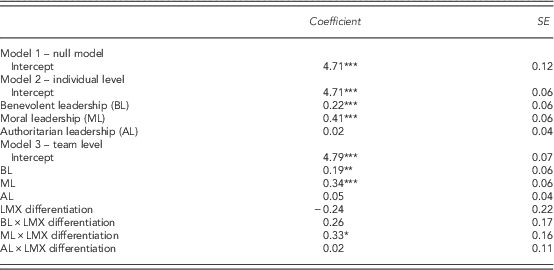
In order to examine Hypotheses 9 and 10, a two-level hierarchical model assessed the extent to which paternalistic leadership and team LMX differentiation were associated with subordinate perceived LMX. Benevolent leadership, moral leadership and subordinate perceived LMX were analyzed at the individual level. Additionally, team LMX differentiation was calculated by using a standard deviation of subordinates’ ratings of perceived LMX.
To justify examination of LMX differentiation at the team level, both intra-class correlation (ICC) statistics were calculated; ICC (1) calculates the proportion of variance in individual responses accounted for by the group and ICC (2) calculates the extent to which group scores are different and reliable. Results indicated that ICC (1)=0.43 indicating 43% of individual team LMX differentiation was attributable to the group. This value surpasses James’s (Reference James1982) median standard of 0.12 (0.00–0.05). Results indicated that ICC (2)=0.74, indicating each group had a meaningfully different and reliable team LMX differentiation score. This value also meets the minimum standard of 0.60 (Glick, Reference Glick1985). Thus, there was substantial within and between-group variation in LMX.
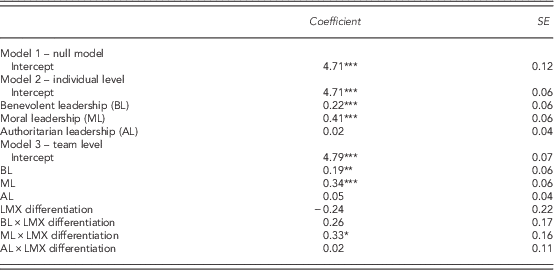
The multi-level analysis was conducted using HLM 7. Three models were calculated for comparison: a null model in which intercepts were free to vary, an individual level model in which benevolent leadership and moral leadership were entered as predictors of subordinate perceived LMX, and a two-level model in which team perceived LMX differentiation was added to the individual model as a moderator. Results for these models are presented in Table 4.
Moderation effects
Note: LMX=leader–member exchange.
*p<.05, **p<.01, ***p<.001.
Figure 2 shows the moderating effect of team LMX differentiation on benevolent leadership, moral leadership and subordinate perceived OCB. At the individual level, benevolent leadership and moral leadership were both positively associated with employee OCB. Furthermore, team LMX differentiation (grouped by ±1 SD) moderated the relationship between benevolent leadership and moral leadership on subordinate perceived LMX. In order to be able to describe the effect, the interactions were drawn according to the procedure recommended by Aiken and West (Reference Aiken and West1991). The figure depicts the pattern of the two-way interaction. It shows that when team LMX differentiation is high (+1 SD) and leader benevolent leadership is low, subordinate perceived LMX is the lowest. The same pattern is shown for moral leadership. Thus, Hypotheses 9 and 10 were supported.
Moderation effects
DISCUSSION
In summary, our study found that benevolent leadership and moral leadership increased subordinate OCB through perceived LMX, and team differentiation of perceived LMX moderated the relationship between perceived LMX and benevolent leadership as well as moral leadership. High level team differentiation of perceived LMX decreased subordinate perceived LMX.
The results presented in our study have implications for theory and practice. First, benevolent and moral leadership were positively associated with both subordinates’ perceptions of LMX and OCB. Benevolent leadership involves supervisors promoting their subordinates’ personal welfare and taking a personal interest in their personal lives whereas moral leadership involves exhibiting moral integrity and concern for workers’ well-being. Accordingly we found that subordinates who perceive their leader exhibits benevolent or moral leadership were more likely to have positive perceptions of their LMX relationship with their supervisor and engage in OCB toward their team members. Supervisors who behave paternalistically with long-term care and concern for the followers’ job-related and personal well-being should be more likely to continue the positive cycle with positive feelings toward their boss and behavior that supports his/her group (Cheng et al., Reference Cheng, Chou, Wu, Huang and Farh2004).
In contrast, authoritarian leadership does not offer the same benefits needed to initiate reciprocal exchanges. As noted earlier, some research has suggested that the lack of affective trust engendered by an authoritarian leader is evidence that the leader–follower relationship is not one of social exchange (Colquitt, Scott, & LePine, Reference Colquitt, Scott and LePine2007). This fits with our finding that subordinates who perceived their leader as authoritarian tended to have more negative perceptions of LMX and were less likely to engage in OCBs. Instead these subordinates probably focused more on behaviors likely to be rewarded by the boss because those were the ones made salient by their boss. In addition, the controlling behaviors exhibited by authoritarian leaders are thought to reduce one’s intrinsic motivation to work (Deci & Ryan, Reference Deci and Ryan1995).
The mediation results help further specify the mechanism underlying the relationship between LMX and OCB identified in previous research (e.g., Hackett et al., Reference Hackett, Farh, Song and Lapierre2003). It appears that when employees perceive positive perceptions of LMX based on the supervisor’s exhibition of benevolent and moral leadership behaviors, the nature of the relationship is more likely to be one of social exchange (Blau, Reference Blau1964). Subordinates in such relationships where the leader shows care and consideration are more willing to reciprocate by engaging in extrarole behaviors that should please their boss.
Our study also has implications for LMX team differentiation research. The LMX model was originally developed to account for how supervisors’ differential treatment of multiple members in a work group influences activity within the group (Henderson et al., Reference Henderson, Liden, Glibkowski and Chaudhry2009). Yet, despite extensive research on LMX, considerably less attention has been afforded to the implications of LMX differentiation. Moral leadership and benevolent leadership significantly negatively correlated with team differences of perceived LMX. Moral and benevolent leadership may result in follower perceptions of acceptance and internalized values, and thus may result in less team differentiation of perceived LMX.
We also found that team perceived LMX differentiation moderated the relationship between subordinates’ perceived LMX and both benevolent and moral leadership. Specifically, when team perceived LMX differentiation increased, the positive effect of benevolent and moral leadership on subordinate perceived LMX decreased. This finding fits with previous research suggesting that subordinates will perceive inequity when leaders provide different levels of resources and support across members of their work groups (Uhl-Bien, Graen, & Scandura, Reference Uhl-Bien, Graen and Scandura2000). It appears that subordinates who perceive the supervisor is ‘playing favorites’ will not exhibit a strong positive relationship between PL and perceived LMX.
These findings suggest that differential supervisory behavior toward subordinates may signal to the group members that the leader is not impartial, a quality thought to be critical to group harmony. The salient differential treatment might affect group members’ perceptions of their own relationship with their supervisor. Previous research has found that social group boundaries have been found to interfere with work group processes by bringing about competitive intergroup behavior among work group members (Larkey, Reference Larkey1996; Sparrowe & Liden, Reference Sparrowe and Liden1997). Thus, when bosses create in- and out-groups within groups, the positive effects of benevolent and moral leadership on subordinate perceived LMX appear to decrease.
Taking together the results on LMX with the results on LMX team differentiation, an implication is that future research should continue to examine LMX differentiation as a distinct team level construct. A corresponding practical implication is that managers should also consider the two subjects separately. Given that our study found that group LMX differentiations may hinder leader–subordinate exchange relationships through decreasing the positive impact of moral leadership and benevolent leadership on subordinate perceived LMX, leaders should afford attention to increasing individual LMX by exhibiting benevolent and moral leadership behaviors while maintaining a lower level of group differences of LMX.
Finally, our study contributes to the existing literature by examining these relationships in a Chinese context. Given China’s patriarchal tradition, it is interesting to observe how paternalistic leadership has spilled over from the family into the workplace. Research on PL and LMX in different contexts will help us gauge the generalizability of our study’s findings.
Limitations
Some limitations should be considered in the interpretation of our study’s results. First, all the subordinate perceptual data were self-reported. Hence, we examined the extent of common method bias by loading all the items on the corresponding constructs, adding a potential method construct, and loading all the items on it. After adding the potential method construct, the model was not significantly improved; thus, common method bias was not a serious problem in this study (Hou, Wen, & Cheng, Reference Hou, Wen and Cheng2004). Second, the data were collected from two hotels in China, which may raise concerns about the generalizability of the findings. Future research should include leader-rated data and consider other cultures and industries.
Acknowledgements
This research was supported by the National Natural Science Foundation of China project numbers 71173214 and 71473238.
Appendix
Paternalistic leadership: (From Cheng, Huang, & Chou, Reference Cheng, Huang and Chou2002)
Benevolent leadership:
1. My supervisor takes very thoughtful care of subordinates who have spent a long time with him/her.
2. My supervisor takes good care of my family members as well.
Moral leadership:
1. My supervisor does not avenge a personal wrong in the name of public interest when he/she is offended.
2. My supervisor does not use guanxi (personal relationships) or back-door practices to obtain illicit personal gains.
Authoritarianism leadership:
1. My supervisor always has the last say in meetings.
2. I feel pressured when working with him/her.
Leader–member exchange: (From Wang, Niu, & Luo, Reference Wang, Niu and Luo2004)
1.
 . My team leader would come to my defense if I were ‘attacked’ by others in the organization.
2.
I do not mind doing additional work for my team leader.3.
. I admire my team leader’s professional skills.4.
. I like to deal with my team leader.5.
. My team leader is a lot of fun to work with.6.
. I am impressed about my team leader’s skills and competence.7.
. I do work for my team leader that goes beyond what is specified in my job description.
 I do not mind doing additional work for my team leader.
 . I admire my team leader’s professional skills.
 . I like to deal with my team leader.
 . My team leader is a lot of fun to work with.
 . I am impressed about my team leader’s skills and competence.
 . I do work for my team leader that goes beyond what is specified in my job description.
OCB: (From Williams & Anderson, Reference Williams and Anderson1991)
1. I provide constructive suggestions about how the team can improve its effectiveness.
2. I am a hard-worker and seldom make mistakes.
3. I always go to my office early and start my work early as well.
4. Even though they are not mandatory, I take part in activities which could improve the image of my team.
5. I catch up with the development of my department.
6. I speak out and defend my team when we receive criticism.
7. I am proud when I represent my team in public.
8. I will remind the leader(s) of any areas that might incur risk for my company.