Introduction
Limited legal timber supplies combined with the demand for this product created by end users encourage villagers, wholesalers and local officials to participate in illegal logging and trafficking activities (McElwee Reference McElwee2004, Gunes & Elvan Reference Gunes and Elvan2005, Sikor & To Reference Sikor and To2011). In 1993, the Vietnamese government promulgated a logging ban in protected areas known as ‘special use forests’, and in 2014, it prohibited the cutting of trees from 70% of natural forests (IUCN 2018). In 2016, the logging ban was extended to include the Forest Certification Scheme for certified forests in the Central Highlands (IUCN 2018). In 2017, the government imposed the new Forestry Law and signed the Vietnam–EU Voluntary Partnership Agreement to comply with the Forest Law Enforcement, Governance and Trade Action Plan of the EU (Pham et al. Reference Pham, Hoang, Nguyen, Dao, Ngo and Pham2019). Nevertheless, there has been no effort to reduce the demand for timber or to increase the legal imports of timber. Legal approaches have failed to curb illegal logging in the country, and more than half of the timber for sale (mainly for construction and furniture) in the market is provided by illegal logging (McElwee Reference McElwee2004, Sikor & To Reference Sikor and To2011). Small-scale illegal logging has been observed in many protected areas across Vietnam because of insufficient law enforcement in these areas (Wikle & Nguyen Reference Wikle and Nguyen2013). The timber is then ‘legalized’ before local carpenters use it to produce furniture, through loggers and traders bribing local officials with money to make sure that illegal timber is safely transported to and processed in local carpenters’ workshops (McElwee Reference McElwee2004, Reference McElwee2010, Sikor & To Reference Sikor and To2011). The failure of the logging bans requires forest managers to find additional approaches to restrict the demand for illegal timber from natural forests. Since socioeconomic factors may be linked to the consumption patterns of timber from natural forests (Gunes & Elvan Reference Gunes and Elvan2005, De Medeiros et al. Reference De Medeiros, Da Silva, De Almeida and De Albuquerque2012), one possible approach is to develop interventions based on the socioeconomic profiles of consumers. However, not enough is known about the relationships between socioeconomic factors and the consumption patterns of timber at the household level in Vietnam and more generally (De Medeiros et al. Reference De Medeiros, Da Silva, De Almeida and De Albuquerque2012, Ramos et al. Reference Ramos, De Medeiros, Albuquerque, Albuquerque, da Cunha, de Lucena and Alves2014).
Socioeconomic profiles help distinguish between different forest consumers, enabling managers to develop targeted and relevant intervention strategies. Forest products may be exotic and exclusive, enabling richer people to demonstrate their social status, or they can provide important basic needs for poorer households (Sunderlin & Huynh Reference Sunderlin and Huynh2005, Nguyen Reference Nguyen2008). Based on this understanding, forest managers can develop intervention programmes for socioeconomic groups. Therefore, socioeconomic profiles are used as important criteria for the targets of integrated conservation and development projects in Asia, Africa and Latin America (Hughes & Flintan Reference Hughes and Flintan2001).
Socioeconomic factors such as land ownership and income have been successfully used to understand the consumption patterns of timber at the household level (Mitra & Mishra Reference Mitra and Mishra2011, De Medeiros et al. Reference De Medeiros, Da Silva, De Almeida and De Albuquerque2012, Baba et al. Reference Baba, Islam and Sofi2016). Previous studies indicate that land areas (including titled and untitled land) are a good proxy of wealth status in land-based economies, and they have a positive relationship with the utilization of timber from natural forests (Mitra & Mishra Reference Mitra and Mishra2011, Baba et al. Reference Baba, Islam and Sofi2016). In northern Vietnam, timber is usually consumed more by richer and higher social classes because they can afford to buy woodcarving products, but the proportion of usage of different wooden products is unclear (Nguyen Reference Nguyen2008). In addition, socioeconomic status often relates to the rarity of timber species, leading to illegal logging activities. Household income also has a close relationship with the demand for timber used for construction and furniture, but the pattern is inconsistent at the global scale (Mitra & Mishra Reference Mitra and Mishra2011, De Medeiros et al. Reference De Medeiros, Da Silva, De Almeida and De Albuquerque2012, Baba et al. Reference Baba, Islam and Sofi2016). In the north-east of Brazil, an increase in household income reduced the consumption of timber from natural forests for construction and furniture (De Medeiros et al. Reference De Medeiros, Da Silva, De Almeida and De Albuquerque2012), while income was positively correlated with the volume of timber being used for these purposes in India (Mitra & Mishra Reference Mitra and Mishra2011, Baba et al. Reference Baba, Islam and Sofi2016). The inconsistency of timber usage patterns for construction and furniture may result from differences in cultural contexts.
Social and cultural milieus can influence the use of timber from natural forests. Wooden furniture styles and designs can illustrate the spirit and cultural identities of households (Liu et al. Reference Liu, Timar and Yi2013, Puspita et al. Reference Puspita, Sachari and Sriwarno2016), and different cultural styles of wooden furniture may require different amounts of timber because they vary in size (Nguyen Reference Nguyen2008, Liu et al. Reference Liu, Timar and Yi2013). Styles and sizes of wooden items may differ between indigenous people and immigrants because they differ in their knowledge of and relationships with woody species from natural forests (Laird et al. Reference Laird, Awung, Lysinge and Ndive2011). Furthermore, indigenous people have a long history of coexistence with natural forests, and some studies indicate that indigenous people consume more forest goods for their livelihoods than immigrants (McElwee Reference McElwee2010, Laird et al. Reference Laird, Awung, Lysinge and Ndive2011, Nguyen et al. Reference Nguyen, Lawler and Paul2019b). Since indigenous people rely on natural forests for their livelihoods, they may also consume more timber for their households to build houses and make domestic furniture items.
The proximity of villages to markets may also play an important role in determining the consumption of timber from natural forests. People who live nearer markets may have more options to substitute forest products by using goods that are available for purchase, reducing their reliance on natural resources (Masozera & Alavalapati Reference Masozera and Alavalapati2004, Schaafsma et al. Reference Schaafsma, Morse-Jones, Posen, Swetnam, Balmford and Bateman2014). Distances from households to markets can have a close relationship with the use of forest products (Masozera & Alavalapati Reference Masozera and Alavalapati2004, Mitra & Mishra Reference Mitra and Mishra2011, Schaafsma et al. Reference Schaafsma, Morse-Jones, Posen, Swetnam, Balmford and Bateman2014). For instance, in India, people who live near markets consumed less timber than those living far from these areas (Mitra & Mishra Reference Mitra and Mishra2011).
Studies on timber at the household level have not distinguished between timbers collected for the different usage purposes of construction and furniture. Research on timber is often mixed in with other forest products such as food, medical plants and the general knowledge regarding plants among villagers (Mitra & Mishra Reference Mitra and Mishra2011, De Medeiros et al. Reference De Medeiros, Da Silva, De Almeida and De Albuquerque2012, Ramos et al. Reference Ramos, De Medeiros, Albuquerque, Albuquerque, da Cunha, de Lucena and Alves2014). While these studies have contributed significantly to understanding of the consumption of timber, they are incomplete regarding cultural and social contexts. In India, several studies analysed the consumption of timber, but not the usage purposes of this product within households (Mitra & Mishra Reference Mitra and Mishra2011, Baba et al. Reference Baba, Islam and Sofi2016). In Brazil, a study analysed the relationship between socioeconomic factors and the consumption of timber for different purposes at the household level, but furniture was mixed with tools (De Medeiros et al. Reference De Medeiros, Da Silva, De Almeida and De Albuquerque2012). In Vietnam, previous studies only estimated the average amount of timber used by households for their domestic use (McElwee Reference McElwee2010, Nguyen & Harwood Reference Nguyen and Harwood2017). These studies did not categorize the families by examining the relationships between their socioeconomic factors and the consumption purposes of timber products for construction and furniture, yet the consumption purposes of timber for construction and furniture in cultural contexts may represent different dynamics of use and collection (Ramos et al. Reference Ramos, De Medeiros, Albuquerque, Albuquerque, da Cunha, de Lucena and Alves2014).
We conducted interviews with villagers in the buffer zones of Vietnam’s Bu Gia Map National Park (BGMNP) in order to quantify the relationships between socioeconomic factors and timber consumption in an area of coexistence of indigenous people and internal immigrants. We examined the use of timber for construction and furniture based on socioeconomic factors with the following hypotheses: (1) higher socioeconomic households consume more timber than medium and low socioeconomic families; (2) indigenous people use more timber than immigrants; and (3) villagers in the Dak O commune, with easier access to markets, consume less timber than villagers in the Bu Gia Map commune, with more difficult access to markets. This study was conducted in the buffer zones of BGMNP because this area has experienced a long period of coexistence of indigenous people and immigrants with concern about illegal logging in these forests (Nguyen et al. Reference Nguyen, Lawler, Goldoftas and Le2019a).
Materials and methods
Study site
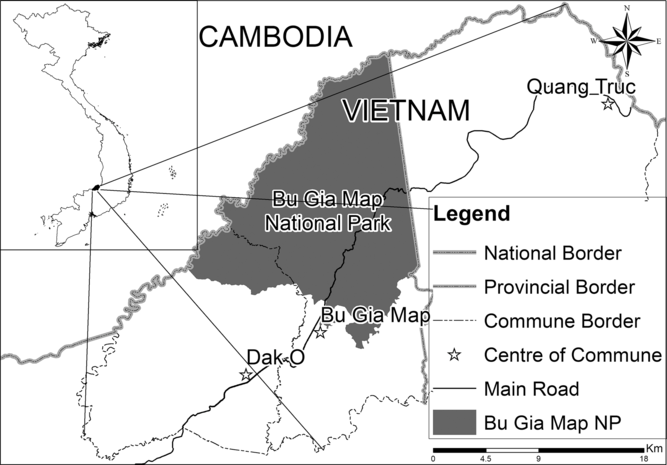
In 2002, BGMNP was upgraded from a nature reserve to a national park in order to better protect natural forests representing the transition from the central highlands to the south-east of Vietnam, and also representing typical evergreen and semi-evergreen monsoon forest ecosystems on low mountains below 1000 m above sea level. The Park is located at 12.1154° N, 107.2430° E in a mountainous area at 300–700 m altitude, which is in the north of Binh Phuoc Province (Fig. 1). It covers an area of 25 601 ha within the home range of many hardwood trees that provide natural habitats for endangered wild animals such as gibbons, langurs, Asian elephants and other globally threatened species. There are many endangered hardwood species in the Park, such as Dalbergia oliveri, Afzelia xylocarpa and other globally threatened plants. They are threatened due to the demand among locals for high-quality timber.
Map of the study site. NP = National Park.

After the American war in 1975, the demography of the buffer zones of the BGMNP was radically changed by the migration policy of the Vietnamese government and spontaneous movement of people from across the country. Before 1975, the indigenous S’tieng and M’nong peoples resided in the buffer zones of the BGMNP, and they relied on natural forests for food supplies and cultural amenities (Gregerson & Thomas Reference Gregerson and Thomas1980). They planted upland rice, corn, beans and other food crops for their sustenance. Since 1975, immigrants have moved into the buffer zones of the Park to search for new economic opportunities. Over the last four decades, the population of this area has changed significantly regarding ethnicity composition and demographics. There are c. 30 000 people from 12 ethnic groups residing in the buffer zones of BGMNP (Nguyen et al. Reference Nguyen, Lawler and Paul2019b). Indigenous people have also switched from slash-and-burn to intensive farming systems. Food crops have been replaced by cash crops such as rubber, cashew nuts, pepper, coffee and cassava (Gregerson & Thomas Reference Gregerson and Thomas1980, Nguyen et al. Reference Nguyen, Lawler and Paul2019b).
There have been no observations of people using fuelwood from natural forests because of the availability of alternatives. Local people use electricity, gas and pruned branches of coffee, rubber and cashew trees for cooking and heating. Some wooden items are important for ritual and worship, but because the study site includes people of different cultures, we use the term ‘wooden furniture’ to represent items used for both furniture and rituals. We examined timber from natural forests for use in construction and to make wooden furniture.
Sampling design
There are three communes in the buffer zones of the BGMNP, including Bu Gia Map, Dak O (Binh Phuoc Province) and Quang Truc (Dak Nong Province) (Fig. 1). Quang Truc is much further away from the border of the BGMNP, so it was excluded from the study. Twelve villages bordering the BGMNP (four in Dak O and eight in Bu Gia Map) were selected because Park managers reported that people who violated the forest law mainly lived in these areas. There were 2418 households with c. 13 500 people in these villages from 12 ethnic groups. Indigenous people and immigrants accounted for 49.4% and 50.4% of the total population of these villages, respectively. A proportionate stratified sampling method was employed to create a sample with the same fractions of indigeneity as the total population. Respondents were selected for indigenous and immigrant population subgroups with 60 and 61 households, respectively. Thus, the sample had 121 participants accounting for 5% of the total population of the study site. This survey was conducted from February to July 2017, and we achieved a 100% response rate from voluntary participants through face-to-face and prearranged interviews (Neuman Reference Neuman2014).
Questionnaire design and definitions of variables
The survey was conducted using existing questionnaires (Grosh & Glewwe Reference Grosh and Glewwe2000, Bakkegaard et al. Reference Bakkegaard, Agrawal, Animon, Hogarth, Miller and Persha2016) and included questions related to timber used for wooden furniture and construction and socioeconomic factors of households. The survey form was pretested to clarify and address problems related to the questions.
Surveys were conducted in person at the most convenient time for all respondents at their homes when they were free from work. All interviewees were the heads of households, with the support of their spouses and/or other family members. Because guided tours of houses are a good technique for the survey of wood use at the local level (Ramos et al. Reference Ramos, De Medeiros, Albuquerque, Albuquerque, da Cunha, de Lucena and Alves2014), we took a tour around the home of each respondent. A camera and a tape measure were used to collect information in the forms of pictures and dimensions of wooden items in order to determine the volume in cubic metres. Some wooden columns were buried under the ground, and respondents were asked about the depths of these holes. For natural shaped or stump-based furniture items, all dimensions were measured, and their pictures were taken at different angles. Because, when building their houses, people often use a notebook to record all required materials and expenses, the contents of these notebooks were captured using a camera to estimate the amount of timber used if it was available. Wooden furniture items made of non-native species were excluded.
Timber consumption
We focused on the amount of timber used by local people for furniture and construction since we did not observe other usages. Local people made use of timber to create furniture such as tables, chairs and other wood-carved items. In addition, they utilized timber as a building material to create windows, ceilings and other parts of the house.
Indigeneity, family size and age of heads of households
Local people were from different ethnic groups, but we categorized them into two main groups, namely indigenous people (S’tieng and M’nong) and immigrants, the latter being people who recently moved into the study area. Indigeneity may have relationships with family size and the ages of the heads of households, which may respond to the demand for timber.
Economic status
Agricultural land and crops significantly affect the incomes of farmers, and they were used as indicators of the economic status of households. In Vietnam, farm size varies because population density is unevenly distributed across regions and provinces (Marsh & MacAulay Reference Marsh and MacAulay2003, Ha et al. Reference Ha, Le, Duong and Nguyen2006). In Nghia Trung near the BGMNP, poor households own less than 2 ha of land, while rich households own more than 4 ha (Ha et al. Reference Ha, Le, Duong and Nguyen2006). Thus, we divided landowners into three groups: small (<2 ha), medium (2–4 ha) and large (>4 ha). Since the number of crops is a good proxy for the income of farmers (Chand Reference Chand1996, Di Falco & Perrings Reference Di Falco and Perrings2003, Pellegrini & Tasciotti Reference Pellegrini and Tasciotti2014), it was also included as a predictor of timber consumption.
Geographical features
Geographical features of households include residential communes (a group of villages, the second smallest territory for administrative purposes in Vietnam) and direct distances to natural forests and to the main road. Residential commune and distances from houses to the main road and natural forests may have an impact on access to the market and forest products of villagers. A handheld GPS device was used to record the coordinates of the locations of the houses of participants. These coordinates were analysed using ArcGIS v.10.3 to determine the direct distances from the houses to the Park and to the main road.
Data analysis
Descriptive statistics were calculated in order to provide an overview of households in the study, illustrating education level, family size, indigeneity, age of the head of the household, land ownership and length of residency. Descriptive statistics were applied in order to understand the proportion of timber used by local people from different sources. In addition, the number of families of woody species was listed based on information reported by respondents in the surveys. An analysis of covariance (ANCOVA) was used to identify important socioeconomic variables regarding timber consumption, as well as interactions among those socioeconomic factors and communes and indigeneity groups. Eta squared (η2) indicates the proportion of variance associated with one or more main effects, errors or interactions of variables in ANCOVA. The amount of timber was calculated in cubic metres, and common logarithms of furniture and construction timber volumes that normalize the distribution of timber consumption among households were used as response variables. The inverse function of the common logarithm (exponential function (Exp)) was used to convert the true value of dependent variables after regression. There were nine explanatory variables, including indigeneity identities, residential communes, family size, age of the head of the household, distance to the BGMNP, distance to the main road, highest education in the family, diversity of crops and land area owned by respondents. Scatterplots were used to check that the general linear model was appropriate for the data. Multicollinearity was checked by applying collinearity diagnostics. Residual diagnostics were checked to determine whether the data were consistent with the assumptions of the general linear model, including normally distributed errors, linear relationships and homogeneous variance across the range of fitted values.
Results
Overview of households
The average age of the heads of the households in the sample was 45.29 years, with an average education level of 5.89 years of formal schooling. Families averaged 5.45 members. Agricultural land was the most important income source of local people, and they owned an average of 3.93 ha. Family members earned their incomes from cash crops, husbandry, forest activities and daily labour wages. A few people were employed by the government, but their salary made little contribution to their household economies. Local people grew rubber, cashew nuts, pepper, coffee and other cash crops; the average number of cash crops was 1.74. The average distances from respondents’ homes to the main road and natural forests were 2.35 and 2.44 km, respectively.
Sources of timber consumed by respondents
All interviewees reported that they consumed timber from hardwood trees that grow in natural forests. Respondents consumed an average of 1.81 and 5.37 m3 of timber for wooden furniture and construction, respectively, and they made use of timber from woody species belonging to ten families that are native to BGMNP and its vicinity (Supplementary Appendix S1, available online). They used timber from stumps, roots, trunks and branches to create wooden items.
The timber was provided from five sources, including the BGMNP, forests in the buffer zones, local carpenters, sawmills and illegal loggers. Most of the respondents used more than one source of timber, and some of them consumed timber from all five sources. While 39 (32.2%) respondents said that their timber originated from the BGMNP, 80 (66.1%) reported that they collected timber from forests in the buffer zones. They also said that their timber was provided by local carpenters; 102 (84.3%) people used wooden furniture from this source. Forty (33.1%) people responded that they bought their timber from local sawmills and 32 (26.5%) used timber provided by illegal loggers.
Socioeconomic, indigeneity and geographical determinants of timber consumption
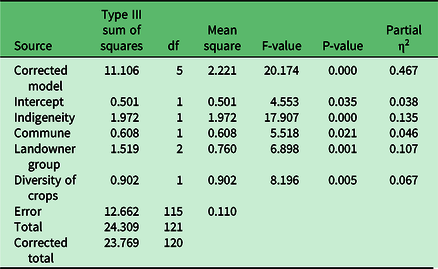
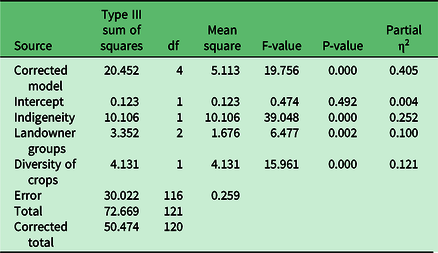
For both furniture (Table 1) and construction timber consumption (Table 2), the socioeconomic factors including land area owned and diversity of crops were statistically significantly related. After controlling for socioeconomic factors, indigeneity and commune were found to be related to the consumption of furniture timber, whereas only indigeneity was related to the consumption of construction timber. Interactions among the socioeconomic factors and both indigeneity and commune were found to be non-significant, indicating that the effects of the socioeconomic variables were consistent across these groups.
Analysis of covariance test of between-subject effects on the consumption of timber for furniture.

Analysis of covariance test of between-subject effects on the consumption of timber for construction.

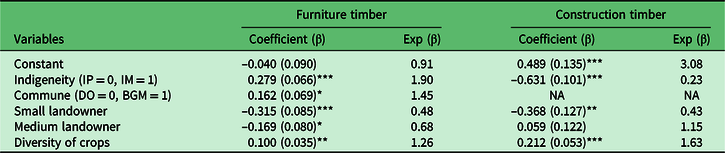
The ANCOVA model explained 46.7% (R2 = 0.467, F = 20.174, p < 0.001) of the variation in the amount of furniture timber consumed by villagers, indicating other important determinants of consumption that were not included in the present study. Indigenous people and immigrants both used timber for construction and wooden furniture, but they have different size and grain texture patterns. The parameter estimates for the ANCOVA model (Table 3) indicate that immigrants used almost twice (1.90 times) as much timber for furniture construction as indigenous people. People who live in the Bu Gia Map commune used 45% more (1.45 times) timber than people living in the Dak O commune. For every unit increase in crop diversity, the consumption of timber for furniture increased by 26% (1.26 times). The difference in the amount of furniture timber consumed by the small and medium landowner groups, compared to the large landowner group, was statistically significant, although there was no discernible difference in consumption between these two groups. The small landowner group was estimated to use 48% (0.48 times) as much timber as the large landowner group, and the medium landowner group used 68% (0.68 times) as much.
Fitted analysis of covariance models with common log transformations of furniture and construction timber as dependent variables (n = 121).

*p < 0.05, **p < 0.01, ***p < 0.001, coefficient (standard deviation).
BGM = Bu Gia Map; DO = Dak O; Exp = exponential; IM = immigrants; IP = indigenous people; NA = not applicable.
The ANCOVA model shows that independent variables explained 40.5% (R2 = 0.405, F = 19.756, p < 0.001) of the variation in the consumption of timber for construction. The parameter estimates for the ANCOVA model (Table 3) indicate that immigrants use 23% (0.23 times) as much timber as indigenous people. For every unit increase in crop diversity, the consumption of timber for construction increased by 63% (1.63 times). The small landowner group used 43% (0.43 times) as much construction timber as the large landowner group.
Discussion
We found that the consumption patterns differed between timber used for construction and timber used for wooden furniture. Large landowners used more timber for wooden furniture than medium and small landowners, while there was no significant difference between medium and small landowners. Large and medium landowners were not significantly different from each other in the consumption of timber for construction, and both used more timber for construction than small landowners. We found that more crops led to an increase in timber used for both construction and furniture. Indigenous people used more timber for construction, but they used less timber for furniture than immigrants. In addition, the village with better access to markets used less timber for furniture.
Our observations confirmed the first hypothesis that higher socioeconomic households consume more timber, especially if it was used for wooden furniture. In areas such as this with land-based incomes, land area owned and crop diversity are robust proxies for the socioeconomic status of people because they significantly contribute to the income of households (Di Falco & Perrings Reference Di Falco and Perrings2003, Pellegrini & Tasciotti Reference Pellegrini and Tasciotti2014). Timber from natural forests is often expensive, and wooden products from these resources are only available to richer people (Bui et al. Reference Bui, Harrison, Lamb and Brown2005, Nguyen Reference Nguyen2008, Nguyen & Harwood Reference Nguyen and Harwood2017). Our results are consistent with previous findings of positive relationships between the socioeconomic status and the consumption of timber products from natural forests (Nguyen Reference Nguyen2008, Mitra & Mishra Reference Mitra and Mishra2011, Baba et al. Reference Baba, Islam and Sofi2016, Nguyen & Harwood Reference Nguyen and Harwood2017). Thus, managers of forests and conservation projects need to target higher socioeconomic households to induce them to abandon their consumption of timber from natural forests. The free listing question was used to understand the origin of timber, and respondents freely listed sources from which they obtained their timber. Although some people admitted their direct collection of timber from the BGMNP, other people did not reveal or maybe gave only part of the story. This problem can be solved by conducting indirect questions to improve the information from future studies.
The lack of difference between the large and medium landowner groups in the consumption of timber for construction may be explained by the lower costs associated with construction as compared to furniture making, both in labour and in the types of timber required. Construction materials do not require timber with good grain texture, and buildings often have a simple, low-price design, meaning that the medium landowner group can afford these products (Bui et al. Reference Bui, Harrison, Lamb and Brown2005, Nguyen Reference Nguyen2008, Nguyen & Harwood Reference Nguyen and Harwood2017).
The findings of this study supported our second hypothesis in part by showing that indigenous people consume more timber for construction than immigrants. Indigenous people are native to natural forests and have close relationships with their surrounding environment (Gadgil et al. Reference Gadgil, Berkes and Folke1993). Indigenous people possess a good knowledge of natural forests, which enables them to use more products in general (Gadgil et al. Reference Gadgil, Berkes and Folke1993, McElwee Reference McElwee2010). Indigenous people often consider forest plants as their main source of food supplies, herbal remedies, construction materials and cultural amenities (Gadgil et al. Reference Gadgil, Berkes and Folke1993, Lawrence et al. Reference Lawrence, Phillips, Ismodes, Lopez, Rose, Wood and Farfan2005, McElwee Reference McElwee2010). Lawrence et al. (Reference Lawrence, Phillips, Ismodes, Lopez, Rose, Wood and Farfan2005) indicate that indigenous people value forest plants for their construction materials more than their immigrant counterparts in Madre de Dios in Peru. The results of this study are in agreement with the findings of other researchers that indigenous people consume more forest products than immigrants in many parts of the world (Sah & Heinen Reference Sah and Heinen2001, Lacuna-Richman Reference Lacuna-Richman2003, Coulibaly-Lingani et al. Reference Coulibaly-Lingani, Tigabu, Savadogo, Oden and Ouadba2009, Laird et al. Reference Laird, Awung, Lysinge and Ndive2011, Webb & Dhakal Reference Webb and Dhakal2011, Nguyen et al. Reference Nguyen, Lawler and Paul2019b).
We also found, however, that indigenous people used less timber than immigrants for furniture. Previous studies only examined the use of non-timber forest products or combined timber and non-timber products without comparing the use of timber for furniture and construction (Sah & Heinen Reference Sah and Heinen2001, Lacuna-Richman Reference Lacuna-Richman2003, Coulibaly-Lingani et al. Reference Coulibaly-Lingani, Tigabu, Savadogo, Oden and Ouadba2009, Laird et al. Reference Laird, Awung, Lysinge and Ndive2011, Webb & Dhakal Reference Webb and Dhakal2011, Nguyen et al. Reference Nguyen, Lawler and Paul2019b). There are several possible reasons why immigrants consumed more furniture timber than indigenous people. Immigrants may have a preference for artistic woodcarving and highly decorated furniture items (Nguyen & Harwood Reference Nguyen and Harwood2017). Indigenous people may have cultural customs that prevent them from using specific species (Saj et al. Reference Saj, Mather and Sicotte2006, Dudley et al. Reference Dudley, Higgins-Zogib and Mansourian2009, Pungetti Reference Pungetti2012). These findings have clear implications for park managers, who need to create interventions based on the consumption purposes of indigenous people and immigrants.
Our observations partially supported the last hypothesis by showing that villagers in the Dak O commune consumed less furniture timber than villagers in the Bu Gia Map commune, although there was no difference between the communes with respect to construction timber. The easy access to markets allows people to find alternative products that reduce their reliance on natural forests (Masozera & Alavalapati Reference Masozera and Alavalapati2004, Schaafsma et al. Reference Schaafsma, Morse-Jones, Posen, Swetnam, Balmford and Bateman2014). The Dak O commune has better access to markets because it is nearer to the district centre. This finding is in agreement with other studies that highlight the importance of better access to markets in reducing the consumption of products from natural forests (Masozera & Alavalapati Reference Masozera and Alavalapati2004, Mitra & Mishra Reference Mitra and Mishra2011). Thus, when alternatives are available, people can choose not to consume timber from the forest.
Park managers and local governors need to create interventions based on socioeconomic factors including landownership, diversity of crops, indigeneity identities and communes. An integrated conservation programme should focus on law enforcement and education to reduce the consumption of timber from natural forests; this approach reduced hunting and making use of the Lora parrot as pets in Bonaire in the Dutch Caribbean (Salazar et al. Reference Salazar, Mills and Veríssimo2019). In addition, silviculture methods are available for woody trees such as acacias, eucalypts and hongmu to be grown in forest plantations, and timber can be harvested within a short period of time (Bui et al. Reference Bui, Harrison, Lamb and Brown2005, Xu et al. Reference Xu, Zeng, Cui, Chen and Ma2016, Nguyen & Harwood Reference Nguyen and Harwood2017). Timber from forest plantations has been used in the north-west of Vietnam and the Philippines, contributing to the conservation of natural forests (Walters Reference Walters2004, Nguyen & Harwood Reference Nguyen and Harwood2017); therefore, timber from forest plantations may provide alternative materials for villagers.
Conclusion
We hypothesized that people of higher socioeconomic status, indigenous groups and those who live farther from markets consume more furniture and construction timber. People belonging to higher socioeconomic groups (owning >4 ha of land), immigrants and those with less access to markets consumed more timber for furniture, while higher socioeconomic groups and indigenous people consumed more timber for construction. Further studies need to examine the sources of timber, cultural contexts and the priority of wood used for different purposes. Our results also suggest that integrated forms of conservation accounting for law enforcement, environmental education and timber alternatives should be applied to reduce threats to woody trees in natural forests.
Supplementary material
To view supplementary material for this article, please visit https://doi.org/10.1017/S0376892920000454.
Acknowledgements
We would like to express our sincere thanks to the Endeavour Scholarship Program (Australian government), World Wildlife Fund (USA) and The Graduate School at La Trobe University for their generous support of the first author to pursue his PhD and fieldwork that acted as a baseline platform for this manuscript. We would like to send our gratitude to the park managers, local officers and villagers for their support and participation. We would like to sincerely thank the two anonymous reviewers for their invaluable comments that helped to improve the manuscript.
Financial support
None.
Conflict of interest
None.
Ethical standards
The authors assert that all procedures contributing to this work comply with the ethical standards of the relevant national and institutional committees on human experimentation and with the Helsinki Declaration of 1975, as revised in 2008.