Introduction
Several studies support an association between neighborhood characteristics and sleep outcomes (McHale et al., Reference McHale, Kim, Kan and Updegraff2010; Astell-Burt et al., Reference Astell-Burt, Feng and Kolt2013; Singh and Kenney, Reference Singh and Kenney2013). For example, a recent large study of Australians found that individuals living in neighborhoods with less green space had a higher risk of short sleep duration (Astell-Burt et al., Reference Astell-Burt, Feng and Kolt2013), and a study of Mexican-American adolescents revealed that those living in neighborhoods with more crime took longer naps (McHale et al., Reference McHale, Kim, Kan and Updegraff2010). Singh and Kenney (Reference Singh and Kenney2013) found that neighborhood characteristics, such as lower perceived safety, greater garbage and litter, poor or dilapidated housing, and vandalism, were associated with a higher prevalence of sleep problems in US children and adolescents. Only a few studies have investigated neighborhood-specific indices other than demographic and socio-economic status as predictors of sleep in older adults (Riedel et al., Reference Riedel2012; Astell-Burt et al., Reference Astell-Burt, Feng and Kolt2013; DeSantis et al., Reference DeSantis, Diez Roux, Moore, Baron, Mujahid and Nieto2013), and we are aware of none that have been conducted in nationally representative samples of US older adults.
Studies assessing the association between socio-environmental factors and insomnia in older adults are of great potential importance, given the elevated prevalence of insomnia among older people and the association between insomnia and poor health outcomes in the growing population of older adults (Ancoli-Israel and Cooke, Reference Ancoli-Israel and Cooke2005; Ustinov et al., Reference Ustinov, Lichstein, Wal, Taylor, Riedel and Bush2010; Kaufmann et al., Reference Kaufmann2013). Therefore, the goal of the present study was to determine the association between neighborhood characteristics and insomnia symptoms in a nationally representative survey of middle-aged and older adults in the United States. Based on past studies’ findings of an association between neighborhood factors and sleep outcomes in older adults (Riedel et al., Reference Riedel2012; Astell-Burt et al., Reference Astell-Burt, Feng and Kolt2013; DeSantis et al., Reference DeSantis, Diez Roux, Moore, Baron, Mujahid and Nieto2013), we hypothesized that poorer scores on measures of neighborhood physical disorder (Smith et al., Reference Smith2013) and neighborhood social cohesion (Smith et al., Reference Smith2013) would be associated with an increased likelihood of insomnia symptoms. Socio-demographic and socio-economic variables, such as race/ethnicity and poverty have been shown to be related to sleep (Gamaldo et al., Reference Gamaldo, McNeely, Shah, Evans and Zonderman2013; Grandner et al., Reference Grandner, Petrov, Rattanaumpawan, Jackson, Platt and Patel2013) and have been known to be associated with neighborhood characteristics and/or cohesion (Galster, Reference Galster2006). We further hypothesized that the association between neighborhood and sleep should be independent of demographic and economic factors.
Methods
Participants
We studied participants in the Health and Retirement Study (HRS), a longitudinal panel study of middle-aged and older adults started in 1992 sponsored by the National Institute on Aging (grant number NIA U01AG009740) and conducted by the University of Michigan. In addition to the original cohort in 1992, five additional sub-samples of individuals were added in 1993, 1998 (two sub-samples), 2004, and 2010. Data on health, employment, wealth, and well-being are collected every two years from more than 26,000 individuals aged more than 50 years (Karp, Reference Karp2007). HRS uses multi-stage area probability sampling with clustering and oversamples Blacks, Hispanics, and Florida residents (Heeringa and Connor, Reference Heeringa and Connor1995). When weighted by survey weights, the HRS sample is representative of the community-dwelling middle-aged and older adults in the United States. The HRS participants provided informed consent, and the HRS has been approved by the University of Michigan Institutional Review Board and the National Institute on Aging.
We limited our analyses to 7,231 HRS participants aged over 50 years with complete data for at least one neighborhood variable and one insomnia variable at the 2006 wave. A total of 5,178 (71.6%) of these individuals also had insomnia and neighborhood data at the 2010 wave. For these individuals, both 2006 and 2010 data were used in analyses.
Measures
neighborhood variables
Eight questions related to neighborhood characteristics were included as part of a Psychosocial and Lifestyle Questionnaire (Smith et al., Reference Smith2013). On this measure, participants were asked to rate the extent of neighborhood physical disorder (four items: vandalism/graffiti, rubbish, vacant/deserted houses, and perceived safety walking alone at night) and social cohesion (four items: feeling part of the area, trusting people, friendliness of people, and the availability of help if in trouble) within a distance of about 1 mile, or a 20-minute walk, from one's home. Ratings were made on a seven-point Likert-type scale (generally, 1 = more favorable scores, 7 = worse scores). An average score for neighborhood physical disorder items was created on a scale of 1 to 7, with higher numbers indicating more physical disorder. Similarly, average scores for lower social cohesion items (rated using the same Likert-type scale) were coded such that higher scores indicated lower, or poorer, social cohesion.
insomnia
Participants were asked about “trouble falling asleep,” “trouble waking up during night,” “trouble waking up too early,” and “feeling rested in morning.” Responses were categorical, with options including “most of the time,” “sometimes,” and “rarely or never.” We converted categorical responses into binary ones. Specifically, for trouble falling asleep, waking up during the night, and waking up too early, we took responses of “most of the time” and “sometimes” to indicate an insomnia symptom and “rarely or never” to indicate its absence. We reverse coded the “feeling rested” variable such that it represented not feeling rested; responses of “sometimes” or “rarely or never” reflected presence of this symptom and “most of the time” indicated its absence.
demographic and health characteristics
Demographic variables, such as age, sex (male/female), race (non-Hispanic White/non-Hispanic Black/Hispanic/Other), education (less than a high school education or a completed GED, high school diploma, some college or a completed college degree, or graduate degree), and total household income (created categories of <$25,000, $25,000–49,999, $50,000–74,999, $75,000–100,000, and above $100,000) were included in analyses. Income information was based on imputed income data files generated by RAND researchers (RAND, 2006; 2010). Details of the imputation process were also supplied by RAND (Chien et al., Reference Chien2013). Body Mass Index (BMI; kg/m2), depressive symptoms as measured by the eight-item version of the Center for Epidemiologic Studies Depression Scale (CES-D; Radloff, Reference Radloff1977), and a number of self-reported health conditions – including hypertension, heart problems (i.e. heart attack, coronary heart disease, angina, congestive heart failure, other heart problems), stroke, diabetes, cancer, and arthritis – were also included in select analyses. A self-reported “memory-related disease” variable was available only in 2006; also, “dementia, senility or any other serious memory impairment” and self-reported Alzheimer's disease were available as two separate variables, but only in 2010. Participants also reported whether they ever consumed alcoholic beverages, and whether they were current smokers.
Statistical analyses
We computed descriptive statistics for the sample, as well as Spearman correlation coefficients between neighborhood physical disorder and lower social cohesion at 2006. For each insomnia symptom, we fit three multivariable Generalized Estimating Equation (GEE) models with neighborhood physical disorder or social cohesion as the primary predictor and the insomnia symptom as the outcome. The first model (Model 1) was adjusted for demographic variables (age, income, education, race, and sex); the second (Model 2) controlled for these covariates and BMI, depressive symptoms, smoking, and alcohol consumption; and the third (fully adjusted) model (Model 3) controlled for these covariates and health conditions. Because resident income is closely related to neighborhood characteristics, we also conducted a sensitivity analysis exploring models both with and without income as a covariate. Because, as described above, different dementia/Alzheimer's disease variables were available in 2006 and 2010, we conducted a second set of sensitivity analyses using 2006 and 2010 data in which we controlled for these three covariates in three separate analyses and compared results with the results from models without them.
Models included data from both 2006 and, when available, 2010, with predictors, outcomes, and most covariates (except for sex, race, and education) allowed to be time varying between 2006 and 2010. For all covariates except sex, race, and education, values for demographic characteristics were used from both 2006 and 2010.
Analyses applied survey weights to ensure the national representativeness of data. To generate population-average estimates of the association between neighborhood characteristics and insomnia, and to account for the lack of independence in variables between 2006 and 2010, we used GEE analysis with a logit link, a binomial family, and a robust variance estimator; the latter is appropriate for the analysis of data from the same individuals over multiple time points. Interaction terms were included between the neighborhood variables and age to investigate the associations between neighborhood characteristics and insomnia as people aged. Analyses were conducted using Stata Version 12.1 (StataCorp, 2011) and the public use data from HRS (Health and Retirement Study, 2010; 2013a; 2013b).
Results
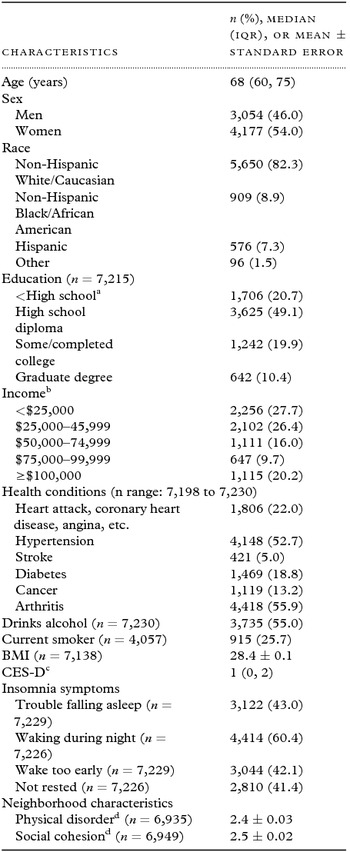
Overall, 54% of our 7,231 participants were women (Table 1). Approximately 82% were non-Hispanic White, about 9% were non-Hispanic Black, and roughly 7% were Hispanic. Approximately 21% of the participants either did not complete high school or completed a GED, almost half of the participants had a high school diploma, and roughly 30% of the participants had some college or more education. Approximately half of the participants had an income of $50,000 or less, while 20% had an income of $100,000 or more. In 2006, the median age was 68 years and the mean BMI was 28.4 (i.e. overweight). Over half of the individuals reported hypertension, about 19% diabetes, and about 22% a heart attack/coronary event; about 5% of the individuals had experienced a stroke. Approximately 13% reported cancer, and almost 56% had arthritis. Over 25% were current smokers, and more than half (55%) ever consumed alcoholic beverages. In terms of insomnia symptoms, over 40% of the individuals reported trouble falling asleep, waking up too early, and not feeling rested; about 60% of the individuals reported trouble in waking up during the night. The mean neighborhood physical disorder score in 2006 was 2.4, and the mean neighborhood social cohesion score was 2.5 (range 1–7, 7 = worst). In our analyses, neighborhood physical disorder and neighborhood lower social cohesion were moderately correlated (r = 0.46, p < 0.001 in 2006). Because of this correlation, we were precluded from investigating their independent contributions to insomnia symptoms within the same model.
Participant characteristics at 2006

Notes: n = 7,231 unless otherwise specified. All percentages are weighted to account for unequal probability of selection of sample, and standard errors are corrected (survey weights are applied) to make results nationally representative. Some percentage values do not sum to 100 due to rounding.
IQR = Interquartile range.
a<High school includes those with a GED.
bIncome represents imputed total household income (respondent and spouse; imputations performed by RAND, 2010; 2006).
cCES-D is an abbreviated, eight-item version. Lower CES-D scores indicate less depressive symptoms.
dHigher scores indicate worse physical disorder or social cohesion.
Neighborhood physical disorder
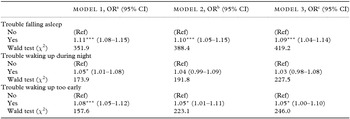
After adjustment for age, sex, race, income, and education (Model 1), for every one-point higher score in neighborhood physical disorder, there was an 11% higher odds of trouble falling asleep (OR = 1.11, 95% CI: 1.08–1.15; Table 2). Similarly, higher scores in neighborhood physical disorder were associated with a higher odds of trouble in waking up during the night and trouble in waking too early (Model 1). After further adjustment for BMI, depressive symptoms, smoking, and alcohol consumption (Model 2), increases in neighborhood physical disorder remained associated with a higher odds of trouble falling asleep (OR = 1.10, 95% CI: 1.05–1.15) and waking up too early (OR = 1.05, 95% CI: 1.01–1.11), but was no longer significantly associated with waking up during the night (OR = 1.04, 95% CI: 0.99–1.09). After additional adjustment for medical conditions (Model 3), every one-point increase in neighborhood physical disorder was associated with a 9% higher odds of trouble falling asleep (OR = 1.09, 95% CI: 1.04–1.14) and 5% higher odds of waking up too early (OR = 1.05, 95% CI: 1.00–1.10).
Association between neighborhood physical disorder and insomnia symptoms

Notes: OR = Odds Ratio; CI = Confidence Interval; GEE analyses were weighted by survey weights.
aModel 1 (n = 6,930) controls for age, income, race, education, and sex.
bModel 2 (n = 3,894–3,896) controls for variables in Model 1 plus BMI, depressive symptoms, smoking, and alcohol consumption.
cModel 3 (n = 3,877–3,879) controls for variables in Model 2 plus hypertension, heart condition (heart attack, coronary heart disease, angina, etc.), stroke, diabetes, cancer, and arthritis.
*p < 0.05, **p < 0.01, ***p < 0.001.
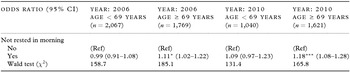
Because the interaction between neighborhood physical disorder and age was significant for the outcome of not feeling rested in the fully adjusted model (p = 0.046), we stratified analyses by time (2006 vs. 2010) and by median age, after combining 2006 and 2010 data (<69 vs. ≥69). We found that there was no association between neighborhood disorder and feeling rested among adults aged <69 years at either time point; however, greater disorder was associated with a greater odds of not feeling rested at both time points among those aged ≥69 years (i.e. 2006 OR = 1.11, 95% CI: 1.02–1.22; 2010 OR = 1.18, 95% CI: 1.08–1.28; Table 3).
Association between neighborhood physical disorder and not feeling rested in the morning, stratified by time and agea

Notes: aModel controls for income, race, education, sex, BMI, depressive symptoms, smoking, alcohol consumption, hypertension, heart condition (heart attack, coronary heart disease, angina, etc.), stroke, diabetes, cancer, and arthritis.
*p < 0.05, **p < 0.01, ***p < 0.001.
Neighborhood social cohesion
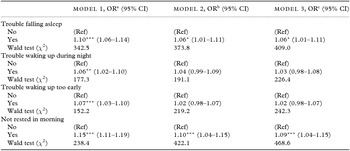
Table 4 shows similar associations between lower social cohesion and insomnia symptoms as seen for neighborhood physical disorder. Model 1 shows an association between poorer social cohesion and significantly higher odds of each of the four insomnia symptoms. These results remained significant in the fully adjusted model for trouble in falling asleep (OR = 1.06, 95% CI: 1.01–1.11) and not feeling rested in the morning (OR = 1.09, 95% CI: 1.04–1.15; Table 4). In each of these instances, poorer social cohesion was associated with a 6% or 9% increased odds of these symptoms respectively.
Association between lower neighborhood social cohesion and insomnia symptoms

Notes: OR = Odds Ratio; CI = Confidence Interval; GEE analyses were weighted by survey weights.
aModel 1 (n = 6,934–6,935) controls for age, income, race, education, and sex.
bModel 2 (n = 3,896–3,898) controls for variables in Model 1 plus BMI, depressive symptoms, smoking, and alcohol consumption.
cModel 3 (n = 3,879–3,881) controls for variables in Model 2 plus hypertension, heart condition (heart attack, coronary heart disease, angina, etc.), stroke, diabetes, cancer, and arthritis.
*p < 0.05, **p < 0.01, ***p < 0.001.
Sensitivity analyses
In the sensitivity analysis excluding income from models with neighborhood physical disorder or social cohesion as the predictor, neither point estimates nor statistical significance changed substantially as compared with the models that included income (results not shown).
The second sensitivity analysis added the 2006 memory-related disease variable, the 2010 Alzheimer's disease variable, or the 2010 “dementia, senility, or any other serious memory impairment” variable to Model 3. Although most results did not change, one association – between social cohesion and not feeling rested (OR = 1.09, 95% CI: 1.00–1.19, p = 0.047) – fell just below significance after including the 2010 dementia/senility variable (OR = 1.09, 95% CI: 1.00–1.18, p = 0.056). The social cohesion-feeling-rested association remained significant and did not change meaningfully after including the 2010 Alzheimer's disease variable and after adding the 2006 memory-related disease variable (data not shown).
Discussion
In this nationally representative study of adults aged 51 years and older, we found that both greater neighborhood physical disorder and lower neighborhood social cohesion were associated with greater odds of trouble falling asleep, and that greater physical disorder was associated with waking up too early in the morning. Lower social cohesion was associated with a greater odds of not feeling rested in the morning across age groups; higher neighborhood physical disorder was associated with a greater odds of not feeling rested in individuals aged 69 years and older only. These associations remained after adjustment for numerous demographic and health variables, suggesting that neighborhood characteristics may exert independent effects on insomnia in the US middle-aged and older adults. In addition, the differential association between neighborhood disorder and insomnia by age group suggests that the sleep of older adults aged 69 years or over may be more sensitive to the effects of neighborhood disorder than that of older adults aged less than 69 years.
Multiple studies support an association between neighborhood characteristics and sleep outcomes. DeSantis and colleagues (Reference DeSantis, Diez Roux, Moore, Baron, Mujahid and Nieto2013) identified an association between greater neighborhood disorder and shorter sleep duration, as well as greater social cohesion and lower daytime sleepiness, adjusting for demographics, depressive symptoms, and health-related factors. However, DeSantis et al.'s (Reference DeSantis, Diez Roux, Moore, Baron, Mujahid and Nieto2013) results differed from ours in that they did not find an association between neighborhood factors and insomnia, perhaps because they included physician diagnosis in their operationalization of insomnia. A housing intervention study by Simonelli et al. (Reference Simonelli2013) found that improving slum housing in Buenos Aires led to improved sleep quality as measured by the Pittsburgh Sleep Quality Index. Older studies support a link between social factors, namely social contact frequency and emotional support, with insomnia (Hanson and Östergren, Reference Hanson and Östergren1987). Social factors have been previously associated with sleep, but to our knowledge, neighborhood-level social cohesion has only recently become a topic of interest (e.g. Mendes de Leon et al., Reference Mendes de Leon2009; DeSantis et al., Reference DeSantis, Diez Roux, Moore, Baron, Mujahid and Nieto2013). The present study adds to the literature on neighborhood disorder/lack of cohesion and sleep by highlighting these neighborhood characteristics as potential risk factors for insomnia in older adults, a population with an elevated prevalence of sleep disturbances.
Research on neighborhood characteristics and insomnia symptoms in older adults has important implications for the connection between environment and health in this population. Not only does this research point to an important role of neighborhood factors with respect to sleep – an important component of health – but it also suggests that modifying neighborhood factors may have positive effects on insomnia and, in turn, on health in general. Evidence supports associations between poor sleep and both poor health-related quality of life in older adults (Reid et al., Reference Reid2006) and cognitive difficulties (Roth and Ancoli-Israel, Reference Roth and Ancoli-Israel1999) as well as reduced daytime functioning in other domains, such as depressive symptoms, anxiety, and fatigue (Ustinov et al., Reference Ustinov, Lichstein, Wal, Taylor, Riedel and Bush2010). Therefore, neighborhood physical disorder and lack of social cohesion could affect a variety of health factors and overall quality of life through their impact on sleep.
Several different mechanisms could account for the association between neighborhood disorder/cohesion and insomnia. First, physical or mental health status could play a mediating role in the association between neighborhood characteristics and sleep quality. Changes in some of our inferences after controlling for mental and health conditions, in Models 2 and 3, lend support to this possibility. Second, positive aspects of neighborhood life may be associated with feelings of safety and security, decreasing hyperarousal that may interfere with sleep (Simonelli et al., Reference Simonelli2013). Third, a distrust of people, one component of our index of low social cohesion, has been shown to be associated with social isolation (Krause, Reference Krause1993), which in turn is associated with greater hypothalamic–pituitary–adrenal (HPA) activation (Cacioppo et al., Reference Cacioppo, Hawkley, Norman and Berntson2011). Evidence suggests that HPA activation and higher cortisol levels may be dysregulated in insomnia (Rodenbeck and Hajak, Reference Rodenbeck and Hajak2001) and may link poor social cohesion to poor sleep. Finally, we acknowledge that many other potential factors may play a role in the association between neighborhood characteristics and insomnia, including neighborhood factors such as housing density, type of housing, number of co-residents, presence of community gardens, and neighborhood noise as well as shift work and use of stimulants such as caffeine. Future research should explore these additional factors as they relate to neighborhood characteristics and insomnia.
Strengths of our study included its large nationally representative sample, comprehensive insomnia symptom assessment, and investigation of both neighborhood physical disorder and social cohesion. Further, we adjusted for a number of potential confounders of the association between neighborhood characteristics and insomnia symptoms in analyses. However, it is possible that observed associations are confounded by unmeasured variables or variables not included in analyses. This may have led to an overestimation of ORs. Another limitation is the absence of objective sleep measures from HRS. Objective sleep measures (e.g. wrist actigraphy), as well as other potential confounders/mediators not included in our study, should be considered in the future research.
In conclusion, we found higher neighborhood disorder and lower neighborhood social cohesion to be associated with a greater odds of insomnia in a nationally representative sample of community-dwelling middle-aged and older adults. To the extent that this link between neighborhood disorder and disturbed sleep is causal, neighborhood-level variables may be modifiable risk factors that can be targeted to improve sleep and related health outcomes.
Conflict of interest
Dr. Michael Smith holds an equity stake in BMED Technologies, which develops self-help materials for behavioral disorders, including insomnia. Potential conflicts related to this interest are managed by the Johns Hopkins University Conflict of Interest Office. Dr. Ramin Mojtabai has received consulting fees from Lundbeck Pharmaceuticals. None of these companies played any role in the formulation of research questions, choice of study design, data collection, data analysis, or any other aspect of this research.
Description of authors’ roles
L.P. Chen-Edinboro performed statistical analyses and wrote the paper. C.N. Kaufmann and R. Mojtabai assisted with statistical analyses and contributed to revising the paper. A.P. Spira conceived and planned the study, supervised data analysis, and revised the manuscript. J.L. Augustinavicius helped to review the literature and contributed to revising the paper. J.M. Parisi and M.T. Smith helped with the presentation and/or interpretation of the data, and they also contributed to revising the paper. A.M.V. Wennberg contributed to revising the paper.
Acknowledgments
This work was supported by the National Institute of Mental Health Psychiatric Epidemiology Training Program (T32MH014592 to LPC-E); National Institute on Aging (F31AG044052 to CNK and K01AG033195 to APS); National Institute of Arthritis and Musculoskeletal and Skin Disease, and National Institute of Dental and Craniofacial Research (R01DA032922, R01AR059410, R01DE019731 to MTS). None of these funders played any role in the research for this study. The HRS is sponsored by the National Institute on Aging (grant number NIA U01AG009740) and conducted by the University of Michigan. The content is solely the responsibility of the authors and does not necessarily represent the official views of the National Institutes of Health. This analysis uses Early Release data from HRS (RAND 2010 HRS Core Income and Wealth Imputations), sponsored by the National Institute on Aging (grant number NIA U01AG009740) and conducted by the University of Michigan. These data have not been cleaned and may contain errors that will be corrected in the Final Public Release version of the dataset.