


Games are an important leisure activity for social interaction, mental stimulation, and enjoyment. Games are activities directed towards accomplishing specific goals within an established set of rules (Suits, Reference Suits1967). Although games are a common leisure activity undertaken by older adults (Jopp & Hertzog, Reference Jopp and Hertzog2010), there is a tendency to focus on game playing earlier in life, particularly in the context of development, socialization, and education. In young children, game playing has been found to increase cooperation (Bay-Hinitz, Peterson, & Quilitch, Reference Bay-Hinitz, Peterson and Quilitch1994) and to improve numerical proficiency (Ramani & Siegler, Reference Ramani and Siegler2008). With adolescents, improved cognitive abilities (Spence & Feng, Reference Spence and Feng2010) and stress relief (Colwell, Reference Colwell2007) have also been identified.
Interest has been growing in the use of digital games, which include video, computer, and mobile-based games, as a means of preventing cognitive decline, increasing physical activity, and improving overall well-being among older adults (Connolly, Boyle, MacArthur, Hainey, & Boyle, Reference Connolly, Boyle, MacArthur, Hainey and Boyle2012). Digital game playing has been demonstrated to increase working and short-term memory, reasoning, task switching (Basak, Boot, Voss, & Kramer, Reference Basak, Boot, Voss and Kramer2008), and multi-tasking (Anguera et al., Reference Anguera, Boccanfuso, Rintoul, Al-Hashimi, Faraji, Janowich and … Gazzaley2013) among older adults. Simulated digital sports games have also been associated with improved physical measures, particularly cardio-respiratory fitness (Maillot, Perrot, & Hartley, Reference Maillot, Perrot and Hartley2012) and promotion of physical activity (Gerling, Schulte, & Masuch, Reference Gerling, Schulte and Masuch2011). A study by Allaire et al. (Reference Allaire, Collins McLaughlin, Trujillo, Whitlock, LaPorte and Gandy2013) found that, compared to non-gamers, digital gamers reported significantly better well-being, lower negative affect, and less depression. Although this study provides evidence for potential benefits of digital game playing, it is interesting to note the majority of the games played were digital versions of traditional card games.
Despite the recent focus on digital games, surprisingly little is known about non-digital game playing among older adults. This may reflect a tendency in health research generally to focus on negative outcomes and disease states (Richman, Kubzansky & Maselko, Reference Richman, Kubzansky and Maselko2005). It may also stem from assumptions that game playing among older adults is primarily a means of distraction (Marken, Reference Marken2005). In contrast, only in the past few years have constructs like playfulness in older adults become a topic of research (Yarnal & Qian, Reference Yarnal and Qian2011).
The small number of studies we were able to identify on non-digital game playing focused primarily on the reasons older adults played games. A qualitative study found that older adults played games for five main reasons: mental and physical fitness, continuity, competition, temporal structure, and belonging (Hoppes, Wilcox, & Graham, Reference Hoppes, Wilcox and Graham2001). Similarly, a study of an African-American women’s card playing group revealed it provided not just a venue for socializing, but also a means for dealing with stress and strengthening social ties (Outley & McKenzie, Reference Outley and McKenzie2007). Playing outdoor recreational games, such as Bocce or lawn bowling, might be associated with perceived improvements in social and physical functioning (Bronikowska, Bronikowski, & Schott, Reference Bronikowska, Bronikowski and Schott2011). O’Brien Cousins and Witcher (2007) found that bingo players cited entertainment and social interactions, with the opportunity to make new social connections, as motives for participation.
Relatively little is known about the demographic predictors of, and outcomes associated with, non-digital game playing. One study indicated that less active, older, widowed women with less education and physical limitations, living in rural areas are more likely to play bingo (O’Brien Cousins & Witcher, 2007). This suggests that the types of games older adults play may be associated with a variety of personal characteristics, and game selection may reflect social capital/status (e.g., games like bingo may be denigrated) (Gillies, Reference Gillies2007). As has been found with digital games, there may also be a cognitive benefit with non-digital game playing, as a prospective cohort study found that older adults who played board games were less likely to develop dementia (Verghese et al., Reference Verghese, Lipton, Katz, Hall, Derby, Kuslansky and … Buschke2003).
Given the importance of non-digital game playing as a leisure activity among older adults and the limited knowledge in this area, we undertook a study to (a) determine the proportion of older adults who play non-digital games, (b) categorize the types of games played and patterns of playing, (c) explore the motivations and perceived benefits of non-digital game playing, and (d) determine socio-demographic factors that are predictors for perceived benefits of non-digital game play.
Methods
This study used data collected from a large cross-sectional survey about patterns of digital and non-digital game-playing among older adults. Approval for this study was obtained by the local university ethics board.
Participants and Recruitment
Adults over the age of 55 years who were able to read and write in English were recruited to participate in this study from four shopping malls, seven residential facilities, six seniors’ centres, and 17 community centres within Greater Vancouver in British Columbia, Canada. We selected the age of 55 as this is the lower age limit of what has been described as the third and fourth ages (Neugarten, Reference Neugarten1974) and chose the sites to obtain a heterogeneous sample of older adults living in the region.
Survey
We developed the questionnaire through an iterative process with feedback from gerontologists, educators, computer scientists, and occupational therapists. Six iterations were undertaken to create the final survey, which included six questions on non-digital game playing and various questions on digital game playing. First, participants were asked if they had played non-digital games in the past year and if not, why not. Participants who reported playing non-digital games were then asked how many hours in a day they played when they opted to play a non-digital game, with the option to select from one of five time spans starting at one hour or less, up to more than eight hours. In two open-ended questions, respondents were asked which non-digital games they played and why they played. Participants were also asked with whom they played, with the option of selecting one of more of the following: on my own, with family members, with friends, with members of a club or association, or other. We assessed perceptions of the benefits of playing digital games by asking respondents to select one or more of the following perceived benefits: mental exercise, social interaction, enjoyment (fun), escape from daily life, or other. In addition, eight demographic questions pertaining to participants’ age, gender, race (i.e., Caucasian, Asian, Other), education, place of residence (e.g., private dwelling, assisted living), living arrangement (e.g., independent, with family), employment, and retirement status were posed. Participants could provide more than one answer to the questions in the survey about the games they played, who they played with, and which benefits they perceived. For example, respondents could report that they played non-digital games with friends, family, and members of a club. As a result, the total responses could add to be greater than 100 per cent. Preliminary results from the digital game playing questions are reported elsewhere (Kaufman, Sixsmith, Sauvé, Renaud, & Duplàa, Reference Kaufman, Sixsmith, Sauvé, Renaud, Duplàa, Herrington, Couros and Irvine2013).
Data Collection
We set up tables at each venue, which were staffed by trained research assistants. The self-administered questionnaire was supplied to the participants in paper and pencil format. If they had any questions about items from the survey, the research assistants were able to provide clarification. People who completed the survey were provided with a $5 gift card.
Data Analysis
A total of 886 adults over age 55 responded to the complete survey, of which 73 per cent (648) reported playing non-digital games. For the present study, only those who answered questions about playing non-digital games were included for further analysis (n = 648). Descriptive statistics were performed on all continuous variables, including age and education, and categorical variables, including gender, retirement status, and living arrangement. Measures of central tendency (means for continuous variables and modes for categorical variables) and variability (standard deviation for continuous variables and proportions for categorical variables) were calculated. Content analysis (Neuendorf, Reference Neuendorf2002) was used to identify the categories of games played. The first author and a trained research assistant independently reviewed all of the types of games that were played and inductively developed preliminary coding guides. Then, based on mutual discussion, a final coding guide was developed and subsequently applied to all of the data. To look at the agreement of coding, the first author and the research assistant independently coded a random sample of 20 surveys. Chi-squared bivariate analyses (Wuensch, Reference Wuensch2011) for categorical variables and independent sample t-tests for continuous variables were conducted to compare results for game playing responses by demographic variables. Finally, logistical regression modelling (Agresti & Kateri, Reference Agresti, Kateri and Lovric2011) was conducted to elucidate potential demographic predictors for response outcomes of the perceived benefits. We explored the interactions among the dependent variables (perceived benefits of non-digital game playing) and the following independent variables: (a) continuous variables age and education level; and (b) categorical variables gender (0 = female, 1 = male), race (dummy coded), retirement status (0 = not retired, 1 = retired), living arrangement (0 = not alone, 1 = alone), and need for living assistance (0 = no, 1 = yes). For dichotomized variables, categories corresponding to values = 1 were treated as the reference group whereas categories corresponding to values = 0 were treated as the non-reference group. The years of schooling corresponding with education level are as follows: less than high school, less than 12 years; high school, 12 years; some college, 12–13 years; 2-year degree, 14–15 years; 4-year degree, 16 years; professional designation/masters/doctoral, more than 16 years. Only significant interactions were included in the final regression models reported. To interpret the main effect, for which the variable was also involved in a significant interaction, the coefficients for the interaction were added to the main effect and exponentiated to give the odds ratio for the level of the variable in the non-reference group. Data analysis was conducted using the Statistical Package for Social Sciences (SPSS for Windows, version 22).
Results
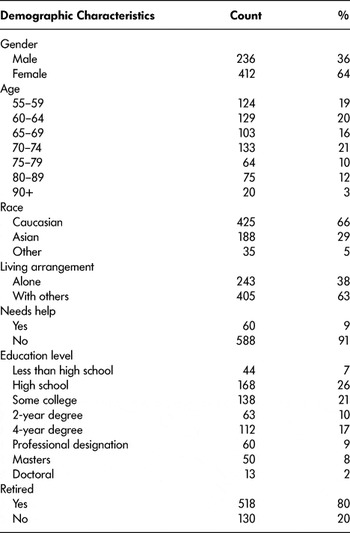
The demographics of respondents who answered questions about non-digital game playing are provided in Table 1. Most respondents were female and had a mean age of 69 years.
Demographics of survey respondents (n = 648)

For those who did not play non-digital games (27%; 246/886), the top reasons among those who provided responses (n = 124) included no interest (51%; 63), no time (26%; 32), or no playmates (10%; 13). Other reasons documented were no opportunity (3%; 4), no equipment (4%; 5), or self-limitation (6%; 7).
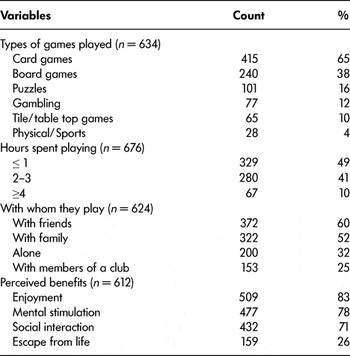
We sorted the open-ended questions on the types of games played into six distinct categories using content analysis to identify the recurring categorical themes. The resultant categories included the following: (1) card games (excludes gambling games, like poker and blackjack), (2) board games (e.g., Scrabble, chess, checkers), (3) puzzles (e.g., crossword, Sudoku, jigsaw), (4) gambling (e.g., slots, bingo, roulette, casino, poker, blackjack), (5) tile or tabletop games (without boards or cards; e.g., Yahtzee), and (6) sports or physical games (e.g., snooker, curling, bowling). The first author and the research assistant had 100 per cent agreement for the categorization of games in the random sample of 20 surveys. Table 2 shows responses to categorical questions on game playing, including the type of game, time spent playing, with whom games were played, and perceived benefits. Card games were the most commonly reported game played, while sports or physically active games were least frequently reported. Only 9.9 per cent of participants reported playing games for longer than 4 hours at a time, while about half (48.7%) reported playing less than an hour at a time. Additionally, the majority of respondents played games with others, either family, friends, or members of a club. The perceived benefits of playing games were enjoyment (83.2%), mental stimulation (77.9%), social interaction (70.6%), and escape from life (26.0%).
Descriptive statistics of non-digital game playing

The associations between perceived benefits of game play and demographic factors are shown in Table 3. Significant statistical associations were observed between gender and all perceived benefits. Race was significantly associated with three of the benefits. Age, education level, and retirement status were significantly associated with mental stimulation, whereas living alone was significantly associated with respondents playing games to escape from daily life. Needing help (i.e., requiring living assistance) did not have a significant statistical association with any perceived benefits of non-digital game play. Some of the t-values reported in Table 3 are negative, meaning that the mean value of the first variable was greater than the mean value of the second variable.
Perceived benefits by demographic strata

* p < .05.
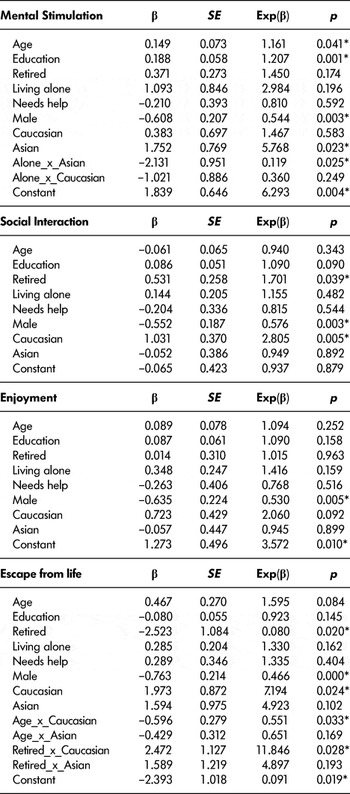
Results of the logistic regression analysis to evaluate demographic predictors related to perceived benefits for playing non-digital games are shown in Table 4. Because not all participants answered questions pertaining to perceived benefits, the sample size for this analysis was 622. Gender was an important predictor for all perceived benefits of non-digital game play. Race was a significant predictor for perceived benefits of mental stimulation, social interaction, and escape from daily life. Results for each of the four outcomes (i.e., mental stimulation, social interaction, enjoyment, escape from life) are described below.
Predictors of perceived benefits for non-digital game (n = 622)

* p < .05.
Mental Stimulation
The logistic regression model for the likelihood of reporting mental stimulation as a benefit of game play was statistically significant, χ2 = 38.562, p < .005. The model explained 9.3 per cent (Nagelkerke R 2) of the variance and correctly classified 78.8 per cent of cases. From the logistic regression model, we found age and education levels were significant predictors for mental stimulation as a perceived benefit for playing games. With all other variables held constant, for each incremental increase in age, the odds ratio of citing mental stimulation as a perceived benefit increased. Similarly, for each unit increase in education level, with all other variables held at a fixed value, the odds ratio (OR) of playing for mental stimulation also increased (OR, 1.207). The OR of reporting mental stimulation as a perceived benefit for males was lower than the OR for females. A significant interaction effect was also found between Asian race and whether or not the respondent lived alone. The OR of playing for mental stimulation of those living alone and of Asian heritage was lower than the OR for other non-Asian races living alone. Among those living alone however, the OR of playing for mental stimulation for those who reported being Asian were around two thirds the OR of those from other non-Asian or Caucasian races playing for mental stimulation.
Social Interaction
Retirement status, gender, and race were all significant predictors for playing non-digital games for social interaction. In particular, the OR of being retired and playing games for social interaction were higher than the OR of those not retired playing for social interaction (OR 1.701). Males were less likely to play for social interaction. Lastly, among Caucasians the OR of playing for social interaction was higher than the OR of playing for social interaction and being of other races. The regression model for reporting social interaction was statistically significant, χ2 = 48.333, p <.005. The model explained 10.6 per cent (Nagelkerke R 2) of the variance and correctly classified 71.4 per cent of cases.
Enjoyment
The only significant predictor of playing for enjoyment was gender. The OR of being male and playing for enjoyment was lower than that of being female and playing for enjoyment. The regression model was statistically significant (χ2 = 24.681, p = .002), explained 6.5 per cent (Nagelkerke R 2) of the variance in playing for enjoyment, and correctly classified 83.4 per cent of cases.
Escape from Life
Gender was a significant predictor in playing non-digital games for escape from daily life. The OR of males playing to escape from daily life were less than half that of females playing for escape. A significant interaction between age and being Caucasian was also found such that the OR of playing for escape by Caucasians decreased for each incremental increase in age compared to other races in which the OR increased with each incremental increase in age. A second interaction effect between retirement status and being Caucasian was also significant. When not retired, the OR of playing for escape among Caucasians was much greater than that of playing for escape among those of other non-Caucasian or Asian races. Not reported in the table, but calculated as described in the analysis section, we found that for individuals who were retired the OR of playing for escape between Caucasians and other races increased to 85.200 (95% CI: 5.218, 1391.201). The logistic regression model of various demographic variables on the likelihood of reporting escape from life as a benefit of game play was statistically significant, χ2 = 37.309, p < .005. The model explained 8.5 per cent (Nagelkerke R 2) of the variance in playing for enjoyment and correctly classified 74.1 per cent of cases.
Discussion
This is one of the few studies to explore non-digital game playing among older adults. Despite ageist assumptions to the contrary – that game playing is an activity of childhood (Bronikowska et al., Reference Bronikowska, Bronikowski and Schott2011) – the majority of older adults reported playing games, emphasizing the importance of game play as an important aspect of their leisure time. This finding echoes research by Ball, Corr, Knight, and Lowis (Reference Ball, Corr, Knight and Lowis2007) that found older adults participated in a variety of games for leisure. Although digital game play may be gaining interest, traditional non-digital games like card games are still clearly an important aspect of leisure time participation. In particular, this study found that 72 per cent of older adults reported playing non-digital games, a greater percentage than the 53 per cent of older adults who reported playing digital games (Kaufman et al., Reference Kaufman, Sixsmith, Sauvé, Renaud, Duplàa, Herrington, Couros and Irvine2013).
The results of this study suggest that time restrictions and lack of interest are the most common barriers for people to not play non-digital games. With respect to digital gaming, there has been considerable effort towards adapting and designing digital games for older adults to overcome multiple barriers in the accessibility of current mainstream digital games (Gerling et al., Reference Gerling, Schulte and Masuch2011). Common barriers to digital game play for older adults include cognitive and physical limitations, motor impairment, reduced visual and auditory acuity, and difficulties resulting from lack of exposure to digital technology (Ijsselsteijn, Nap, de Kort, & Poels, Reference Ijsselsteijn, Nap, de Kort and Poels2007), which could potentially also apply to non-digital game play. Although very few participants in the present study indicated that self-limitation was a reason for not playing non-digital games, similar barriers identified for digital games may be relevant for some categories of non-digital games. This is potentially illustrated in our study by the drop in participation from 65 per cent for card games to 4 per cent for physical and sports related games.
Non-digital games appear to have a highly social component. For the 65 per cent and 38 per cent who reported playing card games and board games, respectively, the majority reported playing with friends and family, highlighting the significant social nature of this activity (Outley & McKenzie, Reference Outley and McKenzie2007). This echoes findings that social interaction was also considered a benefit of non-digital game play by a large majority of those who played non-digital games, which is in keeping with previous research (Hoppes et al., Reference Hoppes, Wilcox and Graham2001). Playing for escape from daily life was less frequently cited compared to enjoyment and mental stimulation. This suggests that respondents played non-digital games for the positive benefits they produced, rather than as means of avoidance, which contrasts baby boomers who commonly report playing digital games as a means of escape from everyday life (Pearce, Reference Pearce2008).
The perception of benefits by participants in the present study indicate that non-digital game play may offer similar benefits to those linked with digital game play, especially given that many digital games are digitalized versions of existing non-digital ones. For example, non-digital game play has been found to have a protective effect against the development of dementia (Verghese et al., Reference Verghese, Lipton, Katz, Hall, Derby, Kuslansky and … Buschke2003). Therefore, non-digital game playing could have a similar effect on cognitive abilities and well-being, as has been found with digital game playing (Depp, Vahia, & Jeste, Reference Depp, Vahia and Jeste2010). Future work aimed towards examining the benefits of games for older adults should include non-digital games, especially given that non-digital games appear more accessible than digital games for this population. As baby boomers age, digital game playing may also become more popular among older adults (Pearce, Reference Pearce2008).
In light of the interest in game play for preventing mental decline, improving social participation, and well-being, demographic factors as predictors for perceived benefits may also provide insight into what motivates different individuals to engage in non-digital game play. In particular, this study identified gender differences in perceived benefits. The likelihood of males playing non-digital games for any of the perceived benefits (mental stimulation, social interaction, enjoyment, and escape from daily life) was approximately half the odds ratio of females citing these perceived benefits. Thus, women tended to have a greater perception of benefits for non-digital game play than men. This finding may reflect the non-representative nature of the sample; however, it is in keeping with previous research that found women played bingo more often than men (O’Brien Cousins & Witcher, 2007). Further investigation of the connection between the subjective perceived benefits and measured objective benefits would help researchers to understand the impact of these perceptions on factors such as well-being; for example, there may be a placebo effect associated with game playing.
In addition to gender differences, other predictive factors emerged for each perceived benefit. Both increasing age and education level were significant factors in playing for mental stimulation, perhaps alluding to the desire to maintain cognitive capabilities as one ages, especially for those with higher levels of educational attainment. For those who reported being Asian, living with others seemed to encourage game playing for mental stimulation more than those of other races; however, this relationship changed for those living alone. Similarly, a Swedish study of a Caucasian population found that those who lived alone participated in fewer leisure activities, including game playing (Agahi & Parker, Reference Agahi and Parker2005).
Predictors for social interaction also reflected differences in races. Caucasians were much more likely to report social interaction as an important benefit for game play than those of other races. This may indicate the importance of social interaction among Caucasian individuals or perhaps indicate that they have fewer opportunities for social interaction. Social interaction was also perceived to be an important benefit of game play by those who were retired. This may reflect the perceived importance of maintaining social contacts and engagement during the transition from working life to retirement (Cozijnsen, Stevens, & van Tilburg, Reference Cozijnsen, Stevens and Van Tilburg2010). Non-digital games may thus provide an important avenue through which to maintain social interaction. The social and lifestyle changes associated with the transition from working to retirement are again reflected in the reporting of game play for escape from daily life. Among Caucasians, escape from daily life through game play becomes more important after retirement than for those of other races. Although trends in leisure participation have been investigated across the transition to retirement (Nimrod, Reference Nimrod2007), cultural differences in these trends may provide more insight into which factors help manage the transition from work to retirement that maintain well-being.
Study Limitations
The study had four main limitations. Given that the results are from a sample of convenience, they may not be representative. In this regard, individuals who were less mobile and healthy were likely excluded from the study. The self-report nature of the survey may also have introduced a social desirability bias. The large number of comparisons increases the possibility of type I error. Finally, the regression models were able to explain only a small amount of variance, which suggests that unmeasured factors may have a stronger impact on perceived benefits of game playing.
Conclusion
This is one of the few studies to explore non-digital game playing among older adults. It was demonstrated that non-digital games are common leisure activities undertaken by older adults and have a variety of perceived benefits, which may vary depending on socio-demographic factors. Overall, women tended to report greater perception of benefits for non-digital game play than men. Most non-digital game playing was found to be relatively sedentary but also social in nature, with the majority of older adults playing for enjoyment. Non-digital games were also played for mental stimulation to help maintain cognition. The findings of this study emphasize the importance of non-digital game playing among older adults and suggest that the use of non-digital game playing to facilitate social interaction and quality of life should be evaluated in future research studies.