Introduction
Protein is known to be a costly nutrient in beef cattle diets. However, excessive use of nitrogen (N) is quite common in the feedlot, leading to economic losses and environmental implications (Dong et al. Reference Dong, Zhao, Chai and Beauchemin2014; Niu et al. Reference Niu, Appuhamy, Leytem, Dungan and Kebreab2016). In general, ruminant animals convert about 0.20–0.30 of their dietary N into animal protein, consequently, about 0.70–0.80 is excreted in the urine and faeces (Doranalli et al. Reference Doranalli, Penner and Mutsvangwa2011). The excess dietary N excreted accumulates in the atmosphere, soil, and groundwater (Cole et al. Reference Cole, Greene, McCollum, Montgomery and McBride2003) being detrimental to the ecosystem. Balancing diets that meet protein requirements during the different growth stages is a way to minimize this problem by reducing N excreted into the environment. Because it is known that animal requirements change over time (Robertson et al. Reference Robertson, Paver and Wilson1970), considering the adoption of feed systems that adjust diets according to the animals’ growth stage is an essential tool to improve production systems from both economic and environmental perspectives.
Nellore (Bos indicus) is the predominant breed in the Brazilian herd (Oliveira & Millen Reference Oliveira and Millen2014), and the use of crossbred animals could be an alternative to reduce the feedlot period. The crossbred F1 Bos taurus × Bos indicus has greater growth potential, due to the effects of breed complementarity, which leads to performance improvements. Trials have been conducted to evaluate N usage efficiency in different genetic groups; however, to our knowledge, there are no data comparing these differences during different stages of the feedlot.
It is hypothesized that: (1) use of the crossbred F1 Angus × Nellore leads to improvements in performance and carcass characteristics; and (2) it is possible to reduce crude protein (CP) during feedlot stages, without adversely affecting animal performance and efficiency. This hypothesis was tested by comparing Nellore v. Angus × Nellore animals, under three dietary CP concentrations, at two stages in the feedlot (backgrounding and finishing), by evaluating intake, performance, feed efficiency and carcass characteristics.
Materials and methods
The experiment was conducted at the Animal Science Department of the Universidade Federal de Viçosa (Viçosa, Brazil). All animal care and handling followed the recommendations of the Ethics Committee for Animal Use (protocol CEUAP/DZO/UFV 05/2013).
Animals and experimental design
Forty-four young bulls (22 Nellore and 22 crossbred F1 Angus × Nellore, A × N) were used in the current study to determine the influence of dietary CP concentration on growth performance, feed efficiency, and carcass traits of backgrounding and finishing cattle fed maize silage based diets.
The bulls were approximately 8 months old at the beginning of the experiment and initial shrunk body weight (SBW) = 219 ± 2.2 kg (Nellore = 212.7 kg; A × N = 226.1 kg). All experimental animals were submitted to a 30-d adaptation period prior to the beginning of the experiment. Eight animals (four from each genotype) were selected randomly to compose the reference group. This group was used as a baseline reference for initial empty body weight (EBW) and dressing percentage of remaining animals, and were slaughtered after the adaptation period. The remaining 36 young bulls were weighed after 16 h of fasting and assigned randomly to one of three dietary treatments. The experiment was conducted in a complete randomized design with six replicates, in a 2 × 3 factorial scheme. The factors were two genotypes and three CP concentrations (100, 120 and 140 g CP/kg dry matter [DM]). Experimental diets were formulated according to the Brazilian Tables of Nutrient Requirements of Zebu Beef Cattle – BR-CORTE (Valadares Filho et al. Reference Valadares Filho, Marcondes, Chizzotti and Paulino2010) to achieve an average daily gain (ADG) of 1.2 kg. The estimated CP, rumen degradable protein (RDP) and metabolizable protein requirements were 136.0, 84.8 and 89.5 g/kg DM, respectively.
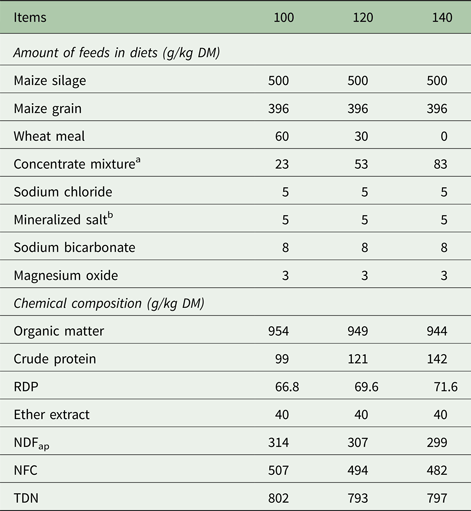
Animals were housed in individual pens, with 30 m2 total area with 8 m2 being covered. The experimental period lasted 224 days, divided into two growth stages (backgrounding = 112 days and finishing = 112 days). Animals were weighed for performance evaluation (ADG) at the beginning and end of each growth stage, after undergoing 16 h of fasting. The forage:concentrate ratio was 50 : 50, using maize silage as the forage source. The total amount of maize silage was provided at 07 : 00 h with half the daily amount of concentrate and the other half of the concentrate was given at 15 : 00 h. Feed intake was adjusted to maintain the feed refused at 50–100 g/kg of the amount offered. Chemical composition and amount of feed in diets are shown in Table 1. The RDP was calculated according to Brazilian Tables of Chemical Composition of Feeds described by Valadares Filho et al. (Reference Valadares Filho, Machado, Furtado, Chizzotti and Amaral2015). The feed efficiency (EFI) was estimated by the ratio between ADG (kg) and dry matter intake (DMI, kg).
Content of feeds and chemical composition of diets

DM, dry matter; RDP, rumen degradable protein; NDFap, neutral detergent fibre corrected for ash and protein; NFC, non-fibre carbohydrates; TDN, total digestible nutrients.
a Concentrate mixture = 833 g soybean meal/kg and 167 g urea/ammonium sulphate/kg.
b Mineralized salt = 223 g Ca/kg; 174 g P/kg; 24 g S/kg; 100 mg |Co/kg; 1250 mg |Cu/kg; 1795 mg Fe/kg; 90 mg |I/kg; 2000 mg Mn/kg; 15 mg Se/kg; 5270 mg Zn/kg and 1740 mg F/kg.
Sample processing and chemical analysis
Feeds offered and refused were weighed daily, sampled and frozen. A weekly sample (composite sample of maize silage and composite sample of refused feeds of each animal) was dried in an oven with forced air circulation (55 °C) for 72 h and ground at 2 mm to determinate the indigestible neutral detergent fibre (iNDF) concentration and 1 mm for other analyses, with a Wiley mill (TECNAL, SP, Brazil). The total DM was evaluated using a drying oven at 105 °C for 16 h. Based on the amount of DM from each animal refusal, composite samples were made for each 28-d period.
Digestion trials were conducted at the backgrounding stage (on days 55, 56 and 57 of total trial) and at the finishing stage (on days 167, 168 and 169 of total trial) to determine diet digestible energy (DE). Faecal samples were collected for three days at 06 : 00 h on d 1, at 12 : 00 h on d 2 and at 18 : 00 h on d 3 of each digestion trial. A composite sample from each animal was created per period and processed as described for silage and leftovers. Indigestible NDF was used as a marker to estimate faecal DM excretion.
The composite sample for each material (silage, concentrate, refusals and faeces) was used to determine the content of DM, organic matter (OM), N and ether extract (EE) according to the methods described by AOAC (AOAC 2012; method number 934.01, 930.05, 981.10, and AOAC 2006; method number 945.16, respectively). The NDF content was estimated according to Mertens (Reference Mertens2002), without the addition of sodium sulphite, using thermostable alpha-amylase in the detergent. The analyses of NDF were performed by using a fibre analyser (Ankom®200, Ankon Technology, Macedon, NY, USA). The NDF content corrected to ash (Mertens Reference Mertens2002) and protein (Licitra et al. Reference Licitra, Hernandez and Van Soest1996) content (NDFap) was estimated. The faecal DM excretion was obtained by dividing the iNDF intake by the faecal iNDF concentration. To quantify iNDF, the faecal samples, concentrate, leftovers and maize silage were placed in filter bags (model F57, Ankon®) and incubated in the rumen of a rumen-cannulated animal for 288 h (Valente et al. Reference Valente, Detmann, Queiroz, Valadares Filho, Gomes and Figueiras2011). Non-fibre carbohydrates (NFC) was calculated according to Detmann & Valadares Filho (Reference Detmann and Valadares Filho2010), as follows:
 $$\eqalign{ {\rm NFC} = & \,100 - [(\% {\rm CP} - \% {\rm CP}\,{\rm from}\,{\rm urea +} \% {\rm urea}) \cr & {\rm +} \% {\rm NDFap +} \% {\rm EE +} \% {\rm ash}].} $$
The total digestible nutrients (TDN) content of the diets was estimated as the sum of digestible (d) nutrients, using the following equation from NRC (2001):
 $${\rm TDN}\,{\rm (}\% {\rm ) = dCP + dNDF + dNFC + 2}.{\rm 25}\,{\rm dEE}$$
Carcass evaluation
Prior to slaughter, all animals were fasted for 16 h. Six animals were selected randomly for slaughter on each day. Animals were slaughtered via captive bolt followed by bleeding. After slaughtering, the gastrointestinal tract (i.e. rumen, reticulum, omasum, abomasum, small and large intestines) of each animal was emptied, washed and weighed. The weight of the empty gastrointestinal tract was added to the weights of the remaining parts of the body (blood, organs, head, hide, tail, hooves and carcass) to determine the EBW.
A blood sample was obtained during exsanguination. The rumen, reticulum, omasum, abomasum, small and large intestines, visceral fat (renal, pelvic and cardiac fats plus mesenteric fat), liver, heart, kidneys, lungs, tongue, spleen, diaphragm, oesophagus, trachea and reproductive tract were ground for 20 min using an industrial grinder to create a homogeneous sample of organs and viscera. The head and limbs had their hide removed, and then were ground using a grinding machine to reduce the size of the bones. The hide was sampled in multiple parts, which overall represented the entire hide.
The carcass of each animal was divided into two halves that were weighed and cooled in a cold chamber at 4 °C for 24 h. At 24 h post-mortem, carcasses were re-weighed to quantify cold carcass weight, and the subcutaneous fat thickness (SFT) was measured at the 12th rib. The right half-carcass was dissected to separate the muscle + fat from bones and each portion was weighed. The muscle + fat of each animal was ground and homogenized to obtain a composite sample of muscle and fat proportional to their weight in the EBW. The bones from each animal were sliced to obtain a bone sample. All samples were lyophilized and, subsequently, ground in an industrial blender (Eberbach Model No. E8017.00, Eberbach Corporation, Ann Arbor, MI, USA) using liquid N to enable sample grinding, since the components had not been partially degreased. Upon completion of grinding, each sampled component (blood, hide, head and hoofs, organs and viscera, muscle + fat, and bones) was taken proportionally, to provide a single sample per animal, representing EBW. These samples were analysed to obtain CP and EE contents, as described above for feed and faecal samples.
Statistical analysis
All statistical procedures were performed using the mixed procedure in SAS (SAS Inst. Inc., Cary, NC, USA) with animal being the experimental unit. Data were analysed in two different models, where data from growth stages (backgrounding and finishing) were evaluated in a complete randomized design with three CP concentration and two genotypes. When significance was observed, a t-test was used to identify differences at P ⩽ 0.05. Secondly, data from carcass evaluation were analysed in a completely randomized design, without aspects of growth stage, with three CP concentration and two genotypes. The orthogonal contrast was used to identify linear and quadratic effects of CP concentration.
Results
Intake, digestibility and performance during backgrounding phase
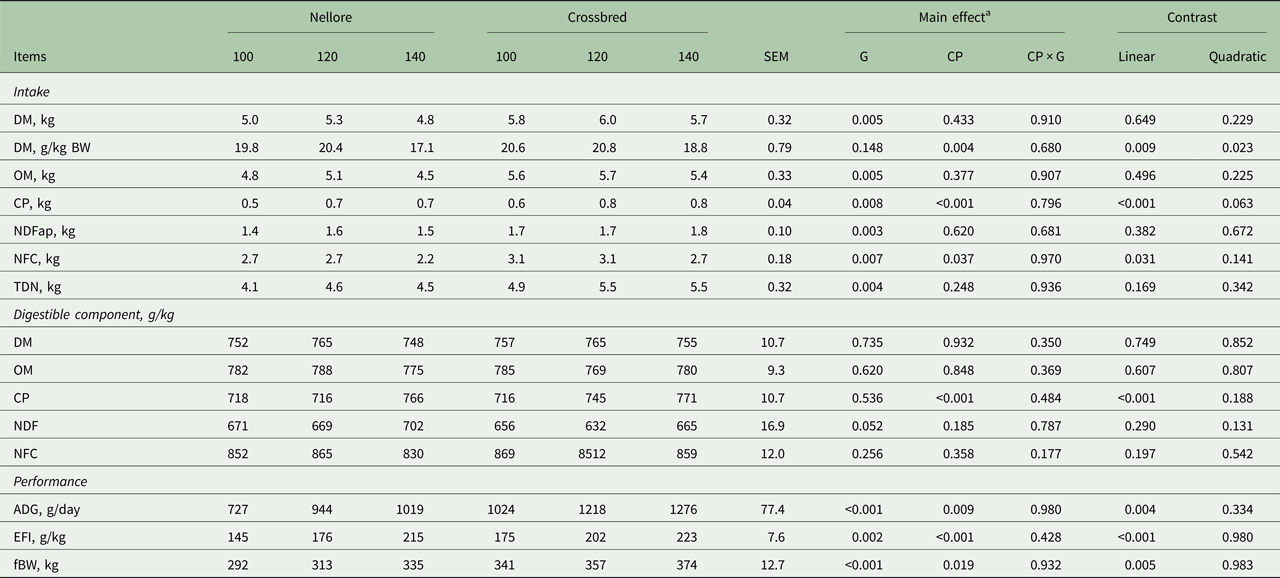
Increasing dietary CP concentration did not affect DMI as kg/day during backgrounding (Table 2); however, consumption presented a quadratic effect (P = 0.023) when expressed as g/kg BW. Crossbred animals had greater DMI as kg/day (P = 0.005) than Nellore cattle, but similar when expressed as g/kg BW. Intake of OM, CP, NDFap and NFC followed a similar pattern to DMI as kg/day (P < 0.01). Intake of CP and NFC also presented a linear effect (P < 0.05) for dietary CP.
Intake and performance of Nellore and crossbred Angus × Nellore fed different crude protein content (CP) during backgrounding stage
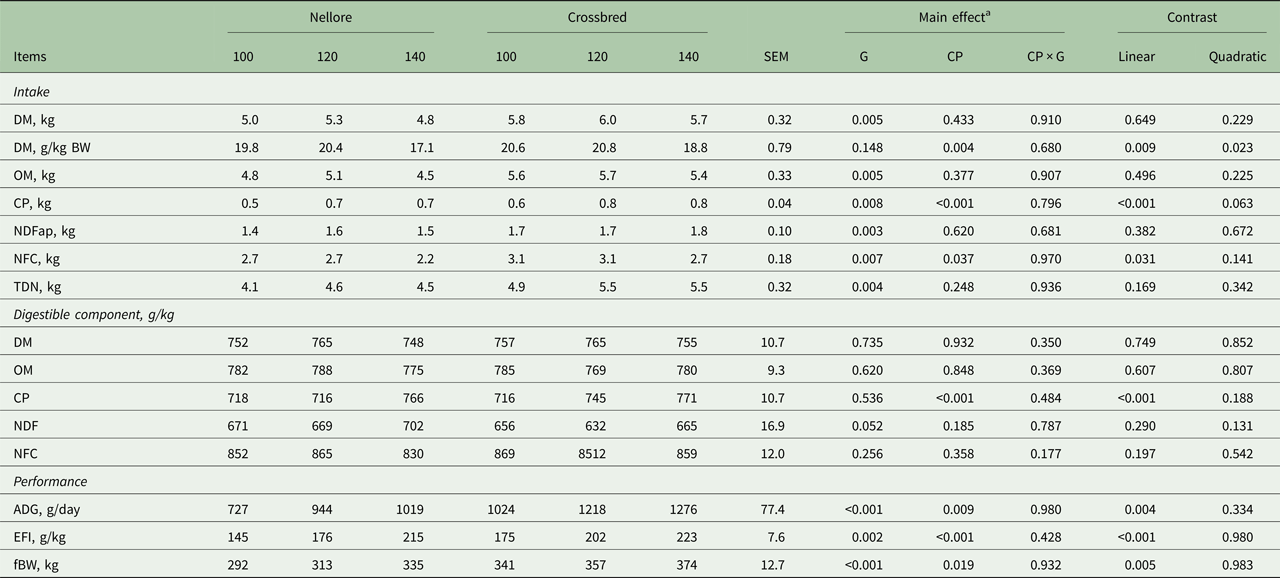
DM, dry matter; OM, organic matter; CP, crude protein; NDFap, neutral detergent fibre corrected to ash and protein; NFC, non-fibre carbohydrates; TDN, total digestible nutrients; ADG, average daily gain; EFI, feed efficiency; fBW, final body weight.
a G, genotype effect; CP, CP effect; CP × G, interaction effect between CP level and genotype.
No effects of genotype were observed in DM, OM, CP or NFC digestibilities (Table 2). However, there was a trend (P = 0.052) for reduction of NDF digestibility from Crossbred to Nellore bulls. Dietary CP affected CP digestibility linearly (P < 0.001) and did not affect other nutrient digestibilities. Lastly, the TDN intake of Crossbred animals was greater (P = 0.004) than Nellore animals (5.28 and 4.40 kg/day, respectively). No effects of dietary CP were observed in TDN intake.
During backgrounding stage, Nellore had a lower ADG (P < 0.001) compared with Crossbred animals (0.89 and 1.17 kg/day, respectively). Also, a linear effect (P = 0.004) of CP on ADG was observed. Similarly, EFI was greater (P < 0.001) in Crossbred animals and increased linearly (P = 0.005) according to dietary CP.
Intake, digestibility and performance during finishing phase
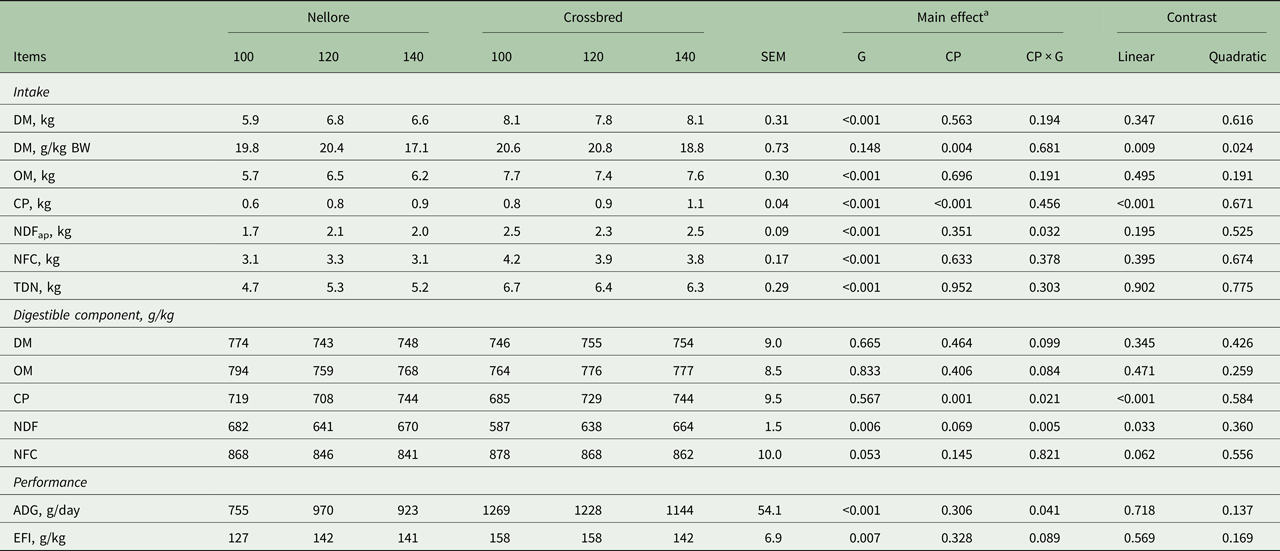
Similar patterns to those observed during the backgrounding phase were observed in the finishing phase for intake of DM, OM, CP, NDF, NFC and TDN as kg/day. Intake of DM, OM, CP, NDF, NFC and TDN were greater (P < 0.001) in Crossbred animals than Nellore (Table 3) as kg/day. A quadratic effect (P = 0.024) was observed for DM intake as g/kg BW according to dietary CP. Dietary CP affected CP intake linearly (P < 0.001).
Intake and performance of Nellore and crossbred Angus × Nellore fed different crude protein content (CP) during finishing stage

DM, dry matter; OM, organic matter; CP, crude protein; NDFap, neutral detergent fibre corrected to ash and protein; NFC, non-fibre carbohydrates; TDN, total digestible nutrients; fBW, final BW; ADG, average daily gain; EFI, feed efficiency.
a G, genotype effect; CP, CP effect; CP × G, interaction effect between CP level and genotype.
Digestibilities of DM and OM were not affected either by genotype or dietary CP (Table 3). The interaction between genotype and dietary CP was observed for CP and NDF digestibilities. Nellore and Crossbred bulls presented similar CP digestibility for each dietary protein; however, Crossbred animals fed 100 g CP/kg DM presented lower CP digestibility than Crossbred animals fed 120 and 140 g CP/kg DM. Regarding NDF digestibility, Crossbred animals fed 100 g CP/kg DM presented lower digestibility coefficient than Crossbred fed 120 and 140 g CP/kg DM, and Nellore cattle fed 100 g CP/kg DM.
Regarding performance in the finishing phase (Table 3), ADG of Crossbred animals was greater than Nellore (1.21 and 0.88, respectively). No differences in ADG within Crossbred animals were observed, regardless of dietary CP; however, Nellore cattle fed 100 g CP/kg DM presented lower ADG than those fed 120 and 140 g CP/kg DM. Feed efficiency was greater for Crossbred than for Nellore animals. No effects of dietary CP on EFI were observed during the finishing phase.
Carcass traits
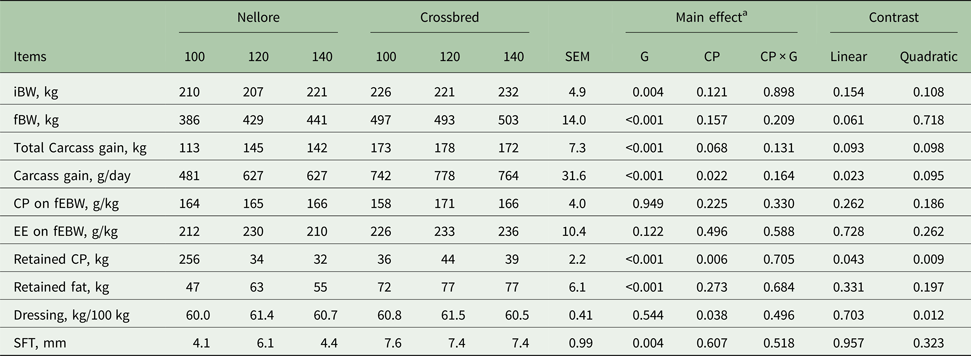
There was a genotype effect on iBW and fBW (P < 0.05), where crossbred animals were heavier than Nellore at the beginning and end of the trial (Table 4). Crossbred animals also gained more carcass during the experiment compared with Nellore cattle (P < 0.001). Crossbred animals retained more protein and fat (P < 0.001) in their bodies compared with Nellore animals (Table 4). There was a genotype effect on subcutaneous fat thickness (SFT). Crossbred animals completed the experiment with a greater SFT compared with Nellore bulls. No differences were observed for CP and EE on fBW, or dressing according to genotypes.
Carcass characteristics of Nellore and crossbred Angus × Nellore fed different crude protein content (CP)

iBW, initial body weight; fBW, final body weight; CP on fEBW, crude protein content on final empty body weight; EE on fEBW, ether extract content on final empty body weight; SFT, subcutaneous fat thickness.
a G, genotype effect; CP, CP effect; CP × G, interaction effect between CP level and genotype.
There was a trend of the quadratic effect of dietary CP (P = 0.095) on carcass gains (total and daily) and a quadratic effect (P = 0.009) of dietary CP on retained CP and dressing. No differences were observed for iBW, fBW, CP or EE on fBW, retained fat and STF regarding dietary CP.
Discussion
Intake during both backgrounding and finishing phases
In the current study, Crossbred animals had a similar DMI when compared with Nellore bulls, as g DM/kg BW, regardless of the growth phase. It is known that changes in DMI are highly correlated with animal BW. Crossbred animals were slightly heavier than Nellore bulls at the start of the experiment (226.1 and 212.7, respectively), despite being contemporaneous animals and coming from the same farm, which may have contributed to the greatest DMI (kg/day). Furthermore, the NRC (1987) and the AFRC (1993) proposed adjustment factors in DMI prediction for different breeds of beef cattle, and reported that Bos taurus breeds had greater potential for DMI. Similarly, the online software program BR-CORTE for diet optimization in tropical conditions (Valadares Filho et al. Reference Valadares Filho, Costa e Silva, Gionbelli, Rotta, Marcondes, Chizzotti and Prados2016) predicts a greater DMI for Crossbred animals than for Nellore in both backgrounding and finishing phases. For Crossbred cattle, estimated DMI = 7.6 and 9.2 kg/day v. 5.0 and 6.2 kg/day for Nellore, during backgrounding and finishing phases respectively, which is in agreement with ADG observed in the current study. Marcondes et al. (Reference Marcondes, Valadares Filho, Oliveira, Paulino, Valadares and Detmann2011a ) also reported a greater DMI for crossbred animals, which led to a greater intake of energy and consequently to a greater ADG.
The crude protein had a quadratic effected on DMI as g/kg BW, which may be a consequence of greater ADG of the animals fed 140 g CP/kg DM compared with animals fed 100 and 120 g CP/kg DM. So, animals fed 140 g CP/kg DM ended the growth phase heavier than animals fed 100 and 120 g CP/kg DM, and the ratio between DMI (kg/day) and BW (kg) is supposed to be decreased. In addition, the ratio between energy and protein intake may have influenced DMI intake. In contrast, increasing CP did not affect DMI (kg/day) during the growing or the finishing stage. This behaviour confirms the results obtained in previous studies with beef cattle fed CP ranging from 9 to 15% CP (Amaral et al. Reference Amaral, Valadares Filho, Detmann, Santos, Prados, Mariz, Alves, Menezes, Villadiego, Novaes and Silva2014; Menezes et al. Reference Menezes, Valadares Filho, Costa e Silva, Pacheco, Pereira, Rotta, Zanetti, Detmann, Silva, Godoi and Rennó2016).
Variations in DMI are frequently associated with changes in nutrient intake, which may explain the effect on the intakes (kg/day) of OM, NDFap and TDN according to genotype. The intake (kg/day) of all analysed nutrients was greater in Crossbred compared with Nellore animals, which can be attributed to the behaviour observed for DMI (kg/day). Similarly, the increments in dietary CP, followed by similar DMI as kg/day, resulted in a linear increase in CP intake for both backgrounding and finishing phases.
Digestibility during both backgrounding and finishing phases
Levels and sources of CP in the diet may explain the variations in the responses for digestibility of nutrients reported in the literature (Van Dung et al. Reference Van Dung, Shang and Yao2014). However, there was no effect of dietary CP on DM and OM digestibilities during either backgrounding or finishing phases in the current study. Similar results were observed by Menezes et al. (Reference Menezes, Valadares Filho, Costa e Silva, Pacheco, Pereira, Rotta, Zanetti, Detmann, Silva, Godoi and Rennó2016), where increasing dietary CP of finishing Nellore cattle did not influence intake or nutrient digestibility, and by Steen (Reference Steen1996), where increasing CP supplementation for beef cattle did not affect ration digestibility.
Genotype affected only NDFap digestibility during backgrounding phase. Nellore cattle had a greater NDF digestibility than Crossbred animals. The greater DMI by crossbred animals could have affected fibre digestibility. Greater DMI promotes an increase in diet passage rate, leading to a reduction in fibre digestibility (Scholljegerdes et al. Reference Scholljegerdes, Hess, Moss, Hixon and Rule2004). In the finishing phase, an interaction between genotype and dietary CP was observed, with a reduction in NDFap digestibility from Nellore to Crossbred fed 100 g CP/kg DM, and from Crossbred fed 120 and 140 g CP/kg DM to Crossbred fed 100 g CP/kg DM. The reduction in NDF digestibility from Nellore to Crossbred animals fed 100 g CP/kg DM may be explained by a similar mechanism observed during backgrounding phase. In addition to that, it may be a result of lack of ruminal nitrogen to NDF microbial degradation, once rumen is the main site of NDF digestion (Sathler et al. Reference Sathler, Prados, Zanetti, Silva, SC Filho, Pacheco, Amaral, Rennó and Paulino2017). Furthermore, the increased proportion of urea in 120 and 140 g CP/kg DM treatments, rather than a greater proportion of wheat meal in the 100 g CP/kg DM treatment, may influence the fibrolytic bacteria activity (Pan et al. Reference Pan, Suzuki, Koike, Ueda, Kobayashi, Tanaka and Okubo2003) and consequently the NDF digestibility.
The CP digestibility was affected by dietary CP. Greater protein levels led to greater CP digestibility. Increased dietary protein level leads to a dilution in metabolic faecal N. In other words, there is a reduced participation of the endogenous fraction (Broderick Reference Broderick2003).
Performance and feed efficiency
Crossbred animals had greater ADG compared with Nellore, in both backgrounding and finishing phases. It may be justified by the increased DMI during both stages of feedlot, which influenced the fBW of animals directly. Crossbred animals had greater fBW not only because they were slightly heavier at the start of the trial, but also because they gained more weight over time. Marcondes et al. (Reference Marcondes, Valadares Filho, Oliveira, Paulino, Paulino, Detmann and Silva2011b ) reported a greater requirement of net energy for Nellore than Crossbred Angus × Nellore animals for BW < 400 kg. This may help to explain why the EFI was greater for Crossbred animals than for Nellore, mainly in the backgrounding phase. In addition, Barbosa (Reference Barbosa, Cyrino, Menten, Lanna and Miyada1998) reported that Crossbred animals had a DMI 8.1% greater than purebred animals and the EFI was 3.0% greater. Barbosa (Reference Barbosa, Cyrino, Menten, Lanna and Miyada1998) attributes the greater EFI of crossbred animals to heterosis and breed complementarity, resulting in genetic gains. However, Marcondes et al. (Reference Marcondes, Valadares Filho, Oliveira, Paulino, Valadares and Detmann2011a ) reported no differences in EFI between Nellore and F1 Angus × Nellore. Besides that, Marcondes et al. (Reference Marcondes, Valadares Filho, Oliveira, Paulino, Valadares and Detmann2011a ) also evaluated carcass gain: DMI ratio, and reported a greater efficiency on carcass gain for crossbred animals.
Regarding dietary CP, there is a possibility of working with different dietary CP on different feedlot phases. During backgrounding, both ADG and EFI showed a linear response to increased dietary CP. It can be inferred that the estimated CP requirement (136 g/kg DM) may not be reduced without compromising the animals’ performance in the initial phase. Thus, for both young Nellore and Crossbred bulls, 140 g CP/kg DM would be recommended during backgrounding.
During the finishing phase, there is a possibility of working with different dietary CP for Nellore and Crossbred animals. Crossbred animals had similar ADG and EFI regardless of dietary CP. Thus, for young Crossbred bulls, 100 g CP/kg DM would be recommended for the finishing phase. However, Nellore animals fed 100 g CP/kg DM had lower ADG, and consequently lower fBW, than animals fed 120 and 140 g CP/kg DM. Nellore animals had a lower DMI compared with crossbred, possibly not reaching the optimal substrate availability for microbial growth by consuming diets with lower CP (Bach et al. Reference Bach, Calsamiglia and Stern2005). It is possible that by consuming a diet with a greater CP content, these animals had a greater substrate for fermentation, which would allow greater ADG, increasing efficiency. Thus, for young Nellore bulls, 120 g CP/kg DM would be recommended for the finishing phase.
Carcass traits
Crossbred animals showed greater carcass gain (total and kg/day). This is confirmed by carcass dressing data, which did not differ between genotypes. Therefore, it is suggested that the greatest ADG of crossbred animals is linked to a greater carcass gain. This is even clearer when evaluating protein and fat retained on the EBW. Crossbred proved superior in relation to protein and fat deposition (kg) compared with Nellore and also had greater SFT deposition. Therefore, Crossbred animals gained more weight and had more fat and protein retained in their carcasses, leading to greater carcass yield. It is known that crossbred animals have heavier BW at maturity. The BR-CORTE software (Valadares Filho et al. Reference Valadares Filho, Costa e Silva, Gionbelli, Rotta, Marcondes, Chizzotti and Prados2016) assumes that EBW at maturity for Nellore = 517 kg and Crossbred = 560 kg, when fat on EBW is 250 g/kg. From this, in the current study, Nellore and Crossbred were slaughtered with, respectively, 0.75 and 0.82 of EBW at maturity, which would explain the greater fat deposition of Crossbred animals.
In the backgrounding phase, animals fed 140 g CP/kg DM were superior than animals receiving different amounts of CP, since they had greater ADG. During this stage, protein retention is greater than fat retention and as protein retains more water in the gain than fat (ARC 1980), it leads to greater efficiency compared with the finishing stage, when animals are closer to maturity and start to retain more fat on their carcasses. It may help to explain why carcass gain (kg/day) was affected linearly by dietary CP. Besides that, CP retention and dressing were affected quadratically by dietary CP, which infers that 120 g CP/kg DM may be adopted regarding these parameters.
Overall effects
It is worth mentioning that in the current experiment the diets with different CP were provided throughout the entire experiment. Thus, the possible responses of reducing CP only in the finishing stage are not yet known and further studies are needed to evaluate this to clarify whether this reduction is detrimental in any stage of life, or only during the finishing stage of the feedlot.
Oliveira & Millen (Reference Oliveira and Millen2014) reported that Brazilian feedlot nutritionists use an average of 134 g/kg DM of CP in finishing diets. Under this condition, it may be inferred that cattle are fed excessive CP. When this occurs, the consequences are economic losses and environmental N excretion. The reduction of CP levels could be a route to improve profitability, and reduce environmental contamination, without compromising animal performance.
In conclusion, crossbred animals (F1 Angus × Nellore) had not only greater performance, but also better carcass traits compared with Nellore, representing an option to increase productivity. Also, it is possible to adjust diets according to phase. During the backgrounding stage, 140 g CP/kg DM should be used, being reduced to 120 g CP/kg DM during finishing stage of a feedlot for Nellore, and to 100 g CP/kg DM for Crossbred, without adversely affecting performance characteristics. This feed management could not only have a great economic impact, but also reduce the environmental impact caused by livestock systems.
Acknowledgements
The authors gratefully acknowledge National Council of Scientific and Technological Development (CNPq), National Institute of Science and Technology in Animal Science (INCT – Ciência Animal), Coordination of Improvement of Personal Higher Education (CAPES), and Foundation for Research Support of the State of Minas Gerais (FAPEMIG) for providing a research grant for this research.