INTRODUCTION
Amyotrophic lateral sclerosis (ALS) is a neurodegenerative disorder affecting the motor neurons responsible for controlling voluntary muscles. ALS patients gradually develop muscle atrophy and weakness. The disease often begins between the ages of 55 and 70 years, and most patients die 3 to 5 years after the onset of symptoms. At present, there is no known cure for ALS, and the most common cause of death is respiratory failure (Musaro, Reference Musaro2012; Wijesekera & Leigh, Reference Wijesekera and Leigh2009). Over the course of the disease, patients have to face various physical and social changes, and symptoms necessitate lifestyle changes (Ganzini et al., Reference Ganzini, Johnston and Silveira2002). Owing to the symptoms, patients require different kinds of assistance and support, and they are often dependent on others to manage the activities of daily living.
It is not unusual for relatives to assume much of the responsibility for caring for the ALS patient, and they often spend several hours performing patient care (Hecht et al., Reference Hecht, Graesel and Tigges2003; Krivickas et al., Reference Krivickas, Shockley and Mitsumoto1997). Providing care for a dying relative is a demanding and often overwhelming experience (Baxter et al., Reference Baxter, Baird and Thompson2013; Brazil et al., Reference Brazil, Bainbridge and Rodriguez2010; Ganzini et al., Reference Ganzini, Johnston and Silveira2002). In ALS, disease progression leads to constant daily changes in a patient's disabilities (Aoun et al., Reference Aoun, Connors and Priddis2012; Ray & Street, Reference Ray and Street2006). Patient care may include dealing with different medical assist devices and may cause psychological distress in relatives (Blackhall, Reference Blackhall2012). Relatives often talk about their responsibilities in relation to the care, but they seldom talk about their own needs (Aoun et al., Reference Aoun, Connors and Priddis2012). For family members, providing care entails limited time and energy, resulting in social restrictions and emotional problems (Chio et al., Reference Chio, Gauthier and Calvo2005; Ray & Street, Reference Ray and Street2006).
Care of ALS patients is intended to address the physical, psychological, and practical problems that arise during the course of the disease. By providing good palliative care, the multidisciplinary team plays an essential role (Bede et al., Reference Bede, Oliver and Stodart2011; Miller et al., Reference Miller, Jackson and Kasarskis2009). The goal of the team is to help patients by treating and relieving symptoms, providing various medical assist devices, offering social and psychological support, and helping the patient and his/her family maintain the best possible quality of life (Gallagher & Monroe. Reference Gallagher, Monroe and Oliver2006; Ganzini et al.. Reference Ganzini, Johnston and Silveira2002; van den Berg et al.. Reference van den Berg, Kalmijn and Lindeman2005). Most ALS patients in Sweden have access to a multidisciplinary ALS team. Patients often also have a palliative team involved in their care, which serves as a complement to the multidisciplinary team.
Considering the important role that relatives play in providing care for ALS patients, it is important to take their experiences into account when developing and improving patient care, and when devising care and support for the relatives themselves. The aim of the present study was to report relatives' experiences of patient care and the support they themselves received during the course of the disease.
METHODS
Design
This was a qualitative study with a descriptive design. The relatives were recruited from two Swedish neurology clinics with a multidisciplinary ALS team. Participants had to be older than 18 years of age and able to understand and express themselves in Swedish. A total of 15 relatives were included (11 women and 4 men). The majority of relatives were spouses (seven wives, four husbands), and four were daughters. The mean age for the women was 50 years (range 26–79), and for the men 64 years (range 61–68). A total of 13 relatives reported having been involved in patient care full time, 1 for a few hours a week, and another had not been involved in the practical aspects of care. Participants were recruited using convenience sampling. Relatives who expressed interest and gave permission to be contacted were called by the first author, who provided verbal information about the study. Written material was then sent to the relatives, and they were to then send in a signed consent form indicating that they wished to participate. It was at this point that the interviews were scheduled.
Data Collection
Data were collected through interviews carried out in participants' homes by the first author (BJL). They took place within 6 to 12 months after the patient had died. The audiotaped interviews ranged in duration from 10 to 56 minutes. They followed a semistructured interview format so as to guarantee that all answered the same questions. The interview guide included three questions about patient care and three about support for relatives. Relatives were asked to describe the care, their experience of the care, and their feelings about the care the patient received. The same question structure was employed to describe relatives' experience of the support they themselves received.
Data Analysis
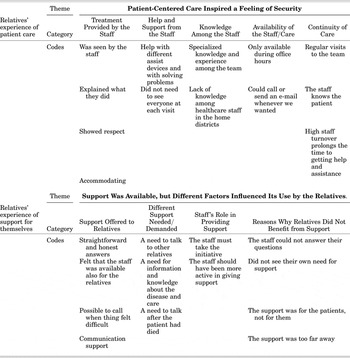
Descriptive statistics were utilized to describe the sample's demographic characteristics. A qualitative content analysis was performed to analyze the interviews (Graneheim & Lundman, Reference Graneheim and Lundman2004; Krippendorff, Reference Krippendorff2004). Interviews were conducted by the first author (BJL), who also transcribed them verbatim. The first author was also involved in caring for some of the patients. The transcribed texts were double-checked against the tape recordings by the second author (CF), to reduce bias and to evaluate how questions were asked and how relatives were treated. No differences were found when the interviewer (BJL) was not involved in care. The interviews were read several times to get an overall sense of the whole picture, and to become familiar with individual interview texts. The data were subdivided into two content areas: relatives' experience of patient care, and relatives' experience of the support they themselves received during the course of the disease. Meaning units related to each content area were identified, condensed, and labeled with a code based on their content. The codes were compared and sorted according to similarities and differences, and categories were developed based on the codes. Finally, the categories were sorted and abstracted, and a theme was formulated for each content area based on the latent content of the interviews (Table 1). Analyses were performed by two of the authors (BJL and CF) independently. The data-analytic process involved a back-and-forth interchange until the authors reached agreement regarding codes, categories, and themes.
Overview of codes, categories, and themes for both content areas

Ethical Approval
Approval of the study was granted by the regional ethical review board in Uppsala. Relatives received verbal and written information about the study and gave their written consent to participate.
RESULTS
The results are presented on the basis of the categories in the text below. To support the results, quotes from the interviews are also presented.
Relatives' Experience of Patient Care
The care was described as positive during this most difficult period. The ALS team was deemed to have provided some security in a completely new and difficult situation. The care was described as being based on patients' needs and designed to make the patient's situation easier. The theme was: “patient-centered care inspired a feeling of security.” This theme consisted of five categories: treatment provided by the staff, help and support from the staff, knowledge among the staff, availability of staff/care, and continuity of care.
Treatment Provided by the Staff
The treatment provided by the staff seemed to be an important contributor to the experience of patient care among all relatives, and it was judged to be friendly and accommodating. Expressions such as “listening,” “sensitive to our needs and desires,” “and perceptive” were often used to describe the treatment provided by the staff. Relatives felt that the staff understood the patients and that patients were treated with respect. Staff members were calming and encouraging, and instilled a feeling of confidence:
They didn't give too much information. Instead, they tried to be sensitive to what we wanted to know. They showed incredible respect by listening to what we wanted before anyone responded. It felt like they tried to give suggestions that would suit [the patient].
Help and Support from the Staff
Staff members were always willing to help. Care was based on patients' care needs. The help and support involved providing assistance through the use of various assist devices and solving different problems to facilitate a patient's daily life. Most relatives felt that measures were taken in timely fashion and that the support was generally one step ahead, as the staff seemed to know what the next step would be:
She got aids [assist devices] in time. It was almost preventive. They helped with aids, so that she could train before using them, before she absolutely needed them.
One relative of a patient who had refused support from the ALS team and instead received it from a rehabilitation team reported that the patient had received good care, but that they had to find solutions to problems by themselves: “You had to come with the ideas on your own. You had to know what to ask for.”
Another relative desired practical help with care provision, for instance, help with showering the patient in connection with team visits. The disabilities the disease had caused made it impracticable for the patient to use the shower at home.
High staff turnover had a negative impact on support and help, sometimes prolonging the time before patients received various needed assists.
Knowledge Among the Staff
All patients were offered support from the ALS team at the nearest hospital. This was a multidisciplinary team, with special knowledge about the disease, treatment, and care. All but one patient accepted that support. The care provided by the teams was described as professional, and the relatives felt that team members had experience and knowledge:
It was a good team, good support. They had more experience. Everyone knew what they were doing. They had the knowledge to know how to best help my mother.
Some relatives experienced a lack of knowledge among the health professionals in their home district who were responsible for care:
They didn't know so much about the disease. It felt like they were lacking in experience. The nurses who came to the home didn't really know. Sometimes you had to tell them that they couldn't do some things.
Availability of Staff/Care
The ALS team was only available during office hours. Despite this, almost all relatives described the availability of the ALS team as satisfactory. They reported that they could just call or send an e-mail with questions, at any hour, and that they normally received a quick response:
They called almost every week, and I could call if I was wondering about anything, and also the personal assistant could call. They were always willing to help.
Help was available when we needed it.
Staff availability had a positive effect on relatives' sense of security. Patients had a direct line to the hospital, which they could use when necessary. Relatives of patients who lived far from the hospital described a lack of access to a team close to their home, which made prompt medical care or prompt help with medical assists difficult. According to one relative:
You really had to fight to get in touch with a doctor, and sometimes it was impossible. Then you felt inadequate. I think there should be more teams that can come if you call them. I was disappointed that we couldn't get help from this kind of team near our home. And it was so hard to get in contact with anyone. We got sent around and were supposed to contact a different team. Never got in contact with anyone.
Continuity of Care
The care was described by most relatives as involving regular appointments with the ALS team until the end of the patient's life. These regular appointments and the fact that care was provided by the same staff at each visit were important, and inspired a feeling of security:
Not having to say the same thing or worry about forgetting to say something of importance at the visits. That it was the same staff who knew the patient at each appointment. It was a great source of security.
Two relatives described these regular visits with the team as tiring for the patient; the hospital visits were intensive and short during the end phase. One relative felt that the patient did not need to meet everyone in the team: “At the end, some of the support and help could have been given over the phone” to the relative.
Relatives' Experience of Support for Themselves During the Course of the Disease
The results showed that almost all relatives had been offered support from the team, but that some had declined the offer for various reasons. Most described their positive and grateful feelings about the support, and how it had inspired a feeling of security. The theme was: “support was available, but different factors influenced use of it among the relatives.” This theme consisted of four categories: support offered to relatives, different support was needed/demanded, the staff's role in providing support, and reasons why relatives did not benefit from support.
Support Offered to Relatives
Most relatives reported having been offered support from the team. The support involved practical information and conversations about the situation. Support was mostly provided by staff from the teams (doctors, nurses, social workers), but some had also seen a psychologist. They reported that it was possible to have a one-on-one talk when needed:
It felt calm and safe to know that I could call this number when it all starts to be too much for me . . . when I need to discuss thoughts and feelings. I had the chance and opportunity if I wanted, and it was always available, and it was open, and I could call or make a visit if I wanted to. It felt like that.
Another said that the team had offered her support, but that she had to initiate the contact, which she experienced negatively. In one family with teenagers, the offered support was described as available for the whole family.
Relatives who lived far away from the ALS team experienced a lack of support close to their homes. They described how they had to search for support on their own.
Different Support Was Needed/Demanded
Relatives needed different kinds of support. Some described needing to talk about their situation, while others reported a need for knowledge and education regarding how to best help the patient. Although most relatives received support, they expressed a need for a kind of support that was not offered. They needed time, in addition to the visit to the team, to talk about their anger and grief in relation to the disease. They had questions that they did not want to ask while the patient was present. Getting answers to their questions was important—questions concerning the patient, care, and the disease. One relative maintained that honest and straightforward answers gave her the strength to provide care. Such answers helped her understand what to expect, so that she could be prepared:
I got the answer I wanted; a straightforward answer and no evasiveness, or not me having to interpret these difficult things that I wanted to have explained. I got them straight out, and it felt good. Because then I could manage to go on.
One relative expressed a desire to talk to other relatives in the same situation, which she thought would have been a good source of support for herself:
There should have been time for relatives to talk. We should have had a chance to talk to each other, share experiences. Then I could have kept myself updated and prepared, known a bit more. That would have helped me in my everyday life with my mother.
Relatives needed advice, education, and practical training in providing day-to-day care for the patient:
If you as a relative could be taught some tricks—for example, how to turn a person over in bed, a person who can't move, or how to brush someone's teeth when she can't spit. I should have had some knowledge that I didn't have. This would have made it easier for me and my mother.
Another reported not having felt any need for support while providing care, but that he had felt the need after the patient had died:
I didn't feel I needed support then, but now afterwards, now you need to sit down and talk to someone.
The Staff's Role in Providing Support
The staff had an important role to play in supporting relatives. Relatives reported that efforts to support them must come from the team, and that support must be offered repeatedly and continuously throughout the course of the disease. They wished that the staff had been more active in giving support, some even stating that the staff should have “forced” them to accept support. According to one, “It was good that they asked about having a talk, but it shouldn't have been a question. Instead, it should've been: I call you in a couple weeks. You're not capable of making a choice.”
It was important that the person responsible for providing support had knowledge and experience of the disease: “It should've been a person with more experience, who knows how it works. Because these talk therapists, they didn't know anything.”
Reasons Why Relatives Did Not Benefit from Support
Although most relatives were offered support, some did not accept it, and for different reasons. Several relatives reported having felt that the support from healthcare should be based on the patient's needs rather than being for the relatives themselves and addressing their particular situations. Relatives were focused on the patient and were not able to consider their own needs:
You don't think about it. You don't think about yourself at the time, you just think about your sick loved one who needs help.
She was the one who was ill, and I tried to help as best I could. You put all your strength into it; your own needs had to come second.
If the staff could not answer their questions, relatives felt that the support had little to offer, even though they understood that some of their questions were impossible to answer. They were caught in the middle of everything:
I lived with it, saw it every single day. I had some questions they could answer, but what I wanted to know was, how much time does he have left, and what should I expect? And that they couldn't answer. That I understand, but I felt it didn't give me anything.
For some, it was important to solve problems by themselves, while some pushed problems into the future:
I did get offers from the social worker and others, but I didn't take them. My method was to activate myself. If you activate yourself, you won't have time to think so much. It made things easier. Don't think. Just act! It's today that counts.
Moreover, practical factors also affected relatives' use of support. One relative was invited to participate in a support group but had to decline because it was too far away from their home.
DISCUSSION
Patient Care
The results showed that most relatives had a positive experience of patient care and reported that the care was based on patients' needs and desires, an approach that is in line with patient-centered care (Kitson et al., Reference Kitson, Marshall and Bassett2013). How patients and relatives were treated determined if they felt they had been handled with respect and dignity.
Most of the patient care and support was described as practical help with different assist devices and with solving problems, all of which facilitated patients' daily living. This finding is in accordance with previous studies on ALS support (Oyebode et al., Reference Oyebode, Smith and Morrison2013). Such practical help also facilitated relatives' ability to manage to care for their loved ones. A few relatives experienced the visits to the ALS team as tiring for the patient. Standards of care for ALS patients are important (Borasio et al., Reference Borasio, Shaw and Hardiman2001), and most of the knowledge and experience of the staff is acquired when seeing patients. But it is also important that the interactions not cause problems for the patient. It is essential that care be individualized and based on patients' needs. Visits should not be experienced as exhausting for the patient.
A perceived lack of specialized knowledge about the disease and care among the staff providing that care could cause relatives to be disappointed with the support and help. The present results confirm that the multidisciplinary team, with specialized knowledge of ALS, plays an important role in providing care and support for both patients and their relatives (Miller et al., Reference Miller, Jackson and Kasarskis2009; van den Berg et al., Reference van den Berg, Kalmijn and Lindeman2005). This specialized knowledge and experience with the disease makes it possible for the staff to know what to expect, and makes it possible for them to provide appropriate assistance and enables them to answer questions. A knowledgeable ALS team was reported to be a crucial factor in creating feelings of security for patients and relatives. In accordance with previous studies (Krivickas et al., Reference Krivickas, Shockley and Mitsumoto1997), some relatives felt that the health professionals in their home district lacked knowledge and experience. Our present results clearly show that health professionals caring for people with ALS outside the hospital setting are in need of support and education, and that it is important that ALS teams provide this support and education (McConigley et al., Reference McConigley, Kristjanson and Aoun2014). Medical information provided by support groups on the internet and the possibility to chat online with other staff members who have knowledge and experience with the disease may be other ways to educate and support those responsible for care.
In one study with cancer patients (Brazil et al., Reference Brazil, Bainbridge and Rodriguez2010), not having 24-hour access to support was described as a source of stress in palliative care. In our study, though the ALS team was only available during office hours, the relatives experienced the degree of their availability as satisfactory. One possible explanation for this may be relatives' knowledge about where to turn, the feeling of receiving prompt answers, and the availability of a palliative team nearby that could provide help and support as needed.
Support for the Relatives Themselves
Most relatives experienced that support was available for them, and they spoke positively about the possibility of talking with someone on a one-to-one basis about their situation. Their needs in terms of support differed: some required knowledge that prepared them for the situation and others needed practical education to facilitate care.
Studies have shown that relatives need education and training when it comes to caring (Bialon & Coke Reference Bialon and Coke2012; Krivickas et al., Reference Krivickas, Shockley and Mitsumoto1997). Lack of knowledge and experience in caring among relatives can lead to difficulties (Brazil et al., Reference Brazil, Bainbridge and Rodriguez2010), and relatives need knowledge to be prepared for what may come (Gysels & Higginson, Reference Gysels and Higginson2009).
Although every relative was offered support, not all of them took advantage of it. There were several reasons for this: a perceived lack of knowledge and experience among the staff providing the support, or the relatives did not think about their own needs.
Perceived insufficient knowledge and understanding among the staff providing support proved to have a negative impact, causing some relatives to decline further help. Brazil and colleagues (Reference Brazil, Bainbridge and Rodriguez2010) found that experience and an understanding of the disease and the situation among staff members were most important in palliative care. Talking with other relatives who had experience with ALS has been shown to help relatives manage their situations (Olsson Ozanne et al., Reference Olsson Ozanne, Graneheim and Persson2012). The internet can also be a way of getting support and a means for contacting others in the same situation.
Most relatives did not think about their own needs, but focused on the patient, a finding that is in accord with earlier studies about palliative care (Bialon & Coke Reference Bialon and Coke2012; Gysels & Higginson, Reference Gysels and Higginson2009; Mitsumoto & Rabkin Reference Mitsumoto and Rabkin2007). By keeping busy and solving problems on their own, they were able to take some control over their situation (O'Brien et al., Reference O'Brien, Whitehead and Jack2011; Oyebode et al., Reference Oyebode, Smith and Morrison2013; Williams et al., Reference Williams, Donnelly and Holmlund2008). By focusing on the patient, they managed to better cope with the situation. One relative said that he had not felt a need to talk during the course of the disease, as his focus was on the patient, but that he did feel that need after the patient died. It is crucial that support be individualized and offered throughout the course of the disease. After the patient has died, the team should offer relatives an opportunity to talk with someone and reflect on what has transpired.
Studies have shown that some relatives experience a lack of support (Oyebode et al., Reference Oyebode, Smith and Morrison2013). They need support that focuses on their needs, not on those of the patient (Olsson Ozanne et al., Reference Olsson Ozanne, Graneheim and Persson2012), and they need both practical and emotional support (Williams et al., Reference Williams, Donnelly and Holmlund2008). Few relatives talked about emotional support during our study and instead focused on practical help. Perhaps we did not ask the right questions. Or perhaps the fact that we brought up patient care before discussing support for relatives influenced their answers. These issues need to be studied further to find out how to improve the support offered to relatives of ALS patients.
STRENGTHS AND LIMITATIONS
By including husbands, wives, and children, we attempted to ensure diversity in gender and age, and to capture different kinds of experiences. The chosen method of data collection and the fact that data analysis was performed by two authors and finally discussed among all coauthors strengthen the trustworthiness of our study. We included 15 relatives in the sample, and these interviews allowed us to achieve saturation. The interviews were conducted 6 to 12 months after the patient had died, which could have influenced relatives' memory of the care and support received. It should be taken into consideration that the first author (BJL), who performed the interviews, had been involved in caring for some of the patients. The second author (CF) listened to eight randomly selected interviews, four from each team, to determine whether the first author's performance as interviewer was affected by the previous acquaintanceship. No differences were detected: the first author posed questions and followed up in a similar manner, irrespective of which relative was interviewed.
In conclusion, our study demonstrated how important it is for both patients and relatives that care and support be based on individual needs. The staff members responsible for providing this care and support must have knowledge of and experience with the disease and the specific care required. If they do not belong to an ALS team, they may need further education and support. The relatives generally focused on the patients' situations and did not think of their own needs. It is therefore important that health professionals be observant of the relatives and offer them help and support to better manage the situation. The knowledge gained from our study will contribute to the information available on how to improve and further develop care and support in palliative care for patients with ALS and their relatives.
ACKNOWLEDGMENTS
This study was financially supported by the Ulrica Croné Foundation, Uppsala University, and Uppsala University Hospital.