Antibiotic resistance is a serious public health threat. Increasing antibiotic resistance severely limits therapeutic options, and it is associated with increased expenditures and worse clinical outcomes.Reference Chandy, Naik and Balaji 1 Antibiotic resistance within hospitals is especially problematic because patients in medical settings are particularly vulnerable to severe infection due to underlying diseases and relatively immunocompromised conditions. 2
In academic and community hospitals, a group of bacteria known as the ESKAPE pathogens have been identified to be of importance: Enterococcus spp, Staphylococcus aureus, Klebsiella spp, Acinetobacter baumannii, Pseudomonas aeruginosa, and Enterobacter spp. These bacteria not only cause the majority of nosocomial infections but also demonstrate concerning patterns of antibiotic resistance.Reference Boucher, Talbot and Bradley 3 , Reference Rice 4 The Centers for Disease Control and Prevention (CDC) estimates that 23,488 deaths in the United States are attributable annually to antibiotic-resistant infections, with 11,000 deaths attributable to methicillin-resistant S. aureus (MRSA) alone. 2
Widespread use of antibiotics has long been recognized as a key driver of the rise in antibiotic resistance.Reference Levy and Marshall 5 Morbidity, mortality, and healthcare costs can all be impacted by the appropriateness and timeliness of antibiotic coverage.Reference Kang, Kim and Park 6 – Reference Kaki, Elligsen and Walker 8 Antibiotic use in hospital is significant; the CDC reports that 56% of patients receive antibiotics during their hospitalization, and 30% receive at least 1 dose of broad-spectrum antibiotics.Reference Fridkin, Baggs and Fagon 9 However, whether antibiotic usage in hospital contributes to hospital-specific antibiotic resistance rates has not been widely evaluated, especially at the regional level.
We hypothesized that contemporaneous hospital-specific antibiotic usage would not consistently predict antibiotic resistance rates in hospital-wide indexes of antibiotic resistance, as a preponderance of infections diagnosed in hospital, even among those caused by ESKAPE pathogens, are likely due to community acquired flora. To test this hypothesis, we conducted an observational ecological study to evaluate the relationship between antibiotic utilization and antibiotic resistance in common nosocomial bacteria across academic and community hospitals in Ontario, Canada.
METHODS
Antibiotic Resistance Data
The province of Ontario has 160 acute-care hospitals. For this study, antibiograms (hospital indexes of resistanceReference Hindler and Stelling 10 ) over the 2014 calendar year (January 1, 2014, to December 31, 2014) were solicited from the largest 100 acute-care hospitals in Ontario. Hospital size was determined by bed count, with the rationale that the largest hospitals were most likely to produce antibiograms. Overall, 37 hospitals shared their antibiograms. Of the excluded hospitals, 4 had an antibiogram but did not contribute, 13 did not produce an antibiogram for the year 2014 at the time of solicitation, 31 were contacted but did not respond, and 15 did not have an identifiable point-of-contact for the desired data (Figure 1). Certain hospitals produced multiple antibiograms (eg, ward-specific or specimen-specific antibiograms); these antibiograms were combined to produce a hospital-level set of antibiotic susceptibility data. When multiple hospitals produced a single combined antibiogram, antibiotic usage data from these hospitals were combined to match. This procedure resulted in 30 sets of antibiotic susceptibility data produced from 52 antibiograms, representing 37 hospitals. The aggregated indices of antibiotic resistance were collected and stored in an open collaboration database as previously described.Reference MacFadden, Fisman and Andre 11
Hospital and antibiogram selection process. an, no. of hospitals; bm, no. of antibiograms; ci, sets of antibiotic susceptibility data included in the analysis.

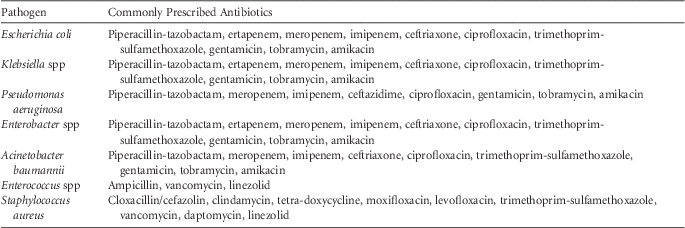
The antibiograms expressed antibiotic resistance in proportion susceptible, defined as the percentage of included isolates susceptible (not resistant or intermediate susceptibility) to a particular antibiotic. The Clinical Laboratory Standards Institute (CLSI) break points were used to designate susceptibility for 45 antibiograms (representing 25 hospitals), while the standards used for the remaining 7 antibiograms (representing 5 hospitals) were unknown. From the antibiograms, antibiotic susceptibilities of Escherichia coli, Klebsiella spp, P. aeruginosa, Enterobacter spp, A. baumannii, Enterococcus spp, and S. aureus to commonly prescribed antibiotics were extracted (Table 1). We included E. coli because it represents a large proportion of all collected nosocomial bacterial isolates. Klebsiella spp, P. aeruginosa, Enterobacter spp, A. baumannii, Enterococcus spp, and S. aureus were chosen, because these ESKAPE pathogens have been identified as having significance in the hospital setting.Reference Boucher, Talbot and Bradley 3
ESKAPE Pathogens and Commonly Prescribed Antibiotics

Antibiotic Usage Data
Antibiotic consumption data were obtained from IMS Health, which included antibiotic purchasing information from the Canadian Drug Store and Hospital Purchases Audit. This consisted of direct drug sales data (from pharmaceutical manufacturers) and indirect drug sales data (from wholesalers and warehouses) to hospitals and pharmacies across Canada.Reference Tan, Ritchie and Alldred 12 These purchasing data were then linked at the hospital level through the Institute of Clinical Evaluative Sciences (ICES) to the Canadian Institutes of Health Information Discharge Abstract Database and Same-Day Surgery database, which are well-validated and describe all hospital admission events and same-day surgeries in Ontario. 13
The IMS Health dataset consisted of the quantities of individual antibiotics purchased per month by all acute-care hospitals in Ontario from January 1, 2014, to December 31, 2014. The dataset includes product name, product description, purchasing hospital, month and year of sale, and quantity purchased. From the product name and description, the antibiotic name and route of administration were derived. The identities of the hospitals were anonymized according to IMS confidentiality policies. This dataset was correlated with internal hospital records of antibiotic dispensing in a prior study and was found to be a valid surrogate for antibiotic consumption.Reference Tan, Ritchie and Alldred 12 Antibiotic purchasing was calculated in defined daily doses (DDDs), a measure of drug use championed by the World Health Organization that standardizes drug consumption based on an assumed average daily maintenance dose. 14
The ICES hospital administrative datasets permit calculation of hospital-specific patient days. These datasets include the number of patient days in the 2014 calendar year at each hospital. One patient day is defined as the provision of accommodations and services to a single patient for a single day. Patient-day data together with DDDs allowed us to express antibiotic consumption as defined daily doses per 1,000 patient days (DDDs/1,000 PD).
Statistical Analysis
The primary outcome was antibiotic susceptibility in percentage as captured in the antibiograms. If a single hospital produced multiple stratified antibiograms, a hospital-level antibiotic susceptibility was calculated for each bacteria and antibiotic pair using weighted arithmetic mean with weights determined by bacterial isolate count. The main predictor variable was antibiotic consumption in DDDs/1,000 PD. If multiple hospitals produced a single combined antibiogram (which often occurred when several hospital sites belonged to the same regional healthcare organization), grouped multihospital antibiotic consumption was calculated for each antibiotic by summing the DDDs for that antibiotic and dividing by the cumulative patient days from the multiple sites.
Multivariate regression analysis was performed, with the primary outcome being antibiotic susceptibility of the individual pathogens. The main predictor variable was hospital antibiotic consumption in DDDs/1,000 PD (the antibiotics chosen were commonly prescribed antibiotics to the seven organisms of interest shown in Table 1); other covariates included hospital type (ie, medium community, large community, or teaching hospital, as defined by affiliation with the Council of Academic Hospitals of Ontario), laboratory standards (CLSI or unknown), hospital volume (in patient days), and antibiotic type (categorical). Laboratory standards was chosen as a covariate to (1) assess whether it was a predictor of antibiotic susceptibility and (2) to adjust for any possible confounding by laboratory standard. A model was fit for each bacterial pathogen and included all commonly prescribed antibiotics for that pathogen, with 7 models in total. Generalized estimating equations (GEE) were used to account for repeated measurements within hospitals, given that for a single organism, the same hospital would contribute multiple observations for susceptibilities to different antibiotics. Statistical analysis was performed using SAS software (2015 university edition; SAS Institute, Cary, NC).
RESULTS
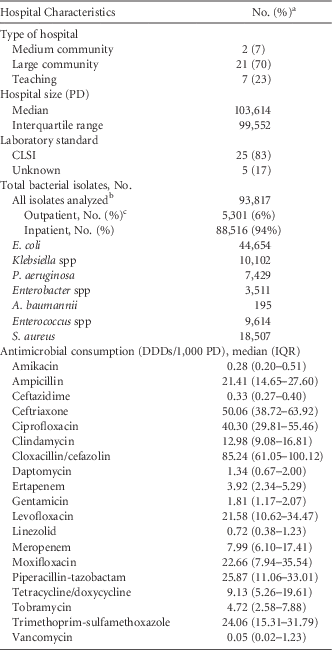
A total of 30 sets of antibiotic susceptibility and antibiotic consumption data representing 30 healthcare institutions were included. Their baseline characteristics are listed in Table 2. Of these 30 institutions, 2 (7%) were medium community hospitals, 21 (70%) were large community hospitals, and 7 (23%) were teaching hospitals. If a single healthcare organization comprised several hospital sites of differing hospital types, the hospital type of the largest hospital site was selected to represent the whole organization. The number of PDs varied greatly, with a median of 103,614 PDs (interquartile range [IQR], 99,552 PDs). Most institutions captured the antibiotic susceptibility of E. coli (97%), Klebsiella spp (97%), P. aeruginosa (97%), Enterobacter spp (87%), Enterococcus spp (83%), and S. aureus (97%), but less than a quarter (23%) reported susceptibility of A. baumannii. Therefore, A. baumanni was excluded from the multivariate analysis.
Characteristics of Hospitals and Healthcare Organizations Included in the Analysis

NOTE. CLSI, Clinical and Laboratory Standards Institute; PD, patient days; DDD, defined daily doses.
a Unless units are otherwise specified.
b One large community hospital contributed bacterial susceptibility data but did not report isolate numbers.
c Outpatient includes isolates specifically designated as outpatient by the hospital and those from the emergency department. All other isolates were categorized as inpatient, and may contain a mixture of inpatient and outpatient sources.
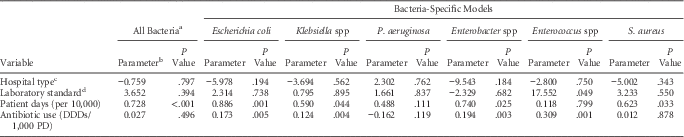
Multivariable regression analyses were performed to examine predictors of antibiotic susceptibility (Table 3). Using P<.05 as the significance threshold, increased antibiotic consumption was associated with a trend towards decreased P. aeruginosa antibiotic susceptibility, where the model parameter of −0.162 indicated that a 0.162% decrease in antibiotic susceptibility was associated with a 1-unit increase in DDDs/1,000 PD (P=.119). However, this trend was not statistically significant. Conversely, increased antibiotic consumption in DDDs/1,000 PD predicted increased antibiotic susceptibility significantly for E. coli (0.173% per DDD/1,000 PD; P=.005), Klebsiella spp (0.124% per DDD/1,000 PD; P=.004), Enterobacter spp (0.194% per DDD/1,000 PD; P=.003), and Enterococcus spp (0.309% per DDD/1,000 PD; P=.001), and nonsignificantly for S. aureus (0.012% per DDD/1,000 PD; P=.878). Among covariates, hospital type (−0.759%; P=.797) and laboratory standard (3.652%; P=.394) did not significantly predict antibiotic susceptibility, whereas increased patient days generally predicted increased organism susceptibility (0.728% per 10,000 PD; P<.001).
Multivariate Analysis to Identify Predictors of Antibiotic Susceptibility

NOTE. DDD, defined daily doses; PD, patient days. A categorical antibiotic predictor was included in the model (not shown).
a A. baumanni was excluded due to the small portion of institutions that reported A. baumanni antibiotic susceptibility.
b Parameter estimate representing the average increase in susceptibility for every unit increase in the predictor variable.
c Medium community was used as the baseline value, followed by large community, then by teaching institution.
d Unknown was used as the reference value.
DISCUSSION
In this multicenter observational ecological study, a total of 30 healthcare institutions representing medium-sized community hospitals, large community hospitals, and academic hospitals were included. For most bacterial pathogens evaluated, increased antibiotic consumption as reflected by antibiotic purchasing, was associated with increased antibiotic susceptibility: significantly so for Escherichia coli, Klebsiella spp, Enterobacter spp, and Enterococcus spp, and with a nonsignificant trend for S. aureus. However, P. aeruginosa was the exception; for this pathogen, increased antibiotic consumption predicted reduced antibiotic susceptibility, although this correlation was not statistically significant.
We found no evidence that contemporaneous hospital antibiotic use was consistently associated with increased hospital-diagnosed pathogen resistance. These findings could be explained in a few ways. Firstly, even among ESKAPE pathogens, a significant proportion of hospital associated infections are likely derived from strains acquired prior to hospital admission; thus, hospital-specific antibiotic usage would not necessarily be expected to predict hospital resistance rates. Antibiograms, because of how they are calculated using patients’ initial microbial cultures, are weighted toward community-acquired pathogens.Reference Hindler and Stelling 10 Clinicians may thus be basing their inpatient antibiotic decisions on community-weighted resistance prevalence and choosing antibiotics with less resistance among these hospital-presenting yet community-acquired pathogens, leading hospital antibiotic use to occur in response to the antibiotic resistance captured in antibiograms. For example, a clinician may choose ceftriaxone at their institution to treat E. coli because they know their antibiogram (which is weighted to community-derived isolates) indicates that it is likely to be effective. Interestingly, among the pathogens we studied, P. aeruginosa is the most likely to be acquired in the hospital setting. This pathogen demonstrated a nonsignificant trend toward decreased susceptibility with increased antibiotic use, which would support these explanations. Our findings also suggest that an increasing number of patient days was associated with higher susceptibility, which may be related to complex relationships between hospital demographics and average lengths of stay.
The impact of antibiotic usage on antibiotic resistance at the regional level has been assessed in prior studies.Reference McDougall, Morton and Playford 15 – Reference Batard, Ollivier and Boutoille 18 A regional study by McDougall et alReference McDougall, Morton and Playford 15 investigated carbapenem usage and resistance in P. aeruginosa in 12 hospitals in Australia. Statewide pharmacy dispensing and distribution software was used to collect antibiotic consumption for each hospital, whereas P. aeruginosa susceptibility to meropenem was extracted from the statewide laboratory information system. Greater use of antipseudomonal carbapenems (eg, meropenem, doripenem, and imipenem) was associated with greater P. aeruginosa carbapenem resistance,Reference McDougall, Morton and Playford 15 which supports our finding that increased antibiotic consumption was associated with a trend toward decreased P. aeruginosa antibiotic susceptibility. Similarly, Miliani et alReference Miliani, L’Hériteau and Lacavé 16 found antibiotic consumption to be significantly associated with high P. aeruginosa resistance rates. Their data source comprised 84 healthcare facilities participating in the Antimicrobial Surveillance Network in northern France and included hospital-wide antibiotic consumption with laboratories serving the healthcare facilities capturing susceptibility.Reference Miliani, L’Hériteau and Lacavé 16
In addition, 2 recent studies evaluated antibiotic use and resistance in Enterobacteriaceae. Lesho et alReference Lesho, Clifford and Chukwuma 17 evaluated carbapenem and fluoroquinolone use and resistance in healthcare beneficiaries of the US Department of Defense. They used physician orders, written prescriptions, or purchased invoices as measures of antibiotic consumption, and they assessed susceptibility using the first documented Enterobacteriaceae isolate per patient per calendar year. No significant association between antibiotic use and resistance was observed at the national or facility level.Reference Lesho, Clifford and Chukwuma 17 Batard et alReference Batard, Ollivier and Boutoille 18 assessed antibiotic use and quinolone resistance in E. coli in 36 acute-care hospitals in France. Antibiotic consumption was collected directly from each hospital, while antibiotic resistance was calculated from nonduplicate E. coli isolates that were resistant to nalidixic acid (a marker of fluoroquinolone resistance). Their analysis found that the incidence of quinolone-resistant E. coli was positively associated with tetracycline, cephalosporin, and quinolone consumption.Reference Batard, Ollivier and Boutoille 18 However, their methodology for selecting eligible isolates, which allowed for multiple isolates from the same patient if they had differing susceptibility patterns, may preferentially weight them toward identifying pathogens that might have changed in susceptibility due to antimicrobial use in hospital. These resistance rates would be weighted toward patients with long stays and recurrent infections with increasingly resistant organisms.
Previously, many infections that occur in the hospital have been thought to be caused by community-derived flora, and these bacteria have been thought to develop resistance in response to outpatient antibiotic use. Cuevas et alReference Cuevas, Oteo and Lázaro 19 compared trends in community use of fluoroquinolones to ciprofloxacin-resistant E. coli in 42 Spanish hospitals. Retail pharmacy sales served as the measure for antibiotic consumption, and antibiotic susceptibility was captured for all first blood E. coli isolates in hospital.Reference Cuevas, Oteo and Lázaro 19 The rate of ciprofloxacin nonsusceptibility in these hospital-collected, bacteremia-causing E. coli isolates strongly and significantly correlated with the consumption of levofloxacin, moxifloxacin, and amoxicillin/clavulanic acid in the community.Reference Cuevas, Oteo and Lázaro 19 This concept of community-originating bacteria causing many infections that present in the hospital setting is also supported by MacDougall et al,Reference MacDougall, Powell and Johnson 20 who analyzed both hospital and community antibiotic consumption. Fluoroquinolone use in hospital was extracted for the 17 participating hospitals using claims data; antibiotic consumption in the community was accounted for by fluoroquinolone prescriptions dispensed from pharmacies in a 16-km radius surrounding each hospital. Meanwhile, antibiotic resistance was represented by the percentage of isolates captured in hospital antibiograms that were fluoroquinolone-resistant E. coli and MRSA.Reference MacDougall, Powell and Johnson 20 Their results indicated a significant association between community fluoroquinolone use and fluoroquinolone-resistant E. coli in hospitals serving these communities.Reference MacDougall, Powell and Johnson 20 In addition to these studies, most human antibiotic use occurs in the ambulatory setting, with 93% of prescriptions in Canada in 2014 dispensed by community pharmacies. 21 This finding further supports the idea that the greatest selection pressure contributing to antibiotic resistance might be exerted by outpatient use.
This study has several limitations. In our ecological study design, we can demonstrate an association between antibiotic use and susceptibility, but causality cannot be determined. The cross-sectional nature of the study also prevented us from assessing temporal associations between antibiotic use and antibiotic resistance. Moreover, not all healthcare facilities contacted were able to provide antibiograms, which limited the sample size. However, the total bacterial isolate count of 93,817 is still considerable compared to similar studies, which have isolate counts ranging from 9,000 to 23,000 in a calendar year.Reference McDougall, Morton and Playford 15 – Reference Batard, Ollivier and Boutoille 18 Additionally, variation exists in the antibiotic susceptibility data we used, due to heterogeneity in the laboratory standards across hospitals (although this did not significantly predict antibiotic susceptibility) and to the need in some instances to combine antibiograms from multiple locations. Furthermore, our lack of access to regional outpatient antibiotic usage prevented us from testing the hypothesis that antibiotic usage in the ambulatory setting serves as an important driver to antibiotic resistance in hospital isolates. Lastly, antibiograms, given their preparation method,Reference Hindler and Stelling 10 are based on the first isolate per patient per species and are thus biased toward community isolates.
In summary, our multicenter observational ecological study found that hospital-specific antibiotic usage was associated with increased, rather than decreased, hospital antibiotic susceptibility for most organisms. We speculate that this may be due to a preponderance of community-derived sources for the hospital infections analyzed, and/or the selection of agents by clinicians based on known patterns of resistance. However, a predominantly nosocomial organism such as P. aeruginosa may exhibit resistance rates that are driven by nosocomial antibiotic use. Further research is needed to validate this hypothesis. Our results highlight the potential importance of community stewardship approaches on impacting antibiotic resistant organisms encountered in hospitals.
ACKNOWLEDGMENTS
This study was partially conducted at the Institute for Clinical Evaluative Sciences (ICES), which is funded by an annual grant from the Ontario Ministry of Health and Long-Term Care (MOHLTC). The opinions, results, and conclusions reported in this paper are those of the authors and are independent from the funding sources. No endorsement by ICES or the Ontario MOHLTC is intended or should be inferred. We would like to thank all the contributing institutions.
Financial support. No financial support was provided relevant to this article.
Potential conflicts of interest. All authors report no conflicts of interest relevant to this article.