Implications
Feeding excess protein and fat in the form of dried distillers grains with solubles (DDGS) to beef cows from calving until mid-lactation did not affect BW or body condition score of the cows. DDGS improved timed-artificial insemination conception rates, which would allow producers to improve the genetic value of their herd, and result in a higher proportion of calves born early in the calving season. Milk production was not altered, but milk composition and fatty acid profile were modified by DDGS, resulting in greater pre-weaning average daily gain and weaning weights of calves from dams fed DDGS.
Introduction
Grass and/or baled hay may not provide adequate amounts of energy and/or protein to meet the nutritional demands of beef females during the last trimester of pregnancy, when nutrients are needed for fetal and placental growth, or following parturition, when increasing milk production necessitates greater nutritional inputs. Dried distillers grains with solubles (DDGS) are a unique, cost-effective feedstuff because calories are almost equally provided from fat, fiber and protein. Use of DDGS as a primary energy source in gestating and lactating cow diets increases protein and unsaturated fatty acid (UFA) intake. Excess dietary protein increases blood urea, which has been correlated with decreased conception rates in dairy cattle (Butler et al., Reference Butler, Calaman and Beam1996) and impaired oocyte development in vitro (Sinclair et al., Reference Sinclair, Kuran, Gebbie, Webb and McEvoy2000). The decrease in conception rates as a result of feeding excess protein may be a result of lowered uterine pH and altered uterine function (Elrod and Butler, Reference Elrod and Butler1993), impaired embryo viability (Rhoads et al., Reference Rhoads, Rhoads, Gilbert, Toole and Butler2006), or altered oviductal environment (Sinclair et al., Reference Sinclair, Garnsworthy, Mann and Sinclair2014). However, when excess protein was fed in combination with additional dietary fat during the last 100 days of gestation and first 100 days of lactation in beef cows, as is the case when DDGS is fed, altered energy partitioning occurs in the cow and reproductive performance was improved (Gunn et al., Reference Gunn, Schoonmaker, Lemenager and Bridges2014). It has been proposed that fat supplementation (Santos et al., Reference Santos, Bilby, Thatcher, Staples and Silvester2008); fatty acid composition, specifically polyunsaturated fatty acids (PUFAs; Mattos et al., Reference Mattos, Staples and Thatcher2000); and type of protein, specifically rumen protein (RUP; Martin et al., Reference Martin, Vonnahme, Adams, Lardy and Funston2007), or a combination of both fat and protein (Engel et al., Reference Engel, Patterson and Perry2008) improve reproductive performance. Gunn et al. (Reference Gunn, Schoonmaker, Lemenager and Bridges2014) also reported increased dystocia rates in cows fed large amounts of DDGS during gestation and lactation. Increased dystocia is a problem that must be avoided, but it is unclear if the beneficial effects of increased UFAs in DDGS diets could potentially outweigh the negative effects of excessive protein when fed to beef cows just during lactation.
When excess protein and fat in the form of DDGS was fed to beef cows during gestation and lactation, progeny birth weights and pre-weaning growth was increased compared with progeny from cows fed isocaloric hay or corn silage-based diets (Radunz et al., Reference Radunz, Fluharty, Day, Zerby and Loerch2010 and Reference Radunz, Fluharty, Relling, Felix, Shoup, Zerby and Loerch2012; Gunn et al., Reference Gunn, Schoonmaker, Lemenager and Bridges2014). These improvements in progeny performance when DDGS was fed to beef cows were thought to be a result of increased concentrations of milk urea nitrogen (MUN) or UFA in milk (Gunn et al., Reference Gunn, Schoonmaker, Lemenager and Bridges2014). However, the continued feeding of DDGS through the first 100 days of lactation makes it unclear whether improved progeny performance was a result of fetal programming. While it is clear that altered nutrient intake during gestation has long-term implications for the progeny (Wu et al., Reference Wu, Bazer, Wallace and Spencer2006), it is unknown what effect altered nutrition during early lactation has on progeny development. Therefore, our objective was to evaluate the performance of dams fed DDGS from calving to mid-lactation and to characterize the growth of their progeny. Our hypothesis was that feeding excess protein and fat in the form of DDGS from calving until mid-lactation would improve reproductive performance of the cows, alter milk composition and consequently improve the growth of male calves.
Material and methods
Animals and diets
The experiment was conducted at the Purdue University Animal Sciences Research and Education Center in West Lafayette, IN. Research protocols using animals followed guidelines in the Guide for the Care and Use of Agricultural Animals in Agricultural Research and Teaching (Federation of Animal Science Societies, 2010) and were approved by the Purdue Animal Care and Use Committee. Angus×Simmental cows (n=54, BCS=5.17±0.06, BW=653±9 kg, age=5.22±2.51 years) with male progeny were used in a complete randomized design to determine effects of feeding DDGS from calving to mid-lactation on cow performance, milk composition and pre-weaning calf growth.
Cow–calf pairs were allotted within 1 week after calving by breed composition, birth date, calf birth weight and sire and cow age. Cow–calf pairs were placed in one of two drylots according to their dietary treatment. Drylots were adjacent 3 ha lots, each with access to 26.8×0.45 m of bunk space, a shared water source (drinking fountain) and a shared bedded pole barn. Topography (flat), soil type and weather exposure of the drylots were identical. Diets were isocaloric (0.95 Mcal/kg NEg) and were formulated to meet or exceed National Research Council (1996) protein, energy and mineral requirements for lactation (Table 1). All diets were formulated using individual ingredient chemical composition analyses obtained by wet chemistry methods (Association of Official Analytical Chemists, 1990) before the beginning of the experiment (Sure-Tech Laboratories, Indianapolis, IN, USA). Diets consisted of 45.3% rye hay and 53% DDGS on a DM basis (DDGS; n=27) or 25.5% rye hay, 65.1% corn silage and 8.5% soybean meal on a DM basis (CON; n=27). Diets differed in CP (19.4% DDGS v. 11.7% CON) and fat (8.8% DDGS v. 2.1% CON) due to the composition of DDGS. Dry matter intake was targeted to be similar between treatments (15.0 kg DDGS v. 15.2 kg CON). Rye hay bales were weighed before delivery and were fed ad libitum in a hay ring. The amount of rye hay delivered was considered rye hay intake for cows. DDGS and mineral for the DDGS diet; and corn silage, soybean meal and mineral for the CON diet were mixed and offered to each group of cows once daily in concrete bunks (26.8 m) at ~0800 h. Feed samples were collected and composited for analysis of DM, CP, ether extract, fatty acids and minerals. Dry matter of dietary ingredients was determined by drying feed ingredients in a forced air oven at 60°C for 72 h and as-fed formulations adjusted accordingly each week.
Diet composition

CON=soybean meal supplemented as an protein source; DDGS=dried distillers grains with solubles used as a protein and energy source; RUP=rumen protein.
1 Vitamin/mineral pre-mix contained (DM basis): 11.0% Ca, 5.0% P, 2.0% Mg, 2.0% K 40 ppm Co, 1000 ppm Cu, 3000 ppm Mn, 27 ppm Se, 3700 ppm Zn, 400 IU/g vitamin A, 40 IU/g vitamin D, 200 IU/kg vitamin E.
2 Analyzed by Sure-Tech Laboratories.
3 Calculated using NRC (1996) values.
Dietary treatments were terminated at day 129±10 PP and cow–calf pairs were placed on pasture and managed as one group until weaning at day 219±10 PP. Initial and final BW for cows and calves were determined by taking the average pre-prandial weights taken on 2 consecutive days. Digital walkover scales (Tru-Test XR3000; Mineral Wells, TX, USA) were used and weighed to the nearest 0.91 (<454 kg) or 2.27 kg (>454 kg) and were checked for accuracy at each weigh date. Subsequent BW for cows and calves and body condition score (BCS) for cows (1=emaciated, 9=obese; Wagner et al., Reference Wagner, Lusby, Oltjen, Rakestraw, Wettemann and Walters1988) were assessed monthly throughout the treatment period. BCS was conducted by the same investigator at all time points throughout the experiment. Calf weights were recorded the same day as cows and were used to calculate calf average daily gain (ADG).
Milk
Milk production was measured on day 64 and 110±10 PP through a twelve h weigh-suckle-weigh procedure (Buskirk et al., Reference Buskirk, Lemenager and Horstman1992). Calves were separated from their dams at 0000 h, allowed to nurse at 0600 h and then separated until 1200 h. At 1200 h, calves were weighed before nursing and were re-weighed immediately after suckling ceased. The weigh-suckle-weigh procedure was repeated at 1800 h. The difference in calf weight before and immediately after nursing was calculated as the milk production for the 6 h period. Milk production at 1200 h and 1800 h were added together then multiplied by two to estimate 24 h milk production. During separation, cows were returned to their pasture where they had access to feed and water and calves were penned in groups of 4 or 5 and were denied dry feed and water throughout the procedure.
Before feeding on day 68 and 116±10 PP, cows and calves were separated for 3 h and milk was totally collected from one quarter of the udder of each cow by hand-milking. Milk was placed in a vial containing methylene blue and shipped to Dairy One Cooperative (Ithaca, NY, USA) for analysis of protein, fat, lactose, total solids and MUN. A second sample was transferred to a 50-ml polystyrene conical tube (BD Falcon, San Jose, CA, USA) and stored at −20°C for analysis of fatty acid composition.
Fatty acid analysis
Total lipid was extracted from milk with a solution of chloroform and methanol (2 : 1) according to the procedures of Folch et al. (Reference Folch, Lees and Sloane Stanley1957) and derivatized to fatty acid methyl esters according to Li and Watkins (Reference Li and Watkins1998). Fatty acid methyl ethers were analyzed by gas chromatography on a gas chromatograph (model 3900; Varian Inc., Palo Alto, CA, USA) equipped with a 30 m column (CP-WAX 52 CB; Varian Inc.) and a flame ionization detector. Samples were run in duplicate, and fatty acid percentage was calculated by averaging the duplicate values for each fatty acid and dividing the individual fatty acid peak areas by the aggregate area. Fatty acid methyl ester peaks were identified by comparing the retention times with separately run fatty acid methyl ester standards (GLC-461; Nu-Chek Prep Inc., Elysian, MN, USA). Short chain fatty acids (SCFA) were classified as 4:0 to 8:0, medium chain fatty acids (MCFA) as 10:0 to 15:0 and long chain fatty acids (LCFA) as those ⩾16:0. Theoretical response factors (Christie, Reference Christie1989) were used to adjust fatty acids for different flame ionization detector response due to fatty acid chain length.
Estrous synchronization and breeding
On day 79±10 PP, cows were synchronized using the 5-day CO-Synch+CIDR protocol that consisted of insertion of an intravaginal progesterone insert (CIDR; Pfizer Animal Health, New York, NY, USA) concurrent with administration of 100 µg of GnRH (Fertagyl, Intervet/Schering-Plough Animal Health, Summit, NJ, USA) at protocol initiation. Five days later, the CIDR was removed and 25 mg of PGF2α (Lutalyse; Pfizer Animal Health, New York, NY, USA) was given at CIDR removal and again 8 h later. After 72 h of CIDR removal and initial PGF2α injection, all cows were timed-artificially inseminated (TAI) concurrent with GnRH administration (Fertagyl; 100 µg). Cows were placed with a bull 10 days after TAI for the remainder of the 60-day breeding season. Cows were ultrasounded (Variable MHz linear array transducer; MicroMaxx, Sonosite, Bothell, WA, USA) 30 and 90 days after TAI to determine conception and overall pregnancy rates, respectively.
Blood urea nitrogen
Blood samples were taken from cows and calves 1 day before termination of treatment for analysis of plasma urea nitrogen (PUN). Blood samples were collected in BD Vacutainer tubes containing 158 USP Sodium Heparin (Becton Drive, Franklin Lakes, NJ, USA), inverted, then placed on ice until centrifugation at 3000×g for 20 min at 4°C. Plasma was separated and stored at −20°C until analysis of PUN, using a commercial kit (Stanbio Urea Nitrogen Procedure No. 0580, Stanbio Laboratory, Boerne, TX, USA). Samples were read at 530 nm in an Opsys MR microplate reader (Dynex Technologies Inc., Chantilly, VA, USA). The intra-assay CV was 6.61% and the inter-assay CV for a control sample containing 30 mg/dl of urea nitrogen was 2.15%.
Statistical analysis
TAI and pregnancy rates were calculated using the GLIMMIX procedure of SAS (SAS Institute Inc., Cary, NC, USA). Cow BW, BCS, milk production, milk composition, milk fatty acid profile, and calf BW and ADG were analyzed using the MIXED procedure of SAS for repeated measures. The covariance structures autoregressive order one, heterogeneous autoregressive order one, unstructured and compound symmetric were compared and the covariance structure with the smallest Bayesian information criterion was chosen for analysis of results. The model included the fixed effects of diet and day, as well as the appropriate diet×day interactions. Simple effects within day were generated using the SLICE function of SAS. PUN was analyzed using the MIXED procedure of SAS as a completely randomized design. Individual animal was used as the experimental unit. We do acknowledge that use of animal as the experimental unit when housed in only two groups does not allow us to discriminate between effect of treatment and effect of group. However, drylot pens used in the experiment were identical in size, bunk space, water source, soil type and weather exposure. Furthermore, the small size of the pens (3 ha) decreases variability within pen. Thus, pens were designed to minimize variation, so that random errors would be independent of treatment and pen variation was insignificant compared with animal variation.
Results and discussion
Cow performance
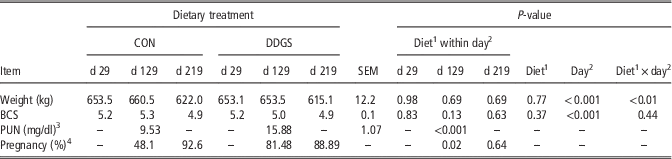
The objective of this experiment was to assess cow and calf performance when the dams were fed excess concentrations of protein and fat, at an energy concentration similar to a corn silage/soybean meal based control diet from early to mid-lactation. This was accomplished by feeding DDGS, a commonly available corn by-product in the United States, as a primary dietary energy source. It should be noted that cows in both treatments obtained the projected ADG during both the pre- and postpartum periods, indicating that a similar amount of megacalories (whether from fat or starch) was delivered to the cows and that potential confounding effect of dietary energy content was reduced. Excess supplemental fat can have a negative effect on fiber digestion and can decrease microbial protein production (Coppock and Wilks, Reference Coppock and Wilks1991), which in turn can decrease milk protein and cow and calf BW gain. However decreased microbial CP production could be offset by the additional dietary NDF and RUP found in DDGS. There was no effect of treatment on cow BW (P=0.77) or BCS (P=0.37) for the duration of the experiment (Table 2). However, there was a day effect for cow BW and BCS (P<0.001) and a diet×day effect for cow BW (P<0.01). Cows fed the CON diet gained weight from calving to day 129, whereas cows fed DDGS maintained weight from calving until day 129. Cows from both treatments lost weight and BCS from day 129 to 219. The high concentration of CP (19.4%) in the DDGS diets increased PUN at day 128 PP (P<0.001). Previous research has demonstrated that DDGS-based diets that contain excess protein and fat promote (Radunz et al., Reference Radunz, Fluharty, Day, Zerby and Loerch2010) or does not impact cow weight gain (Gunn et al., Reference Gunn, Schoonmaker, Lemenager and Bridges2014) and increases blood urea nitrogen (Gunn et al., Reference Gunn, Schoonmaker, Lemenager and Bridges2014). Although Radunz et al. (Reference Radunz, Fluharty, Day, Zerby and Loerch2010) saw no visual differences in BCS, ultrasound revealed that cows fed DDGS gained more back fat compared with those fed hay and suggested that energy was partitioned to subcutaneous fat deposition. In contrast, Gunn et al. (Reference Gunn, Schoonmaker, Lemenager and Bridges2014) reported that feeding DDGS during late gestation did not increase BCS whereas control diets did. It was hypothesized by Gunn et al. (Reference Gunn, Schoonmaker, Lemenager and Bridges2014) that the lack of increase in BCS by feeding DDGS was due to a shift in location of fat deposition, where internal fat was deposited rather than subcutaneous fat. A change in location of fat metabolism is also supported by data from Depenbusch et al. (Reference Depenbusch, Coleman, Higgins and Drouillard2009) who observed a linear decrease in 12th rib fat along with a quadratic increase in internal fat when feedlot heifers were fed from 0% to 75% DDGS on a DM basis. It appears from data in the present experiment that the excess protein and fat in DDGS does not decrease subcutaneous fat stores (as measured by BCS) when it is fed during lactation, however, it is possible that fat deposition may have been altered internally.
Effect of diet from calving until day 129±10 postpartum on cow weight, body condition score, plasma urea N, and pregnancy rates

CON=soybean meal supplemented as an protein source; DDGS=dried distillers grains with solubles used as a protein and energy source, BCS=body condition score.
1 Diet effect. The SLICE function of SAS was used to generate diet effects within day.
2 Day=days postpartum.
3 Plasma urea nitrogen, measured on day 128 postpartum.
4 Pregnancy rates were determined on day 169 (timed AI) and day 229 (overall) postpartum.
TAI rates were greater in cows fed DDGS compared with cows fed CON (P=0.02; 81.5% v. 48.1%), although there were no differences in overall pregnancy rates (P=0.64). Previous research with feeding DDGS during gestation has been inconclusive as to an effect on reproduction. Studies with heifers have reported a decrease in postpartum anestrous when feeding 40% to 50% DDGS during late gestation (Engel et al., Reference Engel, Patterson and Perry2008) or when feeding 43% DDGS during late gestation and early lactation (Gunn et al., Reference Gunn, Schoonmaker, Lemenager and Bridges2014). Pregnancy rates have improved for some studies when DDGS was fed during late gestation (Engel et al., Reference Engel, Patterson and Perry2008), but TAI and overall pregnancy rates have not been altered in other studies when DDGS was fed during late gestation (Radunz et al., Reference Radunz, Fluharty, Day, Zerby and Loerch2010) or during early lactation (Shike et al., Reference Shike, Faulkner, Parrett and Sexten2009). Gunn et al. (Reference Gunn, Schoonmaker, Lemenager and Bridges2014) observed that DDGS increased follicle growth rates, increased dominant follicle diameters and decreased the anestrous period compared with control fed cows. In the current experiment, supplementation of DDGS during lactation may have decreased the anestrous period, and helped the cows to resume cyclicity sooner than those fed the CON diet, thus allowing greater conception rates to TAI. Such an increase in TAI could allow producers to improve the genetic value of their herd as well as progeny marketed for slaughter, would result in a higher proportion of calves born early in the calving season, and subsequently could improve the weight and value of feeder calves.
Plasma urea concentrations in excess of 41 mg/dl have been indicative of decreased fertility (Butler et al., Reference Butler, Calaman and Beam1996). Although PUN concentrations for DDGS cows were ~67% greater than that of CON, they were not greater than the aforementioned concentration associated with suppressed fertility in dairy cows. However, numerous studies looking at the association between circulating urea concentrations and fertility within dairy herds have failed to find any relationship (Cottrill et al., Reference Cottrill, Biggadike, Collins and Laven2002; Mann et al., Reference Mann, Mann, Blache and Webb2005). In a recent review, Lean et al. (Reference Lean, Celi, Raadsma, McNamara and Rabiee2012) found no influence of blood urea concentrations on conception rate. Whereas, Martin et al. (Reference Martin, Vonnahme, Adams, Lardy and Funston2007) reported that increased CP, specifically RUP, increased reproductive performance in beef cows. In the current experiment, the majority of the increase in CP in the DDGS diet was as a result of RUP and RUP was 67% of the CP in the DDGS diet and only 29% of the CP in the CON diet. Also, fat concentrations were elevated in the DDGS diets in the present experiment and a greater percentage of UFAs in DDGS have been reported to bypass ruminal biohydrogenation compared with control diets (Vander Pol et al., Reference Vander Pol, Luebbe, Crawford, Erickson and Klopfenstein2009). It has been proposed that fat supplementation, specifically PUFAs (Mattos et al., Reference Mattos, Staples and Thatcher2000), or a combination of both fat and CP (Engel et al., Reference Engel, Patterson and Perry2008; Gunn et al., Reference Gunn, Schoonmaker, Lemenager and Bridges2014) improve reproductive performance. The specific nutrient and the mechanism by which fat, PUFAs, protein, or their combination increase TAI conception rates remains to be elucidated.
Milk
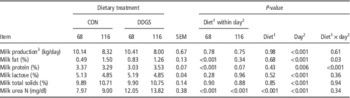
Feeding DDGS diets did not influence milk production on either day 64 or 110 PP (P⩾0.75) as determined by the weigh-suckle-weigh procedure (Table 3). Milk production for both treatments decreased from day 64 to 110 (day effect; P<0.001). Previous studies (Radunz et al., Reference Radunz, Fluharty, Relling, Felix, Shoup, Zerby and Loerch2012; Gunn et al., Reference Gunn, Schoonmaker, Lemenager and Bridges2014) similarly reported that DDGS-based diets had no effect on milk production when compared with isocaloric hay or corn silage-based diets. However, Shike et al. (Reference Shike, Faulkner, Parrett and Sexten2009) reported a decrease in milk production and concomitant increase in BW when multiparous and primiparous cows were limit-fed a 55% DDGS diet at an energy concentration isocaloric with a control diet containing 57% corn gluten feed. In contrast, Winterholler et al. (Reference Winterholler, McMurphy, Mourer, Krehbiel, Horn and Lalman2012) observed a tendency for increased milk production in multiparous and primiparous beef cows with increased supplementation of DDGS.
Effect of diet from calving until day 129±10 postpartum on milk production and milk composition

CON=soybean meal supplemented as an protein source; DDGS=dried distillers grains with solubles used as a protein and energy source.
1 Diet effect. The SLICE function of SAS was used to generate diet effects within day.
2 Day=days postpartum.
3 Milk production was measured on days 64 and 110 postpartum.
The high concentration of CP (19.4%) in the DDGS diets increased MUN (P<0.001) of cows on both day 68 and 116 PP and MUN concentration increased from day 68 to 116 for both treatments (day effect, P<0.001). Milk protein was decreased on day 68 PP (P<0.001), yet tended to be greater on day 116 PP (P=0.07) for cows fed DDGS (diet×day effect; P<0.001). The impact of DDGS on MUN and milk protein has been variable and a slight decrease in milk protein percentage was seen when beef cows were fed 55% dietary DDGS, but not when 77% dietary DDGS was fed during lactation; MUN was not affected (Shike et al., Reference Shike, Faulkner, Parrett and Sexten2009). Gunn et al. (Reference Gunn, Schoonmaker, Lemenager and Bridges2014), observed no differences in milk protein percentages, but an increase in MUN when cows were fed 43% to 49% DDGS compared with cows fed isocaloric control diets. Radunz et al. (Reference Radunz, Fluharty, Day, Zerby and Loerch2010) observed no change in milk protein when DDGS was fed at 4.1 kg/day. Winterholler et al. (Reference Winterholler, McMurphy, Mourer, Krehbiel, Horn and Lalman2012) observed an increase in milk protein percentage and MUN as the amount of DDGS supplementation increased up to 4 kg/day. Increased MUN is an indication of excess dietary protein and/or decreased ruminal microbial synthesis. Increased MUN due to DDGS feeding in the present experiment, as well as other studies (Gunn et al., Reference Gunn, Schoonmaker, Lemenager and Bridges2014; Winterholler et al., Reference Winterholler, McMurphy, Mourer, Krehbiel, Horn and Lalman2012), is likely caused by excess dietary protein, however elevated MUN could be a result of the decreased rumen degradable protein (RDP) content and/or the increased fat content of DDGS-based diets, as supplemental fat can have a negative effect on fiber digestion and can decrease microbial protein production (Coppock and Wilks, Reference Coppock and Wilks1991). However, although formulated RDP content of the DDGS diet in the current study was lower compared with the CON diet, the RDP content of the DDGS diet still exceeded NRC (1996) recommendations. Furthermore, the RUP content of the DDGS diet far exceeded NRC (1996) recommendations and likely offset and decrease in microbial protein. The fact that cow performance (BW and BCS) was not altered in the current experiment further suggests that the increased MUN was the result of excess RUP in the DDGS-based diets.
Milk fat % increased from day 68 to 116 for both treatments (day effect; P<0.001), however; a diet×day interaction occurred for milk fat % (P=0.03). Cows fed DDGS had a greater percentage of milk fat on day 68 PP (P<0.001), but not on day 116 PP (P=0.34). Recent reports (Winterholler et al., Reference Winterholler, McMurphy, Mourer, Krehbiel, Horn and Lalman2012; Gunn et al., Reference Gunn, Schoonmaker, Lemenager and Bridges2014) have indicated that milk fat in beef cows may be as low as 1.4% to 1.7%, however, it is possible that milk fat values in the present experiment were considerably lesser than expected because of incomplete emptying of the quarter at sampling. Nevertheless, it has been reported that within milking variation in milk components and fatty acids is low to none (Larsen et al., Reference Larsen, Weisbjerg, Kristensen and Mortensen2012; Rico et al., Reference Rico, Marshall, Choi, Kaylegian, Dechow and Harvatine2014). Milk lactose decreased from day 68 to 116 (day effect; P<0.001) and milk solids increased from day 68 to 116 (day effect; P<0.001) for both treatments. However, dietary treatment had no effect on total solids (P⩾0.88) or lactose (P⩾0.28) on either day. Radunz et al. (Reference Radunz, Fluharty, Day, Zerby and Loerch2010) and Shike et al. (Reference Shike, Faulkner, Parrett and Sexten2009) observed no effect of DDGS on milk fat percentage, whereas Winterholler et al. (Reference Winterholler, McMurphy, Mourer, Krehbiel, Horn and Lalman2012) and Gunn et al. (Reference Gunn, Schoonmaker, Lemenager and Bridges2014) reported that DDGS decreased milk fat percentage. Different responses in milk fat production among DDGS supplementation studies may be related to the type of forage or basal diets fed. Basal diets can have a profound effect on ruminal metabolism of fatty acids from supplemental fat sources, which might be related to shifts in rumen pH and microbial populations and the complex mechanisms that regulate ruminal lipid metabolism (Sterk et al., Reference Sterk, Johansson, Taweel, Murphy, van Vuuren, Hendricks and Dijkstra2011).
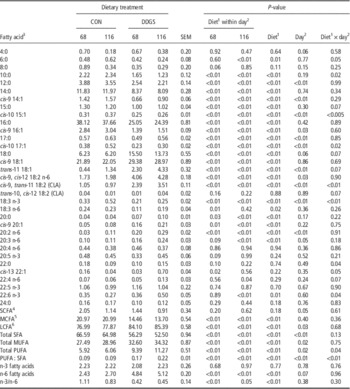
Feeding DDGS resulted in an increase in long chain fatty acids (⩾16:0; P<0.01) and a decrease in MCFAs (10:0 to 15:0; P<0.01) in milk on either day 68 or 116 PP (Table 4). The increase in LCFA in DDGS compared with CON on both days is primarily due to increases in fatty acids ⩾18:0, particularly 18:0 (P⩽0.01), 18:1 isomers (P⩽0.01) and 18:2 (P≤0.01), because 16:0 actually decreased in DDGS compared with CON cows (P⩽0.01). SCFAs decreased (day effect; P⩽0.05) and long chain fatty acids increased from day 68 to 116 (day effect; P=0.03). PUFA and monounsaturated fatty acid (MUFA) content of milk were increased (P⩽0.01) due to DDGS supplementation, and concentration of saturated fatty acids (SFA) were consequently decreased (P<0.01) on both day 68 and 116 PP. MUFAs and PUFA increased (day effect; P⩽0.02) and SFA decreased (day effect; P⩽0.01) from day 68 to 116 for both treatments. Milk PUFA : SFA tended to increase more dramatically in cows fed DDGS compared with cows fed CON from day 68 to 116 (diet×day effect; P⩽0.01). A diet×day effect (P⩽0.01) existed for the concentration of cis-9, trans-11 conjugated linoleic acid (CLA) in milk. Milk CLA was increased 2.3-fold on day 68 PP (P<0.01) but only 1.5-fold on day 116 PP (P⩽0.01) in DDGS compared with CON. The n-3/n-6 ratio was decreased for DDGS compared with CON cows on day 68 PP (P⩽0.01), but was slightly increased for DDGS compared with CON cows on day 116 PP (P=0.05). Changes in milk fatty acid chain length, n-6 fatty acids and the n-3/n-6 ratio in the current experiment was altered in accordance with Gunn et al. (Reference Gunn, Schoonmaker, Lemenager and Bridges2014) where DDGS-based diets were fed to Angus×Simmental cows. Changes in PUFA, MUFA and CLA in the current experiment are consistent with previous studies that have fed DDGS to Holsteins (Kurokawa et al., Reference Kurokawa, Shibata, Tateno, Kanda, Takaura, Ishida and Itabashi2013) and Angus×Simmental cows (Gunn et al., Reference Gunn, Schoonmaker, Lemenager and Bridges2014). SCFA and MCFAs are mainly derived from de novo synthesis in the mammary gland, whereas LCFA are derived from the diet (Bauman and Griinari, Reference Bauman and Griinari2003). DDGS contain elevated PUFA and LCFA, which are partially protected from ruminal biohydrogenation (Vander Pol et al., Reference Vander Pol, Luebbe, Crawford, Erickson and Klopfenstein2009). Additionally, PUFA can hinder de novo synthesis of SCFA and MCFA, resulting in an increased proportion of dietary LCFA in the milk (Bauman and Griinari, Reference Bauman and Griinari2003).
Effect of diet from calving until day 129±10 postpartum on day 68 and 116 postpartum milk fatty acid composition (g/100 g)

CON=soybean meal supplemented as an protein source; DDGS=dried distillers grains with solubles used as a protein and energy source; SFA=saturated fatty acids; MUFA=monounsaturated fatty acids; PUFA=polyunsaturated fatty acids.
1 Diet effect. The SLICE function of SAS was used to generate diet effects within day.
2 Day=days postpartum.
3 g/100 g of fatty acids
4 Short chain fatty acids (4:0 to 8:0).
5 Medium chain fatty acids (10:0 to 15:0).
6 Long chain fatty acids (16:0 and above).
Pre-weaning progeny performance
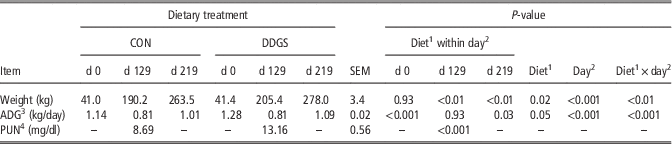
As designed, there were no differences in progeny birth weight (P=0.93; Table 5). There was a protein concentration×day effect for progeny weight and ADG (P<0.01). Calves whose dams were fed DDGS had a greater ADG (P<0.01) from day 0 to 129, were heavier by day 110 (P=0.02) and were 15.2 kg heavier at treatment termination on day 129 (P<0.01) compared with calves whose dams were fed CON. ADG from day 129 to weaning at day 219 was similar (P=0.93) between treatments, however the weight difference between DDGS and CON progeny remained, and DDGS calves were heavier at weaning on day 219 (P<0.01; 278 v. 264 kg). PUN was increased at the termination of the experiment for progeny whose dams were fed DDGS (P<0.001). Gunn et al. (Reference Gunn, Schoonmaker, Lemenager and Bridges2014) reported similar responses when dams were fed DDGS compared with corn silage-based diets from 84 days before 118 days after calving. However, Shike et al. (Reference Shike, Faulkner, Parrett and Sexten2009) reported lower calf ADG when dams were fed DDGS during lactation, which may be accounted for by the decreased milk production observed in that experiment. There were no differences in milk production in the current experiment, suggesting that the increase in growth in male progeny may have been due to alterations in milk composition. It should be noted, however, that intake of maternal diets by calves during the neonatal treatment period in the current experiment was possible, and thus could have contributed to differences in BW. However, studies with milk replacer in dairy calves suggest that increasing protein increases calf BW and protein deposition, although protein may only be beneficial if energy supply is adequate (Bartlett et al., Reference Bartlett, McKeith, VandeHaar, Dahl and Drackley2006). A portion of nitrogen requirements for nursing calves can be met by urea as early as 6 weeks of age (Brown et al., Reference Brown, Lassiter, Everett and Rust1956), thus increased MUN in DDGS fed cows may have been responsible for increased growth rates of progeny. Changes in milk fat content and milk fatty acid composition may be responsible for enhanced calf growth as well. Fatty acids can be oxidized for energy or deposited in adipose tissue depending upon chain length (Drackley, Reference Drackley2005). MCFAs are primarily oxidized for energy and while LCFA may be oxidized, they are primarily deposited into adipose tissue (Drackley, Reference Drackley2005). UFAs may promote muscle cell growth (Hurley et al., Reference Hurley, Flux, Salter and Brameld2006) and may also provide antimicrobial and antiviral effects (Hristov et al., Reference Hristov, Ivan and McAllister2004). Increased concentrations of MCFA, PUFAs, particularly 18:3, or butyrate (4:0) in milk replacer increased rate and efficiency of gain in dairy calves (Hill et al., Reference Hill, Aldrich, Schlotterbeck and Bateman2007). In the current experiment, MCFAs were decreased by the DDGS treatment, but LCFAs and PUFAs were increased and may have improved calf growth. Because ADG was similar after the termination of treatment, DDGS calves were persistently heavier through weaning.
Effect of diet from calving until day 129±10 postpartum on calf weight, average daily gain, and plasma urea N

CON=soybean meal supplemented as an protein source; DDGS=dried distillers grains with solubles used as a protein and energy source.
1 Diet effect. The SLICE function of SAS was used to generate diet effects within day.
2 Day=days postpartum.
3 Average daily gain, measured from day 0 to 129, day 130 to 219, and day 0 to 219.
4 Plasma urea nitrogen, measured on day 128 postpartum.
In summary, feeding excess protein and fat to beef cows in the form of DDGS from calving until mid-lactation did not affect BW or BCS of the cows. DDGS improved TAI conception rates, which would allow producers to improve the genetic value of their herd, and result in a higher proportion of calves born early in the calving season. Milk production was not altered, but milk composition and fatty acid profile were modified by DDGS, resulting in greater weaning weights of calves from dams fed DDGS. Adding DDGS to cow diets after calving increased calf gain, while preventing the high rates of dystocia seen when DDGS were fed during late gestation. In conclusion, feeding DDGS to lactating cows may be a useful method for improving TAI conception rates and calf growth through weaning.
Acknowledgments
Appreciation is extended to the employees of the Purdue Beef Research and Teaching Center for help in conducting this research.