INTRODUCTION
Over the past five decades coral reefs in the Caribbean have changed dramatically (Gardner et al., Reference Gardner, Côté, Gill, Grant and Watkinson2003; Hughes et al., Reference Hughes, Graham, Jackson, Mumby and Steneck2010; De'ath et al., Reference De'ath, Fabricius, Sweatman and Puotinen2012). Regional declines in coral cover have been asynchronous and due to cumulative factors, such as, hurricanes, disease outbreaks, bleaching, pollution and overfishing (Bythell et al., Reference Bythell, Gladfelter and Bythell1993; Hughes, Reference Hughes1994; Bythell et al., Reference Bythell, Hillis-Starr and Rogers2000; Kramer et al., Reference Kramer, Kramer and Ginsburg2003; Hughes et al., Reference Hughes, Graham, Jackson, Mumby and Steneck2010). One of the most dramatic shifts in community structure occurred after the massive die-off of Diadema antillarum (Echinodermata, Echinoidea). This species is considered a keystone herbivore in the western Atlantic, exerting top-down control on algal abundance (Carpenter & Edmunds, Reference Carpenter and Edmunds2006). The long-spined sea urchin has been the focus of many studies after its epizootic event between 1983 and 1984 (Lessios et al., Reference Lessios, Cubit, Robertson, Shulman, Parker, Garrity and Levings1984), when their mortality reached up to 99.9% at some Caribbean locations (Hughes et al., Reference Hughes, Keller, Jackson and Boyle1985; Hunte et al., Reference Hunte, Côté and Tomascik1986).
Herbivores maintain the stability and diversity of the highly-productive coral-dominated state of tropical reefs (Sammarco et al., Reference Sammarco, Levinton and Ogden1974; Sammarco, Reference Sammarco1982; Littler et al., Reference Littler, Littler and Titlyanov1991; Hughes, Reference Hughes1994; Carpenter & Edmunds, Reference Carpenter and Edmunds2006). Diadema antillarum and parrot-fish have the greatest impact on algal abundance and the widest feeding range of algal types (Steneck Reference Steneck1988). Profound changes took place on reefs after the collapse of D. antillarum populations (Hughes et al., Reference Hughes, Keller, Jackson and Boyle1985), shifting the structure and function of Caribbean coral reef ecosystems (Liddell & Ohlhorst, Reference Liddell and Ohlhorst1986). In some Caribbean reef locations, the benthic algal cover increased between 100% and 250% (Phinney et al., Reference Phinney, Muller-Karger, Dustan and Sobel2001). Non-calcareous algae of the genera Gelidium, Coelothrix and Amphiroa became more abundant in Puerto Rico (Vicente, Reference Vicente1987). The potential role of the sea urchin as the agent facilitating the switch between the current algae-dominated state in many Caribbean reefs to the original coral dominated one is considered a ‘new opportunity’ for coral reefs (Knowlton, Reference Knowlton2001), given the demise of herbivorous fish due to overfishing (Idjadi et al., Reference Idjadi, Haring and Precht2010).
Pre-mortality data available for Puerto Rico are useful to understand the dynamics in the recovery process locally (Craft, Reference Craft1975; Rivera & Vicente, Reference Rivera and Vicente1976; Bauer, Reference Bauer1980; Vicente & Goenaga, Reference Vicente and Goenaga1984). Densities dropped from 12.7–13.8 ind m−2 (Craft, Reference Craft1975; Bauer, Reference Bauer1980) to less than 1.0 ind m−2 (Ruiz-Ramos et al., Reference Ruiz-Ramos, Hernández-Delgado and Schizas2011; Soto-Santiago & Irizarry-Soto, Reference Soto-Santiago and Irizarry-Soto2013). Presently, D. antillarum is going through a slow and non-uniform recovery process in many Caribbean reefs where populations still exhibit low densities (Bak et al., Reference Bak, Carpay and Ruyter van Steveninck1984; Vicente & Goenaga, Reference Vicente and Goenaga1984; Hughes et al., Reference Hughes, Keller, Jackson and Boyle1985; Hunte et al., Reference Hunte, Côté and Tomascik1986; Miller et al., Reference Miller, Adams, Ogden, Ogden and Ebersole2003; Lessios, Reference Lessios2005; Weil et al., Reference Weil, Torres and Ashton2005; Debrot & Nagelkerken, Reference Debrot and Nagelkerken2006; Noriega et al., Reference Noriega, Pauls and Mónaco2006; Steiner & Williams. Reference Steiner and Williams2006; Sellers et al., Reference Sellers, Casey, Burge and Koepfler2009; Idjadi et al., Reference Idjadi, Haring and Precht2010; Martín-Blanco et al., Reference Martín-Blanco, González-Sansón, Pina-Amargós and Clero-Alonso2010, Reference Martín-Blanco, Clero-Alonso, González Sansón and Pina-Amargós2011; Ruiz-Ramos et al., Reference Ruiz-Ramos, Hernández-Delgado and Schizas2011; Levitan et al., Reference Levitan, Edmunds and Levitan2014). Differences in recovery may be explained by physical factors such as wave exposure (Chollett et al., Reference Chollett, Mumby, Müller-Karger and Hu2012). Higher densities of the species have been linked to wave sheltered habitats (Clemente & Hernández, Reference Clemente and Hernández2008; Hernández et al., Reference Hernández, Clemente, Sangil and Brito2008). Leeward areas seems to favour higher densities of Diadema and seems to be an important oceanographic factor modeling population dynamics (Debrot & Nagelkerken, Reference Debrot and Nagelkerken2006). The effect of unidirectional hydrodynamic forces on D. antillarum could be explained because its morphological features do not allow a large adhesive area to attach, being considered weakly resistant to wave exposure (Tuya et al., Reference Tuya, Cisneros-Aguirre, Ortega-Borges and Haroun2007).
On the other hand, the recovery of D. antillarum populations at some Caribbean sites has been related to reductions in macroalgae cover and increase of the recruitment for reef-building corals (Bellwood et al., Reference Bellwood, Hughes, Folke and Nystrom2004; Carpenter & Edmunds, Reference Carpenter and Edmunds2006; Idjadi et al., Reference Idjadi, Haring and Precht2010; Soto-Santiago and Irizarry-Soto, Reference Soto-Santiago and Irizarry-Soto2013). It is crucial to assess the current status of D. antillarum populations a decade after the last available data in order to monitor the population dynamics of this important herbivore. The main objectives of this study were to: (1) determine the current density of D. antillarum and compare our results with previous studies to determine whether D. antillarum populations have recovered; (2) analyse spatial and temporal changes in density and size structure; and (3) explore the relationship between the abundance of D. antillarum and wave exposure and in relation to some of the main reef functional groups (calcareous algae, fleshy macroalgae, turf and corals).
MATERIALS AND METHODS
Study area
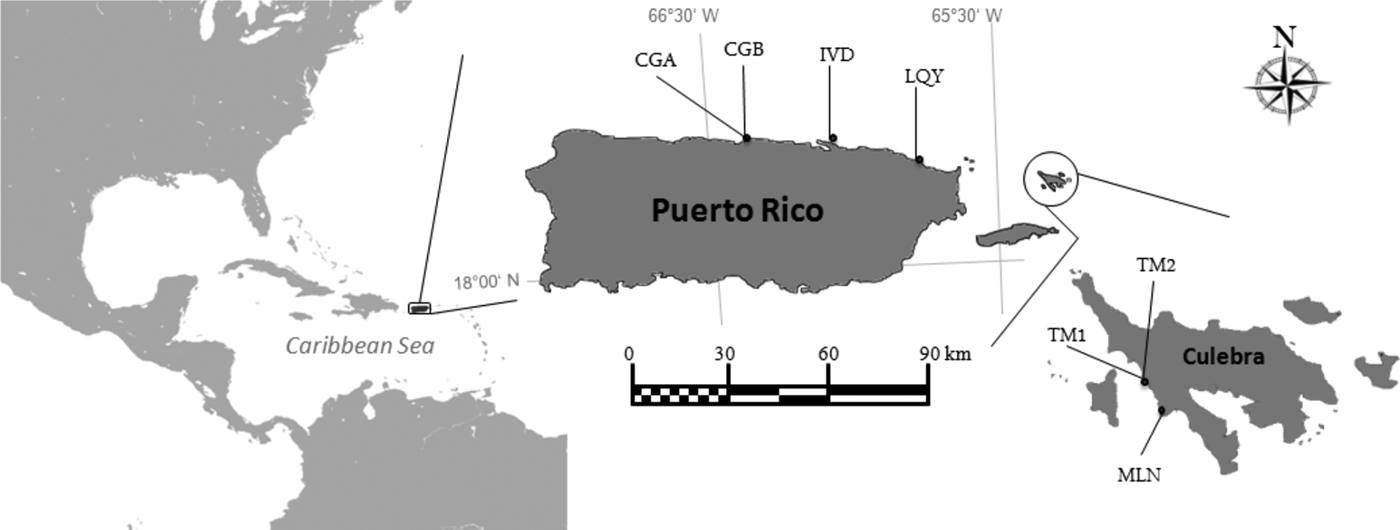
Surveys were conducted between August 2011 and August 2013 at seven shallow-water fringing reefs (1–3 m deep). The sites were Cerro Gordo A (CGA—18°16′51.40″N 65°17′12.21″W), Cerro Gordo B (CGB—18°28′53.78″N 66°20′25.12″W), Isla Verde (IVD—18°26′49.79″N 66°0′49.88″W), Luquillo (LQY—18°23′18.46″N 65°43′5.52″W), Tamarindo 1 (TM1—18°18′55.29″N 65°19′5.82″W), Tamarindo 2 (TM2—18°19′0.78″N 65°19′2.60″W) and Melones (MLN—18°18′15.70″N 65°18′42.27″W) (Figure 1). The first four sites are characterized by a very narrow shelf and high energy sandy beaches, due to the effect of north-east trade winds and North Atlantic winter storms. Due to the high annual precipitation levels and the discharge of rivers (Williams et al., Reference Williams, Benavides-Serrato, García-Arrarás, Hernández-Delgado, Rodríguez-Barreras, Alvarado-Barrientos and Solis-Marin2013), high sediment loads are common in CGA, CGB, IVD and LQY. On the other hand, TM1, TM2, and MLN are located in Culebra Island. This island has no rivers, precipitation is low and it is characterized by volcanic and intrusive rocks, with some limestone deposits, whereas sites along the north coast (CGA, CGB, IVD and LQY) are made up by carbonate rocks (USGS, Reference Veve and Taggart1996).
Study area and sampling sites in Puerto Rico. Cerro Gordo A (CGA), Cerro Gordo B (CGB), Isla Verde (IVD), Luquillo (LQY), Tamarindo 1 (TM1), Tamarindo 2 (TM2) and Melones (MLN).

Survey methodology
Mean densities were estimated using a belt-transect methodology (Sellers et al., Reference Sellers, Casey, Burge and Koepfler2009). At each site, eight fixed transects of 10 m2 (5 m × 2 m) were placed parallel to the coast and separated 10 m from each other. All individuals within transects were counted. All crevices and small holes were carefully inspected to avoid missing any individual. Field sampling was carried out every 6 months. We selected August and February based on differences in local precipitation and temperature (NOAA Coral Reef Watch, 2000), because both abiotic factors have some influence on echinoid population dynamics (Lugo-Ascorbe, Reference Lugo-Ascorbe2004; Williams et al., Reference Williams, García-Sais and Capella2009). With the use of a caliper, we measured the test diameter of fifty sea urchins, which were collected randomly every season by site (caliper error ±0.05 mm). We divided populations in three size-categories: small, <40.0 mm; medium, 41.0–60.0 mm; and large, >60.0 mm following the method of Miller et al. (Reference Miller, Adams, Ogden, Ogden and Ebersole2003).
Substrate complexity, cover and wind analysis
The rope-and-chain method was used to measure the substrate complexity at all sites. It was expressed as the ratio between the total length of a chain and the length of the same chain when molded to the reef surface (complexity index = total length of the chain/total distance when moulding the bottom). The range varied from 1 (flat surface) to higher values indicating more complex topography (Alvarez-Filip et al., Reference Alvarez-Filip, Dulvy, Gill, Cote and Watkinson2009). Five PVC tube quadrats of 25 cm2 per transect were photographed and analysed using CPCe-4.1 (Kohler & Gill, Reference Kohler and Gill2006). We selected 25 points randomly per picture and estimated percentage cover of the following categories: fleshy macroalgae (NCAL), calcareous algae (CAL), turf and live coral (LCOR), using only data from August 2012. Furthermore, we analysed the relationship between the abundance of D. antillarum and the wave exposure based on the chronic stress map given by Chollett et al. (Reference Chollett, Mumby, Müller-Karger and Hu2012). Wave exposure values varied on a scale from 1 (low) to 9 (high). Sites in Culebra (TM1, TM2 and MLN) were under moderate wave action (5.5), LQY occupied an intermediate position with 7.0, whereas IVD, CGA, and CGB were the most affected sites with 7.9. We re-evaluated CGB because Chollet et al. (Reference Chollett, Mumby, Müller-Karger and Hu2012) did not reflect the existence of a natural protection against wave exposure. Culebra sites have a similar protection against high wave action due to the presence of Luis Peña Key in front of these sites. Because of this, we decreased the category of this site from 7.9 to 5.5.
Statistical analysis
We fitted a two-way repeated measures analysis of variance (ANOVA) model to detect differences in mean density between sites. The model incorporates time as fixed factor, and transect (fixed factor) nested inside site (random factor). Mean size was analysed using a two-way ANOVA model with time as fixed factor, and site as random one. Fixed effects were tested using F tests; models involving different random effects were compared using likelihood ratio tests. Mean density data followed a normal distribution. A power transformation was applied for reaching normality and homogeneity of variance (Box & Cox, Reference Box and Cox1964). Result suggested the square (not the square root) for mean size (suggesting a normal distribution for the area of the transversal section). We ran a post-hoc Bonferroni test for multiple comparisons of means for density and size (Zar, Reference Zar2010). Pearson's correlation test was used to determine the relationship between the mean density of D. antillarum and cover non-calcareous algae (fleshy macroalgae), coral, and substrate complexity, but not turf. Potential differences among small, medium and large categories for each site and season were analysed by fitting log-linear models. Furthermore, we ran a non-parametric Spearman correlation test between wave exposure and the mean density of D. antillarum. All statistical analyses were performed in the free-license statistical software R v.3.0.1, with a pval = 0.05 (R Core Team, 2013). Packages MASS and nlme were used for estimation of power transformations, and for complex repeated measured analysis of variance respectively (Venables & Ripley, Reference Venables and Ripley2002; Pinheiro & Bates, Reference Pinheiro, Bates and DebRoy2013).
RESULTS
Spatial and temporal abundance
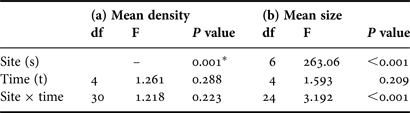
Overall mean density (± 95% confidence interval) of D. antillarum in Puerto Rico was 1.148 ±0.345 ind m−2 at the beginning of the study, and 0.946 ±0.295 ind m−2 at the end. The highest density recorded was 1.398 ±0.342 ind m−2 in February 2012, whereas a minimum of 0.946 ±0.295 ind m−2 was in August 2013. Sites were generally stable temporally in mean density, except in CGA and LQY, where densities increased 0.85 and 0.90 ind m−2 from August of 2011 to February of 2012 respectively. However, temporal differences were not detected among sites (Table 1).
Two-way repeated measure analysis of variance on the abundance (a) and the two-way analysis of variance test on the size of the sea urchin Diadema antillarum (b). *this value comes from a χ2 test that compares models with and without site as a random effect.
Spatial differences in density were found (Table 1). These differences among sites were related with the low densities reported in IVD and CGB (Figure 2). Differences were found between CGB and CGA (Bonferroni, P = 0.025), and TM2 (Bonferroni, P = 0.004); and also between IVD and CGB (Bonferroni, P = 0.033) and TM2 (Bonferroni, P = 0.006). During this study mean densities at CGB, TM2, and MLN were above 1.0 ind m−2 (Figure 2). At TM2 the maximum peak of abundance was 2.402 ±0.624 ind m−2 during February of 2012, whereas at IVD and CGA reported densities were below 0.50 ind m−2.
Spatial and temporal density of Diadema antillarum in Puerto Rico from August 2011 to August 2013 at CGA, CGB, IVD, LQY, TM1, TM2 and MLN (see Methods for acronyms). The X axis represents time with A-11 (August 2011), F-12 (February 2012), etc. The Y axis is the mean density of D. antillarum (ind m−2). Bars represent 95% confidence interval of the mean and red line represents a polynomial fit. Last graph shows the overall temporal change of mean density using pooled data.
Size structure
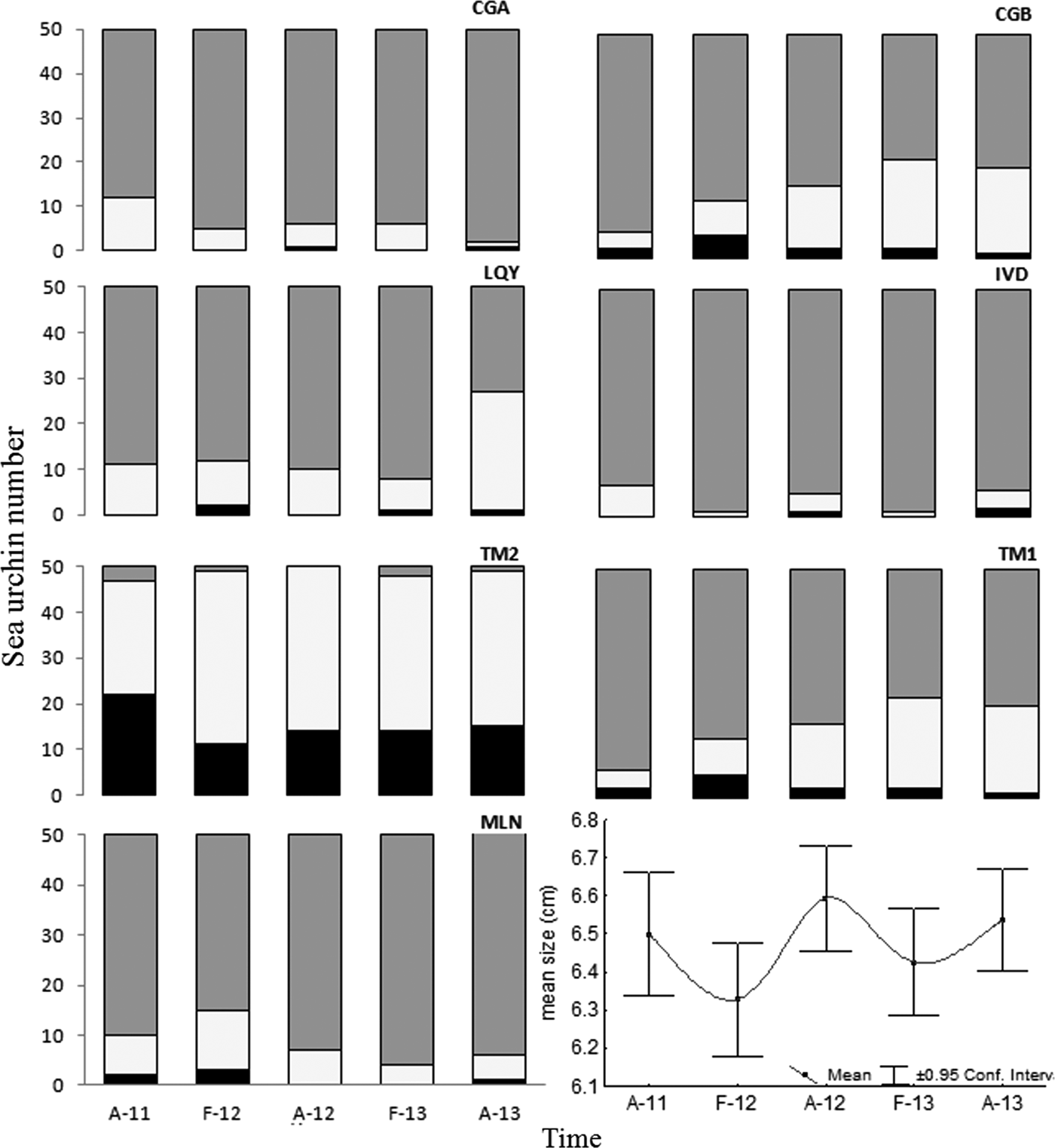
The mean size of D. antillarum fluctuated throughout the study, with maximum values during summer (6.51 ±0.14 cm) and minimums ones during winter (6.23 ±0.15 cm; Figure 3). However, seasonal differences were not significant (Table 1). The mean size peaked at IVD during February of 2013 with 7.91 ±0.77 cm; while TM2 reached the lowest mean size of 4.04 ±1.08 cm during February of 2012. We found spatial and site–time interaction differences on size (Table 1). Spatial differences were related mainly with TM2, the site with the lowest mean size, due to the high abundance of medium and small sizes found in this site (Bonferroni, P < 0.00001), and also among IVD and the other stations (Bonferroni, P < 0.0001; Figure 3).
Seasonal size-classes distribution of Diadema antillarum at CGA, CGB, IVD, LQY, TM1, TM2 and MLN in Puerto Rico (see Materials and Methods for acronyms). Black bar: small size (<40 mm), white: medium size (41–60 mm) and dark grey: large size (>60 mm). Last graph shows the temporal variation of mean size of D. antillarum of all sites.
Small individuals (<40 mm) were the less common size class, contributing with 14% of 1534 echinoids measured during 2 yr at all sites. The exception was TM2, where we found an unusual population size structure, dominated by medium and small size-classes (Figure 3). Small sea urchins represented up to 44% during August 2011, whereas large sea urchins did not reached 10% of abundance at any time in TM2. When we considered new recruits (<25 mm) as a separate size-class, they were only 1.10% of the overall individuals measured during the whole study at all sites; and the majority of them were reported during August 2011. No juveniles were detected at IVD, CGB and TM1, whereas the two sites with the greatest number of juveniles were TM2 (8%) and CGB (4%) during August of 2012.
The large size-class (>60 mm) was the most abundant in space and time, followed by the medium size (41–60 mm); while the small category (<40 mm) was the scarcest one. The cohort distribution analysis by fitting log-linear models showed that population structures changed according to site, and these changes were affected by the season (P = 2.59 × 10⁻⁸). Sites located near each other such as CGA/CGB and TM1/TM2 showed different size structure. Medium and small cohorts were more abundant at CGB and TM2 while large cohort was dominant at CGA and TM1.
Substrate complexity and cover
Substrate complexity varied from 1.06 ±0.02 units at LQY to 1.37 ±0.16 units at MLN. Fleshy macroalgae (NCAL) varied from a minimum of 1.8 ±2.75% in TM2, to a maximum of 43.6 ±13.21% in CGA (Figure 4). Turf showed a similar pattern, with a minimum of 1.45 ±3.69% at TM2 and a maximum of 18.18 ±7.01% at CGA. Calcareous algae were more abundant at sites with both less fleshy macroalgae and turf (Figure 4). The lowest percent of calcareous algae was found at CGA with 1.09 ±1.87%, while TM1 displayed the highest percent with 10.18 ±10.93%. Coral cover was low at CGA and IVD (<10%), but greater than 15% at the other sites, peaking at TM2 (29.09 ±12.15%, Figure 4). We found a significant inverse relationship between the abundance of D. antillarum and the cover of fleshy macroalgae (Pearson, r 2 = 0.909, r = −0.954, P = 0.0009). We found low correlation between the abundance of D. antillarum and coral cover (Pearson, r 2 = 0.305, r = 0.416, P = 0.0093), and no significant relationship between sea urchin abundance and substrate complexity (Pearson, r 2 = 0.541, r = 0.295, P = 0.179). In addition, mean density of D. antillarum was correlated with wave exposure (r2 = 0.519, r = –0.580, P = 0.0003).
Spatial variation of the percentage cover of fleshy macroalgae (NCAL), turf, calcareous algae (CALG) and live coral (LCOR) at CGA, CGB, IVD, LQY, TM1, TM2 and MLN in Puerto Rico (see Materials and Methods for acronyms). Last graph shows the relationship between density of Diadema antillarum and percentage cover of fleshy macroalgae (NCAL). Box represents 95% confidence interval of the mean.
Mean density of D. antillarum was correlated with wave exposure followed the wave action map on Challet et al. (2012) (r =−0.58, P = 0.0003). However, the wave exposure map did not take into account the existence of small key close to CGB that protect this site from extreme wave action. We adjusted the value of CGB (from 7.9 to 5.5) and obtained a higher correlation (r = −0.80, P = 0.00001).
DISCUSSION
There has been a slow and patchy recovery of D. antillarum populations throughout the Caribbean region (Miller et al., Reference Miller, Adams, Ogden, Ogden and Ebersole2003; Weil et al., Reference Weil, Torres and Ashton2005; Steiner & Williams, Reference Steiner and Williams2006; Debrot & Nagelkerken, Reference Debrot and Nagelkerken2006; Brown-Saracino et al., Reference Brown-Saracino, Peckol, Curran and Robbart2007; Miller et al., Reference Miller, Adams, Ebersole and Ruiz2007; Harborne et al., Reference Harborne, Renaud and Tyler2009; Seller et al., Reference Sellers, Casey, Burge and Koepfler2009; Idjadi et al., Reference Idjadi, Haring and Precht2010; Martín-Blanco et al., Reference Martín-Blanco, González-Sansón, Pina-Amargós and Clero-Alonso2010, Reference Martín-Blanco, Clero-Alonso, González Sansón and Pina-Amargós2011; Ruiz-Ramos et al., Reference Ruiz-Ramos, Hernández-Delgado and Schizas2011; Soto-Santiago and Irizarry-Soto, Reference Soto-Santiago and Irizarry-Soto2013; Levitan et al. Reference Levitan, Edmunds and Levitan2014). Recently, relative high densities have been reported in Jamaica, with up to 4.77 ind m−2 (Idjadi et al., Reference Idjadi, Haring and Precht2010), whereas Florida reported a maximum of 0.33 ind m−2 after more than two decades of the die-off (Chiappone et al., Reference Chiappone, Rutten, Swanson and Miller2008).
The available historical data related to D. antillarum populations is fragmented and scarce in Puerto Rico, limiting our understanding of the recovery dynamics of this important herbivore. Populations of the sea urchin dramatically collapsed from 10 ind m−2 to close to zero after the die-off occurred in 1984 in Puerto Rico (Bak et al., Reference Bak, Carpay and Ruyter van Steveninck1984). Bauer (Reference Bauer1980) reported densities of 13.8 ind m−2 in San Juan a few years before the mass mortality. Current densities remain far from pre-mortality levels (Weil et al. Reference Weil, Torres and Ashton2005). Twenty years after the mass mortality, Ruiz-Ramos et al. (Reference Ruiz-Ramos, Hernández-Delgado and Schizas2011) reported D. antillarum densities of less than 1.0 ind m−2 at 26 localities around Puerto Rico. We surveyed one of their sites and found a small increase in D. antillarum density, from 0.04 ind m−2 (Ruiz-Ramos et al., Reference Ruiz-Ramos, Hernández-Delgado and Schizas2011) to 0.36 0.213 ind m−2. A similar pattern was seen at TM1 where density increased from 0.67 in d m−2 reported in 2004 (Ruiz-Ramos et al., Reference Ruiz-Ramos, Hernández-Delgado and Schizas2011) to 1.09 ±0.411 ind m−2 nine years later. Average densities close to 1 ind m−2 are not far from desired densities between 2 and 3 ind m−2 to control fleshy macroalgae (Steiner & Williams, Reference Steiner and Williams2006). However, the pre-mortality densities for D. antillarum in the north coast of Puerto Rico about 10–14 ind m−2 (Craft, Reference Craft1975; Bak et al., Reference Bak, Carpay and Ruyter van Steveninck1984) was excessive and could have been causing significant reef erosion (Hunter, Reference Hunter1977).
Differences in recovery may be explained by local factors such as predation, overfishing, sedimentation and wave exposure (Harborne et al., Reference Harborne, Renaud and Tyler2009; Seller et al., Reference Sellers, Casey, Burge and Koepfler2009; Ruiz-Ramos et al., Reference Ruiz-Ramos, Hernández-Delgado and Schizas2011; Chollett et al., Reference Chollett, Mumby, Müller-Karger and Hu2012). Wave exposure may model population dynamic at local scale (Chollett et al., Reference Chollett, Mumby, Müller-Karger and Hu2012), and it seems to be controling population abundances of D. antillarum in north-eastern Puerto Rico Archipelago. Diadema sp. is considered weakly resistant to unidirectional hydrodynamic forces, because their morphological features does not allow a large adhesive area to attach to the substrate (Tuya et al., Reference Tuya, Cisneros-Aguirre, Ortega-Borges and Haroun2007). Our analysis based on the wave exposure map of Chollett et al. (Reference Chollett, Mumby, Müller-Karger and Hu2012) supports that leeward sites (TM1, TM2, CGB and MLN) tend to have greater densities of D. antillarum (r = −0.80, P = 0.00001). These four sites are protected from high wave action because of the existence of small keys in front of them. On the contrary, IVD and CGA do not have any physical protection against wind/wave action, and are exposed to more wave action, especially during the winter season. In consonance, lower densities of D. antillarum were reported in these two sites. This result agrees with previous studies where higher densities of Diadema sp. have been linked with wave sheltered areas (Debrot & Nagelkerken, Reference Debrot and Nagelkerken2006; Clemente & Hernández, Reference Clemente and Hernández2008; Hernández et al., Reference Hernández, Clemente, Sangil and Brito2008).
Size structure of D. antillarum changed seasonally with a reduction of mean size observed during the winter season (Figure 3). Previous studies in Puerto Rico have found temporal variability in settlement and recruitment that have an influence in mean sizes (Lugo, Reference Lugo-Ascorbe2004; Williams et al., Reference Williams, García-Sais and Capella2009). The species usually has a maximum spawning peak between October and November (Lessios, Reference Lessios1981), with permanence in the water column of between 35 and 75 d (Leber et al., Reference Leber, Lorenzen, Main and Vaughan2008). A reduction of mean size on February could be a consequence of recruitment. Small individuals are usually more abundant during winter in the Caribbean according to Hunte & Younglao (Reference Hunte and Younglao1988); however, we did not observe a clear seasonal pattern related with the abundance of small individuals among sites (Figure 3). Furthermore, the presence of new recruits (<25 mm) was limited to 1.7% of the 1534 sea urchins measured during the whole study. This suggests a serious deficiency of recruits on Puerto Rico, and points towards recruitment limitation as a possible explanation for the lack of recovery of the species in Puerto Rico. Current low densities of D. antillarum may be having a negative indirect effect on their recovery. A study conducted on the sister species Diadema africanum, former Diadema aff. antillarum (Rodríguez et al., Reference Rodríguez, Hernández, Clemente and Coppard2013), showed a positive relationship between the abundance of adults and the abundance of juveniles (Tuya et al., Reference Tuya, Ortega-Borges, Del Rosario-Pinilla and Haroun2006).
Coral cover and calcareous algae tend to increase, whereas non-calcareous become less abundant when the echinoid is present (Edmunds & Carpenter, Reference Edmunds and Carpenter2001; Carpenter & Edmunds, Reference Carpenter and Edmunds2006). Coral coverage has declined worldwide while non-calcareous seaweeds have increased (Fabricius, Reference Fabricius, Dubinsky and Stambleredts2011). Mean live coral cover reported in this study was less than 25%, but it was even lower at sites with low densities of D. antillarum (Figures 2 and 4). Our results are consistent with others studies conducted in the Caribbean (Williams & Polunin, Reference Williams and Polunin2001; Myhre & Acevedo-Gutiérrez, Reference Myhre and Acevedo-Gutiérrez2007; Martín-Blanco et al., Reference Martín-Blanco, Clero-Alonso, González Sansón and Pina-Amargós2011) where the abundance of the black sea urchin correlates negatively with cover of fleshy macroalgae. However, a recent study found an increment of algal dominance in coral reef systems despite of the presence of D. antillarum (Lacey et al., Reference Lacey, Fourqurean and Collado-Videz2013). This apparent lack of relationship could be a consequence of the current low densities, insufficient to maintain a successful control of seaweeds.
Sea urchin adults not only remove macroalgae while grazing; they create adequate conditions for larval settlement (Butman, Reference Butman1987; Karlson & Levitan, Reference Karlson and Levitan1990; Miller et al., Reference Miller, Adams, Ebersole and Ruiz2007; Rogers & Lorenzen, Reference Rogers and Lorenzen2008). Diadema larvae require a hardground free of non-calcareous algae. The presence of secondary metabolites produced by algae, such as tannins and phenols, can affect the fertilization success, larvae survival, and the detection of the sea urchin adult chemical signals (Pennington, Reference Pennington1985; Butman, Reference Butman1987; Hay & Fenical, Reference Hay and Fenical1988). The observed negative correlation between sea urchin density and fleshy macroalgae (Figure 4), which supports the importance of the species as seaweed controllers (Edmunds & Carpenter, Reference Edmunds and Carpenter2001). The maintenance of relative high abundance of fleshy macroalgae in CGA and IVD (Figure 4) could preclude D. antillarum settlement, and consequently, the recovery of this important herbivore.
The necessity of refuge against predators offers a congruent explanation for the existence of a positive relationship between the abundance of sea urchins and substrate complexity (Tuya et al., Reference Tuya, Martin and Luque2004). It is known that higher environmental complexity provides better refuge for D. antillarum (Valdez & Villalobos, Reference Valdez and Villalobos1978; Weil et al., Reference Weil, Torres and Ashton2005). However, the lack of correlation between mean density and substrate complexity found here, and in other recent study (Martín-Blanco et al., Reference Martín-Blanco, González-Sansón, Pina-Amargós and Clero-Alonso2010) suggests a nonlinear response between rugosity and urchin abundance. At a certain threshold of abundance, habitat features should determine site-to-site variability of population densities, but at low densities there would be available living space for all individual even on less complex hardgrounds.
To conclude, the observed abundance of D. antillarum has not yet returned to pre-mortality levels. However, population densities of the species showed some degree of recovery when we compare with previous studies, enabling at least some degree of control on fleshy macroalgae communities (Figure 4). No significant changes in density occurred between 2011 and 2013, and sites with higher densities were generally located in leeward areas. Further studies are required to understand how this factor may affect the population dynamics of this important herbivore across a wave gradient. Southern coast of the island should be considered given it is sheltered against winter storms. The low relative abundance of small size individuals is worrisome and points towards recruitment limitation as an explanation for the limited recovery of D. antillarum in north Puerto Rico Archipelago three decades after the die-off event.
ACKNOWLEDGEMENTS
We would like to thank the Center for Applied Tropical Ecology and Conservation (CATEC) of the University of Puerto Rico. In addition, the first author wants to express his gratitude to Pedro M. Alcolado, PhD, for his valuable comments and suggestions.
FINANCIAL SUPPORT
The Sea Grant Program PD-295 and R92-110 provided economic and logistic support.