Sacoglossa are small opisthobranch molluscs that cut into plant cells and suck out the contents. Sacoglossa are known as the ‘solar-powered snails’ because many species incorporate photosynthetically active chloroplasts that continue to function for several days to months (Evertsen et al., Reference Evertsen, Burghardt, Johnsen and Waegele2007). Nuclear plant genes that regulate chloroplast activity have been integrated into the nuclear genome of a sacoglossan by horizontal gene transfer between plant and animal (Rumpho et al., Reference Rumpho, Worful, Lee, Kannan, Tyler, Bhattacharya, Moustafa and Manhart2008).
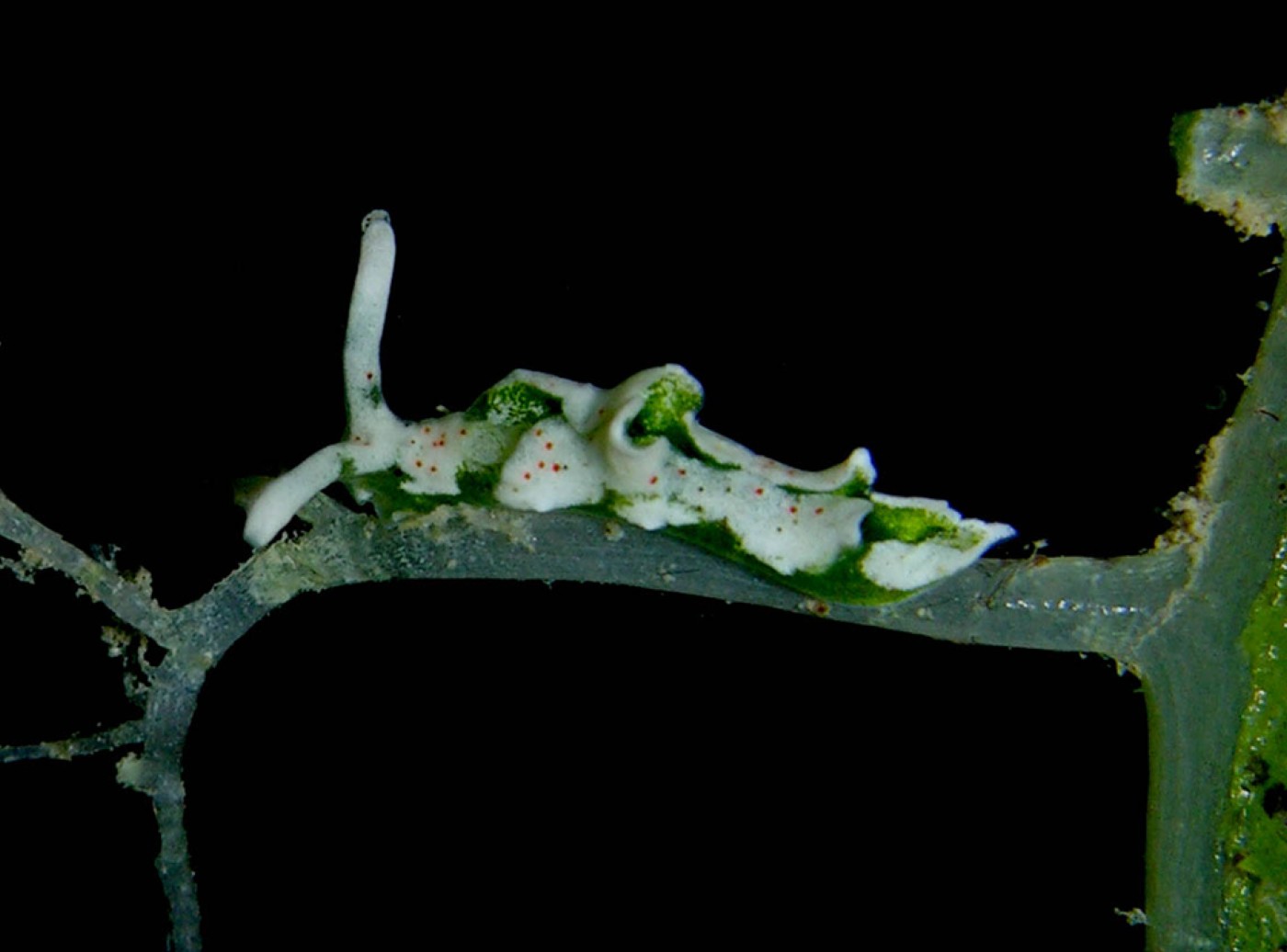
The species Elysia timida (Risso, 1818) reaches a size of up to 2 cm. It feeds on Acetabularia and other algae (Marin & Ros, Reference Marín and Ros1992, Reference Marín and Ros1993). The species is unmistakable because it is the only white and green Elysia with red spots (Figure 1); the western Atlantic animals could, however, belong to a separate species (e.g. Valdés et al., Reference Valdés, Hamann, Behrens and DuPont2006). Elysia timida has a species-specific, curious, ‘hopping’ way of locomotion, waving its tentacles at each step. This is shown in the accompanying film. Because of the presence of polypropionates, Elysia timida apparently tastes bad and fish like the Turkish wrasse Thalassoma pavo quickly learn to avoid it and models coated with extracts from this species (Giménez-Casalduero et al., Reference Giménez-Casalduero, Muniain and García-Charton2002). The reproductive behaviour of the species was described by Schmitt et al. (Reference Schmitt, Anthes and Michiels2007). Elysia timida has been recorded from the Mediterranean Sea, the Cape Verde Islands, Cuba and Florida (Cervera et al., Reference Cervera, Calado, Gavaia, Malaquias, Templado, Ballesteros, Garcia-Gómez and Megina2004, Rolán, Reference Rolán2005, Valdés et al., Reference Valdés, Hamann, Behrens and DuPont2006).
Elysia tímida from São Tomé Island (photograph: A. Anker).
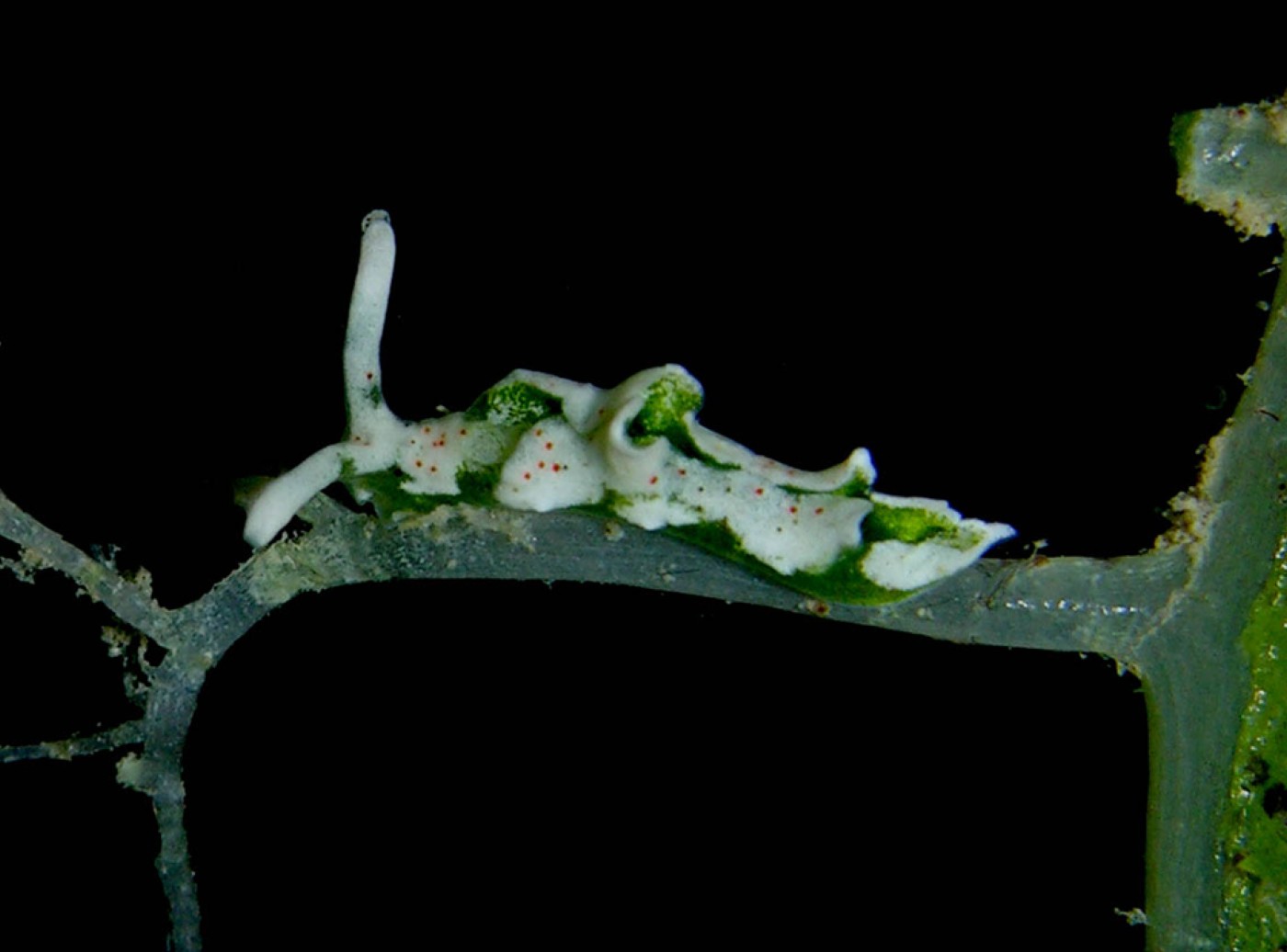
During a trip to São Tomé Island (central eastern Atlantic), the first author encountered an Elysia timida crawling in 1 m depth on the bottom of a small bay next to the fort of São Tomé city on 10 February 2006. The photograph and film accompanying this note were taken of this animal.
Recording Elysia timida at São Tomé Island extends the known range of the species. Wirtz (Reference Wirtz2003, Reference Wirtz2004) suggested that amphi-atlantic (sub) tropical species probably cross the Atlantic near the equator and that their ‘absence’ in the central eastern Atlantic is an artefact due to lack of collecting in this area. The record of the tropical western Atlantic and subtropical eastern Atlantic species Elysia timida at São Tomé Island provides further support for this hypothesis.
ACKNOWLEDGEMENTS
The National Geographic Society sponsored the 2006 expedition to São Tomé (grant number 7937-05 to Sergio Floeter). The Centro de Ciências do Mar (CCMAR) partially financed the travel cost of the first author. The Direcção das Pescas of the Republic of São Tomé and Príncipe gave research and collection permits. Angus Gascoigne was of great help on São Tomé Island.