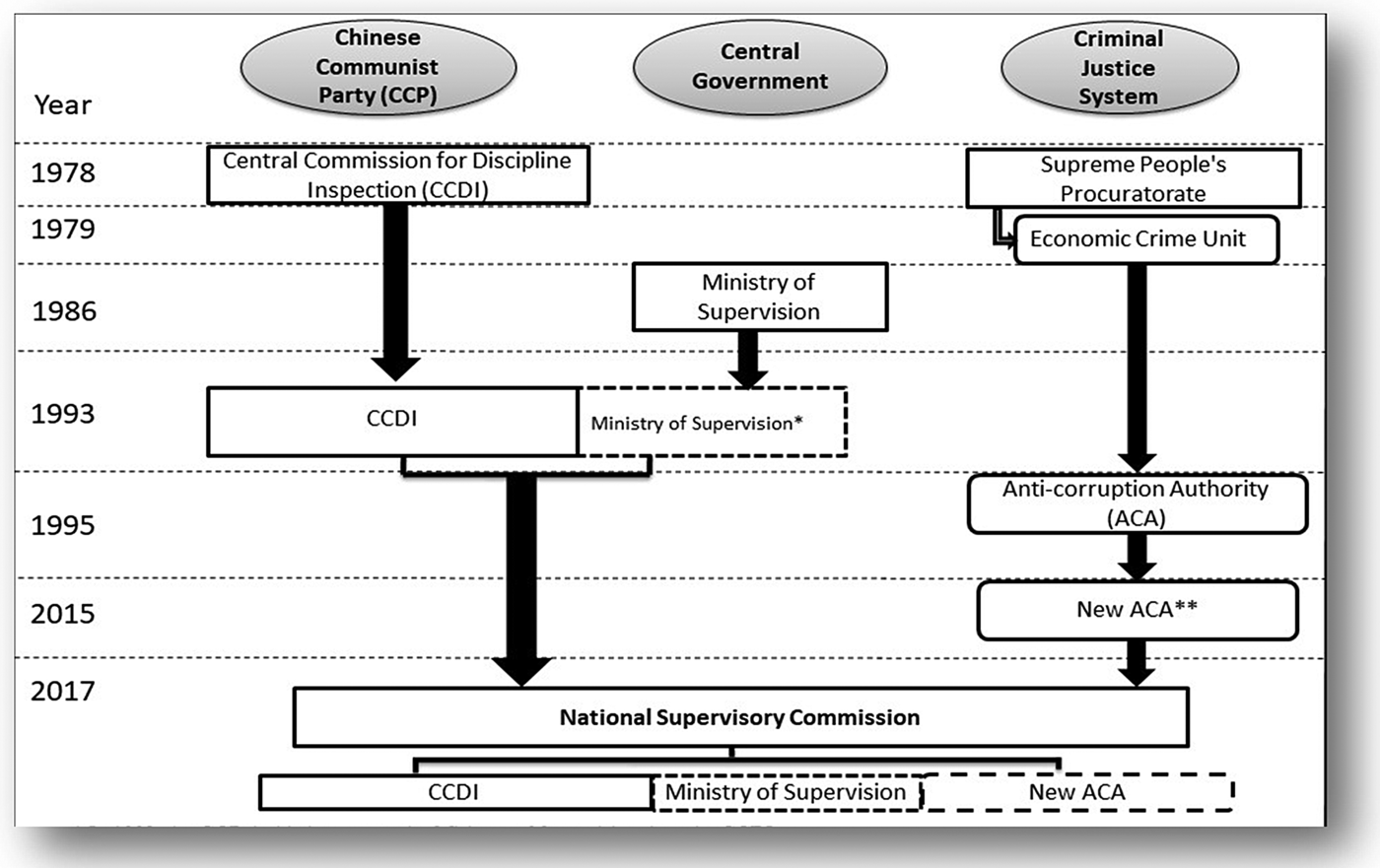
From 1993, when the Chinese Communist Party (CCP) merged the Ministry of Supervision with the Central Commission for Discipline Inspection (CCDI), until early 2018, China's anti-corruption system was characterized by the coexistence of two major institutions: the disciplinary inspection system (CDI) and the anti-corruption force of the People's Procuratorate.Footnote 1 To strengthen the Party's control over anti-corruption work, the CCP decided to establish the National Supervisory Commission by integrating the anti-corruption force of the People's Procuratorate with the disciplinary inspection system. Before a national rollout, the Party conducted pilot programmes in Beijing, Shanxi province and Zhejiang province. In March 2018, the first session of the 13th National People's Congress approved the draft National Supervision Law, and supervisory commissions were established by the People's Congress at all levels across the whole country in the first half of 2018. This dramatic institutional reform is a significant step towards the institutionalization of China's anti-corruption drive.
How does the creation of the National Supervisory Commission affect China's capacity to curb corruption? This article addresses this question by comparing the previous dual-track anti-corruption system with the new, consolidated anti-corruption agency.Footnote 2 First, it examines China's previous anti-corruption system by focusing on four dimensions of the interaction between the CDI and the anti-corruption force of the procuratorate: complementarity, convergence, competition and conflict. Under the Party's leadership, the CDI and the procuratorate complemented each other and worked together to curb corruption. Procurators, who investigate cases by following state laws and due process, were frequently invited to join corruption investigations led by CDI officers, who were committed to upholding Party rules. This collaboration led to a convergence of rules and standards between their institutions, thereby promoting the rule of law within the CDI and strengthening political awareness in the procuratorate. However, this dual-track anti-corruption system was not perfect. Competition and conflict between the CDI and the procuratorate were daily occurrences as each institution adhered to different rules (one was to enforce Party rules; the other to uphold legal principles). Furthermore, the interests of anti-corruption agencies tended to make stakeholders within such a system self-serving. Divergent interests, rules and objectives had a negative impact on the efficiency and effectiveness of the dual-track anti-corruption system.
By merging with the anti-corruption force of the procuratorate, the CDI managed to transform itself from an internal Party organization into a national organization as the supervisory commission pledged to “work jointly with the CDI having the same staff working under two titles, i.e. 合署办公 (he shu ban gong).”Footnote 3 According to information revealed by state-run media outlets, the establishment of the National Supervisory Commission enhances the Party's ability to curb corruption, because a single anti-corruption agency is able to effectively consolidate anti-corruption forces, reduce overlapping investigations and resolve the conflicts that stemmed from the previous system. Empirical data collected in China show that the reform signals a change in the focus of China's anti-corruption work, from punishment to prevention. The reform increases the significance of Party discipline (for example, the Regulations of the Chinese Communist Party on Internal Oversight) in preventing public sector corruption and stopping minor disciplinary violations from developing into serious disciplinary violations and corrupt acts. The integration of the procuratorate's anti-corruption force with the CDI, while enhancing the Party's capacity to curb corruption, may bring new uncertainties to China's political and legal system. This article discusses these potential uncertainties by focusing on three types of unbalanced power relations: between supervision, prosecution and trial; between central and local authorities; and between the state and citizens.
The empirical data used in this article were gathered during seven months of participant observation and from 32 in-depth interviews in six Chinese cities (see Appendix). A growing body of literature employs panel data analyses and big data methods to investigate the consequences of corruption and the effects of anti-corruption moves in China,Footnote 4 but quantitative research methods are not very helpful when examining the ways in which anti-corruption agencies work in practice. The authors therefore have chosen to employ qualitative methods. Given that corruption and anti-corruption measures are sensitive topics in China, accessing interviewees (for example, CDI officers and procurators) and collecting reliable interview data have become extremely difficult, especially since 2014 when President Xi Jinping 习近平 unveiled his new political theory and began to enforce strict Party discipline (congyan zhidang 从严治党). Chinese public officials are reluctant to be interviewed by “outsiders” (i.e. researchers from outside of mainland China, including Hong Kong). As a local researcher, the first author managed to spend seven months in a local procuratorate in B City's H District, working as the assistant chief procurator. This official position enabled her not only to observe the complicated working relationship between the CDI and the procuratorate in the previous anti-corruption system but also to identify the comparative (dis)advantages of the new National Supervisory Commission. Her “insider” status also helped her to cultivate connections with CDI officers and procurators in east China's Z and J provinces, central China's H province, and west China's G province. Interviewees included CDI officers and procurators at various levels. In total, interviews and field notes generated around 175,000 words of transcript material.
Four Dimensions of Institutional Interaction: Complementarity, Convergence, Competition and Conflict
The previous dual-track anti-corruption system was characterized by the coexistence of two major institutions: the disciplinary inspection system (also named the CDI or jiwei 纪委) and the anti-corruption force of the People's Procuratorate (the PP hereafter) (see Figure 1). The relationship between the CDI and the PP, as Fu Hualing has pointed out, was hierarchical in both a political and a legal sense.Footnote 5 From the political perspective, the CDI, as the Party's disciplinary mechanism, played a leadership role in investigating corruption cases (especially those involving senior Party officials) and was responsible for coordinating all anti-corruption initiatives. From the legal perspective, the PP, as an important component of China's formal legal system, exercised legal supervision over the CDI's investigatory work.Footnote 6 These conflicting institutional designs determined the way in which the CDI interacted with the PP when investigating corruption cases.
The Evolution of the Anti-corruption System in Post-Mao China

The interview data we collected show the complementary relationship between the CDI and the PP and the convergence of the institutions’ operating procedures and investigative standards. Despite the fact that each institution had “its own sphere of influences, institutional design, operating procedures, and political logic,” the two institutions, under the leadership of the Party, complemented each other in the investigation of corruption and the punishment of corrupt officials.Footnote 7 Moreover, the interaction between the CDI and the PP gave rise to a convergence of the investigation standards and procedural rules of the two institutions. As Fu notes: “While the disciplinary mechanism brings political factors to bear in the legal process, the legal mechanism also produces a legal impact within jiwei, affecting the organizational structure and the procedural rules of the latter.”Footnote 8
But the coexistence of these two anti-corruption institutions, as interview data show, did not always produce positive outcomes. The dual-track anti-corruption system was not a system with machine-like precision in which the problems of redundant efforts and conflicting actions could be effectively solved. Our fieldwork data suggest that there was a considerable degree of competition and conflict between the two anti-corruption institutions and that overlapping or repeated investigations were a serious problem. Pressure to meet targets and gain promotion, as well as a different operational logic, sometimes made individual institutions within the system self-serving, thus reducing the efficiency and effectiveness of China's overall anti-corruption efforts. In the following section, four essential dimensions of China's previous dual-track anti-corruption system are discussed.
Complementarity
The concept of institutional complementarity has been developed and employed by political economists to analyse financial markets and industrial relations in different forms of capitalism.Footnote 9 One of the essential meanings of complementarity is that it arises from situations in which “components of a whole mutually compensate for each other's deficiencies in constituting the whole.”Footnote 10 Institutionalists also point out that institutions with opposing logic and different institutional arrangements can make up for each other's shortcomings and deficiencies.Footnote 11 Empirical data from China suggest that in the previous dual-track anti-corruption system the complementary relationship between the CDI and the procuratorate enhanced the party-state's ability to investigate corruption. The following section uses these data to identify the institutions’ respective advantages and deficiencies and to show the ways in which each institution compensates for the deficiencies of the other.
The CDI's flexible investigation time frame and the PP's professional capability
When handling corruption cases, CDI officers and procurators helped each other to balance out their respective institutional deficiencies. First, the PP “borrowed” the CDI's flexible (unregulated) time frame for investigation. The PP's investigative power was limited by China's Criminal Procedural Law, Article 117 of which states that “the duration of interrogation by summons or forced appearance may not exceed 12 hours; or, if it is necessary to detain or arrest a criminal suspect in an extraordinarily significant or complicated case, the duration of interrogation by summons or forced appearance may not exceed 24 hours.”Footnote 12 Rigid time limits diminished procurators’ ability to access, collect and examine data and evidence, as described by one interviewee:
What do you think procurators can do in 12 hours? It is far from sufficient for handling a case involving an official who is unwilling to cooperate with us. Even if [the official] is willing to confess, 12 hours are not enough for a complicated and egregious case. When the time is up, s/he can walk away from the interrogation. This is the disadvantage the procuratorate faces in collecting information and investigating corruption cases.Footnote 13
In order to work around the legal time limit, procurators sought the help of CDI officers, who were able to detain and interrogate suspects for as long as they wished. In practice, procurators, who justified their involvement in a CDI investigation because they were providing assistance, questioned suspects in a location provided by the CDI and would issue the summons for the formal investigation of the suspects when they started to confess. At that point, the PP took over the investigation. This flexible time frame enabled procurators to bypass legal restrictions, enhancing their investigatory power. Second, the CDI “borrowed” PP operatives’ professional capabilities to conduct investigations. Despite the fact that the CDI handled all major cases involving senior officials, CDIs at prefecture and county levels usually possessed neither sufficient personnel resources nor professional capabilities to conduct investigations because many officers lacked legal training and academic qualifications.Footnote 14 Evidence transferred by CDI officers to procurators was sometimes insufficient to prove the guilt of the suspect. CDI officers therefore often sought advice on legal and evidential issues from procurators, who had more experience of investigating corruption cases. Given that the CDI had the power to summon officers from other agencies to engage in joint investigations, experienced procurators were frequently “borrowed” to help CDI officers prepare cases that would satisfy the evidential test for prosecution.Footnote 15
The CDI's investigations of disciplinary violations and the PP's criminal investigations
The CDI and the PP had different investigative roles: the CDI was in charge of collecting information relating to violations of Party discipline, whereas the PP was responsible for collecting information involving illegal behaviour and prosecuting all corruption cases. The CDI had an advantage with regard to gathering evidence in that “information relating to violations of Party discipline is easier to collect, while information involving criminal corruption is much harder to find.”Footnote 16 Since violations of Party discipline usually indicate some form of illegal activity, the investigation of disciplinary violations would often lead to the discovery of officials’ criminal behaviour. During an interview, one senior procurator explained:
The CDI primarily investigates disciplinary violations committed by Party members. The issues relating to the violation of Party discipline can be easily found, while collecting evidence of criminal acts is difficult because corruption is hidden. But the investigation of disciplinary violations usually offers clues to law-breaking behaviour … for example, if a government official's mistress or sex tape is exposed to the public, we can deduce that the official is very likely to be corrupt. It is the CDI, rather than the PP, that has the obligation to initiate the investigation process. The PP does not start the investigation, because no information relating to criminal acts is discovered at that point. But the evidence of committing criminal acts may be collected during the investigation conducted by CDI officers, who may hand this case over to procurators.Footnote 17
Moreover, the close relationship between the CDI and the PP was an effective response to the growth of transactive corruption. Andrew Wedeman distinguishes between two major types of corruption: plunder, which includes “the embezzlement of state funds and the theft of state property by officials,” and transactive corruption, which is defined as “a form of illicit exchange between corrupt officials and private actors.”Footnote 18 Wedeman further points out that owing to China's economic reforms, which led to the gradual transfer of assets from the state to the market, “the modal form of corruption shifted from predatory plunder and primarily petty corruption to various forms of transactive corruption.”Footnote 19 This has brought significant challenges to China's anti-corruption institutions. In the previous dual-track anti-corruption system, CDI officers were only able to investigate bribe-takers (corrupt officials); bribe-givers who were private actors, such as businesspeople, were beyond the CDI's reach. In order to carry out comprehensive investigations of both bribe-givers and bribe-takers, the CDI needed to collaborate closely with the PP. As the head of a local anti-corruption bureau explained:
CDI officers are only able to interview and investigate public officials. They can ask officials to offer explanations at designated places and times (shuanggui 双规). But CDI officers cannot deal with businesspeople who are bribe-givers. Under such circumstances, CDI officers demand help from us [procurators], because we have the power to interview these businesspeople. You can see that this is one advantage of the PP.Footnote 20
Similarly, in an interview conducted in November 2017, a senior CDI officer showed that a good rapport in working relationships was essential when handling a complicated case involving public officials and businesspeople:
In joint investigations, CDI officers employ shuanggui to compel Party members who are suspected of violations of discipline to cooperate with questioning. While CDI officers have to rely on procurators to access the businesspeople (bribe-givers) and seize/impound/freeze corrupt officials’ property.Footnote 21
Since bribe-givers usually received lenient or no criminal punishment for their crimes, it was not very difficult for procurators to persuade them to confess to prior offences.Footnote 22 The information gathered by the procurators was then used by CDI officers to break down the bribe-takers’ psychological barriers and force them to admit or acknowledge all facts relating to accepting bribes and the abuse of power.
Convergence
Fieldwork data from China and the existing literature show that there was convergence between the two anti-corruption institutions in that they had become similar entities in terms of politically correct behaviour, procedural rules and investigative techniques. The interaction between the two institutions offered opportunities for CDI officers to learn from procurators, thereby promoting the rule of law within the CDI. The interaction also enabled the Party to instil political factors in the PP, strengthening procurators’ political awareness.
Promoting the rule of law within the CDI
The lack of trained personnel and technical resources encouraged the CDI to “borrow” procurators to conduct joint investigations. The frequent cooperation between procurators and CDI officers made the disciplinary inspection system “resemble a legal system,” which partially solved some concerns relating to the CDI's less regulated investigative behaviour and procedures.Footnote 23 In joint investigations, procurators prevented CDI officers from using illegal investigative techniques when obtaining evidence, largely because evidence collected illegally was inadmissible in court. As noted by Fenfei Li and Jinteng Deng, “during a joint shuanggui investigation, the prosecutors apply their knowledge of law on what activities are admissible to guide interrogations so that the confessions and testimonies obtained therein are legal.”Footnote 24 Moreover, the CDI's investigation practices, as the empirical data show, improved significantly:
In the years when the CDI and the PP had few interactions, CDI officers’ investigative techniques were very rough, leading to the problem of “beating the grass to startle the snake” (dacao jingshe 打草惊蛇). Later, when the CDI and the PP had more cooperation, CDI officers learned a lot from us [procurators]. In fact, now CDI officers’ ideas and ways of handling cases and their common practices of investigation basically follow those of procurators.Footnote 25
Strengthening political awareness in the PP
China has witnessed the accelerated politicization of the PP in recent years, especially since 2014 when Xi Jinping called for “comprehensive and strict management of the Party” (quanmian congyan zhidang 全面从严治党).Footnote 26 Political priorities and political correctness significantly influence the ways in which procurators handle corruption cases. In joint investigations under the previous anti-corruption system, the CDI exerted great influence over the decision-making of procurators; the CDI had the coordinative power in anti-corruption work, so CDI officers led joint investigations. Despite the fact that the anti-corruption force of the procuratorate and the CDI were independent agencies, the chief procurator was not able to ignore instructions from the secretary of the CDI of the equivalent administrative level. This was because the CDI secretary not only had a higher political rank in the Party but also possessed a veto power which substantially influenced the career advancement of the chief procurator. This institutional arrangement placed the PP in a weak position. Political considerations induced procurators to favour Party rules over state laws, damaging judicial independence and eroding the authority of law. As Wang Buyuan points out:
Owing to the influence of the CDI, procurators pay insufficient attention to procedural justice … procurators believe that as long as there is evidence, the case will eventually lead to a guilty verdict … this kind of thinking not only occurs during the investigation stage, but also exerts abnormal influence on prosecution and sentencing. In joint investigations, in order to ensure the smooth conviction of corruption cases, the CDI is able to require investigators, procurators, judges and other relevant staff to report on the handling process of these cases. Owing to the CDI's encouragement and pressure, prosecutors and judges will subconsciously regard the smooth prosecution and sentencing of corruption cases as a good way to demonstrate their professional abilities to the Party and society. A handful of CDI officers and judicial staff will be rewarded or promoted if criminal sanctions are imposed on a corrupt senior official. This kind of thinking has greatly reduced the independence of the judiciary and damaged the establishment of legal authority.Footnote 27
Xi Jinping's reforms have increased the Party's control over the criminal justice system. Political correctness, or political loyalty, has become one of the most important criteria when selecting and promoting public officials, including procurators. In 2017, a procurator informed us that “the objective of the procuratorate is to realize the organic unity of political, social and legal effects when handling corruption cases, and these three effects must be all good.”Footnote 28 In order to ensure that the prosecution of the cases transferred from the CDI proceeded based on the CDI's investigation rather than on the procurators’ re-investigation, the CDI usually employed its coordinative power and leadership role in anti-corruption work to make procurators’ investigations comply with the CDI's political demands rather than adhere to state laws and facts.Footnote 29 The political influence on China's criminal justice system rendered procurators unable to decide whether a prosecution was appropriate solely based on the evaluation of evidence and state laws; they had to take into account other factors, especially the political effects of prosecution. When confronted with a conflict between political obligations and legal provisions, procurators usually chose to follow the former. As a result, the PP, to a certain extent, resembled a disciplinary inspection system.
Competition
The two dimensions (complementarity and convergence) discussed above offer essential perspectives on how the previous dual-track anti-corruption system worked, but these discussions only present a partial picture of the working relationship between the CDI and the PP. This research suggests that in many (if not most) circumstances, the PP and the CDI under the previous anti-corruption system were competitors rather than collaborators. There were three major reasons for this. First, a large proportion of the PP's cases were initiated by the PP rather than transferred from the CDI.Footnote 30 In 2017, a senior procurator noted:
Most [corruption] cases handled by us [procurators] are first investigated by ourselves; we discover clues and get the information based on our own efforts. Corruption cases transferred from the CDI do not usually exceed 30 per cent of all corruption cases handled by procurators.Footnote 31
Based on interview data collected from CDI officers and procurators, Li and Deng also found that the “median ratio of the corruption cases transferred from the CDI in all corruption cases annually investigated by the procuratorate is around 20 per cent … The ratio is consistent with the annual work reports of the CCDI and the SPP [Supreme People's Procuratorate].”Footnote 32
Second, the pressure created by the evaluation system and the financial rewards associated with successfully prosecuting corruption cases encouraged procurators to compete with CDI officers to investigate corruption cases.Footnote 33 All the procuratorates were ranked annually on factors such as the number of cases (especially serious corruption cases involving high-ranking officers and a large amount of money) that were investigated, docketed and prosecuted, the withdrawal rate, the prosecution rate and the conviction rate. Procurators, especially chief procurators, who were from the top-ranking PPs received both monetary and non-monetary rewards (for example, promotion), while those from lower-ranked PPs received no rewards and lost chances of career advancement.Footnote 34 The PPs were strongly motivated to actively search for and investigate corruption cases because of the financial benefits that were closely associated with the number of corruption cases investigated and material values involved.Footnote 35 As Li and Deng point out, the ill-gotten gains of public officials convicted of corruption were forfeited to the local government treasury, which then returned a large proportion of the funds to the procuratorate.Footnote 36 This institutional arrangement meant that there was no shortage of funds for corruption investigations; however, it also led to a form of trading of corruption cases.
Third, there was no clear division of investigative powers between the CDI and the PP, which fuelled the competition between the two institutions. Under the previous anti-corruption system, the CDI tackled major cases involving senior officials and the PP handled minor corruption cases; however, many cases overlapped. The CDI and the PP often investigated the same case simultaneously but separately and without communicating with each other. According to one interviewee:
Whistleblowers sometimes report corruption and bribery cases to the two anti-corruption agencies at the same time. In order to get all the credit, both the PP and the CDI initiate their own investigations without informing each other.Footnote 37
Li and Deng found that there was an informal rule for allocating cases that were simultaneously investigated by both institutions: “When they find out both are working on the same case, the one who has spent more time and effort and achieved more progress can continue and the other will withdraw and close the case.”Footnote 38 The immediate institutional goals (for example, performance evaluation and economic benefits), rather than collective efforts in achieving the wider objective of curbing corruption, made both of the anti-corruption institutions self-serving, and thus the PP and the CDI ended up competing with each other.
Conflict
The previous dual-track anti-corruption system, with its redundant efforts and conflicting actions, was far from perfect. Empirical data suggest that although the inter-agency coordination mechanism was well established, the degree of collaboration between the CDI and the PP was largely determined by the personal preferences of senior officials. In 2017, the head of a local anti-corruption bureau offered us his own understanding of how the collaborative system worked in practice:
If the secretary of the local CDI attaches great importance to the development of collaboration with us [the procuratorate], the two institutions will have very smooth cooperation; otherwise, a lot of conflicts and complaints will arise in our daily work.Footnote 39
Interviewees from both the CDI and PPs recounted occasions when conflicts or complaints had occurred during joint investigations. It appears that institutional self-interest and the unequal distribution of credit and responsibility were the cause of a number of conflicts between CDI officers and procurators. According to one senior procurator:
When we jointly handle a case, the CDI needs to borrow personnel from the procuratorate, but the procuratorate does not want to lend their best investigators to the CDI because the procuratorate has its own pressure, which is to handle a lot of cases by itself. This leads to conflicts between the two institutions.Footnote 40
The secretary of a local CDI also complained:
The CDI and the PP belong to different systems … a chief procurator is elected by the people's congress at the corresponding level [while a CDI head is appointed by the CDI at the next level up]. This means that CDI officers and procurators are “united in appearance but divided at heart” (maohe shenli 貌合神离). If you ask them [procurators] to attend our meetings, they will attend but they will not contribute (chugong bu chuli 出工不出力) [to the investigation work].Footnote 41
The procurators we interviewed explained why there was little incentive for procurators to contribute to the CDI's coordinated investigations:
In joint investigations, all the credit for a successful investigation and conviction of a corruption case goes to the CDI officers, but the responsibilities for a failed conviction … are assigned to us [procurators] … with regard to the problem of information leakage, CDI officers and procurators suspect each other most of the time. There is insufficient trust between the two institutions.Footnote 42
Conflicts also arose through inefficient inter-agency coordination and the institutions’ divergent ways of handling cases. In the previous anti-corruption system, the lack of efficiency was a primary concern for CDI officers and procurators who were involved in joint investigations. An interviewee informed us:
In joint investigations, the CDI has to coordinate task allocation among different agencies including the PP, the police and the audit department. These agencies have a tendency to “pass the buck” (ti piqiu 踢皮球) and deny responsibility for mistakes (xianghu tuiwei 相互推诿). This significantly lowers the efficiency of the CDI's coordinative work.Footnote 43
Moreover, procurators did not always agree with how CDI officers collected and used evidence. From the procurators’ perspective, the investigation work conducted by CDI officers seemed very superficial. As one senior procurator complained:
In joint investigations, CDI officers usually end their investigation when they think they have collected sufficient evidence to prove public officials’ disciplinary violations; they are not willing to look deeper into the cases and collect more evidence, the criminal evidence that is actually demanded by us [procurators].”Footnote 44
Another common complaint among procurators was that owing to factors such as the CDI's self-interest and political considerations, information uncovered by CDI officers was often not shared with the procuratorate.Footnote 45 Furthermore, poor relations between the CDI and the procuratorate sometimes degenerated into hostile and vengeful acts. According to Li and Deng, one local CDI employed its “anti-corruption power to investigate the corruption of the [local] procuratorate.” In retaliation, the local procuratorate launched an investigation into corrupt acts committed by local CDI officers.Footnote 46
The discussion above presents four crucial dimensions of the institutional interaction between the CDI and the PP. The empirical data collected from China provide a lens into the complexity and reality of the inner workings of the anti-corruption institutions of the previous dual-track system. Under the Party's leadership, the CDI and the PP complemented each other, and reforms initiated by the Party meant that the two institutions began to resemble each other. But the competitive relationship between the two institutions seems to offer the most important perspective on how they carried out their daily practices. Conflicts between the CDI and the PP signalled the failure of Party efforts to establish an effective mechanism for coordination and cooperation between different agencies, and inter-agency conflicts reduced the effectiveness of China's anti-corruption work.
Institutional Integration: Does A Single Anti-corruption Agency Model Work Better?
In order to resolve the conflicts between the CDI and the PP, reduce the duplication of investigative work and increase the efficiency of China's anti-corruption system, “a single, unitary anti-corruption body as independent, effective and powerful as the ICAC in Hong Kong” should be established.Footnote 47 Legal scholars, especially those in the field of constitutional law, suggest that the party-state should gradually reduce the significance of the CDI-based political mechanism and give more powers to a legal-centric mechanism (i.e. the anti-corruption force of the procuratorate) to curb corruption. In other words, an independent national agency could be created by taking the anti-corruption duty from the CDI and merging it with the National Anti-Corruption Bureau. This new agency could also be independent from the Supreme People's Procuratorate.Footnote 48 Fu Hualing argues that the anti-corruption campaign, which emphasizes the role of the CDI in mobilizing diverse resources from the PP and other related agencies for anti-corruption work, is the Communist Party's response to a political crisis caused by rampant corruption.Footnote 49 When this political crisis is resolved, anti-corruption work will no longer be a political campaign but rather become “a matter of routine law enforcement.”Footnote 50 At that point, the number of corruption cases significantly declines and the CDI will have to transform its focus from proactive investigation to education and prevention. The advantage of this reform, as Fu further points out, is that the convergence of the two anti-corruption institutions will result in the CDI-based political mechanism losing its comparative advantage, and a legal-centric anti-corruption system would take over the vast majority of corruption cases because it offers “necessary predictability, certainty, and legitimacy.”Footnote 51
The Party, however, decided to establish a single anti-corruption agency, the National Supervisory Commission, by integrating the anti-corruption force of the procuratorate, which includes the anti-corruption bureau, the anti-dereliction of duty and infringement of citizens’ rights department and the corruption prevention department, with the disciplinary inspection system. In March 2018, the National People's Congress approved a constitutional amendment to establish the powerful National Supervisory Commission as a fourth branch of government, giving it the same constitutional status as the State Council, the Supreme People's Court, and the Supreme People's Procuratorate. The National Supervisory Commission answers to the National People's Congress and its standing committee. Yang Xiaodu 杨晓渡, deputy head of the CCDI, was elected head of the National Supervisory Commission in March 2018, and CDI heads at provincial, city and county levels also became heads of equivalent-level supervisory commissions.Footnote 52 It is, as the Chinese say, “one team, two brands” (yitao banzi liangkuai paizi 一套班子,两块牌子).
The creation of the supersized anti-corruption agency has expanded CDI officers’ power to investigate corruption cases. This is because the dual identity of CDI officers (as both supervisory commission officers and CDI officers) enables them to act as CDI officers when investigating cases involving Party members and as supervisory commission officers when investigating non-Party members.Footnote 53 The National Supervision Law, which was passed by the National People's Congress in March 2018, not only standardizes supervisory commission officers’ investigative procedures but also sets higher standards for corruption investigators.Footnote 54 In China Daily, Wu Jianxiong 吴建雄, director of the China Anti-Corruption Judicial Research Centre, wrote that “the supervisory system reform and the establishment of the National Supervisory Commission, which are important steps towards advancing the rule of law, will greatly help to achieve victory against corruption through zero tolerance and an all-inclusive anti-corruption campaign.”Footnote 55 In parallel, a local researcher who studies China's anti-corruption system informed us:
The reform of the national supervisory system is not to employ Party discipline to regulate the behaviour of all personnel who perform public duties, rather it is to make use of the rule of law to regulate anti-corruption work. This is because the transferred procurators have to study Party discipline and CDI officers have to study law and legal institutions.Footnote 56
It is too early to conclude whether the reform of anti-corruption agencies will promote the rule of law in the party-state or whether it will eventually help China end corruption. But interview data collected from 2016 to mid-2018 offer new insights on a shift in China's anti-corruption strategy: the party-state has transformed the focus of its anti-corruption work from punishment to prevention.
From punishment to prevention
The prevention of corruption, rather than the punishment of corrupt activities, has been afforded a higher priority in promoting integrity in the public sector. As an interviewee told us in mid-2018, “China has witnessed a shift in the anti-corruption strategy, from punishment to ‘cure the sickness to save the patient’ (zhibing jiuren 治病救人).”Footnote 57 The term “curing the sickness to save the patient” refers to the central role given to Party discipline in educating public officials and preventing the occurrence of corruption. With the aim of preventing public sector corruption through the Party's self-supervision and self-governance, supervisory commission officers are required to follow the “four forms of oversight and discipline enforcement” (sizhong xingtai 四种形态) in their everyday work.Footnote 58 As a CDI officer told us, “in daily practice, we need to understand the National Supervision Law from a political angle, rather than from a legal perspective; this is because you will not be able to realize the importance of ‘the four forms of oversight and discipline enforcement’ in anti-corruption work if you view it only from the legal perspective.”Footnote 59
The emphasis on the “four forms” suggests that supervisory commissions resolve the vast majority of cases using criticism, self-criticism and disciplinary punishment rather than criminal punishment. According to the Southern Weekend, the number of tip-offs concerning corruption and other malpractices handled by the three pilot locations (Beijing, Shanxi province and Zhejiang province) increased in the first eight months of 2017, compared with the same period in the previous year, by 29.7 per cent in Beijing, 40.4 per cent in Shanxi province, and 91.5 per cent in Zhejiang province.Footnote 60 A CDI officer from one of the pilot locations pointed out that supervisory commission officers choose to focus their attention on conducting disciplinary investigations and preventing minor disciplinary violations from developing into serious disciplinary violations and corrupt acts, and thus the majority of cases handled by them are disciplinary violations.Footnote 61 The interviewee's view is consistent with the information disclosed by the CCDI and the National Supervisory Commission: in the first quarter of 2018, 261,000 officials were subjected to the “four forms” by supervisory commission officers/CDI officers. Of those, only 3 per cent (around 7,800) were processed according to the fourth form of discipline (i.e. were transferred to the procuratorate for criminal investigation and prosecution), compared to 5.6 per cent for 2017.Footnote 62
Three types of unbalanced relationships
The reform of China's anti-corruption system may bring new uncertainties to China's political and legal systems. To be specific, the establishment of the powerful National Supervisory Commission may lead to an unequal relationship between supervision (investigation), prosecution and trial; bring new challenges to the power relationship between central and local authorities; and distort the balance of power between state and citizens.
The unbalanced relationship between supervision, prosecution and trial
The constitutional amendment made in early 2018 establishes a new power structure of one government, one commission and two branches (yifu yiwei liangyuan 一府一委两院).Footnote 63 Despite the fact that the supervisory commission has the same constitutional status as the procuratorate and the court, the commission has more Party and government resources than the procuratorate and the court.Footnote 64 The head of the supervisory commission at the provincial, city and county levels sits on the standing committee of the Party at the equivalent level, while the chief procurator and the chief judge at the equivalent administrative level are one or two levels lower than the head of the supervisory commission in Party hierarchy.Footnote 65 Moreover, the CCDI played a leading role in drafting the National Supervision Law, work that had been complemented by the Legislative Work Committee of the National People's Congress.Footnote 66 The CCDI's control over the drafting of the law gave it the opportunity to expand its powers of investigation, reduce the authority of other agencies, and ignore advice and criticism from the general public and legal professionals.
The unbalanced power relationship between the three agencies means that the mechanisms through which the procuratorate and the court could monitor the supervisory commission cannot work effectively. As Deng Jinting, a legal scholar who conducted extensive interviews with prosecutors and CDI officers, writes:
Several interviewed prosecutors who stayed in the procuratorate expressed their concerns about declining the supervisory commission's request … the supervisory commission is in charge of supervising prosecutors as well. Without other agencies’ approval, the supervisory commission can require same-level prosecutors to sit in the supervisory commission's buildings for questions and interviews and can decide to initiate cases against the prosecutors from thousands of letter-and-visit reports.Footnote 67
The establishment of the supervisory commission significantly strengthens the Party's control over anti-corruption work at all levels, but it weakens the procuratorate and the courts’ power when processing corruption cases. Information from the three pilot locations suggests that the Party has strengthened its leadership over anti-corruption work through consolidating the power of the CDI and the supervisory commission, and that the Party not only cares about the outcome of anti-corruption investigations but also oversees the whole process.Footnote 68 This transformation puts the supervisory commission in an extremely strong position and enables the Party to exert significant influence on the operation of the criminal justice system. Furthermore, such a transformation may significantly weaken the independence and professional capacities of the procuratorate and the courts when handling corruption cases, making the process of prosecution and trial superficial and unjust.
An unbalanced relationship between central and local authorities
The CDI in the previous dual-track anti-corruption system “worked under the dual leadership of the same-level Party committee and the next-level-up CDI.”Footnote 69 The dual leadership was problematic because local Party chiefs had incentives to intervene or even disrupt local CDIs’ investigations of corruption cases.Footnote 70 Under most circumstances, local CDI officers had their hands tied by local Party leaders who were predisposed to protecting the public officials in their networks under the pretext of safeguarding local economic development.Footnote 71 President Xi solved the problem of dual leadership by strengthening the Party's vertical control over CDIs: heads of the CDI were appointed by the next-level-up CDI, and the superior CDI led the inferior CDI's anti-corruption work.Footnote 72 The leadership structure of the CDI is maintained in the supervisory commission system; however, horizontal control by local Party leaders has been significantly weakened. As Deng notes, although the supervisory commission is under the dual leadership of both its corresponding Party committee and its superior supervisory commission, the superior commission leads the work and is able to overturn the local Party's decision.Footnote 73
The reinforcement of vertical control in the supervisory commission system and the tradition of selective and non-transparent investigations within the CDI may lead to a number of problems. The first is that local public officials may lose the motivation to develop the economy and implement policies and become lazy and slack in order to avoid making mistakes. Public officials in China, as Yongshun Cai argues, usually regard “avoiding blame and ensuring political survival” as much more important than “claiming credit [usually through fulfilling economic targets].”Footnote 74 The Party could resolve this problem by requiring the supervisory commission to punish local bureaucrats who delay development projects and fail to implement policies. But the Party may find it difficult to deal with the second problem: in response to uncertainties created by the supervisory commission, local government leaders will include supervisory commission officers in the local government decision-making process. In other words, the supervisory commission is not only an anti-corruption institution but also a political agency that has power to oversee and influence the operation of local government. This weakens local government authority. Moreover, given that the supervisory commission has the power to set up permanent offices in and dispatch personnel to other government agencies and public organizations, government officials will have strong incentives to build networks with officers from the supervisory commission. Owing to the lack of external supervision, the supervisory commission itself may become a source of corruption.Footnote 75 As a result, the Party must now concern itself with how to prevent supervisory commission officers from abusing their power.Footnote 76
The unbalanced relationship between state and citizens
The National Supervision Law was drafted by the CCDI in accordance with political demands rather than consultation with legal minds. Tong Zhiwei argues that the draft law on national supervision marks a retreat from the protection of human rights, because the power of the supervisory commission is too broad and lacks external checks.Footnote 77 In order to improve the efficiency of the supervisory commission, criminal and disciplinary investigations are now conducted by the same department (the case investigation department), but the criminal investigation of corruption cases is not answerable to the Criminal Procedural Law.Footnote 78 The National Supervision Law also grants the supervisory commission the legal power to detain (liuzhi 留置) any suspected bribe-givers and bribe-seekers for three months, a period which can be extended to six months.Footnote 79 The new law significantly broadens the scope of anti-corruption work by entrusting the supervisory commission with supervising personnel who perform public duties – both Party and non-Party members – as well as other individuals such as businesspeople who offer bribes. According to Xinhua News Agency, “in Beijing, one of the three localities that were first to implement the reform, the total number of officials under supervision increased from 210,000 before the reform to 997,000 in December [2017].”Footnote 80
Public officials are also citizens whose basic rights are protected by the Constitutional Law. The objective behind using the National Supervision Law rather than the Criminal Procedural Law when regulating the investigations of duty-related offences is to increase the Party's ability to control corruption by removing public officials’ constitutional rights (for example, their access to lawyers). This constitutes serious discrimination against both the public officials suspected of accepting bribes and the businesspeople who are suspected of offering them.Footnote 81 The liuzhi time limit is also irrational.Footnote 82 Local CDI officers and procurators mentioned that they needed three to six months to investigate a corruption case involving officials at provincial level or above; however, they also noted that a lengthy detention is unnecessary for cases involving only low-ranking officials and private entrepreneurs. Long-term detention for these suspects, especially private entrepreneurs, not only violates human rights but also harms the local economy.Footnote 83
Conclusion
This article offers an empirical study of anti-corruption agencies in China by focusing on the comparison between the previous dual-track anti-corruption model and the new single agency model. The CDI and the procuratorate were the two major anti-corruption institutions in the previous dual-track system, coexisting and interacting with each other. Based on empirical data collected from six cities, this article investigates four dimensions of the interaction between the two institutions: complementarity, convergence, competition and conflict. The CDI and the procuratorate compensated for each other's deficiencies, but they also resembled each other, leading to the convergence of the two institutions in terms of political awareness, investigative standards and procedural rules. A close examination of the dual-track anti-corruption system, however, suggests that under many (if not most) circumstances, the CDI and the procuratorate were in competition with each other. As a result, wasted efforts and duplicated investigations reduced efficiency, and conflict between the CDI and the procuratorate was rife.
The establishment of a single supervisory commission solves the problem of the duplication of investigative work and enhances the Party's capacity to crackdown on corruption. Under the reform, procurators are required to study the Party Constitution and discipline, and CDI officers are required to study law and legal institutions. However, it is too early to conclude whether the reform furthers the rule of law in the party-state. The interview data we collected reveal a significant shift in the emphasis of China's anti-corruption strategy, from punishment to prevention. The principle of “the four forms of oversight and discipline enforcement” reinforces the importance of Party discipline in preventing minor violations from developing into corrupt acts. The Party cannot ignore the potential challenges the reform brings to the political and legal system in China, and it needs to resolve the issue of unbalanced power relations: between supervision, prosecution and trial, between central and local authorities, and between the state and citizens.
Owing to the fact that China has just recently embarked on this dramatic reform, we can only present what has been observed in our field sites. We also note that frontline officers’ daily investigative practices change quickly and regional differences are significant. Reform of China's anti-corruption institutions is a process similar to that followed by China's economic reform, described by Deng Xiaoping 邓小平 as “crossing the river by feeling the stones” (mozhe shitou guohe 摸着石头过河). One interviewee also pointed out that “the supervisory commission reform is a matter of trial and error.”Footnote 84 To establish an effective anti-corruption agency, the Party uses trial and error to resolve the issues that arise. To gain a better understanding of the operational logic of the National Supervisory Commission and its (dis)advantages when compared with the previous system, researchers need long periods of observation and should take into account regional differences when they evaluate this institutional reform.
Acknowledgements
We greatly appreciate the helpful comments and suggestions of Yuejin Jing, Zengke He, Jiangnan Zhu, Hanyu Xiao, Shitong Qiao, Angela Zhang, Albert Chen Hung-yee, Yongxi Chen, David Law, Hilary Wright, Jingyi Wang, three anonymous referees and the editors at The China Quarterly. This research project is sponsored by the Program for Young Innovative Research Team at China University of Political Science and Law (Project No. 19CXTD05). All errors remain our own.
Biographical notes
Li LI is an associate professor in the department of political science, China University of Political Science and Law, China.
Peng WANG is an assistant professor in the department of sociology, the University of Hong Kong, China.
Appendix: List of Interviewees