

Kumiai (Kumeyaay, formerly known as Diegueño; ISO code: DIH) is an endangered Yuman language of the Delta-California subgroup spoken across the Mexico–US border by approximately 150 people (Golla Reference Golla2011). There are two major sets of Kumiai varieties: Northern Kumiai (Ipai/’Iipay) and Southern Kumiai (Tipai/Tiipay) (Golla Reference Golla2011). A third cluster of varieties, located in southeastern San Diego County, is proposed in Langdon (Reference Langdon1991) and Miller (Reference Miller2001). The speech illustrated below is representative of Ja’a, a Southern Kumiai dialect spoken in Juntas de Nejí, Baja California, Mexico (see Figure 1 below). There are currently only four fluent speakers of Ja’a Kumiai (Miller Reference Miller2016b). Recordings were made over a six-month period with a 48-year-old female speaker born and raised in Juntas de Nejí. Quantitative data reported in this paper are taken from a subset of the current corpus, from recordings made with the speaker in a soundproof booth. Only the speech of this single speaker is reported here given the severe endangerment of the language.
Map showing the location of Juntas de Nejí relative to the Pacific Coast and the Mexican–American border.

Previous work on other Kumiai varieties includes comprehensive grammatical descriptions of the Mesa Grande dialect (Northern Kumiai, Langdon Reference Langdon1970) and the Jamul dialect (Southern Kumiai, Miller Reference Miller2001), both spoken north of the US–Mexico border. Kumiai varieties spoken in Mexico have until recently been undocumented; initial research provides morphological and phonological analyses (La Huerta Kumiai, Hinton & Langdon Reference Hinton, Langdon, Langdon and Silver1976; San José de la Zorra Kumiai, Gil Burgoin Reference Gil Burgoin2016). Previous description and documentation of Ja’a Kumiai includes Miller (Reference Miller2016a, Reference Millerb) and a corpus housed at the The Archive of the Indigenous Languages of Latin America (Field 2011). Data from Ja’a is also represented in a documentary collection of Yuman Languages from Baja California (Mexico) by Margaret Field and Amy Miller housed at the Endangered Languages Archive (ELAR; https://elar.soas.ac.uk/Collection/MPI1031994). A transcription in a local orthography developed by Mexico’s National Indigenous Language Institute (Instituto Nacional de Lenguas Indígenas, INALI) in consultation with Mexican Kumiai communities is provided in this Illustration for citation words as well as for the text passage.Footnote 1
Kumiai language varieties have been described as featuring a high degree of variation at all levels of grammatical structure, as noted in Kroeber & Harrington (Reference Kroeber and Harrington1914), Langdon (Reference Langdon1991), Miller (Reference Miller2001), and Field (Reference Field2012). This Illustration addresses some patterns of phonetic and phonological variation, noting especially where our consultant’s speech differs from that reported for other speakers of the language.
Consonants

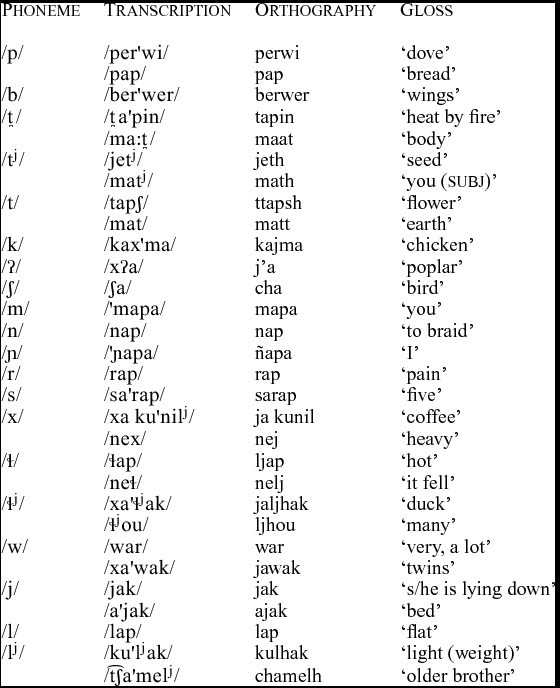
The phonemic inventory of Ja’a Kumiai contains a series of voiceless pulmonic egressive plosives and fricatives as well as voiced nasals and approximants. Obstruents contrast at six places of articulation: bilabial, dental, alveolar, postalveolar, velar, and glottal. Ja’a Kumiai lacks voicing or other laryngeal contrasts, as documented for other Yuman languages (Golla Reference Golla2011). A voiced bilabial stop is marginal and only attested in the speech of some speakers of the language (Miller Reference Miller2016b), including our consultant, and non-modal phonation only surfaces as an allophone of the glottal plosive. Consonants in the Consonant Table above which are in parentheses are of marginal status, and are discussed below.
Coronal obstruents
The dental and alveolar plosives are distinguished by both visual and acoustic characteristics as determined by spectrographic evidence and discussion with our speaker about the location and contact of articulators. The dental stop is laminal, made with the tip of the tongue against the upper teeth and the blade of the tongue resting against the alveolar ridge. The tongue tip may be seen interdentally during the articulation of the dental stop, especially when word-final and unreleased (e.g. maat /maːt̪/ [maːt̪] ‘body’). The alveolar stop is apical, made with tongue tip contact against the center of the alveolar ridge. Discussing the difference in tongue placement with our speaker, the tongue tip was seen curved upward during the articulation of the alveolar stop, such that the body of the tongue is concave in shape. The apico-alveolar stop may vary in its anterio-posterior placement on the alveolar ridge, sometimes having a characteristically retroflex sound. The speaker recorded for this Illustration consistently contrasts a lamino-dental stop with an apico-alveolar stop, suggesting that both place of articulation and primary articulator play a role in defining the anterior stop contrast. To simplify the transcription of the contrast in the consonant chart above, the lamino-dental stop is represented with the dental diacritic as /t̪/, and the apico-alveolar stop is represented without diacritic as /t/.Footnote 2
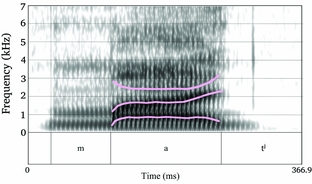
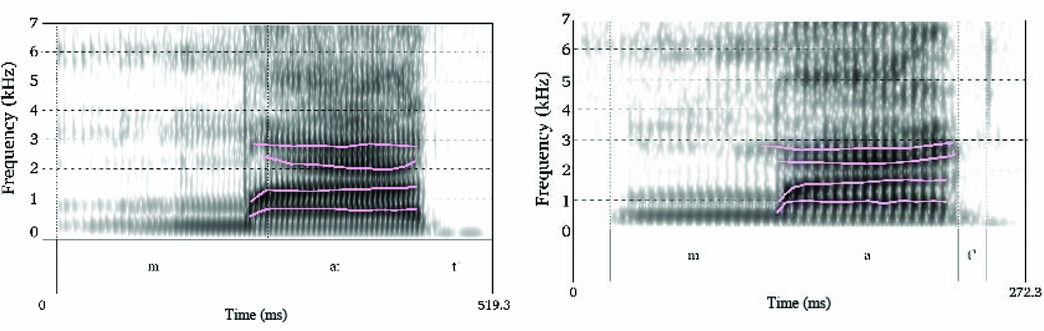
Lamino-dental and apico-alveolar stops are acoustically distinguishable by formant transitions and burst spectra. Pre-vocalically, the laminodental stop has a noisier burst spectrum than the apico-alveolar stop, and the second formant transition into the following vowel enters at a lower frequency (Figure 2). A noisier burst spectrum is consistent with a noisier laminal release, while the brevity of release and louder energy in the mid-frequency range (2–6 kHz) of the apico-alveolar spectrum are consistent with the relative quickness of an apical gesture (Figure 3) (Hamann Reference Hamann2003). Post-vocalically, formant transitions also distinguish these stops (Figure 4). While the second formant transition out of the vowel is similar for the lamino-dental and apico-alveolar stop, the third and fourth formants are lower preceding the apico-alveolar than the lamino-dental. Lowered third and fourth formants are consistent with an apical closure produced behind the alveolar ridge, and indistinguishable second formants are consistent with the acoustic complexities of place and surface area of contact: laminality raises F2, but dentality lowers F2; apicality lowers F2, but a sublingual cavity raises F2 (Hamann Reference Hamann2003).
Spectrograms showing pre-vocalic /t̪/ in /t̪a’pin/ ‘heat’ (left) vs. /t/ in /tapʃ/ ‘flower’ (right).

Spectral slices taken from the durational mid-point of the plosive release show differences in pre-vocalic /t̪/ vs. /t/.

Spectrograms showing post-vocalic /t̪/ in /maːt̪/ ‘body’ vs. /t/ in /mat/ ‘earth’.
In addition to the dental-alveolar place contrast, this language variety also contrasts plain and palatalized alveolar stops in word-final position. In Figure 5, we see F1 decrease and F2 increase into the alveolar closure, suggesting pre-palatalization. While palatalized laterals are reconstructed for Proto-Yuman (Langdon Reference Epstein and Langdon1996), palatalized coronal stops are proposed to have developed from alveolo-palatal affricates in post-tonic position (Miller Reference Miller2016b). Consistent with this observation, we have documented palatalized laterals word-initially and inter-vocalically, but palatalized coronal plosives only word-finally, leading us to posit them as marginal in the phonological system given their restricted distribution.
Spectrogram showing post-vocalic /tj/ in the word /matj/ ‘you’.

As seen in Figures 4 and 5, the speaker in this recording does not release word-final stops. This pattern is innovative among Kumiai varieties, which are described as having clearly released stops with variation between aspirated and non-aspirated allophones in word-final position (Langdon Reference Langdon1970). To the best of our knowledge, word-final unreleased stops have not been reported in any other Kumiai variety. Though a systematic investigation controlling for prosodic contexts has not yet been undertaken, final unreleased stops are documented in a variety of utterance contexts, suggesting that the effect pertains to the word level.
A contrast between a postalveolar affricate and a postalveolar fricative is documented in several dialects of Kumiai (e.g. Jamul Tiipay, Miller Reference Miller2001), including Ja’a Kumiai (Miller Reference Miller2016b). According to Miller (Reference Miller2016b), however, some speakers appear to have neutralized the contrast in this variety. This is the case for our consultant, who exhibits free variation between a postalveolar fricative and a postalveolar affricate, except in post-consonantal environments, where only the fricative production is attested. Figure 6 exemplifies the free variation between the fricative and affricate realizations, with the word for ‘one’ realized as both [t͡ʃin] and [ʃin].
Spectrograms showing variable production of /ʃin/ ‘one’ with /ʃ/ vs. /t͡ʃ/.

The postalveolar fricative in Ja’a Kumiai is reported to be variably realized as laminal postalveolar [ʃ] or retroflex [ʂ] (Miller Reference Miller2016b). (Miller (Reference Miller2001, Reference Miller2016a, Reference Millerb) represents this fricative with the non-IPA symbol [ṣ̌], and describes a third ‘hybrid’ phonetic realization between the laminal and apical productions (Miller Reference Miller2016b). This fricative is posited to derive historically from Proto-Southern-Kumeyaay */ʂ/ (Miller Reference Miller2016b), and is described for the Mesa Grande variety by Langdon (Reference Langdon1970: 30) as an ‘alveolar or post-alveolar [fricative], pronounced with great tenseness, with the apex almost touching the alveolar ridge’. Miller (Reference Miller2016b) proposes that changes underway in Ja’a Kumiai involve the neutralization of */t͡ʃ/ and */ʂ/ in pre-tonic syllables, with /ʂ/ realized variably as [ʃ] or [ʂ]. Under this account, the neutralization involves both fortition of */ʂ/ and lenition of */t͡ʃ/. While there is no evidence that our consultant has a contrast between [ʃ] and [t͡ʃ], we include them both in the phonemic chart above since they are reported to be contrastive for at least some speakers of Ja’a Kumiai (Miller Reference Miller2016b).
Post-alveolar affricates are both acoustically and morphophonologically distinct from stop–fricative clusters in the speech of our speaker. This distinction is exemplified in the spectrograms in Figure 7 with the near-minimal pair /t͡ʃou/ ‘to build’, which contains a word-initial affricate, and /tʃok/ ‘to clean’, which contains a word-initial consonant cluster. As shown in these spectrograms, the affricate in /t͡ʃou/ is characterized acoustically by a shorter duration of the fricative and a shorter closing interval before the onset of the fricative than the stop–fricative cluster in /tʃok/. Phonologically, the affricate is differentiated from the stop–fricative cluster in contexts where the exponence of a derivational category, nominalizing /aʔ-/Footnote 3 is prefixed to plosive-initial bases (e.g. [a’nak] /aʔ-’nak/ ‘chair,’ derived from /nak/ ‘to sit’) and infixed to bases that have a word-initial consonant cluster ([xa’tup] /x-aʔ-’tup/ ‘trampoline,’ derived from /xtup/ ‘jump’). In this morphological context, word-initial affricates are treated as a unit by the nominalizing prefix (e.g. [a’t͡ʃau] /aʔ-’t͡ʃau/ ‘brick’ (lit.: ‘something to build’) but the plosive–fricative cluster is split through an infixation process (e.g. [t̪a’ʃok] /t-aʔ-’ʃok/ ‘cleaning rag’).
Spectrograms showing /tʃ/ in /tʃok/ ‘to clean’ vs. /t͡ʃ/ in /t͡ʃou/ ‘to build’.

Dorsal obstruents
The dorsal plosive of our Ja’a Kumiai speaker varies gradiently from velar to backed velar,Footnote 4 diverging from varieties of Kumiai in which a systematic distribution of distinctly velar and uvular plosives is found. In Jamul Tiipay, Miller (Reference Miller2001) reports a pattern of complementary distribution in uvular and velar plosives where the uvular plosive surfaces in stressed syllables following a non-front vowel. Similarly, Gil Burgoin (Reference Gil Burgoin2016) reports complementary distribution of these allophones in nearby San José de la Zorra Kumiai, where the uvular alternant surfaces post-tonically, often word-finally, and the velar allophone surfaces elsewhere. In Ja’a Kumiai, however, dorsal stops with velar and backed velar place occur in the same contexts. For example, /kur’ʔak/ [k̙uɾ’ʔak] ‘elderly man’ and /ku’tu/ [k̙u’tu] ‘to kick’ share acoustic properties of sounds articulated further back in the oral cavity than canonical velars, but are found in the same phonological context (pretonic followed by [u]) as plosives with canonical velar qualities such as small F3–F2, /ku’nilj/ [ku’nilj] ‘blacken’ and /ku’ljak/ [ku’ljak] ‘light weight’. Typical variation in the backness of the dorsal stop can be seen acoustically in the comparatively lower burst frequency, more turbulent release, and greater F3–F2 of /ku’tu/ in Figure 8 (left).
Spectrograms for /ku’tu/ ‘kick’ (left) and /ku’ljak/ ‘light weight’ (right) show variation in /k/.

The dorsal fricative shows a similarly variable distribution as the dorsal stop, with slight variation in the backness of velar place. In addition, the dorsal fricative exhibits allophonic variation in terms of degree of frication, with a voiceless velar fricative [x], an approximant [x], and a glotal fricative [h] realization. Moderate frication is attested in word-initial contexts such as /xa ku’nilj/ [xa ku’nilj] ‘coffee’ and weaker constriction may be attested in obstruent clusters such as /t͡ʃxui/ [t͡ʃxui] ‘to annoint oneself with incense’ evidenced by its comparatively weaker energy in Figure 9 (center). Even weaker frication, lower energy, and broader spectral range is attested in words such as /pax/ [pah] ‘to return’ (Figure 9) and /xpʃu/ [hpʃu] ‘green’. The variable realization of the dorsal fricative is similar to varieties in which stress is reported to be a conditioning factor. In Jamul Tiipay the dorsal fricative is reported to be realized as a voiceless velar approximant [̥ɰ] post tonically, alternating between [x]~[̥ɰ] elsewhere (Miller Reference Miller2001). In San José de la Zorra Kumiai the fricative is reported to have a variable realization as velar [x], uvular [χ], or glottal [h] in all contexts (Gil Burgoin Reference Gil Burgoin2016: 52).
Spectrograms for /xa ku’nilj/ ‘coffee’ (left), /t͡ʃxui/ ‘to annoint oneself with incense’ (middle), and /pax/ ‘return’ (right) show variation in /x/.

The glottal stop in Ja’a Kumiai may be produced canonically with complete occlusion of the airstream (see /t͡ʃaʔ’jou/ [t͡ʃaʔ’jou] ‘song’), as glottalization of an adjacent vowel (see /xaʔ’nak/ [χa̰’nak̙] ‘to put on a necklace’), and as glottalization of an adjacent sonorant (see /taʔ’nap/ [ta’n̰ap] ‘braid’). In these three examples, the glottal stop is part of the exponence of the nominalizing prefix /aʔ-/, which infixes with certain stems as described above. Glottalization may also be greatly reduced so that the only trace of its realization is a lowering of f0, e.g. /t͡ʃaʔ’jou/ ‘song’ is variably realized as [t͡ʃaʔ’jou] or [t͡ʃa’jou]. Figure 10 and Figure 11 demonstrate these three types of glottal stop realizations.
Spectrograms for /t͡ʃaʔ’jou/ ‘song’ show variable presence of /ʔ/.

Spectrograms showing variable realization of /ʔ/ as creaky voice on a vowel as [a̰] in /xaʔ’nak/ ‘necklace’ (left) and on a nasal as [n̰] in /taʔ’nap/ ‘braid’ (right).

Sonorants
The trill surfaces with three articulations, all of which surface in predictable contexts: a tap [ɾ], a trill [r], or with frication [ ]. These variants may be devoiced in word-initial and word-final contexts. The trill is articulated as a tap [ɾ] intervocalically (e.g. /sa’rap/ [sa’ɾap] ‘five’) and in consonant clusters when flanked by consonants (e.g. /xprʃa/ [xpɾʃa] ‘sycamore’). Word-initially, this sound can be produced as a partially devoiced trill [r̥] (e.g. /rap/ [r̥ap] ‘pain’, /’rʔaːk/ [r̥ʔaːk̙] ‘elderly men’). The trill can also be realized with varying degrees of frication, voicing, and retroflexion in word-medial rime contexts (e.g. /ku’rʔak/ [k̙u’ʔak̙] ‘elderly man’ and /ka’sark/ ‘left’ [ka’saʃk]) but varies freely with a tap articulation (e.g. /t͡ʃir’kwi loi/ [t͡ʃɪɾ’kwi loi] ‘ant that lives in oak trees’ and /per’wi/ [pəɾ’wi] ‘dove’). Word-finally, this sound is generally devoiced (e.g. /aɬj’mar/ [aɬj’mar] ‘to light a fire’, /tiɲor/ [t̪iɲo] ‘to color’). Illustration of tap, trill, and fricative variants of /r/ can be seen in Figure 12.
Spectrograms showing realization of /r/ as tap in /sa’rap/ ‘five’ (left), trill in /rap/ ‘pain’ (center), and fricative in /ti’ɲor/ ‘color’ (right).

Additionally, in a pattern attested across the Delta-California branch of Yuman (Golla Reference Golla2011), the lateral approximant and voiceless lateral fricative exhibit a marginal contrast between plain and palatalized forms, with only a few documented examples of the palatalized kinds (see /xa’ɬjak/ ‘duck’ and /t͡ʃa’melj/ ‘older brother’ in the list of examples at the start of the section) which are attested in free variation in unstressed syllables for other speakers of Ja’a Kumiai (Miller Reference Miller2016b).
Vowels
Ja’a Kumiai has five contrastive vowels /a i e o u/, illustated by the examples below.


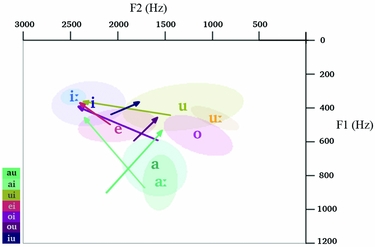
Quantitative data reported in the following sections were taken from 360 words and short phrases elicited over two sessions recorded in a soundproof booth. The files were then segmented in Praat, and data from a total of 855 monophthongs and 130 diphthongs were subsequently extracted and analysed using R statistical programming language. The data extracted include beginning, midpoint, and endpoint values of the first three formants; segment duration; value and location of each word’s pitch maximum; and value and location of each word’s amplitude maximum. The formant values taken from this dataset form the basis of the vowel schema in the above vowel diagram and are plotted in greater detail in Figure 14 below.
Monophthongs
Each of the five contrastive vowels in Ja’a Kumiai contrast in length in stressed environments. Long vowels are most commonly found in forms derived by length ablaut, a common derivational process in Ja’a Kumiai frequently exhibited in plural and nominalized forms, e.g. /ki’nus/ [ki’nus] ‘beautiful one’ vs. /ki’nuːs/ [ki’nuːs] ‘beautiful ones’. Long vowels in stressed syllables are slightly less centralized than their short vowel counterparts (see Figure 14), and the length contrast is not preserved in unstressed syllables of Ja’a Kumiai (Miller Reference Miller2016b), though it remains preserved in the unstressed syllables of related varieties, as in, for example, Mesa Grande (Langdon Reference Langdon1970). Mid vowels, /o/ and /e/, are innovations of Ja’a Kumiai, and it has been speculated that they have arisen due to contact with Spanish (Miller Reference Miller2016b). Related varieties (Jamul Tiipay and Los Conejos) have no mid vowels, and Mesa Grande and Campo have only back mid-vowel /o/ (Langdon Reference Langdon1970, Epstein & Langdon Reference Epstein and Langdon1996, Miller Reference Miller2001, Miller & Langdon Reference Miller and Langdon2008).
Unstressed vowels in word-initial position consistently preserve their quality (see the examples in the list of word-initial vowels above), though elsewhere unstressed vowels are frequently realized as [ə] or [ɪ], as /per’wi/ [pəɾ’wi] ‘dove’ and /si’ɲau nʔor/ [sɪ’ɲau nʔor] ‘acorn’ demonstrate, respectively. Excrescent [ə] or [ɪ] may also appear between consonants in complex clusters. These excrescent vowels are brief (~20 ms), appear unpredictably both within and across tokens, vary freely in quality when they are expressed, and do not participate in phonological processes which pertain to vowels. Yumanists refer to these excrescent, intrusive vowels as inorganic, in contrast to organic, phonemic vowels. Figure 13 illustrates the variable presence of an excrescent [ə] in the consonant cluster of /xpʃiu/ ‘green’ ([xpʃiu] or [xəpʃiu]).
Spectrograms for /xpʃiu/ ‘green’ showing variable presence of excrescent vowel [ə].

Diphthongs
Ja’a Kumiai has a rich set of closing diphthongs /ai ei oi ui au ou iu/, exemplified as follows:

As seen in Figure 14 articulation of final target /u/ and initial targets /i/ and /o/ are more central in diphthongs than in single-target monophthongs. The next section addresses the distribution of diphthongs across syllable types and provides detail about other basic aspects of syllable structure.
This plot approximates the vowel space of Ja’a Kumiai using F1 and F2. Shaded elipses indicate 68% confidence intervals on the tokens gathered for long and non-long monphthongs. Arrows indicate the directionality and endpoints of diphthong trajectories. The legend at bottom left shows diphthong–arrow color correspondences.

Syllable structure
Syllables in Ja’a Kumiai are capable of great complexity. Long vowels and diphthongs are exclusively attested in stressed syllables. While unstressed syllables are V or CV in shape, stressed syllables may have up to four onset segments (e.g. /xplʃa/ ‘sycamore’) and two coda segments (e.g. /tapʃ/ ‘flower’). As heard in /xplʃa/ ‘sycamore’, excrescent, inorganic vowels may intervene in complex consonant clusters. These excrescent vowels occur unpredictably within and across tokens and do not impact phonological processes which target certain syllable positions, such as derivation of causative or nominalized forms. For this reason, insertion of these vowels and any subsequent resyllabification are assumed to be postlexical.
Stress
For the related Jamul variety, Miller (Reference Miller2001) states that stress is predictable and non-contrastive, coextensive with a morphological root posited for all Yuman languages (Miller Reference Miller2001; see also Langdon Reference Langdon1970). In Ja’a Kumiai, stress is similarly morphophonologically predictable: it coincides with the morphological root and supports phonological structures not found in other lexical positions, such as long vowels and complex consonant clusters, as also noted in Miller (Reference Miller2016a). The stressed syllable occurs word-finally excluding enclitics such as tag question marker [-ke’e] /=keʔe/ and demonstrative marker [-pe] /=pe/. Stress falls predictably and non-contrastively, so it is not considered phonemic in the language. However, since morphological structure is necessary to predict the location of primary stress, stress is notated on multisyllabic words in this description.
Phonetically, stressed vowels have longer duration and are significantly more likely to contain the word’s amplitude maximum and pitch maximum than their unstressed counterparts (χ2 = 43.51 and 115.99, respectively; p < .001 in both cases). Normalized relative to the length of the word, the duration of stressed short vowels is on average 2.2 times longer than the duration of unstressed (short) vowels. These results are based on the same sample as that examined in the ‘Vowels’ section above.
Transcription of recorded passage
Broad phonemic transcription
txa ɲak ɲa ɲu:p ta’niu xwakɬ uwiu mʔei sper xan ‖ ɲa’pom kwamp ax’kei ma:t t̪u’pit tu’ju ‖ ɲa’pu:m u’wei mʔei kwamp t̪u’pit puɲu’t̪it ɲip ksper xan ‖ txa ɲak psui sper war ‖ t̪u’pit pu u’t̪ip xui ɲa psui sper xan kwampt kwam ʃa’win xan t̪u’pit ‖ txa ɲa:k an’mak ɲa ‖ ɲat ɲa’pu:m sper xan kwam t̪u’pit u’t̪ip ʃot ‖ ɲa’pu:m txat ɲak u’jau ɲatj mar
Orthographic transcription
Ttja ñak ña ñuup ttaniu jwaklj uwiu m’ei sper jan, ñapom kwamp ajkei maatt tupitt ttuju. Ñapuum uwei m’ei kwamp tupitt puñutitt ñip ksper jan. ttja ñak psui sper war, tupitt pu utip jui ña psui sper jan kwampt kwam chawin jan tupitt. Ttja ñaak anmak ña, ñat ñapuum sper jan kwam tupitt utip chot. Ñapuum ttjatt ñak ujau ñath mar.
English translation
The North Wind and the Sun are fighting to see which of the two of them is stronger, when suddenly an elderly man wrapped in a thick cape passes by. They decide that whichever makes the man remove his cape is the strongest. The North Wind begins to blow with great force, but after blowing forcefully, the elderly man clings to his cape. The North Wind stops, [and] the Sun. The Sun shines brightly, and immediately the old man removes his cape. So the North Wind recognizes that the Sun is stronger.
Spanish translation
El viento del norte y el sol pelean para decidir cual era más fuerte, cuando de repente pasó un an anciano envuelto en una capa. Deciden en que aquel que primero pudiera hacer que el anciano se quitara la capa sería el más fuerte. Entonces el viento del norte comenzó a soplar con mucha fuerza, pero después de soplar mucho, el anciano se aferra a su capa. El viento del norte paró, [y] el sol. El sol brilla brillantemente, y el anciano se quita la capa inmediatamente. Entonces el viento del norte reconoce que el sol es más fuerte.
Acknowledgements
This work was supported by a grant from UCMEXUS. We are grateful to our language teacher, Yolanda Meza, for all of her help. For other helpful discussion and input, we also thank Amalia Arvaniti, Margaret Field, Marc Garellek, Amy Miller and two anonymous reviewers. Any mistakes or omissions are the authors’ sole responsibility.