INTRODUCTION
Cervix cancer remains one of the most serious malignancies among women worldwide.Reference Pisani, Parkin, Muñoz and Ferlay 1 – Reference Parkin, Bray, Ferlay and Pisani 3 It is the second most common cancer in women and the third in terms of cancer mortality.Reference Parkin, Bray, Ferlay and Pisani 3 , Reference Barbera and Thomas 4 The gold standard for treating patients with locally advanced stages of cervical cancer is with concurrent radiation and chemotherapy.Reference Barbera and Thomas 4 – Reference Chereau, Hosserye and Ballester 11 The curative potential of radiation therapy in the management of carcinoma of the cervix is greatly enhanced by the use of intra-cavitary brachytherapy (ICBT).Reference Barbera and Thomas 4 , Reference Nag, Erickson and Thomadsen 12 – Reference Okuma, Yamashita, Kobayashi and Nakagawa 14 The American Brachytherapy Society (ABS) recommends that brachytherapy must be included as a component of the definitive radiation therapy for cervical carcinoma, based on the Patterns of Care studies that show that recurrences as well as complications are decreased when brachytherapy is used in addition to external beam radiation (EBRT).Reference Nag, Erickson and Thomadsen 12 , Reference Teke, Yoney and Teke 15 , Reference Lee, Das and Higgins 16
However, not all patients are able to receive ICBT due to reasons like extensive local tumour extension, previous subtotal hysterectomy, patient unfit for anaesthesia due to comorbidities, patient refusal and failed attempt at brachytherapy. There is little published literature to evaluate the use and effectiveness of external beam radiation alone with chemotherapy. Therefore, we decided to review our experience among this group of patients. Specifically, with the emergence of more precise and accurate radiotherapy techniques such as intensity-modulated radiation therapy (IMRT), we wanted to evaluate the local control and overall survival outcomes among the small proportion of cervix cancer patients treated radically without brachytherapy. Historically with traditional radiotherapy approaches, EBRT is not as good as brachytherapy in terms of outcomes, both local control and survival. However, there is a limited data about whether outcomes can be improved with more modern approaches using IMRT, concurrent boosts and concurrent chemotherapy. We wanted to see if outcomes were improved with our current modern approaches when brachytherapy was not feasible.
MATERIALS AND METHODS
A retrospective ethics approved single institute study was carried out, and we reviewed patients with locally advanced cancer who were treated at our institution from 2000 until 2010 inclusive with curative intent with EBRT alone.
The patients were staged clinically and all had the following investigations: chest X-ray; computed tomography scan of the abdomen and pelvis; and blood work (including complete blood count, electrolytes, creatinine and magnesium levels). Magnetic resonance imaging scans were often ordered to assess local extent of disease since most patients did not have an examination under anaesthesia, but cystoscopy and sigmoidoscopy were not routinely performed unless clinically indicated. Patient demographics, tumour characteristics, treatment and outcomes were analysed. Overall survival, relapse-free survival and local control were calculated using Kaplan–Meier methods.
All patients were treated at The Ottawa Hospital cancer centre with fairly standard EBRT techniques that have been reported previously.Reference Barbera and Thomas 4 Radiotherapy consisted of using megavoltage radiation (usually 18 MV photons) to treat the whole pelvis to a median dose of 45 Gy in 25 fractions over 5 weeks, using daily 1·8 Gy fractions. EBRT boosts were delivered either sequentially or concurrently in order to deliver a total median dose of 65 Gy (range 45–71 Gy) to the primary site. Nine patients were treated with IMRT approaches, using a Tomotherapy® unit (Accuray Incorporated, Sunnyvale, California, USA) and all of them had concurrent boosts. Of all patients, only one patient received <50 Gy and 14 patients were treated with total doses ≥65 Gy. The median total dose of radiation delivered was 66 Gy with IMRT approaches compared with 57 Gy with non-IMRT approaches.
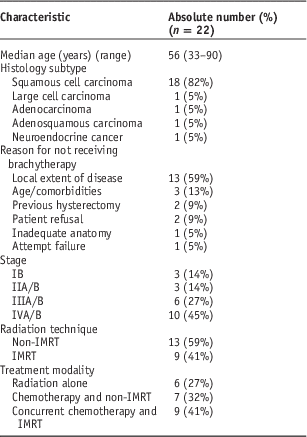
The reasons for not using brachytherapy were as follows: extensive local tumour extension and inadequate response to initial pelvic radiation (59%), previous subtotal hysterectomy or anatomy inadequate for ICBT (14%), patient unfit for anaesthesia due to comorbidities (14%), patient refusal (9%) and failed attempt at brachytherapy (5%).
The majority of patients (73%) received chemotherapy. It generally consisted of weekly concurrent cis-platinum at a dose of 40 mg/m2 during pelvic radiation. The median number of cycles delivered was 6. Weekly blood work was carried out to monitor white blood cell and differential counts as well as haemoglobin, electrolyte, creatinine and magnesium levels. The reason for not using chemotherapy among six patients was age ≥75 years.
RESULTS
There were a total of 22 patients identified (see Table 1) that underwent radical radiotherapy with curative intent using EBRT without brachytherapy. The median age at diagnosis was 56 years (range 33–90). The most common histology was squamous cell carcinoma (82%). Other histology’s include large cell carcinoma (5%), adenocarcinoma (5%), adenosquamous carcinoma (5%) and neuroendocrine cancer (5%). The stage distribution was as follows: stage IB three patients (14%), stage IIA/B three patients (14%), stage IIIA/B six patients (27%) and stage IVA/B ten patients (45%). The median tumour size was 5·5 cm.
Patient/tumour/treatment characteristics

Abbreviation: IMRT, intensity-modulated radiation therapy.
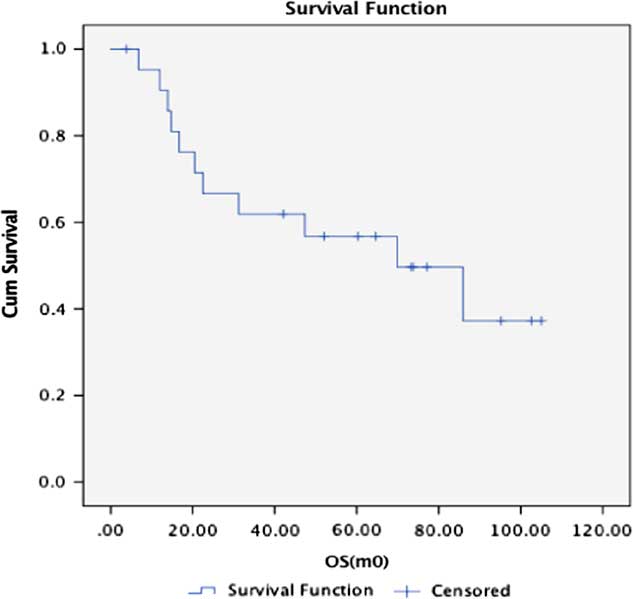
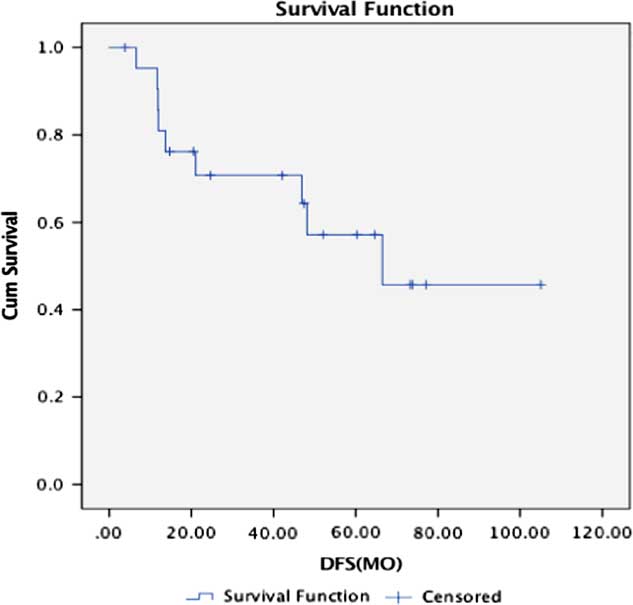
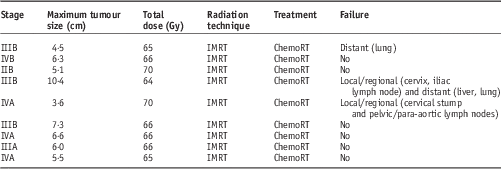
With a median follow-up among survivors of 65 months, the relapse-free survival and overall survival rates are 57 and 50%, respectively (Figures 1 and 2). There were a total of ten relapses (45%), and seven (32%) had a component of local failure. Six (27%) had only loco-regional relapses. There were no documented recurrences in 12 patients. The distant failure sites included para-aortic lymph nodes as well as liver, lung and peritoneum, and bones. Most (80%) recurrences occurred within 3 years of initial diagnosis. As shown in Table 2, among the nine patients who were treated with IMRT approaches and concurrent cis-platinum chemotherapy, there were three recurrences (33%), two of which had a component of local failure. The loco-regional control rate for these patients at 5 years was 78%.
Overall survival.

Disease free survival.

Patients received chemoradiotherapy with intensity-modulated radiation therapy (IMRT)

Toxicity was difficult to accurately quantify retrospectively but only one patient was not able to complete their radiotherapy as prescribed. This was due to significant desquamation within the perineum after 50 Gy so the final 10 Gy was not delivered. Approximately 35% of patients had at least mild to moderate diarrhoea acutely. One-quarter of patients who received chemotherapy had significant haematologic toxicity and did not complete the planned minimum 5 cycles as a consequence. In terms of late toxicity, two patients developed vesicovaginal fistulae but they both initially had clinical stage IVA disease with bladder involvement. Two other patients complained of chronic abdominal pain, and a significant vaginal scarring was noted.
DISCUSSION
The combination of EBRT and ICBT is considered to be the standard treatment approach for treating locally advanced carcinoma of the uterine cervix. ICBT has the advantage of delivering a very high dose to the central tumour and a lower doses to the surrounding normal structures, such as the bladder and rectum, resulting in high local control while minimising normal tissue damage.Reference Nakano, Kato and Ohno 17 Dose modelling studies unequivocally show that brachytherapy achieves the best radiation dose conformity, tumour dose escalation, and sparing of adjacent normal tissues when compared with advanced external beam modalities including IMRT and proton therapy. 18 , 19
Recent technological advances in image-guided planning and delivery of brachytherapy for cervical cancer report impressive local control rates of 100% for stage IB, 96% for stage IIB and 86% for stage IIIB patients.Reference Nakano, Kato and Ohno 17 , Reference Coia, Won, Lanciano, Marcial, Martz and Hanks 20 – Reference Jagsi, Abrahamse, Hawley, Graff, Hamilton and Katz 23 There is also emerging evidence suggesting that combining interstitial and ICBT techniques can further improve radiation doses for cervix cancers while limiting doses to adjacent organs at risk. However, it has been recognised that in some clinical situations (such as bulky lesions, narrow vaginal apex, inability to enter the cervical os, lower vaginal involvement and pelvic sidewall disease), traditional ICBT may be suboptimal.Reference Nag, Erickson and Thomadsen 12 Therefore, the ABS recommends the use of interstitial approaches to improve adequate target coverage if necessary.Reference Viswanathan, Beriwal and De Los Santos 13 , Reference Lee, Das and Higgins 16 , Reference Viswanathan and Thomadsen 24
Although brachytherapy achieves excellent results, a significant proportion of patients do not receive it, and the reasons for omitting brachytherapy vary.Reference Petereit, Frank and Viswanathan 25 Han et al.Reference Han, Milosevic, Fyles, Pintilie and Viswanathan 26 reported an analysis of 7,359 patients using the Surveillance, Epidemiology, and End Results (SEER) database who received EBRT for cervical cancer between 1988 and 2009. During the period of the study, there was a 25% reduction in brachytherapy use and a 13% reduction in the cause specific survival rate. The revision of the SEER coding manual may have partially accounted for a portion of the decline in the brachytherapy use and cancer-specific survival that was observed. Their study nonetheless raises concerns related to the potential for substandard care as a result of omitting brachytherapy when treating locally advanced cervix cancers.Reference Han, Milosevic, Fyles, Pintilie and Viswanathan 26 , Reference Chen, Lin, Jan, Ho and Wang 27 According to Han et al. SEER review,Reference Han, Milosevic, Fyles, Pintilie and Viswanathan 26 brachytherapy treatment was associated with higher 4-year cause specific survival (64·3 versus 51·5%, p<0·001) and overall survival (58·2 versus 46·2%, p<0·001).Reference Han, Milosevic, Fyles, Pintilie and Viswanathan 26
Our single institution experience of treating locally advanced cervix cancer with EBRT alone confirms suboptimal outcomes. However, among these patients, we were simply unable to use ICBT and tried to compensate as best we could with the technology and equipment available to us. Our findings are similar to those reported recently by a Swedish group.Reference Karlsson, Dreifaldt, Mordhorst and Sorbe 28 Although we agree that the best outcomes thus far have been achieved with the inclusion of brachytherapy,Reference Barbera and Thomas 4 , Reference Nag, Erickson and Thomadsen 12 there will always be some patients that are not able to get brachytherapy. These patients were the focus of the current study and we wanted to evaluate their outcomes, and identify ways to potentially improve outcomes. We hope that our findings can provide some guidance to optimise their treatment.
If there are situations where brachytherapy cannot be applied, then the option of adding a boost to higher doses can be done, either concurrently or sequentially, with the goal still being to maximise the loco-regional control. The outcomes in some situations may be more comparable to the standard approach using brachytherapy. We found that reasonably good local control is still possible in situations when external beam doses of 65 Gy or more are used to treat the primary tumour, preferably with modern IMRT approaches, along with concurrent cis-platinum chemotherapy. Grossly involved nodal disease should also be boosted and the literature suggests ≥55 Gy.Reference Liu, Yu, Qian, Zhang and Ma 29 With image-guidance in conjunction with IMRT now widely available, it should be possible to deliver these doses while safely limiting radiation doses to normal structures.
Despite the small size, our group of patients (nine) treated with IMRT approaches had 78% local control. Only two patients failed locally at the cervix and one of those patients also failed within the pelvic and para-aortic lymph nodes. The patients with local failures had stage IIIB and IVA disease. Severe late toxicity does not appear to be a major issue based on our limited data.
Many single institutions evaluated the use of definitive IMRT with brachytherapy in the treatment of cervix cancer but there is very little published literature on the use of IMRT alone without using brachytherapy for the primary management of cervix cancer.Reference Chen, Lin, Jan, Ho and Wang 27 Haas et al.Reference Haas, Witten, Clancey, Episcopia, Accordino and Chalas 30 reported on six cervical cancer patients who had anatomic or medical conditions that precluded ICBT. The patients received stereotactic body radiotherapy (SBRT) boost to the cervix instead, using the doses of 20 Gy in five fractions (five patients) and 19·5 Gy in three fractions (one patient). With a median follow-up of 14 months, there were no reported local failures and no toxicities from the SBRT boost. These results are encouraging but more research and longer follow-up is required before this can be considered a viable alternative to brachytherapy.
Our study did not adequately assess toxicity and likely larger studies are needed to address this issue. However, Mundt et al.Reference Mundt, Mell and Roeske 31 did a preliminary analysis of chronic gastrointestinal (GI) toxicity in gynaecology patients treated on an adjuvant basis with intensity-modulated whole pelvic radiation therapy (IM-WPRT). The results suggested that IM-WPRT is associated with less chronic GI toxicity than conventional pelvic radiotherapy.
Treating cervix cancer remains challenging but many patients with locally advanced disease can still achieve successful outcomes. Based on decades of published studies and clinical experience, radiotherapy is essential for the management of locally advanced cervix cancer, and brachytherapy should be utilised whenever possible. However, despite importance of brachytherapy, there will likely be some patients who are unable to undergo this procedure. If brachytherapy is not possible, then a radical approach can still be considered with external beam radiation, possibly with an image-guided IMRT approach. If high doses of radiation can be delivered to the primary tumour and grossly involved lymph nodes along with concurrent chemotherapy, then loco-regional disease control is possible in most patients. We suggest treating the primary cervix tumour to ≥65 Gy and the grossly involved lymph nodes to ≥55 Gy along with concurrent 5–6 cycles of chemotherapy. We cannot achieve the results seen with brachytherapy but our data suggests an IMRT approach is an acceptable option and that loco-regional control can be achieved in the majority of patients.
Our study has limitations because of the small number of patients, the heterogeneity of the patient population and the variability in the treatment approaches used. However, we hope our findings can help clinicians managing patients with locally advanced cervix cancer in situations where brachytherapy is not possible. Fortunately, this represents a relatively small proportion of all cervix cancer patients, but nonetheless, we need to evaluate for effective treatment options for them. Hopefully, as more centres publish their experience, it will help improve the care for this group of patients.
CONCLUSION
Treating locally advanced cervix cancer with high-dose radiotherapy (≥65 Gy) using modern IMRT approaches along with concurrent chemotherapy shows promise among patients not suitable for brachytherapy, and can potentially lead to good loco-regional control with acceptable levels of toxicity.
Acknowledgements
None.
Financial support
This research received no specific grant from any funding agency, commercial or not-for-profit sectors.
Conflicts of Interest
None.