Sexual problems are a significant health problem among men, with prevalence rates reported in Portugal ranging from 7.3 to 30.6% among gay men (Peixoto & Nobre, Reference Peixoto and Nobre2015) and from 2.9 to 23.2% among heterosexual men (Quinta-Gomes & Nobre, Reference Quinta-Gomes and Nobre2014). Empirical research on cognitive and emotional dimensions and sexual functioning in men has highlighted the role of negative sexual thoughts and negative emotions as precipitating factors for sexual dysfunction (Carvalho & Nobre, Reference Carvalho and Nobre2011; Lacefield & Negy, Reference Lacefield and Negy2012; Nobre & Pinto-Gouveia, Reference Nobre and Pinto-Gouveia2008a; Peixoto & Nobre, Reference Peixoto and Nobre2016a, Reference Peixoto and Nobre2016b). Moreover, according to the cognitive-emotional model of sexual dysfunction (Nobre, Reference Nobre and Hofmann2013), in addition to automatic thoughts and emotions during sexual activity, personality traits also have an impact on male sexual dysfunction (Quinta-Gomes & Nobre, Reference Quinta-Gomes and Nobre2011; Peixoto & Nobre, Reference Peixoto and Nobre2016c), acting as dispositional dimensions.
Automatic thoughts are involuntary images, ideas, or thoughts that occur spontaneously (Beck, Reference Beck1995) and play an important role in emotional responses and human behavior (Beck, Reference Beck1995; DeRubeis et al., Reference DeRubeis, Tang, Beck and Dobson2003). Studies examining the role of automatic thoughts found that heterosexual men with sexual dysfunction were more likely to report automatic thoughts related to erection concerns and failure expectations and had fewer erotic thoughts compared to sexually healthy men (Nobre & Pinto-Gouveia, Reference Nobre and Pinto-Gouveia2008b). A study conducted with heterosexual men with erectile dysfunction showed the same pattern regarding the content of automatic thoughts (Nobre & Pinto-Gouveia, Reference Nobre and Pinto-Gouveia2000). Research on the predictive role of automatic thoughts found that lack of erotic thoughts and thoughts about erection concerns were significant and negative predictors of erectile function (Nobre, Reference Nobre2010) and sexual desire (Carvalho & Nobre, Reference Carvalho and Nobre2011) in heterosexual men.
Although most research on automatic thoughts and cognitive distraction in sexuality has focused on heterosexual samples, some studies have already examined the content of cognitive distraction in sexual minority samples (Lacefield & Negy, Reference Lacefield and Negy2012). According to a study by Lacefield and Negy (Reference Lacefield and Negy2012), sexual minority men reported more cognitive distractions related to their appearance and body image, as well as sexually transmitted infections, compared to heterosexual men.
In addition to automatic thoughts during sexual activity, emotional responses also have a significant impact on the maintenance of sexual difficulties (e.g., Nobre & Pinto-Gouveia, Reference Nobre and Pinto-Gouveia2008a). During sexual activity, negative emotions (e.g., sadness and disappointment) are associated with lower levels of sexual arousal, whereas positive emotions (e.g., pleasure and satisfaction) are positively associated with sexual arousal in heterosexual men (Nobre & Pinto-Gouveia, Reference Nobre and Pinto-Gouveia2008a). Positive and negative emotions during sexual activity were also able to discriminate between heterosexual men with and without sexual dysfunction (Nobre & Pinto-Gouveia, Reference Nobre and Pinto-Gouveia2008a). Moreover, men with erectile dysfunction were found to have an emotional pattern characterized by the presence of negative emotions and the absence of positive emotions during sexual activity (Nobre, Reference Nobre2010; Nobre & Pinto-Gouveia, Reference Nobre and Pinto-Gouveia2000). Similarly, sexually dysfunctional heterosexual men exhibited more negative and fewer positive emotions than sexually healthy men (Nobre & Pinto-Gouveia, Reference Nobre and Pinto-Gouveia2006; Rowland et al., Reference Rowland, Georgoff and Burnett2011). Heterosexual men with sexual desire problems also reported more negative and fewer positive affective states in the sexual context (Carvalho & Nobre, Reference Carvalho and Nobre2011; Shrier et al., Reference Shrier, Feldman, Black, Walls, Kendall, Lops and Beardslee2012).
Because studies on automatic thoughts are limited with samples of sexual minorities, there are few studies on affective states during sexual activity. According to a study by Ridley et al. (Reference Ridley, Ogolsky, Payne, Totenhagen and Cate2008), positive affect in gay men was positively correlated with experiencing sexual thoughts and performing sexual behaviors. Grov et al. (Reference Grov, Golub, Mustanski and Parsons2010) also found that experiencing negative affect was associated with less frequent risky sexual behaviors. More recently, no differences in affective states during sexual activity were found between gay men with and without sexual problems (Peixoto & Nobre, Reference Peixoto and Nobre2016a).
Research on personality dimensions and sexual functioning is limited (Malouff et al., Reference Malouff, Thorsteinsson and Schutte2005). Nevertheless, studies have emphasized the role of the traits neuroticism and extraversion (Fagan et al., Reference Fagan, Wise, Schmidt, Ponticas, Marshall and Costa1991; Quinta-Gomes & Nobre, Reference Quinta-Gomes and Nobre2011; Rosenheim & Neuman, Reference Rosenheim and Neumann1981; Peixoto, & Nobre, Reference Peixoto and Nobre2016c; Schenk et al., Reference Schenk, Pfrang and Rausche1983; Tondo et al., Reference Tondo, Cantone, Carta, Laddomada, Mosticoni and Rudas1991; Ugokwe-Ossai et al., Reference Ugokwe-Ossai, Ezeokana and Ucheagwu2012). Results from studies with heterosexual samples suggest that sexually dysfunctional men exhibit a personality profile characterized by higher levels of neuroticism (Fagan et al., Reference Fagan, Wise, Schmidt, Ponticas, Marshall and Costa1991; Quinta-Gomes & Nobre, Reference Quinta-Gomes and Nobre2011) and lower levels of extraversion (Quinta-Gomes & Nobre, Reference Quinta-Gomes and Nobre2011; Schenk et al., Reference Schenk, Pfrang and Rausche1983) compared to sexually healthy men. Heterosexual men with sexual performance anxiety and erectile dysfunction also reported higher levels of neuroticism (Rosenheim & Neuman, Reference Rosenheim and Neumann1981; Tondo et al., Reference Tondo, Cantone, Carta, Laddomada, Mosticoni and Rudas1991; Ugokwe-Ossai et al., Reference Ugokwe-Ossai, Ezeokana and Ucheagwu2012). A study conducted with gay men also found that gay men with sexual difficulties had higher neuroticism scores compared to sexually healthy gay men (Peixoto & Nobre, Reference Peixoto and Nobre2016c).
According to the cognitive-emotional model of sexual dysfunction (Nobre, Reference Nobre and Hofmann2013), personality dimensions (especially neuroticism and extraversion) may act as intermediates of the cognitive and emotional structure reported by men during sexual activity. Therefore, the present study aims to examine the moderator role of personality traits in linking automatic thoughts and affective states during sexual activity to sexual function in gay and heterosexual men. Based on previous studies examining the role of these variables in male sexuality, both neuroticism and extraversion are expected to be the personality traits that best predict gay and heterosexual men’ sexual functioning and has a moderator role in the association between negative automatic thoughts and affective states during sexual activity and sexual functioning. Considering the sexual orientation dimension, and given the relevancy of neuroticism in gay men samples, it will be expected that neuroticism plays a larger moderator effect on gay men sample, compared to heterosexual men sample.
Method
Participants and Procedures
The project was submitted to the Ethics Committee and the current study is part of a research project approved by the University Ethics Committee. Once approval was granted, a web survey on sexual health was developed. All procedures performed were in accordance with the ethical standards of the institutional ethics committee and with the 1964 Helsinki declaration and its later amendments.
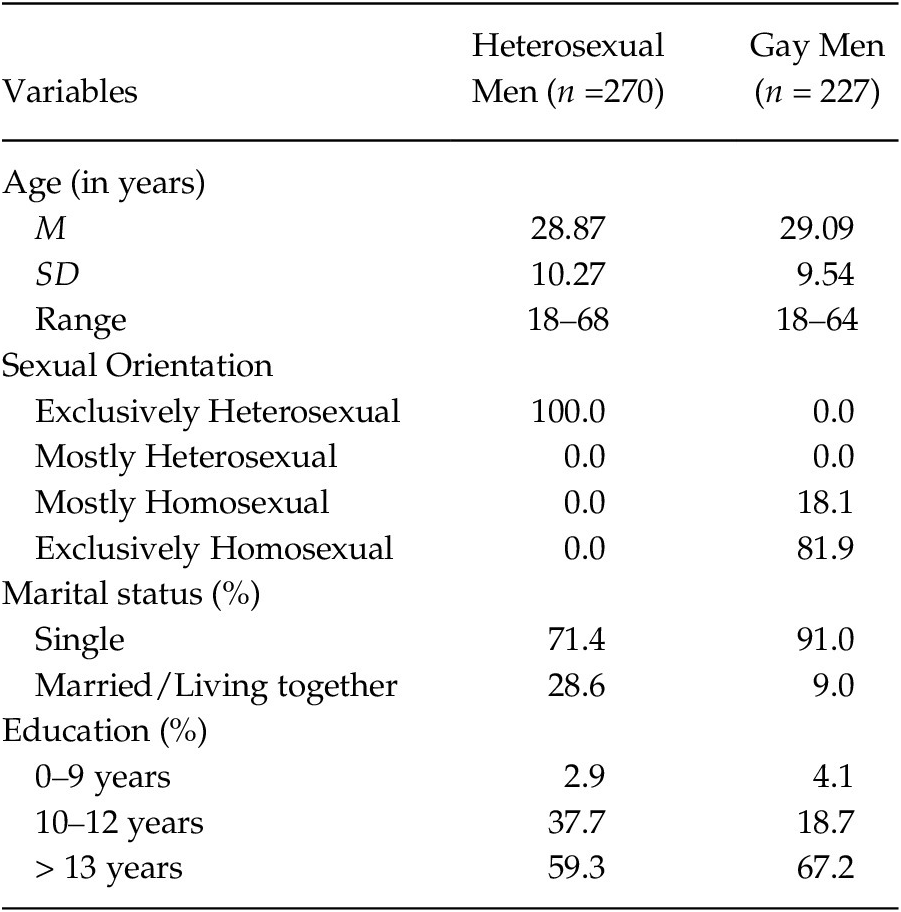
Between May 2012 and May 2013, the web survey was advertised through social media, LGBT forums and associations, and university, LGBT association, and sexual health group mailing lists. Participants were fully educated about the purpose of the study and were able to complete self-report forms after providing informed consent. Data were collected and stored on the university’s server, and no IP address was recorded to maintain privacy and anonymity of the data. Participants took between 10 and 15 minutes to complete the self-report questionnaire and no incentives were offered. A total of 561 men completed the web survey (227 gay men; 270 heterosexual men; 64 bisexual men). For this study purpose, only heterosexual and gay men were included, and the final sample was constituted by 497 participants. Heterosexual men had a mean age of 28.87 years (standard deviation = 10.27), ranging from 18 to 68 years. Gay men had a mean age of 29.09 years (standard deviation = 9.54), with an age range of 18 to 64 years. Table 1 shows the sociodemographic characteristics of the sample.
Sociodemographic Characteristics of the Sample (N =497)

Measures
Sociodemographic Information
Sociodemographic characteristics were evaluated through several questions on personal information, namely age, education level, and marital status. Regarding sexual orientation, participants answered the following question “How would you define your sexual orientation?” using a Likert scale (from 0 = exclusively heterosexual to 6 = exclusively homosexual).
NEO-Five Factor Inventory (NEO-FFI)
The NEO-FFI (Costa & McCrae, Reference Costa and McCrae1992) is a short version of the NEO Personality Inventory Revised (Costa & McCrae, Reference Costa and McCrae1992), which measures the five major personality traits: Neuroticism, Extraversion, Conscientiousness, Agreeableness, and Openness. It is a self-report measure consisting of 60 items answered on a 5-point Likert scale (0 = strongly disagree; 4 = strongly agree). Psychometric studies of the original version showed good psychometric properties with internal consistency ranging from .86 to .95 (Costa & McCrae, Reference Costa and McCrae1992). The Portuguese version replicated the five-factor model, and internal consistency ranged from .69 (openness) to .81 (conscientiousness) (Magalhães et al., Reference Magalhães, Salgueira, Gonzalez, Costa, Costa, Costa and Pedroso-Lima2014). For the current study, internal consistency ranging from .71 to .91 for heterosexual men, and from .75 to .89 for gay men.
Automatic Thoughts Scale from the Sexual Modes Questionnaire
The Sexual Modes Questionnaire (Nobre & Pinto-Gouveia, Reference Nobre and Pinto-Gouveia2003) is a self-report measure developed to assess automatic thoughts, emotions, and sexual responses during sexual activity. For the current study, we used the Automatic Thoughts scale to assess automatic thoughts during sexual activity in men. The male version consists of 30 items measuring five main dimensions: Failure anticipation thoughts, erection concern thoughts, thoughts related to age and sexual function, negative thoughts related to sex, and lack of erotic thoughts. Participants responded on a 5-point Likert scale (1 = never; 5 = always). Psychometric studies revealed good internal consistency with Cronbach alpha .88 and adequate test-retest reliability, r = .65 (Nobre & Pinto-Gouveia, Reference Nobre and Pinto-Gouveia2003). For the current study, internal consistency was .86 in the heterosexual men sample, and .89 in the gay men sample.
The Positive Affect - Negative Affect Scales (PANAS)
The Positive Affect - Negative Affect Scale (PANAS; Watson & Clark, Reference Watson and Clark1994) is a self-report measure which allows to assess emotional states: Positive Affect and Negative Affect, (e.g., Positive Affect: “interested,” “excited”; Negative Affect: “distressed” “ashamed”). It is constituted by 20-items answered according to a 5-point Likert scale (ranging from 0 = very little or nothing to 4 = extremely). Participants answered to the measure considering what they felt during sexual activity - state measure ("Indicate the extent to which you felt this way during sexual activity"). Psychometric studies of the original version revealed good temporal stability, good convergent and discriminant validity, as well as good internal consistency (Watson & Clark, Reference Watson and Clark1994). The Portuguese version revealed good psychometric properties, with good internal consistency, Cronbach alphas of .86 and .89 (Galinha & Pais-Ribeiro, Reference Galinha and Pais-Ribeiro2005). For the current study, internal consistency ranges from .90 to .92 in the heterosexual men sample, and from .92. to .95 in the gay men sample.
The International Index of Erectile Function (IIEF)
The International Index of Erectile Function (Rosen et al., Reference Rosen, Riley, Wagner, Osterloh, Kirkpatrick and Mishra1997) is an easy to administered measure allowing to assess sexual functioning in men, namely erectile function, orgasmic function, sexual desire, satisfaction with intercourse, and overall satisfaction. It comprises 15-items answered according to a 5-point Likert scale, and participants provided information about their sexual functioning over the past four weeks. The original version revealed good psychometric properties (Rosen et al., Reference Rosen, Riley, Wagner, Osterloh, Kirkpatrick and Mishra1997). The Portuguese version also revealed good psychometric properties (Quinta-Gomes & Nobre, Reference Quinta-Gomes and Nobre2012). A modified version of the IIEF, for men who have sex with men, was used with gay men sample (IIEF-MSM; Coyne et al., Reference Coyne, Mandalia, McCullough, Catalan, Noestlinger, Colebunders and Asboe2010). The psychometric study also revealed good internal consistency of the scale (Coyne et al., Reference Coyne, Mandalia, McCullough, Catalan, Noestlinger, Colebunders and Asboe2010). For the current study, internal consistency was .85 to heterosexual men, and .79 to gay men.
Statistical Plan and Analysis
For this study purpose, sexual orientation was coded as “heterosexual” when participants answered Option 0 (exclusively heterosexual) and Option 1 (predominantly heterosexual, only incidentally homosexual), and was coded as “gay” when participants answered Option 5 (predominantly homosexual, only incidentally heterosexual) and Option 6 (exclusively homosexual). Participants answering Option 2 (predominantly heterosexual, but more than incidentally homosexual), 3 (equally heterosexual and homosexual) and 4 (predominantly homosexual, but more than incidentally heterosexual) were excluded from the analysis (n = 64; 11.4%). Descriptive statistics including mean, standard deviation, range and frequencies were performed for sample characterization and for description of all variables in study. A series of multiple regression analyses were conducted using the Enter method, with automatic thoughts and affective states during sexual activity as predictors and male sexual functioning as the criterion variable, separately for heterosexual and gay male samples. Similarly, an identical statistical procedure was conducted with personality traits as predictors and male sexual functioning as a criterion variable. Bonferroni corrections were used to determine confidence levels. For testing the moderation models of personality traits (W and Z) in the relation between automatic thoughts and affective responses during sexual activity (X) and sexual functioning (Y), Process Macro 4.2 (Model 1 and Model 2; Hayes, Reference Hayes2022) for SPSS version 26.0 (IBM) was used. Process Model 1 allows to test the conditional effect (i.e., the effect of one variable - X, on another - Y, conditioned by a third - W), by examining the effect of X on Y along with the moderator, and to assess if this effect is significant. Process Model 2 enables to test the conditional effect (i.e., the effect of one variable - X, on another - Y, conditioned by a third - W, and a fourth - Z), by examining the effect of X on Y along with the moderators, and to assess if the effects are significant.
Results
Personality Traits, Automatic Thoughts, and Affective Response during Sexual Activity and Sexual Functioning in Heterosexual and Gay Men
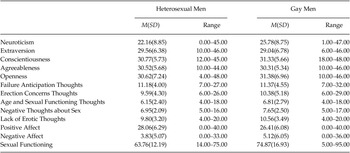
Mean, standard deviation and range for personality traits (Neuroticism, Extraversion, Conscientiousness, Agreeableness, Openness), for automatic thoughts (Failure Anticipation Thoughts, Erection Concerns Thoughts, Negative Thoughts about, Age and Sexual Functioning Thoughts, and Lack of Erotic Thoughts) for Positive Affect and Negative Affect, and for Sexual Functioning in heterosexual and gay men are depicted at Table 2.
Mean, Standard Deviation and Range for Personality Traits, Automatic Thoughts, and Affective Response during Sexual Activity and Sexual Functioning in Heterosexual and Gay Men (N = 497)

Note. Neuroticism, Extraversion, Conscientiousness, Agreeableness, Openness ranging from 0.0 to 48.0; Failure Anticipation Thoughts, Erection Concerns Thoughts ranging from 7 to 35; Negative Thoughts about Sex ranging from 5 to 25; Age and Sexual Functioning Thoughts, Lack of Erotic Thoughts ranging from 4 to 30; Positive Affect and Negative Affect ranging from 0.0 to 40.0; Sexual Functioning ranging from 5.0 to 100.0 (gay men) and 6.0 to 75.0 (heterosexual men).
Personality Traits, Automatic Thoughts, and Affective Response during Sexual Activity as Predictors of Heterosexual Men Sexual Functioning
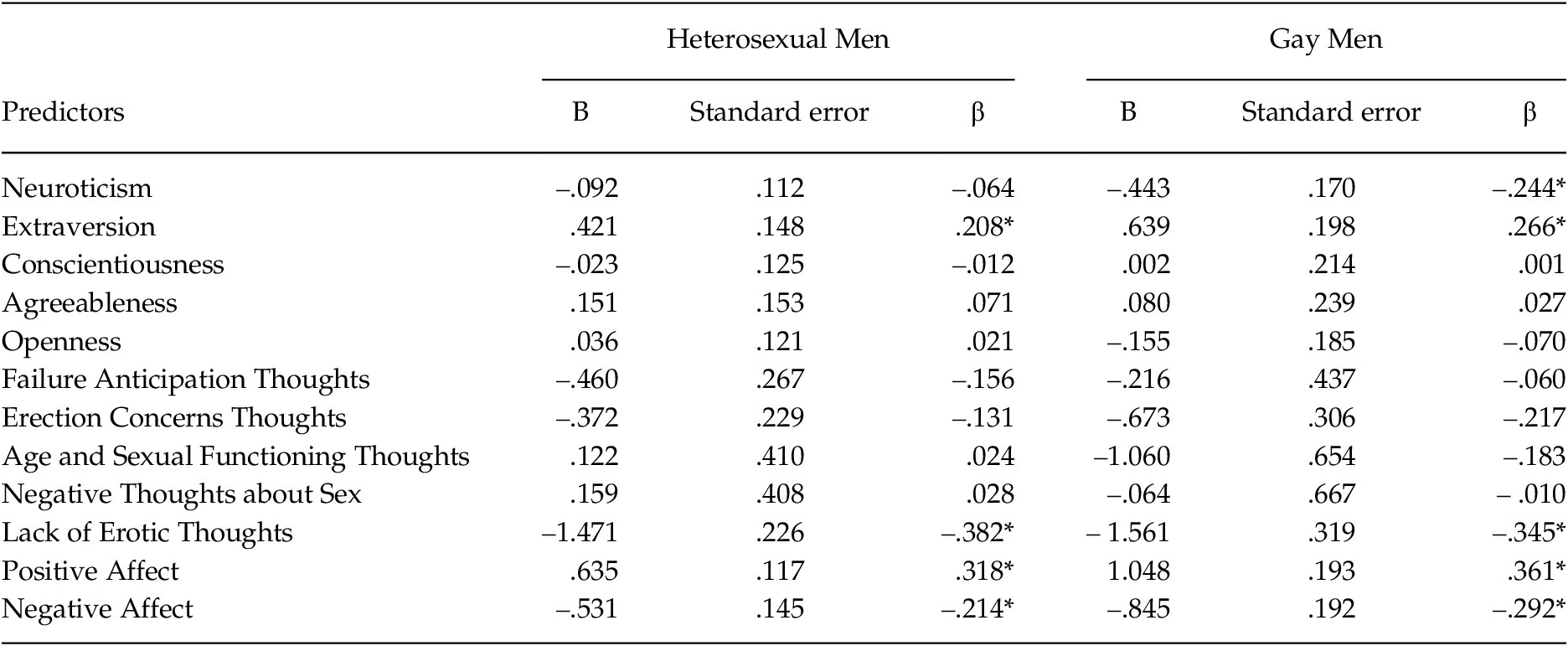
The multiple regression analysis with personality traits as predictors of sexual functioning, showed a significant model accounting for 8.2% of the variance, F(5, 241) = 4.243, p = .001 (R² = .082). Using the Bonferroni correction (p < .01), Extraversion (β = .208, p = .005) was the only significant predictor of sexual functioning. The analysis with automatic thoughts as predictors revealed a significant model accounting for 26.7% of the variance, F(5, 253) = 18.072, p < .001 (R² = .267). Using the Bonferroni correction (p < .01), only Lack of Erotic Thoughts (β = –.382, p < .001) was a significant predictor of sexual functioning. The analysis with affective response as predictors revealed a significant model accounting for 18.1% of the variance, F(2, 256) = 28.130, p < .001 (R² = .181). Using the Bonferroni correction (p < .025), both Positive Affect (β = .318, p < .001), and Negative Affect (β = –.214, p < .001), were significant predictors of sexual functioning (see Table 3).
Personality Traits, Automatic Thoughts, and Affective Response during Sexual Activity as Predictors of the Male Sexual Functioning

Note. Bonferroni correction for Personality Traits p < .01; Bonferroni correction for Automatic Thoughts p < .01; Bonferroni correction for Affective Response p < .02.
Personality Traits, Automatic Thoughts, and Affective Response during Sexual Activity as Predictors of Gay Men Sexual Functioning
Likewise, a multiple regression analysis with personality traits as predictors of sexual functioning was performed, and results showed a significant model accounting for 17.3% of the variance, F(5, 161) = 6.548, p < .001 (R² = .173). Using the Bonferroni correction (p < .01), Extraversion (β = .266, p = .002) and Neuroticism (β = –.244, p = .010) were the best predictor of sexual functioning. The analysis with automatic thoughts as predictors revealed a significant model accounting for 34.4% of the variance, F(5, 149) = 15.085, p < .001 (R² = .344). Using the Bonferroni correction (p < .01), only Lack of Erotic Thoughts (β = –.330, p < .001) was a significant predictor of sexual functioning. The analysis with affective response as predictors revealed a significant model accounting for 25.6% of the variance, F(2, 177) = 30.030, p < .001 (R² = .256). Using the Bonferroni correction (p < .025), both Positive Affect (β = .361, p < .001), and Negative Affect (β = –.292, p < .001), were significant predictors of sexual functioning (see Table 3).
Moderator Role of Personality Traits in the Relationship between Automatic Thoughts and Affective Response during Sexual Activity, and Heterosexual Men Sexual Functioning
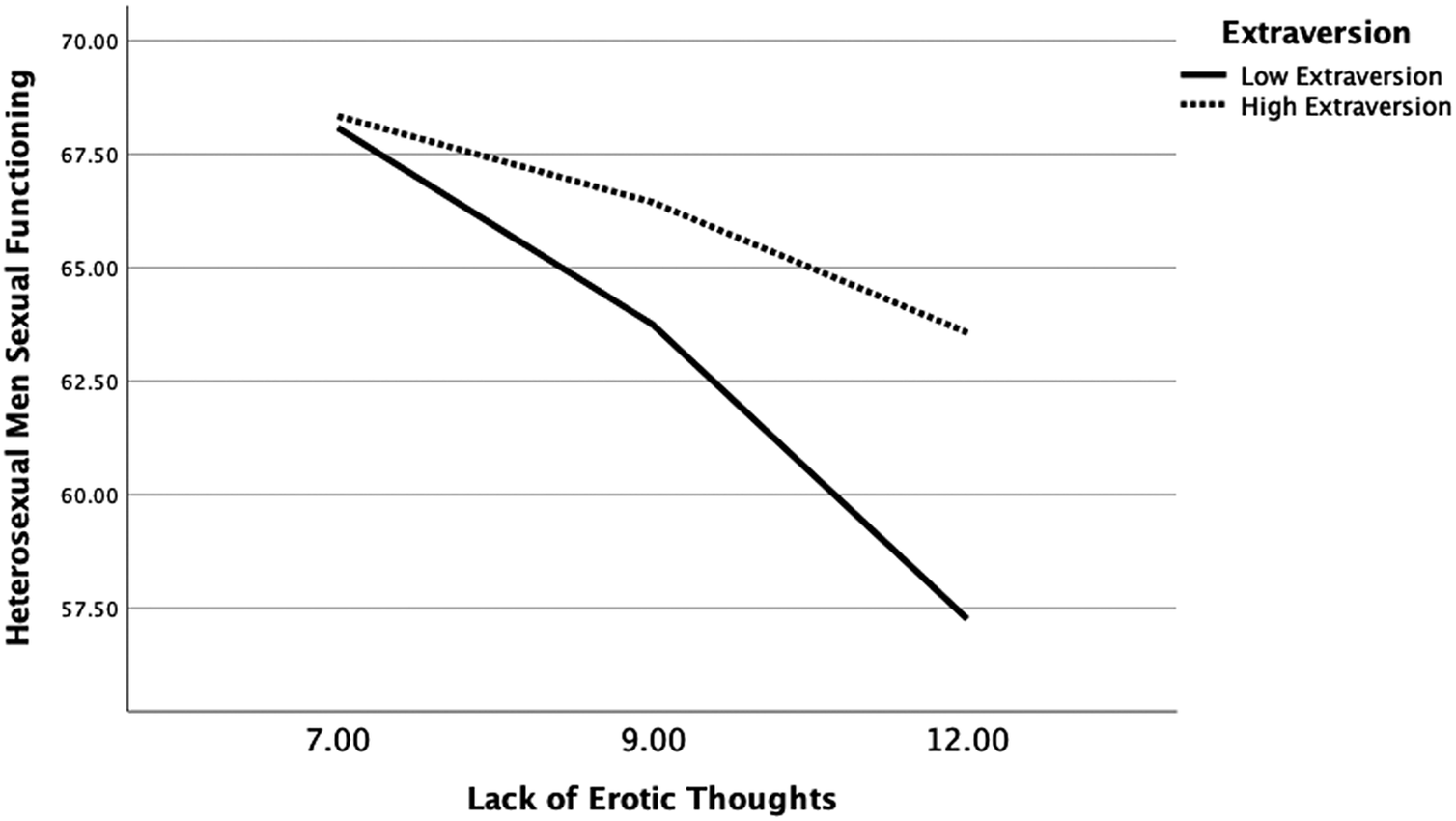
Moderation Model 1 was used to test if Extraversion (personality trait that significantly predicts heterosexual men sexual functioning) moderates the effect of Lack of Erotic Thoughts on Sexual Functioning, after controlling for age. The moderation model explained 25.9% of the variance of Sexual Functioning, which was significant, F(4, 257) = 22.40, p < .001, R2 = .259. After controlling for Age, b = .04, SE = .06, t = 0.65, p = .515, Lack of Erotic Thoughts, b = –4.59, SE = 1.00, t = –4.57 p < .001, and Extraversion, b = –.68, SE = .35, t = –1.98 p = .048 were significantly correlated with Sexual Functioning, as well as the interaction effect Lack of Erotic Thoughts x Extraversion, b = .10, SE = .03, t = 2.91, p = .004. The conditional effect of Extraversion on Sexual Functioning was statistical significant, (W = 24.0) = –2.17, SE = .26, t = –8.21, p < .001, (W = 30.0) = –1.56, SE = .23, t = –6.81, p < .001, and (W = 36.0) = –.95, SE = .35, t = –2.73, p = .007. (see Figure 1).
Moderation Role of Extraversion in the Relationship between Lack of Erotic Thoughts and Sexual Functioning in Heterosexual Men.

A Moderation Model 1 was used to test if Extraversion moderates the effect of Positive Affect on Sexual Functioning, after controlling for age, and the model was statistically significant, F(4, 252) = 22.40, p < .001, R 2 = .162, explaining 16.2% of the variance of Sexual Functioning. After controlling for Age, b = .01, SE = .07, t = 0.11, p = .914, Positive Affect, b = 1.47, SE = 0.51, t = 2.88 p = .004, and Extraversion, b = 1.23, SE = .52, t = 2.36, p = .019 were significantly correlated with Sexual Functioning, but the interaction effect Positive Affect x Extraversion, b = –.03, SE = .02, t = –1.75, p = .081, was not statistically significant correlated with Sexual Functioning. In addition, a Moderation Model 1 was used to test if Extraversion moderates the effect of Negative Affect on Sexual Functioning, after controlling for age, and the model was statistically significant, F(4, 251) = 12.17, p < .001, R 2 = .123, explaining 12.3% of the variance of Sexual Functioning. After controlling for Age, b = .01, SE = .07, t = 0.11, p = .912, Negative Affect, b = –1.79, SE = 0.76, t = –2.35 p = .020, was significantly correlated with Sexual Functioning, however Extraversion, b = .16, SE = .15, t = 1.02, p = .309, and the interaction effect Negative Affect x Extraversion, b = .04, SE = .03, t = 1.51, p = .131, were not statistically significant correlated with Sexual Functioning.
Moderator Role of Personality Traits in the Relationship between Automatic Thoughts and Affective Response during Sexual Activity, and Gay Men Sexual Functioning
A Moderation Model 2 was used to test if Neuroticism and Extraversion moderate the effect of Lack of Erotic Thoughts on Sexual Functioning, after controlling for age, and the model was statistically significant, F(6, 220) = 12.97, p < .001, R 2 = .261, explaining 26.1% of the variance of Sexual Functioning. After controlling for Age, b = –.00, SE = .11, t = –0.03, p = .977, Lack of Erotic Thoughts, b = –4.85, SE = 1.90, t = –2.55 p = .012, was significantly correlated with Sexual Functioning, however Neuroticism, b = –.72, SE = .41, t = –1.76, p = .079, the interaction effect Lack of Erotic Thoughts x Neuroticism b = .04, SE = .04, t = 1.15, p = .250, Extraversion, b = –.30, SE = .51, t = –0.59, p = .554, and the interaction effect Lack of Erotic Thoughts x Extraversion, b = .08, SE = .05, t = 1.75, p = .081, were not statistically significant correlated with Sexual Functioning.
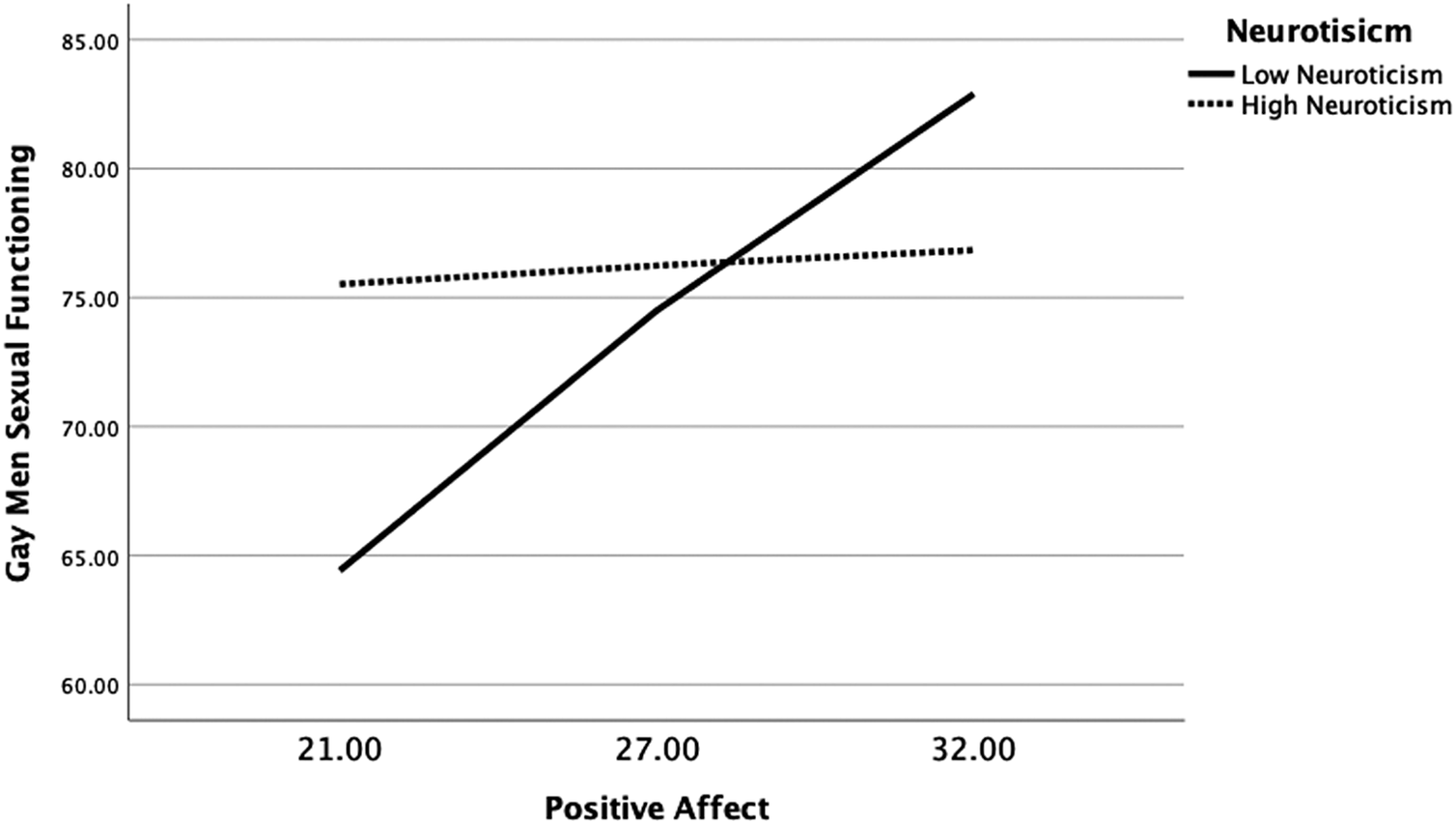
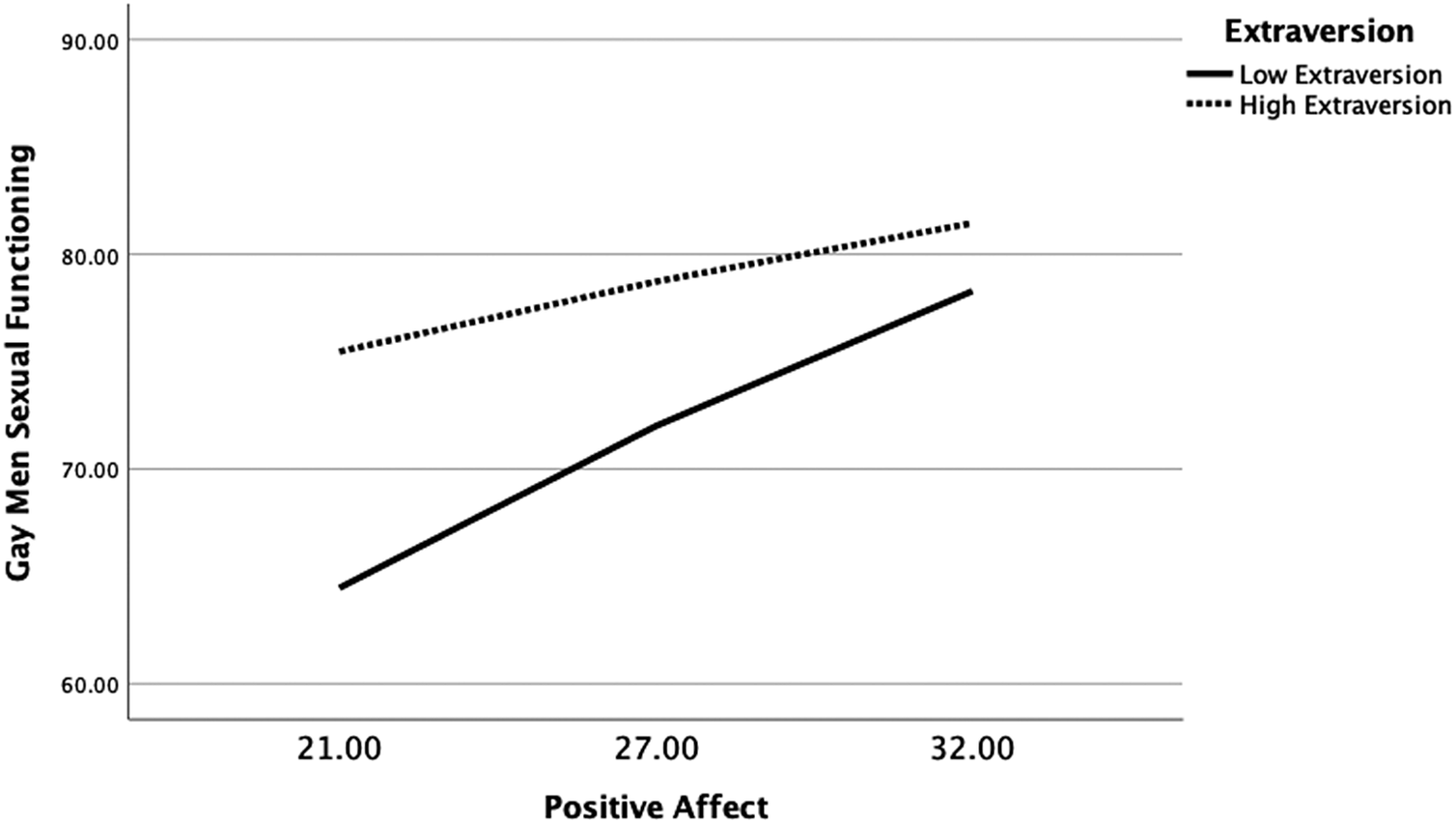
A Moderation Model 2 was used to test if Neuroticism and Extraversion moderate the effect of Positive Affect on Sexual Functioning, after controlling for age, and the model was statistically significant, F(6, 213) = 16.50, p < .001, R 2 = .317, explaining 31.7% of the variance of Sexual Functioning. After controlling for Age, b = –.00, SE = .11, t = –0.02, p = .981, Positive Affect, b = 3.60, SE = .93, t = 3.89 p < .001, the interaction effect Positive Affect x Neuroticism b = –.05, SE = .02, t = –2.36, p = .019, Extraversion, b = 1.90, SE = .64, t = 2.98, p = .003, and the interaction effect Positive Affect x Extraversion, b = –.05, SE = .02, t = –2.29, p = .023, were significantly correlated with Sexual Functioning, but Neuroticism, b = .99, SE = .54, t = 1.85, p = .066, was not statistically significant correlated with Sexual Functioning. The conditional effect of Neuroticism on Sexual Functioning was statistical significant, (W = 16.0) = 1.68, SE = .30, t = 5.64, p < .001, (W = 25.0) = 1.26, SE = .21, t = 6.09, p < .001, and (W = 34.0) = .83, SE = .25, t = 3.38, p < .001 (Figure 2). The conditional effect of Extraversion on Sexual Functioning was statistical significant, (z = 22.36) = 1.68, SE = .30, t = 5.64, p < .001, (z = 30.0) = 1.28, SE = .25, t = 5.14, p < .001, and (z = 36.0) = .97, SE = .29, t = 3.34, p = .001 (see Figure 3).
Moderation Role of Neuroticism in the Relationship between Positive Affect and Sexual Functioning in Gay Men.

Moderation Role of Extraversion in the Relationship between Positive Affect and Sexual Functioning in Gay Men.

A Moderation Model 2 was used to test if Neuroticism and Extraversion moderate the effect of Negative Affect on Sexual Functioning, after controlling for age, and the model was statistically significant, F(6, 217) = 9.92, p < .001, R 2 = .215, explaining 21.5% of the variance of Sexual Functioning. After controlling for Age, b = .07, SE = .11, t = 0.61, p = .546, Extraversion, b = .75, SE = .22, t = 3.46 p < .001, was significantly correlated with Sexual Functioning, however Negative Affect, b = .20, SE = 1.23, t = 0.16, p = .874, Neuroticism, b = –.01, SE = .18, t = –0.05, p = .957, the interaction effect Negative Affect x Neuroticism b = –.03, SE = .03, t = –1.01, p = .314, and the interaction effect Negative Affect x Extraversion, b = .00, SE = .02, t = 0.01, p = .989, were not statistically significant correlated with Sexual Functioning.
Discussion
The present study aims to investigate the moderating role of personality traits on the relationship between automatic thoughts and affective states during sexual activity and sexual functioning in gay and heterosexual men. Based on the empirical findings of the cognitive-emotional model of sexual dysfunction (Nobre, Reference Nobre and Hofmann2013), the predictive role of personality traits, automatic thoughts and affective states during sexual activity, on sexual functioning in gay and heterosexual men was tested. As expected, extraversion was a significant and positive predictor of sexual functioning in men, regardless of sexual orientation. Although extraversion has not received the same attention as neuroticism, previous studies have emphasized the role of introversion (or lower levels of extraversion) on men’s sexual health (Quinta-Gomes & Nobre, Reference Quinta-Gomes and Nobre2011; Schenk et al., Reference Schenk, Pfrang and Rausche1983). According to the current findings, men with higher levels of extraversion also reported better sexual functioning as measured by the IIEF (Coyne et al., Reference Coyne, Mandalia, McCullough, Catalan, Noestlinger, Colebunders and Asboe2010; Rosen et al., Reference Rosen, Riley, Wagner, Osterloh, Kirkpatrick and Mishra1997), regardless of their sexual orientation.
With respect to neuroticism, our hypothesis was partially supported after neuroticism significantly and negatively predicted sexual functioning only in gay men but not in heterosexual men. Although unexpected, gay men scored significantly higher on the Neuroticism Scale than heterosexual men according to a recent study (Peixoto & Nobre, Reference Peixoto and Nobre2016c). A possible explanation for these data may be found in internalized homonegativity scores, suggesting that gay men experience more psychological distress and victimization due to their sexual orientation (Herek & Garnets, Reference Herek and Garnets2007; Williamson, Reference Williamson2000), which may also impact sexual functioning (Ivanković et al., Reference Ivanković, Šević and Štulhofer2015; Simon Rosser et al., Reference Simon Rosser, Bockting, Ross, Miner and Coleman2008; Štulhofer et al., Reference Štulhofer, Ševic and Doyle2014).
Previous research has shown that automatic thoughts related to erection concerns and failure expectations, as well as a lack of erotic thoughts, are frequently associated with sexual dysfunction in heterosexual men (Nobre & Pinto-Gouveia, Reference Nobre and Pinto-Gouveia2000; 2008b). The results of the current study suggest that the lack of erotic thoughts are significant and negative predictors of sexual functioning in both samples. Fewer thoughts related to sexual cues appeared to have a greater impact on sexual functioning than negative and dysfunctional thoughts during sexual activity. Results on affective states during sexual activity also suggest that both positive and negative affect are significant predictors of sexual functioning in men. Greater positive affective states were associated with healthier sexual functioning, whereas greater negative affective states were associated with poorer sexual functioning, in both gay and heterosexual men. These findings are consistent with previous research emphasizing the role of positive and negative emotions in sexual functioning (Nobre & Pinto-Gouveia, Reference Nobre and Pinto-Gouveia2006; Reference Nobre and Pinto-Gouveia2008a; Rowland et al., Reference Rowland, Georgoff and Burnett2011; Shrier et al., Reference Shrier, Feldman, Black, Walls, Kendall, Lops and Beardslee2012).
The results of moderation analyzes in the heterosexual sample suggest that for men with higher scores on the absence of erotic thoughts, sexual functioning increases when they have higher scores on the Extraversion trait or decreases when they have lower scores on the Extraversion trait. It appears that in heterosexual men, extroversion as a personality trait that is stable over time may act as a protective factor in sexual activity in situations where less erotic thoughts are expressed. In the sample of gay men, endorsement of more positive emotions during sexual activity and sexual functioning was moderated by the personality trait extraversion. Gay men who endorsed less positive emotions during sexual activity may have reported better sexual functioning when they were more extroverted or worse sexual functioning when they were less extroverted. This finding may suggest that for gay men, regardless of whether they exhibit positive emotions during sexual activity, their stable tendency to respond positively to situations may be of greater importance (e.g., Pervin & Cervone, Reference Pervin and Cervone2010). With regard to neuroticism, gay men who exhibited a lower neuroticism profile and showed less positive emotions during sexual activity may have reported poorer sexual functioning, but when they showed more positive emotions, they reported better sexual functioning, whereas no differences in sexual functioning were observed in gay men with a higher neuroticism trait, regardless of their level of positive emotions during sexual activity. Low neuroticism appears to booster the effects of positive affect on gay men’s sexual functioning, whereas higher neuroticism has no effect on the effects of positive affect on gay men’s sexual functioning. Despite the specificities found in relation to sexual orientation, with extraversion buffering the negative effects of the absence of erotic thoughts and sexual functioning in heterosexual men and the negative effects of the absence of positive affect and sexual functioning in gay men, extraversion was overall the personality dimension with the greatest influence on the cognitive-affective variables reported during sexual activity by gay and heterosexual men.
Although the current results are seminal, they are preliminary and should be interpreted with caution due to several limitations. First, an online sample was collected and all limitations associated with web-based studies should be considered, as only individuals with Internet access were able to participate. In addition, our sample was young and well-educated, which could affect the results. No medical conditions were controlled, so further studies should be conducted to overcome these limitations. Overall, the sample was small, and the sample has homogeneous sociodemographic characteristics. The data were collected almost 10 years ago. However, the results are not expected to be significantly different from nowadays, considering that one of the key variables is personality traits that are stable over time. Nevertheless, future studies should attempt to replicate the current results to overcome this limitation. Finally, the effect sizes found range from small to moderate. Nonetheless, to our knowledge, this study represents the first attempt to evaluate personality dimensions as moderators of the association between automatic thoughts and affective states in sexual function in gay and heterosexual men. Although further studies are needed, the current study highlights the role of personality traits and cognitive-affective dimensions during sexual activity among gay and heterosexual men.
Cognitive-affective dimensions have been explored for understanding sexual function (e.g., Nobre, Reference Nobre2010), with the role of automatic thoughts and affective responses during sexual activity receiving particular attention for clinical therapeutic work with gay and heterosexual men (e.g., Lacefield & Negy, Reference Lacefield and Negy2012; Peixoto & Nobre, Reference Peixoto and Nobre2015). Nonetheless, a holistic and broader understanding of individuals could enhance psychotherapeutic interventions for sexual dysfunction. The current findings examine the moderator role of dispositional dimensions as personality traits, particularly the personality trait extraversion, between cognitive-affective variables and sexual functioning in gay and heterosexual men, and the personality trait neuroticism, between affective variables and sexual functioning in gay men. Moreover, the current findings suggest similarities in dispositional dimensions that influence sexual functioning in gay and heterosexual men, albeit through different pathways. Extraversion traits may buffer the negative effects of non-erotic cognitive distractions and negative emotions during sexual activity in gay and heterosexual men, whereas low neuroticism may boost the effects of positive emotions during sexual activity in gay men.