Introduction
Cannabis is the most widely used illicit drug worldwide. It is conservatively estimated that cannabis has been used at least once (lifetime prevalence) by about 80.5 million Europeans; thus, almost one in four 15- to 64-year-olds have used cannabis. An estimated 23 million Europeans have used cannabis in the last year or, on average, 6.8% of all 15- to 64-year-olds. During the late 1990s and early 2000s, many European countries reported increases in cannabis use (European Monitoring Centre for Drugs and Drug Addiction, Reference Denis, Lavie, Fatseas and Auriacombe2012). The potency of cannabis products is determined by their content of Δ−9-tetrahydrocannabinol (THC), the primary active constituent. Recent studies have shown that high-potency types have become increasingly available in the last decade (Mehmedic et al. Reference Mehmedic, Chandra, Slade, Denham, Foster, Patel, Ross, Khan and ElSohly2010; Cascini et al. Reference Butcher, Williams, Graham, Archer, Tellegen, Ben-Porath and Kaemmer2012).
Cannabis misuse has been associated with psychiatric, physical and social impairment. Its regular use can induce a range of acute and chronic mental health problems, such as psychosis, mania, anxiety, depression, neurocognitive and structural deficits, and dependence (Johns, Reference Johns2001; Batalla et al. Reference Batalla, Bhattacharyya, Yucel, Fusar-Poli, Crippa, Nogue, Torrens, Pujol, Farre and Martin-Santos2013); in addition, it is often a gateway to other illicit drugs (Hurd et al. Reference Hurd, Michaelides, Miller and Jutras-Aswad2014). Cannabis may also cause organic damage, such as chronic bronchitis, increased risk of pneumonia, poor respiratory function, increased risk of cancer, hypertension, cerebrovascular disease and ischemic heart disease (Hall, Reference Hall2009). Finally, social impairment may lead to accidents, violence, school drop-outs and job loss (Hall, Reference Hall2009; Hall & Degenhardt, Reference Hall and Degenhardt2009).
Early detection of risky cannabis users may be highly relevant to avoid long-term cannabis-related problems. Early-stage intervention has been effective in the treatment of addiction disorders. For instance, brief intervention can reduce alcohol consumption in risky drinkers, with benefits remaining a year afterwards (Kaner et al. Reference Kaner, Dickinson, Beyer, Pienaar, Schlesinger, Campbell, Saunders, Burnand and Heather2009). Counseling approaches, including group and individual sessions of cognitive behavioral therapy (CBT), might also be beneficial for the treatment of cannabis use disorders. Adding voucher-based incentives may enhance treatment when used in combination with other effective psychotherapeutic interventions (Denis et al. Reference Cuenca-Royo, Sanchez-Niubo, Forero, Torrens, Suelves and Domingo-Salvany2006).
The important characteristics that define the utility of early detection instruments include: reliability, validity, adaptability to different patterns of use, and applicability to daily practice. In addition, shortness, clarity, and usability in different settings and populations should facilitate implementation (Piontek et al. Reference Pedersen, Grow, Duncan, Neighbors and Larimer2008; Tiet et al. Reference Tiet, Finney and Moos2008). Reliability describes the consistency of a measure and may be measured with internal consistency, test–retest reliability, or inter-rater reliability. Validity reflects how well a measure corresponds with the real world and may be expressed in terms of content validity [sensitivity, specificity, positive predictive values (PPV) and negative predictive values (NPV) as well as convergent or divergent validity]. There are many instruments to assess cannabis consumption and related problems, but there are no ‘gold standard’ tools for assessing cannabis use disorders. Some authors have warned about this emergent problem in research and clinical practice (Anderson et al. Reference Anderson, Gual and Colom2005; López-Pelayo et al. Reference López-Pelayo, Balcells-Oliveró and Gual-Solé2013). For instance, Conway et al. (Reference Colón, Pérez, Meléndez, Marrero, Ortiz and Suárez2010) emphasized that the same problem occurred with all substances. In addition, registries of cannabis consumption use different definitions of a current cannabis user according to different frequency patterns.
Throughout the 1990s, the same limitations were described for the assessment of alcohol and tobacco use disorders. Alcohol assessment was improved by carrying out studies using a standard unit, while reviewing several tools for assessment. Nowadays, the standard drink unit (Gual et al. Reference Gual, Martos, Lligona and Llopis1999; Kerr & Stockwell, Reference Kerr and Stockwell2012) and Alcohol Use Disorders Identification Test (AUDIT) (Reinert & Allen, Reference Reinert and Allen2007) are recognized as the most useful and reliable tools for assessing alcohol-related problems (Anderson et al. Reference Anderson, Gual and Colom2005). The AUDIT scale has a good internal consistency, test–retest reliability (r = 0.86), and validity (sensitivity 0.95–0.97 and specificity 0.78–0.85). Furthermore, it is helpful in daily practice because it is fast, clear, and can be applied to different settings, such as the emergency room or in primary health care. Several questions refer to patterns of alcohol use (number of standard drink units per day, number of heavy drinking days). Moreover, the AUDIT scale can distinguish hazardous, harmful, and dependence drinking patterns (Anderson et al. Reference Anderson, Gual and Colom2005). The Fagerstrom test (Fagerstrom & Schneider, 1989) and the smoking pack-years (Weintraub et al. Reference Weintraub, Klein, Seelaus, Agarwal and Helfant1985) have demonstrated the same usefulness for assessing tobacco problems.
In the present review, we conducted a systematic literature search to describe and evaluate the structured and validated instruments available for screening and assessing cannabis use and related-disorders.
Method
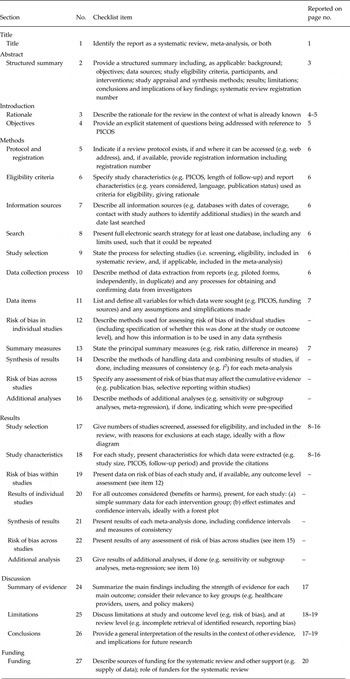
Data for this systematic review were collected with an advanced document protocol in accordance with the PRISMA (Preferred Reporting Items for Systematic Reviews and Meta-Analyses) guidelines (Liberati et al. Reference Liberati, Altman, Tetzlaff, Mulrow, Gotzsche, Ioannidis, Clarke, Devereaux, Kleijnen and Moher2009; Urrutia & Bonfill, Reference Urrutia and Bonfill2010). This protocol provides a checklist for reporting systematic reviews (Table 1).
PRISMA (Preferred Reporting Items for Systematic Reviews and Meta-Analyses) checklist a

PICOS, Participants, Interventions, Comparisons, Outcomes, and Study Design.
a Adapted from Moher et al. (2009).
Search strategy
Electronic searches were performed using Medline (1950–January 2013), Web of Science (1900–January 2013), Journal Citation Reports (1997–January 2013), Science Direct (1823–January 2013), EBM Reviews-Cochrane Database of Systematic Reviews (2005–January 2013), EBM Reviews-ACP Journal Club (1991–January 2013), and EBM Reviews-Cochrane Central Register of Controlled Trials (1991–January 2013). A combination of the following key words were used: psychometric, instrument, scale, tool, assessment, timeframe, measure, DUF (drug use frequency), calendar method, timeline follow-back, quantify, standardized criteria, standard criteria, standard unit; cannabis, marijuana, marihuana, delta-9-tetrahydrocannabinol, THC (delta-9-tetrahydrocannabinol), cannabidiol, cannabinoids, hash, hash oil, and hashish. No language or design restriction was applied. All studies published up to January 2013 were included. The references of selected papers were also screened for relevant articles, yielding 11 additional papers.
Selection criteria
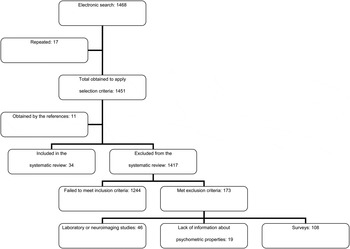
We initially performed a general overview of all assessments of cannabis misuse, which led to a total of 1451 published papers (Fig. 1). The scales were only included if they were designed to: (1) quantify cannabis use; (2) screen and assess for cannabis misuse (abuse and/or dependence); and (3) quantify problems related to cannabis use: severity of dependence. The scales were excluded if: (1) they were recommendations of international organizations or population survey instruments; (2) laboratory or neuroimaging techniques, and (3) lacked information about the psychometric properties.
PRISMA (Preferred Reporting Items for Systematic Reviews and Meta-Analyses) flowchart detailing study selection.

Data extraction
Data were extracted by two reviewers (H.-L.P. and A.B.). We asked the opinion of a senior researcher (A.G.) when papers were questionable. From the articles included, the following data were recorded: authorship, year of publication, population target (e.g. adolescents), number and type of questions, time-frame, aim of the instrument, as well as reliability and validity parameters (internal consistency, test–retest reliability, inter-rater reliability, sensitivity, specificity, PPV, NPV, ‘gold standard’, cut-off, correlations with other instruments).
Results
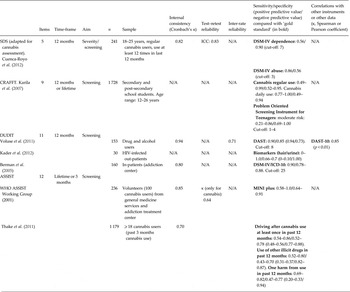
From the 1449 studies identified, 1244 did not meet the a priori selection criteria and 173 met the exclusion criteria (Fig. 1). The 25 instruments included in the review were classified as: (a) specific scales for assessing cannabis use disorders; (b) scales for assessing drug use disorders; (c) structured interviews; and (d) instruments for quantifying cannabis use. Detailed information on all scales is presented in online Supplementary Table S1 and Table 2.
Scales for assessing drug use disorders

SDS, Severity Dependence Scale; ICC, intra-class correlation; DSM, Diagnostic and Statistical Manual of Mental Disorders; N/A, not available; CRAFFT, Car, Relax, Alone, Forget, Friends, Trouble; DUDIT, Drug Use Disorder Identification Test; DAST, Drug Abuse Screening Test; ICD-10, International Classification of Diseases-10; ASSIST, Alcohol, Smoking, and Substance Involvement Screening Test; MINI, Mini International Neuropsychiatric Interview.
Specific scales for assessing cannabis use disorders
We identified six scales specifically designed to assess cannabis use disorders. Psychometric details are provided in online Supplementary Table S1.
Cannabis Problems Questionnaire (CPQ)
The CPQ is a scale adapted from the Alcohol Problems Questionnaire, designed for screening cannabis abuse and dependence (Copeland et al. Reference Conway, Levy, Vanyukoy, Chandler, Rutter, Swan and Neale2005; Martin et al. Reference Martin, Copeland, Gilmour, Gates and Swift2006; Lavender et al. Reference Lavender, Looby and Earleywine2008; Proudfoot et al. Reference Piontek, Kraus and Klempova2010; Fernandez-Artamendi et al. Reference Fagerstrom and Schneider2012b ). It has been validated for adolescents (14–20 years old) and adult populations. The CPQ and Adolescent CPQ (CPQ-A) showed greater validity when the ‘gold standard’ was Diagnostic and Statistical Manual of Mental Disorders (DSM)-IV criteria, but sensitivity was lost when compared with a measure of consumption such as ‘daily use’. The CPQ-A-S (short form) had good validity compared with DSM-IV criteria and there was significant correlation with heavy cannabis use. The S-CAP had good correlation with indices of cannabis use, but no data about sensitivity or specificity were available.
Cannabis Abuse Screening Test (CAST)
The CAST was designed for screening problematic cannabis use. The CAST was tested in young adult (18–25 years old) users in the last month (Fernandez-Artamendi et al. Reference Fagerstrom and Schneider2012b ), adolescent and young adult (16–20 years old) regular users (at least 12 times in the past 12 months) (Cuenca-Royo et al. Reference Copeland, Gilmour, Gates and Swift2012), and in French Army adults (Gheorghiev et al. Reference Fernandez-Artamendi, Fernández-Hermida, Muñiz-Fernández, Secades-Villa and García-Fernández2009; Marimoutou et al. Reference Marimoutou, Queyriaux, Michel, Verret, Haus-Cheymol, Mayet, Deparis and Boutin2010). It showed good content validity when the ‘gold standard’ was DSM-IV criteria or urine sampling.
Cannabis Use Disorder Identification Test (CUDIT)
The CUDIT screens for current cannabis use disorders (dependence/abuse) and was constructed from the AUDIT. It was tested in adolescents and young adults who were regular users (defined by once in the past 6 months) (Annaheim et al. Reference Annaheim, Rehm and Gmel2008) and adult cannabis users who reported cannabis use in the past 3 months (Thake & Davis, Reference Stein and Graham2011). The CUDIT-Revised was tested in adults taking part in a clinic trial of CBT for depression and substance misuse (Adamson et al. Reference Adamson, Kay-Lambkin, Baker, Lewin, Thornton, Kelly and Sellman2010). The CUDIT had high validity when the ‘gold standard’ was the Structured Clinical Interview for DSM-IV (SCID), but it was lower when the ‘gold standard’ was related to the consequences of cannabis such as driving after cannabis use, use of other illicit drugs, harm after past use, smoking at work or school, depressive symptoms, smoking to cope, or self-perception. The best validity data was for the CUDIT-Revised when the ‘gold standard’ was the SCID.
Marijuana Screening Inventory (MSI-X), Marijuana Problem Scale (MPS) and Risk and Consequences Questionnaire-Marijuana (RCQ-M)
The MSI-X was designed for screening problematic cannabis use (Alexander & Leung, Reference Alexander and Leung2006). It was studied in adults referred to specialized addiction treatment. This study only provided data on validity through correlation with other scales. However, the authors referred to a previous study in clinical and community samples that reported data on validity and reliability. The MSI-X had high content validity and convergent validity with other scales in patients referred to specialized treatment.
The MPS is used to measure recent cannabis-related problems (Jungerman & Laranjeira, Reference Jungerman and Laranjeira2008). It was studied in adult marijuana users seeking treatment and showed high correlation with data about use patterns, such as the mean number of joints per day or percentage of days smoked.
The RCQ-M is an instrument to measure cannabis- or alcohol-related problems (Stein et al. Reference Serre, Fatseas, Debrabant, Alexandre, Auriacombe and Swendsen2010). The population studied was incarcerated adolescents. The RCQ-M short version had high internal consistency, but test–retest reliability was low and there were no data about sensitivity or specificity. In contrast, there was high convergent validity with measures of consumption (days used marijuana), dependence symptoms (Marijuana Dependence Symptoms Count), and social impairment (Conduct Disorder Symptom Count).
General scales to assess drug use disorders
We found four scales designed to assess drug use disorders, including cannabis. Psychometric details are provided in Table 2.
Severity Dependence Scale (SDS)
The SDS assesses severity of dependence and may be used to screen abuse or dependence (Cuenca-Royo et al. Reference Copeland, Gilmour, Gates and Swift2012). It was tested in a sample of young adult regular cannabis users (18–25 years old). Regular use was defined by use at least 12 times in the past 12 months. The SDS has shown low sensitivity to diagnose cannabis dependence and low specificity to diagnose cannabis abuse. In contrast, it had high sensitivity to identify cannabis abuse patients and high specificity to confirm dependence. The DSM-IV criteria were always used as the ‘gold standard’.
Car, Relax, Alone, Forget, Friends, Trouble (CRAFFT)
The CRAFFT is a brief screening instrument for adolescents, which assesses alcohol and other substance disorders. It was tested in secondary and post-secondary students (12–26 years old) using the Problem Oriented Screening Instrument for Teenagers (POSIT) or frequency patterns as the ‘gold standard’ (Karila et al. Reference Karila, Legleye, Beck, Corruble, Falissard and Reynaud2007). The CRAFFT showed high variability of validity parameters.
Drug Use Disorder Identification Test (DUDIT)
The DUDIT was adapted from the AUDIT. The DUDIT was tested for adult drug users and adult alcohol users (Voluse et al. Reference Voluse, Gioia, Sobell, Dum, Sobell and Simco2012), adult HIV-infected patients (Kader et al. Reference Kader, Seedat, Koch and Parry2012) and adult drug users (Berman et al. Reference Berman, Bergman, Palmstierna and Schlyter2005). The DUDIT showed high sensitivity and specificity compared with the Drug Abuse Screening Test (DAST), DSM-IV or International Classification of Diseases (ICD)-10 criteria. Convergent validity with DAST-10 was also high. However, the cut-off was highly variable between studies with similar sensitivity and specificity, with values from eight in drug and alcohol users to 25 in in-patients of addiction centers.
Alcohol, Smoking, and Substance Involvement Screening Test (ASSIST)
The ASSIST was developed by the World Health Organization (WHO) to identify psychoactive substance use and related problems in a primary care setting. The ASSIST was tested in adults from general medicine service and addiction treatment centers (WHO ASSIST Working Group, Reference Grant, Harford, Dawson, Chou and Pickering2002) and adult cannabis users (at least once in the past 90 days) (Thake & Davis, Reference Stein and Graham2011). The ASSIST for cannabis showed high internal consistency, but quite low test–retest reliability. When compared with the Mini International Neuropsychiatric Interview (MINI) plus, it showed a wide range of validity. On the contrary, validity decreased when the instrument was compared with risky behaviors.
Structured interviews
Of the structured interviews, seven included drug modules. Psychometric details are provided in online Supplementary Table S2.
Adolescent and young adults
Minnesota Multiphasic Personality Inventory-Adolescent (MMPI-A)
The MMPI-A is a personality inventory, which includes subscales about drug and alcohol problems. Subscales focused on drug problems are ‘alcohol/drug problem acknowledgment’ (ACK) and ‘alcohol/drug problem proneness’ (PRO). MMPI-A subscales were tested in 123 incarcerated adolescents (Stein & Graham, Reference Rodríguez, Valdés, Fernández, Dalbosco, Hoffman, Fernanda, Javiera, Ramírez, Ramírez and Pruzzo2001), and it had high sensitivity compared with other structured interviews and a cut-off of 55 points. Specificity improved with higher cut-offs (70), but sensitivity fell.
Child and Adolescent Psychiatric Assessment (CAPA-C)
The CAPA-C is a diagnostic interview for children and adolescents to evaluate all psychiatric pathologies, including drug problems. It was studied in psychiatric patients aged 10–18 years (Angold & Costello, Reference Angold and Costello1995). The CAPA-C had high internal consistency and test–retest validity, but it did not show validity parameters.
Drug Use History Form (DUHF)
The DUHF is a structured interview that assesses 12 classes of drugs for use and problems. The DUHF was tested in adolescents and young adults (16–25 years) seeking treatment for drug use disorders (Martin et al. Reference Martin, Pearlman and Li1998). There were no data about validity.
Adult structured interviews
Psychiatric Research Interview for Substance and Mental Disorders (PRISM)
The PRISM is a structured interview developed for dual diagnosis of primary and secondary mental illnesses. The PRISM was tested in 105 substance abuse users in treatment centers (Torrens et al. Reference Thake and Davis2004) and showed low convergent validity for cannabis use disorders. A significant correlation was only shown between the PRISM and LEAD (Longitudinal evaluation performed by an Expert, using All Data available) for past cannabis abuse.
MINI
The MINI is a diagnostic interview in accordance with DSM-III-R criteria. It is useful for substance and other psychiatric disorders. The MINI was tested in adult patients (Lecrubier et al. Reference Lecrubier, Sheehan, Weiller, Amorim, Bonora, Sheehan, Janavs and Dunbar1997), showing high validity compared with other structured interviews.
Alcohol Use Disorder and Associated Disabilities Interview Schedule (AUDADIS)
The AUDADIS is a structured diagnostic interview developed to use in the National Longitudinal Alcohol Epidemiologic Survey of the National Institute on Alcohol Abuse and Alcoholism. It includes several modules, including drug assessment. The AUDADIS showed high convergent validity compared with DSM or ICD criteria, but there was no content validity and validity data were not compared with pattern of use or cannabis-related problems other than abuse/dependence (Grant et al. Reference Gheorghiev, Arvers, de Montleau, Fidelle, Queyriaux and Verret1995).
SCID
The SCID is a structured interview based on DSM-IV criteria used to diagnose mental illness including drug use disorders. The SCID was tested in 105 substance abuse users in treatment centers (Torrens et al. Reference Thake and Davis2004) and showed low convergent validity.
Instruments to quantify cannabis use
We found eight instruments designed to quantify cannabis use. Psychometric details are provided in online Supplementary Table S2.
Timeline Follow-Back (TLFB)
The TLFB is a measure used to collect detailed alcohol and other drug use information for clinical trials and clinical populations. The traditional TLFB involves a structured interview with the use of a calendar to allow participants to indicate the occasions when they used alcohol and/or other drugs over a particular time period. The TLFB can yield extensive information about patterns, frequencies and quantities of behavior. High reliability was demonstrated but no sensitivity or specificity data were found (Norberg et al. Reference Moher, Liberati, Tetzlaff and Altman2012; Pedersen et al. Reference Norberg, Mackenzie and Copeland2012).
Other instruments
The Cannabis Use Daily (CUD) is an instrument assessing only the daily use of cannabis. It was tested in adults who reported cannabis use in the past 3 months (Thake & Davis, Reference Stein and Graham2011) and showed low sensitivity and high specificity when the ‘gold standard’ was social or individual harm.
The Paired Method is a type of instrument that attempts to reduce under-reporting of drug use by using the theory of a privileged access interviewer, in which trained students interview other students. Rodriguez et al. (Reference Proudfoot, Vogl, Swift, Martin and Copeland2011) compared this method with self-reporting in a sample of 301 adolescents and showed earlier onset, more cigarettes per week, and a greater percentage of marijuana used in the past year and currently.
Barry et al. (Reference Barry, Fleming, Greenley, Widlak, Kropp and McKee1995) compared a screening question about drug use and related-problems with the DIS-R (brief diagnostic interview based on DSM-III-R criteria) in a sample of 253 patients with severe mental illness. They used questions to assess substance use in the last year, blackouts, the inability to stop, others’ concerns about drinking, perception of a past problem, and perception of the present problem. They concluded that the best predictor of a client's present alcohol or drug problem was whether the case manager thought that the client had substance use problems at some time in his or her life (sensitivity = 0.86, specificity = 0.75).
Serre et al. (Reference Reinert and Allen2012) studied the feasibility and validity of computerized ambulatory monitoring of daily life experiences and substance use (Daily Online Assessment). Their sample included 109 adults from out-patient treatment centers, with 21 being cannabis users. Participants were given electronic personal digital assistants (PDAs) to carry with them for 14 days, and each PDA was programmed to administer four electronic interviews per day. The correlation with the Addiction Severity Index was significantly positive for all drugs.
The Audio-Computer Assisted Self-Interview (ACASI) aims to increase substance use reporting. Colón et al. (Reference Cascini, Aiello and Di Tanna2010) studied its validity in a household survey of 532 adults compared with urinalysis. In the ACASI, the questions are presented on the computer screen and read to the respondent through headphones. The sensitivity of responses for drug use during the last 3 days was 80.0% for marijuana (the ‘gold standard’ was urinalysis).
The Smoking Topography measures cannabis smoking behavior (volume of smoke, puff duration, puff velocity, and interval). It aims to measure cannabis smoking topography characteristics during periods of use ad libitum and to correlate topography assessments with measures of self-reported cannabis use, withdrawal and craving during abstinence, and cognitive task performance. A dose–effect relationship between cannabis consumption and relevant outcomes was described (McClure et al. Reference McClure, Stitzer and Vandrey2012).
Lennox et al. (Reference Lennox, Dennis, Scott and Funk2006) proposed assessing substances by combining three self-reported (recentness, peak quantity, and frequency) and two biometric (urine and saliva) measures of different substances in regular users compared with six ‘gold standards’. For marijuana use, the biomarkers generally did not correlate with other problems, while the psychometric measures did correlate.
Discussion
We have identified 25 instruments to assess cannabis use and cannabis-related problems, which were classified in four groups: cannabis scales (n = 6), drug scales (n = 4), structured interviews (n = 7) and tools for quantifying cannabis use (n = 8). Even though most showed good psychometric properties, none can be considered a ‘gold standard’. At the present time there are many instruments available to assess cannabis use and misuse, but they have limitations which restrict their use in daily practice. For instance, instruments usually are too long to be routinely used. This is a problem for all structured interviews and several scales for assessing only cannabis use. In fact, this is one of the reasons why structured interviews are mainly used in research or in specific situations, such as the differential diagnoses in specialized treatment (Tiet et al. Reference Stein, Lebeau, Clair, Rossi, Martin and Golembeske2008). Another limitation is the time-frame, which is often not appropriate; for example, short periods (usually under 12 months) are used in the CUDIT and CPQ (Tiet et al. Reference Stein, Lebeau, Clair, Rossi, Martin and Golembeske2008). Furthermore, scales are usually tested in cannabis or drug users; data are limited for psychiatric patients, different genders or different age ranges. Other studies have shown similar problems with the implementation of instruments in patients with mental illness (Piontek et al. Reference Pedersen, Grow, Duncan, Neighbors and Larimer2008; Tiet et al. Reference Stein, Lebeau, Clair, Rossi, Martin and Golembeske2008).
On the other hand, the data available on validity are incomplete. In addition, the ‘gold standard’ is usually dependence or abuse criteria (Piontek et al. Reference Pedersen, Grow, Duncan, Neighbors and Larimer2008; Conway et al. Reference Colón, Pérez, Meléndez, Marrero, Ortiz and Suárez2010). This focus of interest is important to validate a scale but it does not consider other users who may be relevant, such as risky cannabis users. Furthermore, validity decreases when ‘gold standards’ are the consequences of cannabis use or patterns of cannabis use.
The current instruments do not assess the organic consequences of cannabis or minimize the impact of the scale (Hall, Reference Hall2009; Conway et al. Reference Colón, Pérez, Meléndez, Marrero, Ortiz and Suárez2010). Hazardous patterns of use are often not assessed. Only the CUDIT and DUDIT considered the different patterns of cannabis use but not frequency or amount (Berman et al. Reference Berman, Bergman, Palmstierna and Schlyter2005; Annaheim et al. Reference Annaheim, Rehm and Gmel2008; Adamson et al. Reference Adamson, Kay-Lambkin, Baker, Lewin, Thornton, Kelly and Sellman2010; Thake & Davis, Reference Stein and Graham2011; Kader et al. Reference Kader, Seedat, Koch and Parry2012; Voluse et al. Reference Torrens, Serrano, Astals, Perez-Dominguez and Martin-Santos2012). Therefore, it is confusing to use the concept of regular use and risky use as synonyms. In consequence, smoking one cigarette per day would correspond to the same level of risk as smoking 10 cigarettes per day. Daily users consume larger quantities of illegal drugs (Johnson & Golub, Reference Johnson and Golub2007). Recently, a strong correlation was reported between the frequency of use and quantity consumed per day of use, suggesting that consumption is more skewed toward the minority of heavy users and knowing the number of users cannot predict the prevalence of cannabis use. This report proposed to examine the frequency and amount used to understand the market and user behavior (Burns et al. Reference Burns, Caulkins, Everingham and Kilmer2013). The concept of regular use is unclear in different studies. Some authors consider regular use to be at least once a month; however, other studies consider it to be once every 3 months or daily use. The patients do not have the same risk of adverse effects when smoking one cigarette in 90 days as 10 cigarettes every day (Hall & Degenhardt, Reference Hall and Degenhardt2009). Thus, the amount and frequency of cannabis use are relevant to explore cannabis-related problems. Moreover, it is difficult to compare different instruments used in regular users to differentiate problematic and risky use.
Finally, instruments to quantify consumption are available, but they do not quantify grams of psychoactive substance per unit of consumption. It is difficult to generalize results because the concentration of THC may change according to the country, region, or type of users (European Monitoring Centre for Drugs and Drug Addiction, 2012). According to preliminary analyses from Arrestee Drug Abuse Monitoring (ADAM) data, there were no differences in the average size of cannabis unit consumption in the 2000s (Burns et al. Reference Burns, Caulkins, Everingham and Kilmer2013). Thus, a standard cannabis unit is feasible to improve measures of illegal drug use, according to previous studies (Johnson & Golub, Reference Johnson and Golub2007). Nowadays, the amounts contained in marijuana remain poorly documented (Johnson & Golub, Reference Johnson and Golub2007). However, there are serious efforts to improve strategies for obtaining details about cannabis consumption (Mariani et al. Reference Mariani, Brooks, Haney and Levin2011). Limitations in this study were: a restricted sample population and a lack of psychoactive measures. Norberg et al. (2012) suggested combining a marijuana substitute (called ‘marijuanilla’) with the TLFB to reflect grams of cannabis use when assessing consumption. However, there were no attempts to measure the psychoactive substance.
The results presented here highlight some important methodological differences across studies, which limit generalization of the results. Inclusion criteria vary widely and there were few exclusion criteria. We found an enormous range of techniques and instruments for assessing cannabis consumption, which hampered comparisons between the different tools and comparisons with high levels of detail. Nevertheless, our findings did not conflict with the objectives of the systematic review, which was to expose the most methods available for assessing cannabis use, even if it was difficult to compare them. Another limitation was the lack of subgroup analysis; for example, we did not analyse population or gender differences among instruments.
Our review also had many positive features. To our knowledge, there has been no previous systematic review that included so many types of instruments for assessing cannabis use and misuse. Furthermore, our systematic review analysed instruments for assessing cannabis in different populations. We concluded that well-performed psychometric properties are not enough to implement effective early systematic identification.
Despite the limitations of the present review, the instruments with the best performance were the CAST, CUDIT, DUDIT and ASSIST. In fact, three of them (DUDIT, CUDIT and ASSIST) ask about cannabis use patterns in their initial questions. In conclusion, there are several instruments for assessing cannabis use in different populations but it is difficult to implement them because the frequency and amount of use are not recorded. According to the results of our systematic review, existing instruments should be used in populations where they have shown good psychometric properties and combined with new strategies, which focus on frequency and amount measurements, to improve early identification and intervention in target populations. This paper proposes to use similar methods of assessment as used for alcohol-related problems in the 1990s. Based on the results of the present review, we conclude that current instruments available for assessing cannabis use disorders need to be further improved. Future instruments for assessing risky cannabis use and cannabis use disorders should demonstrate good psychometric properties and be practical and clinically useful for practitioners. A useful drug screen needs to be brief and focus on current drug use disorders and problems using an appropriate time-frame. In addition, it should be validated in primary health care patients, psychiatric populations and adolescents. Finally, new instruments should consider cannabis potency, dose, patterns of use and health consequences. A standard cannabis unit might prove useful for future instruments in order to improve cannabis use assessment.
Supplementary material
For supplementary material accompanying this paper visit http://dx.doi.org/10.1017/S0033291714002463
Acknowledgements
This study was supported through a research project funded by the Ministry of Health, Social Services, and Equality – National Drug Plan (PI043007) from the Spanish Government and by European Regional Development Funds (FEDER).
Declaration of Interest
A.G. has received honoraria, research grants and travel grants from Lundbeck Janssen, Pfizer, Lilly, Abbvie D&A Pharma and Servier. H.L.-P. has received travel grants from Lundbeck, Lilly, Pfizer, Rovi, Esteve and Janssen. A.B. has received travel grants from Janssen. The other authors have no conflicts of interest.