Introduction
The majority of indigenous chickens in the tropics are maintained under village chicken production systems. These production systems are typically characterised by low input and low output systems, mainly in terms of egg and meat production. However, they also lay small sized eggs and grow slowly. Regardless of this low output, indigenous chickens in the tropics can survive and produce with irregular supplies of feed and water and with minimum health care. They are often part of ‘balanced’ farming systems, have vital roles in the rural household as a source of high quality animal protein and emergency cash income, and play a significant role in the socio-cultural life of the rural community. Indigenous chickens have a number of adaptive traits and genes with special value in the tropics; however, the real value of indigenous chickens is often either unknown or under-estimated. This is mostly due to their low production performance and alleged low ‘commercial’ value. As a result, they have been neglected for centuries, receiving little attention from researchers, development workers and policy makers.
The diversity in agro-ecology, climatic conditions and variation in the purpose of chicken rearing in different regions and production environments in the tropics are believed to contribute to the current high diversity in chicken genetic resources in these areas. However, genetic improvement or evaluation schemes in the tropics on indigenous chicken genetic resources are either rare or non-existent. Instead in most instances, developing countries look for high yielding commercial lines that are developed under the context of intensified management systems. This has been done to increase egg and meat production of indigenous chickens through crossbreeding and to exploit the advantage of the resulting heterosis. In extreme cases, they go for complete breed substitution without proper investigation of the genetic potential and special importance of indigenous chickens (Hodges, Reference HODGES1990). There is an apparent lack of information on the existing production constraints, potentials for intervention and performance of indigenous chickens within the existing production systems. It is, however, important to maximize the use of the existing genetic diversity by improving the current level of production (Peters, Reference PETERS1988; Tadelle, Reference TADELLE2003). This is particularly true in developing countries where breeds or ecotypes have not yet been fully recognized and characterised. However, chickens are an important source of food (meat and eggs) and are used as a means of investment to improve the welfare of the rural poor in the tropics. Despite this, there is an alarming rate of loss of breeds in the tropics. For example, 34%, 37% and 45% of the avian breeds in Africa, Asia and the Pacific region, and Latin America, respectively, are on the verge of extinction (FAO, Reference FAO2000).
Currently there is a general consensus (Seré and Steinfeld, Reference SERÉ and STEINFELD1996) that introducing high yielding livestock breeds developed under specialised modes of production into traditional and extensive production systems can lead to a loss of genetic diversity in indigenous animals. It is therefore important to identify, characterise and evaluate existing genetic resources. This needs to be done for sustainable use of the existing genotypes that have adapted to the production environment in which they are maintained.
Therefore, systematic identification, inventory and description of the chicken ecotypes and their production environment and management systems should be done as an entry point to plan a rational use of indigenous chicken genetic resources. This can be followed by breed characterisation, conservation and sustainable utilisation. It is hence necessary to identify such breeds, assess their performance, study genetic variation within and among ecotypes, and to set up plausible conservation strategies. In the recent past this plan was supported by a growing concern to conserve biodiversity and to evaluate the potential value of indigenous chickens not only for current but also for future unforeseen uses. The objective of our paper was to review the current state of knowledge on phenotypic characterisation and performance of indigenous chicken genetic resources in the tropics.
Sources of variation
Studies on morphological characteristics, such as comb and feathers types, have shown similarities between the Red Jungle Fowl and the domestic chicken. Based on this geneticists generally accept the Red Jungle fowl, which is currently in wild form in Asia, as the common ancestor of domestic chickens (Crawford, Reference CRAWFORD1990; Horst, Reference HORST1991). Archaeological evidence also indicates that chickens were domesticated in the Indus River Valley (present-day Pakistan) as early as 3250 BC (Moiseyeva, Reference MOISEYEVA1998).
It is believed that different stocks were distributed in the course of domestication and human migration to the north, east and west from the centre of domestication. Therefore, migratory humans that travelled to different parts of the world distributed and adopted domesticated chickens. In each region and locality domestic chickens evolved in response to a wide range of natural and artificial selection forces. Current genetically diverse animal populations are the result of these long-term evolutionary forces. These forces enabled the domestic animal species to adapt to different environmental conditions and to a wide range of human needs (Clutton-Brock, Reference CLUTTON-BROCK1999).
Specific environmental factors driving genetic divergence of different indigenous chicken populations include temperature, humidity, vegetation type and disease challenge. Diverse human needs in the form of selective breeding for distinct phenotypes also contributed to the diversity of present day chicken populations maintained in different parts of the tropics. Variation in human population density, culture and farming systems are also believed to contribute to the evolution of diverse chicken genetic resources. However, these natural and man-made factors may not act in tandem on this evolutionary divergence.
Chicken breed or ecotype identification
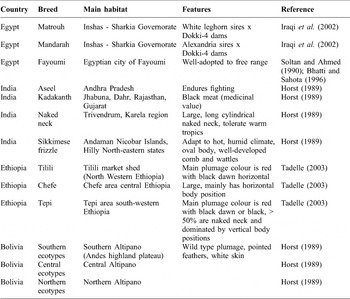
In most tropical countries, chicken populations are identified, described, characterised and reported as ecotype and/or breeds based on the agro-ecologies and the corresponding market sheds they inhabit. Geographical separation and criteria imposed by humans determine and influence this genetic divergence (Table 1).
Main habitats and special features of chicken breeds/ecotypes in the tropics.

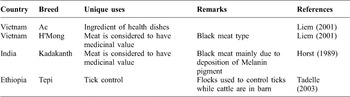
Marketing and the movement of poultry is the main cause of genetic mixing of chicken populations. This is why chickens from different regions or agro-ecologies or geographical barriers and markets tend to be more heterogeneous than chickens kept in a particular geographical location with a similar type of production system. Usually chicken ecotypes are named after the name of the region (agro-ecology) or local market (e.g. ecotypes of Horro and Tepi in Ethiopia) (Tadelle, Reference TADELLE2003). In addition there are ecotypes/breeds named after the major gene(s) they carry and major gene-related external characteristics (e.g. the naked neck and frizzle fowls in South Africa and India). Chicken populations can be also identified based on their special use and benefits (e.g. Ayam Bali of Indonesia, AC of Vietnam and Kadakanth of India) (Table 2). However, the system in Egypt is quite different. Egypt has well-developed breeds through long term crossbreeding and selection using local chicken populations as main foundation stocks (Hossary and Galal, Reference HOSSARY and GALAL1995). In some tropical countries there are no identified ecotypes and therefore, chicken populations are simply called indigenous, local, native etc. For example, in most Arabian countries native chickens are called ‘Balady’ which means native whereas native chickens in Malaysia and Indonesia are called Kampung, which means ‘countryside’ or ‘village’ (Horst, Reference HORST1989).
Unique uses of indigenous chicken ecotypes in some countries of the tropics.

Study results on the identification and performance of chicken ecotypes in the tropics have been reported by many authors (Nwosu, Reference NWOSU1979; Teketel, Reference TEKETEL1986; Horst, Reference HORST1989; Abebe, Reference ABEBE1992; Olori, Reference OLORI1994; Mafeni, Reference MAFENI1995; Van Marle-Koster, Reference VAN MARLE-KOSTER2001; Tadelle, Reference TADELLE2003). The focus of the majority of the characterisation studies were ecotype/breed identification followed by performance evaluation targeting growth and egg production related traits, and on determining immuno-competence levels. Existing studies generally attempt to evaluate the genetic potential of the indigenous birds under improved conditions of health care, nutrition and husbandry practices. This is without giving due emphasis to additional versatile uses and benefits of indigenous animals over the exotics. The majority of works tend to overlook behavioural and reproductive (e.g. broodiness) and other auxiliary traits, which are important under a village production environment.
Uses of indigenous chickens
Chickens are most widely known for their use as food (meat and egg), commercial products (feather products, vaccines etc.) and experimental animals in developed countries. However chickens in developing countries have more diverse uses and benefits to households. The use of indigenous chickens in the tropics varies from region to region and from community to community within a region (Table 2). In the tropics, smallholders keep chickens for their socio-religious functions. Plumage colour, sex, comb type, feather cover and age of bird are important criteria of selection for socio-religious functions. This is because the commitment of an individual/community to a particular spiritual being, deity or season and traditional and/or religious festivals are evaluated by the quality of the offering that satisfies special morphological features of the chicken demanded by the receiver.
Even though the majority of the characterisation works have been involving different chicken ecotypes/breeds from a single country, quite a few characterisation works included chicken breeds from different countries and even across continents (Horst, Reference HORST1989; Mafeni, Reference MAFENI1995; Van Marle-Koster, Reference VAN MARLE-KOSTER2001). In the later case, well-established and possibly unrelated breeds were used as a reference breed (meta-population) for performance comparisons (Tadelle, Reference TADELLE2003).
Phenotypic variation in chicken populations
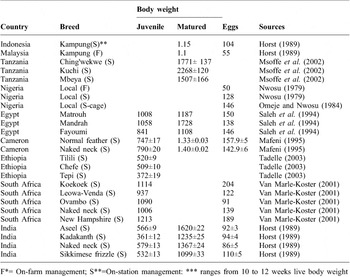
Wherever evaluation schemes were implemented, indigenous chicken breeds/ecotypes were found to be highly productive and large between- and within-breed variations were reported. The growth and egg production performance of ecotypes studied shows a large variation among different ecotypes. Remarkably some ecotypes show high performance. For example, a large variation in growth, egg production and other traits among individuals within ecotypes can be seen from high coefficients of variation (CV) observed within ecotypes (Table 3).
On-farm and on-station mean (s.e) juvenile (g) and mature body weight (kg) and egg number per year of some indigenous chicken breeds found in the tropics.

F*= On-farm management; S**=On-station management: *** ranges from 10 to 12 weeks live body weight
According to Hammond (Reference HAMMOND1999) large variations were common for most of the traits of locally adapted village poultry populations, with coefficients of variation (CV) ranging from 25 to 50%. This is much higher than the 5 to 15% CV's found in the high input production systems. However, in spite of these variations, on average tropical chickens have a low production rates, are small in size, show high variation in plumage colour and have better adaptation. The low production level of indigenous chicken in the tropics is explained both in their output and productivity compared to improved commercial egg and meat type breeds. Although local chicks are slow growers and poor layers of small sized eggs, they are, however, ideal mothers and good sitters (Tadelle and Ogle, Reference TADELLE and OGLE2001), excellent foragers and hardy (Teketel, Reference TEKETEL1986; Dorgham, Reference DORGHAM1989; Darwish et al., 1990) and posses natural immunity against common diseases (Mtambo, Reference MTAMBO2000). For example, the genetic resistance of native Egyptian breeds to very virulent infectious bursal disease virus (vvIBDV) and Newcastle disease virus (NDV) has been shown in two experiments. In the first experiment, birds from four breeds (Gimmizah, Sina, Dandrawi and Mandarah) were challenged with vvIBDV. The Mandarah chickens had the lowest mortalities (10%) compared to the Gimmizah, Sina and Dandrawi chickens (55%, 35% and 55%, respectively). In the second experiment, these four chicken breeds were challenged with virulent NDV. The Mandarah chickens again emerged as relatively resistant breed (20% mortality), whereas the Sina, Dandrawi and Gimmizah breeds were highly susceptible (showed 85%, 100% and 100% of mortality, respectively) (Hassan et al., Reference HASSAN, AFIFY and ALY2004). Moreover, Mtambo (Reference MTAMBO2000) from Tanzania reported that rural chicken ecotype showed resistance to Salmonella gallinaruem and typhoid infections under on-station management conditions.
The small body size of indigenous chickens is a desirable characteristic in tropical and sub-tropical environments. One of the most important positive characters of village chicken is their hardiness, which is the ability to tolerate the harsh environmental conditions and poor husbandry practices (climate, handling, watering, and feeding) without much loss in production. According to Dorgham (Reference DORGHAM1989) and Darwish et al. (1990), local Egyptian chickens are more tolerant to feed restrictions compared to Leghorn and New Hampshire. Teketel (Reference TEKETEL1986), after testing five indigenous ecotypes under practical conditions in Ethiopia, concluded that indigenous birds had special tolerance enabling them to sustain egg production despite increases in environmental temperature during their second year of laying, compared to White Leghorn. One of the most important fitness traits in village chickens is fertility. Teketel (Reference TEKETEL1986) from Ethiopia and Saleh et al. (Reference SALEH, EL-SAYED and HATTABA1994) from Egypt reported higher fertility rates of eggs from local chickens compared to eggs from White Leghorns. Moreover, unlike specialised chicken breeds for either egg or meat production, indigenous chickens of the developing countries are multipurpose. They have different morphological features, which can be seen as desirable traits. Feather cover, body positions and conformation vary among regions and counties. Differences in body conformation are particularly manifested in cockerels (Tadelle, Reference TADELLE2003).
Reports on indigenous ecotypes in the tropics showed that their potential for egg production and growth is very low under smallholder farmers’ management conditions. However, under improved feeding, housing and health care conditions, levels of production increased significantly (Table 3). The mean body weight gain of local chicken ecotypes from Ethiopia under on-station management at eight weeks of age was 212g (Tadelle, Reference TADELLE2003), which is more than the 157g average body weight gain under traditional management conditions in the central highlands of Ethiopia (Tadelle and Ogle, Reference TADELLE and OGLE2001). This indicates that improving the level of management can bring noticeable improvement in the growth performance of local chickens. Mixed sex local chicken ecotypes from Ethiopia had a mean body weight gain of 405g (range: 349 to 479g) for different ecotypes (Tadelle, Reference TADELLE2003), which is lower than the reported of Mafeni (Reference MAFENI1995) for Cameroon indigenous chickens (538g). However, it is higher than that report of Omeje and Nwosu (Reference OMEJE and NWOSU1984) for Nigerian chicken ecotypes (371g) and 351g for southern Ethiopian chickens at 12 weeks of age (Teketel, Reference TEKETEL1986). The AACMC (1984) reported that local cocks reach 1.5kg live weight at 6 months of age whereas hens have 30% lower body weight under smallholder farmers’ management condition in Ethiopia. However, cockerels were 36% heavier than their female contemporaries at 18 weeks of age under improved management (Tadelle, Reference TADELLE2003). Teketel (Reference TEKETEL1986) also found that local chickens reach 61% and 85% of White Leghorn body weight at 6 months and final body weight, respectively. Abebe (Reference ABEBE1992) reported that local birds in eastern Ethiopia attained 71.5% of White Leghorns weight at six months of age under improved management conditions. However, results from Nigeria showed that local ecotypes attained only about 33% of the body weight of the reference breed (Dahlem Red dual purpose breed) at all ages (Horst, Reference HORST1989). The study on Nigerian chickens’ gene pool proved differences in body weight and shank length between ecotypes from the north and southern regions of the country. The body weight and shank length of chicken originated from Kwara State was consistently higher compared to other ecotypes originated from other parts of Nigeria (Horst, Reference HORST1989). However, these two populations are simply called indigenous Nigerian chicken despite their variation.
Genetic improvement of tropical chickens
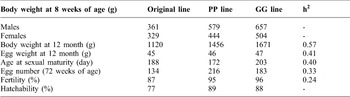
Only limited research has been reported comparing performance in the form of a structured breeding scheme which enables estimation of population genetic parameters, identification of performance levels and special traits. This can be also subsequently used in the evaluation of selective breeding schemes and testing the combining ability and level of heterosis from crossing of different indigenous chickens in the tropics. However, there are limited reports on structured genetic improvement programs for indigenous chickens in the tropics. These include work in Egypt, India and Nigeria. According to Hossary and Galal (Reference HOSSARY and GALAL1995) after long years of selection GG growth and PP egg production lines were developed. The performance test showed that both selected lines surpassed the Fayoumi flock in all productive and reproductive traits. Accordingly, egg number was improved by more than 60% without affecting egg weight, and the estimated heritability (h2) value showed that high genetic variation still exist and therefore, high response to selection could be expected (Table 4). As a result of these improvements the Fayoumi has been exported to different countries in the tropics including to Bangladesh, India, Vietnam, Pakistan and Ethiopia. This breed is claimed to have a wide range of adaptation and sustainable production under tropical and village conditions in many developing countries (Soltan and Ahmed, Reference SOLTAN and AHMED1990; Bhatti and Sahota, Reference BHATTI and SAHOTA1996). In India, Iyer (Reference IYER1950) worked on selection of local chicken strain called Desi, and he reported increase in annual egg production from 116 to 140 eggs per bird and egg weight from 43 to 49g after six generations of selection. The other attempt was made by Oluyemi (Reference OLUYEMI1979) in Nigeria and he reported an increase in the twelve week body weight of local chicks by 297g after seven years of selection. This large within and between ecotypes variation for traits studied is a useful genetic attribute where selection can be applied to improve production performance of indigenous chickens.
Performance of different strains of Fayoumi chicken breed in Egypt (Hossary and Galal, Reference HOSSARY and GALAL1995).

Conclusions and recommendations
Indigenous chicken ecotypes kept under smallholder conditions require a set of behaviour and reproductive traits to secure sustainable production. So far, little work has been done to conduct in depth study of local chickens under on-farm conditions. Under station conditions with different husbandry practices, these traits are difficult to assess or even, in some instances, chicken performances were depressed when managed under commercial farming practises. This can result in incomplete set of information that is misleading regarding the sustainable production ability of indigenous chickens under less intensive systems. The sustained use of indigenous chickens in the traditional or family poultry production system showed the need to consider the value of indigenous chickens. Therefore, a stratified on-farm analysis is required to appraise the needs and opportunities of the different production systems, for a realistic assessment of the economic value of these traditional traits. This is the main input to define breeding objectives that are appropriate for smallholder specific condition.
It is also important that international organizations like FAO and ILRI can take the lead in developing standard approaches for identification, characterisation and valuation of indigenous chicken genetic resources. Moreover, these organizations should be involved in the documentation and synthesis of published and unpublished research reports to support the identification and characterisation works that are intended to establish national chicken genetic resources conservation program. This effort needs to be further supported by the commitment to maintain live animals for detailed studies on disease resistance and control measures, performance recording under on-farm conditions and to estimate population genetic parameters.
The characterisation work has to include detailed descriptions of the physical environment and production system including the socio-cultural condition of the community. Moreover, traits, performance, flock structure, main uses, geographic distribution, qualitative and quantitative morphological features and population size need to be used as descriptor lists. This is important to make comparison among ecotypes and across regions. This can be also used as input for collaborative work among countries and regions and across continents for example to prioritize indigenous chickens in conservation programs.