Implications
Although the major source of eggs among poultry species is chicken, Japanese quail production is in development as an alternate source in numerous countries, owing to its fast growth and maturation. Yet, welfare issues in this species have not been a major concern compared with laying hens for example. Understanding how adding simple structural elements in their battery cages affect their growth and behaviour in different environments (undisturbed or exposed to negative daily events as in classic husbandry systems) will have implications in quail production in order to improve their welfare thanks to a behavioural rather than a genetic approach.
Introduction
Animal welfare is characterised by the absence of repeated negative emotions (e.g. pain or frustration) and by the presence of positive emotions (e.g. joy) (Boissy et al., Reference Boissy, Manteuffel, Jensen, Moe, Spruijt, Keeling, Winckler, Forkman, Dimitrov, Langbein, Bakken, Veissier and Aubert2007). Chronic stress and welfare are two interlinked concepts. Indeed, through the perception of repeated negative events, also called stressors, chronic stress can disrupt homoeostasis and induce physiological and behavioural alterations (Cyr and Romero, Reference Cyr and Romero2007). These behavioural modifications might be the first way animals cope with environmental challenges (Keeling and Jensen, Reference Keeling and Jensen2009). To alleviate stock breeding species’ chronic stress, genetic selection has been used to obtain animals adapted to their environment (e.g. Muir and Craig, Reference Muir and Craig1998). Hence, genetic lines of poultry have been created in order to decrease feather pecking or fear, or to increase social motivation (Minvielle et al., Reference Minvielle, Mills, Faure, Monvoisin and Gourichon2002). Previous studies evidenced that chronic stress had fewer effects on the fearfulness and hypothalamic–pituitary–adrenal (HPA) axis response of quail selected for their low level of fearfulness than on that of quail selected for their high level of reactivity (Calandreau et al., Reference Calandreau, Favreau-Peigné, Bertin, Constantin, Arnould, Laurence, Lumineau, Houdelier, Richard-Yris, Boissy and Leterrier2011; Laurence et al., Reference Laurence, Houdelier, Petton, Calandreau, Arnould, Favreau-Peigné, Leterrier, Boissy, Richard-Yris and Lumineau2012). Another way to reduce stress and to improve animal welfare is environmental enrichment (EE), that is to say, to adapt the environment to the animals’ behavioural needs instead of adapting the animals to captivity. By modifying animals’ captive environment with the aim of increasing its complexity and improving biological functioning (Newberry, Reference Newberry1995; Jones, Reference Jones1996), EE can be used to prevent, or for recovery from, induced behavioural disorders (Grigor et al., Reference Grigor, Hughes and Appleby1995; Meehan et al., Reference Meehan, Garner and Mench2004).
The term EE describes a large variety of environmental modifications (e.g. Newberry, Reference Newberry1995). Some can have particular effects, for example, foraging enrichment can increase activity and decrease stereotypic behaviour (e.g. Huber-Eicher and Wechsler, Reference Huber-Eicher and Wechsler1998) whereas structural elements (perches, dividers, covers) can reduce fearfulness (Buchwalder and Wechsler, Reference Buchwalder and Wechsler1997) or modulate social interactions (Newberry, Reference Newberry1995) thereby modifying an animal’s perception of its general environment. Taking quail’s behavioural characteristics into consideration, we added two enrichments in the cages. First, we placed visual barriers in order to decrease disturbance among birds (e.g. aggression or disruption of resting period) (Cornetto et al., Reference Cornetto, Estevez and Douglass2002). Moreover, this made the cage a more confined space, as quail both in the wild and in captivity prefer covered sites and decreased their flight behaviours in response to a frightening stimulus (Buchwalder and Wechsler, Reference Buchwalder and Wechsler1997). In addition, a piece of plastic grass was placed in each enriched cage to provide pleasant contact and enhance comfort behaviours such as scratching or dust bathing (Favreau-Peigné et al., Reference Favreau-Peigné, Calandreau, Constantin, Gaultier, Bertin, Arnould, Laurence, Richard-Yris, Houdelier, Lumineau, Boissy and Leterrier2014).
In quail, EE had a positive effect on immune parameters in stressed quail (Nazar and Marin, Reference Nazar and Marin2011). However, to our knowledge, the effects of EE on behavioural modifications induced by chronic stress have never been investigated in birds. Hence, this study is a fundamental basis for indication of ways to improve captive animals’ living conditions. Indeed, as stressful events cannot be totally eliminated in captivity, EE could emerge as a preventive therapeutic means to increase animal welfare. We used a Latin square design: with or without EE and with or without chronic stressors. This experimental design had two complementary goals: first, to assess the potential benefits of EE for Japanese quail housed in battery cages; second, to assess whether EE housing would alleviate CSP effects on the quail’s behaviours shown previously (Calandreau et al., Reference Calandreau, Favreau-Peigné, Bertin, Constantin, Arnould, Laurence, Lumineau, Houdelier, Richard-Yris, Boissy and Leterrier2011; Laurence et al., Reference Laurence, Houdelier, Petton, Calandreau, Arnould, Favreau-Peigné, Leterrier, Boissy, Richard-Yris and Lumineau2012). We hypothesised that EE would reduce fearfulness and thus decrease the impact of the stressors applied during the chronic stress procedure (CSP). During the treatment, all quail were observed in their home cage to evaluate potential modifications of their activity (Hawkins et al., Reference Hawkins, Morton, Cameron, Cuthill, Francis, Freire, Gosler, Healy, Hudson, Inglis, Jones, Kirkwood, Lawton, Monaghan, Sherwin and Townsend2001). At the end of the treatment, we assessed the quail’s fearfulness, defined as the propensity to be frightened more or less easily (Jones, Reference Jones1996), in an open field and an emergence test, two classic ethological tests for poultry evaluating their state of fear (Forkman et al., Reference Forkman, Boissy, Meunier-Salaün, Canali and Jones2007).
Material and methods
Animals and housing conditions
Animal care procedures were conducted in accordance with the guidelines set by the European Communities Council Directive (86/609/EEC) and French legislation on animal research. The regional ethic committee (CREEA: ‘Comité Rennais d’Ethique en Expérimentation Animale’) approved our protocol (agreement no. R-2011-SLU-01).
Our subjects were 58 female Japanese quails (Coturnix coturnix japonica) issued from a former cross between meat and egg-laying lines. Eggs were provided by the Pôle d’Expérimentation Avicole de Tours (UE PEAT, INRA, Nouzilly, France). They were incubated for 17 days in a collective incubator in our laboratory (38.5°C, 45% of humidity for 15 days and 65% of humidity for the last 2 days). After hatching, quails were reared in groups (males and females) of 30 chicks in cages with litter (93×45×32 cm). During the 2 weeks following hatching, cages were provided with two heating lamps (38±1°C) and a green light dimly (30 lux) lit the rooms during the night to help the chicks locate the heat source. After this period, the chicks were able to regulate their body temperature and ambient temperature was maintained at 19±2°C. When they were 17 days old their sex was determined relying on feather dimorphism, and males and females were then reared separately. Females were wing-tagged (classical tags for poultry, 115×8 mm, Union Franco-Suisse®) and transferred to individual battery cages (24.5×35×20 cm). There were no visual barriers in battery cages, thus juvenile quail could see, hear and interact with each other. Distress calls stopped within an hour after the transfer. Lights were on (230 lux) from 0800 to 2000 h (12 : 12 h light : dark cycle) during all the experiment. Water and food (high protein cereal diet in the form of mixed pellets for chicks and granulates for adults) were provided ad libitum. To eliminate the sex parameter only females were studied. Males were kept for another behavioural study. At the end of the experiment, stressed females were kept for another study and control females were used for reproduction.
EE
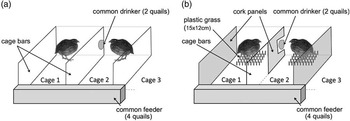
At the beginning of the CSP, 17-day-old females were placed in four batteries: two batteries for each group (control and treated). Batteries were placed in four distinct experimental rooms in a same hallway, CSP and control quail being at the two extremities of it, separated by several other experimental rooms. Each battery was composed of four rows, one on top of the other, of four individual cages, separated by bars (Figure 1a). This allowed visual and tactile interactions between quail in adjacent cages. Our enrichment consisted in the addition of several elements modulating quail’s physical and social environments. The cage bars of each enriched cage (Figure 1b) were entirely covered with a cork panel on one side, whereas the other side was only half covered. Thus, each quail had only one neighbour and the half cork panel provided a place for a quail to hide from its neighbour. Finally, a piece of plastic green grass (15×12 cm) was put on the cage floor in the rear. Plastic grass can be used for dust bathing and both plastic grass and cork panels can be used as an exploration substrate. Half of the rows of all the batteries were enriched, alternating with non-enriched rows. To counteract possible interactions between height of the cages in the battery and EE, the first and the third rows were enriched in one battery whereas the second and the fourth rows were enriched in the other battery.
Two-dimensional views of cages. (a) Non-enriched cages and (b) environmental-enriched cages.

CSP
CSP began when the quail were transferred to the batteries (post-hatching day 17) and lasted for 14 days (until post-hatching day 31). It was applied to half of the subjects (two rooms, treated group) whereas the other half (the two other rooms, control group) was left undisturbed, but the experimenter visited them regularly. The CSP consisted of nine stressors applied randomly, during both night and day, with variable durations (from 2 to 180 min). This reduced the possibility of habituation to the stressors as unpredictability is known to induce stress reactions in domestic fowl (Jones, Reference Jones1996). The stressors used were adapted from validated studies of rodents (Willner, Reference Willner1997) and quail (Guibert et al., Reference Guibert, Richard-Yris, Lumineau, Kotrschal, Bertin, Petton, Möstl and Houdelier2011) and induce behavioural and/or physiological changes. Five stressors were applied individually: a metal stick was briskly scraped laterally on cage rods twice, row by row in a random order each time (noise and suddenness); a novel object (e.g. a tiny flag) was agitated inside the cage through the door (novelty and suddenness) for 10 s once per cage; air or water (at ambient temperature) were sprayed (two jets directed at the quail) twice in 30 min; quail’s movement were restricted by placing them behind a rectangular piece of wood in a corner of their cage. This physical restraint only prevents locomotion in the cage, and behind this device, quail could still turn around and observe their environment as permitted by the low height of the device (surface available during physical restraint: 68 cm²). The duration of the restraint varied between 30 and 50 min, in order to increase unpredictability: when quails were 20 days old and 23 days old the restraint lasted 30 min; then a 40-min contention was applied 4 days later and a 50-min contention on the last day of CSP. This increase in duration was meant to avoid predictability of this stressor. Four other stressors were applied to the entire battery: balanced movement for 2 min (by rolling the battery back and forth ~5 cm), three times in 30 min; ventilators starting automatically and repeatedly for 5 to 15 min at night; food accessibility delayed by placing transparent devices on the troughs just before daytime, for 3 h; unexpected sounds (100 dB – with a dominant frequency comprised between 605 and 3112 Hz) lasting 4 s three times in 2 to 10 min, night and/or day. This last stressor was composed of three different sounds, none having any biological signification for quail. We also applied two social stressors: quails were moved to another cage in the same battery in order to change their neighbours. This procedure was applied twice during the CSP (on days 5 and 9). Moreover, for 1 h, a quail was put in the home cage of another quail, within the same battery. Thus, two non-familiar quails were put together in one individual cage of the battery. This social stressor was applied twice during the CSP (on days 8 and 12), so that each quail was once the resident, and once the intruder.
To differentiate the experimenter from the caregiver, the experimenter dressed in white (gown) and blue (mask, gloves and shoes) when stressors were applied, otherwise she was dressed in green (i.e. observations and care giving).
A total of 12 control quails were housed in standard cages (non-EE control quail) and 16 control quails were housed in enriched cages (EE control quail). A total of 16 treated quails were housed in standard cages (non-EE treated quail) and 14 treated quails were housed in enriched cages (EE treated quail).
BW and sexual development
The subjects were weighed seven times: once a week from the beginning of the CSP until 40 days after the end of the CSP (CSP+40). Their sexual development was controlled by measuring the width of their cloacal vent (Adkins, Reference Adkins1973) once a week from CSP+7 until full sexual development (CSP+35). The same trained person carried out all these morphological measures.
Quail’s activity in their home cage
Time budgets were evaluated on the 6th, 8th, 10th and 14th day of the CSP, alternatively during the morning and the afternoon. When no stressor was applied, the instantaneous scan sampling method was used to assess the control and experimental quail’s activity. The experimenter stood upright and motionless in the open doorways alternatively, in the dark at >2 m from the cages for 2 h (16 scans/quail). The following behaviours were noted: resting in a low posture (feet not visible), resting in a lying posture (lying on one side, on the cage floor), comfort behaviours (i.e. preening, stretching/scratching body parts), food-directed behaviours (drinking, feeding and foraging), exploring cage (i.e. pecking at different cage elements except feeder and drinker) and stereotypic pacing (i.e. walking along the same side of the cage, repeatedly and rapidly, with abnormal head movements).
Fearfulness tests
At the end of the CSP (31-day-old quail), chronic stress and cage type effects on fearfulness were assessed by two classical ethological tests for poultry revealing different aspects of this behavioural trait. These tests took place from CSP+2 days to CSP+6 days, during a whole day for each test. To avoid any bias owing to the moment of the day, quails from each group were tested alternatively.
Open-field test
Quails were placed individually in the centre of a cylindrical arena (ø=120 cm, H=70 cm) on a linoleum floor, in the dark. Then the light was switched on in the arena and all behaviours were recorded for 5 min by an experimenter hidden behind a one-way mirror. First distress call and first step latencies were noted. The number of steps was noted, as well as exploration activities (pecking the floor or the walls) and fear behaviours (crouching, freezing, trembling, running, jumping, defecation).
Emergence test
We followed a protocol similar to that described by Mills and Faure (Reference Mills and Faure1986). A quail was taken out of its cage and put in a small dark wooden box (emergence box: 18×18×18 cm) placed at the entrance of a larger brighter cage (emergence cage: 62×60×33 cm) with a glass front and wood shavings on the floor. The emergence box remained closed for 1 min. During this time, the latency of the first contact call and the number of these calls were recorded. Then the emergence box was opened and the quail was allowed 3 min to emerge into the emergence cage. The latency to leave the emergence box (head, first foot, entire body) and the latency of the first contact call were noted. When the subject was in the emergence cage, its behaviour was recorded continuously for 3 min. The following parameters were noted: locomotor and distress call latencies, number of distress calls, fear behaviours (see the ‘Open-field test’ section) and comfort behaviours (preening, scratching litter, dust bathing). Latencies to emerge from the box are related to fearfulness: the more emotive an individual, the longer it takes to leave the box (Jones, Reference Jones1987). Other types of behaviour observed in the emergence cage are also indicators of fearfulness (i.e. preening and dust bathing are positive markers whereas fear postures and escape attempts are negative markers). Finally, latency to call conspecifics and number of distress calls are indicators of social reinstatement of quail, but this is modulated by fear of the novel environment, which inhibits vocal activity (Forkman et al., Reference Forkman, Boissy, Meunier-Salaün, Canali and Jones2007).
Statistical analyses
First, Kolmogorov–Smirnov tests determined whether residuals were normally distributed. Activity rates data were subjected to arcsine square root transformation and a logarithm transformation was applied to cloacal width, latency to explore the ground, number of fear behaviours and steps per seconds in order to fit a normal distribution. Home cage activities were analysed by week, using two-way on repeated measurements between the 2 weeks (two observation sessions per week) ANOVA (CSP×cage type×week). Fearfulness tests data were analysed by two-way ANOVAs (CSP×cage type) and post hoc LSD Fisher tests, using Statistica software (Statsoft®). The level of significance was set at P⩽0.05. Data are represented as means±s.e.m.
Results
BW and sexual development
Neither CSP nor cage type significantly influenced BWs during the experiment (ANOVA on repeated measures, CSP: P=0.68, cage type: P=0.40, CSP×cage type: P=0.47, measures×cage type: P=0.81, measures×CSP: P=0.12, measures×CSP×cage type: P=0.78).
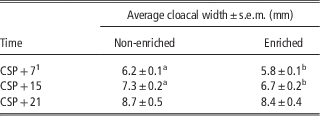
We evidenced no effects of CSP or interaction between cage type and CSP on sexual development. However, cage type influenced the sexual development of quail 1 week (CSP+7) and 2 weeks (CSP+15) after the treatment, but this effect was no longer significant 3 weeks after the end of the treatment (CSP+21). The cloacal vent widths of EE quail were smaller than those of non-EE quail (Table 1).
Effect of cage type on quail’s sexual development after CSP

CSP=chronic stress procedure.
1 CSP+X: X days after the end of the CSP.
a,b P<0.05.
Quail’s activity in their home cage
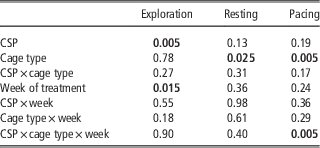
P-value of main factors and their interactions are summarised in Table 2.
Main factors and interactions P-values for exploration, resting and pacing in the home cage during the 2 weeks of treatment

CSP=chronic stress procedure.
Bold indicates significant P-values (P<0.05).
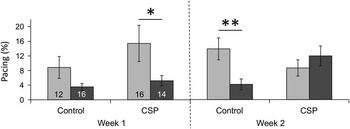
On the one hand, CSP had a significant effect on exploration behaviour as treated quail explored less their home cage (whether enriched or not) than control quail (mean percentage of scans±s.e.m., week 1, control quail: 6.0±0.9, treated quail: 3.9±0.8; week 2, control group: 9.3±1.2, CSP group: 5.5±1.2). On the other hand EE had a significant effect on resting, as quail housed in enriched cages (whether stressed or not) rested more than quail housed in standard cages (week 1, non-EE quail: 33.5±2.6, EE quail: 42.9±2.4; week 2, non-EE quail: 30.5±2.2, EE quail: 34.4±3.0). Finally, there was not only an effect of the cage type on pacing (quail housed in an enriched cage paced globally less) but also a significant interaction between CSP, cage type and the week of treatment (Figure 2). After 1 week of treatment, EE/stressed quail paced significantly less (LSD Fisher test, P=0.01), whereas this behaviour was maximum in the non-EE/stressed quail. By contrast, after 2 weeks of treatment, EE significantly decreased pacing in control quail (P=0.002), but not in stressed quail (P=0.43).
Stereotypic pacing in the home cage (mean per cent of scans±s.e.m.) during the 1st and 2nd weeks of the CSP. Post hoc LSD Fisher tests: *P⩽0.05, **P<0.01. Light grey: non-enriched cages, dark grey: enriched cages. Number of quails per group are indicated on the bars. CSP=chronic stress procedure.

Fearfulness tests
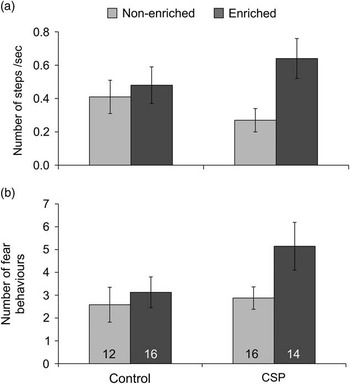
Cage type influenced quail’s fearfulness in the open-field arena: the locomotor activity of EE quail was significantly greater than that of non-EE quail (P=0.04, Figure 3a) and EE quail displayed significantly more fear behaviours (P=0.05, Figure 3b). CSP tended to increase the number of fear behaviours (P=0.07, Figure 3b). Numbers of vocalisations and exploration behaviours were not influenced by either of the tested factors (vocalisations, CSP: P=0.32; cage type: P=0.39; interaction: P=0.51; global mean: 1.3±0.1; exploration, CSP: P=0.31; cage type: P=0.76; interaction: P=0.13; global mean: 0.8±0.04).
Open-field activities. (a) Locomotion (mean step rate±s.e.m.) where P=0.04 for cage type (NE v. EE) and (b) fear behaviours (mean number±s.e.m.) where P=0.05 for chronic stress procedure (control v. CSP). Number of quails per group are indicated on the bars in b. CSP=chronic stress procedure; NE=non-enriched environment; EE=environmental enrichment.

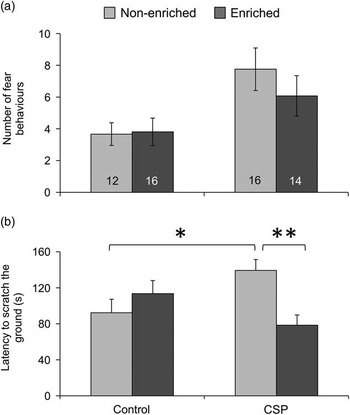
In the emergence test, neither CSP nor cage type modified the latency to leave the emergence box (cage type: P=0.24; CSP: P=0.89, interaction: P=0.88, global mean: 12.5±3.8) or the number of vocalisations (cage type: P=0.51; CSP: P=0.16, interaction: P=0.84, global mean: 2.4±0.6). However, once in the novel environment the quail’s behaviour depended on the factors tested. First, CSP increased the quail’s reactivity in the emergence test. Indeed, CSP quail expressed significantly more fear behaviours (P=0.008, Figure 4a). Second, we evidenced a significant interaction between cage type and CSP for the latency to express comfort behaviours (latency to scratch the ground: cage type: P=0.66; CSP: P=0.15; interaction: P=0.003, Figure 4b). On the one hand, CSP significantly increased non-EE quail’s latency to express comfort behaviours (LSD Fisher tests, P=0.02), whereas CSP had no significant effects on this behaviour of EE quail (P=0.28). On the other hand, EE significantly decreased the latency of treated quail’s comfort behaviours (P=0.001).
Emergence test activities. (a) Fear behaviours (numbers mean±s.e.m.) and (b) latency to scratch the litter (in seconds mean±s.e.m.). Post hoc LSD Fisher tests, *P⩽0.05, **P<0.01. Number of quails per group are indicated on the bars in a.

Discussion
The present study evidences that chronic exposure to stressors increases quail’s fearfulness as indicated by enhancement of their reactivity to novel environments. Spontaneous behaviours in the home cage were mainly influenced by cage type. However, the emergence test revealed that CSP effects were alleviated when chronically stressed quail were housed in EE cages. Finally, our CSP did not influence quail’s growth or development, but EE delayed their sexual maturation at the beginning of their development.
BW and sexual development
BW was influenced neither by CSP nor by cage type. However, our protocol did not aim to induce strong effects similar to depression-like states and our treatment was only applied when quails were 17 to 30 days old. Nonetheless, we observed a difference in the females’ cloacal vent width between cage types at the beginning of their sexual development. Cork panels in the enriched cages provided an area to be isolated. Interactions between Japanese quail females impact on their sexual maturation (Guyomarc’h and Guyomarc’h, Reference Guyomarc’h and Guyomarc’h1984). The quantity of interactions between females is positively related to their sexual development under stimulating photoperiodic conditions. In the present study, quail reared in non-enriched cages had no choice but to interact with the other females in the same battery row, and this could explain their faster development.
Activity in the home cage
CSP and EE both influenced quail’s activity in their home cage. On the one hand, CSP decreased exploration, which could have welfare implications. Indeed, exploration accounts for a large proportion of quail’s daily activity as for other domestic species, and modification of this activity rate can be used as a welfare indicator (Wood-Gush and Vestergaard, Reference Wood-Gush and Vestergaard1989). On the other hand, EE quail spent longer time resting and less time pacing. This could be owing to the cork panels that prevented EE quail from being disturbed by their neighbours (Cornetto et al., Reference Cornetto, Estevez and Douglass2002). Furthermore, EE quail’s increase of resting rate might be a consequence of the cork panels inducing a lower vigilance state. Moreover, the presence of cork panels might have prevented social facilitation of stereotypic behaviour for EE quail. Indeed, reports show that individuals of several species housed next to others performing stereotypies increased their stereotypic activities (e.g. Zeltner et al., Reference Zeltner, Klein and Huber-Eicher2000). Our cork panels used to enrich the cage provided a dim zone at the rear of the cage where quail can rest, whereas the feeder was at the front of the cage and brightly lit. This kind of environment is supposed to improve poultry welfare (Davis et al., Reference Davis, Prescott, Savory and Wathes1999; Moura et al., Reference Moura, Nääs, Pereira, Silva and Camargo2006) but contrary to that currently recommended to poultry stock breeders that specifies a minimum light intensity but does not take into consideration a variation of light intensity inside the facilities (Moura et al., Reference Moura, Nääs, Pereira, Silva and Camargo2006).
Furthermore, EE had a beneficial effect on the quail’s stereotypic behaviours, as indicated by EE quail’s low level of pacing. Indeed, the fact that standard battery cages are very barren, with reduced possibilities for quail to isolate themselves from environmental stimuli can explain non-EE quail’s high level of stereotypic pacing, an indication of poor welfare (Broom, Reference Broom1991). Nonetheless, after 2 weeks of chronic stress treatment, the effect of EE on pacing was weaker and there was an interaction between cage type and CSP. During the 2nd week of CSP, EE had a beneficial effect on control quail, but EE treated quail paced as much as EE control quail despite cage enrichment. Thus, after 2 weeks of CSP, which is known to increase stereotypic behaviours (e.g. Wiepkema and Schouten, Reference Wiepkema and Schouten1992), CSP seemed to have stronger effects than EE. Although EE decreased time spent stereotypic pacing after 1 week of treatment, EE was not sufficient to modulate the effect of chronic stress treatment after 2 weeks of treatment. Altogether, the decrease of pacing and the increase of resting suggest that EE improved the welfare of quail housed in battery cages. Surprisingly, our results did not evidence an increase of pacing by quail exposed to CSP. As stated above, this effect may have been masked as in a barren environment control’s quail pacing rates were already high.
Fearfulness tests
Globally, the quail’s reactivity to fearful situations was influenced by both cage type and treatment. Treated quail displayed more fear behaviour and less comfort behaviour than did control quail in the emergence test and CSP also tended to increase fear behaviour in the open-field test. So, in agreement with mammal and bird literature, CSP increased the fearfulness of quail confronted to novel and stressful situations (Marin et al., Reference Marin, Cruz and Planeta2007; Calandreau et al., Reference Calandreau, Favreau-Peigné, Bertin, Constantin, Arnould, Laurence, Lumineau, Houdelier, Richard-Yris, Boissy and Leterrier2011). Furthermore, in the open-field test, EE increased fearfulness. Indeed, EE quail’s locomotor activity was greater and they expressed more fear behaviours than did non-EE quail, indicating a higher fearfulness. General activity during an open-field test is generally inversely correlated with fearfulness. Quail that remain silent and stay still are considered to be more fearful than quail that vocalise and explore actively in this novel environment, the quail appears then to be using a passive strategy to confront the situation (Mills and Faure, Reference Mills and Faure1986; Forkman et al., Reference Forkman, Boissy, Meunier-Salaün, Canali and Jones2007). However, reports show that high levels of locomotion can also reflect high fear levels in the arena, individuals using in this case an active response strategy (escape behaviour and/or active search for conspecifics) (e.g. Jones and Merry, Reference Jones and Merry1988). Compared with the home cage, the open-field arena could be more stressful for quail that were habituated to a cage with cork panels providing hiding places and thus protection from some stressful events (e.g. aggression, suddenness). In fact, structures, such as cover or shelter, may have different welfare effects depending on environmental contexts inside and outside the home cage. They may make birds less reactive or less nervous in some situations in their familiar environment but on the contrary, leave them open to experiencing acute stress when exposed to novel situations (Collins et al., Reference Collins, Archer and Barnard2008).
By contrast, EE alleviated chronic stress effects on the comfort behaviours expressed in this test. Although chronic stress impacted on non-EE quail’s latency to express comfort behaviours, this was not so for EE quail. CSP increased quail’s, especially non-EE quail’s, fearfulness as indicated by the increased number of comfort behaviours. Furthermore, EE alleviated these effects as EE quail presented shorter latencies before scratching the litter and treatment effects on the number of comfort behaviours were absent. Thus, we conclude that EE impaired the effects of chronic stress on fearfulness in this test. The different effects of EE in the open field and in the emergence test highlight the multidimensional aspect of fear in quail as demonstrated by previous studies (Mignon-Grasteau et al., Reference Mignon-Grasteau, Roussot, Delaby, Faure, Mills, Leterrier, Guémené, Constantin, Mills, Lepape and Beaumont2003). Amazon parrots in enriched environments approached a novel object quicker, but familiar handlers later, than did parrots in non-enriched environments, illustrating different motivation states towards different stimuli (Meehan and Mench, Reference Meehan and Mench2002). Thus, a given enrichment can have different impacts revealed by different test situations, as our study evidences.
We had hypothesised that EE would reduce Japanese quail’s fearfulness following 2 weeks of stress treatment. Emergence test data supported our hypothesis as EE alleviated chronic stress effects on comfort behaviour. However, EE quail’s fear responses were higher in the open-field test. Miller and Mench (Reference Miller and Mench2005) evidenced that structural enrichment increased Japanese quail’s activity but decreased pacing, while having only a limited effect on fear responses in a surprise predator test. Similarly, Collins et al. (Reference Collins, Archer and Barnard2008) found no effect of cover in the home cage on Zebra finches’ (Taeniopygia guttata) reactivity to humans. In the present study, EE increased resting and decreased stereotypic pacing in the home cages and fearfulness in the emergence test. Moreover, EE alleviated some of the CSP effects on behaviour. During the 1st week of treatment, pacing was decreased in EE stressed quail. These results led us to conclude that EE improved welfare, even though it was not sufficient to counteract CSP alterations after 2 weeks of treatment. This could be owing to the increased intensity of our procedure. In fact, physical restraint increased at the end of the treatment to avoid habituation to this stressor. Furthermore, EE decreased fearfulness of CSP quail in one of the two fearfulness tests. Globally, our results allow us to hypothesise that EE decreased quail’s fearfulness and thus alleviated their sensitivity to the stressors applied during the CSP (Widman et al., Reference Widman, Abrahamsen and Rosellini1992) and subsequently decreased its impact. Moreover, EE could also have increased quail’s controllability of their environment. This could have then induced a decrease of treatment effects (Chamove, Reference Chamove1989; Van de Weerd et al., Reference Van de Weerd, Aarsen, Mulder, Kruitwagen, Hendriksen and Baumans2002). Actually, in addition to foraging and dust-bathing material, we provided panels that created a shelter at the rear of the cage. This could have diminished the effects of certain stressors. Finally, another hypothesis is that treatment affected EE as much as non-EE treated quail, but that their coping strategies could differ in stressful situations, as shown by reports for other captive bird species (Hawkins et al., Reference Hawkins, Morton, Cameron, Cuthill, Francis, Freire, Gosler, Healy, Hudson, Inglis, Jones, Kirkwood, Lawton, Monaghan, Sherwin and Townsend2001).
Conclusion
To summarise, some of our results indicate that quail’s welfare were improved after being housed for 2 weeks in an enriched environment, and that in particular stereotypic activities decreased. Moreover, we are the first to show that negative chronic stress effects on fearfulness expressed by quail in their home cage and in a novel environment can be alleviated by enrichment. However, these effects depend on test conditions and therefore question the complexity to be used to improve animal welfare. The next stage of this study is to evaluate the alleviating effects of EE applied after the CSP. Although EE cannot always be easily implemented (e.g. cost, practicality for caregivers or biosecurity), these applied ethology results are essential to help improve captive animals’ welfare. Indeed, whereas the current tendency is to alleviate bad welfare by administrating antidepressants, especially to pets, behavioural strategies, like EE, should be considered first.
Acknowledgements
This work was supported by the French National Research Agency, program Emofarm (ANR-09-BLAN-0339). The authors are thankful to Dr Ann Cloarec for improving the writing of the manuscript and C. Petton for maintenance of our quail.