INTRODUCTION AND CONTEXT
Although The Gambia is the smallest country on the African continent, per capita it ranks among the highest contributors to irregular migrants who make the journey across the Mediterranean (The Economist 2016). Images of dramatic arrivals and rescue operations on the high seas have spread moral panic about invasion as well as humanitarian pleas to address the situation. This research documents the stories of a cross section of Gambian society, to better understand the deep roots of the ‘backway’ phenomenon. If people want to migrate from West Africa to Europe, they often have to depend on illegal (otherwise referred to as irregular or clandestine) activities and on human smugglers, since the official (or legal) ways to reach Europe are limited and difficult to gain access to. Primarily youth, they risk their lives on routes from West Africa through the desert to Libya; from Libya they get into overloaded boats that will take them to Italy and other parts of Europe. They all know that there are risks and they could lose their lives, but they still do it, or want to do it, because of the pressures they are facing at home and the successes they have seen by those who have landed on the shores of Europe. It is important to emphasise that although the popular media might have us think otherwise, it is ‘highly misleading to characterise migration from Africa as an exodus from Africa or an invasion of Europe and other destination countries’ as levels remain comparatively low in the international migration context (Flahaux & de Haas Reference Flahaux and de Haas2016: 22). This research asks the question: What motivates the Gambian youth to leave everything they know to confront the trek towards becoming ‘illegal’?
It has been estimated that some 10–15% of all global migrants are undocumented, with an increase expected in the coming years (Mbaye Reference Mbaye2014: 2). The majority of academic studies of such migration experiences come from Mexico–USA, with relatively few of Africa–Europe. Those studies from the African continent tend to be limited to better-researched countries such as Morocco, Senegal, Ghana and South Africa (Flahaux & De Haas Reference Flahaux and de Haas2016: 3).
‘Given the tremendous suffering caused by increased migration policing and the seriousness of this ongoing humanitarian catastrophe, scholars should approach the next step of this research agenda with great urgency’ (Mainwaring & Brigden Reference Mainwaring and Brigden2016: 258). In addition to the pressing need for more in-depth understanding of the motivations for movement within the West African region, and The Gambia specifically, significant questions and gaps in the migration literature remain. This is curious, given the societal and humanitarian crises that have recently been unfolding. Until the 1980s and 90s, approaches to migration largely focused on the obvious socioeconomic and political drivers of movement. This perspective continues to dominate the public discourse. While these remain important drivers of human movement, it has been argued that there is a pressing need for the literature to be complemented by culturally and historically sensitive accounts shedding more light on the causes and repercussions of these migratory processes (Graw & Schielke Reference Graw and Schielke2012: 9). Gambians are now Europe's second-largest diaspora as a share of the home-country population (UNHCR 2016; World Bank 2018). Establishing a deeper understanding of the motives of Gambians on the move, or desiring to move, would therefore be an important addition to the migration literature, and a critical theme in contemporary Africa. As this article will illustrate, the significance of the Gambian ‘backway’ is more than a description of the complexity of migration aspirations. Better understanding of what Gambians aspire to is pertinent migration management, with decision-makers and NGOs benefitting greatly from understanding the context within which Gambians endeavour to reach capabilities to leave.
THE GAMBIA
Situated on the west coast of the continent, and sandwiched to the north and south by Senegal, The Gambia stretches 450 km along the Gambia River. The country has a population of 2 million, with a high growth rate of 2.8% per year over the past decade. A remarkable 57% of the population is aged 24 and under (CIA 2018). It is one of the more densely populated countries on the continent. Most of the population, however, is concentrated in the urban and peri-urban centres (57%) (World Bank 2018). It is one of the poorest countries in the world, with a Gross National Income of less than US$500 per capita (World Bank 2013). As such, many people do not have the capacity to meet their basic needs and rights in terms of food, health care and education. More than half the population lives under the poverty line (less than $2/day), unemployment rates are over half the population with even higher rates among the younger demographic (UNDP 2016, as cited in MGSoG 2017). There are few opportunities for employment, especially in the rural areas, and many families rely on ineffective family farms. Beyond agriculture, the country largely depends on tourism and remittances, the latter accounting for as much as 22% of the country's GDP (IFAD 2016: 22), one of the highest on the African continent. For those fortunate enough to have formal employment, income rates are so low as to still make it nearly impossible to make ends meet. Slow economic growth, limited employment opportunities and food insecurity has driven a dramatic increase in emigration (World Bank 2018).
The Gambia under former dictator President Jammeh (1996–2017) was corrupt and the country moved towards economic despair. The democratically elected Barrow government now has a country that is bankrupt, with soaring unemployment and dysfunctional labour markets, that it will have to move forward (Zanker & Altrogge Reference Zanker and Altrogge2017: 2). The new government has spoken positively and optimistically about the change in government leading to changes in migration: ‘the change in context from a dictatorship to a democracy will encourage people to remain and pursue their interest’ (Isatou Touray, Gambian Minister of Trade, Regional Integration and Employment, as cited in Dempha et al. Reference Dempha, Nambwira, Jallow and Secka2017). This is not at all what the average Gambian was saying, however.
ABOUT THE ‘BACKWAY’
There has been a long history and complex ‘culture’ and tradition of regional migration in West Africa, which spans close to 20 centuries (Kebbeh Reference Kebbeh2013: 1; Willems Reference Willems2014: 320; Zanker & Altrogge Reference Zanker and Altrogge2017: 3), largely due to its geographic location, drawing international trade and the movement of people throughout history. Intercontinental migration, however, was relatively new to the mid-latter part of the 20th century, beginning as a privilege that only the minority of the population could embark upon. It now has become one of the most success-promising strategies in the country (Kebbeh Reference Kebbeh2013; Zanker & Altrogge Reference Zanker and Altrogge2017: 3). In the 1990s through early 2000s, Gambians most often chose to reach Europe via a sea route to the Canary Islands. This peaked in 2006, when more than 30,000 African migrants arrived in the Canaries, 12% of which were Gambians. The large number of would-be migrants landing on the shores of Spain took Europe by surprise (Gaibazzi Reference Gaibazzi2015: 1). With the heavy and increased attention and surveillance on the waters off the coasts of Senegal and The Gambia, and the onset of the global economic crisis late in 2007, migrants turned their attention to the land (Kebbeh Reference Kebbeh2013: 5). The most common route since the mid-2000s has been the backway from Gambia through Senegal, Mali and Niger into Algeria or mostly Libya. From Libya, the journey continues on to Italy and the rest of Europe (Embiricos Reference Embiricos2016; Zanker & Altrogge Reference Zanker and Altrogge2017: 4).
Since the early 2000s, migration from The Gambia has risen dramatically. In the 1970s, most Gambian migrants (90%) went only as far as Senegal (Hultin et al. Reference Hultin, Jallow, Lawrance and Sarr2017: 337). But by the early 2000s, researchers were sounding the alarm bells regarding the backway: ‘Trafficking in illegal migrants, hitherto a rare phenomenon, is on the increase as young people are now involved in evasive, risky ventures to gain entry into fortressed Europe’ (Adepoju Reference Adepoju2003: 38).
The trek is costly, and many families sell land or other valuable properties to send one family member the backway; a journey that involves human smugglers (Strand Jagne Reference Strand Jagne2014: 14). With language like ‘Africa has never seen such a flood of young men heading for Europe’ (Washington Post 2015), there is little surprise that there is so much push-back from European nations, compelled by their voting citizens to do something about the problem. The numbers aren't insignificant: the number of migrants crossing by sea to Italy nearly quadrupled from 2013 to 2014, reaching about 170,100. The Gambia is a big contributor to those figures (Washington Post 2015). For its size, The Gambia is experiencing a disproportionate number of people leaving the country; among the top five in the International Organization for Migration's league of the six main nationalities identified attempting to cross the Mediterranean from Libya to Italy (Hunt Reference Hunt2015). Although it is inherently difficult to track statistics of clandestine migrants (Carling Reference Carling2016), and there are few recent data into and out of The Gambia, available data indicate that irregular migrants from The Gambia constitute a significant proportion of those travelling to Europe. The UNHCR ranks The Gambia fourth as a country of origin, with other studies ranking it fifth (e.g. MGSoG 2017).
‘Humans are a migratory species. It is hardly surprising, therefore, that migration is being widely used by people today to adapt to the unequal distribution of risks and opportunities that prevail in the contemporary world’ (Donato & Massey Reference Donato and Massey2016: 8). Today, unskilled West Africans are generally considered a social burden that must be barred from entry, not only in Europe, but in most Western destinations (Jonsson Reference Jonsson2008: 4; Parkes Reference Parkes2017). ‘Some observers have argued that the recent intensified suffering along transnational migration routes that cross the globe constitutes the worst migration crisis since the end of WWII’ (Mainwaring & Brigden Reference Mainwaring and Brigden2016: 243). Given the alarming background in relation to the backway, there has been relatively little research on the Gambian clandestine migration – exceptions include Uggla (Reference Uggla2015), who focused only on those who made unsuccessful attempts and Zanker & Altrogge (Reference Zanker and Altrogge2017). There has been more written about Senegalese migrants (Andersson Reference Andersson2014; Mbaye Reference Mbaye2014), but although The Gambia and Senegal do have shared histories and cultures, their migrant stories are unique. No one has previously set out to understand the perspective of Gambians from all sectors of society on the backway ‘syndrome’ until this study. As Bal & Willems (Reference Bal and Willems2013: 250) stated, even though more people than ever before are either on the move, or thinking about themselves or their children moving, this phenomenon has received comparatively little academic attention.
METHODOLOGY
Fieldwork data were collected in January and February 2018. The researcher's ability to speak one of the predominant local languages (Mandinka), as well as long-term connections to the country and culture, and family connections, made accessing individual stories and communities easy. The data consisted of field notes and transcripts of semi-structured interviews. Informants comprised a large and varied group of people, all of whom were interviewed and/or participated in group discussions. Informants were recruited through several independent snowballing chains. Interviews lasted up to two–three hours, taking place in English, the official language of The Gambia, but with some in Wollof and in Mandinka. Local languages and introductions were also made for establishing relationships and interacting in group settings. All interviews were recorded, with the consent of the interviewees. Individuals from a wide cross section of Gambian society were interviewed; young and old, male and female, urban and rural. I had both private conversations with individuals and general discussions with groups. A narrative approach was utilised, drawing on narrative theory, and using semi-structured interviews, which provided the opportunity for interviewees to indicate what themes and issues were important to them. A cross-sectional analysis was undertaken upon completion of the fieldwork, where the interviewees’ narratives were compared and contrasted to find similarities and patterns, in order to construct a common narrative.
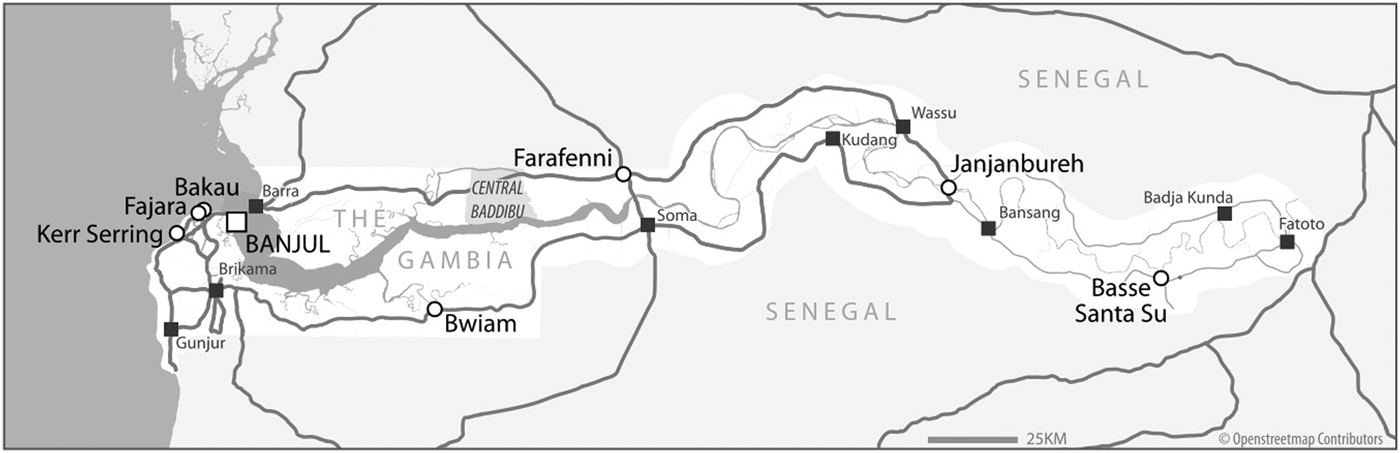
Similar to Bal & Willems (Reference Bal and Willems2013: 254), the research started from the premise that a comprehensive study of Gambian irregular migration need not directly relate to migrant successes. I conducted interviews and had discussions both with individuals and groups who had made attempts to go the backway, and those who had not, but all of them knew of it and had personal experiences with friends or family members. Some interviews were held with relevant NGOs and government officials and agencies. In excess of 24 individual and group interviews were held at a variety of locations in The Gambia (Figure 1). In total, 93 individuals were interviewed and participated in the study.
Location of interviews across The Gambia, West Africa.

THEORETICAL FRAMEWORK: MIGRATION
An understanding of Gambian irregular migration involves much more than the concepts of push and pull factors that have been a traditional mainstay in the migration literature. Scholars have challenged conventional push-pull models by arguing that, particularly in poor societies, development increases rather than decreases levels of migration. In addition, it is important to move beyond images of African migrants as objects ‘passively pushed around by external “push” factors such as poverty, demographic pressure, violent conflict or environmental degradation’ (Flahaux & de Haas Reference Flahaux and de Haas2016: 3–4). There remains no single, coherent theory of international migration, only a fragmented set of theories that have developed largely in isolation from one another, sometimes but not always segmented by disciplinary boundaries (Massey et al. Reference Massey, Arango, Hugo, Kouaouci, Pellegrino and Taylor1993: 432). It can be argued that migration theory has been at an impasse for several decades and Massey's frustration from 1993 remains today (de Haas Reference de Haas2014: 4).
The purpose of this research was to unravel how and why aspiring migrants came to believe that their futures belong elsewhere, and what implications this is having personally, socially and culturally in the country. As Carling (Reference Carling2002: 5) discussed, traditional migration theories are restrictive in that they do not apply to frustration about immobility among people in many traditional countries of emigration. Jonsson (Reference Jonsson2008: 4) noted this when encountering fieldwork that resulted in those expressing a sense of ‘involuntary immobility’ affecting all aspects of their lives. Carling & Collins (Reference Carling and Collins2017: 1) note that migration is a multi-faceted reality and the ways of engaging with migration intersect with traditional concerns of migration theory, and that ‘why people migrate, where they choose to go and how migration flows wax and wane’. As Carling (Reference Carling2002: 9) points out, because migration literature has always been concerned with contrasting migration with non-migration, the possibility of wanting to migrate but not being able to do so is often lost.
The theoretical framework and underlying premise of this paper rethinks the drivers of migration to rather focus on aspiration and desire to migrate. Scholarship on emotions in human mobility provides insight into how emotions are involved in people's plans to migrate, and that paying attention to emotions is critical to humanising migration (Carling & Collins Reference Carling and Collins2017: 5). Flahaux & de Haas (Reference Flahaux and de Haas2016: 4) refer to aspirations and capabilities in the context of migration, as people who aspire to migrate will only do so if they have the resources to make this happen. A migration aspiration in the context of this study most often means that there is a strong conviction among those embarking on the backway that leaving would be better than staying. Migration transition theory argues that with increasing income, education and access to information and networks, peoples’ capabilities and aspirations to migrate can also increase (Willems Reference Willems2014: 331; Flahaux & de Haas Reference Flahaux and de Haas2016: 23), highlighting that this trend is one that is likely to continue in the future. Applying Sen's (Reference Sen1985) capabilities framework to migration, human mobility is viewed as people's capability (freedom) to choose where to live – including the option to stay – instead of a more or less automated, passive and predictable response to a set of static push and pull factors (Graw Reference Graw, Graw and Schielke2012: 36; de Haas Reference de Haas2014: 4). The theoretical framework for the present work on Gambian irregular migration is therefore situated in deep socio-cultural roots of migration imaginations and that those who aspire to migrate are situated in a culture of migration, but without the capability to necessarily do so.
The results of this study will illustrate that Gambians are motivated by actual or perceived economic motivations abroad; that the wealth one gains in Europe can then be sent home to help build family homes and subsequent prestige. The results will show that the aspirational motives are not so simple, however. Some have argued that Gambians once travelled abroad to escape the fear and furore of the former Jammeh regime (Uggla Reference Uggla2015; Zanker & Altrogge Reference Zanker and Altrogge2017), and certainly there were those who did. Arguments have also been made that backway migrants may now decline as a result of the relatively newly elected democratic government (Zanker Reference Zanker2017). Those who were interviewed for this study, however, indicated that the backway, regardless of the political context, will certainly not diminish as a result of a more stable democracy. Time will tell.
RESULTS
‘Every Gambian knows somebody who has gone backway. The guys going … they don't know nothing about the map’ (Male, 40s), meaning they don't know the route they take, only the names of the places. It would not be an over-statement to say that every Gambian knows someone who has either tried and failed or succeeded in their backway journey. Almost all know someone who has died trying, and everyone knows how risky it is. And yet many set out. ‘Personally, I see it [migration] more as a matter of survival – since time immemorial’ (Male, 20s). ‘Let them [Europeans] not see them [those who embark on backway] as criminals’ (Male, 70s). ‘It is not a passion for anyone to die’ (Male, 20s).
Similarly to Gaibazzi's finding (Reference Gaibazzi2015: 94), men shoulder the financial obligations for their parents and households, and since households are in a chronic need of cash for basic consumption items, men are expected to go and find it. This is the explanation, in its most basic form, but as the results from this research show, there is a complex personal, societal and cultural series of contexts for the backway phenomenon. Compounded by this is the so-called ‘Babylon syndrome’ in which young men daydream of and wishfully plan their travels to Europe or North America. This is an open ambition among many unemployed Gambian youth (Nyanzi et al. Reference Nyanzi, Rosenberg-Jallow, Bah and Nyanzi2005: 564). The compelling question of why people are so eager and ready to take such great risks to get to their aspired destinies is multi-faceted and complex. The explanations are socially embedded and culturally informed (Bal & Willems Reference Bal and Willems2013: 249) and so much more than people simply moving to take advantage of opportunities (Donato & Massey Reference Donato and Massey2016: 15).
Personal motivations to move
Many interviewees expressed the sentiment that they would simply like to experience the world firsthand – to travel. ‘People here … would just like to go see [Europe]’ (Male, 20s). ‘Everybody wants to go outside [to Europe], everybody’ (Male, 40s). ‘I just wanted to experience abroad’ (Male returnee, 20s). The opportunity to travel and get a ‘special experience’ to tell about after their return seems to be important (Dunnwald 2011, as cited in Uggla Reference Uggla2015: 25). The desire to travel or to migrate is not only based on the promise of financial security, but also rooted in a sense of curiosity and adventure. There is a strong desire to see for oneself what has been seen and read about in the media and the stories received from other travellers.
Lack of jobs and poverty is obviously a strong personal motivating factor to migrate. ‘People want to work … but there is no work’ (Female, 40s). ‘Gambia … we need more help … for food, for jobs’ (Male returnee, 20s). ‘These young men now … don't have the opportunities their fathers had’ (Male, 70s). Lack of jobs for the large youth population ‘is a serious conundrum’ (Male, 30s). ‘People living here are not bad people, not criminals, but situation is that they are born into poverty … [you] see your parents struggling, as you grow up; want to make things better … that makes them [those who go backway] sacrifice their lives to get out of poverty, not because of being bad people’ (Male returnee, 20s). ‘It's like pouring petrol into fire’ (Female, 60s) [in reference to increasing cost of goods on top of an already unaffordable situation]. ‘If you are working for less than $100/month [a typical situation in The Gambia], a bag of rice is half that … pay rent … fish money. You can't survive off what you need [get] in a month, let alone school fees, or if someone gets sick …’ (Female, 40s). ‘The government should create jobs for those who want to stay. Those who want to go – let them go’ (Female official, 40s). ‘Poverty is there, and society is not handling it right’ (Male, 50s). ‘Until jobs are created, the backway will not stop’ (Male, 30s).
The Gambia has struggled economically for decades and with a growing population, increased exposure to and desire for better ways of life, people are seeking ways out of poverty. The skilled emigration rate (63% in 2000) was ranked among the top worldwide and second highest among African countries. And emigrants from The Gambia, both skilled and unskilled, send high levels of remittances home. Moving outside the rural areas as well as to other countries, especially in Europe and North America, has become a common and enduring coping strategy for many Gambians (Kebbeh Reference Kebbeh2013: 3).
Although some will argue that economic opportunities abroad are the main reason why young people attempt to migrate (e.g. Isatou Touray, Gambian Minister of Trade, Regional Integration and Employment, as cited in Dempha et al. Reference Dempha, Nambwira, Jallow and Secka2017), this study clearly indicates that this is not the complete picture at all. With the Gambian government continuing to focus on the most simplistic reasons, rather than the complex reality, the backway will not be properly addressed. Findings from Dempha et al. (Reference Dempha, Nambwira, Jallow and Secka2017) of failed backway migrants (so-called returnees) were that 23% of those interviewed were unemployed at the time of their departure, a number the report calls ‘high’. But with over three-quarters of those who went having had some form of employment, the backway obviously isn't purely about access to jobs.
The theme of mindset came up often with many interviewees. This came across in the form of: ‘People think Europe has everything; we need to decolonise our minds’ (Male, 20s). ‘I see backway as a psychological thing; not just economic’ (Male, 30s). ‘Many people here believe that you can't make it [succeed] within the country’ (Male, 30s). ‘Youth feel they have no value if they don't have money’ (Female, 20s). ‘It's a rejection of self’ (Male, 30s). ‘When these semesters [people who travel to Europe and return] come back – with all these flashy cars … with a Mercedes-Benz, a house for the family … in a short amount of time – so why not just go?!’ (Male, 50s). Those who made it to Europe ‘come back … bling, bling, all over the place … make people in Gambia feel jealous’ (Male, 40s). Interviewees were mixed in terms of those who believed what they were told by those who had successfully made it to Europe and those who acknowledged that some stories might be inflated. It is not unusual that family and friends who are already abroad give non-accurate information about their living conditions in Europe, in order to make things look better than they actually are. ‘Social media is not helping … [one can] chat on a daily basis … can be in an Italian detention camp … [and] will say that it is all great, even though it is not’ (Male, 50s). Due to complex social and cultural factors, settled migrants send prejudiced positive information from Europe to the African continent. People mostly provide false information because they do not want to disappoint their relatives back home, who are often co-financing their migration (Schapendonk & van Moppes Reference Schapendonk and van Moppes2007: 10). It is in the mind of many Gambians that whatever the conditions, they will certainly be better than staying at home. There has become an inordinate disillusionment with ‘what Africa has to offer them’ (Nyanzi et al. Reference Nyanzi, Rosenberg-Jallow, Bah and Nyanzi2005: 567).
If one stays, works hard and tries to make a go of advancing in life in The Gambia, there is a common perception that there are only certain kinds of jobs that will satisfy the youth. ‘People feel too big to do certain things [jobs]’ (Male returnee, 40s). Gambian youth ‘want to work in offices. If they can't be bankers, they go backway’ (Male, 30s). ‘Some people are looking for jobs. Everybody is expecting to work for government. Everyone can't work for government. Not enough jobs … otherwise you must go … need to have some kind of help to stop them’ (Male official, 40s). Similar findings have been noted elsewhere, such as among Indian migrants who would not work at jobs beneath them in their own country but are prepared to do anything once they are abroad (Ali Reference Ali2007: 50).
Socio-cultural motivations to move
Social pressure is a strong motivational factor in migration decisions and migration aspirations are formed in specific social contexts. ‘Rather than absolute poverty, the decisive factor is often a perceived inability to fill a social role. Research from across West Africa has shown this to be a common theme, while the precise nature of the social roles differ’ (Hernandez-Carretero & Carling Reference Hernandez-Carretero and Carling2012: 410; Carling Reference Carling2002; Jonsson Reference Jonsson2008). Graw (Reference Graw, Graw and Schielke2012: 35) has concluded that remittances and expectations from experiences abroad has penetrated individual minds as well as the very social tissue of families and communities.
Pressure to migrate (from friends, relatives and society at large) is a dominant theme from the interviews in The Gambia. This has also been noted in other places; for example in Hyderabad, India, it has become ‘normative’ to migrate in search of work, in large part to fulfil a man's duty to provide for his family. Not migrating, or rather not wanting to migrate, is perceived as ‘deviant’ behaviour (Ali Reference Ali2007: 51). Pressure, as manifested in stress on the individual was described in the present study. ‘Things are so stressful here’ (Male, 40s). ‘Some people … will have more peace of mind to travel and risk death … than stay’(Male returnee, 20s). ‘People have two things on their mind … I will either die or survive, but because of pressure in The Gambia, they take the risk’ (Male, 70s). When asked if they felt that it was expected for people to go backway, the response was most often ‘Yes, of course’ (Male returnee, 40s).
Gambian ‘society will recognise you when you go away and come back … sending money … that is when Gambians recognise you as having succeeded’ (Male, 30s). ‘Mamas will brag to tell others that the daughter's husband is in Europe’ (Female, 50s). Respect is very important in Gambia and one way people earn respect is by their wealth, often measured by how one dresses and looks, what you have done for yourself and for your family and if you are perceived as successful (Gaibazzi Reference Gaibazzi2014: 41; Strand Jagne Reference Strand Jagne2014: 13, 33; Hultin et al. Reference Hultin, Jallow, Lawrance and Sarr2017: 337). Achieving a social position as adults is in fact a key theme in the lives of young men in Africa in particular (Hernandez-Carretero & Carling Reference Hernandez-Carretero and Carling2012: 410). The ‘New Economics of Migration’ argues that migration is not an individual decision but rather a household one, taken in order to diversify the family income risks (Mbaye Reference Mbaye2014: 5). Although this was certainly the case for some, it definitely wasn't for all, as discussed further below. Carling & Collins (Reference Carling and Collins2017: 7) argue that an individual's interest in migration only exists within a particular social context. The backway migrants are clearly guided by a narrative about family and responsibility, with gender norms that fall heavily upon men in terms of providing for the family (Uggla Reference Uggla2015: 15), yet women also make the journey, although in much smaller numbers. The aspirational motives for men and women are essentially the same, although the intensity of longing for men is much stronger as it ties in to traditional cultural norms of men being providers for the family.
Nowadays, social prestige (and the transition into adulthood) is also attainable when one acquires financial independence in order to support one's parents and family members, and because of the prevailing economic constraints at the macro level, this autonomy appears to be more easily gained through international migration. Hence, ‘the migrant’ has now become an additional role model. And so, in the popular imagination, migrants have become heroes. (Willems Reference Willems2014: 321)
‘The system [that has been in place for a long time] is a problem’ (Male returnee, 40s). ‘A lot of young people want to help their families, their lives. This is the drive. Not because they are lesser human beings’ (Male, 20s). Interviewees from this study certainly indicated that backway migration is now something inevitable, unavoidable and even embedded in the very culture of The Gambia. More than a ‘culture of regional migration’ (Zanker & Altrogge Reference Zanker and Altrogge2017: 3) there is now a culture of irregular international migration. In an environment where migration leads to status and prestige, and traditional migration routes no longer allow for those opportunities, irregular routes become the new cultural expectation. Although both regular and irregular modes of migration are aspirational (Ifekwunigwe Reference Ifekwunigwe2013: 219), there is an important distinction to be made between African migrations that are motivated by survival and those made by the ‘brain drain’ elite, who currently largely constitute those who can legally and successfully acquire visas to travel abroad. There is now a ‘sociocultural embeddedness of migration related perceptions and imaginations, as well as the general pervasiveness of the culture of (international) migration’ (Willems Reference Willems2014: 321).
Kandel & Massey (Reference Kandel and Massey2002: 982) write that in communities characterised by a culture of migration, international movement becomes so deeply rooted that the prospect of transnational movement becomes the norm, and young people ‘expect’ to live and work in a particular foreign country at some point in their lives. International migration is cultural in the sense that the aspiration to migrate is transmitted across generations and between people through social networks (Jonsson Reference Jonsson2008: 9). It has become routine for Gambian youths to imagine their future away from their country: the aspiration to travel to Europe or North America to pursue an education, earn money, or simply gain new cultural experiences has become the norm.
Bal & Willems (Reference Bal and Willems2013: 253) note the ‘culture of migration’ and argue that successful migration causes migration: ‘the culture of migration is those ideas, practices and cultural artefacts that reinforce the celebration of migration and migrants'. This is evident in The Gambian context. Seeing friends, relatives and neighbours dramatically improve their socioeconomic circumstances leads Gambians to psychologically invest less in The Gambia and more in the prospect of leaving for a better life in Europe or abroad. Similar cases of the culture-of-migration argument have been documented among Mexican and Indian migrants (Kandel & Massey Reference Kandel and Massey2002: 984; Ali Reference Ali2007: 38). The culture of migration framework is a complement to examining economic factors and network ties to migrate. Migration changes local culture in a way that affects not only those families that send migrants abroad, but also those who remain at home (Ali Reference Ali2007: 38). Ali (Reference Ali2007: 39) further proposes that in the culture of migration, people learn to migrate and learn to desire to migrate. The desire to migrate among Gambians has become generalised and normative, with important consequences for life for those who remain in the country. Being a migrant in and of itself has become a status symbol; something to aspire to. Someone you'd want your child to marry. Someone you'd want to have as your son or daughter. And yet there are also the often unspoken outcomes for some; those who travel and can't find work, only to end up selling drugs or getting involved in illegal money-making initiatives abroad. ‘This isn't something people openly talk about’ (Male, 50s).
Environmental motivations to move
A theme that primarily elderly interviewees brought forward was the need for youth to leave The Gambia today because life is harder, farming isn't as easy as it once was and the climate has drastically changed. Most people rely on subsistence farming, but food security has been affected by a series of crop failures in recent years. ‘Climate change is making farming increasingly vulnerable to the extremes of flooding and drought’ says a project coordinator for NGO Concern Universal (Hunt Reference Hunt2015). ‘If the government is saying some people should go farming [as a source of income/employment], some are ready to do it. But the drought is making it very difficult; there's not enough rainfall for them to harvest anything’ (Female, 70s). In addition, deforestation and increased land exploitation contributed to widespread erosion. In the 1970s and 1980s, The Gambia was affected by severe droughts, and the price of peanuts – the main agricultural staple – continued to fall in the international market (Kebbeh Reference Kebbeh2013: 3). Gaibazzi (Reference Gaibazzi2014: 41) has written that the rise of labour migration to the West must also be viewed against the backdrop of the economic and ecological degradation of the Gambia's rural economy. ‘Those who farm bring back millet, those who migrate bring back money for buying bags of rice’ (Gaibazzi Reference Gaibazzi2014: 41). Others state that environmental change could plausibly shape migration in significant ways, but given the complex interactions with socioeconomic diversity, it is too far to claim that climate change is a determinant of migration (Carling & Collins Reference Carling and Collins2017: 12). Traditional work sectors such as agriculture and fisheries no longer provide the livelihoods they once did. Consequently, most Gambian youth do not perceive a return to agriculture as a realistic alternative to emigration.
Complexity of migration motives
The interviews from this study strongly indicate that the motives behind Gambian irregular migration are much more complex than simple economic drivers that traditional push-pull models could explain. ‘There are many drivers [push factors] … need to study/understand them all. A guerilla approach is required’ (Male, 30s). ‘We need to go and understand what is behind the waves of the Mediterranean [push factors]. We need to consider the roots’ (Male, 20s). ‘Empirical studies have revealed that despair and dreams of Europe are too simplistic an explanation for making sense of their (migrant) fantasies, let alone their practices of travel’ (Gaibazzi Reference Gaibazzi2015: 2).
Motives for migration are complex. Yet scholars have struggled to condense these more complex accounts in a way that might alter popular and political conceptions of why and how migration occurs (Carling & Collins Reference Carling and Collins2017: 3). As Flahaux and de Haas (Reference Flahaux and de Haas2016: 4) describe, migration aspirations depend on people's more general life aspirations and their perceptions of the extent to which these aspirations can be fulfilled ‘here’ versus ‘there’. Both these aspirations and perceptions about geographic opportunities are highly subjective and likely to change under the influence of social and cultural change. Improved access to information and exposure to other (wealthy and/or Western) lifestyles conveyed through education, media and advertising (and tourists and tourism in the case of The Gambia) tend to change people's perceptions of the ‘good life’ alongside increasing material aspirations and a growing appetite for consumer goods (Flahaux & de Haas Reference Flahaux and de Haas2016: 4). The complexity of migration motives in The Gambia should encourage more comparative analyses and substantive understanding if the intent is to better mitigate humanitarian crises.
MIGRATION ASPIRATIONS
There is little doubt that many Gambians aspire to a better way of life, and the pull of Europe cannot be overestimated. Some have tied this desire to the strong tourism sector in The Gambia (Zanker & Altrogge Reference Zanker and Altrogge2017: 1), which has increased interactions with Europeans. The presence of tourists and what their appearance and actions represent, adds to the idea about Europe as prosperous (Uggla Reference Uggla2015: 12). Educational campaigns to deter would-be migrants, shouldn't be only about the risks, not only ‘you might die on the way’, said one European IOM officer. ‘It should also be about the fact that you might not get a job in Spain, you might not have a nice life there’ (Andersson Reference Andersson2014: 43). Most don't think about this, however. To many potential migrants, Europe only stands for economic wealth and social success. In their research in Senegal, Schapendonk & van Moppes (Reference Schapendonk and van Moppes2007: 10) found that the popular perception among young men is: ‘In Europe they have more beautiful cars, more beautiful houses and more beautiful women, so why not go there?’
The Gambian mindset, a term that interviewees themselves often used, was a significant aspirational factor in the desire to travel. One aspires to reach Europe. ‘Africa [is viewed as] the place for the negatives, and Europe as the place of heaven’ (Male, 40s). ‘Over time, what drums in the mind of the youth is what one starts to believe … In some ways, it's [going backway] a rejection of self’ (Male, 40s). ‘Media … has helped to create a negative self-image … need to change this perception’ (Male, 20s). ‘Every young person has an ambition and are eager. [They are] hopeless where they are … see hope in moving to Europe’ (Male, 30s) ‘[It's] not all about unemployment. Some people, even with good jobs … [go]. [It's] about making quick, quick money. [They think] why not sell my stuff and go … then build a storied building, big car, within maybe two years. [You're] not able to do that for maybe twenty years if they stayed’ (Male, 50s). Even with the low wage jobs available to low-skilled emigrants, relatively small sums of Euros can translate into increased standards of living for the family back home (Zanker & Altrogge Reference Zanker and Altrogge2017: 14). At the same time, ‘there needs to be more discussion about what really happens to migrants in Europe. That is the elephant in the room’ (Hunt Reference Hunt2015).
Globalisation
Globalisation has seen countries limiting and controlling international migration (Donato & Massey Reference Donato and Massey2016: 7). At the same time, developing countries are increasingly exposed to the characteristics of the more developed world. What is new in this age of globalisation is the acceleration of the rate of change; the rapid speed of air transportation, and the instantaneous electronic transfer of information and capital, which have made globalisation a reality (Richmond Reference Richmond2002: 708). ‘The village was the village [before internet, social media] … now, the village is not the village’ [indirect reference to globalisation/outside influence] (Male, 30s). The global world has increasingly entered local lives of people even in peripheral parts of our world. Mueller (Reference Mueller2016) noted that Africans generally see no way for a viable or half-way desirable future in the towns and villages ‘where they are stuck’, linked to the global marketplace via social media. Although globalisation theoretically established a ‘global village’, which presumes unrestricted movement, the reality for most in the developing world is that there are more barriers now than ever (Akokpari Reference Akokpari2006: 131; Graw Reference Graw, Graw and Schielke2012: 32). Globalisation has rewarded the rich with powers to travel, shrinking distances and connecting people to places that would have once been out of reach except for the most wealthy. At the same time, the media that now connects those in developing regions, sharing the visual media of wealth and prosperity in the West, is making it clear that there is a double standard for them. The label ‘migrants’ is usually, and paradoxically, reserved for them. While globalisation hails connectedness, it is simultaneously marked by efforts towards closure (Alpes Reference Alpes2014: 260). Globalisation is now, in fact, defined by a hierarchy of mobility.
These migrants haunt the rich world, but it is rarely clear who they are or why they provoke such fear. What they have in common is their relative poverty and the suspicion attached to their movements – a suspicion that, for some, comes to subsume their whole identity in the eyes of their reluctant hosts. These are the ‘illegal immigrants’, the absolute Others to dream of a mobile world: those who cannot – or should not – move. (Andersson Reference Andersson2014: 4)
Donato & Massey (Reference Donato and Massey2016: 15) reflect that given the inequalities in wealth between nations, it is surprising that more people didn't embark on migration as globalisation spread during the early 21st century. Connections to global networks reinforce youths’ migration aspirations, while at the same time making the experience of immobility all the more frustrating (Jonsson Reference Jonsson2008: 39).
MIGRATION CAPABILITIES
One can have strong aspirations to migrate but very low capability. This doesn't simply imply financial means. You may be healthy, have a passport, have no criminal record, and even the means to fly to your desired location. But you won't be allowed entry. Not if you're from one of the undesirable countries of origin. The frustration that inevitably would arrive from this situation; desiring to travel but being incapable, not because of any factor of your own making, but from countries not wanting you. So right or wrong, ‘At the end of the day, some will just take the bus’ [embark on backway] (Male, 30s). Carling (Reference Carling2002) therefore argues for an analytical distinction between the aspiration and the ability to migrate, to account for ‘involuntary immobility’, defined as the aspiration to migrate but the inability to do so. Carling's notion of ‘involuntary immobility’ aptly describes the current situation of young Gambians.
What could render ones’ desire to move more incapable than the residual colonial view of the ‘African’? Some interviewees lamented that colonialism, and its legacy were still impacting The Gambia and that a double standard very much remained in place. ‘White skin came backway to The Gambia [British colonisers], so why can't we go there?’ (Female, 20s). ‘Let's make the world more fair’ (Male returnee, 20s) [reference to more freedom for Gambians to travel]. Can it be argued that racial and colonial legacies continue to underpin efforts to keep black Africans out of Europe? In his work on Senegalese migrants, Andersson (Reference Andersson2014: 27) saw the ‘illegal migrant’ personified as a racial figure endowed with an essential set of characteristics, ‘carrying distressing echoes from the presumably long-forgotten colonial past’. Flahaux & de Haas (Reference Flahaux and de Haas2016: 5) write that ‘the role of colonial and post-colonial African states in shaping migration processes is poorly understood. This is a major research gap.’ Colonial rule put an end to mobility in the Senegambia region with a drastic change in the geographic configuration of migration (Colvin Reference Colvin1981: 58). The legacy unfortunately seems to not only remain but be getting worse as ‘fortress Europe’ reinforces itself.
Western visas and the double standard
The topic of one's inability to secure a visa to travel to Europe or most Western countries was raised by many interviewees and was perhaps the most dominant theme of the dialogue. ‘This [inability to travel legally/trauma of going backway] is what we face as youth in Africa, not just Gambia’ (Male, 20s). ‘Why is it so difficult for us [Gambians] to go to Europe, and so easy for them to come here?’ (Male, 20s). ‘Now, when the doors [to Europe] are closed [due to visa restrictions], the flood gates [backway] open.’ (Male, 30s). ‘Even me [a backway returnee], I don't support backway. People should be able to go the right way’(Male returnee, 20s). ‘Backway is not the answer [to problems in The Gambia], because it's not easy. The answer? … Make the [entry] visa easy for us, so we can travel.’ (Male returnee, 20s). ‘The government says young people this, young people that, but we need to negotiate with Western countries so young people can embark on travel’ (Female, 30s). ‘For the West, [it's] very easy and cheap for them [Westerners] to come here. We have to be free’ (Female official, 40s). ‘It's fortress Europe now. You can't get in’ (Male official, 40s). ‘The cost of visas is very high. The UK … they are the ones who colonised The Gambia; a six-month visa application to the UK is the cost of my salary for one month! The limitations on getting a visa are very restrictive’ (Female official, 40s).
The current system of passports and visas dates back to 1920, when the newly formed League of Nations convened an international conference to establish standards for passports and guidelines for their use (Donato & Massey Reference Donato and Massey2016: 9). The subsequent economic integration of the European Union resulted in the manner in which irregular immigrants were controlled. Consequently, the regulation of visas, coupled with increasingly right-leaning European governments and public push-back on the ‘migrant issue’ has resulted in fewer people being granted the elusive visa (Lopez-Sala & Godenau Reference Lopez-Sala and Godenau2017: 20). Following the Schengen Agreement, which in 1999 became the basis of EU policy of internal and external border management, the EU proceeded to draw up a ‘blacklist’ of countries whose nationals need a visa to enter the Schengen area (Gaibazzi Reference Gaibazzi2014: 42). In the past, people found the means to travel ‘legally’ but securing a visa to travel for leisure, to attend university or to secure a job, is next to impossible now. The inability to secure a travel visa is one of the largest factors in rendering people incapable of fulfilling their migration aspirations.
CONSEQUENCES OF THE GAMBIAN BACKWAY
Some interviewees consider the backway phenomenon to be a crisis, an epidemic. ‘It is a crisis’ (Male, 50s). ‘It is a huge emergency [returnees], with epidemic proportions’ (Male, 20s). A decade ago, Jonsson (Reference Jonsson2008: 38) stated that it remained to be seen whether forced immobility would lead to further social decline or to new forms and meanings of livelihood and identity. Unfortunately it seems to be the former. And with those who have left, entire communities are now having to redefine themselves in their absence as the loss of Gambian youth was a very common topic among interviewees. ‘Here, with the issue of irregular migration, a whole generation is being lost’(Male official, 30s). ‘Past 10 years, it [backway] was a serious, serious issue … the phenomenon was controlled … but now every other youth wants to go. You used to see youth clubs in the village. Now, no youth left. No more clubs’ (Male, 50s). ‘Of course [backway is an emergency] – the youths are the backbone. They are going to be the leaders of tomorrow; but we are losing them’ (Male official, 40s).
Returnees
It has been argued (Mainwaring & Brigden Reference Mainwaring and Brigden2016: 250) that migration studies are biased towards those dealing with successful’ migrants, while overlooking those whose journeys are ‘stymied’. Gambians who had left, only to return home after several unsuccessful attempts were a common topic with returnees as well as Gambians in general. The International Organization for Migration (IOM), as a humanitarian entity, is working to bring back Gambians who remain trapped in limbo, often in dire circumstances in Libyan prisons. They are not forced to return home but are given the option to be driven or flown back. Facing death and starvation, many take up the offer, only to face stigma as having been unsuccessful once back in The Gambia. There is frustration among returnees as they feel that they perhaps should not have returned or there are feelings of misunderstanding of what was expected upon return. ‘It's stressful, [I] got so close, only to be thrown back home, and having lost all resources’ (Male returnee, 20s). ‘[Organisations are] making promises to returnees, but then … nothing’ (Male returnee, 20s). Representatives from the Gambian IOM office expressed some frustration at the rumours among returnees of what they might expect when they come home. There are feelings that money and resources would be readily available. ‘[There are] a lot of misconceptions. A lot of high expectations that need to be managed, including the parents; the perception is that they [returnees] must at least come back with something’ (Male official, 40s). The arrival of voluntary returnees, some argue (Dempha et al. Reference Dempha, Nambwira, Jallow and Secka2017: 13) will not only escalate economic and social challenges but will also bring about a heightened sense of desperation and hopelessness. The government of The Gambia is therefore searching for strategic means to provide sustainable employment and livelihood for migrant returnees and their families. The impact of these measures is yet to be seen.
Many discussed the fact that although they knew the trip would be difficult and dangerous, the magnitude and reality of suffering was more than they could ever have imagined. ‘I had no idea it [backway] was like this before I left. I thought, if you have the money, you can just go’(Male returnee, 20s). ‘If you leave Gambia, Senegal … then you start to suffer. Everything is for money; even to have a drink of water’ (Male returnee, 20s). ‘Many of my friends … they even died in my arms … You see dead bodies [along the backway route/in the Sahara]. One pick-up [truck] will carry 115 human beings. People on the bottom will die’ (Male returnee, 30s). ‘People who go now, don't know what they will face’ (Male returnee, 20s). Many returnees stated that they would discourage anyone from embarking on the journey, given what they had experienced and seen. This is a sentiment that has been made by other migrants, such as those returning to Nigeria (BBC News 2017).
DISCUSSION
To address the backway, some have argued that it is vital to discuss why people should not leave, and more reasons to stay should be emphasised (Zanker & Altrogge Reference Zanker and Altrogge2017: 1). The results of this study indicate, however, that the very fabric of Gambian society is now interwoven with the desire and ambition to leave. Forcing undesired ‘opportunities’ (i.e. fishing and farming) on the youth of the country will not make them want to stay. In fact, it will probably lead to more disenfranchisement and frustration among the population. And can anyone really blame someone who has the means to travel but isn't allowed, forced by external entities and decision-makers, lacking the ability to get legal documents? The Gambian government therefore remains trapped in a mindset of idealism, with the belief that if economic opportunities are created within the country, they will stay. There has yet to be any meaningful implementation of these ideals. and yet those interviewed expressed that this might help in some regard. The government and the donor agencies, largely funded by the EU, are implementing programmes that are not yet widely known nor accessible to the community at large. As one interviewee stated, ‘this [backway] is not a normal development situation; it has to be managed as an emergency’ (Male, 20s).
Slowing down irregular migration has become a priority on the European political agenda over the past two decades (Lopez-Sala & Godenau Reference Lopez-Sala and Godenau2017: 18). Numerous national and European Union initiatives have emerged in the past few years in attempts to revitalise economic growth and employment programmes in migrant countries of origin (e.g. Germany's ‘Marshall Plan for Africa’ to support economic development in countries in a bid to slow the flow of migrants; EU Emergency Trust Fund for Africa (2.4 billion Euros); the EU External Investment Plan (EIP; 3.5 billion Euros). Providing financial assistance in areas of origin is desirable in its own right, but direct linkages to stemming migration should not be overestimated. ‘Improvement of economic capacity across the population at large is, in the short to medium term, more likely to increase migration aspirations than to diminish them' (de Haas Reference de Haas2006; Carling & Hernandez-Carretero Reference Carling and Hernandez-Carretero2011: 50). As one interviewee in the present study noted, ‘giving money to create jobs to keep people here is not the issue. They [young Gambians] want to travel’ [Female official, 40s]. In fact, a number of interviewees described scenarios where returnees received funds to start up small businesses, only to use that money to fund another attempt to go backway.
Are there solutions to the Gambian backway? Enabling people to leave via legal channels would inevitably curb the flow of irregular migrants, but this is unlikely to change any time in the near future and might only get worse. There remains the question of whether there are in fact any specific policies, programmes or initiatives that will mitigate irregular migration. Increasing the policing of the movement of people has generally not been successful, and government initiatives are meagre at best. ‘[The solution] must not be a matter of militarisation; strengthening borders. We need to understand and address the root causes’ (Male, 20s). ‘This syndrome [backway] will still continue; if one route closes, another will open’ (Female, 20s). For over a decade now, many EU countries have attempted to stem the flow of migrants across the Mediterranean by pressuring North African countries to clamp down on irregular migration and to sign readmission agreements in exchange for development aid and financial support (de Haas Reference de Haas2006). Within The Gambia, one will find campaigns to stop the flow of migrants, but these are not widespread nor widely known. ‘Say No Way to Back Way’ has not stopped the movement of people aspiring for something other than what they have available at home.
Governments of destination countries are increasingly focusing on how to keep migrants out without considering the actual roots of the emigration pressure. And there is a moral dilemma; humans should have the freedom to travel and move and migrate, so why focus on initiatives to keep them boxed in the confines of the boundaries of their home nations at all? Perhaps the Gambian government would be well advised to advocate for a more humanitarian approach to migration.
It has been shown that programmes to keep people from travelling will not work when so many are committed to leave (Hernandez-Carretero & Carling Reference Hernandez-Carretero and Carling2012: 407). When children are born into communities where the ones who successfully left are heralded as heroes, their desires and imaginations are unlikely to be fulfilled by some European initiatives and programmes scattered across the country. At the same time, many of the participants of this study acknowledged that The Gambia would benefit from an educational or awareness campaign that might increase national pride and encourage young people who want to stay in The Gambia to feel pride in their choices. ‘[We] … need education here … that they do not need to travel to be happy’ (Male, 40s). Returning to the concept of migration aspirations, better understandings of what Gambians aspire to is pertinent to migration management. Decision-makers and NGOs would therefore benefit greatly from deeper understanding of the context within which Gambians aspire to and endeavour to reach capabilities to leave.
Those working to police the borders indicate that the sea route is now becoming an option again. ‘Those activities of eight years back [going by sea] are coming back again. We are expecting it … we have seen the alarm’ (Male official, 40s). There seems no end in sight for the Gambian backway. As one interviewee stated, the ‘backway is a problem that is here to stay’ (Male official, 50s). And despite all this, there is also a strong sentiment of love of country, and sadness that if only things were better in The Gambia, one wouldn't feel the sense of urgency to go, acknowledging that of course, ‘There's no place like home’ (Male returnee, 30s).