INTRODUCTION
Schistosomiasis is still a major health problem in many tropical and subtropical countries. It is estimated that at least 200 million people are currently infected with schistosomiasis and another 600 million people are at risk of infection (WHO, 2002). Currently, praziquantel (PZQ) is the drug of choice according to the World Health Organization, being effective against all 5 species of Schistosoma that infect humans (Doenhoff et al. Reference Doenhoff, Kusel, Coles and Cioli2002). Although the mechanism of action of this drug against Schistosoma mansoni is still not completely elucidated (Cioli and Picca-Matoccia, Reference Cioli and Pica-Mattoccia2003), some of its effects on the parasite are well known, such as muscular contraction, tegumental damage and metabolic changes (Pax et al. Reference Pax, Bennett and Fetterer1978; Fetterer et al. Reference Fetterer, Pax and Bennett1980; Becker et al. Reference Becker, Mehlhorn, Andrews, Thomas and Eckert1980; Mehlhorn et al. Reference Mehlhorn, Becker, Andrews, Thomas and Frenkel1981; Lima et al. Reference Lima, Vieira, Harder and Kusel1994; Ribeiro et al. Reference Ribeiro, Coelho, Vieira, Watson and Kusel1998; Oliveira et al. Reference Oliveira, Kusel, Ribeiro and Coelho2006; Kusel et al. Reference Kusel, Oliveira, Todd, Ronketti, Lima, Mattos, Reis, Coelho, Thornhill and Ribeiro2006). The availability of a drug with low toxicity, oral single dose and administration with high effectiveness, allows the large-scale treatment of populations. However, the use of large-scale chemotherapy with successive treatments, as the main method for the control of schistosomiasis in endemic areas, could result in the appearance of resistant isolates, by means of selective drug pressure (Coelho et al. Reference Coelho, Lima and Nogueira1997).
It has been recently suggested that the excretory system of Schistosoma has an important role in the parasite-host interaction and drug excretion. Sato et al. (Reference Sato, Kusel and Thornhill2002, Reference Sato, Kusel and Thornhill2004) described the utilization of the fluorescent marker resorufin, a substrate for P-glycoprotein (PgP), for evaluation of the excretory activity of S. mansoni. PgP is a protein that exerts an important role in the absorption, elimination and distribution of many xenobiotics, including a variety of drugs (Schinkel and Johker, Reference Schinkel and Jonker2003). Oliveira et al. (Reference Oliveira, Kusel, Ribeiro and Coelho2006), using resorufin, demonstrated that PZQ is able to inhibit the excretory activity of S. mansoni adult worms (LE isolate, which is susceptible to PZQ), and this activity can be restored when the worm is no longer in contact with the drug. Messerli et al. (Reference Messerli, Kasinathan, Morgan, Spranger and Greenberg2009) point to higher levels of Pgp being associated with reduced susceptibility to PZQ in S. mansoni.
The parasite-host interaction is extremely complicated, and the membrane surface is an interface between the two organisms (Oliveira et al. Reference Oliveira, Kusel, Ribeiro and Coelho2006). The literature shows that the Schistosoma tegument is an important target for anti-schistosomal drugs. William et al. (Reference William, Botros, Ismail, Farghally, Day and Bennett2001) observed a decrease in the magnitude of the damage caused by PZQ to the tegument of PZQ-resistant adult worms, when compared with the tegument of susceptible adult worms. Moreover, Oliveira et al. (Reference Oliveira, Kusel, Ribeiro and Coelho2006) demonstrated that PZQ is able to cause damage to the tegument of susceptible adult worms, using the probe Hoechst 33258 (bisbenzimide), a hydrophilic probe, which becomes fluorescent only when it binds to the DNA after diffusing into subtegumental cells where there are tegumental lesions, thus acting as an indicator of membrane integrity.
The evaluation of the presence of tegumental damage and excretory activity in adult worms, after exposure to PZQ, using specific fluorescent markers, would be a novel method for identification of resistant S. mansoni isolates. In this work we have compared, using fluorescence microscopy, the changes caused by PZQ to the excretory system and to the tegument of adult normal (LE) worms with those less susceptible to PZQ (isolate LE-PZQ which was produced by use of drug pressure on infected Biomphalaria glabrata (Couto et al. manuscript submitted for publication preparation). This isolate LE-PZQ was termed resistant in accordance with the concept of resistance suggested by Coles and Kinoti (Reference Coles and Kinoti1997), i.e. “a population of Schistosoma is resistant when either a susceptible population shows a significant decrease in its response to a schistosomicide or it is significantly less sensitive than a fully susceptible population”.
MATERIALS AND METHODS
Life cycle of the parasite and infection of animals
Swiss mice were infected subcutaneously with 100 S. mansoni cercariae (LE or LE-PZQ isolates). The LE isolate had been maintained for more than 50 years at the Centro de Pesquisas René Rachou (CPqRR)/FIOCRUZ (Pellegrino and Katz, Reference Pellegrino and Katz1968). The cercariae LE-PZQ were from an S. mansoni isolate submitted to treatments with PZQ at the intramolluscan stage. This isolate was obtained when infected Biomphalaria glabrata snails were submitted to 3 treatments with PZQ, each treatment administered on 5 consecutive days, with 1 week interval, for selection of less susceptible parasites to PZQ. The isolate LE-PZQ was passaged through mice and treated 45 days after infection with 400 mg/kg PZQ. It was observed that 52·3% of worms were recovered alive, whereas in the isolate without chemotherapeutical pressure (control) only 10% of worms were recovered alive (Couto et al. manuscript submitted for publication preparation). These values for worm recovery suggest that LE-PZQ isolate is resistant (Coles and Kinoti, Reference Coles and Kinoti1997).
In vitro and in vivo experiments
Mice infected with LE or LE-PZQ cercariae, were perfused 45 days after infection, according to the technique described by Smithers and Terry (Reference Smithers and Terry1965), using culture medium RPMI-1640 (Sigma Chemical Co., St Louis, MO, USA) with 0·2% heparin as perfusate. Four worm pairs were distributed into each well of tissue culture plates containing 6 wells (6-well plates). The worms of the LE and LE-PZQ isolates were put into separate wells. The methodologies for evaluation of the excretory system activity and tegumental damage have been previously described (Oliveira et al. Reference Oliveira, Kusel, Ribeiro and Coelho2006). Photographic records were taken with a digital camera (Canon EOS Digital Rebel XT).
Evaluation of the excretory system activity of adult worms LE and LE-PZQ with resorufin and incubation with PZQ in vitro
The worms were maintained for 30 min in 4 ml of RPMI culture medium containing an additional 5% foetal bovine serum (FBS – Gibco Limited, Paisley, Scotland, UK) and 100 μg/ml of the antibiotics penicillin/streptomycin (Sigma). Then, 10 µl of resorufin (Sigma – stored solution 10 mg/ml in medium) were added to each well, and incubated in 5% CO2 at 37°C for 30 min. After being washed 5 times with 2 ml of RPMI to remove the excess probe, 2 µg/ml of PZQ (Cestox® – Merck) were added to the wells containing worms (LE-PZQ or LE isolates), incubated in 5% CO2, at 37°C for 15 min. The worms were once again washed 5 times with culture medium and transferred to slides within a square demarcated with Vaseline to avoid overflow of the worms and medium. They were then observed under a fluorescence microscope (Karl Zeiss Axiostar Plus filter for Rhodamine – excitation/maximal emission of resorufin 571/585 nm). Where there is significant accumulation of resorufin into the excretory tubules, the resorufin appears bright red or yellow on a fainter red background.
Evaluation of tegumental damage in LE and LE-PZQ adult worms after incubation with PZQ in vitro, using the probe Hoechst 33258
The worms were maintained in 2 ml of RPMI culture medium containing 5% FBS and 100 μg/ml of the antibiotics penicillin/streptomycin. Then, 2 µg/ml PZQ were added and the worms incubated in 5% CO2, at 37°C for 1 h, after which they were washed 5 times with 1 ml of culture medium to remove the drug. Ten µl of the probe Hoechst 33258 (Sigma – stored aqueous solution 10 mg/ml) were added, and the worms were incubated in 5% CO2 at 37°C for 15 min. The worms were washed 5 times with culture medium, and transferred to slides demarcated with Vaseline before observation under the fluorescence microscope (Karl Zeiss Axiostar Plus filter for DAPI – excitation/maximal emission of Hoechst 33258 352/455 nm).
Evaluation of tegumental damage in LE and LE-PZQ adult worms, after treatment with PZQ in vivo, using the probe Hoechst 33258
Mice infected with LE or LE-PZQ cercariae, were treated 45 days post-infection with 400 mg/kg PZQ. After 2 h, mice were perfused according to the technique described by Smithers and Terry (Reference Smithers and Terry1965), using RPMI-1640 culture medium containing 0·2% heparin. Four pairs of worms were placed into each well of 6-well culture plates. The worms of the LE and LE-PZQ isolates were put into separate wells with 2 ml of RPMI culture medium containing 5% FBS and 100 μg/ml of the antibiotics penicillin/streptomycin. Then, 10 µl of the probe Hoechst 33258 were added, and the worms were incubated in 5% CO2 at 37°C for 15 min. The worms were washed 5 times with culture medium, and transferred to slides demarcated with Vaseline before observation under the fluorescence microscope (Karl Zeiss Axiostar Plus filter for DAPI – excitation/maximal emission of Hoechst 33258 352/455 nm).
RESULTS
Labelling of the excretory system of adult worms (LE and LE-PZQ) with resorufin and incubation with PZQ
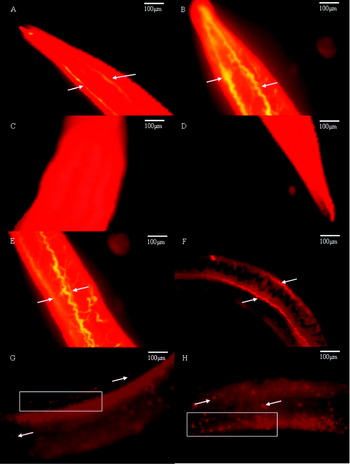
Due to the variability of results in female worms, we chose to evaluate only the excretory activity of males. The excretory system of adult male worms derived from LE and LE-PZQ cercariae, exposed to resorufin in vitro was brightly labelled by the probe with yellow or bright red fluorescence (Fig. 1A, B and E, F, respectively. After PZQ treatment, in each well, the majority of the male worms of the LE isolate showed complete inhibition at a PZQ concentration of 2 µg/ml (Fig. 1C and D) whereas very few (25%) of the isolate LE-PZQ showed inhibition. Thus, it was observed that the majority of the LE-PZQ worms exposed to resorufin and incubated with PZQ in vitro, showed some fluorescence in the excretory system although of less intensity compared with the worms not exposed to PZQ (Fig. 1G and H). This result indicates a reduction in the susceptibility of the worms LE-PZQ to PZQ.
In vitro evaluation of the effect of PZQ on the excretory system of Schistosoma mansoni adult worms. (A and B) S. mansoni LE labelled with the probe resorufin and not exposed to PZQ. (C and D) S. mansoni LE labelled with the probe resorufin and exposed to 2 µg/ml PZQ. (E and F) S. mansoni LE-PZQ labelled with the probe resorufin and not exposed to PZQ. (G and H) S. mansoni LE-PZQ labelled with the probe resorufin and exposed to 2 µg/ml PZQ. Arrow: main tubule and ramifications of the excretory system. Each Scale bar represents 100 µm. In G and H, labelled regions of the excretory system are shown in a box as well as by an arrow.

Evaluation of the tegumental damage of adult worms after exposure to PZQ in vitro and in vivo using the probe Hoechst 33258
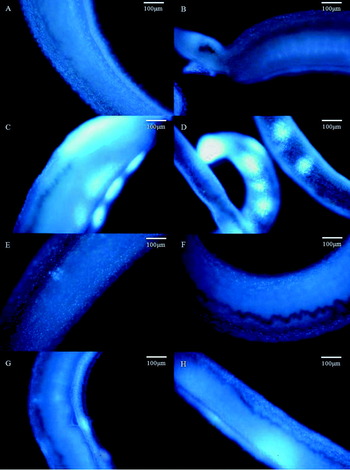
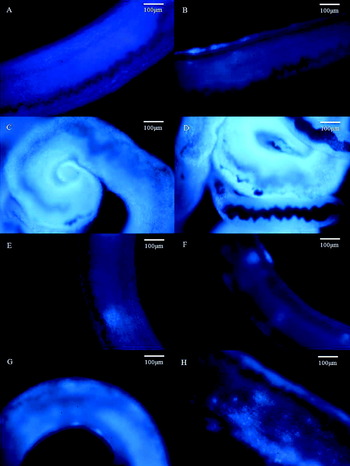
The fluorescent regions indicate tegumental damage. The worms derived from the LE (Figs 2A and B and 3A and B) and LE-PZQ isolates (Figs 2E and F and 3E and F) that were not exposed to the drug in vitro or in vivo did not show tegumental damage. In each well, the majority of the male and female worms of the LE isolate, exposed to 2 µg/ml in vitro or worms obtained from mice 2 h after administration of PZQ (single oral dose of 400 mg/kg) showed intense damage in the tegument (Figs 2C and 3C and D) but very few (25%) of the LE-PZQ worms showed tegumental damage. Thus, in each well, the majority of the LE-PZQ male and female worms presented significantly less intense damage in their teguments in comparison with the LE worms (Figs 2G and H and 3G and H). These results corroborate the findings concerning the excretory activity, indicating a reduction in the susceptibility of the LE-PZQ to PZQ.
In vitro evaluation of the effect of PZQ on the tegument of Schistosoma mansoni adult worms. (A and B) S. mansoni LE not exposed to PZQ and labelled with the probe Hoechst 33258. (C and D) S. mansoni LE exposed to 2 µg/ml PZQ and labelled with the probe Hoechst 33258. (E and F) S. mansoni LE-PZQ not exposed to PZQ and labelled with the probe Hoechst 33258. (G and H) S. mansoni LE-PZQ exposed to 2 µg/ml PZQ and labelled with the probe Hoechst 33258. The fluorescent areas indicate intense lesions. Each Scale bar represents 100 µm.

The tegument of Schistosoma mansoni adult worms observed in vivo. (A and B) S. mansoni LE not treated with PZQ and labelled with the probe Hoechst 33258. (C and D) S. mansoni LE treated with 400 mg/kg PZQ and labelled with the probe Hoechst 33258 of PZQ. (E and F) S. mansoni LE-PZQ not treated with PZQ and labelled with the probe Hoechst 33258. (G and H) S. mansoni LE-PZQ treated with 400 mg/kg and labelled with the probe Hoechst 33258. The fluorescent areas indicate intense lesions. Each Scale bar represents 100 µm.

DISCUSSION
In the experiments examining the changes caused by PZQ in the excretory system of S. mansoni, our findings corroborate the results obtained by Oliveira et al. (Reference Oliveira, Kusel, Ribeiro and Coelho2006), showing that PZQ was able to inhibit the excretory activity of S. mansoni adult worms (susceptible LE isolate). Compared to the parasites of the LE isolate, PZQ was not able to completely inhibit the excretory activity of the worms from the LE-PZQ isolate. After PZQ treatment of these resistant worms, (LE-PZQ isolate) it was possible to observe a clear labelling with the probe resorufin, although less intense than that observed in the untreated control. The control LE-PZQ parasites showed accumulation of resorufin into the excretory ducts as a yellow or bright red fluorescence on a red background. After treatment with PZQ there was some bright red fluorescence detectable in the parasite (arrowed and put in a box for clarity). As described by Sato et al. (Reference Sato, Kusel and Thornhill2002), we chose to work only with male parasites, due to variation in the responses of females to resorufin. Resorufin is a putative substrate of PgP. The SMDR2, a PgP homologue, has already been described in S. mansoni by Bosch et al. (Reference Bosch, Wang, Tao and Schoemaker1994). These PgP, as well as the proteins associated with the resistance to multi-drugs (MRP), are ABC carriers (ATP – Binding Cassette) and are associated with a resistance phenotype to drugs, as well as frequently expressed drug-resistant tumour cells, with the function to reduce cytotoxicity of drugs in the cytoplasm of those cells (Kusel et al. Reference Kusel, Oliveira, Todd, Ronketti, Lima, Mattos, Reis, Coelho, Thornhill and Ribeiro2006). In this way, the super-expression of these homologous PgPs with S. mansoni may be responsible for the resistance of this parasite to the drug. Messerli et al. (Reference Messerli, Kasinathan, Morgan, Spranger and Greenberg2009) obtained results indicating that high levels of SMDR2 may be associated with the reduced susceptibility to PgP in S. mansoni.
We can assert as a hypothesis that the labelling of the excretory system of LE-PZQ worms, even after exposure to the drug in vitro, demonstrates the continued excretory activity of the worm. If PZQ is excreted through the excretory system of the schistosome, the possible resistance mechanism would be related to a rapid excretion of PZQ in LE-PZQ isolate, thus impairing its lethal activity on the parasite. PZQ might be more damaging to the LE isolate worms if their excretory activity was inhibited by the drug. We suggest that PgP or homologous proteins present in the epithelium of the excretory system have an important role in the elimination of various drugs. This suggestion is in accordance with that of Schinkel et al. (Reference Schinkel and Jonker2003).
It is well known that PZQ is able to cause intense damage to the surface of the adult worm (Becker et al. Reference Becker, Mehlhorn, Andrews, Thomas and Eckert1980; Mehlhorn et al. Reference Mehlhorn, Becker, Andrews, Thomas and Frenkel1981; Oliveira et al. Reference Oliveira, Kusel, Ribeiro and Coelho2006). The damage generated by PZQ causes either the immediate death of the parasite, or could lead to the exposure of antigens which, after recognition by the specific immune response, would consequently eliminate the parasite (Harnett and Kusel, Reference Harnett and Kusel1986; Doenhoff et al. Reference Doenhoff, Sabah, Fletcher, Webbe and Bain1987; Modha et al. Reference Modha, Lambertucci, Doenhoff and McLaren1990). The magnitude of the tegumental lesions of adult worms has already been suggested as a possible parameter to differentiate susceptible and resistant isolates to PZQ (William et al. Reference William, Botros, Ismail, Farghally, Day and Bennett2001).
A sensitive tool for identification of tegumental lesions in S. mansoni is the fluorescent probe Hoechst 33258 (Oliveira et al. Reference Oliveira, Kusel, Ribeiro and Coelho2006). This probe has already been used in various studies, not only in adult worms (Lima et al. Reference Lima, Vieira, Harder and Kusel1994; Oliveira et al. Reference Oliveira, Kusel, Ribeiro and Coelho2006), but also in schistosomula (Kusel et al. Reference Kusel, Al-Adhami and Doenhoff2007), sporocyst (Mattos et al. Reference Mattos, Kusel, Pimenta and Coelho2006), and cercariae (Thornhill et al. Reference Thornhill, Kusel, Oliveira, Ribeiro, Lima, Coelho, Meveigh and Mattos2009). The probe Hoechst 33258, which binds DNA of cells, is a very sensitive indicator of membrane integrity, since even the worms of the LE and LE-PZQ isolates – not exposed to PZQ in vitro or in vivo – showed slight labelling with the probe, leading to some variability among the groups. These small labelled regions, observed in the worms of the control group, are a consequence of the method used for worm recovery (Oliveira et al. Reference Oliveira, Kusel, Ribeiro and Coelho2006). However, the distinct labelling by Hoechst 33258 in worms of the LE isolate exposed to PZQ in vitro and in vivo is very clear, confirming the capacity of PZQ to cause tegumental damage in S. mansoni worms of the control group (susceptible to PZQ). However, in worms of the LE-PZQ isolate exposed to the drug in vitro and in vivo, only small fluorescent regions could be observed. According to William et al. (Reference William, Botros, Ismail, Farghally, Day and Bennett2001), the worms that are less susceptible to the effects of PZQ on the tegument in vivo, are also less susceptible to the same effects of the drug in vitro. Ismail et al. (Reference Ismail, Metwally, Farghaly, Bruce, Tao and Bennett1996) also demonstrated that worms resistant to the effects of PZQ in vivo showed a significant reduction in the responses of PZQ in vitro.
In conclusion, we have shown that resistant adult worms (produced from S. mansoni-infected B. glabrata snails subjected to PZQ drug pressure) exhibit less tegumental damage and less inhibition of the excretory system than normal parasites. Further work on cercariae and other larval stages of normal and resistant isolates would be valuable.
ACKNOWLEDGEMENTS
Thanks to Vera de Paula Ribeiro for translation from Portuguese; to the technicians of the Mollusc Room, at the Centro de Pesquisa René-Rachou-Fiocruz, for providing the parasites and to CNPq and CAPES for financial support.