
 35M⊙







1. Introduction
The three observing runs of the LIGO-Virgo-KAGRA (LVK; LIGO Scientific Collaboration and Virgo Collaboration et al. 2020; Abbott et al. Reference Abbott2021; Abbott et al. Reference Abbott2023) collaboration revealed a population of stellar black holes (BHs) more massive than those known from X-ray binaries (Miller-Jones et al. Reference Miller-Jones2021). By GWTC-3, 90 BBH mergersFootnote † enabled inference of the BH mass spectrum, favoring a Power Law + Peak model with a Gaussian excess at
 $M_{\rm BH}\sim34\,{{\rm M_{\odot}}}$
(Abbott et al. Reference Abbott2023; Callister & Farr Reference Callister and Farr2024). This feature may trace specific evolutionary pathways (Abbott et al. Reference Abbott2021).
Theoretical models of BBH formation remain uncertain (see review by Spera et al. Reference Spera, Trani and Mencagli2022). Two main channels are proposed: (i) isolated binaries (e.g. Mapelli Reference Mapelli2016a; Spera et al. Reference Spera, Mapelli, Giacobbo, Trani, Bressan and Costa2019; Iorio et al. Reference Iorio2023) or (ii) dynamical assembly in dense clusters (e.g. Rodriguez et al. Reference Rodriguez, Morscher, Pattabiraman, Chatterjee, Haster and Rasio2015; Mapelli Reference Mapelli2016b; Arca Sedda et al. Reference Arca Sedda, Mapelli, Benacquista and Spera2023). Both are affected by uncertainties in winds, rotation, and SN physics (e.g. Burrows et al. Reference Burrows, Radice and Vartanyan2019; Ugolini et al. Reference Ugolini, Limongi, Schneider, Chieffi, Carlo and Spera2025). Pair-instability processes, dividing into PISNe and PPISNe (Fowler & Hoyle Reference Fowler and Hoyle1964), shape the upper BH mass limit (Woosley Reference Woosley2017). While the
 $35\,{{\rm M_{\odot}}}$
bump has been attributed to PPISNe (Belczynski et al. Reference Belczynski2016), recent works emphasize binary interactions such as SMT and CE (van Son et al. Reference van Son2022; Dorozsmai & Toonen Reference Dorozsmai and Toonen2024).
Here we explore how single-star and binary evolution combine to shape the BH mass spectrum using SEVN (Spera et al. Reference Spera, Mapelli, Giacobbo, Trani, Bressan and Costa2019; Iorio et al. Reference Iorio2023). Section 2 summarizes the setup, Section 3 presents the impact of CE efficiency, and Section 4 discusses IMF effects.
2. Methods
We employ the population-synthesis code SEVN (Spera et al. Reference Spera, Mapelli and Bressan2015), which interpolates stellar tracks from PARSEC v2.7.0 (Bressan et al. Reference Bressan, Marigo, Girardi, Salasnich, Dal Cero, Rubele and Nanni2012). Initial conditions follow Iorio et al. (Reference Iorio2023): primary masses are drawn from a Kroupa IMF in
 $[8,150]\,{{\rm M_{\odot}}}$
, and secondaries from
 $[5,150]\,{{\rm M_{\odot}}}$
. This analysis focuses on a subsample of the simulations presented in Ugolini et al. (prep), consisting of
 $10^{7}$
binaries evolved for each of 15 metallicities and 6 CE prescriptions, plus an additional run adopting a Larson IMF (Larson Reference Larson1998).
3. Effect of BSE on the
 $35\,{{\rm M_{\odot}}}$
peak

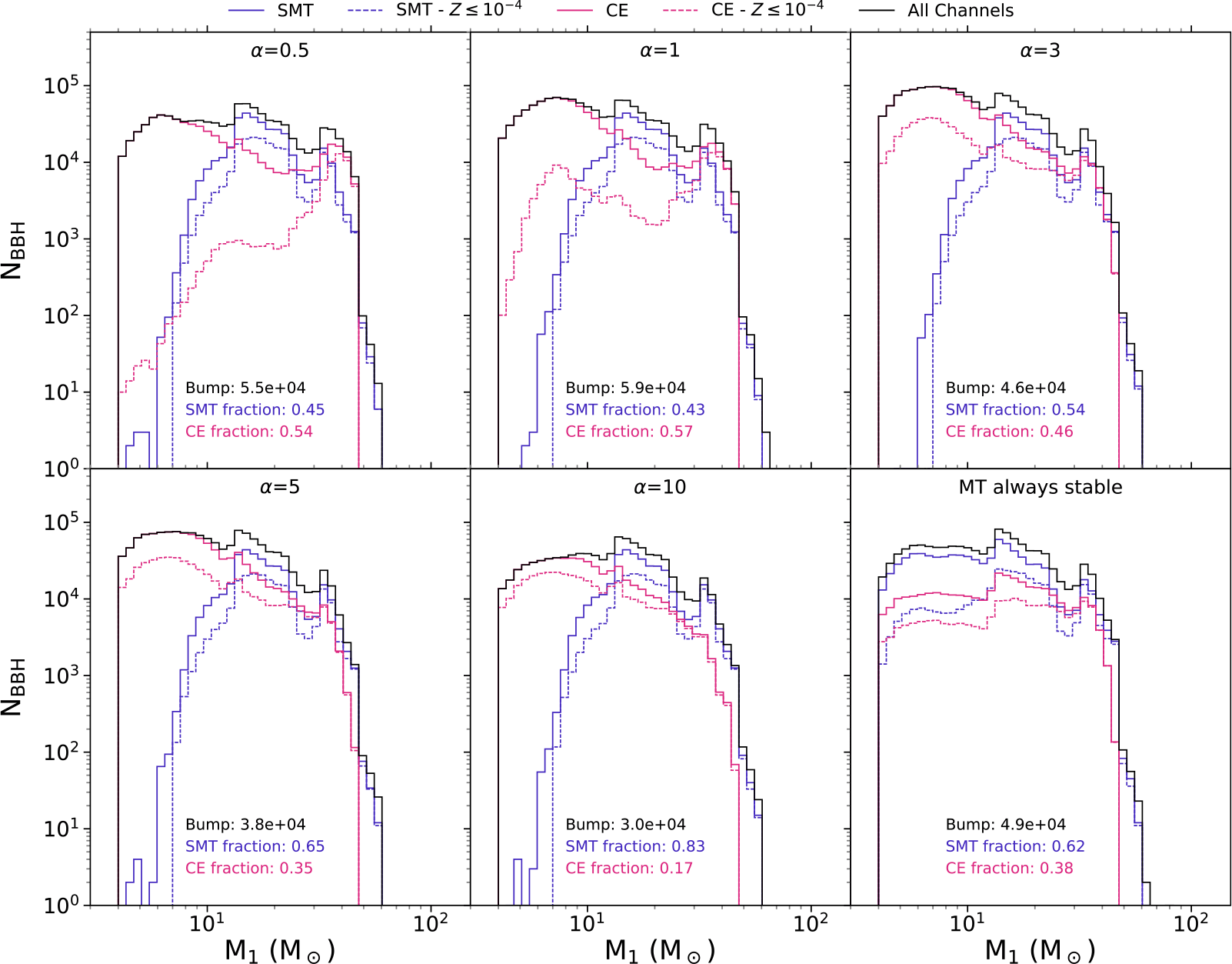
Primary BH mass distribution of merging BBHs for different CE efficiencies
 $\alpha$
. Upper row:
 $\alpha=0.5,1,3$
; lower row:
 $\alpha=5,10$
, and the always-stable MT case. Blue: SMT channel; purple: CE channel. Dashed: metal-poor (
 $Z\leq 5\times10^{-4}$
); solid: full population. The black curve is the total over all the channels.

We assess how the CE efficiency parameter
 $\alpha$
shape the BH mass spectrum under our fiducial ccSN+PPISN combination (delayed_Gauss+ M20). We also consider an “always-stable MT” setup, where CE can still occur only if both stars overflow their Roche lobes (treated with
 $\alpha=3$
when it happens).
CE parameter
 $\alpha=0.5$
. CE ejection is inefficient, so many systems merge as stars rather than form BBHs. Among survivors, the long-lasting CE phase shrinks orbits efficiently, making CE the dominant channel in the BBH sample. Indeed, the CE channel supplies
 $\sim54\%$
of BHs in the 32–
 $37\,{{\rm M_{\odot}}}$
bump, with CE and SMT nearly degenerate at 32–
 $34.5\,{{\rm M_{\odot}}}$
, and CE producing more BHs at 35–
 $37\,{{\rm M_{\odot}}}$
. SMT builds up BHs at
 $\sim13$
–
 $22\,{{\rm M_{\odot}}}$
(about 65% of SMT-formed primaries).
CE parameter
 $\alpha=1$
. CE shrinks orbits less than at
 $\alpha=0.5$
, thus more binaries successfully eject the envelope before merging, increasing the overall merger yield. CE contributes to 57% of the BBH in the bump. As at
 $\alpha=0.5$
, channels are degenerate at 32–
 $34.5\,{{\rm M_{\odot}}}$
; CE contributes more at 35–
 $37.5\,{{\rm M_{\odot}}}$
.
CE parameter
 $\alpha=3$
. Maximum amount of BBH among all the setups. The 32–
 $37\,{{\rm M_{\odot}}}$
bump is now primarily from SMT (
 $\sim54\%$
), with CE and SMT contributing similarly at 35–
 $37\,{{\rm M_{\odot}}}$
.
CE parameter
 $\alpha=5$
. CE still dominates for
 $M_{\rm BH}\leq 14\,{{\rm M_{\odot}}}$
, while SMT dominates at 16–
 $22\,{{\rm M_{\odot}}}$
and in the 32–
 $37\,{{\rm M_{\odot}}}$
bump. In this bump, 65% of systems evolved without CE (pure SMT). CE systems contributing to the bump decline because prompt ejection leaves separations too wide to merge within a Hubble time.
CE parameter
 $\alpha=10$
. SMT shapes the higher-mass distribution. In the
 $32-37\,{{\rm M_{\odot}}}$
mass-interval, 83% of merging systems never undergo CE. The total number of mergers and the general shape resemble
 $\alpha=0.5$
, but the bump is narrower for high
 $\alpha$
(concentrated at 32–
 $34.5\,{{\rm M_{\odot}}}$
) and broader for low
 $\alpha$
(extending to
 $\sim37\,{{\rm M_{\odot}}}$
).
Always-stable MT. CE becomes secondary (it can still occur if both stars overflow their RLs). Even the least-massive BHs are then mostly formed via SMT, yet CE still contributes
 $\sim38\%$
of primaries in the bump.
Global feature. Across models, primaries tend to accumulate at 32–
 $37\,{{\rm M_{\odot}}}$
: about 7% of BHs form in this interval, versus only
 $\sim3\%$
and
 $\sim2\%$
in the adjacent 27–
 $32\,{{\rm M_{\odot}}}$
and 37–
 $42\,{{\rm M_{\odot}}}$
bins, respectively. In sum, CE predominantly seeds the low-mass end, while SMT governs the 32–
 $37\,{{\rm M_{\odot}}}$
excess, with their balance regulated by
 $\alpha$
.
4. Effect of a top-heavy IMF
Stars that populate the 32–
 $37\,{{\rm M_{\odot}}}$
bump typically have
 ${ M_{\rm ZAMS}} \gtrsim 70\,{{\rm M_{\odot}}}$
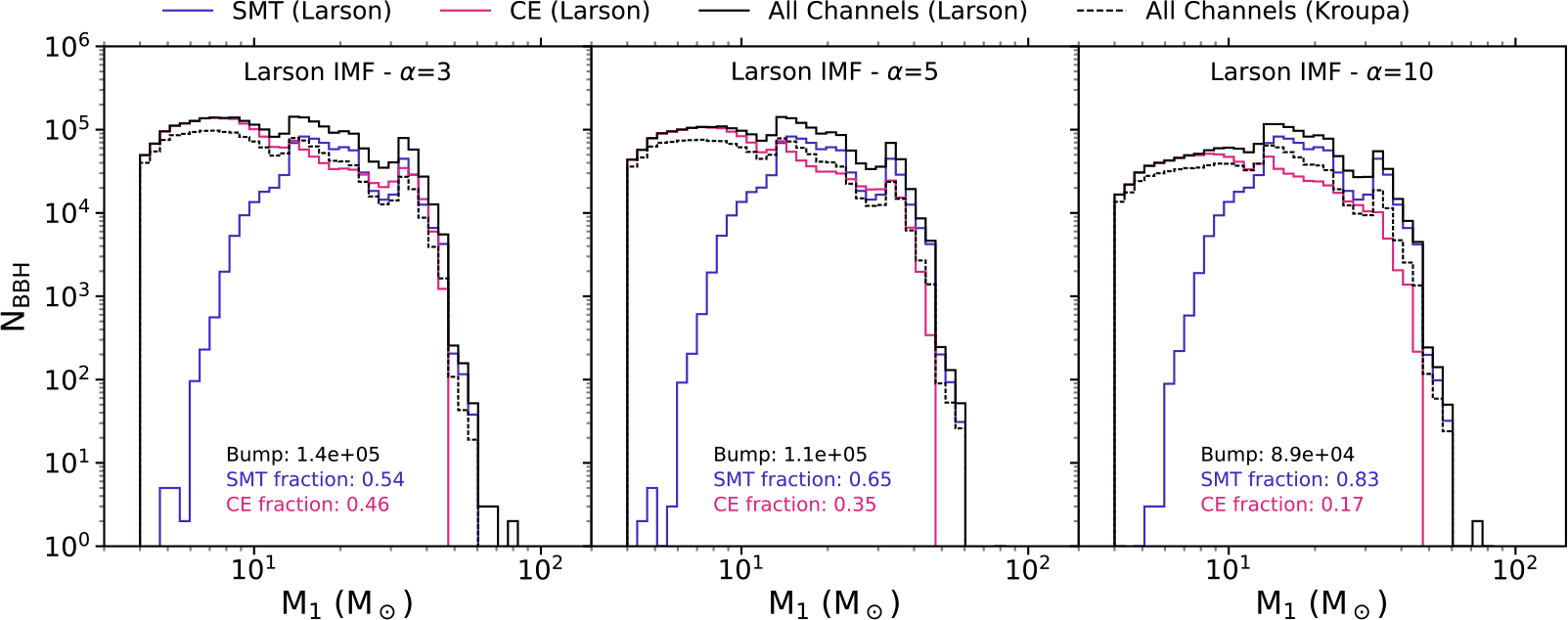
, making the IMF a key factor in setting their relative abundance. To test this, we adopt a Larson IMF (Larson Reference Larson1998), usually invoked for Pop III stars but applied here across all metallicities to probe the effect of favoring massive stars. Other initial conditions follow our fiducial setup (see Section 2). Figure 2 shows the resulting distributions for
 $\alpha=3,5,10$
.
Primary BH mass distribution of merging BBHs for a Larson IMF and different CE efficiencies
 $\alpha=3,5,10$
. Blue: SMT; purple: CE. Black solid: Larson IMF; black dashed: Kroupa IMF.

CE parameter
 $\alpha=3$
. As in the Kroupa IMF case, SMT contributes 54% of bump primaries and CE 46%. The Larson IMF, however, boosts the overall merger yield by
 $\sim67\%$
and nearly triples the number of systems in the 32–
 $37\,{{\rm M_{\odot}}}$
range. The abundance of low-mass BHs (
 $M_{\rm BH}\lesssim 10\,{{\rm M_{\odot}}}$
) is only mildly affected.
CE parameter
 $\alpha=5$
. The bump is dominated by SMT (65%) with CE contributing 35%, similar to the Kroupa case, but the absolute number of bump BHs again rises by a factor
 $\sim3$
, and the total mergers increase by
 $\sim68\%$
.
CE parameter
 $\alpha=10$
. As in the Kroupa IMF case, 83% of bump BHs evolve without CE. The Larson IMF triples the bump population relative to Kroupa and raises the overall merger count by
 $\sim80\%$
.
In summary, adopting a top-heavy IMF greatly amplifies the 32–
 $37\,{{\rm M_{\odot}}}$
feature and the total merger rate, while leaving the qualitative role of CE vs. SMT largely unchanged.
5. Summary and conclusions
Large-scale population synthesis with SEVN shows that:
-
• The 32–
$37\,{{\rm M_{\odot}}}$
bump arises from a combination of CE and SMT pathways. CE dominates for
$\alpha\le1$
, SMT for
$\alpha\ge3$
. -
• A top-heavy IMF amplifies the bump and merger rate without changing the CE/SMT balance.
-
• CE efficiency and IMF leave measurable signatures on the BH mass spectrum, offering GW observations a way to constrain them.


Future work will integrate these results into the semi-analytical BPOP model (Arca Sedda et al. Reference Arca Sedda, Mapelli, Benacquista and Spera2023) to include metallicity and star-formation histories.
Acknowledgements
The author acknowledges Mario Spera, Marco Limongi, and Manuel Arca sedda for useful discussion and comments
Supplementary material
To view supplementary material for this article, please visit https://doi.org/10.1017/S1743921325104122
 α
 α=0.5,1,3
 α=5,10
 Z≤5×10⁻⁴
 α=3,5,10


 Open access

